The Curse of Skeleton Munroe

Category: MLJ

  • ALIENS AND SO FORTH ROUND-UP 033

    Aliens. 

    Fifth Dimensional Beings: 

    These big-headed fellows feature in the origin story of Marvex the Super-Robot, but since we only see Marvex’ creator Bolo and his associates, we can’t really say too much about the culture of these Fifth Dimensional creatures. They have big heads, certainly, and a high enough degree of technology that Bolo is able to whip up a sentient robot on a whim, but whether that’s the sort of thing the population at large is getting up to or Bolo is the local equivalent of Lex Luthor is unknown and unknowable, alas. (Daring Mystery Comics 003, 1940)

    Green Devils:

    When Perisphere Payne seeks out a missing scientific expedition on an unnamed planet circling the star Polaris, he finds that they have come to mischief at the nubby little hands of the Green Devils, the planet’s native inhabitants who probably don’t call themselves that.

    While the Green Devils are just another band of primitives, eager to sacrifice the nearest blonde woman to their gods, they are also the most alien aliens that we have seen in a while and so I have a great deal of affection for them. Just look at their long noodly limbs! Their buggy eyes! Beautiful. (Science Comics 006, 1940)

    Pigwidgeons: 

    The final act of the story of the adventures of the Rocket and the Queen of Diamonds involves him leaving the Diamond Empire in his namesake rocket and her abdicating her throne to stow away and go with him. The Queen’s unexpected presence on the ship causes the Rocket to wreck the steering mechanism, and they crash on a strange planet.

    When they recover, the two find that they have been captured Gulliver-style by a group of tiny, rabbit-riding people called Pigwidgeons, who are melodramatic but ultimately good-hearted, and whose initial hostility is due to them mistaking the duo for… 

    … the Gromans, a species of human-sized fascists with a Roman Empire aesthetic to match their name. Though the Gromans have evidently been attacking the Pigwidgeons with impunity for some time, the arrival of the Rocket and the Queen shifts the balance of power, and over the next couple of issues the duo forge a new era of peace at the barrel of a ray gun. (Pep Comics 010, 1940)

    Pluvians:

    A plague is ravaging Earth in the far future of 1982, and Power Nelson has set aside his antipathy for the despotic government of Seng I to help them acquire the radium that they need to effect a cure. He sets out for the radium-rich planet Pluvius, where he meets the Pluvians, ruled by King Rari, and forget what I said about the Green Devils because these guys are my favourite aliens. Whether they have a smooth orange carapace or are wearing modified onesies is not specified and it doesn’t matter because they look fantastic either way, particularly as the sleek and retro-high-tech look it gives them is contrasted with their apparently Medieval society.

    The Pluvians agree to supply the needed radium in exchange for Nelson’s aid against their rival society, the Hairy Guroos, about whom there isn’t much to say. They’re humanoids with luxuriant hair and beards living in a Medieval monarchy (albeit a matriarchal one, which is fun), and that’s about it. They do use radium boulders as ammunition in their catapults, which is a good indication that Nelson has come to the right planet.

    For once in a Golden Age comic the solution to a problem involving hostile aliens does not involve mass alien casualties. Instead, Power Nelson does a regime change, by kidnapping the warmongering Guroo Queen Wodo and leaving her more amiable sister Queen Leelee in charge. (Prize Comics 003, 1940)

  • REAL PERSON ROUND-UP 024

    You just can’t keep ’em out of comics, those real people.

    Adolf Hitler:

    Dispatches super-spy Miss X to America. (Daredevil Comics 005, 1941)

    Raymond Stokes, the actor playing Hitler in a British propaganda film about London (the super-hero, not the city) inexplicably also turns out to be a Nazi agent who attempts to murder the Prime Minister when he makes a cameo appearance in the movie. (Daredevil Comics 005, 1941)

    Al Capone:  

    No-first-name Perrone here is another classic example of a crook lent a bit of legitimacy via a Capone-alike name. (Daring Mystery Comics 001, 1940)

    Charles Biro:

    Carnival stunt-eater Ydlab Orib is a transparent Biro name-drop, though the “Baldy” part of his backward name doesn’t really jibe with the pictorial record of the man himself. Whether he was a prodigious eater or not is unrecorded as far as I can find. I would venture that we are witness to a series of in-jokes here. (Daredevil Comics 005, 1941)

    Comics Folk:

    Give a Golden Age comic creator like Edd Ashe a chance to write a list and you’ll get a bunch of references to other Golden Age comics guys. For example, this collection of football stats features a (Harry “A”) Chesler College, a (Gil) Fox University and a (Mort) Meskin Mining & Mech. And a double-barrelled reference to Bob Wood, with Wood Military College and also Woodro College, referencing a Bob Wood/Charles Biro combination pen name. (Daredevil Comics 006, 1941)

    The list of schools also includes one called Lamont and I was ready to discount it, but then remembered that there was a reference to a Lamont in the previous issue, as a circus freak called the “Man of Wood,” which made me think that this might be a third Bob Wood reference and wouldn’t you know it some places list his middle name as Lamont or Lemont. What’s with all the Bob Wood references, Edd Ashe? 

    Franklin Roosevelt: 

    Once again, President Roosevelt is placed in the unenviable position of being in charge of a country plagued by the Claw’s particular brand of bullshit. He’s also placed in shadow and a 3/4 reverse view, because comic artists didn’t like to draw his face, presumably out of respect. (Daredevil Comics 002, 1941)

    Fritz Julius Kuhn: 

    I’ll be honest: I had no idea who Fritz Kuhn was and certainly didn’t twig to “Herr Kahn” here being a version of him until I took a look to see if “Nordic infested […] Yorkville” was a real place and spotted his name associated with our favourite band of overhyped losers the German-American Bund on its Wikipedia page. Like the Bund itself, the spectre of Kuhn seems to have haunted comics long after he himself was relevant – he had already been slung in jail for tax evasion by the time this comic was published. (Daredevil Comics 005, 1941)

    I was curious, so I looked back at the various Bunds we have thusfar encountered to see if any of them had their own version of Kuhn, and the only real candidates to jump out at me were Fritz Kessel, leader of the Termania Bund (Wonderworld Comics 018, 1940) and Fritz Hewn – presumably rhymes with Kuhn – leader of the Young Bundists (Blue Ribbon Comics 014, 1941)

    George Roussos: 

    Given the uncommon nature of the surname “Roussos” I have to assume that the crooked newspaper editor in this 13 story is yet another example of Lev Gleason reference-your-coworkers style yuck-em-ups. (Daredevil Comics 003, 1941)

    Three issues later sees a murder be committed above the Roussos Pool Room. (Daredevil Comics 006, 1941)

    And in the same issue, an index of insane asylum inmates yields a Roussos, a (Jerry) Robinson and a (Bob) Wood. And possibly others, but I can’t place them.

    Heinrich Himmler:

    One of several Nazi officials vexed by the hero London and his “L” campaign (Daredevil Comics 006, 1941)

    Rudolph Hess:

    Rudolph Hess (or Hesst) and his flight to England are framed as a straightforward espionage mission, with Hesst landing along with fifty picked men via black parachutes. He is immediately captured by London. (Daredevil Comics 003, 1941)

    Winston Churchill: 

    Initially, I was all set to point out that this “London” adventure featured a completely made-up niece of Winston Churchill making a daring escape from Nazi-occupied Holland, but imagine my surprise when her uncle showed up and was a store-brand imitation Churchill with a mustache. I was particularly caught off guard by this as while US-based comics had a weird reluctance to portray or name FDR they usually had no such qualms about doing so with the PM. (Daredevil Comics 002, 1941)

    The False-Churchill returns in the “London” feature in Daredevil Comics 004, and this time his inexplicable presence is highlighted by the unaltered name of Lloyd’s of London in the upper left.

    Finally, the Churchill-alike in Daredevil Comics 005 looks different enough from both the real deal and Mustache Churchill that we must assume that there has been some sort of regime change between issues. 

  • PROBLEMATIC ROUND-UP 007

    Damn their problematic hides!

    Rango: 

    A former Vaudeville magician who employs a magical gem and some rubberoid mask blackface to establish himself as medicine man/bandit chief in Africa, Rango aka Harrigan is ultimately unmasked by Yarko the Great. (Wonderworld Comics 015, 1940) 

    Unnamed Witch Doctor: 

    This unnamed Haitian witch doctor has a very unusual scheme: blind entire American cities with a floating vision of some of his men and then loot those same cities of all of their diamonds. Why diamonds specifically? No clue. He is also notable for giving Zambini the Miracle Man a harder time than Satan himself, before eventually being killed, just like Satan himself. (Zip Comics 005, 1940)

    War Hatchet: 

    Fascist spies striking at the US by inciting Native American tribes to violence is unfortunately going to crop up more than a couple of times as we make our way through the comics of the Forties (and I reckon that the same plot will be recycled with Commie spies in the Fifties and Sixties, alas). This time, the plot is spearheaded by a fellow who calls himself War Hatchet, a European ex-pat turned bandit chief who has returned to the fold to do some espionage work for the dear old unnamed fatherland. 

    As is often the case, War Hatchet makes an okay argument for the colonized to rise up against their oppressors, only with a bunch of murder appended and the unspoken coda that there will be new oppressors later on. Spy Smasher not only stabs him to death but chucks him into a fire afterward. (Spy Smasher 001, 1941)

    the Yellow Horde: 

    The Yellow Horde is a gang of guys in cool looking yellow suits who break into defense plants and shoot poison gas balls everywhere. They turn out to be Chinese, and while the name is arguably in reference to the cool suits I just can’t bring myself to trust 1940s America not to get a little bit of racism in for fun.

    The Yellow Horde’s boss turns out to be an unnamed costumed Nazi who is pretending to be Chinese but also forcing the Horde into doing his bidding. why both? Who knows. Ultimately he gets beaten up by the Hood. (Cat-Man Comics 005, 1941)

  • PROBLEMATIC ROUND-UP 007

    Damn their problematic hides!

    Rango: 

    A former Vaudeville magician who employs a magical gem and some rubberoid mask blackface to establish himself as medicine man/bandit chief in Africa, Rango aka Harrigan is ultimately unmasked by Yarko the Great. (Wonderworld Comics 015, 1940) 

    Unnamed Witch Doctor: 

    This unnamed Haitian witch doctor has a very unusual scheme: blind entire American cities with a floating vision of some of his men and then loot those same cities of all of their diamonds. Why diamonds specifically? No clue. He is also notable for giving Zambini the Miracle Man a harder time than Satan himself, before eventually being killed, just like Satan himself. (Zip Comics 005, 1940)

    War Hatchet: 

    Fascist spies striking at the US by inciting Native American tribes to violence is unfortunately going to crop up more than a couple of times as we make our way through the comics of the Forties (and I reckon that the same plot will be recycled with Commie spies in the Fifties and Sixties, alas). This time, the plot is spearheaded by a fellow who calls himself War Hatchet, a European ex-pat turned bandit chief who has returned to the fold to do some espionage work for the dear old unnamed fatherland. 

    As is often the case, War Hatchet makes an okay argument for the colonized to rise up against their oppressors, only with a bunch of murder appended and the unspoken coda that there will be new oppressors later on. Spy Smasher not only stabs him to death but chucks him into a fire afterward. (Spy Smasher 001, 1941)

    the Yellow Horde: 

    The Yellow Horde is a gang of guys in cool looking yellow suits who break into defense plants and shoot poison gas balls everywhere. They turn out to be Chinese, and while the name is arguably in reference to the cool suits I just can’t bring myself to trust 1940s America not to get a little bit of racism in for fun.

    The Yellow Horde’s boss turns out to be an unnamed costumed Nazi who is pretending to be Chinese but also forcing the Horde into doing his bidding. why both? Who knows. Ultimately he gets beaten up by the Hood. (Cat-Man Comics 005, 1941)

  • CATALOGUE OF WOUNDS 007

    CATALOGUE OF WOUNDS 007

    The right shoulder: unsung victim of the comics pages. 

    Captain Battle: 

    Captain Battle gets a fashionable bullet-creased skull on the docks of San Francisco. (Captain Battle Comics 001, 1941) 

    the Cloak:

    Being shot in the left shoulder is the inciting incident that leads Jeff Cardiff to adopt the Cloak identity in the first place. (Big Shot Comics 015, 1941)

    the Face:

    Shot in the right shoulder (Big Shot Comics 011, 1941)

    Shot in the right shoulder again. (Big Shot Comics 018, 1941)

    Shot in the left shoulder, which must have come as a relief. (Big Shot Comics 019, 1941)

    the Fox:

    Shot in the right shoulder. (Blue Ribbon Comics 012, 1941)

    Kaänga: 

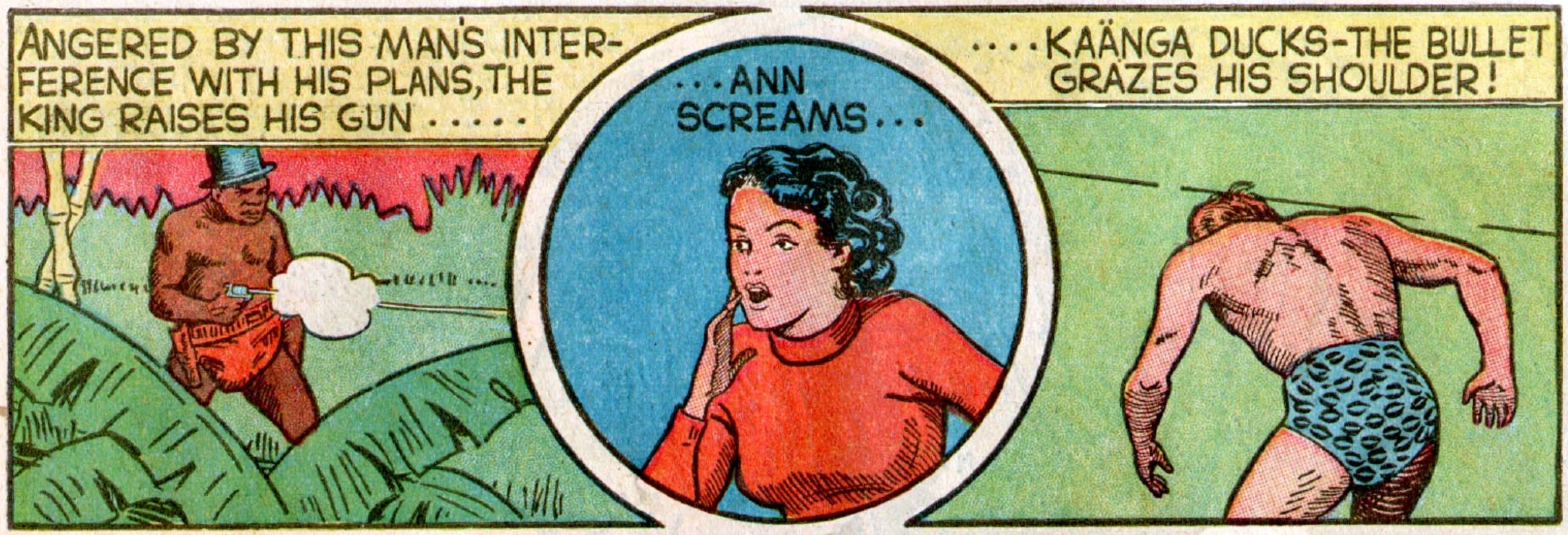
    Shot in the right shoulder. (Jungle Comics 003, 1940)

    Marvelo, Monarch of Magicians:

    Shot in the right arm. (Big Shot Comics 012, 1941)

    In what is probably the most sever non-fatal injury we have seen thus far, Marvelo takes an ape-powered throwing knife to the chest and is just barely alive for the remainder of the comic. (Big Shot Comics 016, 1941)

    Skyman:

    Skyman is shot in the ever-popular right shoulder, and no wonder: it’s a big ol’ target. (Big Shot Comics 002, 1940)

  • MEDIA IN COMICS 001

    I’ve often mentioned how comics as a medium has a grand tradition of not using the real names for people (see about half the entries in our collection of Real Folk in comics) places (see the grand list of fictional countries on every continent of our list of Locations) and things, so I hope that it won’t surprise you when I say that they make up all the media, too. And since I have a big list of all the made-up books, newspaper columns, stage shows and movies sitting around already I figured I should share.

    Movies:

    Lover Mine (Funny Picture Stories v2 005, 1938)

    Flying Cadets, Colossal Pictures, stunts by the Four Aces (The Funnies 021, 1938)

    Star-Dust (Funny Picture Stories v3 002, 1939)

    War Eagles, Colossal Studios (Keen Detective Funnies v2 006, 1939)

    Pilots All, Mammoth Film Company (Keen Detective Funnies v2 010, 1939)

    The Mystery of the Creeping Spook, Superbo Pictures (Keen Detective Funnies v2 011, 1939)

    White Goddess (Funny Pages v3 008 1939) 

    Newspaper Columns:

    “On Broadway” by Walt “Bob Phantom” Whitney. (Blue Ribbon Comics 002, 1939)

    Plays:

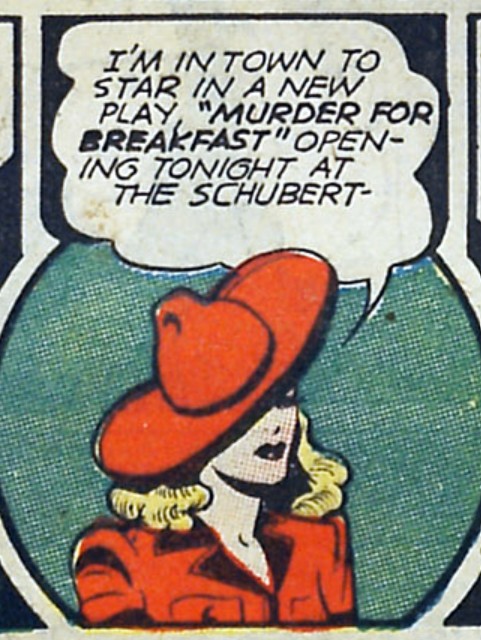
    “Murder for Breakfast”, starring Kay Kenyon, one of Presto Martin’s many Hollywood friends. (Silver Streak Comics 010, 1941)

    Songs:

    “Boogie-Woogie Blast” (Champion Comics 002, 1939)

  • MEDIA IN COMICS 001

    MEDIA IN COMICS 001

    I’ve often mentioned how comics as a medium has a grand tradition of not using the real names for people (see about half the entries in our collection of Real Folk in comics) places (see the grand list of fictional countries on every continent of our list of Locations) and things, so I hope that it won’t surprise you when I say that they make up all the media, too. And since I have a big list of all the made-up books, newspaper columns, stage shows and movies sitting around already I figured I should share.

    Movies:

    Lover Mine (Funny Picture Stories v2 005, 1938)

    Flying Cadets, Colossal Pictures, stunts by the Four Aces (The Funnies 021, 1938)

    Star-Dust (Funny Picture Stories v3 002, 1939)

    War Eagles, Colossal Studios (Keen Detective Funnies v2 006, 1939)

    Pilots All, Mammoth Film Company (Keen Detective Funnies v2 010, 1939)

    The Mystery of the Creeping Spook, Superbo Pictures (Keen Detective Funnies v2 011, 1939)

    White Goddess (Funny Pages v3 008 1939) 

    Newspaper Columns:

    “On Broadway” by Walt “Bob Phantom” Whitney. (Blue Ribbon Comics 002, 1939)

    Plays:

    “Murder for Breakfast”, starring Kay Kenyon, one of Presto Martin’s many Hollywood friends. (Silver Streak Comics 010, 1941)

    Songs:

    “Boogie-Woogie Blast” (Champion Comics 002, 1939)

  • CATALOGUE OF WOUNDS 005

    CATALOGUE OF WOUNDS 005

    More wounds for the Catalogue of Wounds!

    Ace of Space:

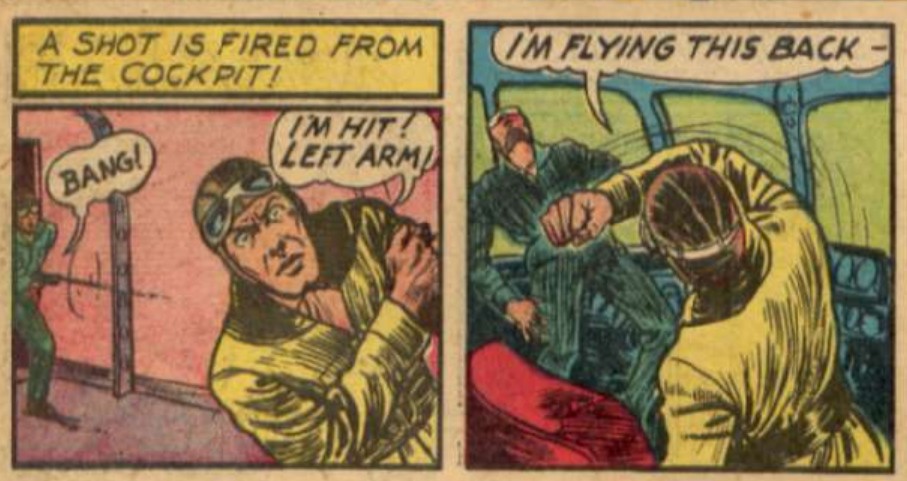
    Shot in the left arm during an attempted skyjacking. (Feature Comics 041, 1941)

    the Black Hood:

    As part of Kip Burland’s journey to masked vigilantism he gets shot all to hell and back by the Skull’s minions. The shots we can see happening are all hitting him in the torso, and according to his hermit mentor there were at least eight of them. Sheesh. (Top-Notch Comics 009, 1940)

    Chic Carter:

    Chic takes a bullet to his right arm while contending with the Phantom’s very satanic boss. (Smash Comics 015, 1941)

    the Comet:

    Shot in the left shoulder by a gun-wielding member of an angry mob that is after him. (Pep Comics 004, 1940)

    the Fox:

    Severely whipped and beaten by the Night Riders during his origin. (Blue Ribbon Comics 004, 1940)

    Galahad: 

    Takes a sword blow meant for King Arthur, and while all these bullet wounds and so forth can get a little abstracted, this is a real overhand chop that has to be threatening to hit his lung. Galahad only survives due to Merlin’s magical intervention. (Top-Notch Comics 008, 1940)

    the Green Falcon:

    Takes an arrow to the left shoulder. (Blue Ribbon Comics 013, 1941)

    the Shadow:

    Shot in the left arm by Zevox, aka the Head. (Shadow Comics v1 004, 1940)

    The Shadow’s left arm can’t get a break, as a few issues later it gets a throwing knife to the shoulder. (Shadow Comics v1 007, 1940)

    the Spider:

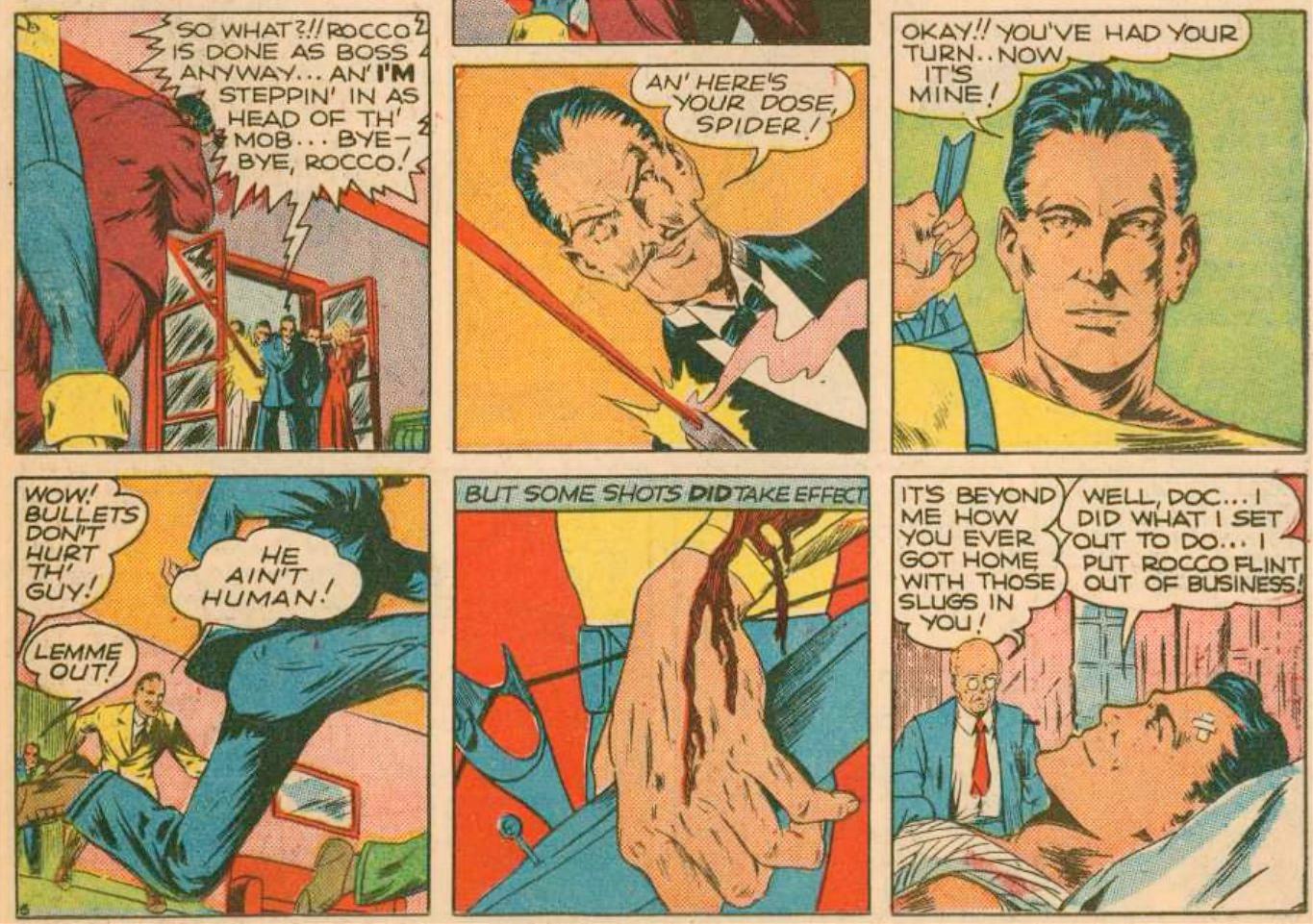
    I don’t know the precise number of times the Spider is shot here while tanking bullets to scare a gang but it sure is enough to impress his doctor. (Crack Comics 007, 1940)

    A year later, the Spider gets near-fatally shot in the chest by the Crow. (Crack Comics 018, 1941)

    Whiz, King of Falcons: 

    Silver Streak’s animal companion Whiz is struck in the bird-shoulder by a machine gun round. (Silver Streak Comics 010, 1941)

  • CATALOGUE OF WOUNDS 005

    CATALOGUE OF WOUNDS 005

    More wounds for the Catalogue of Wounds!

    Ace of Space:

    Shot in the left arm during an attempted skyjacking. (Feature Comics 041, 1941)

    the Black Hood:

    As part of Kip Burland’s journey to masked vigilantism he gets shot all to hell and back by the Skull’s minions. The shots we can see happening are all hitting him in the torso, and according to his hermit mentor there were at least eight of them. Sheesh. (Top-Notch Comics 009, 1940)

    Chic Carter:

    Chic takes a bullet to his right arm while contending with the Phantom’s very satanic boss. (Smash Comics 015, 1941)

    the Comet:

    Shot in the left shoulder by a gun-wielding member of an angry mob that is after him. (Pep Comics 004, 1940)

    the Fox:

    Severely whipped and beaten by the Night Riders during his origin. (Blue Ribbon Comics 004, 1940)

    Galahad: 

    Takes a sword blow meant for King Arthur, and while all these bullet wounds and so forth can get a little abstracted, this is a real overhand chop that has to be threatening to hit his lung. Galahad only survives due to Merlin’s magical intervention. (Top-Notch Comics 008, 1940)

    the Green Falcon:

    Takes an arrow to the left shoulder. (Blue Ribbon Comics 013, 1941)

    the Shadow:

    Shot in the left arm by Zevox, aka the Head. (Shadow Comics v1 004, 1940)

    The Shadow’s left arm can’t get a break, as a few issues later it gets a throwing knife to the shoulder. (Shadow Comics v1 007, 1940)

    the Spider:

    I don’t know the precise number of times the Spider is shot here while tanking bullets to scare a gang but it sure is enough to impress his doctor. (Crack Comics 007, 1940)

    A year later, the Spider gets near-fatally shot in the chest by the Crow. (Crack Comics 018, 1941)

    Whiz, King of Falcons: 

    Silver Streak’s animal companion Whiz is struck in the bird-shoulder by a machine gun round. (Silver Streak Comics 010, 1941)

  • MAD AND CRIMINAL SCIENTIST ROUND-UP 023

    Perhaps we should make ethics a mandatory subject for the sciences again.

    Kruger: 

    While tooling around in the desert one day, Diamond Jack encounters a young woman named Ruth West, whose physician brother has been captured by the diabolical scientist Kruger and taken to Terror Valley in order to help in Kruger’s work turning men into hybrid creatures called Vulture Men, with the ultimate goal of using them to take over the world. If that plot sounds at all familiar, it’s because it is almost exactly the same as the one in Wonderworld Comics 015, featuring the Flame and Dr Belos, right down to the name of the valley, the colour of the Vulture men and the fact that the scientist has his own private hydroelectric dam.

    Just how did this happen? Three distinct possibilities spring to mind:

    1. The Diamond Jack writer (Gus Ricca? He’s got the generally accepted art credit) just plain old cribbed the story off of the Flame adventure, which came out about six months earlier

    2. Gus Ricca and the Flame writer (unidentified) knew one another and came up with the idea for the story together in the reasonable expectation that nobody would notice. Alternately, the same person might have written both stories for two different artists.

    3. The biggest coincidence in the history of mankind.

    Whatever the reason for it, we are left with two very similar stories to compare:

    Kruger’s Vulture Men are much more appealing to me than Belos’ – particularly their weird pawlike hands. While Belos’ version does look a bit more like something you could do to a person via surgery (except for the part where they have functional dragon wings coming out of their backs of course), the lack of humanity in the bird heads of Kruger’s really drives home the horror of their being transformed against their wills. I also appreciate their seemingly organic feather kilts.

    Kruger also has a better look than Belos – his having a bit of the vulture to his look makes a lot of aesthetic sense! I do miss Belos’ one long tooth, though.

    The one place where Kruger loses out to Belos is in means of destruction. Being drowned by your own bursting dam doesn’t hold a candle to getting fatally beaned with the skull of one of your own failed experiments (though “I’m drowning – AAAGH!” are pretty good last words). (Wow Comics 001, 1940)

    Categorized in: Animals (Birds) 

    Professor Stargaze: 

    Professor Stargaze is a mad astronomer (nominative determinism) who discovers that the wandering and flaming planet Inferno will soon pass near Earth and wipe all life from its surface. Not only does Stargaze decide not to share this information with the world (possibly a morally neutral act) but he is so convinced that it is the right thing to happen that he tags along with Zambini the Miracle Man and tries to prevent him from stopping it (actively evil).

    Stargaze is ultimately fried to a crisp when he attempts to assassinate Zambini with a flaming spear, then reincarnated as a rat by magic, then restored to his human form back on Earth once it is saved. Has he learned a lesson from all this? Unclear. (Zip Comics 002, 1940)

    Categorized in: Day Jobs (Astronomers), Doctors and Professors

    Doctor Igor:

    Doctor Igor is a scientist with a vision: to develop a method of creating giant men via electrical stimulation of the pituitary gland, and to use an army of these men to take over the world. To that end, he has taken over a remote island (probably because it already has a castle on it) and used its inhabitants as guinea pigs.

    Igor probably saw the fact that the island had a copra plantation on it as a plus, since it provided a supply experimental subjects for him, but what he failed to anticipate was that an interruption of commercial product is likely to draw the attention of an adventurer such as Lance Rand to investigate just what the heck was going on. Igor is ultimately undone when his own creation trips over some equipment and blows up the castle. (Cat-Man Comics 002, 1941)

    Categorized in: Accessories (Castles), Doctors and Professors 

    Borcia:

    Borcia (also called “Garcia” one time which is probably an editorial oversight but possibly means that his name is either Garcia Borcia or Borcia Garcia) is a formerly-famous scientist whose mind cracked due to overwork and who now dreams of world conquest. And how better to achieve that dream than by stealing the magic gem owned by small-time super-hero Dr Diamond?

    Once both the gem and Dr Diamond are in his clutches, Borcia reveals his world domination plot: let loose a moderately cool-looking giant robot called Najar to just kind of indiscriminately rampage through the nearby town of Verez, Mexico. Presumably there will be more robots later on. As for the magic diamond: it seems to play no real role in the plan. Borcia just wanted it, I guess.

    As so often happens, Borcia is betrayed by his own step-daughter Elena, who just wants a normal, non-evil life and resents being part of a super-villainous household. Dr Diamond proves more than a match for Najar, and despite some typical super-villain bluster as he is lead off to jail, Borcia is never seen again. (Cat-Man Comics 003, 1941)

    Categorized in: Accessories (Gems (Magic), Giant Robots), Location (Mexico)