The Curse of Skeleton Munroe

Category: MLJ

  • MAD AND CRIMINAL SCIENTIST ROUND-UP 023

    MAD AND CRIMINAL SCIENTIST ROUND-UP 023

    Perhaps we should make ethics a mandatory subject for the sciences again.

    Kruger: 

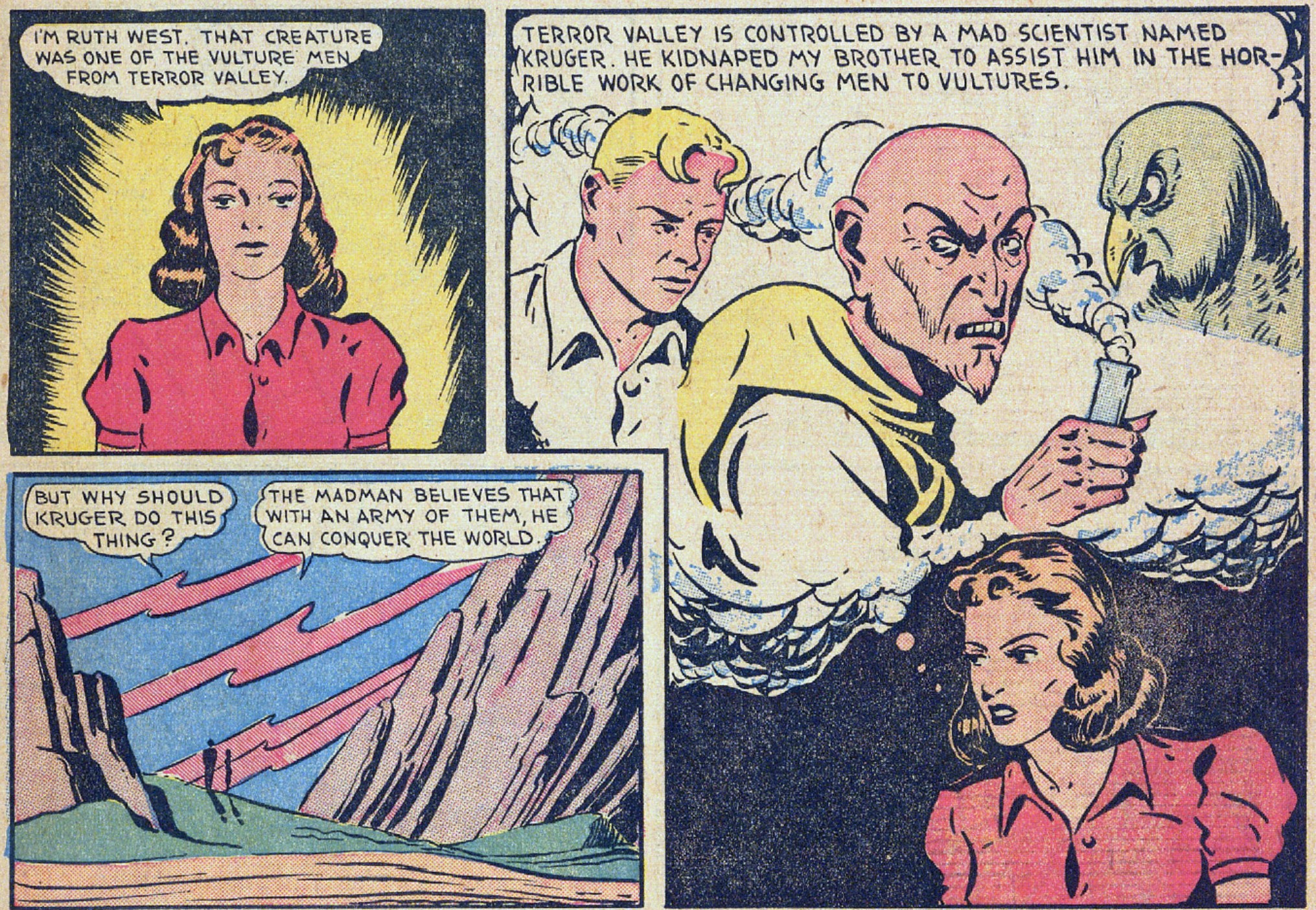
    While tooling around in the desert one day, Diamond Jack encounters a young woman named Ruth West, whose physician brother has been captured by the diabolical scientist Kruger and taken to Terror Valley in order to help in Kruger’s work turning men into hybrid creatures called Vulture Men, with the ultimate goal of using them to take over the world. If that plot sounds at all familiar, it’s because it is almost exactly the same as the one in Wonderworld Comics 015, featuring the Flame and Dr Belos, right down to the name of the valley, the colour of the Vulture men and the fact that the scientist has his own private hydroelectric dam.

    Just how did this happen? Three distinct possibilities spring to mind:

    1. The Diamond Jack writer (Gus Ricca? He’s got the generally accepted art credit) just plain old cribbed the story off of the Flame adventure, which came out about six months earlier

    2. Gus Ricca and the Flame writer (unidentified) knew one another and came up with the idea for the story together in the reasonable expectation that nobody would notice. Alternately, the same person might have written both stories for two different artists.

    3. The biggest coincidence in the history of mankind.

    Whatever the reason for it, we are left with two very similar stories to compare:

    Kruger’s Vulture Men are much more appealing to me than Belos’ – particularly their weird pawlike hands. While Belos’ version does look a bit more like something you could do to a person via surgery (except for the part where they have functional dragon wings coming out of their backs of course), the lack of humanity in the bird heads of Kruger’s really drives home the horror of their being transformed against their wills. I also appreciate their seemingly organic feather kilts.

    Kruger also has a better look than Belos – his having a bit of the vulture to his look makes a lot of aesthetic sense! I do miss Belos’ one long tooth, though.

    The one place where Kruger loses out to Belos is in means of destruction. Being drowned by your own bursting dam doesn’t hold a candle to getting fatally beaned with the skull of one of your own failed experiments (though “I’m drowning – AAAGH!” are pretty good last words). (Wow Comics 001, 1940)

    Categorized in: Animals (Birds) 

    Professor Stargaze: 

    Professor Stargaze is a mad astronomer (nominative determinism) who discovers that the wandering and flaming planet Inferno will soon pass near Earth and wipe all life from its surface. Not only does Stargaze decide not to share this information with the world (possibly a morally neutral act) but he is so convinced that it is the right thing to happen that he tags along with Zambini the Miracle Man and tries to prevent him from stopping it (actively evil).

    Stargaze is ultimately fried to a crisp when he attempts to assassinate Zambini with a flaming spear, then reincarnated as a rat by magic, then restored to his human form back on Earth once it is saved. Has he learned a lesson from all this? Unclear. (Zip Comics 002, 1940)

    Categorized in: Day Jobs (Astronomers), Doctors and Professors

    Doctor Igor:

    Doctor Igor is a scientist with a vision: to develop a method of creating giant men via electrical stimulation of the pituitary gland, and to use an army of these men to take over the world. To that end, he has taken over a remote island (probably because it already has a castle on it) and used its inhabitants as guinea pigs.

    Igor probably saw the fact that the island had a copra plantation on it as a plus, since it provided a supply experimental subjects for him, but what he failed to anticipate was that an interruption of commercial product is likely to draw the attention of an adventurer such as Lance Rand to investigate just what the heck was going on. Igor is ultimately undone when his own creation trips over some equipment and blows up the castle. (Cat-Man Comics 002, 1941)

    Categorized in: Accessories (Castles), Doctors and Professors 

    Borcia:

    Borcia (also called “Garcia” one time which is probably an editorial oversight but possibly means that his name is either Garcia Borcia or Borcia Garcia) is a formerly-famous scientist whose mind cracked due to overwork and who now dreams of world conquest. And how better to achieve that dream than by stealing the magic gem owned by small-time super-hero Dr Diamond?

    Once both the gem and Dr Diamond are in his clutches, Borcia reveals his world domination plot: let loose a moderately cool-looking giant robot called Najar to just kind of indiscriminately rampage through the nearby town of Verez, Mexico. Presumably there will be more robots later on. As for the magic diamond: it seems to play no real role in the plan. Borcia just wanted it, I guess.

    As so often happens, Borcia is betrayed by his own step-daughter Elena, who just wants a normal, non-evil life and resents being part of a super-villainous household. Dr Diamond proves more than a match for Najar, and despite some typical super-villain bluster as he is lead off to jail, Borcia is never seen again. (Cat-Man Comics 003, 1941)

    Categorized in: Accessories (Gems (Magic), Giant Robots), Location (Mexico)

  • GENERIC COSTUMED VILLAIN ROUND-UP 032

    A more fantastical bunch of genericos than usual! How fun!

    Benjie Frazier: 

    This mysterious cloaked figure hires femme fatale Sonia, aka Princess Cleo, to help him drive all of the inhabitants out of “center of New York society” Formal Park (99% certain that this is a substitution for former real-life society hub Tuxedo Park). To that end, the pair deploy such tools as squads of hooded goons, a mysteriously appearing brand to indicate that their victims have suffered “the Pharaoh’s Curse”, and a drug that drives regular people into a murderous frenzy. 

    Things come to a head when the socially prominent Dudley “Mr Satan” Bradshaw and his scornful love interest Doris O’Day are invited out to a Formal Park event and end up unmasking their host Benjie Frazier as the mastermind behind the scheme. And just why has he been murdering people in such elaborate ways? A damn land grab, the most boring possible motivation for supercrime. He wanted to get rich by selling land to the state for a reservoir, folks. Shaking my damn head over here. (Zip Comics 008, 1940)

    Unnamed Brain-in-Jar Men: 

    Another cover illustration with no bearing on the story inside – very very sad. Are these headless men with their brains in little glass backpacks the creations of a mad scientist? Some sore of weird aliens? A transhumanist mafia? We shall never know. (Zip Comics 009, 1940)

    the Lion-Man: 

    This were-lion is remarkable not only for being in the Amazon (which I can only assume is way out of its natural range if we can apply such concepts to supernatural beings) but also because it only appears in the first half of a six-page story as an unrelated distraction while some crooks to steal diamonds from Doctor Voodoo’s home village. Just tremendous disrespect on the writer’s part for the gravity of a lycanthropic* foe. (Whiz Comics 014, 1941)

    *yes I’m aware that the lycan part of the word is referring specifically to wolves but I’m being lazy about my language, okay? The footnote is still lazy because most of the words in it are short.

    Queen Zoe: 

    Queen Zoe is the ruler of a lost kingdom called El Casa del Oro deep in the Amazon whose culture appears to be a mixture of Inca and Conquistador and who is not overtly evil but who for instance threatens to throw someone into a volcano for interfering in her proposed seduction of Dr Voodoo.

    Queen Zoe’s secret is that she is actually thousands of years old thanks to the fact that she has the Fountain of Youth in her basement. She tries to sweeten her seduction of Dr Voodoo with the promise of eternal life but the Fountain is evidently a big prude because it chooses to stop working the exact second that Zoe makes her pitch and instead of getting some action she instead crumbles to dust. (Whiz Comics 015, 1941)

  • REAL PERSON ROUND-UP 020

    Where would comic books be without real people, after all?

    Easter Island: 

    Lance O’Casey and his pal Dan’l Doom fight some wreckers on Easter island, and while I can’t tell if the place saw enough ship traffic in the 1940s to make shipwrecking a profitable enterprise, I will say that the concept of Lance and Dan’l just casually passing by one of the most isolated islands in the Pacific Ocean while travelling from place to place is an eyebrow raiser.

    The whole Easter Island aspect of the adventure honestly seems to just be a bit of set dressing, but I sure do love these extremely flat moai statues.(Whiz Comics 013, 1941) 

    Fort Knox: 

    As “Fort Gnox,” robbed by Dr Sivana. (Whiz Comics 014, 1940)

    FDR: 

    Spy Smasher saves the president from being assassinated by probable-Nazi spy the Dark Angel, leading to what I can only interpret as a very awkward meeting between the two. (Spy Smasher 001, 1941) 

    Fiorello La Guardia (Not): 

    Wow Comics 004 features not one but two mayors who are not Fiorello La Guardia in comics previously established to be set in New York City. I’d say poor guy for not getting elected in two different versions of Earth-S but neither of these guys are exactly having a good time. (Wow Comics 004, 1941)

    Harry “A” Chesler: 

    The Zip Comics 007
    Steel Sterling story involves a crooked moneylending firm called the
    Uwana Loan Company, and here we see the door of that company with H. “A”
    C. listed as president. Comic book publisher Harry “A” Chesler was a
    decent boss as far as I can tell, so once and future Chesler employee/
    “Steel Sterling” scribe Charles Biro is probably indulging in some
    classic comic book yuk-em-ups here rather than a trenchant skewering.
    (Zip Comics 007, 1940) 

    Henry L. Stimson: 

    US Secretary of State. As “Secretary Simpson,” almost gets assassinated and mummified by the Black Thorn. (America’s Greatest Comics 001, 1941) 

    J Edgar Hoover:

    As “FBI Chief Doover” almost gets assassinated by the Ghost. (am greatest 001 1941)

    Ken Crawford: 

    The Mask adopts a reporter alias as part of an attempt to find out the Spy Smasher’s secret identity, and there is no doubt in my mind that “Crawf Kenford” is a classic syllable-flip reference to venerable political correspondent Ken Crawford. (Whiz Comics 013, 1941)

    Mort Meskin: 

    You have to squint to read it, but that red sign says “M. Meskin, Fish” on it. (Zip Comics 007, 1940)

    William Tell: 

    Golden Arrow plays William Tell in a local school pageant, with love interest Carol Braddock as the apple-headed son. (Whiz Comics 012, 1941) 

  • FASCIST GOON CLEARING HOUSE 011

    The fools! The fascist fools.

    the Steel Guard: 

    The Steel Guard are a home-grown fascist group in the Balkan country of Murania, who plot to sell out their country and its oil wells to the Nazis. They fail to recognize the threat inherent in leaving a camera in the hands of crack magazine photographer Fran Frazer and she ruins their entire setup with a few evidence-heavy snaps. (Top-Notch Comics 010, 1940)

    the Redshirts: 

    The Redshirts are a homegrown US fascist group whose ideology is unexplored in their sole appearance, as some of their members have already been captured as the story begins and thus their focus is on freeing them via a quick gubernatorial kidnapping. The Dart, as can be seen above, does not take this lying down. (Weird Comics 006, 1940)

    the Termania Bund:

    Yet another German-American Bund stand-in, the Termania Bund has the temerity to appropriate the flag of Switzerland (or possibly the Red Cross) as their symbol before being destroyed by the Flame. (Wonderworld Comics 018, 1940)

    the Gnatzis: 

    It’s not quite the same as our usual collection of subversives and bundists, but I simply had to highlight one of the most dismissive stand-ins for the Nazi Party I have ever encountered. Gnatzis, heh. Plus a lot of them get beaten up by Captain Marvel, which you always like to see. (Whiz Comics 012, 1941)

  • FASCIST GOON CLEARING HOUSE 011

    The fools! The fascist fools.

    the Steel Guard: 

    The Steel Guard are a home-grown fascist group in the Balkan country of Murania, who plot to sell out their country and its oil wells to the Nazis. They fail to recognize the threat inherent in leaving a camera in the hands of crack magazine photographer Fran Frazer and she ruins their entire setup with a few evidence-heavy snaps. (Top-Notch Comics 010, 1940)

    the Redshirts: 

    The Redshirts are a homegrown US fascist group whose ideology is unexplored in their sole appearance, as some of their members have already been captured as the story begins and thus their focus is on freeing them via a quick gubernatorial kidnapping. The Dart, as can be seen above, does not take this lying down. (Weird Comics 006, 1940)

    the Termania Bund:

    Yet another German-American Bund stand-in, the Termania Bund has the temerity to appropriate the flag of Switzerland (or possibly the Red Cross) as their symbol before being destroyed by the Flame. (Wonderworld Comics 018, 1940)

    the Gnatzis: 

    It’s not quite the same as our usual collection of subversives and bundists, but I simply had to highlight one of the most dismissive stand-ins for the Nazi Party I have ever encountered. Gnatzis, heh. Plus a lot of them get beaten up by Captain Marvel, which you always like to see. (Whiz Comics 012, 1941)

  • MINOR SUPER-HERO ROUND-UP 067

    Something for everyone* in this one.

    *not really. 

    Zambini the Miracle Man: 

    Zambini the Miracle Man, aka Zambini the Great, is your fairly typical comic book magic man, albeit a bit more flamboyantly dressed than even that crowd normally are.

    Though Zambini has a lot of the regular magic abilities of his peer group his signature trick involves his magical Boomerang Amulet, which causes evil to rebound on its sender. This takes forms as diverse as a cobra returning to the one who released it to bombs flying back up to the plane that dropped them to magic spells rebounding on their casters. 

    (please also note the final panel above, in which Zambini is being made a Knight of Ritania, which I here recognize as an honour)

    Finally, while I generally do enjoy when a magic user has a weakness to counter their nigh-omnipotence, Zambini might just have the worst one in comics: the touch of a human hand renders him completely powerless and unable to resist, to the point that this Hundanian spy is able to gently lead him to their headquarters and he is only saved when her boss gets jealous – thank heavens that Hundania doesn’t have a robust anti-workplace romance policy. This weakness kind of falls by the roadside as time goes on but does occasionally crop up now and then in horrible ways. (Zip Comics 001, 1940)

    Perhaps the most interesting thing about Zambini is his magical system: for his first two appearances he casts spells by spouting nonsense words (as far as I can tell), but from Zip Comics 003 onward, he uses a version of Ubbi Dubbi that involves inserting the syllable “ab” instead of “ub”. I don’t know if it’s strictly better than speaking backward, Zatara style, but it certainly is unique.

    Atom Blake, Boy Wizard **UPDATE**:

    I had read the 1940-1941 issues of Wow Comics before embarking on my great comics-reading project, so I already knew going in that Atom Blake would essentially speed-run the process of getting tired of living among mere mortals and heading off into space, Dr Manhattan style, but I had forgotten that he is doing so in order to look for his long-lost father. Also, while I did remember that Blake duplicated himself before setting out I had misremembered it as him leaving behind a non-super version of himself on Earth while the superhuman part set off for adventure. What I’m saying here is that the version of Atom Blake that I had remembered is way more interesting than the actual character. (Wow Comics 002, 1941) 

    the Hunchback: 

    The Hunchback is in actuality wealthy playboy Allan Lanier, who became obsessed with the figure of Quasimodo after seeing the 1939 film version of the Hunchback of Notre Dame (or possibly a literal picture of the character – the text box isn’t 100% clear) and combined that with his interest in wiping out crime to become a weird spectre of the night, Batman-style.

    Lanier is refreshingly up-front about his interest in criminology, to the extent that he is seen droning on and on about it before a date with his fiance Betty Brenton. I don’t know if I’d like every fellow with a secret identity to abandon the “disaffected socialite” act, but it is nice to see the odd one do without it and just be a weird eccentric.

    The Hunchback really leans into two specific aspects of his inspiration: he is absurdly acrobatic, and he metes out insane and terrifying violence to his foes. The latter has git to be one of the better justifications for the dread a masked figure of the night inspires among the criminal fraternity.

    We’re on a bit of a run of characters who share their secret identity with their love interest and Alan Lanier is one of them: his fiance Betty has to be told before she will let the Hunchback help her (this might be the downside of the whole “reputation for insane violence” thing). (Wow Comics 002, 1941)

    In the Hunchback’s second adventure, in Wow Comics 003, Lanier switches to a slightly more conventional super-hero outfit. It’s a generic but not terrible design, and I always appreciate a character making a bold hat choice, but I think that it is perhaps a bit too twee for a character who is supposed to be some sort of rampaging engine of madness and destruction. The old uniform came back out of the closet for the Hunchback’s remaining appearances.

    Pinky the Whiz Kid: 

    Pinky the future Whiz Kid (not technically called that until 1942, but whatever, we’re loose and goosey around here) is already a fan of Mr Scarlet before he is rendered a crime orphan by the villainous Mr Hyde (upcoming), who seemingly randomly murders his mother.

    Pinky ends up at Oaklawn Orphanage, which just so happens to be run by Mr Hyde’s alter ego, Dr Jelke. When Hyde/Jelke and Mr Scarlet inevitably clash, Pinky is right there in his homemade sidekick costume to help out.

    Pinky is adopted by District Attorney Brian Butler, ostensibly to keep him out of trouble, but since Pinky has worked out that Brian is secretly Mr Scarlet he is able to blackmail him into becoming his sidekick. It sounds more sinister than it reads, honestly.

    The real downside to Mr Scarlet getting a sidekick is that Miss Wade, formerly a romantic sparring partner for Brian and occasional daring assistant in her own right, is relegated to the role of scolding caretaker as she sensibly attempts to prevent a teenager from flinging himself into danger. It’s a real loss to the comic.(Wow Comics 004, 1941)

  • DIVINE ROUND-UP 022

    DIVINE ROUND-UP 022

    Oh my gosh this place has so many god options.

    the Sacred Leopard: 

    The animal-worshipping tribe who all dress like the animal in question is a regular trope in jungle comics so of course Kalthar, lord of the jungle eventually encounters some of them. In this case it’s Leopard Men from the Leopard Village, who dress in leopard skins and worship Karno, the leopard (Karno seems to be the collective singular noun for the leopard, a thing that happens a lot in jungle adventure books. I’m sure that it happens in real-world language as well, just as I’m sure that most of the examples in comics are just arbitrarily made up). The Leopard Men attack Kalthar and his people because they are being manipulated by a slaver who has a vendetta against them, and end up minus a lot of leopards for their trouble.

    God Style: Animist (Zip Comics 005, 1940)

    Roor the Octopus God: 

    After former Zatara foe Setap achieves her goal of regaining her youth, she reforms and starts looking to reconnect with her Atlantean roots by the simplest way possible: enlisting Zatara’s help in finding the sunken city of Atlantis.

    Everything is going great – Setap is welcomed with open arms, she and Zatara are learning why Atlantis sank (hit by a lost second moon, natch), etc – when one of the sailors they brought with them starts trouble while stealing everything not nailed down, as so often happens when an ancient civilization is discovered by sea. Specifically, the sailor enters the temple of Roor, the Octopus God, within which the giant and insatiable immortal octopoid was not so much worshipped as imprisoned.

    Roor is free to lay waste to Atlantis, and not even the power of Zatara can touch him. The Atlanteans are justifiably upset by this.

    Thankfully, the one magic that Zatara has that can affect Roor is that of illusion, by which means he fools the ancient/powerful/gullible god into eating a whole heap of sponge and salt and then exploding himself by drinking more water than he can contain. Atlantis is saved!

    God Style: Real (Action Comics v1 018, 1939) 

    the Sacred Oak: 

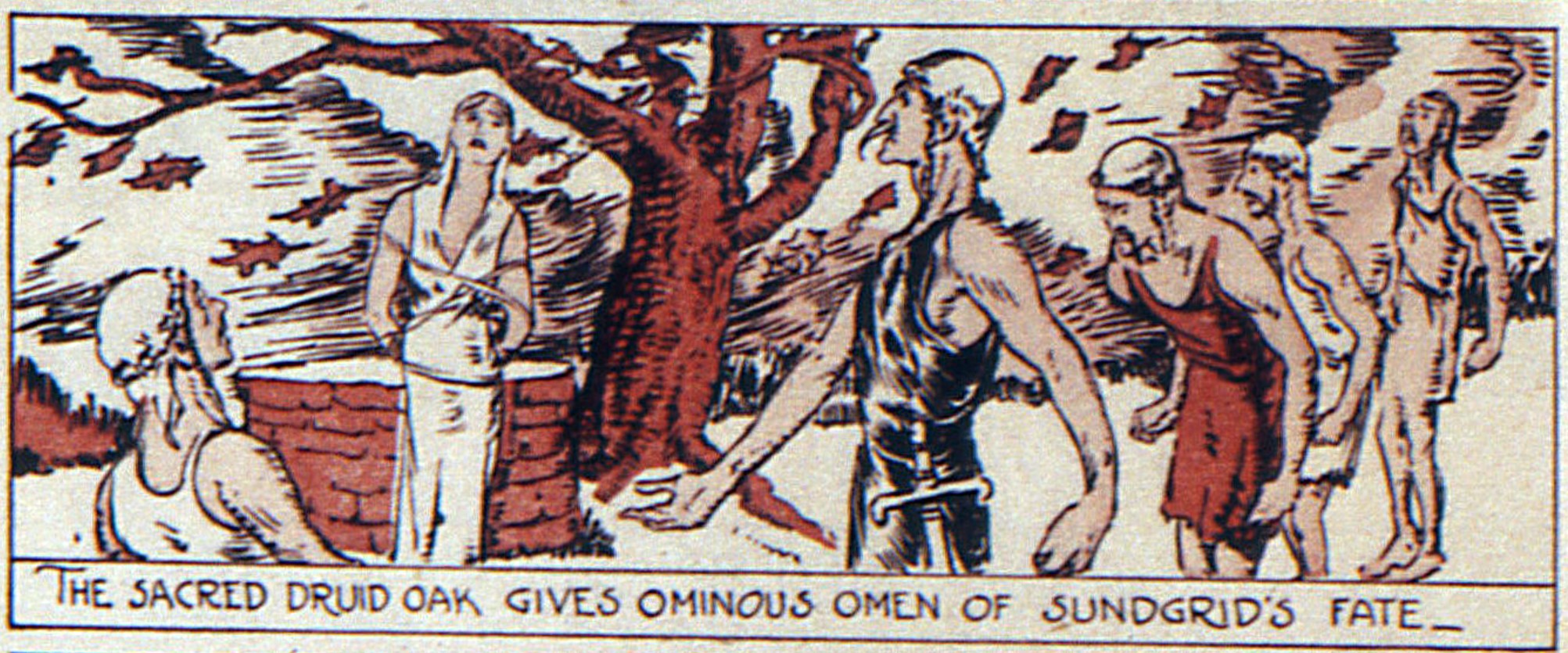
    One of the earliest DC books, New Comics (which eventually becomes New Adventure and then just Adventure Comics) had among its many features an adventure strip called ‘Vikings’ which was kind of slow and dour like a lot of early comics but did feature these doily-hatted Druids and their Sacred Oak that communicates to them via stiff breezes.

    God Style: Animist (New Comics v1 010, 1936) 

    Shin-Giva: 

    Shin-Giva is the god of the Dwarf People of Matto Grosso in Brazil, and his solid platinum idol is the focus of the attention of crooked explorer Frank Hart, who wants to steal it, and his former partner Henri Rinaldo along with Zatara, who want to return it to Shin-Giva’s worshippers and do so thanks to Zatrara’s mighty magicks (please note that the idol is not returned out of any sense that you shouldn’t just waltz in and take valuables from less technologically-advanced societies but rather out of a desire to not crash the world platinum market. So noble!).

    God Style: Idol (Action Comics v1 033, 1941) 

  • MINOR SUPER-VILLAIN 878: MR NIMBUS

    (Zip Comics 009, 1940)

    Mr Nimbus is a simple kind of crook: he has developed or otherwise acquired a liquid that creates a corrosive green gas and he is going to use that to kill people and steal riches from them. No dreams of world domination, no grand designs, just good old fashioned murder and robbery. But also no especial care taken, as he leaves behind a very big clue to the location of his next crime for the Scarlet Avenger and his Operative 1, Inez Courtney to find.

    Mr Nimbus dutifully shows up to gas the Metropolitan Opera House and steal all of the jewellery on display in the audience, but thanks to his carelessness the Scarlet Avenger is there to prevent any rich people from getting killed. Too bad about the performers, though. The downside to being a simple kind of crook, I guess, is that you are also quite predictable.  

    Everything comes to head on the Opera House roof, from which Mr Nimbus takes what should be a fatal fall, only to be missing when the Scarlet Avenger checks for his body, like a proverbial Michael Myers. Look out for him in the 1941 run of Zip Comics! Will my whole “simple guy” thesis hold up? Who knows!

    (Mr Nimbus also has a cool hypnotic ring but it didn’t fit the narrative I was building about him being a simple, one-trick villain. The thesis was already flawed) 

  • GENERIC COSTUMED VILLAIN ROUND-UP 031

    They’re not good people and they’re not good at what they do and yet they still have a certain charm. 

    This guy is exclusively called “the Fiend” in narration boxes even though he is introduced as “the Great Master” and “Mako”. He practices voodoo and just sort of generically terrorizes the Haitian countryside until Yarko the Great comes at the behest of the intriguingly named Doctor Medico to settle his hash. And speaking of names, this issue features multiple characters referring to voodoo practitioners rather than their subjects as “zombies,” which is a new one on me unless of course you count the Grand Zombie. (Wonderworld Comics 019, 1940)

    Called “the Wolf” by detective Dr Fung as he is hunting him down, this masked fellow is actually Horace Bailey, a Wall Street financier who killed his partner to gain full control of their firm and made the mistake of involving a super-sleuth in the execution of his perfect murder. (Wonderworld Comics 020, 1940)

    Don Cervantes is a fellow who discovered silver in the hills near the small probably-Mexican town of Toranto and decided that the best way to keep it all to himself was to revive the practice of human sacrifice in the area. This does not prevent Nevada Jones from moving in and deposing him, of course. (Zip Comics 007, 1940)

    Comic books having cover illustrations that do not reflect the action in the book itself are nothing new, but this is the first time I have felt the need to highlight any of the characters on them whose adventures have gone unchronicled. Here’s to you, Executioner, Green Guy with Sickle Claw and Tiny Green Guy, I’m sure that you were very dastardly. (Zip Comics 008, 1940)

  • MINOR SUPER-VILLAIN 877: TWISTO THE RUBBER MAN

    (Zip Comics 009, 1940) 

    The Tingling Bros Circus is in trouble! Someone has been killing the performers, mid-act, with throwing knives, and it has caused enough financial disruption to the show that owner Jack Tingling is on the verge of bankruptcy!

    As you might have surmised from the fact that this entry is about him, the person responsible for the murders is sideshow attraction Twisto the Rubber Man, and we’ll get to his motivations in a second because they are one of two notable things about him. First, though, we must take note of the other notable thing: his powers. According to his own patter he was born with them, which I suppose makes him some sort of mutant. Whatever the reason, he is able to stretch and twist his body to a superhuman degree, as if he were completely boneless. He doesn’t seem to be able to extend his limbs at will, but his fist does continue travelling under its own momentum to sock new Steel Sterling sidekick Loony in the head in the above panel. He is also able to mould his face into a new shape as if it were made of putty – all in all, he’s a much more limited version of stretching characters like the soon-to-debut Plastic Man.

    But just why did Twisto do all of those murders? Why to drive down the value of the circus so that he can buy it, make his lion-taming wife Lilli a star and grow rich, of course! It’s a foolproof plan, spoiled only by the fact that Lilli considers it “bad” and “wrong” and “illegal” to murder her friends and coworkers for a shot at the big-time.

    Having been rejected by the woman that he loves over a few measly murders, Twisto has a bit of a mental break and turns to the only solution he knows: more murders. First on the agenda is Lilli, whose big cat act he sabotages by giving the beasts a taste of his own blood, thus transforming them into uncontrollable man-eaters (this is one of those tropes that crops up a fair amount, that an animal, once it tastes human blood, can’t stop craving it. Is it true? No idea). 

    At this point, Twisto is so deep in the murder hole (not to mention probably a bit light headed from all that missing blood) that he kind of talks himself into becoming a serial killer by extrapolating from “my beautiful, intelligent wife rejected me because of the crimes I did” to “all beautiful, intelligent women are my enemies and must die.” He almost starts his misogynistic murder spree with Steel Sterling love interest Dora Cummings, but is stopped by the timely intervention of Steel himself.

    Twisto’s progressive mental break continues: his murderous mania transitions into a childlike passivity and he is led away to jail without issue. This isn’t the last you’ll see of ol’ Twisto the Rubber Man, however, as he seemingly snaps out it and escapes immediately after being left alone. We’ll see him again in 1941, presumably with a whole new range of criminal motivations.