The Curse of Skeleton Munroe

Category: Hercules

  • MEDIA IN COMICS 014

    Forget lost media, here are some media that only exist in comic books

    Movies: 

    A Modern Macbeth is one of innumerable in-comic movies that we never really learn anything about. Is it a musical? Is that why a singer is speaking at the premiere? Is it a reference to another movie? The only pre-1941 movie with a similar title that I can find is 1917’s A Modern Monte Cristo and that seems a bit of a stretch. (More Fun Comics 072, 1941)

    Captain Marvel stars in a film called Crusher of Crime in one of our earliest examples of a super-hero starring in a film as themselves. No clue what it’s about but we can probably assume that it’s standard 40s super-hero fare. (Whiz Comics 020, 1941)

    More intriguingly, the character of Whitey Murphy joins the Captain Marvel cast just two issues later, and dialogue between him and Billy Batson implies that not only does the real-world film The Adventures of Captain Marvel exist in the comics universe, but that both Captain Marvel and Billy Batson appeared in it and also that some or all the events of the film actually happened.

    This is reinforced by the fact that Billy goes to see “The Guillotine”, the second chapter of the serial, in Captain Marvel Adventures 003 (Whiz Comics 022, 1941)

    The costume party held for the premiere of The Phantom Duelist (film) held in the castle of the Phantom Duelist (ghost) provides the opportunity for the Phantom Duelist (super-villain) to murder Reynolds (film producer, universally-hated). (Doll Man Quarterly 001, 1941)

    One of the minor recurring tropes of comics is “tough guy goes to Hollywood and finds it exhausting,” seen here as the super-hero Hercules is talked into making a sadly unnamed jungle movie and it almost kills him. (Hit Comics 010, 1941)

    Music:

    The song “Icy Igloo Blues” is the key to District Attorney Steve Malone solving a major jewel robbery case. (Detective Comics v1 053, 1941)

    The “Symphony of Death” was employed by the nefarious Doctor Death in his murders. Do music nerds in comic book universes hold Nights of Evil concerts where they play pieces like this? (Wow Comics 002, 1941)

    Speaking of which, here are six extremely on-the-nose songs composed by the Murder Maestro as part of his own efforts in the field of killing: “A Message to My Heart” (victim shot in the heart), “I’m Drowning My Sorrows” (drowned), “I’m Burning Up Over You” (set on fire), “My Sleepy-Time Pal” (poisoned, weirdly), “I’m Walking on Air” (dropped from a plane) and “I’m Getting Up in the World” (fake attempt on own life). (More Fun Comics 072, 1941)

    Newspaper Columns:

    “Walter Winkle on Broadway” is of course yet another take on the gossip column of Walter Winchell. (Feature Comics 049, 1941)

    Television:

    There are in fact Martian invaders in this Human Torch story, but since they don’t get up to any NYC-destroying I must conclude that this is an unnamed and very coincidental television program. (Marvel Mystery Comics v1 003 1940) 

  • DIVINE ROUND-UP 013

    Piping hot deities for you this mornining.

    Sivu the Tiger God: 

    The worshippers of Sivu the Tiger God come to New York City to recover the jewelled eyes of their great idol, which are known as the Death Ruby and the Doom Ruby and held in the New York Museum and the collection of Beverly van Pell, respectively. Detective Dan Dare gets involved when he is hired by Mrs van Pell and the rubies ultimately stay right where they are. A shame, but at least we get to see that six-armed, four-legged, chubby, tiger-headed representation of Sivu, right?

    God Style: Idol. (Whiz Comics 003b, 1940) 

    Zeus: 

    The MLJ Hercules is the first super-hero of that name to actually be the demi-god in question, and he accordingly has a couple of meetings with his dad Zeus to discuss the state of the fight for truth and justice back on Earth. What I mostly want to point out about this version of the King of Olympus is that he’s probably the most flamboyantly dressed Zeus in comics before Jack Kirby illustrates him in Thor. 

    God style: Real (Blue Ribbon Comics 005, 1940)

    Charon: 

    A pretty by-the-numbers version of Charon who doesn’t deserve to be bullied by Dr Fate just because he needs to cross the Styx. He didn’t even try a bribe first!

    God Style: Real (More Fun Comics 056, 1940) 

    Wisdom: 

    The reason that Dr Fate is visiting the underworld is to check on whether his enemy Wotan is in fact dead, and to that end he is consulting with “Wisdom, who rules the world,” which I can only assume is another entry in the long tradition (that started four issues earlier with the origin of the Spectre) of alluding to the Abrahamic (or let’s face it: Christian) god via a combination of vague wording, blinding light and dialogue from an unseen source.

    God Style: Real (More Fun Comics 056, 1940) 

    (annoyingly, I can’t figure out where the bit about the seven gates to the underworld is from. It feels familiar and I wanted to see if it was from a non-Greek, non-Christian source because then this trip would be incorporating three whole mythologies, but there is simply too much “Gates of Hell” talk online to find it easily) 

  • DIVINE ROUND-UP 013

    Piping hot deities for you this mornining.

    Sivu the Tiger God: 

    The worshippers of Sivu the Tiger God come to New York City to recover the jewelled eyes of their great idol, which are known as the Death Ruby and the Doom Ruby and held in the New York Museum and the collection of Beverly van Pell, respectively. Detective Dan Dare gets involved when he is hired by Mrs van Pell and the rubies ultimately stay right where they are. A shame, but at least we get to see that six-armed, four-legged, chubby, tiger-headed representation of Sivu, right?

    God Style: Idol. (Whiz Comics 003b, 1940) 

    Zeus: 

    The MLJ Hercules is the first super-hero of that name to actually be the demi-god in question, and he accordingly has a couple of meetings with his dad Zeus to discuss the state of the fight for truth and justice back on Earth. What I mostly want to point out about this version of the King of Olympus is that he’s probably the most flamboyantly dressed Zeus in comics before Jack Kirby illustrates him in Thor. 

    God style: Real (Blue Ribbon Comics 005, 1940)

    Charon: 

    A pretty by-the-numbers version of Charon who doesn’t deserve to be bullied by Dr Fate just because he needs to cross the Styx. He didn’t even try a bribe first!

    God Style: Real (More Fun Comics 056, 1940) 

    Wisdom: 

    The reason that Dr Fate is visiting the underworld is to check on whether his enemy Wotan is in fact dead, and to that end he is consulting with “Wisdom, who rules the world,” which I can only assume is another entry in the long tradition (that started four issues earlier with the origin of the Spectre) of alluding to the Abrahamic (or let’s face it: Christian) god via a combination of vague wording, blinding light and dialogue from an unseen source.

    God Style: Real (More Fun Comics 056, 1940) 

    (annoyingly, I can’t figure out where the bit about the seven gates to the underworld is from. It feels familiar and I wanted to see if it was from a non-Greek, non-Christian source because then this trip would be incorporating three whole mythologies, but there is simply too much “Gates of Hell” talk online to find it easily) 

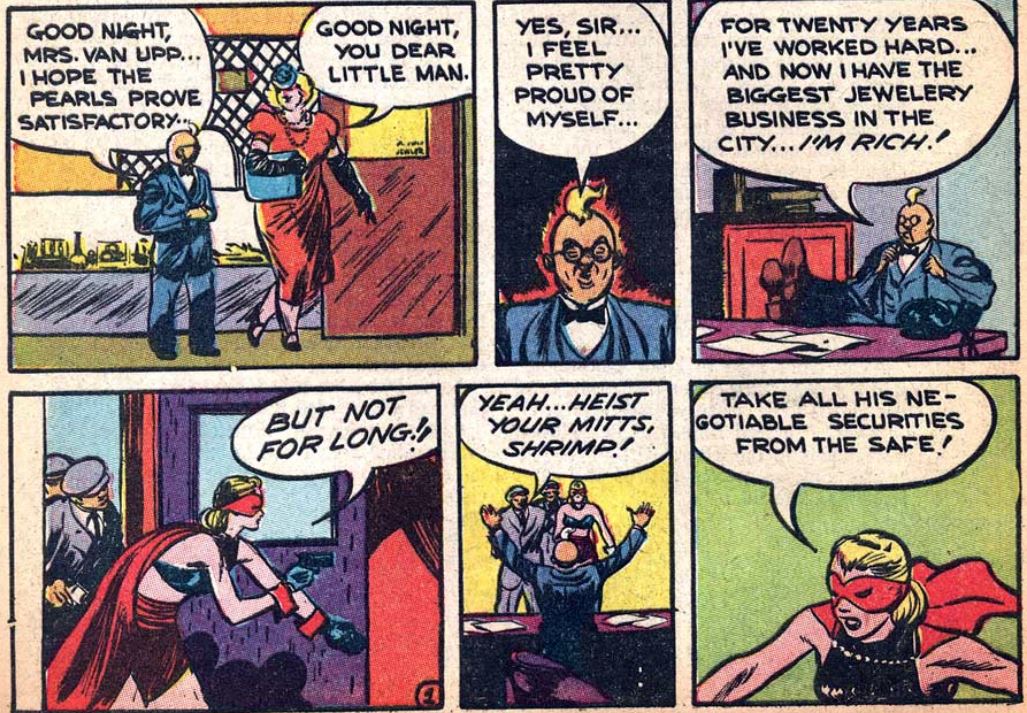
  • MINOR SUPER-VILLAIN 523: NATCHA

    MINOR SUPER-VILLAIN 523: NATCHA

    (Blue Ribbon Comics 008, 1941) 

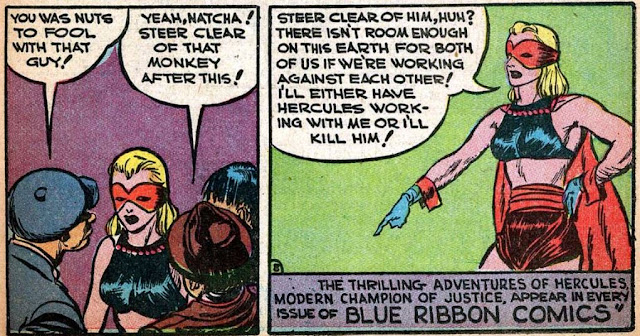
    Technically, Natcha is just another costumed gang boss, but she has a lot more style than you usually get with those.

    This being MLJ’s Hercules, Natcha is thematically linked to one of his iconic Twelve Labours, in this case the theft of the Girdle of Hippolyta. Of course, this version of Hercules was ridding the ancient world of evil rather than atoning for his own crimes via arbitrarily hard tasks, so the girdle doesn’t come into it and Hippolyta is implied to have been a villain of some sort whom Hercules reformed.

    Natcha’s victim here ends up as an ad hoc sidekick to Hercules for this adventure and gets saddled with the name “Little Zooey” for no apparent reason, despite his vigorous protests.

    I really like Natcha! She’s much more of a bruiser than most lady crooks of the Golden Age! Sure she’s a crook but she’s a crook with panache. Not that that helps her when a literal demigod shows up on her doorstep, even if he does have to take care of Little Zooey.

    Both Natcha and Little Zooey are set to reappear in future Hercules adventures but are instead banished to comic book limbo thanks to the Hercules feature never appearing again, a sad end for about one and a half good characters. Natcha in particular should absolutely be BRUNG BACK the next time someone takes a pass at reviving the Archie super-heroes even if Hercules is left in the big pile of also-rans with Lancelot Strong and the Wizard.

  • MINOR SUPER-HERO ROUND-UP 009

    All Archie/MLJ edition!

    Rang-a-Tang the Wonder Dog:

    The Wonder Dog is an uncommon but distinct type of comic book hero and Rang-a-Tang here is typical of the breed: essentially a dog with human intelligence. Rang-a-Tang escaped from a cruel but evidently very talented circus dog trainer and almost immediately teamed up with police Detective Hy Speed, who was perhaps lashing out at the world for his own moniker when he gave his new dog one of the all-time worst names. I mean, I get that it’s a knockoff of Rin-Tin-Tin but he also had a very bad name. 

    By issue seven of Blue Ribbon Comics Rang and Hy had moved to Hollywood and acquired a third companion in Richy Waters, aka Richy the Amazing Boy, and apparently free-range child actor with no adult supervision to speak of. Richy gradually usurps Rang-a-Tang’s place as the strip’s protagonist over the next year or so, which is disappointing to those of us who enjoy dogs more than child actors. (Blue Ribbon Comics 001-022, 1939-1942)

    Bob Phantom:

    As far as his super-hero identity goes, Bob Phantom is fairly regular: he shares with many other Golden Age heroes the power to suddenly appear – in a cloud of smoke in his case (though crucially he is generating the smoke as opposed to appearing in a preexisting cloud like the Vision. Or preexisting fire like the Flame, preexisting water like the Shark, etc. You get it) – and also has some degree of intangibility – definitely enough that bullets don’t affect him. Per his name, he’s very into spooking crooks out via psychological torment.

    Bob Phantom’s civilian identity is that of Walt Whitney, writer of the newspaper gossip column “On Broadway” which he uses to taunt both criminals and the New York District Attorney for some reason. Possibly just to be a scamp. (Blue Ribbon Comics 002, 1939)

    (between Bob Phantom, Top Ten character Jack Phantom and cartoon character Danny Phantom there are just enough characters with “Phantom” as a last name to make me think I’m missing some sort of very obvious pun)

    UPDATE

    UPDATE 1940 

    Corporal Collins, Infantryman:

    An American serving in the French Army (and later the British Army after the Nazis conquer France), Corporal Collins is for no apparent reason a super soldier with crack reflexes,  a danger sense that allows him to dodge enemy bullets and a “fabri-steel flexible repeller” that allows him to effectively deflect incoming bullets back to their source. The more overtly super-heroic aspects of  Collins get toned down after a couple of issues and he becomes just another comic book military paragon with a comic relief sidekick named Slapsie and a rivalry with fellow MLJ military hero Sergeant Boyle and his sidekick Twerp. (Blue Ribbon Comics 002, 1939)

    Hercules:

    It’s time for another Hercules! This Hercules is the real deal Olympian, sent to Earth by Zeus to combat evil (and possibly also as a prank? He seems to be completely unprepared when he pops up in the middle of a New York City analog). Functionally, he’s exactly the same as the other two Herculeses we’ve seen so far: a great big shirtless blonde guy with super strength. He even gets a job as a sideshow strongman like the both of them.

    The real innovation in this version of Hercules is the assertion that his famous Twelve Labours were in fact “wiping out the evils of Ancient Greece” and then drawing parallels between them and his adventures in the modern day, including:

    – the Slaying of the Nemean Lion -> killing gang boss Leo Nymia, the Lion of the Underworld (Hercules also steals Nymia’s suit as a version of wearing the lion’s hide)

    – the Slaying of the Lernean Hydra ->  deposing political fixer Hy Dralerny and his “Nameless Nine” organization

    – the Cleaning of the Augean Stables -> cleaning up crooked gambling at the local racetrack – very tortured and involves both a gambler named Augie King, and two jockeys named Tom and Dick Rivers who had to be “set in the right channels”

    – the Capture of the Erymanthian Boar -> very disappointing. Hercules captures a fat pseudo-Nazi General (who isn’t even named Hairy Man Ian) and because he shoots down a bunch of planes while doing it shoehorns in the Slaying of the Stymphalian Birds. Absolutely the worst of the bunch.

    – Stealing the girdle of Hippolyta -> Contending with the villainess Natch, about whom we shall speak anon.

    Sadly for the mythological completionists out there, Hercules stopped appearing after just six labours, so we’ll never get to see him take on Mary Diomedes the Cannibal Equestrian or twin cattle rustlers Gary and Gerry Young. (Blue Ribbon Comics 004, 1940)

  • MINOR SUPER-HERO ROUND-UP 009

    All Archie/MLJ edition!

    Rang-a-Tang the Wonder Dog:

    The Wonder Dog is an uncommon but distinct type of comic book hero and Rang-a-Tang here is typical of the breed: essentially a dog with human intelligence. Rang-a-Tang escaped from a cruel but evidently very talented circus dog trainer and almost immediately teamed up with police Detective Hy Speed, who was perhaps lashing out at the world for his own moniker when he gave his new dog one of the all-time worst names. I mean, I get that it’s a knockoff of Rin-Tin-Tin but he also had a very bad name. 

    By issue seven of Blue Ribbon Comics Rang and Hy had moved to Hollywood and acquired a third companion in Richy Waters, aka Richy the Amazing Boy, and apparently free-range child actor with no adult supervision to speak of. Richy gradually usurps Rang-a-Tang’s place as the strip’s protagonist over the next year or so, which is disappointing to those of us who enjoy dogs more than child actors. (Blue Ribbon Comics 001-022, 1939-1942)

    Bob Phantom:

    As far as his super-hero identity goes, Bob Phantom is fairly regular: he shares with many other Golden Age heroes the power to suddenly appear – in a cloud of smoke in his case (though crucially he is generating the smoke as opposed to appearing in a preexisting cloud like the Vision. Or preexisting fire like the Flame, preexisting water like the Shark, etc. You get it) – and also has some degree of intangibility – definitely enough that bullets don’t affect him. Per his name, he’s very into spooking crooks out via psychological torment.

    Bob Phantom’s civilian identity is that of Walt Whitney, writer of the newspaper gossip column “On Broadway” which he uses to taunt both criminals and the New York District Attorney for some reason. Possibly just to be a scamp. (Blue Ribbon Comics 002, 1939)

    (between Bob Phantom, Top Ten character Jack Phantom and cartoon character Danny Phantom there are just enough characters with “Phantom” as a last name to make me think I’m missing some sort of very obvious pun)

    UPDATE

    UPDATE 1940 

    Corporal Collins, Infantryman:

    An American serving in the French Army (and later the British Army after the Nazis conquer France), Corporal Collins is for no apparent reason a super soldier with crack reflexes,  a danger sense that allows him to dodge enemy bullets and a “fabri-steel flexible repeller” that allows him to effectively deflect incoming bullets back to their source. The more overtly super-heroic aspects of  Collins get toned down after a couple of issues and he becomes just another comic book military paragon with a comic relief sidekick named Slapsie and a rivalry with fellow MLJ military hero Sergeant Boyle and his sidekick Twerp. (Blue Ribbon Comics 002, 1939)

    Hercules:

    It’s time for another Hercules! This Hercules is the real deal Olympian, sent to Earth by Zeus to combat evil (and possibly also as a prank? He seems to be completely unprepared when he pops up in the middle of a New York City analog). Functionally, he’s exactly the same as the other two Herculeses we’ve seen so far: a great big shirtless blonde guy with super strength. He even gets a job as a sideshow strongman like the both of them.

    The real innovation in this version of Hercules is the assertion that his famous Twelve Labours were in fact “wiping out the evils of Ancient Greece” and then drawing parallels between them and his adventures in the modern day, including:

    – the Slaying of the Nemean Lion -> killing gang boss Leo Nymia, the Lion of the Underworld (Hercules also steals Nymia’s suit as a version of wearing the lion’s hide)

    – the Slaying of the Lernean Hydra ->  deposing political fixer Hy Dralerny and his “Nameless Nine” organization

    – the Cleaning of the Augean Stables -> cleaning up crooked gambling at the local racetrack – very tortured and involves both a gambler named Augie King, and two jockeys named Tom and Dick Rivers who had to be “set in the right channels”

    – the Capture of the Erymanthian Boar -> very disappointing. Hercules captures a fat pseudo-Nazi General (who isn’t even named Hairy Man Ian) and because he shoots down a bunch of planes while doing it shoehorns in the Slaying of the Stymphalian Birds. Absolutely the worst of the bunch.

    – Stealing the girdle of Hippolyta -> Contending with the villainess Natch, about whom we shall speak anon.

    Sadly for the mythological completionists out there, Hercules stopped appearing after just six labours, so we’ll never get to see him take on Mary Diomedes the Cannibal Equestrian or twin cattle rustlers Gary and Gerry Young. (Blue Ribbon Comics 004, 1940)

  • MINOR SUPER-VILLAIN 519: THE GHOST OF THE CYCLOPS

    (Blue Bolt v2 004-005, 1941)

    We open on a bit of… not hubris but it’s often framed as hubris. I’m sure that TV Tropes has a name for it but danged if I’m going to go hunting for it. It’s the phenomenon in which a character in an ongoing fictional setting jokes about how they’re sure glad that *SPECIFIC THING* isn’t real etc and that thing is the focus of the next story. In this case, Sergeant Spook says he’s glad that mythology doesn’t real and so Ghost Town doesn’t have to contend with the ghosts of mythological characters and BAM the ghost of the Cyclops starts destroying Alaska.

    Although the human world sees these attacks as merely a bizarre and terrifying natural disaster the ghosts of Ghost Town know what’s up and dispatch Sergeant Spook northward. On arrival he is met and guided by several of the Cyclops’ recent victims – always a handy part of being a ghost cop.

    Spook’s encounter with the Cyclops follows a fairly predictable pattern: cornered in a cave, he anages to temporarily blind the other ghost and then trace him back to his lair by clinging to his cyclopean sandals. This encounter does serve to further muddy the waters of how ghosts workin Sergeant Spook comics, however: can a ghost hit another ghost with a corporeal snowball? Is Alaska covered in a layer of ghost snow? Or is the Cyclops just super-vulnerable to eye-damaging attacks like a video game boss?

    The second issue of this two-parter is a bit perfunctory: Spook arrives at the Cyclops’ lair where we learn that when not translucent to signify that he is a ghost in the corporeal world the Cyclops is green. He is also served by other, unidentified ghosts who are presumably being bullied into servitude with the threat of violence like the Ghost of King Tut’s slaves. He also captures Sergeant Spook with very little trouble. Things look bad, but then:

    HERCULES! Because of course if the Cyclops is real then there’s gotta be guys like Hercules (famous foe of the Cyclops) running around too. There’s a bit of a scuffle and then he plants a slobberknocker on the Cyclops that decisively concludes things.

    Hercules’ reward: eternal vigilance. His ghost pledges to guard the Cyclops’ ghost for the rest of time, which will presumably entail regular brawls whenever his charge wakes up and wants to cause more chaos. Maybe this is a good outcome for Hercules? I just hope that someone in Ghost Town thinks to ship him some ghost books or the like.

  • MAD AND CRIMINAL SCIENTIST ROUND-UP 005

    Just a little crypto-fascist saboteur named Dr Vee who battled Dynamic Man but I like his name and I like his style. His sartorial style. Not the fascism. (Mystic v1 002, 1940)

    Lemo here has a mechanical mole-style tank and reckons he can take over the world with it after almost destroying one (1) circus tent. It’s a good thing he was blown up by one of Marvel’s many Herculeses before he could get too far and get disappointed. (Mystic Comics v1 004, 1940)

    This fellow, known only as the Mystery Man, has been working on the problem of how to counter snipers in warfare, and the scheme that he has come up with involves breeding up vicious wolf-dogs, training them to hate a particular smell and then applying that smell to the shoes of enemy combatants so that the dogs hunt and kill them. There’s a slight problem with this plan that the two crypto-fascist gentlemen that he’s trying to sell this system to don’t seem to come on to, even when he offers to sell them the scent and the dogs and doesn’t mention offering a dedicated group of scent-applying agents (or maybe he had some smaller dogs trained to do the job and he was going to upsell them later).

    The Mystery Man only gets caught because he has been picking up hitchhiking college students and using them to train the dogs and the person responsible for their safety is friends with giant super-hero Mighty Man and long story short the Mystery Man gets eaten by dogs. (Amazing-Man Comics 009, 1940)

    This here unnamed fella has a four-step plan: 

    1. Capture the Iron Skull 

    2. Inject the Iron Skull with a serum that turns him completely to iron

    3. Inject his iron blood into robots to make them alive somehow

    4. Profit

    Steps 1 and 2 go fine but as seen above a major flaw in the plan is that the Iron Skull is now more powerful and mops the floor with his erstwhile captor. The robots don’t even show up! (Amazing-Man Comics 015, 1940)

  • MINOR SUPER-HERO 051: HERCULES

    (Mystic Comics v1 003)

    Every long running super-hero universe is going to acquire some Herculeses and the Marvel Universe might just have the most of all – I counted an even dozen just now and I’m sure there are more that aren’t properly documented on the fan wikis – the DCU doesn’t come close even if you count reboots of the same characters. Why? Not sure!

    This Hercules is the son of one Dr David, raised on Snow Island in the Arctic to be a mental and physical paragon. He’s super-strong and though his height is pretty inconsistent he’s gotta be at least eight and up to ten feet tall. He busts up one mad scientist and saves a town from a flood but that’s about it. Personally I think that he should come back (sorry, BRUNG BACK), just to add a little confusion to the modern Marvel Hercules scene.

  • HONOURS – HERCULES

    (Hit Comics 010, 1941)


    Hercules cleans up the Giller Mob and gets the key to… a city. Probably New York? Who can say for sure – he moved around more than most 40s super-heroes.

    This also leads to a brief and harrowing Hollywood career in which he stars in one – alas! – unnamed jungle action movie.