The Curse of Skeleton Munroe

Category: fake god

  • MINOR SUPER-VILLAIN 900: TRUG

    (Whiz Comics 013, 1941) 

    Trug is a student of magic and of Ibis the Invincible specifically who creeps out of the shadows after Ibis and Taia’s ward Tommy has defeated his school’s boxing champion and tempts the despondent youth into stealing the Ibistick for him (the sad boy is then turned into a tree and then never mentioned again – very sad).

    Trug’s Ibis scholarship extends beyond kind of dressing like him and knowing where his extended family hang out into important topics like how not to kill yourself while using the Ibistick. Unlike every poor chump who has gotten their hands on it before him, Trug is aware that it will visit any harm intended for Ibis back on its wielder and so deals exclusively in barriers, crevasses and other nonlethal means of keeping his rival at bay.

    Where Trug fails is in not being a creep and kidnapping Taia as he leaves to enjoy his newfound power. Quite aside from any moral implications, this is a sure way to make Ibis just that much more determined in his quest to defeat his foe.

    Fore reasons of his own, Trug heads north, subjugates the local peoples and builds a palace, and here I notice that he has kidnapped Taia not as a creepy “I will make you my queen” kind of thing but as a hostage, which I would still not call a good idea but which at least has a bit of logic to it.

    One thing that Trug has clearly not considered is that Ibis still has access to magical items that he used the Ibistick to create and that using two of these – the crystal ball and super-plane, specifically – he is able to locate and travel to Trug’s new kingdom in swift order. Trug thus makes the mistake of summoning an air force to deal with whoever might be encroaching on his airspace, only for them to turn on him and cause a piece of his own palace to fall and bonk him unconscious.

    Trug ends his days as a decorative statue as part of the compensation offered by Ibis to his former subjects. (Whiz Comics 014, 1941) 

    Trug isn’t a statue for very long before he is carried off by slavers and worshipped as an idol. When Ibis is then asked for help, he restores Trug to human form as part of a scheme to show that he is a mere mortal.

    Turning Trug back and forth from statue to man to show that he is in fact powerless swiftly convinces his erstwhile worshippers to abandon him, and somehow also that they should give up their warlike ways and make peace with their former enemies. Trug, meanwhile, is left at liberty and feeling vengeful, though he is under-dressed in the Arctic. (Whiz Comics 015, 1941)

    Undaunted by his circumstances, Trug hops on a log and starts paddling his way South, and has the good fortune to encounter a helpful man with a magic bag of wind, who he promptly robs and murders. He makes an opportunistic and unsuccessful attempt to kill Ibis and Taia by summoning a storm demon, then composes himself and… (Whiz Comics 016, 1941)

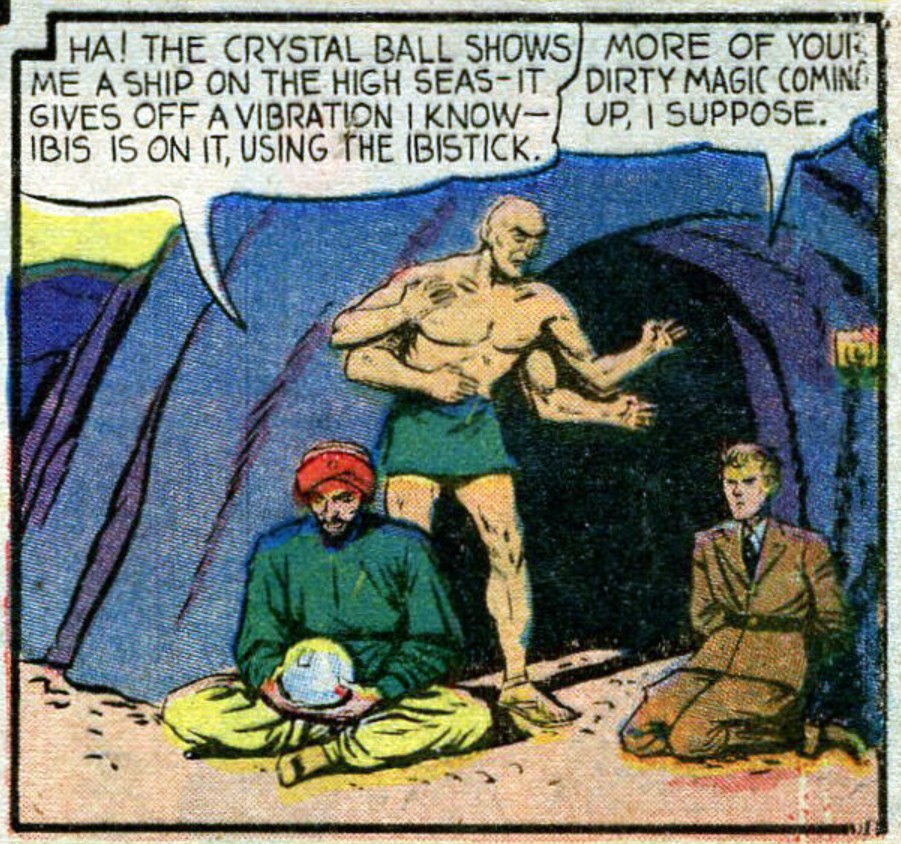
    … kidnaps Ibis and Taia’s ward Tommy and uses him as bait in yet another attempt to kill Ibis, and while the first part of that plan works like a charm, his trapping game is pretty haphazard. His ace in the hole is clearly the god-monster the Man of the Mountain (the four-armed guy above) but he also blows up the ship that Ibis is crossing the Pacific on (ineffective) and places fairly obvious traps like a clearly-carnivorous tree and a demon disguised as a pretty lady on the path leading to his cave hideout. (Whiz Comics 017, 1941) 

    The Man of the Mountain, though imposing, is not too bright and is lured off of a cliff with relative ease, after which Trug just kind of gives up. There is a small amount of tension as the ambient magical energies of the area render the Ibistick powerless and thus Ibis and Taia are trapped on the side of a mountain, but that barely counts as a deathtrap. (Whiz Comics 018, 1941)

    We now enter that phase of any recurring villain’s career in which they go from being a legitimate threat to a bit of a joke, and in Trug’s case this begins when he is rejected by a loser named Mudge who himself is looking to get revenge on Ibis for foiling his plans. Trug might have fallen on hard times but he knows how to size up a fool, and Mudge is exactly the kind of guy to fall for the old Fake Satan trick. Where he was unwilling to team up with an unsuccessful magician he is more than happy to sell his soul for a chance at revenge, the dope.

    Mudge and Satan/Trug attempt to kill Ibis and Taia with a magic bomb, but fail as Ibis saw them coming a mile away and substituted a couple of magical duplicates for them. He afflicts Mudge with donkey ears for his trouble, which only redoubles his commitment to revenge.

    The duo next attempt to harm Ibis by killing Taia and are fooled by the same magical duplicate trick, upon which Ibis reveals that he was not only on to them but that he know that “Satan” was actually Trug the whole time. Mudge and Trug are then sealed up in a wall to die, which is pretty tough justice, but we must remember that Ibis is from another time.

    Though Mudge’s fate is sealed, Trug will return in 1942. (Whiz Comics 020, 1941)

  • MINOR SUPER-VILLAIN 900: TRUG

    MINOR SUPER-VILLAIN 900: TRUG

    (Whiz Comics 013, 1941) 

    Trug is a student of magic and of Ibis the Invincible specifically who creeps out of the shadows after Ibis and Taia’s ward Tommy has defeated his school’s boxing champion and tempts the despondent youth into stealing the Ibistick for him (the sad boy is then turned into a tree and then never mentioned again – very sad).

    Trug’s Ibis scholarship extends beyond kind of dressing like him and knowing where his extended family hang out into important topics like how not to kill yourself while using the Ibistick. Unlike every poor chump who has gotten their hands on it before him, Trug is aware that it will visit any harm intended for Ibis back on its wielder and so deals exclusively in barriers, crevasses and other nonlethal means of keeping his rival at bay.

    Where Trug fails is in not being a creep and kidnapping Taia as he leaves to enjoy his newfound power. Quite aside from any moral implications, this is a sure way to make Ibis just that much more determined in his quest to defeat his foe.

    Fore reasons of his own, Trug heads north, subjugates the local peoples and builds a palace, and here I notice that he has kidnapped Taia not as a creepy “I will make you my queen” kind of thing but as a hostage, which I would still not call a good idea but which at least has a bit of logic to it.

    One thing that Trug has clearly not considered is that Ibis still has access to magical items that he used the Ibistick to create and that using two of these – the crystal ball and super-plane, specifically – he is able to locate and travel to Trug’s new kingdom in swift order. Trug thus makes the mistake of summoning an air force to deal with whoever might be encroaching on his airspace, only for them to turn on him and cause a piece of his own palace to fall and bonk him unconscious.

    Trug ends his days as a decorative statue as part of the compensation offered by Ibis to his former subjects. (Whiz Comics 014, 1941) 

    Trug isn’t a statue for very long before he is carried off by slavers and worshipped as an idol. When Ibis is then asked for help, he restores Trug to human form as part of a scheme to show that he is a mere mortal.

    Turning Trug back and forth from statue to man to show that he is in fact powerless swiftly convinces his erstwhile worshippers to abandon him, and somehow also that they should give up their warlike ways and make peace with their former enemies. Trug, meanwhile, is left at liberty and feeling vengeful, though he is under-dressed in the Arctic. (Whiz Comics 015, 1941)

    Undaunted by his circumstances, Trug hops on a log and starts paddling his way South, and has the good fortune to encounter a helpful man with a magic bag of wind, who he promptly robs and murders. He makes an opportunistic and unsuccessful attempt to kill Ibis and Taia by summoning a storm demon, then composes himself and… (Whiz Comics 016, 1941)

    … kidnaps Ibis and Taia’s ward Tommy and uses him as bait in yet another attempt to kill Ibis, and while the first part of that plan works like a charm, his trapping game is pretty haphazard. His ace in the hole is clearly the god-monster the Man of the Mountain (the four-armed guy above) but he also blows up the ship that Ibis is crossing the Pacific on (ineffective) and places fairly obvious traps like a clearly-carnivorous tree and a demon disguised as a pretty lady on the path leading to his cave hideout. (Whiz Comics 017, 1941) 

    The Man of the Mountain, though imposing, is not too bright and is lured off of a cliff with relative ease, after which Trug just kind of gives up. There is a small amount of tension as the ambient magical energies of the area render the Ibistick powerless and thus Ibis and Taia are trapped on the side of a mountain, but that barely counts as a deathtrap. (Whiz Comics 018, 1941)

    We now enter that phase of any recurring villain’s career in which they go from being a legitimate threat to a bit of a joke, and in Trug’s case this begins when he is rejected by a loser named Mudge who himself is looking to get revenge on Ibis for foiling his plans. Trug might have fallen on hard times but he knows how to size up a fool, and Mudge is exactly the kind of guy to fall for the old Fake Satan trick. Where he was unwilling to team up with an unsuccessful magician he is more than happy to sell his soul for a chance at revenge, the dope.

    Mudge and Satan/Trug attempt to kill Ibis and Taia with a magic bomb, but fail as Ibis saw them coming a mile away and substituted a couple of magical duplicates for them. He afflicts Mudge with donkey ears for his trouble, which only redoubles his commitment to revenge.

    The duo next attempt to harm Ibis by killing Taia and are fooled by the same magical duplicate trick, upon which Ibis reveals that he was not only on to them but that he know that “Satan” was actually Trug the whole time. Mudge and Trug are then sealed up in a wall to die, which is pretty tough justice, but we must remember that Ibis is from another time.

    Though Mudge’s fate is sealed, Trug will return in 1942. (Whiz Comics 020, 1941)
  • DIVINE ROUND-UP 016

    Gods aplenty! 

    Tyalpo: 

    The god worshipped by Ibis the Invincible villain Piang the Terrible. Probably real, in that Piang has real magical power that he calls upon Tyalpo to activate, even if the god himself shows up only in idol form.

    God Style: Idol (Real?) (Whiz Comics 009, 1940) 

    Goddess of the Jungle: 

    Sandor is a jungle hero who doesn’t so much adventure as get into one long series of scrapes and situations in Northern India, the second most popular location to be a jungle hero by my reckoning. One of those scrapes involves him nearly getting sacrificed to the Goddess of the Jungle, about whom we never really learn more than her name. 

    God Style: Invoked (New Comics 006, 1936)

    the Golden Dragon: 

    “The Golden Dragon” is a serial that ran in Adventure Comics for around three years (and in fact started back when the book was called New Comics), about a group of adventurers and soldiers of fortune travelling from China to Mongolia in search of the fabled treasure of the Golden Dragon, while fending off attempts by the villainous Torgadoff to halt their journey, presumably so that he can seek the treasure himself. 

    Adventure Comics 034 finds de facto expedition leader Ian Murray at the end of the trail, which turns out to be a very much still in-use Temple of the Golden Dragon, with Torgadoff turning out to be one of the high priests. Does this dampen his desire to strip the place of its treasure? Absolutely not! This is a 1930s adventurer we’re talking about! The presence of a non-Christian religious practice only increases his lust for gold!

    Even the treasure-hungry Murray is taken aback, however, when the Golden Dragon shows up and turns out to be a real, living creature – presumably some sort of giant snake rather than a more traditional dragon based on how dumb it seems to be. 

    Murray’s reverence for this wonder of the natural world extends about as far as his respect for other cultures, and he ends up blasting the Golden Dragon at the first opportunity (but not before tossing Torgadoff into it’s crushing coils). The death of their god causes the worshippers to retreat, and the heroic adventurers are able to loot the temple and retire to lives of ease and luxury.

    God Style: Animist (Adventure Comics 034, 1939) 

    the Golden God: 

    The Golden God is one of the innumerable gods worshipped by the uncountable made-up Amazon tribes that comics are full of, and like so many of these gods, the Golden God is sought out by adventurers because it is represented by an idol of solid gold. Heroic adventurers the Companions Three seek out the idol after being hired by a woman named Cassie Bennett to find her father, Professor Bennett, who is supposedly after it on anthropological grounds 

    As usual, the anthropological value of an artifact outweighs the fact that the idol in question is still being used, but that turns out to matter a bit less than it normally does because the Golden God has in fact been discarded in favour of an unnamed new god, This new god in turn is revealed to be the Companions’ antagonist Hook Harroday, who is himself after the gold.

    Harroday’s plan to messily murder the Companions Three falls apart under a barrage of punches, and the group escapes with the idol of the Golden God, which Professor Bennett sells to a museum in a real triumph for selfless anthropology. 

    God Style: Idol (Master Comics 015, 1941) 
  • DIVINE ROUND-UP 016

    Gods aplenty! 

    Tyalpo: 

    The god worshipped by Ibis the Invincible villain Piang the Terrible. Probably real, in that Piang has real magical power that he calls upon Tyalpo to activate, even if the god himself shows up only in idol form.

    God Style: Idol (Real?) (Whiz Comics 009, 1940) 

    Goddess of the Jungle: 

    Sandor is a jungle hero who doesn’t so much adventure as get into one long series of scrapes and situations in Northern India, the second most popular location to be a jungle hero by my reckoning. One of those scrapes involves him nearly getting sacrificed to the Goddess of the Jungle, about whom we never really learn more than her name. 

    God Style: Invoked (New Comics 006, 1936)

    the Golden Dragon: 

    “The Golden Dragon” is a serial that ran in Adventure Comics for around three years (and in fact started back when the book was called New Comics), about a group of adventurers and soldiers of fortune travelling from China to Mongolia in search of the fabled treasure of the Golden Dragon, while fending off attempts by the villainous Torgadoff to halt their journey, presumably so that he can seek the treasure himself. 

    Adventure Comics 034 finds de facto expedition leader Ian Murray at the end of the trail, which turns out to be a very much still in-use Temple of the Golden Dragon, with Torgadoff turning out to be one of the high priests. Does this dampen his desire to strip the place of its treasure? Absolutely not! This is a 1930s adventurer we’re talking about! The presence of a non-Christian religious practice only increases his lust for gold!

    Even the treasure-hungry Murray is taken aback, however, when the Golden Dragon shows up and turns out to be a real, living creature – presumably some sort of giant snake rather than a more traditional dragon based on how dumb it seems to be. 

    Murray’s reverence for this wonder of the natural world extends about as far as his respect for other cultures, and he ends up blasting the Golden Dragon at the first opportunity (but not before tossing Torgadoff into it’s crushing coils). The death of their god causes the worshippers to retreat, and the heroic adventurers are able to loot the temple and retire to lives of ease and luxury.

    God Style: Animist (Adventure Comics 034, 1939) 

    the Golden God: 

    The Golden God is one of the innumerable gods worshipped by the uncountable made-up Amazon tribes that comics are full of, and like so many of these gods, the Golden God is sought out by adventurers because it is represented by an idol of solid gold. Heroic adventurers the Companions Three seek out the idol after being hired by a woman named Cassie Bennett to find her father, Professor Bennett, who is supposedly after it on anthropological grounds 

    As usual, the anthropological value of an artifact outweighs the fact that the idol in question is still being used, but that turns out to matter a bit less than it normally does because the Golden God has in fact been discarded in favour of an unnamed new god, This new god in turn is revealed to be the Companions’ antagonist Hook Harroday, who is himself after the gold.

    Harroday’s plan to messily murder the Companions Three falls apart under a barrage of punches, and the group escapes with the idol of the Golden God, which Professor Bennett sells to a museum in a real triumph for selfless anthropology. 

    God Style: Idol (Master Comics 015, 1941) 

  • DIVINE ROUND-UP 015

    Hate and deception abound in this batch of deities.

    Wangwa, God of Hate: 

    Wangwa, God of Hate is the personal god of Okoro, medicine man of the Blancas and enemy of Doctor Voodoo. I’ve never decided if the Evil Medicine Man trope is mere condescension toward native spiritual practices or a porting over of the Evil Vizier archetype to jungle comics, and in all honesty it’s probably both. Anyway, Okoro fits the mould to a T and he worships the god of hate. Sorry he’s so fuzzy.

    God Style: Idol (Whiz Comics 008, 1940) 

    Cheops:

    Adventurer Clip Carson and his archaeologist companion Jim Blake are searching for the fabled lost tomb of Cheops one day when they find themselves in the midst of an entire cult dedicated to the worship of what is apparently the resurrected Pharaoh himself. Carson and Blake are captured by the cult, upon which the supposed Cheops – with very little prompting, mind you – reveals himself to be Sergeant Beatty of the local colonial government, out to seize the treasures of Cheops for himself. Blake and Carson of course escape, and along the way Beatty is exposed as a fraud and torn apart by his former devotees. 

    The deep need for modern Egyptians in adventure fiction to turn to Ancient Egyptian religion, but only in the most secret, cultish, conspiratorial way is another one of those things that you end up wondering about once you read it enough times. Is it merely a fun and easy way to inject some mysterious action into your story? If so, why does it crop up instories set in Egypt so much more than ones set in Greece of Italy? Is it racism again? 

    God Style: Complicated – Cheops/Khufu could be considered to be a deified ruler of Egypt, even though the practice of doing so became common something like a thousand years after his time. Plus this is just some dude posing as him. (Action Comics v1 016, 1939)

    Doolong: 

    Remember Korieg the Sea Devil from a little while ago? Well, the same island people who hate that guy just love to worship Doolong, “god of [their] ancestors”. Not too much detail on Doolong, other than a) his idol is just a little face mounted on the wall and b) he slings a very accurate prophecy – he totally predicts the arrival of Tex Thomson and his party on the island, even if the small matter of Tex being the Princess’ destined mate is inaccurate. 

    God Style: Idol (Real?) (Action Comics v1 011, 1939)

    the Druid God: 

    This is possibly only obvious to someone who lives in the area, but the “group of islands” being indicated in the above image is clearly Cape Breton, Nova Scotia. Was Cape Breton seen as a place just far enough outside of the everyday for things like shipwrecks and secret cults to happen in, or did “Reynolds of the Mounted” scribe and lifelong resident of New York State Art Pinajian just trace a random bit of Canadian coastline and call it a day?

    Speaking of shipwrecks and secret cults, the first of those happens when Sergeant Reynolds heads toward the last known location of missing rich guy Johnny Westlake. Like Johnny, Reynolds washes up on the shore and is found and nursed back to health by local Pierre Dulac.

    Westlake has been on the island long enough to be able to relate the local legend of the Druid Cave, a spooky cave surrounded by spooky rock formations and regarded with fear by the superstitious islanders, who believe that though the cave is full of gold it is also cursed and that anyone venturing inside will die. Reynolds and Westlake venture inside after finding a local fisherman dying on the nearby beach and discover that the cave does in fact contain an ancient treasure and that the curse is probably just plain old asphyxiation thanks to some natural gas deposits.

    Here’s where the cult comes in: the islanders just kind of spontaneously develop it after finding Westlake emerging from the cave shortly before an explosion rocks the countryside. Never trust a group who turn to human sacrifice as a first option, is what I always say.

    In the end, the real culprit behind the murders and explosions turns out to be Pierre Dulac, who, far from being an altruistic soul, has been manipulating the situation to bring maximum chaos as a distraction while he sneaks off with the treasure. He didn’t reckon with Reynolds’ tenacity, of course, and ends up exploding along with the treasure and all evidence of whatever fantastic culture produced the Druid Cave. The islanders just kind of scatter, presumably to keep the worship of the Druid God alive in secret.

    God Style: Invoked (Feature Comics 045, 1941)

  • DIVINE ROUND-UP 011

    Lookit’m go!

    Thor: 

    This particular version of Thor, Norse God of Thunder invests mortal man Grant Farrel with his powers, but while most ancient gods who get up to that sort of thing in comics are looking for an agent to fight against or promote a cause or agenda, Thor seems to just seems to want to see his powers being used in adventures. It’s kind of wholesome!

    Please also note the weird discs on Thor’s helmet. What the heck is up with those? 

    God style: real (Weird Comics 001, 1940)

    the Slave Giants’ Goddess: 

    Space-time adventurer Flip Falcon (back when he was called Flick Falcon, before someone realized that “flick” in comic book block lettering is awful close to “fuck”) spent his first few escapades getting in the middle of a conflict between various Martian races and an invading three-armed species. As a part of this, Fli(ck/p) and his companion Adele come up with a scheme to substitute her for the idol that the Three-Arms had been using to control the credulous Martian Giants.

    This works well enough that it causes a minor holy war among the Giants, but I suppose that all’s fair in planetary defense. 

    God style: idol/ fake (Fantastic Comics 003, 1940) 

    the Sun God: 

    A big tree worshipped by a group of hominids known as “flat heads” via human hominid sacrifice. Fortunately for Og, Son of Fire and his companions, they represent a slightly more quick-witted type of hominid and manage to escape this grisly fate. 

    God style: animist (The Funnies 013, 1937)

    Zagu: 

    Source of conflict between a local tribe who insist that he lives in a mine site and the guy who really wants to mine there. Unsurprisingly, the Red Panther shows up to take the mine owner’s side.

    God style: invoked (Jungle Comics 003, 1940) 

  • PROBLEMATIC ROUND-UP 005

    PROBLEMATIC ROUND-UP 005

    Some day we will hit Peak Problematic and I can’t decide if it will be soon or in a decade or so. 

    the White Leader: 

    Our last Problematic Round-Up featured a lot of white guys dressing up like Yellow Peril villains in order to lead Chinese gangs, something that we will unfortunately be seeing plenty more of. This here fellow follows a different path: not putting on yellowface in order to lead a Chinese gang and in fact leaning hard the other way by having them call him “the Great White Leader” or just “the White Leader” the whole time. Is this technically better? I suppose it is. Is it not by much? Certainly!

    Anyway, the White Leader is really wealthy playboy Anthony Clare, who turns out to be wealthy because he is a drug kingpin. Until he gets pinched by Detective Sergeant Burke, of course. (Startling Comics 001, 1940) 

    the Voa:

    Roger Barrow and his nephew Phillip Acton have just returned from a diamond-buying trip to Africa, and they must have been on their best behaviour because the local inhabitants of wherever they were doing their business sent them home with what is essentially a curse on their heads: the promise that the death-god Voa will follow them back.

    This is of course a classic setup for a Woman in Red whodunnit mystery, with one of the six possible suspects bumping off the rest for those sweet, sweet diamonds. It’s a classic solution to such a problem!

    To give this comic the tiniest amount of benefit of the doubt I think that the false Voa that shows up to start killing people (aka Phillip Acton, the nephew) is dressed up like some sort of mahogany idol, but what that all adds up to is that while he is not technically doing blackface, he certainly appears to be doing blackface. It’s not better, I’ll say that right now.

    Anyway, he was going to murder his whole family in order to get his hands on some stupid diamonds, so it’s not like we were under the impression that he was a good person. About the only fun thing about this one is that Acton’s chosen weapon is a blowgun that shoots poisoned crystal shards. (Thrilling Comics 005, 1940)

    Princess Ah-Ku:

    Princess Ah-Ku is a recurring villain of Bob Phantom’s and she’s just kind of generic: generically villainous, generically Yellow Peril… she even adopts an extremely generic alter ego called the Master in her first appearance. Most of her schemes involve smuggling. (Top-Notch Comics 004, 1940)

    Princess Ah-Ku returns in Top-Notch Comics 005 under yet another identity, as the Doctor, leader of a gang of kidnappers. As always, the surgical outfit-as-costume is a very strong look, though something about the reveal of Ah-Ku as the real identity of the Doctor makes me think that this was a last-minute change to spice up the adventure a bit.

    Top-Notch Comics 006 involves Ah-Ku doing some opium smuggling, with a sideline in trying to figure out who Bob Phantom is so that she can kill him off. This allows for the hilarious old bit where she captures Walt Whitney in order to grill him for information on his own alter ego.

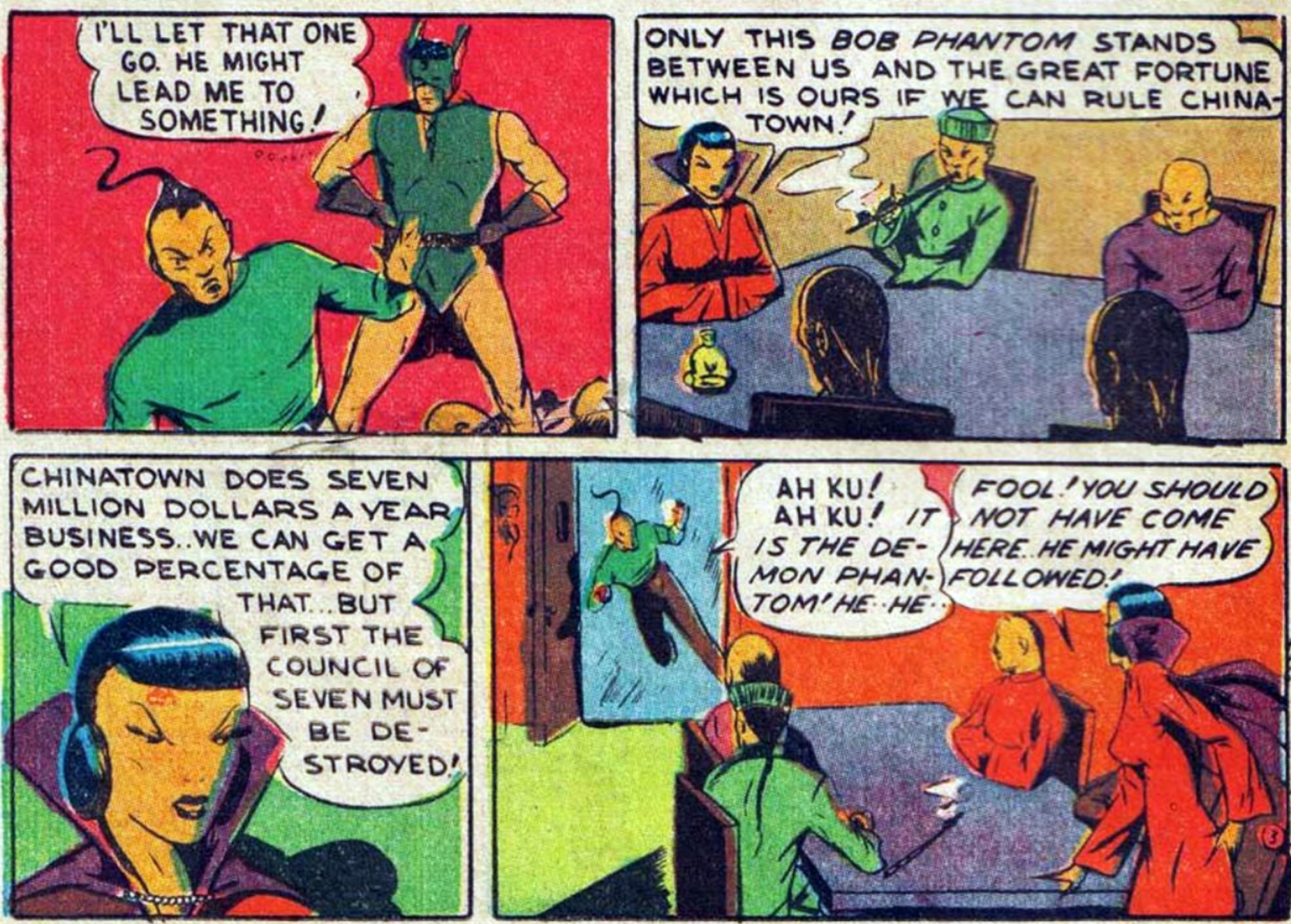
    In her final appearance in Top-Notch Comics 009, Princess Ah-Ku attempts to take over Chinatown by killing off the Council of Seven who apparently have been running it. She manages to get it down to a Council of Four before Bob Phantom catches wise and steps in.

    Princess Ah-Ku is finally brought to justice thanks to Bob Phantom’s unexpected skill with the throwing axe. Perhaps it’s for the best – at the rate her Yellow Peril levels were rising, the next time we saw Ah-Ku she might have sported a fu manchu.

    the Brahmins: 

    Kardak the Mystic and his gal-pal Lorna are just kind of wandering around the Louisiana bayous when they stumble across a Siva-worshipping cult of fanatics in a weird mystical pocket dimension. They foil the Brahmins’ initial attempts to destroy human civilization (and acquire a new companion named Balthar in the process) and then spend the remainder of 1940 on a voyage through various other magical lands on the way to confront the Brahmins’ masters, conveniently named the Master Brahmins. Look out for them in a 1941 edition of this very Round-Up. (Top-Notch Comics 006, 1940)

  • PROBLEMATIC ROUND-UP 005

    PROBLEMATIC ROUND-UP 005

    Some day we will hit Peak Problematic and I can’t decide if it will be soon or in a decade or so. 

    the White Leader: 

    Our last Problematic Round-Up featured a lot of white guys dressing up like Yellow Peril villains in order to lead Chinese gangs, something that we will unfortunately be seeing plenty more of. This here fellow follows a different path: not putting on yellowface in order to lead a Chinese gang and in fact leaning hard the other way by having them call him “the Great White Leader” or just “the White Leader” the whole time. Is this technically better? I suppose it is. Is it not by much? Certainly!

    Anyway, the White Leader is really wealthy playboy Anthony Clare, who turns out to be wealthy because he is a drug kingpin. Until he gets pinched by Detective Sergeant Burke, of course. (Startling Comics 001, 1940) 

    the Voa:

    Roger Barrow and his nephew Phillip Acton have just returned from a diamond-buying trip to Africa, and they must have been on their best behaviour because the local inhabitants of wherever they were doing their business sent them home with what is essentially a curse on their heads: the promise that the death-god Voa will follow them back.

    This is of course a classic setup for a Woman in Red whodunnit mystery, with one of the six possible suspects bumping off the rest for those sweet, sweet diamonds. It’s a classic solution to such a problem!

    To give this comic the tiniest amount of benefit of the doubt I think that the false Voa that shows up to start killing people (aka Phillip Acton, the nephew) is dressed up like some sort of mahogany idol, but what that all adds up to is that while he is not technically doing blackface, he certainly appears to be doing blackface. It’s not better, I’ll say that right now.

    Anyway, he was going to murder his whole family in order to get his hands on some stupid diamonds, so it’s not like we were under the impression that he was a good person. About the only fun thing about this one is that Acton’s chosen weapon is a blowgun that shoots poisoned crystal shards. (Thrilling Comics 005, 1940)

    Princess Ah-Ku:

    Princess Ah-Ku is a recurring villain of Bob Phantom’s and she’s just kind of generic: generically villainous, generically Yellow Peril… she even adopts an extremely generic alter ego called the Master in her first appearance. Most of her schemes involve smuggling. (Top-Notch Comics 004, 1940)

    Princess Ah-Ku returns in Top-Notch Comics 005 under yet another identity, as the Doctor, leader of a gang of kidnappers. As always, the surgical outfit-as-costume is a very strong look, though something about the reveal of Ah-Ku as the real identity of the Doctor makes me think that this was a last-minute change to spice up the adventure a bit.

    Top-Notch Comics 006 involves Ah-Ku doing some opium smuggling, with a sideline in trying to figure out who Bob Phantom is so that she can kill him off. This allows for the hilarious old bit where she captures Walt Whitney in order to grill him for information on his own alter ego.

    In her final appearance in Top-Notch Comics 009, Princess Ah-Ku attempts to take over Chinatown by killing off the Council of Seven who apparently have been running it. She manages to get it down to a Council of Four before Bob Phantom catches wise and steps in.

    Princess Ah-Ku is finally brought to justice thanks to Bob Phantom’s unexpected skill with the throwing axe. Perhaps it’s for the best – at the rate her Yellow Peril levels were rising, the next time we saw Ah-Ku she might have sported a fu manchu.

    the Brahmins: 

    Kardak the Mystic and his gal-pal Lorna are just kind of wandering around the Louisiana bayous when they stumble across a Siva-worshipping cult of fanatics in a weird mystical pocket dimension. They foil the Brahmins’ initial attempts to destroy human civilization (and acquire a new companion named Balthar in the process) and then spend the remainder of 1940 on a voyage through various other magical lands on the way to confront the Brahmins’ masters, conveniently named the Master Brahmins. Look out for them in a 1941 edition of this very Round-Up. (Top-Notch Comics 006, 1940)

  • DIVINE ROUND-UP 008

    Some more dubious theology for you. 

    the Stone Tablet:

    The pompous jackasses at the British Archaeological Club really get Mr Mystic’s goat when they treat the theories of his friend Doctor Gadasky like trash, so he does the only sensible thing and uses his magic to travel back to 1 000 000 CE to see for himself. Gadasky claims that Cro-Magnons had a religion based around the worship of a stone tablet, and wouldn’t you know it, he’s right!

    Mr Mystic’s jaunt through time is about as well-considered as those things normally are, and he ends up causing the deaths of two Cro-Magnons, including the Stone Tablet’s keeper, plus the loss of the Tablet itself in a quicksand pit, which is a boon for Gadasky, as he is able to dig it up in the present and prove his theories. Take that, establishment jerks!

    Speaking of those theories, just where did they come from? Is the fact that Gada, the Stone Tablet’s guardian, is a dead ringer for Gadasky and that Gadasky carries an echo of the wound that killed Gada (reptile-bird beak to the skull) on his flesh an indication that the Tablet posesses some measure of actual power? Could be!

    God style: idol (the Spirit Section, 8 December, 1940)

    Oona, the Angry God: 

    Oona is the Angry God, a generically sinister Asian deity who requires the sacrifice of a good English girl now and then. Inspector Dayton is of course having none of that, particularly as the sacrifice happens to be his love interest Wini. Oona worship in England is ended at the barrel of a gun.

    God style: idol (Jumbo Comics 022, 1940) 

    Orga: 

    In a near-deserted lost city of gold, Sheena, Queen of the Jungle and her paramour Bob Reynolds come across an unnamed mad king and his court of trained gorillas. The King has been sacrificing travellers (and implicitly his own people, leading to the city’s depleted population) to his gods. I can only assume that the fantastic idol behind the king’s throne is a representation of Orga, the only god mentioned by name. 

    God style: idol (Jumbo Comics 009, 1939) 

    Orta the Sun-God: 

    Captured and sentenced to death by a Peruvian tribe, Marvelo, Monarch of Magicians pulls a variant on the old “we are divine beings, you primitives” gag by transforming his companion into a fireball. Is Orta the Sun-God something that Marvelo makes up on the spot or is he exploiting these (admittedly inhospitable) people’s extant beliefs? We shall never know.

    God style: fake (Big-Shot Comics 014, 1941) 

  • DIVINE ROUND-UP 008

    Some more dubious theology for you. 

    the Stone Tablet:

    The pompous jackasses at the British Archaeological Club really get Mr Mystic’s goat when they treat the theories of his friend Doctor Gadasky like trash, so he does the only sensible thing and uses his magic to travel back to 1 000 000 CE to see for himself. Gadasky claims that Cro-Magnons had a religion based around the worship of a stone tablet, and wouldn’t you know it, he’s right!

    Mr Mystic’s jaunt through time is about as well-considered as those things normally are, and he ends up causing the deaths of two Cro-Magnons, including the Stone Tablet’s keeper, plus the loss of the Tablet itself in a quicksand pit, which is a boon for Gadasky, as he is able to dig it up in the present and prove his theories. Take that, establishment jerks!

    Speaking of those theories, just where did they come from? Is the fact that Gada, the Stone Tablet’s guardian, is a dead ringer for Gadasky and that Gadasky carries an echo of the wound that killed Gada (reptile-bird beak to the skull) on his flesh an indication that the Tablet posesses some measure of actual power? Could be!

    God style: idol (the Spirit Section, 8 December, 1940)

    Oona, the Angry God: 

    Oona is the Angry God, a generically sinister Asian deity who requires the sacrifice of a good English girl now and then. Inspector Dayton is of course having none of that, particularly as the sacrifice happens to be his love interest Wini. Oona worship in England is ended at the barrel of a gun.

    God style: idol (Jumbo Comics 022, 1940) 

    Orga: 

    In a near-deserted lost city of gold, Sheena, Queen of the Jungle and her paramour Bob Reynolds come across an unnamed mad king and his court of trained gorillas. The King has been sacrificing travellers (and implicitly his own people, leading to the city’s depleted population) to his gods. I can only assume that the fantastic idol behind the king’s throne is a representation of Orga, the only god mentioned by name. 

    God style: idol (Jumbo Comics 009, 1939) 

    Orta the Sun-God: 

    Captured and sentenced to death by a Peruvian tribe, Marvelo, Monarch of Magicians pulls a variant on the old “we are divine beings, you primitives” gag by transforming his companion into a fireball. Is Orta the Sun-God something that Marvelo makes up on the spot or is he exploiting these (admittedly inhospitable) people’s extant beliefs? We shall never know.

    God style: fake (Big-Shot Comics 014, 1941)