The Curse of Skeleton Munroe

Category: resurrected mummy

  • MINOR SUPER-VILLAIN 949: PRINCESS SHEBA

    (Daredevil Comics 002, 1941)

    1900! Archaeologist Professor Pierce leads an expedition to find the tomb of Princess Sheba in Arabia! Buried alive in a solid gold tomb with a gold cobra perched on her chest, Princess Sheba appears to be meant to be the daughter of the biblical Queen of Sheba. The mummy, her grave goods and praticularly the golden cobra found sitting on her chest are all promptly packed up and shipped back to New York.

    Professor Pierce puzzles over the inscription on the golden cobra for the next forty years, until, in 1941, he decodes it and learns that the cobra is in fact a bottle filled with special mummy-resurrection juice.

    What can a dedicated Egyptologist do in a situation like this, other
    than immediately run to the museum and unwrap the top half of Princess
    Sheba’s mummy so that he can give her the juice. After all, if it works
    it will be a tremendous boon to science, and if it doesn’t, well, they
    probably have plenty of other mummies.

    The fluid works, and Princess Sheba is restored to life as a goth. I was initially going to classify this as a lucky event for Pierce, but it does complicate his life considerably as he not only has to cover up the fact that one of the museum’s mummies is missing but also has an unexpected nude woman who he has implicitly taken responsibility for.

    And a responsibility it is, because Princess Sheba is not only a woman out of time but a complete amnesiac. She learns English and so forth with supernatural rapidity, but Pierce forces her to remain isolated and withholds the information that she was entombed alive because she was born with the ability to control men’s minds with a kiss and used that power for evil in her first life. This turns out to have been a good idea, because as soon as he does tell her she stabs him to death to gain control of the cobra fluid and use her power for evil. 

    Please note that her mind-control kiss is called “the Kiss of Death” and that that is very annoying to me.

    Sheba declares herself the Queen of America and sets about building an army of men to enact her will, though her methodology is a bit weird. She targets powerful and influential men, but the only use she puts them to (that we see, at least) is to cut out their tongues and employ them as gangsters in a pretty conventional crime wave. Is this evidence of a fundamental lack of imagination on her part or is it that despite her rapid learning she is still effectively a child and cannot yet make subtle plans? Or was her brain all shrivelled and dehydrated for a few thousand years too many?

    This is when the Daredevil gets involved after capturing one of her Tongueless Ones and making him write out the directions to her lair – tonguelessness as a tool of secrecy has really lost a lot of its cache as literacy rates have gone up. Sheba goes into the old familiar femme fatale’s “this is the most handsome man I have ever met” routine, and… c’mon. It makes sense when people do that to Superman or the Spirit, or even Batman, as you can see enough of the face to make some sort of judgment, but this guy? Frankly, her interest read as disingenuous and Daredevil is correct in his decision not to kiss her.

    The confrontation between the two ends in a bit of an anticlimax, as Daredevil doesn’t really do anything beyond avoiding that kiss. Instead, Sheba throws the jar of life-juice at him in a fit of pique, then shrivels back into a mummy almost immediately. Like every comic book character who is dependant on a serum for survival she seems to have timed her doses to the minute instead of leaving a little wiggle room in case of unexpected delays. Or maybe the cobra was magic somehow, whatever. The day is saved and hopefully the surviving Tongueless Ones can go back to their old lives in some fashion.

    AND THEY GO BACK TO DISPLAYING HER MUMMY IN THE MUSEUM

    Categorized in: Origin (Resurrected Mummy), Power (Mind Control Kiss), Royalty (Princesses)

  • MINOR SUPER-VILLAIN 939: THE BLACK PHARAOH

    (Silver Streak Comics 014, 1941)

    After his initial defeat at the hands of Thun-Dohr, the villainous Sin Khaii is on the lookout for an ally in his war on humanity and he finds one in the pages of a tome called the Book of the Dead, and presumably it’s the Egyptian Book of the Dead because the candidate he lines up is called the Black Pharaoh, the only Pharaoh evil enough that he was cursed and sealed up in a pyramid to think about what he had done for all time. The only way he would be able to go free is if a) the pyramid moves, which will free the Pharaoh’s servant Tut-Mut, who b) must then find new guys to take the place of the Black Pharaoh and his cronies. All of this stands as a real lesson for those inclined to mete out mystic justice: if you’re going to seal away evil or otherwise prevent awfulness from getting everywhere and your work can only be undone by a very specific set of circumstances, don’t write those circumstances down anywhere.

    As usual, I attempted to figure out just who if anyone the Black Pharaoh is supposed to be, with the only real clue being that he was buried in “the oldest pyramid in Egypt,” and while there are a few contenders for that title due to the gradual development of pyramid technology, the oldest pyramid-shaped pyramid like the depicted in the story seems to be the Red Pyramid near Cairo. What does this tell us? Only that the Black Pharaoh was interred some time after 2563 BC, alas.

    Sin Khaii isn’t one to be deterred by any Ancient Egyptian mystics. He uses his dark majicks to transport the pyramid to the former site of the New York World’s Fair and then deploys a bug from the criminally-underutilized Pandora’s Box to infect passersby with Curiosity so that they will enter the structure and fall prey to Tut-Mut.

    The innocent people of Queens need not fear, however, for Thun-Dohr and his mentor the Dalai Lama (not that one) are on the case. Thun-Dohr ambushes the Black Pharaoh’s servants as they ransack a museum, only to be captured via some pretty cool shadow magic.

    Finally, the Black Pharaoh and Sin Khaii get down to business and formulate a plan: they are going to recreate Ancient Egypt on a grand scale by smothering the entire United States in a layer of sand. This is why the Pharaoh’s men are looting museums, to get all of their boss’ stuff back before it is buried forever.

    (the duo’s apocalyptic sandstorm is shown blowing across the Atlantic from Egypt, and there’s a part of me that wants to get really pedantic about the relative sizes of the two countries and point out just how thin the available sand would be spread, but we are dealing with magic after all. Presumably the sand would be multiplied somehow? I’m much more concerned about the state that Egypt was left in – just how much of that sand was load-bearing?) 

    If there’s one thing about shadow magic, it’s that you need shadows to use it, and the Dalai Lama deals with that by blowing out the candle that was supplying the particular shadows keeping Thun-Dohr bound. Thun-Dohr disrupts the ritual – is the sand just hovering somewhere in the mid-Atlantic? This has to be the kind of thing that inspires conspiracy theories in a comic book universe, particularly in the kind where super-heroic stuff isn’t front page news.

    Thun-Dohr and the Black Pharaoh engage in Thrilling Astral Combat (I think. Whenever two people are battling on a cloud I assume that this is shorthand for their astral forms duking it out in the Aetherial Realms, but in this case it’s possible that they have merely chosen the clouds as their battlefield for some unexplained reason) with Our Hero emerging victorious and the villainous Pharaoh at the bottom of the ocean, weighed down by his sins. After that it is a simple matter for Thun-Dohr and his mentor to restore the pyramid and sand to Egypt.

    As always, it’s kind of disappointing when an ancient evil that was sealed away for untold eons is dispatched with relative ease in the present day. After all, why go to all the trouble with the curse of eternal slumber if you could just murder the guy in the first place? I suppose the fact that the Black Pharaoh was royalty might have played into it somehow, though on the other hand “being murdered” has to be the most expected way to die for a historical royal. Give me more formidable primordial evils!

    Categorized in: Colour (Black), Origin (Resurrected Mummy), Royalty (Pharaoh)

  • MINOR SUPER-VILLAIN 911: RAMESES

    MINOR SUPER-VILLAIN 911: RAMESES

    (Whiz Comics 025, 1941)

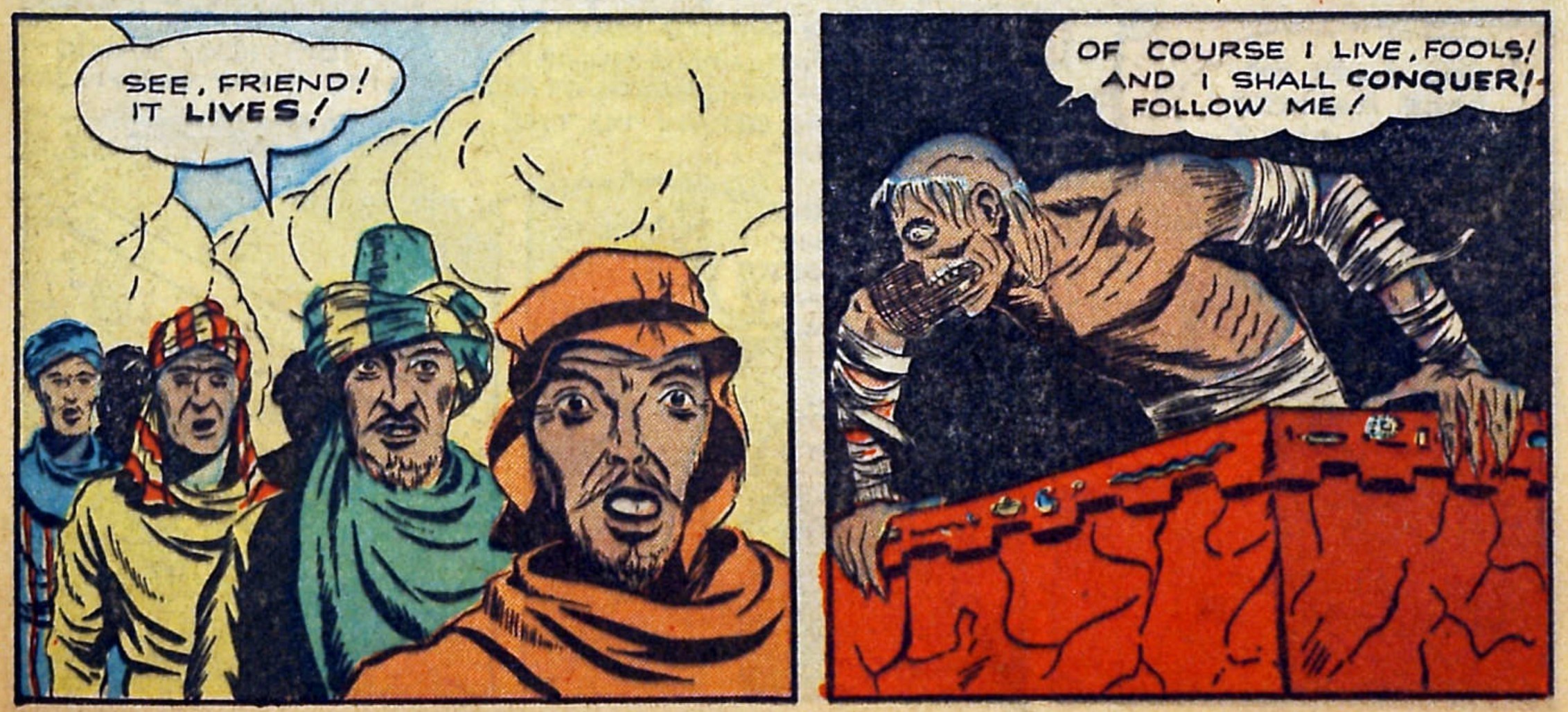
    We open in Egypt, where a group of partisans led by a fellow with the unlikely name of “Girbo, the Mad Mullah”* are brainstorming ways in which they might expel both the Germans and the British from their country, and Girbo has an innovative solution: he has procured the mummy of the Pharaoh Rameses, along with a vial of mummy-resurrection juice, and is going to bring the ancient king back to life to lead them. And it works!

    The problem that I am faced with here is that Egyptian history features a full eleven different rulers named Ramesses and just which one this was is not specified here. I was all fired up and ready to dig through the history of each one (on Wikipedia, at least), when I realized that there was a clear and obvious front-runner in the person of Ramesses II, ol’ Ozymandias himself, if only because he loomed largest in the public consciousness of the time as the presumed Pharaoh of the story of Exodus. 

    *while I’m not going to claim that the depiction of Egyptian Muslims in this story is good or even particularly sympathetic, you must believe me when I say that (aside from Girbo) these guys get about as sympathetic a depiction as you get in comics the 1940s, or indeed into the 80s. It’s a low bar but they cleared it.

    Rameses begins his campaign on a high note, with a raid on a British fort that establishes both his ruthlessness and complete invulnerability to bullets. One must pity his poor horse, however.

    Things take a turn when a Nazi officer shows up with the intention of allying with this new faction against the common British for, only to be slain at Rameses’ command. This violation of the flag of truce raises some concern amongst his followers but what really gets the talking is his assertion that he should be enough of a god for them and that they should abandon their faith to serve him.

    Having driven away his followers with his evil ways, Rameses drives home his point with magical snakes. 

    The loss of his followers means nothing to the undead Pharaoh, who simply raises an army of the dead to assist him in his next assault on the British forces. Meanwhile, Girbo attempts to slay Ibis the Invincible to prevent his further interference in their plans but is himself killed when Ibis proves his better in swordplay.

    Rameses’ undead forces, though formidable, are vulnerable to sunlight, something that the Ibistick can easily provide even though the mechanics of how it might have done so are troubling. But what to do with an eight foot tall megalomaniacal mummy-man? Things look hopeless until Rameses himself lets slip the fact that the only thing capable of containing him is his own tomb that Ibis is able to defeat him, by simply moving said tomb over top of the villain.

    Though Rameses is left to stew in the darkness, he is in fact one of Ibis the Invincible’s few recurring villains. We will see his bony face and weird mummy tonsure again.

  • MINOR SUPER-VILLAIN 911: RAMESES

    (Whiz Comics 025, 1941)

    We open in Egypt, where a group of partisans led by a fellow with the unlikely name of “Girbo, the Mad Mullah”* are brainstorming ways in which they might expel both the Germans and the British from their country, and Girbo has an innovative solution: he has procured the mummy of the Pharaoh Rameses, along with a vial of mummy-resurrection juice, and is going to bring the ancient king back to life to lead them. And it works!

    The problem that I am faced with here is that Egyptian history features a full eleven different rulers named Ramesses and just which one this was is not specified here. I was all fired up and ready to dig through the history of each one (on Wikipedia, at least), when I realized that there was a clear and obvious front-runner in the person of Ramesses II, ol’ Ozymandias himself, if only because he loomed largest in the public consciousness of the time as the presumed Pharaoh of the story of Exodus. 

    *while I’m not going to claim that the depiction of Egyptian Muslims in this story is good or even particularly sympathetic, you must believe me when I say that (aside from Girbo) these guys get about as sympathetic a depiction as you get in comics the 1940s, or indeed into the 80s. It’s a low bar but they cleared it.

    Rameses begins his campaign on a high note, with a raid on a British fort that establishes both his ruthlessness and complete invulnerability to bullets. One must pity his poor horse, however.

    Things take a turn when a Nazi officer shows up with the intention of allying with this new faction against the common British for, only to be slain at Rameses’ command. This violation of the flag of truce raises some concern amongst his followers but what really gets the talking is his assertion that he should be enough of a god for them and that they should abandon their faith to serve him.

    Having driven away his followers with his evil ways, Rameses drives home his point with magical snakes. 

    The loss of his followers means nothing to the undead Pharaoh, who simply raises an army of the dead to assist him in his next assault on the British forces. Meanwhile, Girbo attempts to slay Ibis the Invincible to prevent his further interference in their plans but is himself killed when Ibis proves his better in swordplay.

    Rameses’ undead forces, though formidable, are vulnerable to sunlight, something that the Ibistick can easily provide even though the mechanics of how it might have done so are troubling. But what to do with an eight foot tall megalomaniacal mummy-man? Things look hopeless until Rameses himself lets slip the fact that the only thing capable of containing him is his own tomb that Ibis is able to defeat him, by simply moving said tomb over top of the villain.

    Though Rameses is left to stew in the darkness, he is in fact one of Ibis the Invincible’s few recurring villains. We will see his bony face and weird mummy tonsure again.

  • MINOR SUPER-HERO ROUND-UP 061

    Superfolk galore! 

    the Buzzard: 

    In an unnamed New-York-alike city, the gadgeteering mayor equips a young man with a suite of devices to help him engage in a vigilante crusade against crime. Chief among these gadgets is a gas that makes whomever it touches resemble a balding, big-nosed man in thick glasses and a tailcoat – the perfect disguise! Armed with this gas, plus some clawed gloves and a heat ray, the Buzzard begins tearing his way through the city’s underworld. 

    The gas also seems to allow the Buzzard to make his shadow resemble his namesake bird, an ability that is very useful for vexing the city’s Buzzard-hating police chief who, it turns out, is also the father of the Buzzard’s secret identity. 

    I unironically love the Buzzard and his whole weird setup, and while I find most modern revivals of public domain Golden Age characters to be a pretty mixed bag, I’m pretty bummed that none of them have elevated him out of his single issue obscurity – he’s got a real weirdo charm that the fiftieth version of the Nedor characters can’t approach. (Wham Comics 002, 1940) 

    the Cyclone: 

    The Cyclone is really Peter Grant, a young man who has a fairly unique version of the Batman origin, which of course is when a tragedy inspires an obsessive dedication to training and working toward some related goal, i.e., in Batman’s case the murder of his parents inspiring his eternal war against crime. The real twist in the Cyclone’s case seems to be the total absence of a motivation: Grant just woke up one day and decided to turn his body into a living weapon to aim at evil.

    The Cyclone is presented as being a regular human and so I had been assuming that the whirlwind patterns around his lower body when he jumps around were a stylistic choice meant to represent his fantastic leaping ability. They really are some enormous jumps, however, so it’s also possible that the Cyclone is meant to have some sort of wind-assisted jumping power. He only had three adventures, alas, so we shall never know. (Whirlwind Comics 001, 1940)

    Ibis the Invincible: 

    Ibis the Invincible, aka Prince Amentep, is a 12th Dynasty Egyptian who just kind of spontaneously comes back to life after 4000 years as a mummy. Why? Well, it’s not spelled out until the 1942 Ibis the Invincible series, but spoilers: his true love had been shot with an arrow that put her to sleep for those four millennia and he put himself in a magical sleep of his own in order to be with her again. 

    Ibis achieves this state of mystic sleep with the aid of the Ibistick, a magical wand capable of very nearly anything. Much like his fellow Golden Age magical super-heroes, Ibis’ near-omnipotence can occasionally seem plot-obliteratingly powerful. 

    The key difference between Ibis and his contemporaries, however, is that the Ibistick is a small object that is constantly being lost or stolen. Further, it requires absolutely no special knowledge to be used and can be operated by both children and animals with ease. More than a few of Ibis’ greatest foes (e.g., the Hobo-Millionaire) are simply regular humans armed with his own magic wand. The caveat to all this is the fact that the Ibistick will never harm its true owner, and will in fact inflict any baleful magic cast from it at him back on its wielder. This means that Ibis is able to defeat an evil wielder of the Ibistick by merely being annoying enough that they try to turn him into a toad or gold or ice or on on memorable occasion to mind control Taia into stabbing him to death and then wait for it to backfire on them. (Whiz Comics 002, 1940)

    UPDATE 1941 

    Taia: 

    Taia is the 4000-year-sleeping love for whom Ibis the Invincible made his way to the future. After a bit of moping around the globe he manages to track down her mummy and revive her, upon which they kind of implicitly are a married couple. While I very much enjoy Taia and the dynamic she has with Ibis, she does get a pretty raw deal – being your own husband’s de facto sidekick is bad enough, but Taia very rarely gets to be anything more than a kidnap victim/bargaining chip. The few modern versions of Ibis the Invincible try to do more with her, but they still don’t do much.

    Taia is said to be cousin to “Senwosri III” who is probably meant to be Pharaoh Senusret III, given that Taia and Ibis are said to be from the 12th Dynasty. So that’s something. (Whiz Comics 002, 1940)


  • MINOR SUPER-HERO ROUND-UP 044

    A full hand of Better (Nedor/Standard/Pines) Comics characters for ye.

    Captain Future:

    When young Dr Andrew Bryant finds himself fired from his job as a… research physicist? electrical engineer?… at the Pacific Electrical Corporation he responds like any rational person would: by working day and night in in a desperate bid to finish his research in the time he has left, until his tired brain thinks its way into an industrial accident. Luckily for Bryant he lives in a super-hero universe, so when he crosses gamma and infra-red rays and blows up his laboratory he is not gruesomely killed but instead filled with super-energies.

    Dubbing himself Captain Future (because he represents the future state of humanity, natch) and donning a pretty minimal costume, Bryant sets out to mete out fist-based justice on the world using a suite of super powers including: mind reading, remote viewing, the ability to both hear and broadcast radio, flight, enhanced strength, energy blasts and a magnetic forcefield that repels bullets but is ineffective against cowardly blows to the head. Sometimes his powers run out or are used up and he has to scurry off and blast himself with radiation again, which makes him one of the earlier super-heroes to have that kind of narratively-interesting power limitation. Plus he is occasionally vulnerable to high levels of electricity or other energy disrupting his powers in a kryptonite kind of way – he’s just a “my powers don’t work on this specific material” away from the Limiting Your Super Powered Character trifecta! (Startling Comics 001, 1940)

    Mystico:

    When scientist Dr Slade needs to test his Vita-Ray device to see if it really can resurrect the dead like he thinks it can, does he start out on easy mode with a selection of freshly deceased lab mice like some sort of rule-following nerd? He does not! Instead, he gets ahold of a 2000-year-old mummy, perhaps the most dead guy available, and turns the power up as high as it can go. And it works! The mummy is restored to life! And also his flailing causes a power feedback that results in an explosion that kills everyone involved… maybe the lab mice would have been a good starting point after all.

    The one person to survive the lab explosion is the newly-resurrected mummy, who turns out to have a wide array of magical powers – lucky for the narrative that Slade grabbed the wizard mummy and not some minor aristocrat’s 3rd Dynasty failson or an unlucky desiccated tomb robber. Dubbing himself Mystico, the formerly-ancient Egyptian fast-tracks his assimilation to future society with some new clothes and a top-of-the-line car.

    In a fortuitous turn of events for the local authorities, Mystico also adopts a set of conventional American values and immediately sets his vast powers to the task of rooting out crime. I suppose that if you’re an ancient and powerful wizard suddenly thrust into a strange world your options boil down to overthrowing the status quo (super-villain), maintaining the status quo (super-hero) or keeping your head down and living a quiet life (boring comic book). (Startling Comics 001, 1940)

    Dr X:

    At first glance, Dr X slots neatly into the category of “scientist super-villains who headline their own comics serial” alongside such luminaries as Dr Doom and Landor, Maker of Monsters. After all, he’s a creepy looking rodent-man whose primary field of study is seeing just how many dangerous alien worlds he can send his niece Cynthia’s astral form to without really briefing her on what she’s getting into first, or indeed without a clear idea of exactly what happens to someone if their astral form is eaten by an alien dinosaur.

    But no, Dr X is a good guy! He tries his hardest to keep Cynthia and her boyfriend Bob Stone from getting eaten by those dinosaurs (after metaphorically delivering them to them on a platter, sure, but the thought is there), and even staves off an invasion of Earth by the Moon! Truly we must all learn not to judge a book by its sinister cover.

    That said, is it reasonable that Alan Moore made him a weird creepy murderer in the pages of Terra Incognito? Completely! (Startling Comics 001, 1940)

    the Masked Rider: 

    The Masked Rider is really Bronc Randall, cowboy and ex-rodeo performer, who returns home after two years to find small-town Western injustice running rampant and decides to do something about it by donning a small cloth mask and otherwise changing nothing about his fairly distinctive look. And it works! The Masked Rider then goes on to dispense justice for another dozen issues or so. 

    (is the Masked Raider another Western comic that fooled me into thinking it was set in the Old West until several issues in when someone rocked up in a truck? Indeed it is)

    This is actually Better Publications’ second Masked Rider, appearing one month after the one we have already encountered if I have my dates right. Plus, there was a bit of text fiction featuring a third Masked Rider in Best Comics the previous year. Did someone at the company have a thing for the name or is the Masked Rider just one of the most generic Western hero monikers? (Startling Comics 001, 1940)