The Curse of Skeleton Munroe

Category: Street & Smith

  • REAL PERSON ROUND-UP 028

    Mostly a case of the Usual Suspects today here in the Real Person Round-Up, I’m afraid.

    Adolf Hitler:

    The bulk of the comic this panel comes from is MIA as far as people without hundreds of dollars of Buy Golden Age Comics money are concerned, and this is the only real look we get of this slightly off-brand Hitler and Goering. I might not have bothered to include them here devoid of other context except for…

    … the splash page for the story, featuring our Hitler-alike in a beast-man form and commanding a horde of Hitlerian minions that are probably both allegorical but which are very representative of the “mad-dog” framing that he was being given in a lot of the comics of the time. Presumably air ace Bill Barnes really scuttles his plans. (Bill Barnes America’s Air Ace Comics 002, 1941)

    This husky Hitler look-alike is the head of a fascist force that almost manages to destroy the US military presence in Alaska but is himself destroyed by the Liberty Guards. (Man of War Comics 001, 1941)

    Here time/space traveller Whiz Wilson encounters a particularly low-rent Hitler-alike named Raggo. (Lightning Comics v1 006, 1941)

    Cordell Hull:

    When Bill Barnes needs two hundred jeeps to defend the Panama Canal, who does he call? Secretary of State Cordell Hull, that’s who! (Bill Barnes, America’s Air Ace Comics 005, 1941)

    Franklin Roosevelt:

    A more on-model  (and more face-forward) version of Roosevelt than we usually see in comics learns of the existence of the Liberty Scouts from their sponsor, retired patriotic millionaire Patrick Henry (who named himself such after immigrating to the US as a young man). (Liberty Scouts Comics 002, 1941)

    FDR returns in the second Liberty Scouts comic to tour the very on-the-nose Fort America (Liberty Scouts Comics 003, 1941)

    Hermann Goering:

    Orders the destruction of Bill Barnes. (Bill Barnes America’s Air Ace Comics 004, 1941)

    Hollywood Shuffle:

    It’s another classic case of mixing up first and last names of movie stars to make all-new ones, in this case Tyrone Taylor (Tyrone Power/ Robert Taylor, probably), and Myrna Rogers (Myrna Loy/ Ginger Rogers, almost certainly). (Detective Comics v1 046, 1940)

    Leopard Men:

    Since I recently realized that I had failed to be curious enough and that the Leopard Men were not just a fanciful idea that people kept coming up with but in fact a vilified version of real African secret societies, they now get a place in the Real Person Round-Up. These particular Leopard Men are just as bloodthirsty and savage as the rest of their fictional ilk, but are distinguished by being some of the few to not wear some sort of leopard-head cowl. Possibly because the Red Panther already has that bit of fashion sewn up. (Jungle Comics 020, 1941)

  • REAL PERSON ROUND-UP 028

    Mostly a case of the Usual Suspects today here in the Real Person Round-Up, I’m afraid.

    Adolf Hitler:

    The bulk of the comic this panel comes from is MIA as far as people without hundreds of dollars of Buy Golden Age Comics money are concerned, and this is the only real look we get of this slightly off-brand Hitler and Goering. I might not have bothered to include them here devoid of other context except for…

    … the splash page for the story, featuring our Hitler-alike in a beast-man form and commanding a horde of Hitlerian minions that are probably both allegorical but which are very representative of the “mad-dog” framing that he was being given in a lot of the comics of the time. Presumably air ace Bill Barnes really scuttles his plans. (Bill Barnes America’s Air Ace Comics 002, 1941)

    This husky Hitler look-alike is the head of a fascist force that almost manages to destroy the US military presence in Alaska but is himself destroyed by the Liberty Guards. (Man of War Comics 001, 1941)

    Here time/space traveller Whiz Wilson encounters a particularly low-rent Hitler-alike named Raggo. (Lightning Comics v1 006, 1941)

    Cordell Hull:

    When Bill Barnes needs two hundred jeeps to defend the Panama Canal, who does he call? Secretary of State Cordell Hull, that’s who! (Bill Barnes, America’s Air Ace Comics 005, 1941)

    Franklin Roosevelt:

    A more on-model  (and more face-forward) version of Roosevelt than we usually see in comics learns of the existence of the Liberty Scouts from their sponsor, retired patriotic millionaire Patrick Henry (who named himself such after immigrating to the US as a young man). (Liberty Scouts Comics 002, 1941)

    FDR returns in the second Liberty Scouts comic to tour the very on-the-nose Fort America (Liberty Scouts Comics 003, 1941)

    Hermann Goering:

    Orders the destruction of Bill Barnes. (Bill Barnes America’s Air Ace Comics 004, 1941)

    Hollywood Shuffle:

    It’s another classic case of mixing up first and last names of movie stars to make all-new ones, in this case Tyrone Taylor (Tyrone Power/ Robert Taylor, probably), and Myrna Rogers (Myrna Loy/ Ginger Rogers, almost certainly). (Detective Comics v1 046, 1940)

    Leopard Men:

    Since I recently realized that I had failed to be curious enough and that the Leopard Men were not just a fanciful idea that people kept coming up with but in fact a vilified version of real African secret societies, they now get a place in the Real Person Round-Up. These particular Leopard Men are just as bloodthirsty and savage as the rest of their fictional ilk, but are distinguished by being some of the few to not wear some sort of leopard-head cowl. Possibly because the Red Panther already has that bit of fashion sewn up. (Jungle Comics 020, 1941)

  • MINOR SUPER-VILLAIN 990: THE EMPEROR

    (Bill Barnes, America’s Air Ace Comics 003, 1941)

    The first chunk of the story that the Emperor appears in is not available anywhere that I can find, but what remains is enough to evaluate him and determine that yes, he is a super-villain. Specifically, he is a scientist who discovered “the secret of atomic power” and decided that the best way to use it was as part of an attempt to conquer the world. Plus he has all of his henchmen running around in little uniforms, a clear sign of super-villainy.

    The part of the Emperor’s plans that we get to see involves using cool-looking rocket bombers to blow big holes in various US cities and then sending out agents provocateur to stir up public support for surrender as an alternative to continued explosions.

    Unfortunately for the Emperor, Bill Barnes (America’s Air Ace) is on the case, and he’s such a mechanical genius that he is able to divine the secrets of atomic energy merely by creeping around the engine room of one of those cool rocket bombers for about half an hour. Barnes builds his own fleet of nuclear-powered aircraft, tracks the Emperor to a secret base in the Rockies and then wipes him off the map with atomic bombs. I suppose that the actual Emperor himself might have suvived, since we never actually see him alive or dead, but it’s pretty unlikely.

    BONUS: Bill Barnes is awarded “the highest honor of the nation” by FDR for stopping the Emperor, which is either the Medal of Honor or… some precursor to the Medal of Freedom that I can’t find (logically there had to be a highest civilian honour before 1942 but Wikipedia is being coy). It all depends on whether America’s Air Ace is a military or civilian role.

    Categorized in: Accessories (Mountain Base), Royalty (Emperors), Supercrime (Attempted Conquest of the US)

  • MINOR SUPER-VILLAIN 990: THE EMPEROR

    (Bill Barnes, America’s Air Ace Comics 003, 1941)

    The first chunk of the story that the Emperor appears in is not available anywhere that I can find, but what remains is enough to evaluate him and determine that yes, he is a super-villain. Specifically, he is a scientist who discovered “the secret of atomic power” and decided that the best way to use it was as part of an attempt to conquer the world. Plus he has all of his henchmen running around in little uniforms, a clear sign of super-villainy.

    The part of the Emperor’s plans that we get to see involves using cool-looking rocket bombers to blow big holes in various US cities and then sending out agents provocateur to stir up public support for surrender as an alternative to continued explosions.

    Unfortunately for the Emperor, Bill Barnes (America’s Air Ace) is on the case, and he’s such a mechanical genius that he is able to divine the secrets of atomic energy merely by creeping around the engine room of one of those cool rocket bombers for about half an hour. Barnes builds his own fleet of nuclear-powered aircraft, tracks the Emperor to a secret base in the Rockies and then wipes him off the map with atomic bombs. I suppose that the actual Emperor himself might have suvived, since we never actually see him alive or dead, but it’s pretty unlikely.

    BONUS: Bill Barnes is awarded “the highest honor of the nation” by FDR for stopping the Emperor, which is either the Medal of Honor or… some precursor to the Medal of Freedom that I can’t find (logically there had to be a highest civilian honour before 1942 but Wikipedia is being coy). It all depends on whether America’s Air Ace is a military or civilian role.

    Categorized in: Accessories (Mountain Base), Royalty (Emperors), Supercrime (Attempted Conquest of the US)

  • ALIENS AND SO FORTH ROUND-UP 051

    A disappointingly humanoid bunch of aliens today.

    Gigantians:

    The Gigantians of Gigantia are the kind of advanced society who like nothing more than to gas on about how primitive and backward Earth is to space travellers like Rocket Rooney and his pal, but are still content to have a hereditary monarchy. True to their name, they are super huge in their natural state but have the good graces to shrink themselves down whenever their Earth visitors show up. (Bill Barnes, America’s Air Ace Comics 003, 1941)

    Inhabitants of Starergo:

    Though the Gigantians are a benevolent and technically advanced super species who live in a perfect society, they are frequently beset by various enemies who want nothing more than to utterly destroy them and who give them the opportunity to demonstrate their benevolent and advanced weapons systems – one might almost believe that they enjoy the opportunity to blast some of the nonenlightened now and again. 

    These include the inhabitants of Starergo, who attack them on the same day every year and have done so for the past one thousand years, and even though the attack always ends in a Starergoan defeat, this does not deter them. We never actually see one of the inhabitants of Starergo, but the fact that their planet’s name is “ogre rats” backward possibly indicates something of their character. (Bill Barnes, America’s Air Ace Comics 003, 1941)

    Merzoatics:

    The Merzoatics are another in the seemingly endless list of species who want the Gigantians dead, and since their attack is entirely ground-based (they have tanks and artillery in addition to the swords and pikes pictured here) we must assume that they are also native to Gigantia. This does not, alas, help them avoid the rays to the Gigantians’ paralysis ray cannon. (Bill Barnes, America’s Air Ace Comics 004, 1941)

    Martians:

    These Martians are from the year 3090 CE or thereabout, which means that it is reasonably probable that they are descended from Earth colonists rather than being native to Mars. Whatever their origins, they have let a bald jerk named Pytho rise to power and convince them to enact aggression on the peoples of Mercury, a situation which continues until Pytho is undone by the efforts of the heroic Planet Payson. (Planet Comics 006, 1941)

  • ALIENS AND SO FORTH ROUND-UP 051

    A disappointingly humanoid bunch of aliens today.

    Gigantians:

    The Gigantians of Gigantia are the kind of advanced society who like nothing more than to gas on about how primitive and backward Earth is to space travellers like Rocket Rooney and his pal, but are still content to have a hereditary monarchy. True to their name, they are super huge in their natural state but have the good graces to shrink themselves down whenever their Earth visitors show up. (Bill Barnes, America’s Air Ace Comics 003, 1941)

    Inhabitants of Starergo:

    Though the Gigantians are a benevolent and technically advanced super species who live in a perfect society, they are frequently beset by various enemies who want nothing more than to utterly destroy them and who give them the opportunity to demonstrate their benevolent and advanced weapons systems – one might almost believe that they enjoy the opportunity to blast some of the nonenlightened now and again. 

    These include the inhabitants of Starergo, who attack them on the same day every year and have done so for the past one thousand years, and even though the attack always ends in a Starergoan defeat, this does not deter them. We never actually see one of the inhabitants of Starergo, but the fact that their planet’s name is “ogre rats” backward possibly indicates something of their character. (Bill Barnes, America’s Air Ace Comics 003, 1941)

    Merzoatics:

    The Merzoatics are another in the seemingly endless list of species who want the Gigantians dead, and since their attack is entirely ground-based (they have tanks and artillery in addition to the swords and pikes pictured here) we must assume that they are also native to Gigantia. This does not, alas, help them avoid the rays to the Gigantians’ paralysis ray cannon. (Bill Barnes, America’s Air Ace Comics 004, 1941)

    Martians:

    These Martians are from the year 3090 CE or thereabout, which means that it is reasonably probable that they are descended from Earth colonists rather than being native to Mars. Whatever their origins, they have let a bald jerk named Pytho rise to power and convince them to enact aggression on the peoples of Mercury, a situation which continues until Pytho is undone by the efforts of the heroic Planet Payson. (Planet Comics 006, 1941)

  • NOTES – JULY 2026

    Honours:

    Pilot Bill Barnes is almost certainly awarded the Victoria Cross for blowing up a Nazi gas stockpile. He also gets a pie. (Bill Barnes, America’s Air Ace Comics 004, 1941)

    The Liberty Scouts are given nonspecific (but secret) medals for saving NYC from being destroyed. Strut also gets a pie. (Liberty Scouts Comics 002, 1941)

  • REAL PERSON ROUND-UP 025

    If comics are reflections of the real world then why should we be surprised to find them so full of real people?

    Adolf Hitler:

    Hiller is the “mad dictator” who inspires Hercules to reincarnate and eventually become Marvel Boy. He’s about as close as you get to putting a Hitler in your comic as you can get without actually saying the name. The whole name. The “t” part. (Daring Mystery Comics 006, 1940)

    This otherwise-unnamed Fuehrer of a likewise nameless underground nation that vexes the America inhabited by Captain Daring in 3051 CE is a clear inspired-by-Hitler type. (Daring Mystery Comics 007, 1941)

    Citizen V takes a break from his propaganda campaign in Occupied Europe to sneak into Germany and become a member of the Punched Hitler in the Nose Club. (Daring Mystery Comics 008, 1942)

    This version of Hitler appears in a long dream sequence in the comedic Army Life strip “Private Rook” that appears to exist solely to make a joke about him being gay (the bit where he is the Princess Tanya’s Fairy Godmother, specifically). This isn’t great, but it is remarkable for being the only time I personally have seen such a thing in a Golden Age comic. (Army and Navy Comics 003, 1941)

    Though Cap punches Hitler on the cover of his very first issue, it is in fact Bucky who lands the first blow on him (and Goering) in the pages of a comic. (Captain America Comics 002, 1941)

    the Borgias:

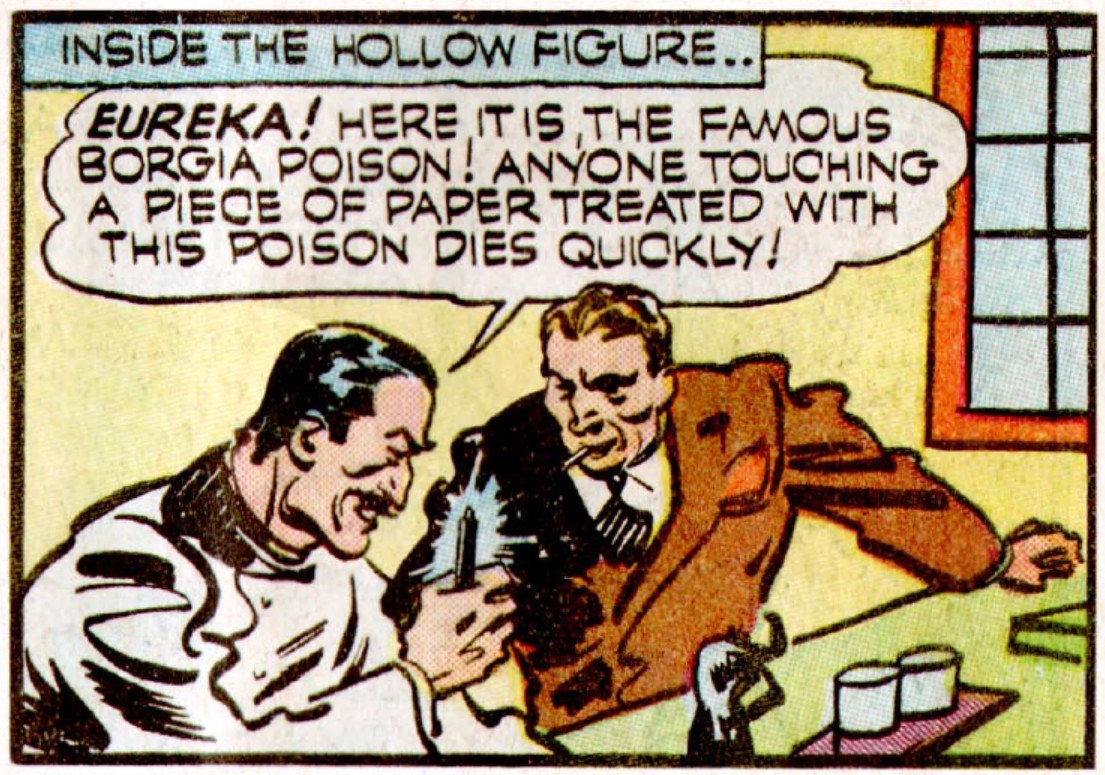
    Cesare, Lucrezia and the rest of the Borgia family might not actually appear in comics all that often, but they certainly do figure into their plots via the absolute piles of poisoned and poison-adjacent artifacts that are attributed to them. Borgia trinkets crop up so frequently, in fact, that I am surprised that it’s taken us this long to encounter one, in the form of a hollow silver statuette that contains a deadly contact poison. (Fantastic Comics 018, 1941)

    Fort Knox:

    Stardust the Super Wizard’s final foe, the unfortunately-named “Slant-Eye,” was a classic comic book Fort Knox robber. (Fantastic Comics 016, 1941)

    Francis Biddle:

    Major Victory has to consult with the US Attorney General in 1941, and in 1941 the US Attorney General was Francis Biddle. The man in the panel above is not Francis Biddle. (Dynamic Comics 002, 1941)

    Franklin D Roosevelt:

    Seen ordering the creation of a super-soldier, i.e. Captain America, to combat domestic espionage. (Captain America Comics 001, 1941)

    Fritz Kuhn:

    Fritz Knoll, purveyor of domestic espionage, is probably a reference to the chief Bundist. (Fantastic Comics 021, 1941)

    Henry L Stimson:

    The US didn’t even have a Secretary of Defense until after WWII, so I am not sure who this guy hanging out with Samson is supposed to be. The analogous position at the time this comic came out was Secretary of War, and that was Henry L Stimson, and this is not him. A true mystery man in all senses. (Fantastic Comics 023, 1941)

    J Edgar Hoover:

    J Arthur Grover, head of the FBI and clear J Edgar Hover stand-in, is also the man in charge of the program that would eventually be known as Project: Rebirth, aka the super-soldier program that produces Captain America later in this same issue. (Captain America Comics 001, 1941)

    Tutankhamen:

    Some of King Tut’s grave goods are among the items stolen by the Butterfly. (Captain America Comics 003 1941)

  • REAL PERSON ROUND-UP 025

    REAL PERSON ROUND-UP 025

    If comics are reflections of the real world then why should we be surprised to find them so full of real people?

    Adolf Hitler:

    Hiller is the “mad dictator” who inspires Hercules to reincarnate and eventually become Marvel Boy. He’s about as close as you get to putting a Hitler in your comic as you can get without actually saying the name. The whole name. The “t” part. (Daring Mystery Comics 006, 1940)

    This otherwise-unnamed Fuehrer of a likewise nameless underground nation that vexes the America inhabited by Captain Daring in 3051 CE is a clear inspired-by-Hitler type. (Daring Mystery Comics 007, 1941)

    Citizen V takes a break from his propaganda campaign in Occupied Europe to sneak into Germany and become a member of the Punched Hitler in the Nose Club. (Daring Mystery Comics 008, 1942)

    This version of Hitler appears in a long dream sequence in the comedic Army Life strip “Private Rook” that appears to exist solely to make a joke about him being gay (the bit where he is the Princess Tanya’s Fairy Godmother, specifically). This isn’t great, but it is remarkable for being the only time I personally have seen such a thing in a Golden Age comic. (Army and Navy Comics 003, 1941)

    Though Cap punches Hitler on the cover of his very first issue, it is in fact Bucky who lands the first blow on him (and Goering) in the pages of a comic. (Captain America Comics 002, 1941)

    the Borgias:

    Cesare, Lucrezia and the rest of the Borgia family might not actually appear in comics all that often, but they certainly do figure into their plots via the absolute piles of poisoned and poison-adjacent artifacts that are attributed to them. Borgia trinkets crop up so frequently, in fact, that I am surprised that it’s taken us this long to encounter one, in the form of a hollow silver statuette that contains a deadly contact poison. (Fantastic Comics 018, 1941)

    Fort Knox:

    Stardust the Super Wizard’s final foe, the unfortunately-named “Slant-Eye,” was a classic comic book Fort Knox robber. (Fantastic Comics 016, 1941)

    Francis Biddle:

    Major Victory has to consult with the US Attorney General in 1941, and in 1941 the US Attorney General was Francis Biddle. The man in the panel above is not Francis Biddle. (Dynamic Comics 002, 1941)

    Franklin D Roosevelt:

    Seen ordering the creation of a super-soldier, i.e. Captain America, to combat domestic espionage. (Captain America Comics 001, 1941)

    Fritz Kuhn:

    Fritz Knoll, purveyor of domestic espionage, is probably a reference to the chief Bundist. (Fantastic Comics 021, 1941)

    Henry L Stimson:

    The US didn’t even have a Secretary of Defense until after WWII, so I am not sure who this guy hanging out with Samson is supposed to be. The analogous position at the time this comic came out was Secretary of War, and that was Henry L Stimson, and this is not him. A true mystery man in all senses. (Fantastic Comics 023, 1941)

    J Edgar Hoover:

    J Arthur Grover, head of the FBI and clear J Edgar Hover stand-in, is also the man in charge of the program that would eventually be known as Project: Rebirth, aka the super-soldier program that produces Captain America later in this same issue. (Captain America Comics 001, 1941)

    Tutankhamen:

    Some of King Tut’s grave goods are among the items stolen by the Butterfly. (Captain America Comics 003 1941)

  • MINOR SUPER-HERO ROUND-UP 094

    Super-heroes, coincidentally arranged in ascending order of notability!

    Kalkor:

    A faithful priest of Isis c.1000 BC, Kalkor is restored to life at the same time as Nagana, the Queen of Evil, as a foil to her power. He is empowered with the same immortality and comic book magic as Nagana so that he may combat her effectively (and perhaps as a way for Isis to make up for crushing him to death as a byproduct of collapsing a temple on Nagana to put an end to her evil ways).  

    Important note: though many Golden and Silver Age super-heroes may act like they have taken a vow of celibacy, Kalkor is one of the few who may have actually done so, as part of his Christianity-influenced version of Isis-worship. (Fantastic Comics 022, 1941)

    Kalkor is not really a super-hero in the traditional sense – he doesn’t roam around looking for guys mugging old ladies or Fifth Columnists sabotaging munitions factories. Instead, he follows Nagana around and foils whatever scheme she pursues in her ongoing effort to conquer the world. And like many characters who operate purely in reference to the actions of others, Kalkor is kind of dull.

    In order to get around our era more easily, Kalkor adopts the funny-about-twenty-years-ago-our time alias of John Kerry. He also seems to shop at the same Big Coat Store as fellow Fox super-hero Samson.

    Categorized in: Day Job (Priest), Origin (Divine Empowerment, Mystic Mutate, Resurrected Mystic Champion)

    the Gladiator:

    The Gladiator is Dan Kenneth, a “famous art connoisseur.” This baffled me hardcore until I realized that there was a pretty good chance that he was in fact an art conservationist or something like that, and sure enough a critical aspect of the villain’s scheme in his first outing is having Kenneth “recondition” a painting he has just bought, and in his second and final appearance they just go ahead and call him an art dealer.

    Kenneth gets mixed up in an overly-complicated plot by the aforementioned client to steal his own painting and still get cash – not insurance fraud but a second, stupider thing, see the upcoming entry on the Monster for further details – that is in fact so ridiculous that he can’t even convince the police to help him out. What else can he do but engage in a bit of vigilante justice in such a situation. He puts on a Roman gladiator outfit that he happens to have laying around, grabs his favourite cestus and bowling pin and sets out to meet his destiny. And then, as so frequently happens, the one-time foray into vigilante justice becomes a full-fledged hobby. (Fantastic Comics 023, 1941)

    Categorized in: Activities (Gladiators), Day Job (Art Dealer), Powers (Weapons Master)

    the Avenger:

    The Avenger is maybe the third most popular Street & Smith pulp character, and as such was adapted to comics in the early 40s and again every time the old gang gets together for another shot at the comics page in DC Front Line or wherever. Alas, just like his pulp career, none of the Avenger’s forays into comic books last very long, especially as compared to those of Doc Savage or the Shadow.

    Maybe I’m wrong, but the problem with comic book adaptations of the Avenger always seems to be that they take a premise like “solder of fortune loses family to criminals and thus sets out to balance the scales, armed with face that can be moulded like putty, a gun called Mike, a knife called Ike and a diverse cast of assistants called Justice Inc” and boil it down to “unsmiling widower tackles depressing crime.” (Shadow Comics v1 002, 1940)

    Categorized in: Accessories (Sidekicks), Origin (Mental Mutate, Motivated by Loss), Power (Moldable Face)

    Betty Ross:

    Betty Ross, aka Agent X-13, is a government agent who first appears as the seemingly-elderly-but-really beautiful guardian of the curio shop that conceals the super-soldier facility where Steve Rogers becomes Captain America (okay, it’s not 100% clear that this is Betty Ross in the original comics, but retcons have firmly established that it is). She goes on to take part in many of Captain America and Bucky’s Golden Age adventures – more, in fact, than the original Cap/Bucky duo (retcons again, being deployed to explain how they kept having adventures after they were supposedly frozen and dead, respectively. Or frozen and frozen, depending on the retcon). Late in the WWII era she even adopts a costumed identity of her own: Golden Girl.

    Betty plays a big enough role in these Golden Age comics that I was tempted to give her a full-fledged Super-Hero page such as characters like Lois Lane or Alfred will probably get but alas, she has been almost entirely replaced by Peggy Carter in comics published in the Silver Age and beyond. Is this because she shares a name with the Hulk’s love interest (who she was made the great aunt of in yet another retcon)? Possibly! (Captain America Comics 001, 1940)

    Categorized in: Accessories (Rubberoid Mask), Day Job (FBI Agent), Team Membership (FBI)