The Curse of Skeleton Munroe

Category: kidnapper

  • MINOR SUPER-VILLAIN 991: ZIRA

    (Jungle Comics 013, 1941)

    While searching for her champion Sir Champion (annoying thing to have to write and the main reason I’m happy that he eventually fades into obscurity), who has failed to return from a hunt, Camilla, Queen of the Lost Empire is confronted by the ghostly vision of a blonde lady who rules an ancient lost castle. This is just a kind of person you get in the undefined part of Africa that houses the Lost Empire.

    The lady’s name, by the way, is Zira, Princess of the Palace of the Black Heart. She also refers to herself as a “wizardess,” and while I am generally of the opinion that gendered job titles like that are retrograde and unhelpful I must admit to being charmed. Wizardess!

    This vision leads Camilla back to the aforementioned Palace of the Black Heart, where her mortal form is revealed to be a middle-aged lady, or “old hag” as our hero so tactfully puts it. Zira states that Sir Champion is locked up in her dungeon and she will return him in exchange for all of Camilla’s magic powers. The sum total of these powers, from my notes, being the ability to talk to gorillas and the power to call upon Thor and Baal to freeze someone. Frankly not a bad trade for someone’s life. Do we include her eternal life? She got that from a potion, after all.

    Camilla evidently wishes to continue to speak to apes and so she and her men battle with Zira’s forces until they are ironically defeated by some apes.

    It then turns out that Camilla has more tricks up her sleeve than I had in my notes. She offers to brew up a potion to make Zira good looking in exchange for freedom for her and her men, and since this is the same comic that made a point of calling Zira a wizardess, she is of course very vain by default and takes the deal immediately.

    The thing about taking advantage of a woman’s default vanity in such a comic is of course the fact that the vain woman will also be extremely fickle, as seen when the newly-hot Zira reneges on her deal in favour of keeping Sir Champion for her own horny purposes. Things quickly turn violent and Sir Champion is forced to slay Zira to save Camilla’s life. All in all it’s a real eleventh-hour fumble on Zira’s part.

    Categorized in: Accessories (Castles), Genrica (Ends in -a), Powers (Various Magics)

  • MINOR SUPER-VILLAIN 980: THE WERE-WOLF

    (Four Favorites 001, 1941)

    Lash Lightning is one of those characters who is so very powerful that he outclasses all regular human opposition, barring some extraordinary circumstance. That’s why a movie-style, immune-to-all-harm werewolf is a perfect foil for him!

    The story of the Were-Wolf begins c.1921 (or possibly 1911 – accounts vary!), when Sumter Military Academy student Adolph Krimetz, sick of being bullied and nicknamed “Wolf” because of his unusual appearance, attacks a fellow student and accidentally kills him. Fearing official reprisals, Krimetz flees into the wilderness, where he remains for the next twenty (or thirty!) years. 

    Eventually, Krimetz decides to get revenge on the men who bullied him at school, as he blames them for his exile from society. He is emboldened in his quest by the fact that at some point in the intervening years he discovered that his childhood nickname was ironically close to the truth, because he is in fact an actual werewolf!

    Krimetz’s particular style of lycanthropy is worth noting here: he transforms into something approaching a fully canine form, but only in his upper body, meaning that he technically remains humanoid. It’s a wild look, particularly when paired with his homemade fur kilt and footwraps. As the Were-Wolf, Krimetz is super strong, able to travel long distances in a series of super-jumps and is completely immune to all harm – presumably excepting harm caused by silver, but this is never really brought up.

    Starting with his old classmates Generals Andrews and Johnson (and Johnson’s daughter Joan, filling the role of damsel in distress), Krimetz proceeds to kidnap at least sixteen people. Like fellow revenge-seeker the Master, he seems to be compelled to assemble all of his potential victims before killing any of them, and like the Master this ultimately backfires on him. Krimetz, at least, has a motive beyond revenge for doing so, as he plans on torturing military secrets out of his enemies so that he can sell them to the highest bidder.

    Before doing any of that, however, Krimetz sets out to destroy Sumter Military Academy, the scene of his childhood humiliations. Since he has captured Lash Lightning and is thus leaving him alone with all of his prisoners, this is effectively a recipe for their escape. Having freed everyone, Lash rushes off to prevent the bombing.

    While Lash might be incapable of harming the Were-Wolf, it turns out that a big old lightning bolt can compel him to turn back into a human, and a human is very vulnerable to, for instance, being punched headlong onto a barrel of TNT and exploding.

    REVENGE KILLER SCORE: either 0/16 or 0/216+ if we’re including all of the military school kids he also failed to murder.

    BUT WAIT:

    Even though the Were-Wolf is clearly exploded at the end of his first appearance, he does not in fact die. He returns in Four Favorites 002, still obsessed with revenge but directed against the US military in general, rather than the specific people and institutions who harmed him in his youth. To that end, he derails a troop train that is travelling across the Midwest, and goes on to attempt similar acts against an army convoy and some troop-transporting aircraft

    A lot of the dramatic focus of this issue is taken up by the plight of Old Mike Jasper, the railway switchman who Krimetz frames for the derailment and who is almost convicted for the crime a mere one day later despite the fact that a) the case against him is extremely circumstantial and b) much of it is based around a general skepticism of his claim that a werewolf did it, never mind that a werewolf just kidnapped more than a dozen high-level army officers and is currently out there sabotaging military transports. Old Mike has a terrible lawyer, is what I’m implying.

    Krimetz is jailed for the mass murdering, but he will return for a further two appearances in 1942! 

  • MINOR SUPER-VILLAIN 971: THE MONSTER

    (Fantastic Comics 023, 1941)

    The comic opens in media res, as a (the) Monster bursts into the hotel room of art critic Iona Hall and carries her off into the night. Cut to the Gorman Art Gallery the next day, where we see… Iona Hall!?

    As you might have guessed, this isn’t the real Iona Hall, and “famous art connoisseur” Dan Kenneth spots this when he is introduced to the false Hall by gallery owner Gorman. When Kenneth attempts to discover the reason for this imposture, however, he and the repentant fake are attacked by gun-toting goons and have to engage in a thrilling chase, and then, when he is able to ask the question a second time, the Monster shows up and carries away the double in the same manner as the original.

    It’s such a weird situation that Kenneth can’t even convince the police to look into it lest he be thrown in the drunk tank for challenging their view of reality. He simply has to adopt a new identity as the vigilante Gladiator in order to knock the beast out and discover just what the heck is going on.

    So what the heck is going on? It’s perfectly simple: art collector Craven has a painting by the great artist Velasquez and wants to have both it and some more money. To that end here is his plan:

    1. Bring in art critic Iona Hall
    2. Kidnap Hall as the Monster
    3. Replace Hall with lookalike June Starr
    4. Have his crony Gorman sell the painting at auction
    5. Buy his own painting for less than it’s worth
    6. Ask Dan Kenneth to give the painting the once-over for him
    7. As the Monster again, steal the painting from Kenneth
    8. Hold Kenneth responsible for the loss of the painting
    9. Collect the money from Kenneth and enjoy it while the painting hangs in his home.

    Some flaws in this plan include:

    1. Iona Hall seems to be completely superfluous to the plan, unless she is there to authenticate the painting
    2. Even if this is the case, kidnapping and replacing Hall is only necessary if the painting is fake, which it isn’t
    3. June Starr is an unwilling accomplice who acts against the plan at least three times – an unkidnapped Iona Hall is far preferable
    4. The auction is completely unnecessary if Craven openly owns the painting – just ask Kenneth to clean it for you
    5. Plus you’ve driven down the price by buying it cheap. Perhaps they sold it for the amount that they thought that they could get out of Kenneth, in which case they chose the wrong scam and they should have been doing:
    6. Insurance fraud. The scam they should have been pulling was insurance fraud

    All in all I must assume that Craven was just too excited about his cool monster suit and came up with a plan that allowed him to use it a couple of times, because that is the only lens through which this scheme makes a lick of sense.

    Categorized in: Accessories (Personal Transport – Robotic Exoskeletons), Animals (Monsters), Narrative Footballs (Misc Origin Story Guys) 

  • MINOR SUPER-VILLAIN 971: THE MONSTER

    (Fantastic Comics 023, 1941)

    The comic opens in media res, as a (the) Monster bursts into the hotel room of art critic Iona Hall and carries her off into the night. Cut to the Gorman Art Gallery the next day, where we see… Iona Hall!?

    As you might have guessed, this isn’t the real Iona Hall, and “famous art connoisseur” Dan Kenneth spots this when he is introduced to the false Hall by gallery owner Gorman. When Kenneth attempts to discover the reason for this imposture, however, he and the repentant fake are attacked by gun-toting goons and have to engage in a thrilling chase, and then, when he is able to ask the question a second time, the Monster shows up and carries away the double in the same manner as the original.

    It’s such a weird situation that Kenneth can’t even convince the police to look into it lest he be thrown in the drunk tank for challenging their view of reality. He simply has to adopt a new identity as the vigilante Gladiator in order to knock the beast out and discover just what the heck is going on.

    So what the heck is going on? It’s perfectly simple: art collector Craven has a painting by the great artist Velasquez and wants to have both it and some more money. To that end here is his plan:

    1. Bring in art critic Iona Hall
    2. Kidnap Hall as the Monster
    3. Replace Hall with lookalike June Starr
    4. Have his crony Gorman sell the painting at auction
    5. Buy his own painting for less than it’s worth
    6. Ask Dan Kenneth to give the painting the once-over for him
    7. As the Monster again, steal the painting from Kenneth
    8. Hold Kenneth responsible for the loss of the painting
    9. Collect the money from Kenneth and enjoy it while the painting hangs in his home.

    Some flaws in this plan include:

    1. Iona Hall seems to be completely superfluous to the plan, unless she is there to authenticate the painting
    2. Even if this is the case, kidnapping and replacing Hall is only necessary if the painting is fake, which it isn’t
    3. June Starr is an unwilling accomplice who acts against the plan at least three times – an unkidnapped Iona Hall is far preferable
    4. The auction is completely unnecessary if Craven openly owns the painting – just ask Kenneth to clean it for you
    5. Plus you’ve driven down the price by buying it cheap. Perhaps they sold it for the amount that they thought that they could get out of Kenneth, in which case they chose the wrong scam and they should have been doing:
    6. Insurance fraud. The scam they should have been pulling was insurance fraud

    All in all I must assume that Craven was just too excited about his cool monster suit and came up with a plan that allowed him to use it a couple of times, because that is the only lens through which this scheme makes a lick of sense.

    Categorized in: Accessories (Personal Transport – Robotic Exoskeletons), Animals (Monsters), Narrative Footballs (Misc Origin Story Guys) 

  • PROBLEMATIC ROUND-UP 008

    Once again I must regretfully inform you that some comic books are problematic. Like, racially.

    the Laughing Hyenas: 

    Hey, it’s our first racial hate group, and I think I’m just going to preemptively file these under “problematic” because they’re a) not fun to talk about and b) necessitate talking about hate-crimes even if I, for example, choose not to use the panels with lynchings in them.

    The Laughing Hyenas are actually kind of a hate group by proxy, as they have been hired to keep the Black residents of the geographically-nonspecific town of Souda “in line” by murdering one of them every once in a while, and have been doing so frequently enough and/or long enough that even the local folks willing to volunteer for such a task have gotten sick of it, so boss Bull Karson had to import some Chicago toughguys to do his dirty work for him.

    Oddly, given the sheer volume of murder that the Laughing Hyenas were perpetrating, the Silver Streak doesn’t actually bring them in to the authorities ore even extra-judiciously kill them. Instead, he just dumps them on a slow boat to Rangoon. (Silver Streak Comics 013, 1941)

    the Modern Thief of Bagdad:

    Ali Hassan, aka the Modern Thief of Bagdad, is an Iraqi thief who comes to NYC to steal the Konoor Diamond, and as a result comes into conflict with Captain Battle and his young protege Hale Battle. A simple story that would ordinarily wrap up quite quickly, but this is a book-length yarn, which means that there is an extended chase sequence that occupies the 28 pages between the theft and Hassan’s arrival back in Baghdad. Some highlights:

    Chapter 1, “The Modern Thief of Bagdad!”: Hassan steals the gem, then give Battle and Hale the slip in Chinatown. Olyra, the mysterious guardian of the Konoor Diamond, is kidnapped.

    Chapter 2, “Perils of the Sargasso Sea!”: Hassan’s submarine becomes mired in sargassum and is attacked by a sea monster. Battle and Hale kill the beast. Hassan and his men dress up like ghost pirates. Olyra is rescued and then kidnapped again.

    Chapter 3, “Lost in the Underground World!”: Hassan’s plane crashes in Africa and he and Olyra are captured by cannibals (lil’ bonus racism for you there). Battle and Hale rescue them before being betrayed and dumped in a pit of quicksand. There is a brief interlude in an cave system full of monsters before it suddenly blows up. Hassan and his men dress up like ghosts. Olyra is rescued.

    Chapter 4, “House of Giants”: Battle & co track Hassan to a castle in Tibet, where they are captured and subjected to a shrink ray. They have various adventures as tiny men before resuming their original size. Olyra is kidnapped.

    I would call Hassan himself… an average amount of racist. He’s depicted in much the same generically foreign vein as I’ve seen in a South American president or a Basque fisherman (or indeed a Cape Breton fisherman at least once). As a villain, he’s pretty great: bombastic, treacherous, fond of leaving boastful notes for his enemies. If it was just him I might have skipped making this a Problematic Round-Up entry.

    It’s not just him, however, and once the story hits Chapter 5, “Magic Spell of the Arabian Nights” we get a real dose of Orientalism full in the face, as our heroes touch down in a Baghdad straight out of the Arabian Nights, complete with a wicked ruler (confusingly named Emperor Pasha Golu) who Hassan has been working for the whole time.

    It’s such a pastiche of a city, in fact, that Hale and Olyra just kind of stumble across Aladdin’s lamp and flying carpet while they are escaping from a dungeon. I suppose that all this is at least a little thematically appropriate, as Ali Hassan, the Modern Thief of Bagdad, is a reference to a movie that is a remake of a different movie that is itself a pastiche of the Arabian Nights.

    The Modern Thief of Bagdad meets his end in a pretty underwhelming manner: Captain Battle ducks as he swings a sword at him and he falls off of a balcony. A pretty terrible way to go for a villain who clearly thought that he was very cool, to be honest. The evil Pash Golu also meets his end in the process, leaving Olyra free to reveal that she is actually Olyria, Princess and true ruler of Bagdad. A truly impenetrable alias! 

    Finally, such is Hale Battle’s hunger for souvenirs that he uses his third genie with to acquire a replica of the diamond for his collection, even though for my money the real deal Lamp of Aladdin with one wish left on it would be the ultimate keepsake. (Captain Battle Comics 002, 1941)

    the King:

    The King is a fellow who gains control over a Romani group by showing them a… birthmark? tattoo? that proves his right to rule and that looks so intensely falsifiable that I am shocked there isn’t some sort two-factor authentication, or even a code phrase. And just what is is reason for exerting this control? Why, so that he can turn his new subjects into a child kidnapping ring. You can see how I would consider this problematic.

    The King is of course not the real ruler, that is not a real skull birthmark and he is no match for Dynamic Man. He turns out to be a crooked newspaper publisher named Brower who loves money more than making good plans to acquire it. (Dynamic Comics 002, 1941)

    the Dragon:

    The Dragon is a very ordinary Yellow Peril villain who is after some top secret bomber plans on behalf of an unspecified Asian nation. There are exactly four interesting things about him: 1) he is the first villain faced by Samson and David in their brief New Look era before they disappear along with most of Fox Features’ other characters during their financial trouble. 2) he is a classic calling card leaver in the form of a claw mark on the chests of men he has killed

     3) he works alongside his sister Orchid, which isn’t the rarest arrangement but is always fun to note

     4) he has these stone lions outside of his HQ that grab intruders as they come through. It’s a fun trap but never actually explained: are they some sort of mechanism, or demonic magic like the caption box suggests?

    Much of the issue in questioned is concerned with Samson chasing the Dragon and Orchid around. Once he catches up to them it’s all over. (Fantastic Comics 022, 1941)

  • PROBLEMATIC ROUND-UP 008

    Once again I must regretfully inform you that some comic books are problematic. Like, racially.

    the Laughing Hyenas: 

    Hey, it’s our first racial hate group, and I think I’m just going to preemptively file these under “problematic” because they’re a) not fun to talk about and b) necessitate talking about hate-crimes even if I, for example, choose not to use the panels with lynchings in them.

    The Laughing Hyenas are actually kind of a hate group by proxy, as they have been hired to keep the Black residents of the geographically-nonspecific town of Souda “in line” by murdering one of them every once in a while, and have been doing so frequently enough and/or long enough that even the local folks willing to volunteer for such a task have gotten sick of it, so boss Bull Karson had to import some Chicago toughguys to do his dirty work for him.

    Oddly, given the sheer volume of murder that the Laughing Hyenas were perpetrating, the Silver Streak doesn’t actually bring them in to the authorities ore even extra-judiciously kill them. Instead, he just dumps them on a slow boat to Rangoon. (Silver Streak Comics 013, 1941)

    the Modern Thief of Bagdad:

    Ali Hassan, aka the Modern Thief of Bagdad, is an Iraqi thief who comes to NYC to steal the Konoor Diamond, and as a result comes into conflict with Captain Battle and his young protege Hale Battle. A simple story that would ordinarily wrap up quite quickly, but this is a book-length yarn, which means that there is an extended chase sequence that occupies the 28 pages between the theft and Hassan’s arrival back in Baghdad. Some highlights:

    Chapter 1, “The Modern Thief of Bagdad!”: Hassan steals the gem, then give Battle and Hale the slip in Chinatown. Olyra, the mysterious guardian of the Konoor Diamond, is kidnapped.

    Chapter 2, “Perils of the Sargasso Sea!”: Hassan’s submarine becomes mired in sargassum and is attacked by a sea monster. Battle and Hale kill the beast. Hassan and his men dress up like ghost pirates. Olyra is rescued and then kidnapped again.

    Chapter 3, “Lost in the Underground World!”: Hassan’s plane crashes in Africa and he and Olyra are captured by cannibals (lil’ bonus racism for you there). Battle and Hale rescue them before being betrayed and dumped in a pit of quicksand. There is a brief interlude in an cave system full of monsters before it suddenly blows up. Hassan and his men dress up like ghosts. Olyra is rescued.

    Chapter 4, “House of Giants”: Battle & co track Hassan to a castle in Tibet, where they are captured and subjected to a shrink ray. They have various adventures as tiny men before resuming their original size. Olyra is kidnapped.

    I would call Hassan himself… an average amount of racist. He’s depicted in much the same generically foreign vein as I’ve seen in a South American president or a Basque fisherman (or indeed a Cape Breton fisherman at least once). As a villain, he’s pretty great: bombastic, treacherous, fond of leaving boastful notes for his enemies. If it was just him I might have skipped making this a Problematic Round-Up entry.

    It’s not just him, however, and once the story hits Chapter 5, “Magic Spell of the Arabian Nights” we get a real dose of Orientalism full in the face, as our heroes touch down in a Baghdad straight out of the Arabian Nights, complete with a wicked ruler (confusingly named Emperor Pasha Golu) who Hassan has been working for the whole time.

    It’s such a pastiche of a city, in fact, that Hale and Olyra just kind of stumble across Aladdin’s lamp and flying carpet while they are escaping from a dungeon. I suppose that all this is at least a little thematically appropriate, as Ali Hassan, the Modern Thief of Bagdad, is a reference to a movie that is a remake of a different movie that is itself a pastiche of the Arabian Nights.

    The Modern Thief of Bagdad meets his end in a pretty underwhelming manner: Captain Battle ducks as he swings a sword at him and he falls off of a balcony. A pretty terrible way to go for a villain who clearly thought that he was very cool, to be honest. The evil Pash Golu also meets his end in the process, leaving Olyra free to reveal that she is actually Olyria, Princess and true ruler of Bagdad. A truly impenetrable alias! 

    Finally, such is Hale Battle’s hunger for souvenirs that he uses his third genie with to acquire a replica of the diamond for his collection, even though for my money the real deal Lamp of Aladdin with one wish left on it would be the ultimate keepsake. (Captain Battle Comics 002, 1941)

    the King:

    The King is a fellow who gains control over a Romani group by showing them a… birthmark? tattoo? that proves his right to rule and that looks so intensely falsifiable that I am shocked there isn’t some sort two-factor authentication, or even a code phrase. And just what is is reason for exerting this control? Why, so that he can turn his new subjects into a child kidnapping ring. You can see how I would consider this problematic.

    The King is of course not the real ruler, that is not a real skull birthmark and he is no match for Dynamic Man. He turns out to be a crooked newspaper publisher named Brower who loves money more than making good plans to acquire it. (Dynamic Comics 002, 1941)

    the Dragon:

    The Dragon is a very ordinary Yellow Peril villain who is after some top secret bomber plans on behalf of an unspecified Asian nation. There are exactly four interesting things about him: 1) he is the first villain faced by Samson and David in their brief New Look era before they disappear along with most of Fox Features’ other characters during their financial trouble. 2) he is a classic calling card leaver in the form of a claw mark on the chests of men he has killed

     3) he works alongside his sister Orchid, which isn’t the rarest arrangement but is always fun to note

     4) he has these stone lions outside of his HQ that grab intruders as they come through. It’s a fun trap but never actually explained: are they some sort of mechanism, or demonic magic like the caption box suggests?

    Much of the issue in questioned is concerned with Samson chasing the Dragon and Orchid around. Once he catches up to them it’s all over. (Fantastic Comics 022, 1941)

  • MINOR SUPER-VILLAIN 962: THE MASTER

    (Exciting Comics 015, 1941)

    The
    Master is a mysterious new crooks who has been going around town kidnapping wealthy men,
    and the Black Terror and Tim have been running around after him and
    trying to figure out just what the heck is going on. The Master is also a classic Bad Boss in the “ruthlessly kill your minions” mould.

    As it turns out, the Master has broadly the same origin story as early Batman villain the Ugliest Man in the World,
    only instead of a medical student who was injected with a random
    cocktail of drugs and turned ugly in a frat hazing gone wrong, he is
    instead a chemistry student who was exploded by a random mixture of chemicals in some frat bullying gone
    wrong. Like his counterpart, the Master (aka Alfred Foster, aka Phillip
    van Allen) dropped out of sight, acquired a rubberoid mask and
    established a new identity so that he could enact his revenge on those
    he blamed for his disfigurement.

    Unlike the Ugliest Man in
    the World, the Master’s theming is not strong. He himself is vaguely
    Egyptian themed, while his henchmen are just a bunch of Malaysian guys who he does not treat very well.

    The
    Master’s plan also revolves around gathering up his tormentors so that
    he can kill them all at once, meaning that his revenge goes almost entirely unfulfilled when he is accidentally
    killed by one of his own men. All in all a very poor foray into super-villainy.

    Revenge Killer Score: 0/12

    Categorized in: Accessories (Rubberoid Mask), Generica (Masters), Origin (Extensively Scarred Face)

  • MINOR SUPER-VILLAIN 539 UPDATE: THE CLAW (post-Daredevil, 1941)

    MINOR SUPER-VILLAIN 539 UPDATE: THE CLAW (post-Daredevil, 1941)

    In keeping with my decision to split the Claw updates for 1941 by heroic foe, here are the details of his three-issue dalliance with engineer Bill Hopkins.

    When last we saw the Claw… he was in the Pacific, roughing up Adolf Hitler. But before that, at the end of his long back-and-forth with the Daredevil, there was the small matter of his asking Lucifer for aid and getting it, with the caveat that if he still lost in his next encounter with Daredevil he would be “banished into Asia forever!” And since he did lose, that means that he can’t return to America, right?

    Evidently not, because in  Daredevil Comics 002, the Claw kidnaps a train filled with 2000 soldiers as it passes through Pennsylvania, then sends a note to the president (note the custom signature) to ask for the complete US gold supply in ransom.

    Meanwhile, the Claw is showing his prisoners home movies designed to bend them to his will. Note the Hitler impression: in 1941 this is shorthand for being a megalomaniac rather than a genocidal megalomaniac (though in all cases it marks you as being a bit of an uninspired hack). Whether he gets the gold or not, the Claw intends to use these men in yet another attempt to conquer the US.

    One of these soldiers, Dick Hopkins, has a brother named Bill Hopkins, who has the radical idea to retrace the path of the original train in a second one and see if anything happens, which it does. This really erodes my confidence in the authorities of this fictional reality, frankly. You’d think “take a couple of lads and check the tracks between here and where the train disappeared” would be the logical first step to take but Bill seems to be the first one to think of it. 

    Perhaps the Claw was able to return to America by sacrificing some of his power to Lucifer, because Bill Hopkins’ thrown rocks and pistol shots are much more effective than such things as artillery and machine guns have been in the past.

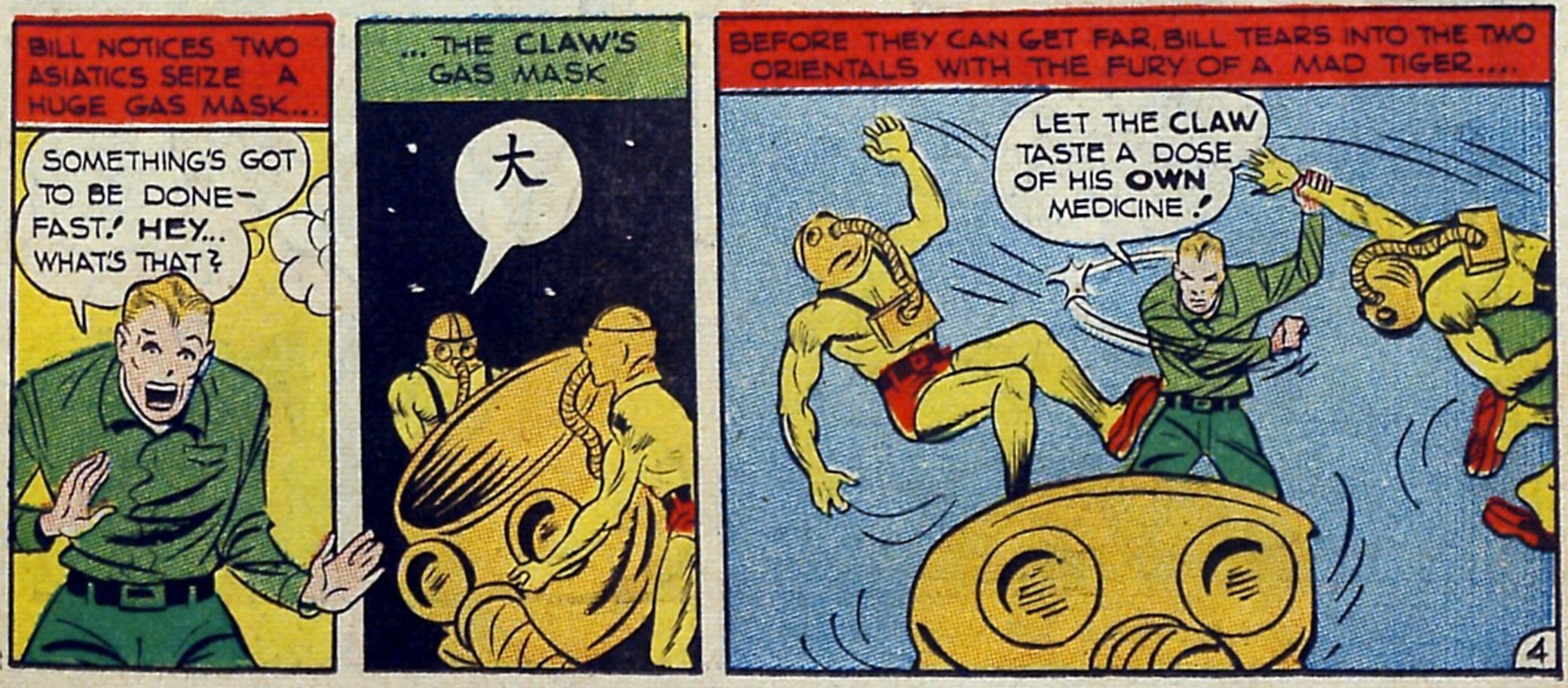
    The second part of Bill’s plan, after “find out where the Claw has stashed 2000 men” is “come find me if I disappear” and accordingly, in Daredevil Comics 003, the US Army locates the Claw’s base by following the extra set of train tracks that split off the main trunk and head directly into a cliff face. Once again, the Claw seems weaker than usual and the Army is pushing his forces back successfully enough that he orders his men to flood the base with poison gas. It is at this point that Bill has his best idea yet, as he steals the Claw’s enormous gas mask and chucks it down a convenient bottomless pit.

    The Claw is more affected by poison gas than the regular-sized humans in the room thanks to the fact that his big body needs more oxygen and thus are breathing in more gas, and while I love a well-rationalized weakness in a character it does call into question all future Claw foes for not immediately tear gassing him on sight.

    What I don’t love is that the Claw, already a distillation of Yellow Peril tropes, is one-upping himself by adopting what I just learned is called a wonton font in his speech bubbles. I think that it’s supposed to be adding emphasis when he is yelling but at this point he is almost always yelling.

     Daredevil Comics 004: The Claw brought into NYC in chains/in triumph. He almost instantly escapes.

    Seeking vengeance on Bill Hopkins, the Claw fords the Hudson River and in so doing becomes the first-ever super-villain to enter Hoboken.

    Bill doesn’t take this aggression lying down, and meets the Claw on a handy rooftop with a can of kerosene and a match, and this is a pretty good illustration of a though I have had while writing this: the Claw battling super-heroes is all well and good, but what I really enjoy is seeing him get it from regular folks. Bill Hopkins and his Home Alone energy might just be the best that the “Claw” feature ever gets, and it’s a real shame that this is the last we will be seeing of him.

    The Claw very reasonably exits via the river. So long forever, Bill. Next time: the Ghost!

  • MINOR SUPER-VILLAIN 539 UPDATE: THE CLAW (post-Daredevil, 1941)

    In keeping with my decision to split the Claw updates for 1941 by heroic foe, here are the details of his three-issue dalliance with engineer Bill Hopkins.

    When last we saw the Claw… he was in the Pacific, roughing up Adolf Hitler. But before that, at the end of his long back-and-forth with the Daredevil, there was the small matter of his asking Lucifer for aid and getting it, with the caveat that if he still lost in his next encounter with Daredevil he would be “banished into Asia forever!” And since he did lose, that means that he can’t return to America, right?

    Evidently not, because in  Daredevil Comics 002, the Claw kidnaps a train filled with 2000 soldiers as it passes through Pennsylvania, then sends a note to the president (note the custom signature) to ask for the complete US gold supply in ransom.

    Meanwhile, the Claw is showing his prisoners home movies designed to bend them to his will. Note the Hitler impression: in 1941 this is shorthand for being a megalomaniac rather than a genocidal megalomaniac (though in all cases it marks you as being a bit of an uninspired hack). Whether he gets the gold or not, the Claw intends to use these men in yet another attempt to conquer the US.

    One of these soldiers, Dick Hopkins, has a brother named Bill Hopkins, who has the radical idea to retrace the path of the original train in a second one and see if anything happens, which it does. This really erodes my confidence in the authorities of this fictional reality, frankly. You’d think “take a couple of lads and check the tracks between here and where the train disappeared” would be the logical first step to take but Bill seems to be the first one to think of it. 

    Perhaps the Claw was able to return to America by sacrificing some of his power to Lucifer, because Bill Hopkins’ thrown rocks and pistol shots are much more effective than such things as artillery and machine guns have been in the past.

    The second part of Bill’s plan, after “find out where the Claw has stashed 2000 men” is “come find me if I disappear” and accordingly, in Daredevil Comics 003, the US Army locates the Claw’s base by following the extra set of train tracks that split off the main trunk and head directly into a cliff face. Once again, the Claw seems weaker than usual and the Army is pushing his forces back successfully enough that he orders his men to flood the base with poison gas. It is at this point that Bill has his best idea yet, as he steals the Claw’s enormous gas mask and chucks it down a convenient bottomless pit.

    The Claw is more affected by poison gas than the regular-sized humans in the room thanks to the fact that his big body needs more oxygen and thus are breathing in more gas, and while I love a well-rationalized weakness in a character it does call into question all future Claw foes for not immediately tear gassing him on sight.

    What I don’t love is that the Claw, already a distillation of Yellow Peril tropes, is one-upping himself by adopting what I just learned is called a wonton font in his speech bubbles. I think that it’s supposed to be adding emphasis when he is yelling but at this point he is almost always yelling.

     Daredevil Comics 004: The Claw brought into NYC in chains/in triumph. He almost instantly escapes.

    Seeking vengeance on Bill Hopkins, the Claw fords the Hudson River and in so doing becomes the first-ever super-villain to enter Hoboken.

    Bill doesn’t take this aggression lying down, and meets the Claw on a handy rooftop with a can of kerosene and a match, and this is a pretty good illustration of a though I have had while writing this: the Claw battling super-heroes is all well and good, but what I really enjoy is seeing him get it from regular folks. Bill Hopkins and his Home Alone energy might just be the best that the “Claw” feature ever gets, and it’s a real shame that this is the last we will be seeing of him.

    The Claw very reasonably exits via the river. So long forever, Bill. Next time: the Ghost!

  • MINOR SUPER-VILLAIN 942: THE SERPENT

    (Silver Streak Comics 015, 1941)

    The Serpent, a well-established and powerful crimelord, has been laying low due to the threat posed by the Daredevil, but all that is at an end now because as far as she can tell the Daredevil isn’t around any longer. She puts in a call to her men, and I really like the sequence that follows. Nothing can stop these guys from getting to work, not prison, not pool, not partying with babes.

    The Serpent’s plan is both simple and audacious: kidnap the children of the wealthy simultaneously in at least thirteen cities across the US, relying on the mass confusion of the event to hinder law enforcement long enough for her to collect the 10 million dollars ransom and skedaddle.

    It turns out that the Serpent was right to fear the Daredevil as he had not retired or been killed but had instead been lying low specifically to draw her out. Now that she has revealed herself, he jumps into action and, barring a brief spell in the Serpent’s dungeons (from which she has the audacity to try to ransom him back to the police!), he breaks up her operation in no time flat.

    The Serpent herself is captured after an attempt to assassinate the Daredevil at his home because he a) didn’t check to see if anyone was following him and b) walked back in uniform. Terrible secret identity hygiene, Daredevil!

    Though she is jailed (and makes a great face while being captured!), the Serpent joins the ranks of one-off characters who are just kind of out there with full knowledge of their enemy’s secrets. Luckily for the Daredevil, he existed in a less continuity-obsessed time than later heroes and so the Serpent never comes back to bite him for his carelessness.

    Categorized in: Animals (Snakes), Kidnappers (Ransom), Villains Who Know Their Heroic Foe’s Secret Identity