The Curse of Skeleton Munroe

Category: Quality Comics

  • FASCIST GOON CLEARING HOUSE 004

    More goon/ more fascist

    The Band AKA the Anti-American Band AKA the Un-American Band are yet another take on the German-American Bund distinguished by the fact that they were infiltrated by Bruce Blackburn – Counterspy so a) they were one of the few gangs of fascist goons to last more than one adventure and b) they were the villains that Blackburn created his shortlived alter-ego the Destroying Demon to fight (Feature Comics 038-041, 1940-1941)

    The Advance Front! Fascist agitators who seem to be actual Nazis, or at least be using actual swastikas. I hesitate to call this refreshing but it’s at least simpler to call someone a Nazi than a crypto-fascist Nazi-alike German analog. Beat to tar by USA, the Spirit of Old Glory (Feature Comics 046, 1941)

    Hold Tight America is our first example of the fascist group that is calling for peace in order to advance their plans for war before being foiled by Doll Man (Feature Comics 049, 1941)

    The Hand is just as halfassed and slapdash as these chumps usually are but I’ll say this for them: they capture and almost manage to assassinate not just the Black Condor but FDR too! (Crack Comics 019, 1941)

  • FASCIST GOON CLEARING HOUSE 003

    More goons. Fascist goons? Yes.

    The Anti-American Party operated in the South American country of Santa Palos, home of the Red Gaucho, and got up to a lot of malarky at a fancy dress ball. Crucially, they disguised one of their agents as the Red Gaucho, leading to a lot of mixups between the agent, the Gaucho and a clueless dope who also came dressed as the hero (Nickel Comics 006, 1940)

    The Black Guard, agents of the Germany-analog country of Nordicha operating in neighbouring oil-rich country Ruina and foiled by Secret Agent X-5 (later G-5) (Hit Comics 002, 1940)

    Now that I’m revisiting them I reckon that the Green Gloves should have been a regular entry but it’s too late now. In contrast to all of the other fascist groups represented here so far, the Green Gloves are devoted to a guy amazingly named Glover Green with no allegiance to any foreign power. Green seems to be your garden variety megalomaniac with a real glove fixation, down to traitors to the group getting a green glove brand on their foreheads (Detective Comics v1 045, 1940)

    The Nastonian-American Society is just another German-American Bund analog (Adventure Comics 051, 1940)

  • FASCIST GOON CLEARING HOUSE 002

    FASCIST GOON CLEARING HOUSE 002

    More fascist chodes for your edification:

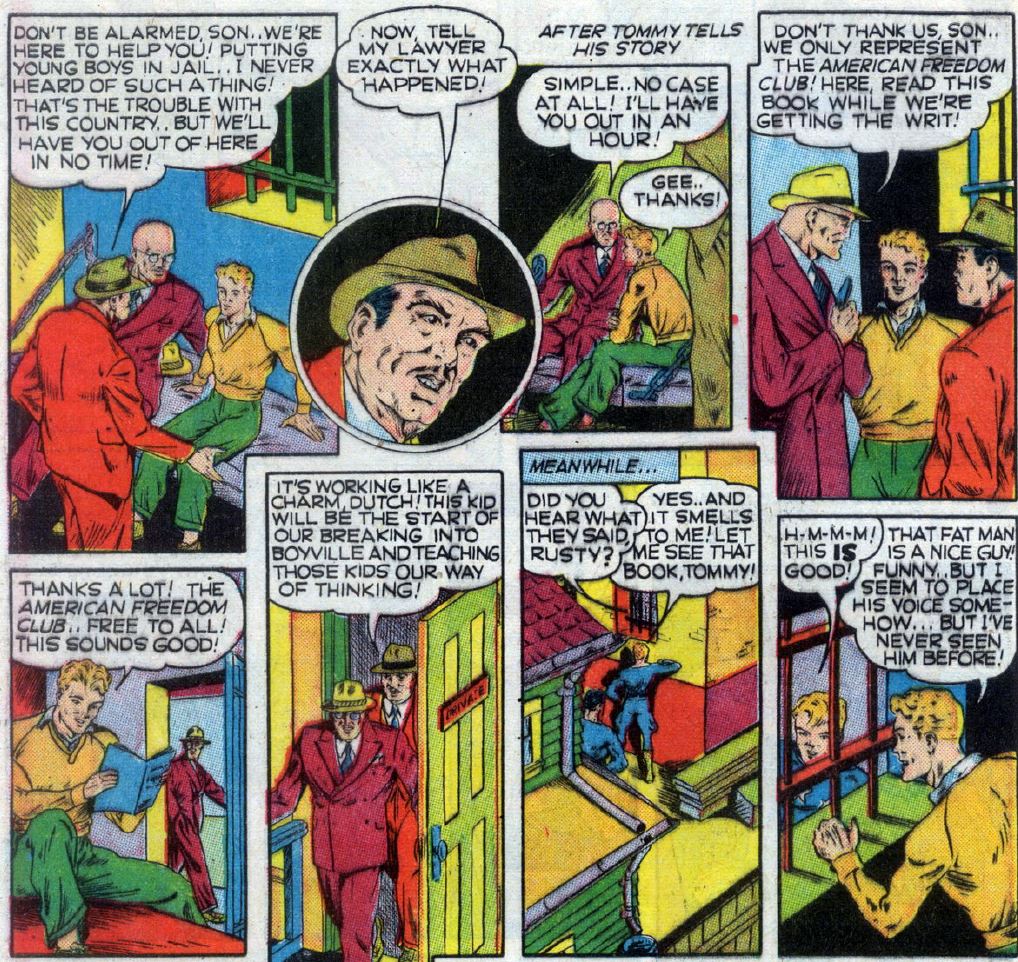
    The American Freedom Club AKA the Movement AKA the New Order were propagandists looking to corrupt the youth of the nation, starting with the Boyville Orphanage and ending with a beating from the Boyville Brigadiers (Feature Comics 047, 1941)

    The Anti-American Bund, a standard outsized play on the weenies that were the German-American Bund (remember them as the ones who ran away before Jack Kirby could ride the elevator down to beat them up). This version is for some reason forcing this lady who merely married a bundist to be their leader until she is rescued by Neon the Unknown (Hit Comics 008, 1941)

    The Double Cross! A non-specific Axis force poised to invade the US from within but foiled by the scientific acumen of Wizard Wells and the rough and tumble charm of his assistant Tug (Crack Comics 012, 1941)

    The Fasdicks/ the Fasdick Company, a fascist organization operating a business as a front for an invasion of the Phillipines and possibly a very oblique rude pun name? Foiled by Spin Shaw (Feature Comics 040, 1941)

  • GENERIC COSTUMED VILLAIN ROUND-UP 007

    The hits keep on coming:

    This Fellow’s name is Becker and he and his wife run a gang while pretending to be among its victims. An okay scheme, but not really up to foiling Bulletman and Bulletgirl. (Master Comics 014, 1941)

    This guy here is why I have such a hard time relegating masked Western bandits to the dregs of the generic costumed villains: he’s as by-the-numbers a bandit as they come, he robs one stagecoach total, he ends up dying because he falls off his horse… but he is frequently and consistently referred to a “Alkali, the Scourge of the Plains” which is as endearing as it is possible to be. (Master Comics 019, 1941)

    I’m overlooking the fact that this bundist-style not-exactly-German spy encountered by Miss America doesn’t actually wear a costume because a) he’s called the Leader, b) he lives in a wax museum and c) he has a pet gorilla named Gargo. (Military Comics 002, 1941)

    Captain Rajah, AKA the Master, was a jewel thief who ran up against Captain Desmo, in a story even more weirdly pro-colonial than Captain Desmo stories usually are – Captain Rajah is immediately suspicious for being an Indian officer in the Bengal Lancers, continued to be suspected throughout and then turned out to be the Master. The story is from before the invention of “defying expectations”. (More Fun Comics 065, 1941)

  • GENERIC COSTUMED VILLAIN ROUND-UP 007

    The hits keep on coming:

    This Fellow’s name is Becker and he and his wife run a gang while pretending to be among its victims. An okay scheme, but not really up to foiling Bulletman and Bulletgirl. (Master Comics 014, 1941)

    This guy here is why I have such a hard time relegating masked Western bandits to the dregs of the generic costumed villains: he’s as by-the-numbers a bandit as they come, he robs one stagecoach total, he ends up dying because he falls off his horse… but he is frequently and consistently referred to a “Alkali, the Scourge of the Plains” which is as endearing as it is possible to be. (Master Comics 019, 1941)

    I’m overlooking the fact that this bundist-style not-exactly-German spy encountered by Miss America doesn’t actually wear a costume because a) he’s called the Leader, b) he lives in a wax museum and c) he has a pet gorilla named Gargo. (Military Comics 002, 1941)

    Captain Rajah, AKA the Master, was a jewel thief who ran up against Captain Desmo, in a story even more weirdly pro-colonial than Captain Desmo stories usually are – Captain Rajah is immediately suspicious for being an Indian officer in the Bengal Lancers, continued to be suspected throughout and then turned out to be the Master. The story is from before the invention of “defying expectations”. (More Fun Comics 065, 1941)

  • MINOR SUPER-VILLAIN 367: KOROZAN

    (Minute-Man 001, 1941) 

    Korozan is a not-quite-Japanese spylord whose two gimmicks are a) that he is very ugly and b) that his spy cell are all basically a cult dedicated to that cool idol, with Korozan as the cult leader/ godhead. Nothing really interesting is done with the cult angle beyond an abortive sacrifice – it’s just your standard Yellow Peril stuff about foreigners and their savage religions. Korozan gets kicked into a furnace and that’s the end.

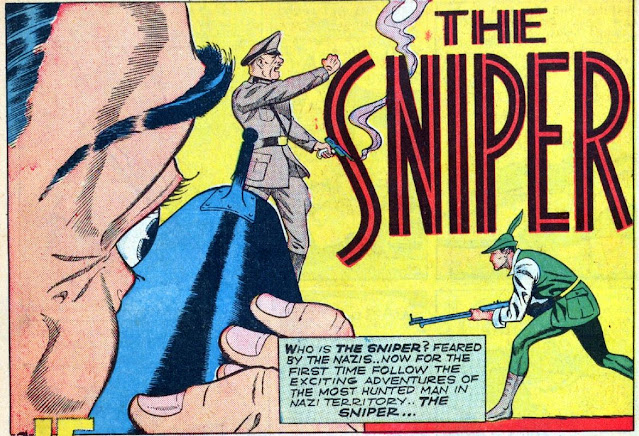
  • MINOR SUPER-HERO 046: THE SNIPER

    (Military Comics 005-034, 1941-1944)

    Not that Golden Age super-heroes didn’t often kill their enemies, but the Sniper here is an example of a style of hero that had a brief niche to themselves in the 40s and then didn’t really reemerge until the 70s – I am talking of course about heroes who deliberately hunt and kill their foes. Those foes are specifically Axis in the case of the Sniper and his colleagues the Marksman, the Americommando, etc.

    Not that the Sniper’s adventures are grim, Punisher-esque murder sprees. He has fun with his prey! Like a cat!

    TRIVIA: the Sniper’s first adventure is a flashback to 1940, published in 1941, and his second is a contemporary adventure published in 1942, so he has no recorded activity in 1941! Not very interesting, but true!

  • MINOR SUPER-VILLAIN 366: THE SCAVENGERS

    (Military Comics 005, 1941) 

    The Scavengers are an interesting bunch, but all of the most interesting things about them are implied rather than stated. As seen above, they show up to loot and murder in the aftermath of WWII battles. The fact that they all look the same, like little rat-men, is probably meant to be a metaphorical signifier of their moral degradation but I like the implication that this is what happens to battlefield looters, like the the transformation of a ghoul or other cannibal. This of course means that there could be Scavengers throughout human history – fun!

    The Scavengers don’t actually get to do much scavenging in-story, sadly. Instead, they are captured by the Nazis and enlisted in their capacity as weird little creeps to dispose of the Blackhawks. And they do pretty well at it! Their downfall comes due to the interference of the excellently-named femme fatale Red Laura, who somewhat predictably falls for Blackhawk’s nobility and shirtlessness.

    Despite having a heroic last stand, pictured above, Red Laura actually manages to survive the issue. One hopes that she was a bit more picky about who she worked for going forward, because I am inordinately fond of her. It’s just such a good name!

    In conclusion, the Scavengers should be BRUNG BACK. Not only did they not all die at the end of the adventure (as the Blackhawks are about as likely to punch out as to shoot an opponent) but the idea of them cropping up in the aftermath of war throughout history is very cool! We need more types of human monster who wear their spiritual corruption on the outside, if only for greater variety in D&D.

  • NOTES – NOVEMBER 2023

    Fate of the Wreck of the Athenia


    Showing tremendous respect for the dead, the Blue Tracer uses the wreck of the Athenia as armour while attacking a Nazi battleship. (Military Comics 005, 1941) 

    Honours


    Marine pilots “Loops” McCann and “Banks” Barrows are “decorated for valor” after a barroom brawl in a Shanghai nightclub leads to the destruction of a Japanese spy cell (Military Comics 005, 1941)

    On Crypto-Fascism: 

    As I’ve said before, the US was officially Not Involved in WWII until the December 1941 Pearl Harbor attack and so a lot of pre-1941 comics feature generically Germanish or Japaneseish spies operating on US soil. Military Comics actually features a fair number of actual Nazis (and even some rare comic book appearances by Italian fascists) by having most of its features take place outside of the US. With issue 5 as an example: the Blckhawks battle Nazis in Oslo; the Sniper does the same in Austria; Shot & Shell vex them in a generic Europe; the Death Patrol liberates Nazi POWs as part of the RAF and the Blue Tracer does the same in the Atlantic.

    Loops & Banks, above, are US Marines and as such do not actually battle the Japanese in Shanghai. The most interesting contrast is between Miss America and Yankee Eagle, who both battle Nazi submarines that are preying on US shipping but since the Miss America Nazis are operating out of a New England base and the Yankee Eagle Nazis are based at sea only the latter are actually called Nazis.

    Comics in Comics:

    Inza Cramer meets a fan (More Fun Comics 063, 1941)

    Drawn Without Reference:

    I know that paleontology wasn’t quite as advanced in 1941 as it is today but that is a wild take on what a pterodactyl looked like (More Fun 067, 1941)

    Dynamic Action:

    Check out the dynamic action on adventurer Clip Carson! (More Fun Comics 068, 1941)

  • MINOR SUPER-VILLAIN 365: THE BLACK TIGRESS

    (Military Comics 004, 1941)

    The Black Tigress is a Gestapo agent operating in Egypt with the goal of capturing or destroying the Suez Canal with her army of little Perter Lorre looking Nazis. Nothing particularly remarkable, but she does have the distinction of being the first of many, many minor super-villains to be faced by the Blackhawks.

    She is also the first of many femmes fatale to be encountered by Blackhawk himself, and Will Eisner creation (and Howard Chaykin adoptee, for that matter) that he is, he will encounter many. She is even the first of those to fall in love with Blackhawk, not that it turned out well for her: her love not reciprocated, she dies while trying to murder the object of her affections.