The Curse of Skeleton Munroe

Category: Quality Comics

  • MINOR SUPER-VILLAIN 228: THE PURPLE MONSTER

    (Feature Comics 049, 1941)

    The Purple Monster is a pretty lacklustre super-villain. He ticks all the boxes: volcano lair on an island somewhere off BC, army of costumed henchmen, subjugated population of poor island yokels to exploit complete with fake human sacrifices and an unexplained sinister use for the sacrificial victims… it’s a complete checklist of features designed to qualify him for this list. He even draws his name from a local superstition, albeit one he started himself by projecting a monstrous face on the purple clouds that billow from the volcano.

    It’s all so… low-rent. He’s set himself up with all of this super-villain infrastructure to what? Extort resources out of a small community? Maybe organ harvesting or something? If he plans on moving on to greater things he doesn’t get around to saying it on-panel – just as well he suffers the fate of most volcano-dwelling crooks: death by exploding volcano.

  • GO OUT WITH DIGNITY

    (Feature Comics 047, 1941)

  • GO OUT WITH DIGNITY

    (Feature Comics 047, 1941)

  • MINOR SUPER-VILLAIN 227: FRAULEIN DOKTOR’S DAUGHTER

    (Feature Comics 046-055, 1941-1942) 

    If you, like me, aren’t familiar with WWI-era espionage figures, then this one will require some explanation. Fraulein Doktor was the only name that German spy Elsbeth Schragmüller was known by, even after the war had ended and up until German records were seized in 1945, in fact. And once Captain Bruce Blackburn’s adventures had wrung all of the interest they could out of the German-American Bund, a sexy spy nemesis was just the ticket! Thus: Sonya (presumably) Schragmüller, Fraulein Doktor’s Daughter!

    Sonya’s a fine foe for a regular-style espionage character like Bruce Blackburn, full of all of the staples of the genre: poisons, disguises, fake cults, horniness, etc., but she has three real features of interest aside from being the made-up child of a real person:

    -she has an enormous body count relative to her number of appearances, managing to knock off at least a couple of US intelligence agents per operation.

    -even though she refers to her country of origin as “the Homeland” as is standard in the Counterspy strip, she is presented as the daughter of a German intelligence agent – this is about as close to outright saying she’s a Nazi as you get in mid-1941! (I sometimes feel weird getting so excited for actual Nazis to show up in the books I’m reading, but if it’s so I can see them get beat up a bunch I guess it’s fine)

    -since she’s the major ongoing villain of the Bruce Blackburn strip, and since the industry standard way to keep an espionage villain around is to have them escape at the end of every story, she never really gets caught, and since the strip ends in mid-1942, she ends her time in comics at large, a rare fate.

    ADDENDUM: CARL

    In the first Fraulein Doktor’s Daughter story she has no henchmen. In the second, she has three, Carl, Fritz and Otto, all apprehended. In the third, a second Carl, probably also arrested. In the fourth, Karl, who ends up dead. What does this mean beyond the writers having a limited pool of German names to draw from? I have no idea!

  • MINOR SUPER-VILLAIN 227: FRAULEIN DOKTOR’S DAUGHTER

    (Feature Comics 046-055, 1941-1942) 

    If you, like me, aren’t familiar with WWI-era espionage figures, then this one will require some explanation. Fraulein Doktor was the only name that German spy Elsbeth Schragmüller was known by, even after the war had ended and up until German records were seized in 1945, in fact. And once Captain Bruce Blackburn’s adventures had wrung all of the interest they could out of the German-American Bund, a sexy spy nemesis was just the ticket! Thus: Sonya (presumably) Schragmüller, Fraulein Doktor’s Daughter!

    Sonya’s a fine foe for a regular-style espionage character like Bruce Blackburn, full of all of the staples of the genre: poisons, disguises, fake cults, horniness, etc., but she has three real features of interest aside from being the made-up child of a real person:

    -she has an enormous body count relative to her number of appearances, managing to knock off at least a couple of US intelligence agents per operation.

    -even though she refers to her country of origin as “the Homeland” as is standard in the Counterspy strip, she is presented as the daughter of a German intelligence agent – this is about as close to outright saying she’s a Nazi as you get in mid-1941! (I sometimes feel weird getting so excited for actual Nazis to show up in the books I’m reading, but if it’s so I can see them get beat up a bunch I guess it’s fine)

    -since she’s the major ongoing villain of the Bruce Blackburn strip, and since the industry standard way to keep an espionage villain around is to have them escape at the end of every story, she never really gets caught, and since the strip ends in mid-1942, she ends her time in comics at large, a rare fate.

    ADDENDUM: CARL

    In the first Fraulein Doktor’s Daughter story she has no henchmen. In the second, she has three, Carl, Fritz and Otto, all apprehended. In the third, a second Carl, probably also arrested. In the fourth, Karl, who ends up dead. What does this mean beyond the writers having a limited pool of German names to draw from? I have no idea!

  • MINOR SUPER-HERO 030: THE RED TRIANGLE

    (Feature Comics 046, 1941)

    An exciting development! Up until now our minor super-heroes have been of two flavours: the stars of minor super-hero strips or a new identity adopted by the stars of crime or adventure strips – the key word in either case is star – they are the focus and driving force of the strip.

    The Red Triangle is our first example of another type of super-hero: the single issue guest star. These are far more common in the Silver Age, when they pop up every so often to complicate the main hero’s life for an adventure before retiring in shame or glory. I don’t have a full classification scheme for them yet, but I suspect that there will be a distinction between at least two types: the one who is making an attempt at being a big-time super-hero and the one who temporarily adopts an alternate persona to achieve a goal, with the Red Triangle being the latter.

    So: the Red Triangle is a masked vigilante who gets involved with a Reynolds of the Mounted case, which actually and weirdly makes him one of the earliest Canadian super-heroes.

    The Red Triangle, real name Baxter, is a man who got mixed up in a counterfeiting gang and when they wouldn’t let him back out, disappeared and adopted a new vigilante identity. It’s unclear whether he spent the year that he was the Triangle getting into any other crimefighting adventures – the crooks all know his name, but that might just be because he’s been hassling them specifically. 

    Once the gang’s been rounded up, Baxter takes the usual path that this style of minor super-hero does and hangs up the Red Triangle identity to return to the simple life of a hotelier.

  • MINOR SUPER-HERO 029: THE BOYVILLE BRIGADIERS

    (Feature Comics 045, 1941)

    It’s a tale as old as time, by which I mean about a year: noncostumed adventurers adopting costumed identities to keep up with the oncoming juggernaut that is the Golden Age super-hero boom. In this case, it’s Rusty Ryan and the other unusually muscular teens of the Boyville orphanage, who up until now were more of a high school sports type of bunch, dealing with the plague of unscrupulous gamblers betting on local hockey games and catching the occasional band of counterfeiters.

    As the Boyville Brigadiers, Ryan and his cohorts are even more dull than what I just described. Rather than the Kirby-style boy gang dynamic of making every member their own distinct style of weirdo, the Brigadiers barely have names, let alone personalities. The only really interesting thing about them, in fact, is how weirdly similar their costumes are to Captain America’s. 

    Still, they go on the list of patriotic heroes. Hooray!

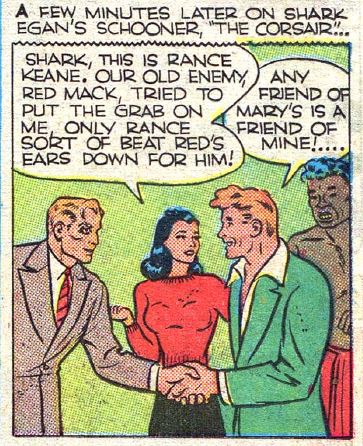
  • RANCE KEANE MEETS SHARK EGAN: THE CROSSOVER EVENT OF 1941

    (Feature Comics 045-046, 1941)

    Golden Age crossovers were a pretty rare thing, other than in places like All-Star Comics where that was the whole idea, but one place you occasionally encounter them is in the kind of adventure strips that filled out the bulk of anthology comics before the super-heroes really got into full market domination mode, and especially if the same person was working on both characters and wanted to have them meet up and say what a good series of adventures each other was having. 

    The weird thing about this meetup is that Rance Keane, a Quality character and star of the strip, is meeting Shark Egan, a Dell character whose own adventures had been cancelled more than a year earlier, in Popular Comics 053! The characters are roughly equivalent – Shark is a sea dog-style adventurer while Rance is a cowboy who transitioned into the same – but this dockside mutual admiration moment is very unlikely!

    If I were to advance a theory it would be to speculate that Rance Keane scribe William A Smith might have had a hand in Shark Egan too – some of the earlier strips in Popular look a bit like his work – and decided to reappropriate his creations once they were defunct at Dell. We will never know what his plans were though, as both Shark and Rance made but one more appearance in Feature 046 before setting off for parts unknown.

    (Shoutout to Comic Book Plus user Ed Love, who is the only person I could find mentioning this in a cursory search)

  • NOTES: JANUARY 2023

    Names:


    Bulldog Teeters. (Feature Comics 044, 1941)


    Zero the Ghost Detective getting straight-up punched by a ghost. (Feature Comics 051, 1941)

    Dates: Johnny Thunder born 7th July, 1917 (Flash Comics v1 001, 1940)

    Calling Cards:


    He only ever used ’em a couple of times but the Flash had metal lightning bolt dart calling cards.

    Costumes:


    Absolutely the best Hawkman costume variant is the brief period in which he wore a big hat in the shape of a sassy hawk’s head (Flash Comics v1 003, 1940)

  • MINOR SUPER-VILLAIN 226: THE BLACK BAT

    (Feature Comics 043, 1941) 

    Another example of the classic combination of someone posing as a spooky local legend-figure in order to scare folk away from a valuable area. In this case one Jean Dupre and his mother are trying to use the legend of the giant Black Bat (that they might have just made up) to scare their step sister/ daughter Marie away from the family ranch, which is just lousy with radium ore.

    It’s a good attempt, foiled by only a few factors: 1) Marie won’t leave and instead calls in the RCMP; 2) Reynolds of the Mounties and his guide/ skáld the Old Timer show up and basically immediately unravel the plot; 3) they both end up dead, from a rock to the head (Madame Dupre) and glider malfunction (Jean Dupre). As usual, the less profitable option of splitting the proceeds of your find with the rightful owner would have been the way to go.

    Unless I’ve been grossly negligent, this mother/ son duo is our first French Canadian representation on the list, so there’s that at least.

    MINOR EDIT: This is touted as Reynolds’ first case in the previous episode, but also he’s already a sergeant at the beginning of the story so I don’t know when it happened. Some time in the past!