The Curse of Skeleton Munroe

Category: Quality Comics

  • MINOR SUPER-VILLAIN 223: THE VULTURE

    (Doll Man 001, 1941)

    The Vulture! Flying thief extraordinaire! Terror of NYC for about a week!

    In reality the Vulture if a very weird looking guy named Aylmer who is predictably upset at his treatment by an uncaring world but seemingly mostly about being short. Hey, if Quality Comics New York is an accepting enough place that that’s all this guy gets bullied about then I have to give it to them, honestly.

    The really interesting thing about Aylmer/ the Vulture is not his technology (impressive as a homemade flying suit is) but the fact that he gets away at the end of the story and never appears again. Now, Doll Man comics aren’t quite as obsessively catalogued online as, say, Batman comics but as far as I can tell, this dude never ends up paying for the theft of millions of dollar worth of jewelry, the kidnapping of Martha “will someday be Doll Girl” Roberts or the murder of his own father, and in the Golden Age of Comics, motto Crime Does Not Pay, that is a wild and wooly thing to happen.

  • MINOR SUPER-VILLAIN 223: THE VULTURE

    (Doll Man 001, 1941)

    The Vulture! Flying thief extraordinaire! Terror of NYC for about a week!

    In reality the Vulture if a very weird looking guy named Aylmer who is predictably upset at his treatment by an uncaring world but seemingly mostly about being short. Hey, if Quality Comics New York is an accepting enough place that that’s all this guy gets bullied about then I have to give it to them, honestly.

    The really interesting thing about Aylmer/ the Vulture is not his technology (impressive as a homemade flying suit is) but the fact that he gets away at the end of the story and never appears again. Now, Doll Man comics aren’t quite as obsessively catalogued online as, say, Batman comics but as far as I can tell, this dude never ends up paying for the theft of millions of dollar worth of jewelry, the kidnapping of Martha “will someday be Doll Girl” Roberts or the murder of his own father, and in the Golden Age of Comics, motto Crime Does Not Pay, that is a wild and wooly thing to happen.

  • MINOR SUPER-VILLAIN 222: THE PHANTOM DUELIST

    (Doll Man 001, 1941)

    The Phantom Duelist is and example of a couple of my favourite comic book story setups: 1. the eerie local legend used as a basis for crime and 2. the murder mystery with a whole passel of suspects. Plus there’s a dose of “aren’t Hollywood people weird!” for flavour.

    So: movie producer Reynolds decides to drum up a bit of publicity by buying a haunted castle and importing it to Hollywood. The only problem: Reynolds is a bit of a shitheel and so is promptly murdered by someone posing as the castle’s resident ghost, the Phantom Duelist.

    The suspects: 

    -Rocky Perrone, gangster who Reynolds refuses to pay off a gambling debt to

    -Pierce, Reynolds’ leading man who he antagonized and threatened to blacklist

    -Marrow, who wants to marry Reynolds’ leading lady but is unable to because of her contract

    The murder happens at a costume party and Pierce is almost a self-frame due to showing up as the Phantom Duelist. In the end though, the murderer is revealed to be… a fourth guy! Steve Morton the publicity agent who Reynolds has apparently been blackmailing for the past 25 years!

    So a couple of points off for presenting an unfair mystery (and another couple for so many of the characters not having first names) but over all top notch comic book tomfoolery.

    Number of Episodes of the “Super-Villains of Hollywood” podcast: One episode only. SOme prurient attention paid to Reynolds’ shitty doings.

  • MINOR SUPER-VILLAIN 222: THE PHANTOM DUELIST

    (Doll Man 001, 1941)

    The Phantom Duelist is and example of a couple of my favourite comic book story setups: 1. the eerie local legend used as a basis for crime and 2. the murder mystery with a whole passel of suspects. Plus there’s a dose of “aren’t Hollywood people weird!” for flavour.

    So: movie producer Reynolds decides to drum up a bit of publicity by buying a haunted castle and importing it to Hollywood. The only problem: Reynolds is a bit of a shitheel and so is promptly murdered by someone posing as the castle’s resident ghost, the Phantom Duelist.

    The suspects: 

    -Rocky Perrone, gangster who Reynolds refuses to pay off a gambling debt to

    -Pierce, Reynolds’ leading man who he antagonized and threatened to blacklist

    -Marrow, who wants to marry Reynolds’ leading lady but is unable to because of her contract

    The murder happens at a costume party and Pierce is almost a self-frame due to showing up as the Phantom Duelist. In the end though, the murderer is revealed to be… a fourth guy! Steve Morton the publicity agent who Reynolds has apparently been blackmailing for the past 25 years!

    So a couple of points off for presenting an unfair mystery (and another couple for so many of the characters not having first names) but over all top notch comic book tomfoolery.

    Number of Episodes of the “Super-Villains of Hollywood” podcast: One episode only. SOme prurient attention paid to Reynolds’ shitty doings.

  • NOTES: DECEMBER 2022

    (Detective Comics v1 058, 1941)


    Comic book character of the year Claudia Carol, folks.

    Names: (Doc Savage Comics v1 003, 1941)

    Bit of nominative determinism going on. The protagonist of this piece is Brad Marshall:

    Marshal Brad Marshall:

    Crook name of Bat Crawley (Feature Comics 040, 1941)

    I’m only mostly certain, but I think that “Fasdick” here might be subbing in for “fascist”. The government in question does bear all the hallmarks of being a stand-in for one of the Axis powers, but it’s a wild stretch, even so. (Feature Comics 040, 1941)

  • GENERIC COSTUMED VILLAIN ROUND-UP 003

    Yet another collection of also-rans and never-weres.

    Philip White: 

    Philip White here got exactly one panel into his career as a masked spy chief before Madam Fatal unmasked him. (Crack Comics 014, 1941)

    Basil: 

    An auctioneer named Basil ran an overly complicated scheme to steal the fabled Five Bloodstones of Mu. His plans were also undone by Madam Fatal and ended in his grisly demise. (Crack Comics 016, 1941)

    Unnamed Crook: 

    This unnamed thief almost got away with the Dare Diamond under the very nose of detective Larry Steele. (Detective Comics v1 049, 1941)

    Howard: 

    A baseball pitcher named Howard got up to some shady betting schemes and ended up a generic costumed villain. Let this be a lesson, kids. Also part of his big plan involved shooting himself in the arm with a gimmicked up baseball mitt-gun, which is an early sign that you might not be cut out for costumed villainy. (Detective Comics v1 052, 1941)

  • MINOR SUPER-VILLAIN 208: THE TERROR

    (Crack Comics 018, 1941)

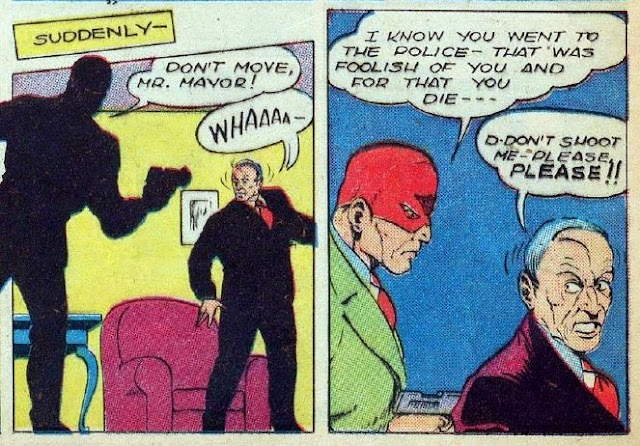
    Not too much to distinguish this guy: he’s Bumps Bale, a former pinball racketeer (you’re just as likely to see Batman smashing up a bunch of pinball machines as an underground casino or a slot machine in the 40s. Gambling is Bad and Pinball is Gambling, was the attitude) who had hit hard times and decided to go into extorting mayors as a second career. Accordingly, he poisoned city comptroller Ezra Daves and promised Unnamed Mayor here some of the same if one million dollars in small bills was not produced post haste. Sadly for the Terror, the Clock got involved.

    I do have to say that I appreciate the cowl-style mask that the Terror is sporting. Personally I find it far more aesthetically pleasing than the executioner’s hoods and cloth draperies that have been more the norm thusfar.

    (also for those keeping track this is presumably the mayor who took over after the Big Shot was ousted, placing him somewhere on a very spicy alternate Wikipedia page for List of Mayors of New York City)

  • MINOR SUPER-VILLAIN 207: THE BLACK WITCH

    (Crack Comics 018, 1941)

    The Black Witch is a member of a long comic book tradition: Haitian voodoo practitioners who use their sinister powers to get up to no good – in this case kidnapping the wife of one of Richard “Madam Fatal” Stanton’s friends as raw material in a search for eternal youth.

    The Black Witch is also part of a long-term demographic shift in comics: while the Haitian voodoo character is a staple villain s(and sometimes hero) into at least the 90s, in the early days they were basically all white folks like the Black Witch here, or the Master of Corpses. A question that I’m not qualified to answer: is this more racist than the state of things post 1960 or so when the population of voodoo villains more accurately represents the demographic makeup of Haiti or is it semi-vilifying an entire ethnoreligious group? 

  • MINOR SUPER-VILLAIN 206: THE CROW

    (Crack Comics 018, 1941)

    The Crow! Wanted in every country on the Earth! A villain with a very impressive resume! It’s actually a bit disappointing when he just does some regular bank robbing in this issue.

    To be fair, he does give the Spider much more of a run for his money than his usual foe, and he does end up returning in Crack 021 the next year, in which he steals the Black Widow and uses it for evil deeds. I don’t know if it’s quite enough, but it’s something.

  • MINOR SUPER-VILLAIN 206: THE CROW

    (Crack Comics 018, 1941)

    The Crow! Wanted in every country on the Earth! A villain with a very impressive resume! It’s actually a bit disappointing when he just does some regular bank robbing in this issue.

    To be fair, he does give the Spider much more of a run for his money than his usual foe, and he does end up returning in Crack 021 the next year, in which he steals the Black Widow and uses it for evil deeds. I don’t know if it’s quite enough, but it’s something.