The Curse of Skeleton Munroe

Category: Quality Comics

  • DIVINE ROUND-UP 025

    Gods gods gods. 

    Puni, God of Fire: 

    Sea-faring adventurer Lance O’Casey almost gets sacrificed to this fire god by the cannibalistic inhabitants of a tropical Antarctic island before escaping, entering the volcano in question and meeting the other Puni. Not sure how much the volcano-dwelling madman and the actual religion influenced each other, but it must have been at least a little. Also: cool idol.

    God Style: Idol (Whiz Comics 019, 1941) 

    the War God:

    This War God idol functions like one of those hollow dog statues you see at grocery stores, that you put your change in to help raise money for people to get seeing eye dogs (and if that’s not a thing where you live then sorry for the unrelatable analogy), only the money is meant to go to the defense of China against Japanese invasion, and instead of a dog it is a sick-ass god-monster. It’s never entirely clear if this is supposed to be a representation of an actual god or just a marketing gimmick.

    God Style: Idol (More Fun Comics 059, 1940)

     Wotan:

    As was established when he beat up Mars that one time, Merlin the Magician hates war, and seeing as he has a magic cloak and a can-do attitude he sets out to do something about it. His first step is to go back in time and save a couple of young Ancient Britons from being human sacrificed by some Druids. What does this have to do with ending war? No idea, but then again I don’t have a magic cloak so my perspective might just be too mundane to comprehend the intricacies.

    Having reviewed the plan, I must conclude that Merlin just needed a couple of people with no ties who would be grateful enough to him to do whatever he wanted and that Druidic sacrifices were his first thought. Specifically, he asks these young folk to act as peace ambassadors to an unnamed fascist nation in order to undermine the efforts of the war god Wotan, who has been roaming the Earth inciting men to war.

    (It would have been quite thematically satisfying if the two young people had been rescued from being sacrificed to Wotan, and while that might have implicitly been the intent, it’s just not there on the page) 

    The young people are somewhat successful, in that they are immediately killed by a similarly young and idealistic pair of enemy soldiers (and what a progressive fascist nation, to field female soldiers in 1941!) who then become overwhelmed with remorse and swear of war forever, at which point Merlin appears and restores his agents to life – an effective but painful strategy, it seems.

    All this talk of pacifism and understanding between nations draws the ire of Wotan himself, who shows up to kill Merlin and ends up on the end of a killing sword-blow from the magician, making the current score Gods: 0 Merlin the Magician: 4.

    God Style: Real (National Comics 011, 1941)

    Death: 

    This version of Death is bound to obey an artifact known as the Sceptre of Eternity, and as such has been commanded to replace the lost daughter of a guy called the Sheik of Kamroon in the 12th Century, and as such has made off with a present-day woman named Betty Jekil. I’m pretty sure that this was a calculated move, as Betty’s father turns to super-magician El Carim for help, which ultimately results in El Carim trading the Sceptre of Eternity for Betty’s life, which is a pretty good deal for Death.

    God Style: Anthropomorphic Personification (Master Comics 019, 1941)

  • DIVINE ROUND-UP 024

    Not a lot of depth to this batch of gods.

    the Tiger God: 

    When the Tiger’s Eye Emerald, formerly installed as the eye in an idol of the Tiger God in India, is stolen, detective Dan Dare is brought in on the case and almost immediately captured by the tiger-worshippers who were responsible for the theft. As usual it is only the current and not historical owner of the stolen artifact who is considered legitimate and so after slaying the avatar of the Tiger-God pictured above, Dan returns the emerald.

    God Style: Idol (Whiz Comics 018, 1941)

    the Sun God:

    Samar of the Jungle gets into it with a local tribe and ends up captured and slated for sacrifice to their Sun God. Disappointingly, though this involves being burned, it is at a boring old stake rather than by the sun itself. Just as well that he manages to escape.

    God style: Animist (Feature Comics 049, 1941)

    Takal:

    The final adventure of the Bob Kane-created kid gang Rusty and His Pals concerns a hunt for lost treasure, specifically the Idol of Takal, stolen by a group of villainous ex-circus performers called the Unholy Four twenty years earlier. Takal doesn’t actually feature too prominently into Rusty and the Pals’ attempt to re-steal the idol for themselves, aside from being made to talk via ventriloquism to awe his worshippers. 

    God Style: Idol (Adventure Comics 049, 1940)

    Tanis: 

    In one of the two separate adventures in which the Three Aces find a remnant of lost Atlantis, they travel deep blow the Azores to settle a conflict over Atlantean succession caused by power-grasping courtiers. The ultimate solution: use surface world chemistry to simulate an intervention by the god Tanis by setting the throne room on fire. It’s unorthodox, but it works! 

    God Style: Invoked (Action Comics v1 038, 1941)

  • DIVINE ROUND-UP 020

    Human sacrifice is the order of the day with this bunch of deific bad-boys. 

    Shem: 

    Shem, the Sun God, is worshipped in the Land of Shem by the Shemmites, aka the Men of Shem. It’s a very well-branded religion. 

    The Shemmites capture and attempt to sacrifice Kalthar, king of the jungle, but fail to reckon with his tendency to grow to fifteen feet tall and be invulnerable to harm, and are ultimately driven from their lands. 

    God Style: Invoked (Zip Comics 004, 1940) 

    Marro: 

    When the Three Aces set out into the Amazon jungle to investigate rumours of an ancient flying machine they end up discovering a lost colony of Atlantis for the second time in their careers – an astonishing hit rate (though their memories were wiped after leaving the first one and a language barrier probably prevented them from knowing about the Atlantis connection this time, if we’re going to be scrupulously accurate). Upon arriving, they are immediately captured and prepared for sacrifice to the Atlanteans’ god Marro. 

    Luckily for the three aviators, Marro turns out to be the very ancient aircraft they seek, sealed against the ravages of time in a glass dome. They manage to convince the Atlanteans to not sacrifice them if they can make the god fly again as it did in their legends, and being the expert fliers that they are, the Aces pull it off without a hitch. 

    God Style: Animist (Action Comics v1 043, 1941)

    Moloch: 

    The set up for this is a bit convoluted, but here goes: an anthropologist named Dr Chadwick is showing Zero, the Ghost Detective a weird skull that he dug up in Egypt one day when the ghost of the skull’s former owner shows up to take it back, and makes off with Chadwick’s daughter, to boot. Zero pursues the ghost back to Egypt and through a portal to Ancient Egypt, where he finds himself in a temple to Moloch and learns that the skull had been stuffed full of jewels sacred to the god. Zero manages to escape back to the 20th Century with the girl but wisely leaves the jewels behind.

    There is of course a lot of business involving human sacrifice to Moloch via the white hot hands of his idol, and while Moloch himself only shows up in the form of the idol the question remains: just who is raising all these ghosts and powering this time portal?

    God Style: Idol (Real?) (Feature Comics 041, 1941)

    the “Monster-God”: 

    The Monster-God is not this fellow’s name. We never learn what, in fact, it is, because the adventure he appears in is another boilerplate heroic-white-explorers-versus-evil-native-heathens adventure, handled with all of Fawcett Comics’ trademark cultural sensitivity. I include him only for completions’ sake and to point out that I like how gangly he is.

    God Style: Idol (Whiz Comics 006, 1940)

  • DIVINE ROUND-UP 019

    These pantheons are going to fill up if we’re not careful.

    Ammon-Ra:

    Worshipped by a secret sect in the hidden underground city-state of Ruxor in Egypt, Ammon-Ra, contrary to the above image, is probably just an idol that Yarko the Great is making speak so that he doesn’t have to keep magically duelling High Priest Ramma-Tep. 

    God style: Idol (Wonderworld Comics 018, 1940)

    Kila:

    Kila, the supposed Hindu God of Destruction, is represented here by a ruby idol. There’s not much else concrete to say about this particular god, because Sheldon Lenox, the fellow selling the idol, stages a series of crimes using a fake cult in order to get it back and that sort of thing really muddies the waters.

    God Style: Idol (Detective Comics v1 035, 1940)

    Kilu:

    In a classic set-up, a pirate captain and a wicked witch doctor have teamed up to control an island tribe using a hollow idol of the tribe’s god, Kilu. The whole operation is upended by the heroic Captain Fortune and the idol of Kilu is blasted by his ship’s cannon.

    God Style: Idol (Feature Comics 030, 1940)

    Koru: 

    Having heard about a fabulous fortune in rubies somewhere in the African jungle, adventure Tod Hunter and his monocled pal Tommy set out to steal them from their place on the idol of Koru, God of the Ruby Eye. Let me tell you, they are pretty put out when the worshippers of Koru very reasonably imprison them rather than allow them to waltz in and deface their sacred idol. 

    The duo (along with some other miscellaneous imprisoned treasure hunters) of course end up escaping and stealing all of the rubies, because they are the protagonists of an adventure story and thus are in the right, Along the way they discover that the idol of Koru is hollow and has a little guy living inside of it to speak in the god’s voice, just like every other giant idol in comics.

    God Style: Idol (New Adventure Comics 027, 1938) 

  • DIVINE ROUND-UP 017

    You’ll never believe it: more gods. 

    the Serpent Gods: 

    While pursuing crook Rango in the African jungle, Yarko the Great comes across a couple being sacrificed to the Serpent Gods by being flung into a pit of sacred serpents. But are the serpents the Serpent Gods themselves? There is no further context given, so we must assume that they are.

    God style: Animist (Wonderworld Comics 015, 1940) 

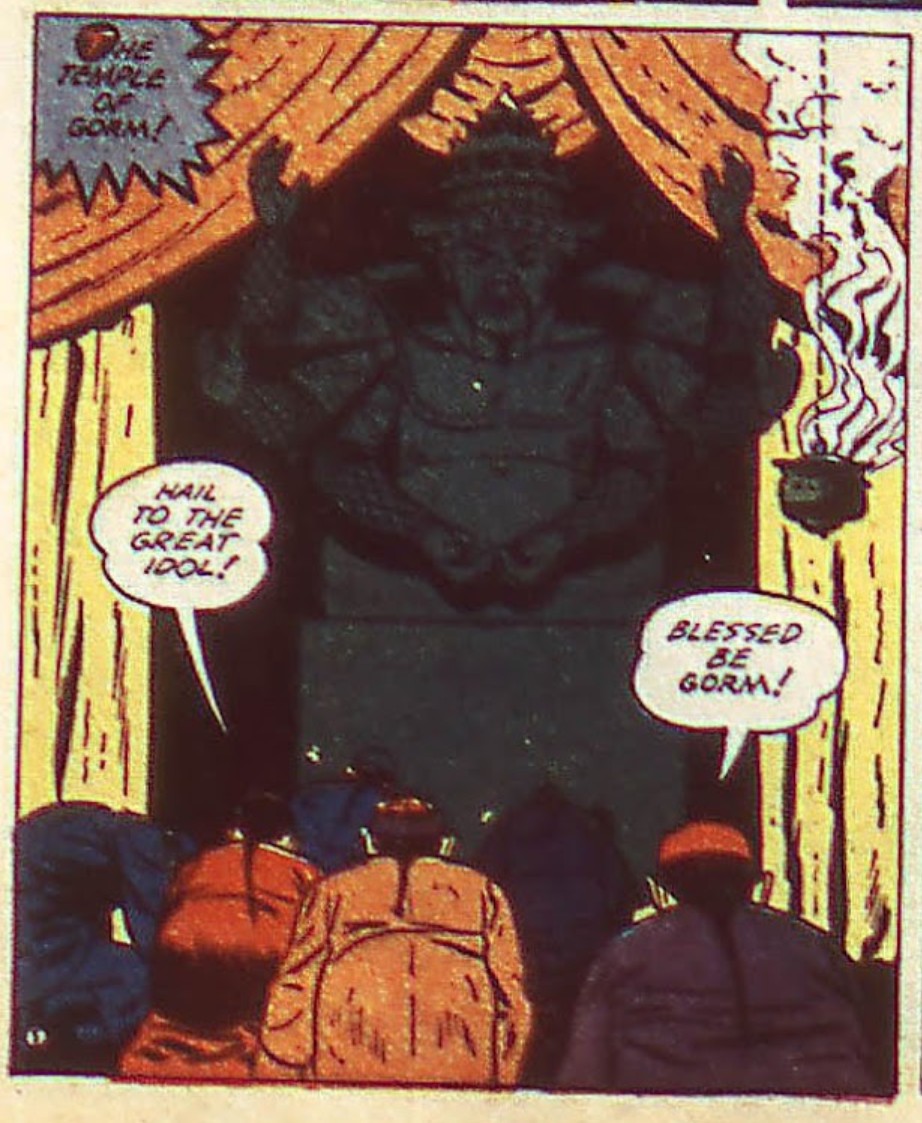
    Gorm: 

    Gorm is the god of the villainous Hatchet Cult, a gang that the Flash encounters early in his career, but since the Hatchet Cult is made up of white gangsters surgically made to look Chinese in order to throw the authorities off of their trail, one must assume that Gorm is just another part of the ruse (though for who’s benefit these guys are praying is a mystery to me).

    God Style: Idol (Flash Comics v1 022, 1941) 

    the Great God Orrab: 

    The Great God Orrab is yet another idol to which Our Heroes are almost sacrificed, ho hum. The interesting thing about this particular god, however, is that the hero in question is Blaze Barton, which placed Orrab in the year 50033 CE or thereabouts, and makes it very possible that his worshippers are in fact post-apocalyptic remnants worshipping the equivalent of a McDonaldland statue.

    God Style: Idol (Hit Comics 009, 1941)

    Hu, the Horse God: 

    Adventurer Lance Larkin and a lady named Marsha are looking for the “Land of the Flying Dragons” in Siberia, and wouldn’t you know it, they find it! And there are flying dragons (well, “pterodactyls”) there! There are also caveman-style Ape-Men riding the dragons, who swiftly capture Lance and Marsha and take them to be sacrificed at the altar of Hu, the Horse God. It is only the arrival of Lance’s loyal steed Satan, taken to be an earthly avatar of Hu, that saves the two.

    So just why do a bunch of cavemen who ride flying reptiles and have never seen a horse in their lives have a horse as their god? Because hundreds of thousands of years ago when they came to this prehistoric enclave they had horses and those horses saved them from disaster somehow. This inspired the reverence, but didn’t stop the horses from eventually dying out, which then inspired the taming of the “pterodactyls”.

    God-Style: Idol (More Fun Comics 067, 1941) 

  • DIVINE ROUND-UP 017

    DIVINE ROUND-UP 017

    You’ll never believe it: more gods. 

    the Serpent Gods: 

    While pursuing crook Rango in the African jungle, Yarko the Great comes across a couple being sacrificed to the Serpent Gods by being flung into a pit of sacred serpents. But are the serpents the Serpent Gods themselves? There is no further context given, so we must assume that they are.

    God style: Animist (Wonderworld Comics 015, 1940) 

    Gorm: 

    Gorm is the god of the villainous Hatchet Cult, a gang that the Flash encounters early in his career, but since the Hatchet Cult is made up of white gangsters surgically made to look Chinese in order to throw the authorities off of their trail, one must assume that Gorm is just another part of the ruse (though for who’s benefit these guys are praying is a mystery to me).

    God Style: Idol (Flash Comics v1 022, 1941) 

    the Great God Orrab: 

    The Great God Orrab is yet another idol to which Our Heroes are almost sacrificed, ho hum. The interesting thing about this particular god, however, is that the hero in question is Blaze Barton, which placed Orrab in the year 50033 CE or thereabouts, and makes it very possible that his worshippers are in fact post-apocalyptic remnants worshipping the equivalent of a McDonaldland statue.

    God Style: Idol (Hit Comics 009, 1941)

    Hu, the Horse God: 

    Adventurer Lance Larkin and a lady named Marsha are looking for the “Land of the Flying Dragons” in Siberia, and wouldn’t you know it, they find it! And there are flying dragons (well, “pterodactyls”) there! There are also caveman-style Ape-Men riding the dragons, who swiftly capture Lance and Marsha and take them to be sacrificed at the altar of Hu, the Horse God. It is only the arrival of Lance’s loyal steed Satan, taken to be an earthly avatar of Hu, that saves the two.

    So just why do a bunch of cavemen who ride flying reptiles and have never seen a horse in their lives have a horse as their god? Because hundreds of thousands of years ago when they came to this prehistoric enclave they had horses and those horses saved them from disaster somehow. This inspired the reverence, but didn’t stop the horses from eventually dying out, which then inspired the taming of the “pterodactyls”.

    God-Style: Idol (More Fun Comics 067, 1941) 

  • DIVINE ROUND-UP 015

    Hate and deception abound in this batch of deities.

    Wangwa, God of Hate: 

    Wangwa, God of Hate is the personal god of Okoro, medicine man of the Blancas and enemy of Doctor Voodoo. I’ve never decided if the Evil Medicine Man trope is mere condescension toward native spiritual practices or a porting over of the Evil Vizier archetype to jungle comics, and in all honesty it’s probably both. Anyway, Okoro fits the mould to a T and he worships the god of hate. Sorry he’s so fuzzy.

    God Style: Idol (Whiz Comics 008, 1940) 

    Cheops:

    Adventurer Clip Carson and his archaeologist companion Jim Blake are searching for the fabled lost tomb of Cheops one day when they find themselves in the midst of an entire cult dedicated to the worship of what is apparently the resurrected Pharaoh himself. Carson and Blake are captured by the cult, upon which the supposed Cheops – with very little prompting, mind you – reveals himself to be Sergeant Beatty of the local colonial government, out to seize the treasures of Cheops for himself. Blake and Carson of course escape, and along the way Beatty is exposed as a fraud and torn apart by his former devotees. 

    The deep need for modern Egyptians in adventure fiction to turn to Ancient Egyptian religion, but only in the most secret, cultish, conspiratorial way is another one of those things that you end up wondering about once you read it enough times. Is it merely a fun and easy way to inject some mysterious action into your story? If so, why does it crop up instories set in Egypt so much more than ones set in Greece of Italy? Is it racism again? 

    God Style: Complicated – Cheops/Khufu could be considered to be a deified ruler of Egypt, even though the practice of doing so became common something like a thousand years after his time. Plus this is just some dude posing as him. (Action Comics v1 016, 1939)

    Doolong: 

    Remember Korieg the Sea Devil from a little while ago? Well, the same island people who hate that guy just love to worship Doolong, “god of [their] ancestors”. Not too much detail on Doolong, other than a) his idol is just a little face mounted on the wall and b) he slings a very accurate prophecy – he totally predicts the arrival of Tex Thomson and his party on the island, even if the small matter of Tex being the Princess’ destined mate is inaccurate. 

    God Style: Idol (Real?) (Action Comics v1 011, 1939)

    the Druid God: 

    This is possibly only obvious to someone who lives in the area, but the “group of islands” being indicated in the above image is clearly Cape Breton, Nova Scotia. Was Cape Breton seen as a place just far enough outside of the everyday for things like shipwrecks and secret cults to happen in, or did “Reynolds of the Mounted” scribe and lifelong resident of New York State Art Pinajian just trace a random bit of Canadian coastline and call it a day?

    Speaking of shipwrecks and secret cults, the first of those happens when Sergeant Reynolds heads toward the last known location of missing rich guy Johnny Westlake. Like Johnny, Reynolds washes up on the shore and is found and nursed back to health by local Pierre Dulac.

    Westlake has been on the island long enough to be able to relate the local legend of the Druid Cave, a spooky cave surrounded by spooky rock formations and regarded with fear by the superstitious islanders, who believe that though the cave is full of gold it is also cursed and that anyone venturing inside will die. Reynolds and Westlake venture inside after finding a local fisherman dying on the nearby beach and discover that the cave does in fact contain an ancient treasure and that the curse is probably just plain old asphyxiation thanks to some natural gas deposits.

    Here’s where the cult comes in: the islanders just kind of spontaneously develop it after finding Westlake emerging from the cave shortly before an explosion rocks the countryside. Never trust a group who turn to human sacrifice as a first option, is what I always say.

    In the end, the real culprit behind the murders and explosions turns out to be Pierre Dulac, who, far from being an altruistic soul, has been manipulating the situation to bring maximum chaos as a distraction while he sneaks off with the treasure. He didn’t reckon with Reynolds’ tenacity, of course, and ends up exploding along with the treasure and all evidence of whatever fantastic culture produced the Druid Cave. The islanders just kind of scatter, presumably to keep the worship of the Druid God alive in secret.

    God Style: Invoked (Feature Comics 045, 1941)

  • ALIENS AND SO FORTH ROUND-UP 021

    A motley crew of mostly cavemen await ye. 

    Pleistocene Men: 

    When rich jerk Rodney Stark wants to take over the world, he know just where to go: the Arctic, where he can use his heat ray to thaw out a frozen tribe of prehistoric men to act as his personal army. Did he already know that they were there or was he just assuming that he could dig up a few guys just by sinking a hole any old place? Unclear.

    In what must have been an unexpected boon for Stark, the Pleistocene Men turn out to have been altered both physically and mentally by their long stay in the ice. Not only are they now super strong and invulnerable to harm, but they are also super smart for some reason? Stark just handwaves it by saying that the cold sharpened their intelligence, but in practical terms it means that they learn to speak English and fly planes super fast.

    Captain Marvel ends up dropping Stark and his entire caveman air force back down the hole he originally dug them out of, where presumably they froze solid again. Who knows how powerful they will become before next they are thawed? (Whiz Comics 007, 1940)

    Ape-Men:

    A simpler type of prehistoric remnant, these Ape-Men are encountered by boxer/adventurer Socko Strong on an isolated Atlantic island full of dinosaurs before the entire place blows up courtesy of a local volcano. (Adventure Comics 042, 1939)

    Bat Men of Venus: 

    These Bat Men have come from Venus to Earth c.50 030 CE to engage in some friendly diplomatic relations. Unfortunately for them, this is not long after a global catastrophe has not only drastically reduced the human population but unleashed the hostile Crust Dwellers onto the surface of the planet, and they are almost fatally menaced before being rescued by heroic Earthling survivor Blaze Barton. 

    Really appreciate a) bat people designs that really commit to the weirdness of bat faces b) gliding bat people c) seeing some different Venusian designs before the Venus = aquatic paradigm really sets in in the 1950s. (Hit Comics 002, 1940)

    Beast Men of Boota: 

    The Beast Men of Boota are just what it says on the tin: beast men (or at least hairy guys) who are from Boota, which I assume is what this forest village is called. They live in one of the innumerable lands beneath the Antarctic that are traversed by Cotton Carver, and briefly worship him as the Tunder Man, thanks to his surface world guns. (Adventure Comics 054, 1940)

  • DIVINE ROUND-UP 014

    Once again I present to you some deities. 

    Pelenona: 

    South Pacific adventurer Lance O’Casey almost gets sacrificed to the volcano goddess Pelenona on the of the same name because a different, more evil adventurer had made off with the island’s sacred temple jewels.

    The people of the same island also worship a shipwrecked circus gorilla as god-monster the Eepa, 

    God Style: Animist (Whiz Comics 008, 1940)

    the Creeping Death:

    The Jungle Twins were a pair of brothers who were separated as infants when their parents’ jungle expedition was attacked by raiders. William Dale was taken back to New York by a loyal nursemaid to grow up in the lap of luxury, while his brother Steve was left behind in the jungle to – you guessed it – become the toughest, baddest dude and rule over all he surveyed.

    Years later, William made his way back to the jungle to find Steve, and along the way he and his servant Dagoo were captured by apemen and left as sacrifices for their god, the Creeping Death, which turns out to be a whole river full of giant crocodiles! Dagoo gets them out of this scrape using some magic pipes to put the crocs to sleep, despite William being a total asshole to him. 

    God Style: Animist (Nickel Comics 001, 1940)

    Dagan the Only: 

    Cotton Carver is your classic Golden Age comics adventurer, and in one of his first outings he stumbles into a classic Golden Age adventure setting: a vast network of temperate, well-lit caverns beneath Antarctica. From then on, his adventuring career involves getting into scrapes in underground nation after underground nation as he looks for a way back to the surface world. After making a particularly perilous transition from the Land of the White Witch to the kingdom of Thule (pre-WWII, so not a red flag), Carver and his companions encounter a group of archers who are making their yearly pilgrimage to the shrine of Dagan the Only. 

    The actual worship of Dagan the Only is a bit of a mystery – he requires travellers of the Path of Peril between the LotWW and Thule to delivered living unto him, which suggests human sacrifice and triggers a bloody battle between the archers and Carver’s people, but that turns out to be a ruse by the princess of Thule to acquire their help in defeating an enemy. Later on, however, Cotton and his pals make the transition to the next underground land by being tossed into Dagan’s sacrificial pit. All we can say for sure is that he has a great name.

    God Style: Idol (Adventure Comics 039, 1939)

    the Devil God: 

    A cool-ass idol that Zero the Ghost Detective smashes up in order to banish a ghost in the Guatemalan jungle. Though Zero asserts that the ghost is operating under the Devil God’s will, I would say that it’s equally likely that the idol is his anchor to the material world. Also, we only have Zero’s word for it that this guy is named the Devil God.

    God Style: Idol (Real?) (Feature Comics 049, 1941) 

  • DIVINE ROUND-UP 014

    Once again I present to you some deities. 

    Pelenona: 

    South Pacific adventurer Lance O’Casey almost gets sacrificed to the volcano goddess Pelenona on the of the same name because a different, more evil adventurer had made off with the island’s sacred temple jewels.

    The people of the same island also worship a shipwrecked circus gorilla as god-monster the Eepa, 

    God Style: Animist (Whiz Comics 008, 1940)

    the Creeping Death:

    The Jungle Twins were a pair of brothers who were separated as infants when their parents’ jungle expedition was attacked by raiders. William Dale was taken back to New York by a loyal nursemaid to grow up in the lap of luxury, while his brother Steve was left behind in the jungle to – you guessed it – become the toughest, baddest dude and rule over all he surveyed.

    Years later, William made his way back to the jungle to find Steve, and along the way he and his servant Dagoo were captured by apemen and left as sacrifices for their god, the Creeping Death, which turns out to be a whole river full of giant crocodiles! Dagoo gets them out of this scrape using some magic pipes to put the crocs to sleep, despite William being a total asshole to him. 

    God Style: Animist (Nickel Comics 001, 1940)

    Dagan the Only: 

    Cotton Carver is your classic Golden Age comics adventurer, and in one of his first outings he stumbles into a classic Golden Age adventure setting: a vast network of temperate, well-lit caverns beneath Antarctica. From then on, his adventuring career involves getting into scrapes in underground nation after underground nation as he looks for a way back to the surface world. After making a particularly perilous transition from the Land of the White Witch to the kingdom of Thule (pre-WWII, so not a red flag), Carver and his companions encounter a group of archers who are making their yearly pilgrimage to the shrine of Dagan the Only. 

    The actual worship of Dagan the Only is a bit of a mystery – he requires travellers of the Path of Peril between the LotWW and Thule to delivered living unto him, which suggests human sacrifice and triggers a bloody battle between the archers and Carver’s people, but that turns out to be a ruse by the princess of Thule to acquire their help in defeating an enemy. Later on, however, Cotton and his pals make the transition to the next underground land by being tossed into Dagan’s sacrificial pit. All we can say for sure is that he has a great name.

    God Style: Idol (Adventure Comics 039, 1939)

    the Devil God: 

    A cool-ass idol that Zero the Ghost Detective smashes up in order to banish a ghost in the Guatemalan jungle. Though Zero asserts that the ghost is operating under the Devil God’s will, I would say that it’s equally likely that the idol is his anchor to the material world. Also, we only have Zero’s word for it that this guy is named the Devil God.

    God Style: Idol (Real?) (Feature Comics 049, 1941)