The Curse of Skeleton Munroe

Category: Quality Comics

  • ALIENS AND SO FORTH ROUND-UP 020

    ALIENS AND SO FORTH ROUND-UP 020

    You won’t believe the aliens and alien-adjacent societies we got in here. 

    Scorpians and Subterrines: 

    When crack reporter Scoop Smith and his photographer pal Blimp Black fly to Mexico to investigate reports of an “invisible revolutionary army” they get the story in a very direct way when they are shot down and taken captive by the Scorpians, who dwell in the underground kingdom of Scorpia and are extremely on-theme about the scorpion thing at all times, as can be seen in in the throne room of Scorpian King Cortes and its five distinct bits of scorpion decor.


    Scoop and Blimp are escorted to the Horror Chamber to be eaten by giant scorpions, because even the Scorpian methods of execution are on brand. They escape thanks to a thrown rock and a handy earthquake and discover the Subterrines, a second underground civilization that is also seeking to overthrow the Mexican government.  

    While the Scorpians under King Cortes kind of vaguely evoke the conquistadors of old, the Subterrines are pretty explicitly the descendants of native Mexican peoples who fled underground and now seek to reclaim their lands (and may I say that “everyone has long white beards now” is about the most benign version of becoming troglodytic cave-dwellers). The two groups of course hate one another and set to battling to the death for the honour of conquering Mexico, only to be annihilated together by the Mexican army. (Whiz Comics 005, 1940)

    Ape Men:

    If you’ve ever wondered if there was a version of the Paul Bunyan story in which he had an ape man for a companion, well wonder no more, because it happened in National Comics, when King, the ape man in question, wanders out of the woods and starts attacking lumberjacks, only to find himself on the receiving end of a beatdown from Paul Bunyan himself. After this, the impressionable King adopts the lumberjack way of life and joins Paul’s supporting cast. (National Comics 006, 1940)

    Joins Paul’s supporting cast for one issue, that is, because in National Comics 007 a scientist shows up at camp with a lead on where King might hail from, prompting Paul and the lads to set out to return him to his people, and if you’ve ever wondered if there was a version of the Paul Bunyan story in which he traveled through India to the Himalayas, well, you are in luck. Paul and the lads find King’s tribe and for the second time in as many issues, Paul Bunyan has to fist fight a Himalayan Ape Man in order to make peace.

    Bat-Men:

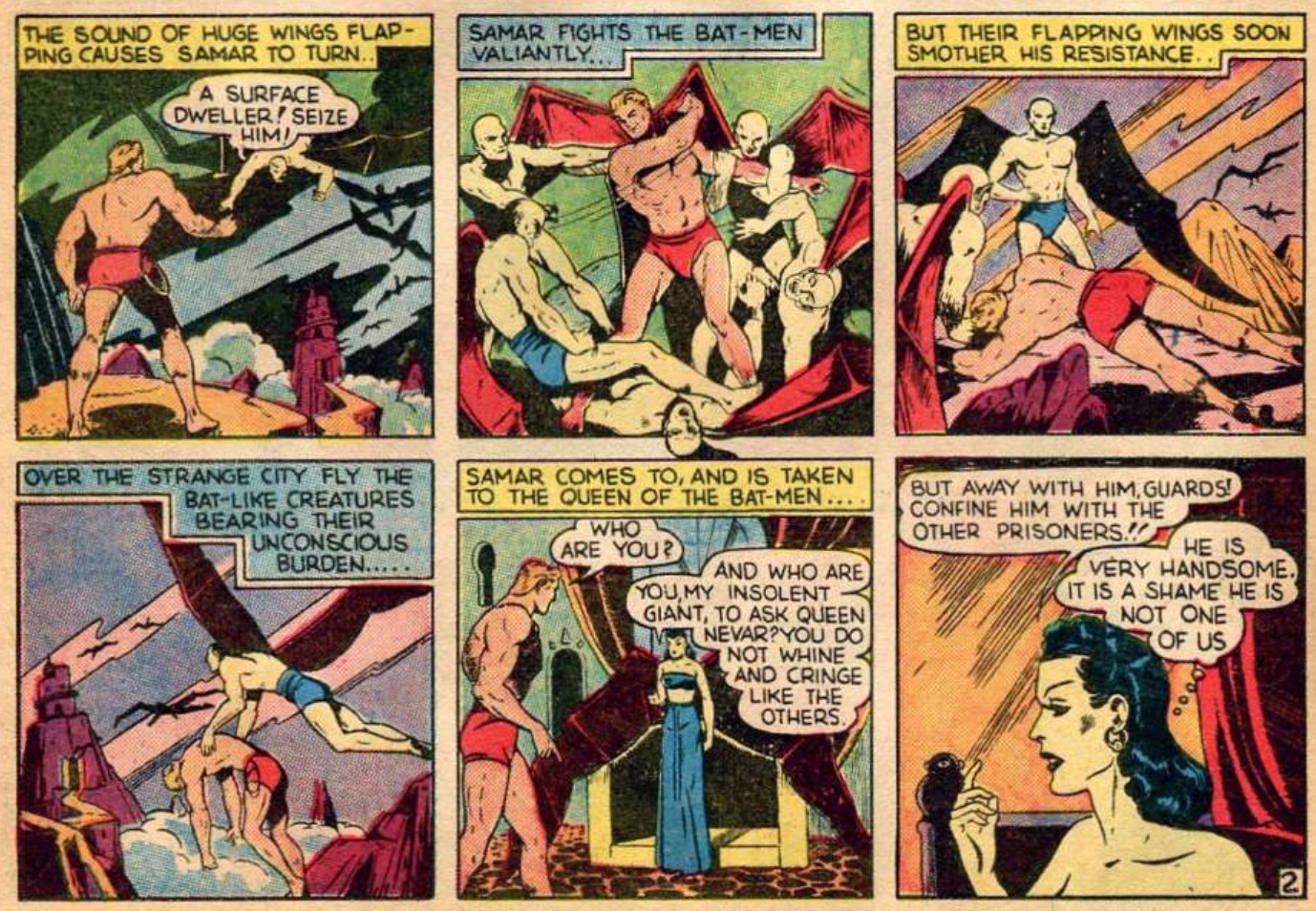
    Though the Bat-Men are very, very vampire-like – bat-winged humanoids who capture humans and drink their blood and can make humans into Bat-Men and are destroyed by sunlight – the keen senses of jungle-man Samar tell him that they are not, though he never really clarifies what they actually are. 

    The Bat-Men and their underground city are destroyed when they force Samar to battle a tyrannosaur in their gladiatorial arena and he inadvertently collapses the cave roof while killing the beast with a catapult. (Feature Comics 038, 1940)

    the Bat-Men of Mephis: 

    One of the many intelligent races to inhabit the planet Mephistos in the year 2500 CE, the Bat-Men of Mephis as their name suggests live in the tunnels beneath the city of Mephis, posing as statuary until it is time to attack. It’s a very urban adaptation, which is fun. I also appreciate their little ears. (Flash Comics v1 002, 1940)

  • ALIENS AND SO FORTH ROUND-UP 020

    You won’t believe the aliens and alien-adjacent societies we got in here. 

    Scorpians and Subterrines: 

    When crack reporter Scoop Smith and his photographer pal Blimp Black fly to Mexico to investigate reports of an “invisible revolutionary army” they get the story in a very direct way when they are shot down and taken captive by the Scorpians, who dwell in the underground kingdom of Scorpia and are extremely on-theme about the scorpion thing at all times, as can be seen in in the throne room of Scorpian King Cortes and its five distinct bits of scorpion decor.


    Scoop and Blimp are escorted to the Horror Chamber to be eaten by giant scorpions, because even the Scorpian methods of execution are on brand. They escape thanks to a thrown rock and a handy earthquake and discover the Subterrines, a second underground civilization that is also seeking to overthrow the Mexican government.  

    While the Scorpians under King Cortes kind of vaguely evoke the conquistadors of old, the Subterrines are pretty explicitly the descendants of native Mexican peoples who fled underground and now seek to reclaim their lands (and may I say that “everyone has long white beards now” is about the most benign version of becoming troglodytic cave-dwellers). The two groups of course hate one another and set to battling to the death for the honour of conquering Mexico, only to be annihilated together by the Mexican army. (Whiz Comics 005, 1940)

    Ape Men:

    If you’ve ever wondered if there was a version of the Paul Bunyan story in which he had an ape man for a companion, well wonder no more, because it happened in National Comics, when King, the ape man in question, wanders out of the woods and starts attacking lumberjacks, only to find himself on the receiving end of a beatdown from Paul Bunyan himself. After this, the impressionable King adopts the lumberjack way of life and joins Paul’s supporting cast. (National Comics 006, 1940)

    Joins Paul’s supporting cast for one issue, that is, because in National Comics 007 a scientist shows up at camp with a lead on where King might hail from, prompting Paul and the lads to set out to return him to his people, and if you’ve ever wondered if there was a version of the Paul Bunyan story in which he traveled through India to the Himalayas, well, you are in luck. Paul and the lads find King’s tribe and for the second time in as many issues, Paul Bunyan has to fist fight a Himalayan Ape Man in order to make peace.

    Bat-Men:

    Though the Bat-Men are very, very vampire-like – bat-winged humanoids who capture humans and drink their blood and can make humans into Bat-Men and are destroyed by sunlight – the keen senses of jungle-man Samar tell him that they are not, though he never really clarifies what they actually are. 

    The Bat-Men and their underground city are destroyed when they force Samar to battle a tyrannosaur in their gladiatorial arena and he inadvertently collapses the cave roof while killing the beast with a catapult. (Feature Comics 038, 1940)

    the Bat-Men of Mephis: 

    One of the many intelligent races to inhabit the planet Mephistos in the year 2500 CE, the Bat-Men of Mephis as their name suggests live in the tunnels beneath the city of Mephis, posing as statuary until it is time to attack. It’s a very urban adaptation, which is fun. I also appreciate their little ears. (Flash Comics v1 002, 1940)

  • PROBLEMATIC ROUND-UP 004

    Sax Rohmer has a lot to answer for.

    the Golden Dragon:

    We’ve seen it before and we’ll see it again – the Golden Dragon is yet another Fu Manchu-style Yellow Peril crimelord bent on bending the world to his will. He messes up by making his campaign of kidnapping and extortion a bit too obvious, which attracts the attention of the Invisible Hood, who in turn rallies various kidnap victims etc into a fighting force to take the Dragon’s organization down from within. (Smash Comics 013, 1940)

    the Key: 

    The Key is a Chinese gang boss operating out of London who specializes in getting his men out of prison almost as soon as they go in, by the simple expedient of faking their deaths with an exotic drug then recovering their “corpses” once they’re trucked off for burial. The twist is that the Key is in fact the very non-Chinese warden of Yorkshire Prison, where all of these guys are escaping from. Two things about the Key: 1. while his mask is presumably just as effective and lifelike as any other rubberoid prosthetic in comics it is also just king of hilariously and obviously strapped onto his face as you can see above, and 2. dovetailing from this, I do not think that the Key was originally going to be the warden. I think that someone took a look at a story about a regular gang boss who was just very good at jailbreaks and decided that it needed something more and so went through and added some extra juice via the addition of the mask and a few lines (“Hmm… That voice is familiar…”) to the already-drawn panels. For what it’s worth, which is not much. (Smash Comics 013, 1940)

    the Scarlet Seal:

    The Scarlet Seal! A character who I absolutely was thinking of when I established the Problematic Round-Up, because he is Very Problematic!

    The basic concept of the Scarlet Seal is fairly innocuous, and in fact is one that creator Harry Campbell returned to again and again: the hero who excels at their first career but then casts that aside to take up scientific pursuits, and then is forced into the role of detective by circumstance. There’s been Wizard Wells (football star to scientist to reluctant detective), Dean Denton (world’s greatest ventriloquist to scientist to detective), John Law, kind of (scientist to lawyer to detective, but really all at once), and now Barry Moore, who leaves a lucrative career as a film star to become a police scientist back in his home town of Center City, and eventually segues into the role of vigilante.

    As far as the problematic aspect of the character goes, there are actually two distinct strains of the stuff going on here. The first involves the Center City Police Commissioner, a namby-pamby former social worker and bleeding heart liberal strawman who doesn’t even believe in torturing confessions out of people (and also bans the use of informants and undercover police officers for unclear reasons). As it turns out, it was only the threat of the rubber hose that was keeping the Center City underworld in check, and the press is having a field day at the expense of  Barry Moore’s dad, Police Chief Moore.

    It’s at this point that Barry decides that what Center City really needs is some sort of vigilante willing to go out and do the hard work that this soft-hearted Commissioner didn’t have the stones for. And you know, if that was it, if he had just put on a costume and set off into the night to beat people up, then it would just be a more extreme version of the authoritarian streak that comic book fans of a more thoughtful nature have always had to reckon with.

    But no, because Barry Moore it turns out was not just any actor, he was a villainous character actor, and the last movie he made was one in which he played a sinister Asian. Thus, he makes the decision to weaponize his skill at yellowface by establishing a secondary identity as Wen au Chung, importer of Chinese goods, who in turn is the sinister Scarlet Seal, bane of the underworld and the police alike. It’s the old classic Green Hornet setup where the Scarlet Seal acts like he’s horning in on various criminal enterprises while actually setting up the crooks to be arrested or (more frequently) killed.

    Two further things: 1. He’s called the Scarlet Seal because he leaves a red stamp on the foreheads of his victims and 2. In the above panels the Scarlet Seal has just allowed the issue’s crooks to kill each other in a gunfight and then arranges things so that one of them, a corrupt cop, is posthumously acclaimed as a hero rather than being held accountable for his crimes. An infuriating character in every respect, that’s our Scarlet Seal. (Smash Comics 016, 1940)

    Dr Feng: 

    Yet another Fu Manchu Yellow Peril villain who is actually a white guy in yellowface. This time we have Dr Feng, head of the Ling Yung Tong aka the Yellow Death Society, but in actuality Blaine Moffat, wealthy real estate mogul. Much of his appearance is taken up with a self-kidnapping scheme to get out of the fact that he has murdered an investigator who got too close, so his actual motivation for becoming a problematic super-villain are left unexplored. (Startling Comics 001, 1940)

  • REAL PERSON ROUND-UP 013

    REAL PERSON ROUND-UP 013

    Yet again we have a selection of comic book appearances of real-style people for you to enjoy.

    Adolf Hitler:

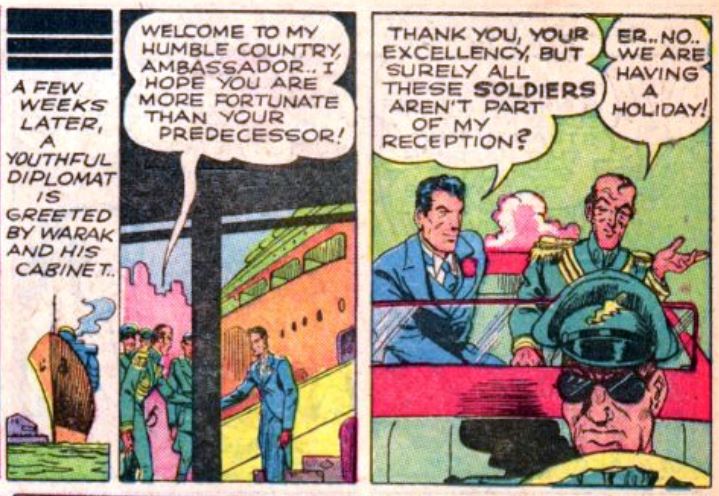
    Warak, dictator of Barbaria is a bit generic as far as pseudo-Hitlers go, but a pseudo-Hitler he is. (Smash Comics 017, 1940)

    Scraggs, leader of the Green Shirts, is very much a “make the leader look like Hitler as shorthand for These Guys Are Fascists” character, a subspecies that will nearly die out some time in 1941 but survives in small numbers to this day. (Startling Comics 001, 1940)

    Devil’s Island: 

    Black X has himself sent to, and then escapes from, Devil’s Island in order to secure a fellow prisoner with valuable US defense secrets in his head. (Smash Comics 013, 1940)

    FDR:

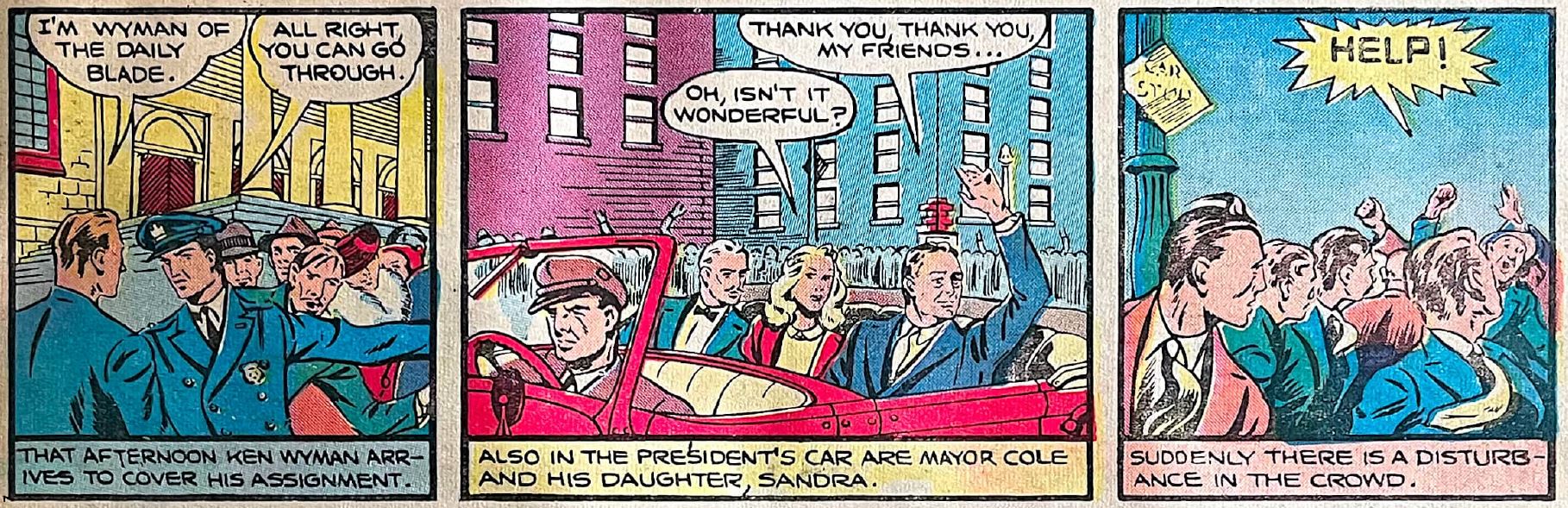
    An off-model Roosevelt visits Carterville and is kidnapped by Devil’s Dagger nemesis Jeff Marlowe (and thus retroactively by Marlowe’s boss Mr H). This is a wild move for a regional crime boss to pull! (Master Comics 006, 1940)

    Gill Fox:

    Probably a different guy to the last “Gil Fox” to appear in a Clip Chance comic – this one is just a small town baseball player. (Smash Comics 015, 1940)

    Groucho Marx:

    Goucho’s look lifted wholesale for this unnamed comedy character. (Star Comics 010, 1938)

    Hollywood:

    Autograph hound adds Shock Gibson to her collection along with “Cary Trooper” and “Glark Cable,” aka Gary Cooper and Clark Gable. (Speed Comics 009, 1940)

    Joe Devlin: 

    Given the prior instance of Joe Devlin being referenced in a Clip Chance story I must assume that the “John Devlin” mentioned here is another. (Smash Comics 014, 1940)

    Joseph Stalin:

    The Three Aces (but not the DC Comics Three Aces, the Harvey Comics ones) transport three anthropology-minded sisters to Paraguay to study the Guató people and stumble upon a plot by the sinister witch doctor Ni Lats to bring all under his sway via hypnotic mind control, for which crime he is drowned in a swamp.

    (slight aside: the Guató are a real people being used as set dressing for an exotic locale, and weirdly, in checking to see if that was the case I’m pretty sure I stumbled across the exact reference that Klaus Nordling drew from – every detail in the brief entry on the Guató in the 1911 Encyclopedia Britannica is reflected in the story. The mind control thing is added plot) (Speed Comics 010, 1940)

    Samuel Goldwyn:

    Is this movie producer named Sam meant to be Samuel Goldwyn or merely a lookalike reference to him? Regardless, this is clearly Samuel Goldwyn. (Speed Comics 010, 1940)

  • REAL PERSON ROUND-UP 013

    REAL PERSON ROUND-UP 013

    Yet again we have a selection of comic book appearances of real-style people for you to enjoy.

    Adolf Hitler:

    Warak, dictator of Barbaria is a bit generic as far as pseudo-Hitlers go, but a pseudo-Hitler he is. (Smash Comics 017, 1940)

    Scraggs, leader of the Green Shirts, is very much a “make the leader look like Hitler as shorthand for These Guys Are Fascists” character, a subspecies that will nearly die out some time in 1941 but survives in small numbers to this day. (Startling Comics 001, 1940)

    Devil’s Island: 

    Black X has himself sent to, and then escapes from, Devil’s Island in order to secure a fellow prisoner with valuable US defense secrets in his head. (Smash Comics 013, 1940)

    FDR:

    An off-model Roosevelt visits Carterville and is kidnapped by Devil’s Dagger nemesis Jeff Marlowe (and thus retroactively by Marlowe’s boss Mr H). This is a wild move for a regional crime boss to pull! (Master Comics 006, 1940)

    Gill Fox:

    Probably a different guy to the last “Gil Fox” to appear in a Clip Chance comic – this one is just a small town baseball player. (Smash Comics 015, 1940)

    Groucho Marx:

    Goucho’s look lifted wholesale for this unnamed comedy character. (Star Comics 010, 1938)

    Hollywood:

    Autograph hound adds Shock Gibson to her collection along with “Cary Trooper” and “Glark Cable,” aka Gary Cooper and Clark Gable. (Speed Comics 009, 1940)

    Joe Devlin: 

    Given the prior instance of Joe Devlin being referenced in a Clip Chance story I must assume that the “John Devlin” mentioned here is another. (Smash Comics 014, 1940)

    Joseph Stalin:

    The Three Aces (but not the DC Comics Three Aces, the Harvey Comics ones) transport three anthropology-minded sisters to Paraguay to study the Guató people and stumble upon a plot by the sinister witch doctor Ni Lats to bring all under his sway via hypnotic mind control, for which crime he is drowned in a swamp.

    (slight aside: the Guató are a real people being used as set dressing for an exotic locale, and weirdly, in checking to see if that was the case I’m pretty sure I stumbled across the exact reference that Klaus Nordling drew from – every detail in the brief entry on the Guató in the 1911 Encyclopedia Britannica is reflected in the story. The mind control thing is added plot) (Speed Comics 010, 1940)

    Samuel Goldwyn:

    Is this movie producer named Sam meant to be Samuel Goldwyn or merely a lookalike reference to him? Regardless, this is clearly Samuel Goldwyn. (Speed Comics 010, 1940)

  • MINOR SUPER-HERO ROUND-UP 043

    A grab bag of old characters I skipped over back in the early days when I thought that this blog wasn’t going to be completely self-indulgent. 

    Mr Clue: 

    He only had one adventure in which he solves the murder of a mayor by a police chief, but Mr Clue is too great a name not to take note of. (Master Comics 001, 1940)

    the Red Gaucho: 

    A swashbuckling hero in the Zorro mode, the Red Gaucho protects the South American nation of Santa Palos from threats both foreign and domestic before eventually just kind of wandering North to have adventures in a sort of generic Central America. He’s a fun character! He has one of the biggest hats in comics!

    The Red Gaucho is also a character I think about whenever the topic of white supremacy comes up. White supremacy is one of those topics that gets a lot of people very angry, but at its base it’s simply the belief that the world consists of white people and everyone else and more specifically that it’s white people versus everyone else in a competition to keep white people on top, where they belong. And the further back you go, the less people felt the need to hide the fact that that was their worldview, and possibly the place that that attitude is most on display is in early Golden Age comics – just read any set outside North America and you’ll catch on to it pretty quickly.

    Anyway, that is all to say that even though it’s more subtle than a lot of other examples of this worldview in comics, ever since I noticed that every single appearance of the Red Gaucho includes a disclaimer assuring readers that he was in fact the child of two Americans and not some horrible South American – heavens forfend! – his smiling face pops into my head whenever the subject comes up.(Nickel Comics 004, 1940)

    the Hawk:

    On a less heavy note, here’s the Hawk! Created by George Brenner, who also created the Clock, the Hawk has the distinction of being the first masked crimefighter to appear in a comic that would eventually be amalgamated into the DC Comics fold (the Clock had only appeared in Centaur comics up until this point and wouldn’t make his way into a Quality book for a few months yet). A heady and heavily qualified distinction!

    The Hawk is secretly T. James Harrington II, wealthy and useless playboy who hangs around looking bored until some crime happens and it’s time for the Hawk to hit the streets. It’s a bit Bruce Wayne/Batman only without the parental murder.

    Unlike Batman, the Hawk leans pretty minimal on the costume front, with his major identifying feature being a set of slip-on claws. 

    The Hawk also has a couple of assistants named Link and Rollo who are touted as the only people who know the Hawk’s identity but who don’t get much time to show their stuff in this, their one-panel appearance. Astute readers might note that the crook that the Hawk has just captured likely also knows his secret identity at this point but please note that Link and Rollo are identified as the only living people to know the secret. Sinister stuff!

    DC has already gone with the Crimson Avenger as the Official First Golden Age Super-Hero but I reckon that the Hawk would be a fun guy to be brung back for some future story involving early mystery men antics. (Feature Funnies 002, 1937)

    *Hero Update* Shock Gibson:

    It had to happen someday: Shock Gibson disguises himself as a cowboy and in the process abandons his iconic helmet forever. Fare the well, helmet. (Speed Comics 007, 1940)

  • FASCIST GOON CLEARING HOUSE 009

    Buncha Smash Comics fascists I lost behind the couch for a while.

    Just why this German-American Bund equivalent is called the Groups is a real mystery for the ages – it’s possible that these people are protesting, like, all bundist-style organizations at once and calling them “the Groups” collectively, though why they would do so at one specific group’s meeting is beyond me. Whatever the truth of their name, the leadership of the Groups meet their ends after an attempt to steal American defense plans is foiled by Wings Wendall. (Smash Comics 007, 1940)

    The Batzi Tribe is really just a stand-in for the Nazi party and Hugh Hazzard and his pal Bozo the Iron Man only have to contend with the espionage wing of the group, but it’s such a weird wild name that I feel compelled to highlight it here along with the information that their New York headquarters was located in a neighbourhood known as Krautville. (Smash Comics 008, 1940)

    The Metallic Army is a very cool-looking bunch who invade the US out of nowhere from the Southwest one day. Almost nothing of their origin or motivation is revealed in favour of hard-core battle action, but based on the names of its officers (Hardt, Zergoff) the Army is a communo-fascist Central-to-Eastern European pastiche.

    Wherever the Metallic Army came from I can tell you one thing: those uniforms are not metallic because of any kind of armour or even bullet-resistant cloth – once Wings Wendall gets going he mows them down like grass. (Smash Comics 012, 1940)

    The Black Troops are yet another bundist group faced by Wings Wendall, albeit an unusually successful one – they manage to capture a number of large East Coast cities and are beginning to ship American weapons and supplies to their unspecified Axis home country when Wendall manages to bring down the whole operation by throwing its leader out of a plane. (Smash Comics 016, 1940)

  • FASCIST GOON CLEARING HOUSE 009

    Buncha Smash Comics fascists I lost behind the couch for a while.

    Just why this German-American Bund equivalent is called the Groups is a real mystery for the ages – it’s possible that these people are protesting, like, all bundist-style organizations at once and calling them “the Groups” collectively, though why they would do so at one specific group’s meeting is beyond me. Whatever the truth of their name, the leadership of the Groups meet their ends after an attempt to steal American defense plans is foiled by Wings Wendall. (Smash Comics 007, 1940)

    The Batzi Tribe is really just a stand-in for the Nazi party and Hugh Hazzard and his pal Bozo the Iron Man only have to contend with the espionage wing of the group, but it’s such a weird wild name that I feel compelled to highlight it here along with the information that their New York headquarters was located in a neighbourhood known as Krautville. (Smash Comics 008, 1940)

    The Metallic Army is a very cool-looking bunch who invade the US out of nowhere from the Southwest one day. Almost nothing of their origin or motivation is revealed in favour of hard-core battle action, but based on the names of its officers (Hardt, Zergoff) the Army is a communo-fascist Central-to-Eastern European pastiche.

    Wherever the Metallic Army came from I can tell you one thing: those uniforms are not metallic because of any kind of armour or even bullet-resistant cloth – once Wings Wendall gets going he mows them down like grass. (Smash Comics 012, 1940)

    The Black Troops are yet another bundist group faced by Wings Wendall, albeit an unusually successful one – they manage to capture a number of large East Coast cities and are beginning to ship American weapons and supplies to their unspecified Axis home country when Wendall manages to bring down the whole operation by throwing its leader out of a plane. (Smash Comics 016, 1940)

  • MINOR SUPER-VILLAIN 758: THE WIZARD

    (Smash Comics 017, 1940)

    The Wizard is your classic big-headed smart guy gang boss (his head is on the smaller end of the bighead spectrum but he accentuates it perfectly with the most unpleasant hairstyle I have ever seen). He and his gang (the Wizard Gang, natch) have been lying low for long enough that one of them starts getting squirrely and talking about leaving, with deadly consequences. The Wizard shoots him, is what I’m saying. And what a shame, because the Wizard has just finished his master plan: put bombs in little remote controlled planes and then use them to do robberies. Not the most groundbreaking scheme in the world, but not bad.

    The plane bombs seem to be effective, as the Wizard Gang really cleans up on loot. Is there a major difference between a bomb mounted on a plane and one thrown by a guy? Evidently! 

    Even more impressively, the Wizard’s plan to just stay out of town for a while has had the intended effect of erasing all of his gang members from the collective police memory. It’s quite remarkable, though again the simpler answer might just be that they are managing to stay out of sight of the cops.

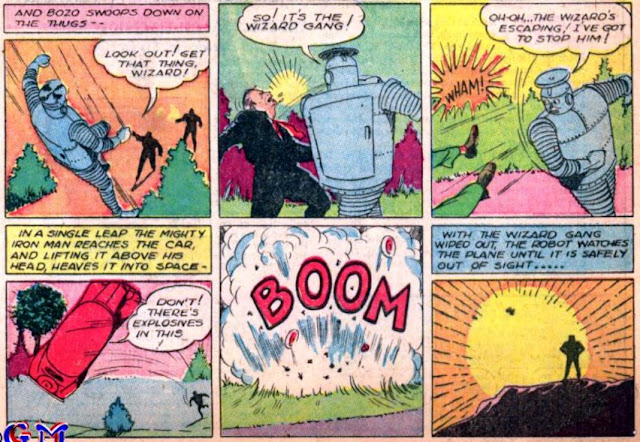
    All good things must come to an end, however, in this case in the form of Hugh Hazzard and his explosion-proof robotic exoskeleton. And of course once a superstrong robot is involved it’s just a matter of time before the Wizard meets his end in a recklessly-hurled car full of explosives.

  • MINOR SUPER-VILLAIN 758: THE WIZARD

    (Smash Comics 017, 1940)

    The Wizard is your classic big-headed smart guy gang boss (his head is on the smaller end of the bighead spectrum but he accentuates it perfectly with the most unpleasant hairstyle I have ever seen). He and his gang (the Wizard Gang, natch) have been lying low for long enough that one of them starts getting squirrely and talking about leaving, with deadly consequences. The Wizard shoots him, is what I’m saying. And what a shame, because the Wizard has just finished his master plan: put bombs in little remote controlled planes and then use them to do robberies. Not the most groundbreaking scheme in the world, but not bad.

    The plane bombs seem to be effective, as the Wizard Gang really cleans up on loot. Is there a major difference between a bomb mounted on a plane and one thrown by a guy? Evidently! 

    Even more impressively, the Wizard’s plan to just stay out of town for a while has had the intended effect of erasing all of his gang members from the collective police memory. It’s quite remarkable, though again the simpler answer might just be that they are managing to stay out of sight of the cops.

    All good things must come to an end, however, in this case in the form of Hugh Hazzard and his explosion-proof robotic exoskeleton. And of course once a superstrong robot is involved it’s just a matter of time before the Wizard meets his end in a recklessly-hurled car full of explosives.