The Curse of Skeleton Munroe

Category: Quality Comics

  • MINOR SUPER-VILLAIN 744: PROXOFF

    (Smash Comics 009, 1940)

    Proxoff is an example of a Kind of Guy that you see in Golden Age Comics: he came through the chaos of the Great War and said to himself “if this ever happens again then I’m going to come out on top.” Together with his aides van Damm and Count Trini, Proxoff has established secret airfields and fortresses in Siberia and presumably elsewhere and is waiting for his moment to swoop in and conquer the weakened nations of the world once they’ve fought one another for a while.

    Proxoff’s scheme hinges on his army of men who do not fear death, as exemplified by this would-be assassin who, having failed to kill Black X, bumps himself off using a cool skeletonizing drug (in-universe, the skeleton thing is not really for any reason, but on a meta level it points the Black X to its point of origin in Siberia).

    The “no fear of death” thing eventually proves to be Proxoff’s downfall. Firstly, they’ve been so heavily conditioned that Black X’s aide Batu is able to mesmerize an entire submarine without even trying, and secondly, the impulse to die rather than submit to capture overtakes them when Batu drops his concentration during some depth charge action and they all kill themselves rather than, say attempting to take back the ship.

    Things get even worse once Proxoff’s men see actual combat, as they don’t even see the point of returning enemy fire and prolonging their own existences. Truly this is an indictment of the trope of the henchman loyal unto death.

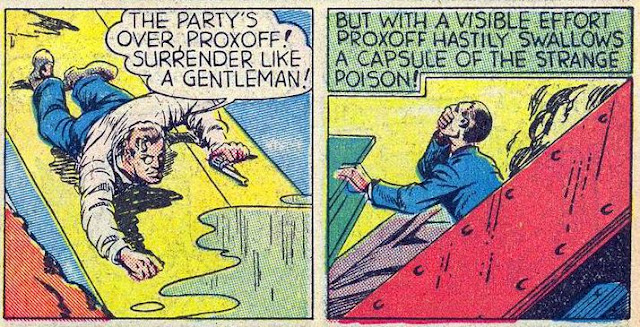
    Proxoff himself meets an ironic end: as Black X closes in on him he must resort to his own skeleton drug rather than being captured, and the caption makes sure to emphasize that he, unlike his men, does not particularly want to die.

  • MINOR SUPER-VILLAIN 743: THE VOODOO MASTER

    MINOR SUPER-VILLAIN 743: THE VOODOO MASTER

    (Smash Comics 008, 1940)

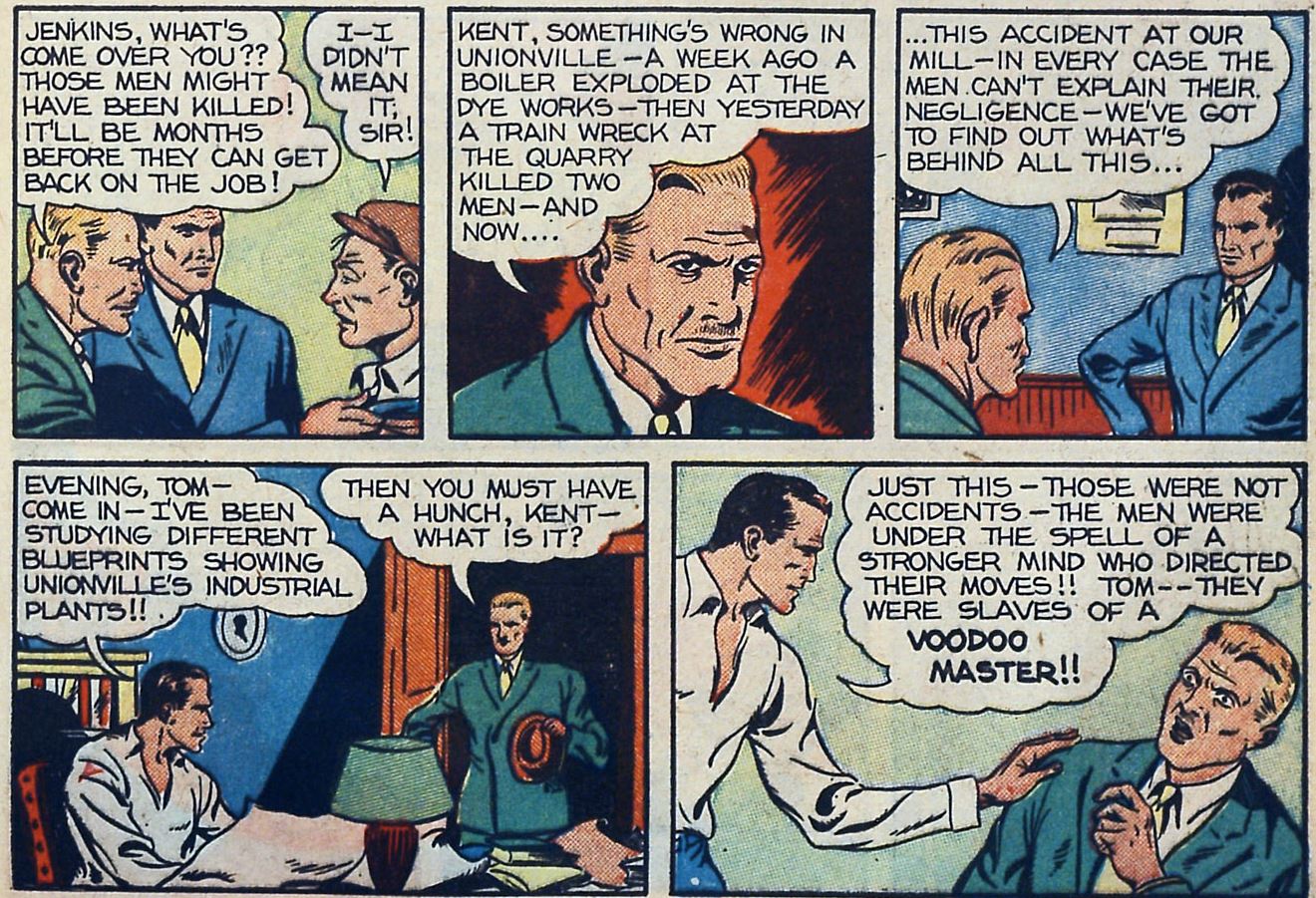
    Times are tough in Unionville: the local factories are all suffering accidents which appear to be due to systemic worker negligence but which add up to a campaign of sabotage, and since it’s a factory town, if things continue as they are then everyone is completely screwed.

    Luckily for the good folk of Unionville, the steel mill that the latest incident occurred at is managed by a guy named Tom, and Tom is friends with a fellow named Kent Thurston, and Kent Thurston is also known as the Invisible Hood, who immediately works out that the obvious culprit must be… a voodoo master!

    The Invisible Hood’s theories are vindicated when the next incident of sabotage triggers an explosion that knocks loose a couple of memories in the unwitting steelworker who set it in motion. Turns out that the mysterious villain is hiding out in the nearby abandoned castle, which is a new one on me.

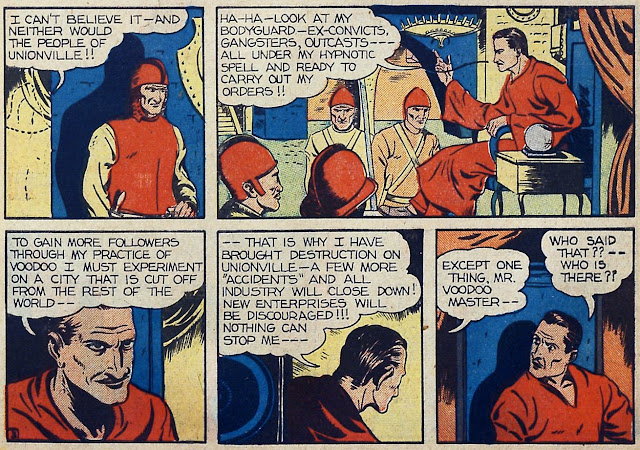
    Inside, the Hood does indeed discover the Voodoo Master (and whether this is a name he had for himself is rendered irrelevant by the fact that he accepts it as his when it is used by others – a real relief after a month or so heavy in unofficial names). The Voodoo Master has surrounded himself with crooks in faux-Medieval garb, and the goofiness of this aesthetic almost overshadows just how sinister and creepy the man’s actual scheme is: he plans to ruin Unionville financially and so isolate it from the rest of the country so that he can use its population as fodder to test out the extent of his powers. That’s some twisted 90s psychothriller shit, the sort of thing that can get very dark, very quickly.

    Invisible Hood stories aren’t very long, so there are only two further points of interest vis-a-vis the Voodoo Master. The first is that he does seem to have some credible magical acumen, as he whips up a quick anti-invisibility spell once he becomes aware of the Hood’s presence in his lair. This is honestly a lot more flexible than non-heroic comic book magic users usually are – the Voodoo Master seems to be the rare one not working off of AD&D Magic User rules.

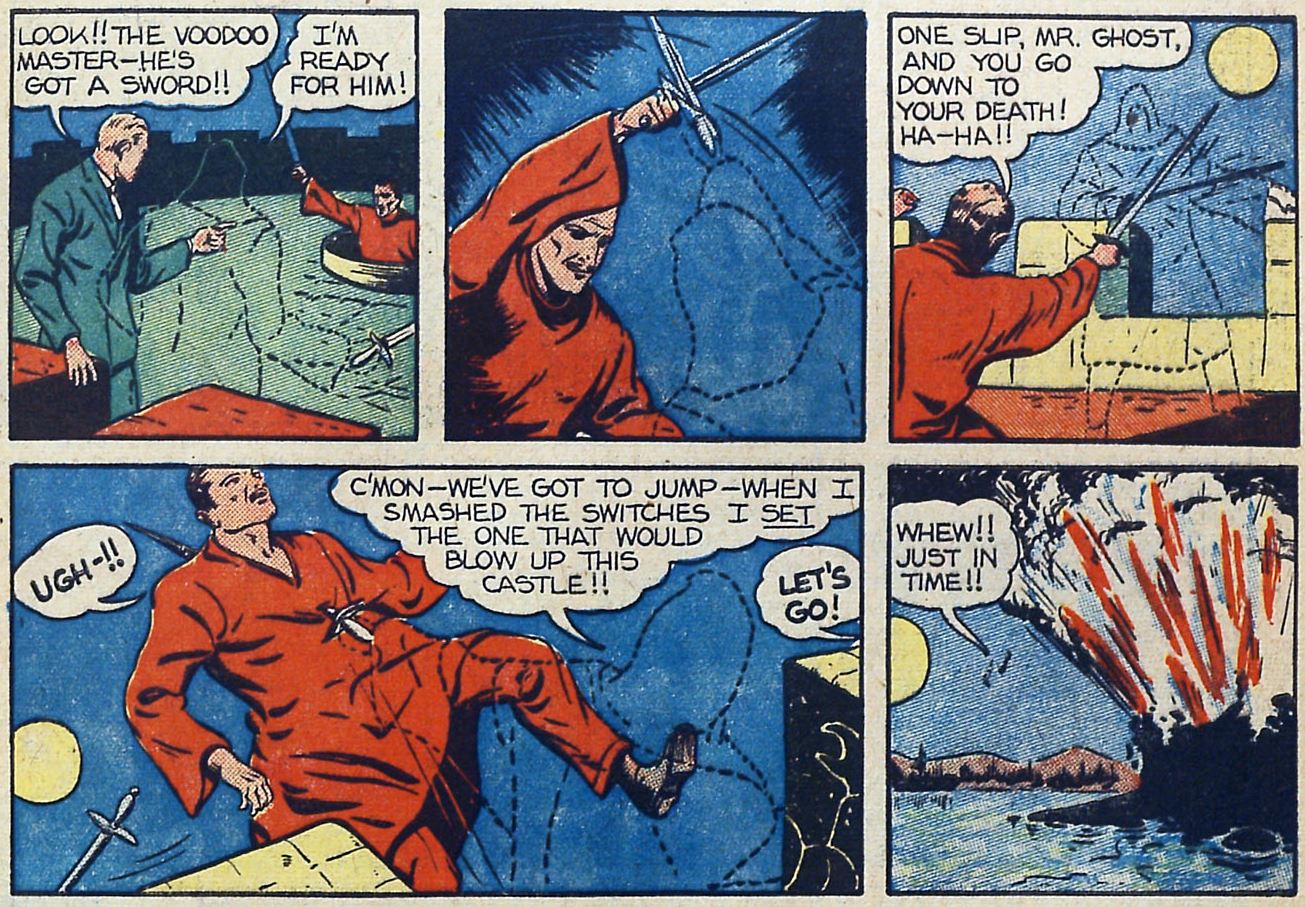
    There’s such a thing as getting too confident, however, as the Voodoo Master proves when, brimming over with hubris, he challenges an invisible man to a sword fight on his castle parapet. This ends predictably, and Unionville is saved!

  • MINOR SUPER-VILLAIN 743: THE VOODOO MASTER

    MINOR SUPER-VILLAIN 743: THE VOODOO MASTER

    (Smash Comics 008, 1940)

    Times are tough in Unionville: the local factories are all suffering accidents which appear to be due to systemic worker negligence but which add up to a campaign of sabotage, and since it’s a factory town, if things continue as they are then everyone is completely screwed.

    Luckily for the good folk of Unionville, the steel mill that the latest incident occurred at is managed by a guy named Tom, and Tom is friends with a fellow named Kent Thurston, and Kent Thurston is also known as the Invisible Hood, who immediately works out that the obvious culprit must be… a voodoo master!

    The Invisible Hood’s theories are vindicated when the next incident of sabotage triggers an explosion that knocks loose a couple of memories in the unwitting steelworker who set it in motion. Turns out that the mysterious villain is hiding out in the nearby abandoned castle, which is a new one on me.

    Inside, the Hood does indeed discover the Voodoo Master (and whether this is a name he had for himself is rendered irrelevant by the fact that he accepts it as his when it is used by others – a real relief after a month or so heavy in unofficial names). The Voodoo Master has surrounded himself with crooks in faux-Medieval garb, and the goofiness of this aesthetic almost overshadows just how sinister and creepy the man’s actual scheme is: he plans to ruin Unionville financially and so isolate it from the rest of the country so that he can use its population as fodder to test out the extent of his powers. That’s some twisted 90s psychothriller shit, the sort of thing that can get very dark, very quickly.

    Invisible Hood stories aren’t very long, so there are only two further points of interest vis-a-vis the Voodoo Master. The first is that he does seem to have some credible magical acumen, as he whips up a quick anti-invisibility spell once he becomes aware of the Hood’s presence in his lair. This is honestly a lot more flexible than non-heroic comic book magic users usually are – the Voodoo Master seems to be the rare one not working off of AD&D Magic User rules.

    There’s such a thing as getting too confident, however, as the Voodoo Master proves when, brimming over with hubris, he challenges an invisible man to a sword fight on his castle parapet. This ends predictably, and Unionville is saved!

  • MINOR SUPER-VILLAIN 741: THE MASKED ONE

    MINOR SUPER-VILLAIN 741: THE MASKED ONE

    (Smash Comics 007, 1940)

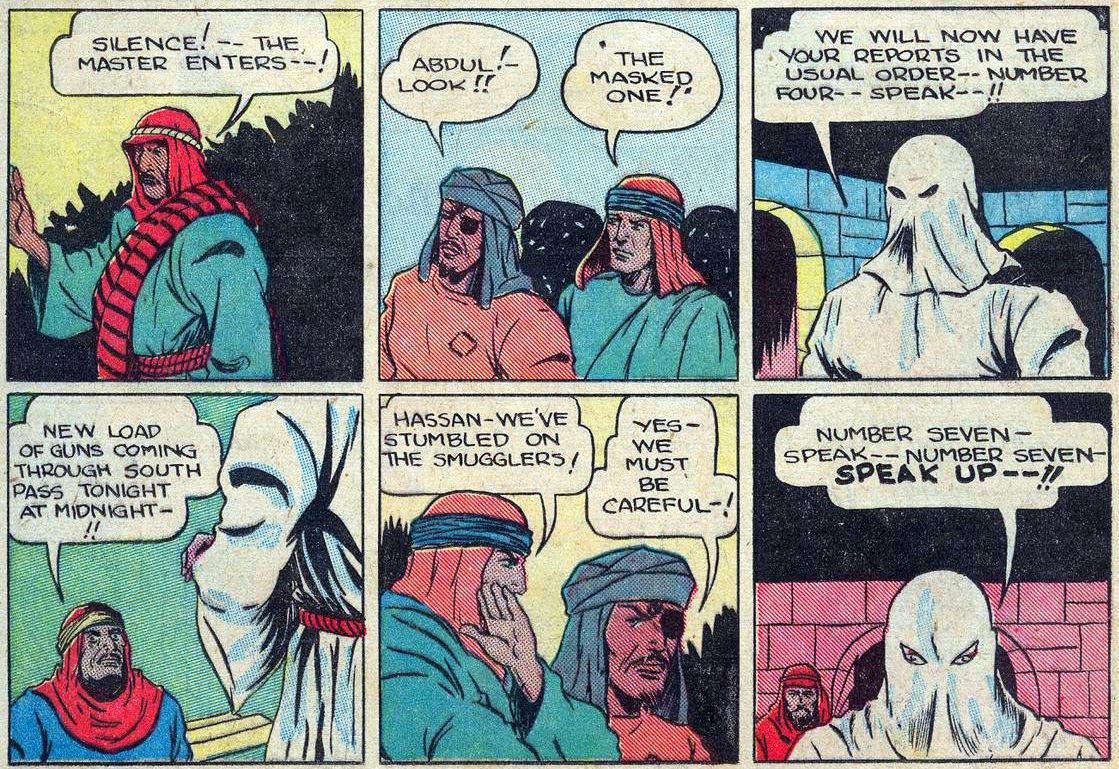
    Sometimes a villain is as simple as a hooded gun-runner called the Masked One, and that’s who we have here. Also, he is captured by Quality Comics adventure character Abdul the Arab, a name that isn’t technically problematic but sure does make the corner of your eye twitch when you read it (plus the comics it appears in meet all the problematic specifications, so your eye is right to react).

    The Masked One is actually Webb, a character who could not be more clearly signposted as the prime suspect if his name was Eno Deksam but who elicits the same amount of surprise when unmasked as Abdul’s own mother might. Perhaps he was just giving the Masked One the benefit of the doubt in not assuming he’d be so obvious.

  • MINOR SUPER-VILLAIN 739: THE AVENGER

    (Smash Comics 003, 1939 – Smash Comics 012, 1940) 

    The Avenger is a cottage-industry villain, which is a term I just made up for particular kind of villain that you saw a fair amount in the Golden Age and then again in 1980s cartoons, wherein battling and thwarting them is the sole focus of a hero’s career – see also Mr H and the Conqueror.

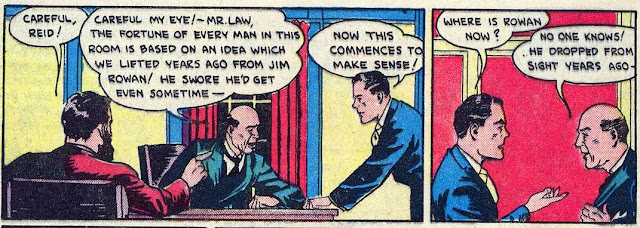
    The Avenger is also a revenge-focused villain: he is really Jim Rowan, a man who was swindled out of an unspecified invention decades earlier and now seeks to ruin and murder the thirteen men who did the swindling and have since grown wealthy off of it. This is a pretty reasonable motivation for revenge, and the Avenger might even have managed to come across as a somewhat sympathetic figure if he gave even one single damn about who else he might harm or kill in pursuit of his quest. His various schemes:

    – bankrupt airline owner Carter by blowing up his passenger planes mid-flight

    – murder electric company owner Amos Reid and frame his son George for the crime

    – ruin railroad owner Edgar Karr by wrecking his trains

    – incite mob violence against drug manufacturer Roger Carlin by tainting his products and distributing them to the poor

    – just some low-effort murder attempts against group member Albert Mills

    – ruin Rolls the bus company owner by stealing his buses, passengers and all 

    – attempt to murder industrialist Roger O. Gates directly (but mistakenly kill a man who looks like him)

    – blow up the munitions factory of Mr Arms

    There’s also a threat by the Avenger against nonspecific industrialist Albert Lewis that turns out to be bogus because Lewis has been imprisoned and impersonated by Rowan/the Avenger in order to aid his plan to destroy the others. The “death threat” is in actuality a ruse to get detective John Law alone and kill him. This leads to the discovery of another revenge scheme:

    – lock Albert Lewis up in an insane asylum and take his place while acting as the Avenger, thus not only framing him but leaving him somewhere where he can’t even tell anyone about it or be counted as even more insane

    None of these schemes actually succeed, however, because the 13 men have hired scientist/lawyer/detective John Law (aka the Scientective) to discover just who is targeting them and why. Like fellow Henry Campbell creations Wizard Wells and Dean Denton, Law is a scientific genius who uses his knowledge and inventions to further his crusade against crime. He never quite gets ahead of the Avenger, but he’s cagey enough to thwart his schemes before they can reach murderous fruition. Except for Amos Reid’s murder, of course, because that was the first step in a plan to ruin Reid’s legacy. And that one innocent man who died, that was a shame. The dozens of people who died on Carter’s planes don’t count, of course, because that happened before Law was hired. Look, the important thing is that twelve wealthy men were saved from facing the consequences of their actions.

    The Avenger/John Law stories are entertaining stuff but nothing to write home about, mostly because both characters tend to employ what was cutting-edge or unusual science c.1940 that today is either unremarkable (remote controlled aircraft, thermite, dry ice) or is still a bit sci-fi seeming (magnetic levitation, increasing the skin’s permeability via ultrasound) but all of it is applied in this very dry, matter-of-fact, everyone-is-wearing-a-suit way that drains some of the wonder and majesty from the proceedings.

    A couple of interesting things about the Avenger:


    The Avenger isn’t a habitual costume wearer but he does throw on a hood a couple of times and I thought I’d showcase that. I prefer the red one!

    This deathtrap, which involves a rapidly-spinning propeller and a strobe light synched to its movements to create the illusion of a stationary bar, is very fun and unique! Strobe lights! Very futuristic!

    Also fun: Law’s method for discovering the identity of the Avenger. He has thirteen phone lines installed, each with its own unique number, and gives one to each of his thirteen suspects. He then issues a provocative statement to the press and simply waits to see which phone rings when the Avenger calls to yell at him. This is, frankly, an amazing hack for any situation involving multiple suspects.

    I can only assume that the Avenger’s death came as a direct result of the series being discontinued – John Law, up to this point a fairly nonviolent man, abruptly shifts gears and blows the villain out of the skies with his own drone bomb. It’s an ignominious end to be sure.

    REVENGE KILLER SCORE: 1/13 – a pretty poor showing, due mostly to the Avenger’s desire to draw out his targets’ suffering. If he had gone for the kill straight away he might have done a bit better.

  • MINOR SUPER-VILLAIN 739: THE AVENGER

    (Smash Comics 003, 1939 – Smash Comics 012, 1940) 

    The Avenger is a cottage-industry villain, which is a term I just made up for particular kind of villain that you saw a fair amount in the Golden Age and then again in 1980s cartoons, wherein battling and thwarting them is the sole focus of a hero’s career – see also Mr H and the Conqueror.

    The Avenger is also a revenge-focused villain: he is really Jim Rowan, a man who was swindled out of an unspecified invention decades earlier and now seeks to ruin and murder the thirteen men who did the swindling and have since grown wealthy off of it. This is a pretty reasonable motivation for revenge, and the Avenger might even have managed to come across as a somewhat sympathetic figure if he gave even one single damn about who else he might harm or kill in pursuit of his quest. His various schemes:

    – bankrupt airline owner Carter by blowing up his passenger planes mid-flight

    – murder electric company owner Amos Reid and frame his son George for the crime

    – ruin railroad owner Edgar Karr by wrecking his trains

    – incite mob violence against drug manufacturer Roger Carlin by tainting his products and distributing them to the poor

    – just some low-effort murder attempts against group member Albert Mills

    – ruin Rolls the bus company owner by stealing his buses, passengers and all 

    – attempt to murder industrialist Roger O. Gates directly (but mistakenly kill a man who looks like him)

    – blow up the munitions factory of Mr Arms

    There’s also a threat by the Avenger against nonspecific industrialist Albert Lewis that turns out to be bogus because Lewis has been imprisoned and impersonated by Rowan/the Avenger in order to aid his plan to destroy the others. The “death threat” is in actuality a ruse to get detective John Law alone and kill him. This leads to the discovery of another revenge scheme:

    – lock Albert Lewis up in an insane asylum and take his place while acting as the Avenger, thus not only framing him but leaving him somewhere where he can’t even tell anyone about it or be counted as even more insane

    None of these schemes actually succeed, however, because the 13 men have hired scientist/lawyer/detective John Law (aka the Scientective) to discover just who is targeting them and why. Like fellow Henry Campbell creations Wizard Wells and Dean Denton, Law is a scientific genius who uses his knowledge and inventions to further his crusade against crime. He never quite gets ahead of the Avenger, but he’s cagey enough to thwart his schemes before they can reach murderous fruition. Except for Amos Reid’s murder, of course, because that was the first step in a plan to ruin Reid’s legacy. And that one innocent man who died, that was a shame. The dozens of people who died on Carter’s planes don’t count, of course, because that happened before Law was hired. Look, the important thing is that twelve wealthy men were saved from facing the consequences of their actions.

    The Avenger/John Law stories are entertaining stuff but nothing to write home about, mostly because both characters tend to employ what was cutting-edge or unusual science c.1940 that today is either unremarkable (remote controlled aircraft, thermite, dry ice) or is still a bit sci-fi seeming (magnetic levitation, increasing the skin’s permeability via ultrasound) but all of it is applied in this very dry, matter-of-fact, everyone-is-wearing-a-suit way that drains some of the wonder and majesty from the proceedings.

    A couple of interesting things about the Avenger:


    The Avenger isn’t a habitual costume wearer but he does throw on a hood a couple of times and I thought I’d showcase that. I prefer the red one!

    This deathtrap, which involves a rapidly-spinning propeller and a strobe light synched to its movements to create the illusion of a stationary bar, is very fun and unique! Strobe lights! Very futuristic!

    Also fun: Law’s method for discovering the identity of the Avenger. He has thirteen phone lines installed, each with its own unique number, and gives one to each of his thirteen suspects. He then issues a provocative statement to the press and simply waits to see which phone rings when the Avenger calls to yell at him. This is, frankly, an amazing hack for any situation involving multiple suspects.

    I can only assume that the Avenger’s death came as a direct result of the series being discontinued – John Law, up to this point a fairly nonviolent man, abruptly shifts gears and blows the villain out of the skies with his own drone bomb. It’s an ignominious end to be sure.

    REVENGE KILLER SCORE: 1/13 – a pretty poor showing, due mostly to the Avenger’s desire to draw out his targets’ suffering. If he had gone for the kill straight away he might have done a bit better.

  • MINOR SUPER-VILLAIN 738: KADU-KAN

    (Smash Comics 006, 1940)

    Time for a very obscure character indeed: Kadu-Kan, who put out Black X’s eye in an attempt to induce him to spill some military secrets. Kadu-Kan is therefore a major figure in the history of the character to be mentioned in one panel and never again, and then only to provide a reason for Black X’s ever-present monocle.

    (Speaking of Black X and setups with no real payoff, the first Black X adventure in Feature Funnies 013, 1938 includes this enemy spy who is a double of Black X and escapes into the night at the end of the story, to never return)

  • NOTES: MARCH 2025

    Supercut Updates:

    Fresh new Skeletons With Jobs and Looming Spectres of Death await ye.

    Abandoned Ideas: 

    I came very close to assembling a supercut of Women Kissing the Protagonist in the Last Panel While Their Father Looks Coyly On, but it would be way too labour-intensive to assemble. Plus probably a bit creepy to see all in one place.

    Anti-Drug Propaganda:

    Chic Carter investigates a dangerous drug ring after a college kid goes nuts and kills his friend… ON WEED. (Smash Comics 009, 1940)

    Cops Shooting at Fleeing Suspects:

    Coupla crooks running from the police get fired upon. (Smash Comics 010, 1940)

    Dinosaurs:

    Shock Gibson discovers a lost plateau full of dinosaurs, including this, the grodiest pterodactyl I have ever seen. I love it. (Speed Comics 005, 1940)

  • NOTES: MARCH 2025

    Supercut Updates:

    Fresh new Skeletons With Jobs and Looming Spectres of Death await ye.

    Abandoned Ideas: 

    I came very close to assembling a supercut of Women Kissing the Protagonist in the Last Panel While Their Father Looks Coyly On, but it would be way too labour-intensive to assemble. Plus probably a bit creepy to see all in one place.

    Anti-Drug Propaganda:

    Chic Carter investigates a dangerous drug ring after a college kid goes nuts and kills his friend… ON WEED. (Smash Comics 009, 1940)

    Cops Shooting at Fleeing Suspects:

    Coupla crooks running from the police get fired upon. (Smash Comics 010, 1940)

    Dinosaurs:

    Shock Gibson discovers a lost plateau full of dinosaurs, including this, the grodiest pterodactyl I have ever seen. I love it. (Speed Comics 005, 1940)

  • NOTES: FEBRUARY 2025

    Secret Knowledge: 

    This is mostly me not wanting to sign up for a Fandom account but confidential to the Dickie Dean page on the Public Domain Super Heroes wiki:

    -Dickie Dean is said to be 14 in the splash blurb of his first appearance in Silver Streak Comics 003

    -in the same story he receives a telegram from J Edgar Hoover in which he is addressed as Richard 

    -in Silver Streak Comics 006 he is addressed as “Richard Bruce Dean”

    Memes of Yore – Hamburgers: 

    Can’t have a hamburger without onions. (Feature Funnies 048, 1948)

    Honours:

    Swashbucking reporter Chic Carter receives the Moravian Military Cross for his role in fighting off an invasion force. (Smash Comics 006, 1940)