The Curse of Skeleton Munroe

Category: Quality Comics

  • MAD AND CRIMINAL SCIENTIST ROUND-UP 014

    Don’t bother asking to see their degrees.

    This unnamed scientist has been kidnapping preteens and changing them into hulking brutes via some pretty fantastical brain surgery. He of course gets his ass fatally handed to him by the Red Panther but not before he goes on about producing a new super race and as always I have to question your devotion to science if you think that your physical alterations to these kids are going to be passed on. Who are you, Lamarck? You’re going to be performing brain operations on babies all day every day. (Jungle Comics 009, 1940)

    Von Blumb is a scientist who is saved from death and treated well by Camilla in her Lost Empire, then heads off into the wilderness to further his research. When he doesn’t return after a few weeks, Camilla and Sir Champion head out to check on him and he repays their consideration by capturing them and subjecting them to his reducing serum and adding them to his collection of unwilling subjects. Long story short, they get loose, defeat his pet spider in gladiatorial combat and he gets squashed by a rock. (Jungle Comics 012, 1940)

    Von Lohfer is a scientist with a grudge against John D Rockefeller stand-in J B Rockland, who called him a fake and ruined his life. But if Rockland was claiming that von Lohfer was unable to mind control a bunch of cops into doing his bidding he was dead wrong, because that’s just what he does until he is ultimately stopped by Quicksilver. (National Comics 005, 1940)

    Dr Morbidd has a great name and a really remarkable facial deformity, and he’s been using science to raise people from the dead to do his bidding. This is all solid stuff but it doesn’t amount to much actual super-villainy. There’s some allusion to Morbidd’s science zombies being sent out to do murders but the major thing he seems to be interested in is being a real creep to this one young woman he has captured. It would be quite narratively satisfying if he met his end at the hands of his own creations, but sadly he gets his head blown clean off when Merlin the Magician reflects his own death ray beam back at him. (National Comics 005, 1940)

  • NOTES – JANUARY 2025

    Heaven help me, I looked forward to the 1950s issues of Planet Comics to see what the Gale Allen feature ended up like and boy oh boy do I regret it. It’s one thing to only read comics from 1940, but seeing the improvements to the form after a decade or so makes it hard to go back. But I must soldier on!

    Happy New Year!

    Infographics:

    A conceptual drawing of a spaceship and some speculative facts about space travel c.1940 (Planet Comics 009, 1940)

    Ephemera:

    This is a bit out of order seeing as I have a two week or so buffer of posts most of the time and I write the Notes bits as they occur to me, but a real theme that has emerged as I’ve read the 1940 issues of Planet Comics has been that Fiction house was just repurposing whole stories left and right, including ones that were written and drawn for characters from other comic book companies. To be clear, I don’t think that this was a shady business practice or anything, just that the industry was still new and that almost every book was an anthology title that features were being shuffled in and out of constantly – it’s no wonder that artists were left with finished stories that were no longer wanted from time to time – why not just slap a new name on the hero and publish it?

    With that in mind, I am 100% confident in saying that this first Crash Parker story started life as a Cyclone story over at Quality Comics – the setup of colonizing a new planet after a space race and even the look of the evil Martian king are dead giveaways. Good news for fans of Cyclone, the character who appeared in 4 comics in 1940, I guess. (Planet Comics 009, 1940)

    Honours:

    American pilot Ted O’Neil is given an unspecified medal for bringing down an Axis superweapon. (Prize Comics 004, 1940)

    Names:

    The third case tackled by Fox Features mid tier hero the Eagle is catching a gang of pickpockets, and that gang’s lead is named Ben Dread, which I think is unnecessarily cool. Save the good names for more interesting criminals, I say. (Science Comics 003, 1940) 

    Drawn Without Reference:

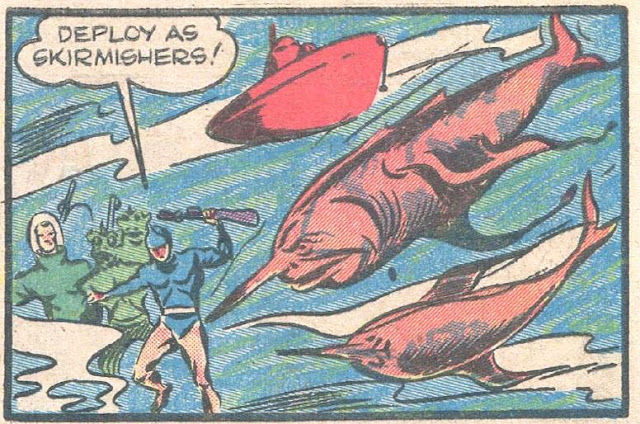
    This might just be the bold new look the narwhal have been looking for. (Science Comics 008, 1940)

  • NOTES – JANUARY 2025

    Heaven help me, I looked forward to the 1950s issues of Planet Comics to see what the Gale Allen feature ended up like and boy oh boy do I regret it. It’s one thing to only read comics from 1940, but seeing the improvements to the form after a decade or so makes it hard to go back. But I must soldier on!

    Happy New Year!

    Infographics:

    A conceptual drawing of a spaceship and some speculative facts about space travel c.1940 (Planet Comics 009, 1940)

    Ephemera:

    This is a bit out of order seeing as I have a two week or so buffer of posts most of the time and I write the Notes bits as they occur to me, but a real theme that has emerged as I’ve read the 1940 issues of Planet Comics has been that Fiction house was just repurposing whole stories left and right, including ones that were written and drawn for characters from other comic book companies. To be clear, I don’t think that this was a shady business practice or anything, just that the industry was still new and that almost every book was an anthology title that features were being shuffled in and out of constantly – it’s no wonder that artists were left with finished stories that were no longer wanted from time to time – why not just slap a new name on the hero and publish it?

    With that in mind, I am 100% confident in saying that this first Crash Parker story started life as a Cyclone story over at Quality Comics – the setup of colonizing a new planet after a space race and even the look of the evil Martian king are dead giveaways. Good news for fans of Cyclone, the character who appeared in 4 comics in 1940, I guess. (Planet Comics 009, 1940)

    Honours:

    American pilot Ted O’Neil is given an unspecified medal for bringing down an Axis superweapon. (Prize Comics 004, 1940)

    Names:

    The third case tackled by Fox Features mid tier hero the Eagle is catching a gang of pickpockets, and that gang’s lead is named Ben Dread, which I think is unnecessarily cool. Save the good names for more interesting criminals, I say. (Science Comics 003, 1940) 

    Drawn Without Reference:

    This might just be the bold new look the narwhal have been looking for. (Science Comics 008, 1940)

  • REAL PERSON ROUND-UP 008

    If they’re real then why are they in a comic book?

    Anastacio Somoza García:

    The Shield meets with the President of Nicaragua and as per usual the artist did not bother to check what the President of Nicaragua actually looked like. (Pep Comics 006, 1940)

    Clark Gable:

    Boxer Kayo Ward stars in a movie (“Hot Lips and Hot Fists,” a riff on 1933’s “The Prizefighter and the Lady” starring real-life boxers Primo Carnera, Max Baer and Jack Dempsey) and the opening night crowd includes not only Clark Gable but Edgar Bergen and Charlie McCarthy, all under their real names in a wild break from comics custom. (Pep Comics 008, 1940)

    FDR:

    Misc minor appearances: 

    Meets with the Shield (Pep Comics 006, 1940)

    Shown blowing off a cabinet meeting to watch a boxing match (Pep Comics 007, 1940)

    J Edgar Hoover:

    He’s never actually named but “the Chief of the FBI” and only person who knows the secret identity of Joe Higgins, aka the Shield, is clearly supposed to be J Edgar Hoover, and they do occasionally refer to him by his surname. (Pep Comics 001-004, 006-009, 1940)

    Joe DiMaggio:

    Famed baseball player Slugger Madaggio (or possibly MaDaggio) is murdered mid-game for failing to pay protection money. Two other players, Wheezy Seen and Cal Bubble, as well as a manager named Terrier are mentioned in the story but I simply do not know enough about baseball to know who they are references to, if anyone. Also, the lady in the above picture is Madaggio’s wife and thus an oblique reference to actress Dorothy Arnold. (Pep Comics 007, 1940)

    Joe Louis:

    Boxer Kayo Ward is signed to fight Joe Louis for the heavyweight boxing championship, only Kayo is then kidnapped and replaced with a double by gamblers looking to fix the match, and when he manages to get free and fight for real the kidnapping has had enough of a negative effect on him that Louis sportingly calls the fight off rather than beat Ward to a pulp. They’re supposed to reconvene in six months – will it happen in 1941? (Pep Comics 006-007, 1940)

    Mata Hari:

    Sent to Antwerp to extract a British general’s daughter before the Nazi invasion, army hero Sergeant Boyle engages in some classic comedy of errors shtick as he accidentally brings back the wrong woman, only to find out that he has inadvertently captured the famed spy “Hatter Mary.” (Pep Comics 008, 1940)

    PT Barnum:

    There are a lot of comic book circus mans who are some sort of version of PT Barnum but this guy, Barnham by name, really captures the spirit of the man with his exploitation of Paul Bunyan’s ape-man friend. (National Comics 006, 1940)

    the Seven Dwarfs:

    The “Prince Buttonhead” feature in Pep Comics is from the school of one-page comic book humour strips that are best described as incoherent, with only the feeblest attempt at jokes or even a structured plot. The Five Dopes here (Block-Head, Lunk-Head, Stupid, Useless and Lame-Brain) are interesting for being so very on-model as a Seven Dwarfs parody. (Pep Comics 005, 1940)

    Various Golden Age Comics Creators:

    During Kayo Ward’s rise to the top he fights a lot of also-rans, and compiling a splash panel of them dovetailed nicely with the grand comic book tradition of using your coworkers’ names for mildly embarrassing purposes. In order (and focusing on MLJ credits because it’s an illustrious group), we have: 

    Butch Blezard – Okay I have no idea who this guy is. Bad start.

    “Canvas-Back” Shorten – Harry Shorten, co-creator of the Shield

    “Chick” Biro – Charles Biro, creator of Steel Sterling

    “Biff” Zoffer – Another mystery character

    “Mush” Meskin – Mort Meskin, prolific MLJ illustrator

    “Flash” Ashe – Edd Ashe, illustrator of the Wizard

    “Nosedive” Novick – Irv Novick, co-creator of the Shield

    “50 Second” Streeter – Lin Streeter, MLJ illustrator

    “Slam” Sundell – Abner Sundell, MLJ editor

    “Socker” Benson – probably not a reference, as he was a boxer faced by Ward in a prior issue. (Pep Comics 005, 1940)

    Pep Comics was a real hotbed of this kind of thing in 1940, as seen in this ad for “Meskin’s Matzhos”  (Pep Comics 007, 1940)

    Here’s Charles Biro ditching work to catch a boxing match. (Pep Comics 007, 1940)

    Handprints outside Grauman’s Chinese Theatre, featuring “Biro W. Mouskin,” “Sundell something (possibly M. Wood? as in Bob Wood, co-creator of Kayo Ward?) as well as “Mickey Looney” and “Joe E. Frown” (Mickey Rooney and Joe E. Brown, natch) (Pep Comics 008, 1940)

    And finally, the movie that Kayo Ward stars in is a Sundell Production. (Pep Comics 008, 1940)

    Unknown:

    The specifics of Jimmie Fiddle here, with his entertainment column in the NY Reflection, and especially the detail of him rating things with orchids, ping my “this is a version of a real guy” sense quite hard, but I can’t find a good thread to grab onto for a search. (Pep Comics 008, 1940)

    EDIT: a list of New York periodicals of the 1930s turned up the NY Review as a possible original of the NY Reflection, but any further investigation is hampered by the popularity of the New York Review of Books. It’s a dead end!

    ACTUAL UPDATE: We found him!

  • REAL PERSON ROUND-UP 008

    If they’re real then why are they in a comic book?

    Anastacio Somoza García:

    The Shield meets with the President of Nicaragua and as per usual the artist did not bother to check what the President of Nicaragua actually looked like. (Pep Comics 006, 1940)

    Clark Gable:

    Boxer Kayo Ward stars in a movie (“Hot Lips and Hot Fists,” a riff on 1933’s “The Prizefighter and the Lady” starring real-life boxers Primo Carnera, Max Baer and Jack Dempsey) and the opening night crowd includes not only Clark Gable but Edgar Bergen and Charlie McCarthy, all under their real names in a wild break from comics custom. (Pep Comics 008, 1940)

    FDR:

    Misc minor appearances: 

    Meets with the Shield (Pep Comics 006, 1940)

    Shown blowing off a cabinet meeting to watch a boxing match (Pep Comics 007, 1940)

    J Edgar Hoover:

    He’s never actually named but “the Chief of the FBI” and only person who knows the secret identity of Joe Higgins, aka the Shield, is clearly supposed to be J Edgar Hoover, and they do occasionally refer to him by his surname. (Pep Comics 001-004, 006-009, 1940)

    Joe DiMaggio:

    Famed baseball player Slugger Madaggio (or possibly MaDaggio) is murdered mid-game for failing to pay protection money. Two other players, Wheezy Seen and Cal Bubble, as well as a manager named Terrier are mentioned in the story but I simply do not know enough about baseball to know who they are references to, if anyone. Also, the lady in the above picture is Madaggio’s wife and thus an oblique reference to actress Dorothy Arnold. (Pep Comics 007, 1940)

    Joe Louis:

    Boxer Kayo Ward is signed to fight Joe Louis for the heavyweight boxing championship, only Kayo is then kidnapped and replaced with a double by gamblers looking to fix the match, and when he manages to get free and fight for real the kidnapping has had enough of a negative effect on him that Louis sportingly calls the fight off rather than beat Ward to a pulp. They’re supposed to reconvene in six months – will it happen in 1941? (Pep Comics 006-007, 1940)

    Mata Hari:

    Sent to Antwerp to extract a British general’s daughter before the Nazi invasion, army hero Sergeant Boyle engages in some classic comedy of errors shtick as he accidentally brings back the wrong woman, only to find out that he has inadvertently captured the famed spy “Hatter Mary.” (Pep Comics 008, 1940)

    PT Barnum:

    There are a lot of comic book circus mans who are some sort of version of PT Barnum but this guy, Barnham by name, really captures the spirit of the man with his exploitation of Paul Bunyan’s ape-man friend. (National Comics 006, 1940)

    the Seven Dwarfs:

    The “Prince Buttonhead” feature in Pep Comics is from the school of one-page comic book humour strips that are best described as incoherent, with only the feeblest attempt at jokes or even a structured plot. The Five Dopes here (Block-Head, Lunk-Head, Stupid, Useless and Lame-Brain) are interesting for being so very on-model as a Seven Dwarfs parody. (Pep Comics 005, 1940)

    Various Golden Age Comics Creators:

    During Kayo Ward’s rise to the top he fights a lot of also-rans, and compiling a splash panel of them dovetailed nicely with the grand comic book tradition of using your coworkers’ names for mildly embarrassing purposes. In order (and focusing on MLJ credits because it’s an illustrious group), we have: 

    Butch Blezard – Okay I have no idea who this guy is. Bad start.

    “Canvas-Back” Shorten – Harry Shorten, co-creator of the Shield

    “Chick” Biro – Charles Biro, creator of Steel Sterling

    “Biff” Zoffer – Another mystery character

    “Mush” Meskin – Mort Meskin, prolific MLJ illustrator

    “Flash” Ashe – Edd Ashe, illustrator of the Wizard

    “Nosedive” Novick – Irv Novick, co-creator of the Shield

    “50 Second” Streeter – Lin Streeter, MLJ illustrator

    “Slam” Sundell – Abner Sundell, MLJ editor

    “Socker” Benson – probably not a reference, as he was a boxer faced by Ward in a prior issue. (Pep Comics 005, 1940)

    Pep Comics was a real hotbed of this kind of thing in 1940, as seen in this ad for “Meskin’s Matzhos”  (Pep Comics 007, 1940)

    Here’s Charles Biro ditching work to catch a boxing match. (Pep Comics 007, 1940)

    Handprints outside Grauman’s Chinese Theatre, featuring “Biro W. Mouskin,” “Sundell something (possibly M. Wood? as in Bob Wood, co-creator of Kayo Ward?) as well as “Mickey Looney” and “Joe E. Frown” (Mickey Rooney and Joe E. Brown, natch) (Pep Comics 008, 1940)

    And finally, the movie that Kayo Ward stars in is a Sundell Production. (Pep Comics 008, 1940)

    Unknown:

    The specifics of Jimmie Fiddle here, with his entertainment column in the NY Reflection, and especially the detail of him rating things with orchids, ping my “this is a version of a real guy” sense quite hard, but I can’t find a good thread to grab onto for a search. (Pep Comics 008, 1940)

    EDIT: a list of New York periodicals of the 1930s turned up the NY Review as a possible original of the NY Reflection, but any further investigation is hampered by the popularity of the New York Review of Books. It’s a dead end!

    ACTUAL UPDATE: We found him!

  • GENERIC COSTUMED VILLAIN ROUND-UP 017

    GENERIC COSTUMED VILLAIN ROUND-UP 017

    Buncha mooks this time.

    The ship that picked up scientist-adventurer Dean Denton and his pals from the island of Baron Blood just so happened to have a pseudo-Nazi spy (fake name Lieutenant James, code name K-192, real name unknown) committing murders on it for unclear reasons. Despite composing a crime scene to contain nothing but clues pointing to other members of the crew Denton rounds him up pretty quickly. (Masked Marvel 003, 1940)

    Pilot Prop Powers has to defend his ship and his cargo of gold bullion from this air pirate and his scurvy crew, and the story ends up glossing over his huge flying aerodrome a bit. Well, I think it’s cool, unnamed air pirate captain. I’m sorry they blew it up. (National Comics 001, 1940)

    Klotz, aka the Master Spy, has the distinction of being the first foe to battle the Shield. His greatest moment is pictured above, as the Shield is so absorbed in reading spy files that he doesn’t notice approximately fifty boxes of TNT being piled up behind him. Klotz also returns in the 1984 series The Original Shield because there’s nothing like battling an extremely old man to make for an exciting comic experience. (Pep Comics 001, 1940)

    This bunch of clowns work for a mysterious figure who has been murdering Hollywood stars in connection with a jewel-smuggling ring. They’re not in the story for very long before their employer murders them all with mustard gas – the henchman’s greatest occupational hazard is, as always, the boss. Why do all these murders over some simple smuggled jewelry? Because the mastermind is Biff Crossley, himself a famous actor, and he wants nobody who can possibly tie him to the crime left alive, that’s why. (Pep Comics 008, 1940)

    THE SUPER-VILLAINS OF HOLLYWOOD PODCAST: The super-villainy might be a bit generic but this story is fodder for a whole season of tSVoHpod: Crossley murders two other stars (one of them inside Grauman’s Chinese Theatre, using a bullet-firing compact) and tries to frame a third by pretending to be a target himself, he bumps off his own men, the Shield is there, and the whole thing ends with Crossley’s defiant suicide. Sensational! This is podcasting, baby!

  • FASCIST GOON CLEARING HOUSE 008

    Will they ever mend their evil ways?

    Like the Purple Shirts before them, the Black Legion exists mainly to represent the Forces of Unamericanism that Uncle Sam stands against, as they seek to win the hearts and minds of in this case the small Midwest community of Glen Valley (by shooting anyone who resists). The only real bit of innovation that they bring to the table are these rad machine gun motorcycles they go into battle on.

    They also have a nose cutout on their masks, which indicates that they prioritize comfort over style. (National Comics 005, 1940)

    The unnamed group that Uncle Sam fights in the next issue has a similar uniform in warm brown tones, and makes the interesting choice to wear it even while operating their submersible aircraft carrier base in the middle of the Pacific Ocean. That’s some real dedication to secrecy. (National Comics 006, 1940)

    The European-American Band, yet another take on the German-American Bund, is deceived and then dismantled in fairly short order by vacationing cartoonist-detective Pen Miller. (National Comics 006, 1940)

    No comic book analog of the German-American Bund is particularly kind in its depiction but the Moronia Bund might just be the most insulting. I’m not sure why all the Moronian Americans are bald – it doesn’t seem to be a requirement for entry as Perry “the Press Guardian” Chase is able to join up as a junior member to spy on them despite his luscious black locks. (Pep Comics 002, 1940)

    (surprisingly, the Moronia Bund – under the slightly more sleek name “the Moroniabund” manages to scrape up another bunch of bald fascists to make a second appearance in Pep Comics 003, but gets its ass just as thoroughly kicked by the Press Guardian as the first time)

  • FASCIST GOON CLEARING HOUSE 008

    Will they ever mend their evil ways?

    Like the Purple Shirts before them, the Black Legion exists mainly to represent the Forces of Unamericanism that Uncle Sam stands against, as they seek to win the hearts and minds of in this case the small Midwest community of Glen Valley (by shooting anyone who resists). The only real bit of innovation that they bring to the table are these rad machine gun motorcycles they go into battle on.

    They also have a nose cutout on their masks, which indicates that they prioritize comfort over style. (National Comics 005, 1940)

    The unnamed group that Uncle Sam fights in the next issue has a similar uniform in warm brown tones, and makes the interesting choice to wear it even while operating their submersible aircraft carrier base in the middle of the Pacific Ocean. That’s some real dedication to secrecy. (National Comics 006, 1940)

    The European-American Band, yet another take on the German-American Bund, is deceived and then dismantled in fairly short order by vacationing cartoonist-detective Pen Miller. (National Comics 006, 1940)

    No comic book analog of the German-American Bund is particularly kind in its depiction but the Moronia Bund might just be the most insulting. I’m not sure why all the Moronian Americans are bald – it doesn’t seem to be a requirement for entry as Perry “the Press Guardian” Chase is able to join up as a junior member to spy on them despite his luscious black locks. (Pep Comics 002, 1940)

    (surprisingly, the Moronia Bund – under the slightly more sleek name “the Moroniabund” manages to scrape up another bunch of bald fascists to make a second appearance in Pep Comics 003, but gets its ass just as thoroughly kicked by the Press Guardian as the first time)

  • REAL PERSON ROUND-UP 007

    It’s a bumper crop of real people (and famous fictional ones) showing up in comics!

    Adolf Hitler:

    This is very, very tenuous but this adventure story is concerned with a hunt for mythical man-goat lycanthropes known as “weredolfs” and I’ll be danged if I can think of a reason for them to be called that other than as a very oblique jab at Adolf Hitler. (Hyper Mystery Comics 001, 1940)

    Less tenuous: when Cartho (one of the seemingly limitless number of lost empires dotting the jungles of Africa) attempts to invade Camilla’s Lost Empire, its jerk of a leader is of course named Hitlo. (Jungle Comics 010, 1940)

    Mias here is the leaser of a small Asian country that has set its sights on conquering the Philippines. He’s a pastiche of 40s dictators but his Hitlerian traits shine brightest. (National Comics 003, 1940)

    FDR:

    Minor appearances:

    Congratulates Wonder Boy for helping some farmers (National Comics 005, 1940)

    the Forty Thieves:

    It’s never really explained how, but the Forty Thieves of Arabian Nights fame steal the Ophar Jewel from a lady in modern London and Merlin the Magician heads back in time to get it back with the help of a contemporary Cockney street gang. (National Comics 004, 1940)

    Jack Dempsey:

    Former boxing champ Jack Dempsey and his New York restaurant pop up with a fair frequency in 1940s comics, particularly ones featuring boxers such as Kid Dixon here. Why he and other boxers tended to show up under their own names rather than under flimsy pseudonyms like “Dack Jempsey” is a mystery – although I suppose that the real life boxing community had already proven to be okay with showing up in the “Joe Palooka” comic strip so perhaps comics creators assumed that they would be fair game. (National Comics 003, 1940) 

    John D Rockefeller:

    Minor appearances:

    Never-seen millionaire and target of criminal scientist von Lohfer is by context clues an analog of Rockefeller. (National Comics 005, 1940)

    Michael Malloy:

    The story of Michael Malloy, the seemingly unkillable man targeted by a gang in a life insurance racket, is an evocative one, so it’s unsurprising to see it crop up as a comic book plot here and there. Happily for Malloy’s in-story equivalent Milligan, the gang is rounded up by comic book artist/ detective Pen Miller before they are finally able to overcome his iron constitution. (National Comics 002, 1940)

    Neville Chamberlain:

    The Kid Patrol, a mid-to-low-tier kid gang, encounters this clearly allusive lad, Sir Chamberlain Bumbershoote by name, while they are being pranked and vexed by another gang. Weirdly, though Bumbershoote’s talk of appeasement and attempt to get a signed nonaggression pact with this very Hitlerian gang leader are presented derisively he himself is a formidable figure who routs the entire gang with his trusty umbrella. Neville Chamberlain must have been hovering precisely on the precipice of becoming an historical punchline when this one was published. (National Comics 006, 1940)

    Ruby Keeler:

    Hollywood comic strip ‘Olly of the Movies,’ well into its second year, was overdue for some gratuitous movie star cameos so actress Ruby Keeler just kind of shows up on a beach along with Dick Powell and Busby Berkeley. Everyone says hello and then parts ways. (Famous Funnies 023, 1936)

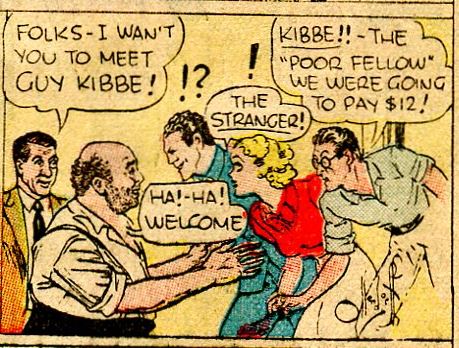
    The gratuity continues in the next issue, with perfunctory appearances by Hugh Herbert, Joan Blondell and Zasu Pitts, and with Guy Kibbee in a very minor role in the actual plot. (Famous Funnies 024, 1936)

    (Famous Funnies 024 also features this crowd of what are presumably supposed to recognizable Hollywood faces but I can only identify Bing Crosby in the yellow sweater vest and then only because someone did an impression of him on the previous page. Bub bub boo!)

    Sherlock Holmes: 

    They may not have given him a parody name, but Dinky Dinkerton here is clearly a Holmes parody comedy character, aided by Doctor Philip Anbust (aka Sniffy) in the Watson role (the third member of the trio, secretary Flossie, is not a Holmes character parody but is the brains of the operation, something that Holmes pastiches often leave out, to their ultimate detriment). (Reg’lar Fellers Heroic Comics 001, 1940)

    Another broad Sherlock Holmes pastiche is the unfortunately-named-to-modern-eyes Fuller Spunk, who is actually an actor known for playing “Herlock Olmes”, so perhaps he is more of a reference to Basil Rathbone. (interesting to note that the character of Marcel was originally bringing “female impersonation” to the group but that that skill was tossed aside in favour of a suite of stage magician tricks) (Hyper Mystery Comics 002, 1940)

    Shoshenq I:

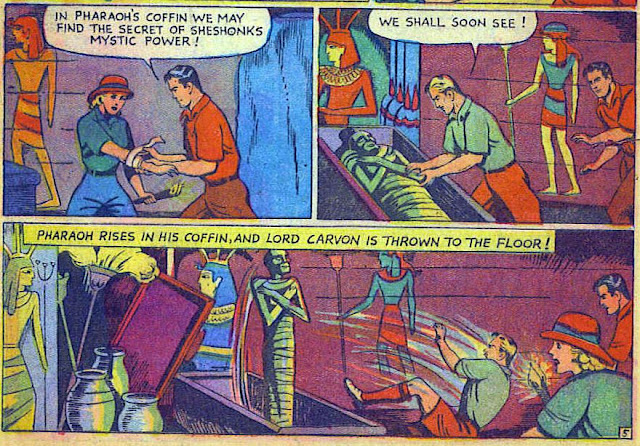
    In Jungle Comics 011, previously straightforward jungle explorer Roy Lance goes nuts for discovering the mystic secrets of the pharaohs* and specifically for finding the genie-controlling power of Sheshonk. Who is Sheshonk, you ask? Why, he is better known as Pharaoh Shoshenq I, more famous than he might otherwise be because he is associated with the Biblical figure Shishak who warred against Solomon and looted the treasures of the Temple – he is mentioned as having been the one to hide away the Ark of the Covenant in Raiders of the Lost Ark, for example. (Shoshenk I is also a candidate to be the father of an Egyptian princess married to Solomon, which the story alludes to by calling him “father-in-law to King Solomon”)

    *based on the fact that both the Roy Lance and Red Panther stories in Jungle 010 were out-of-context sci-fi adventures and that the Simba story in 009 was made up of repurposed panels from earlier Simba stories I suspect that Fiction House had gotten a bit behind and were renaming characters in any old stories they had spare in order to make deadlines.

    This story also features two other possible allusive figures: Lance’s doomed companion Lord Carvon seems likely to be a reference to Lord Carnarvon of the Curse of King Tut fame, while “Tera Bey, Mistress of Mysteries” is a figure as evocative as she is elusive. Literally the only thing I have been able to come up with is the possibility that she is a reference to Queen Tera, mysterious ancient mummy from the Bram Stoker novel The Jewel of Seven Stars, but it’s equally likely that she is a made-up bit of deus ex machina to get our heroes out of a sealed tomb. (Jungle Comics 011, 1940)

  • MINOR SUPER-VILLAIN 681: BARON HOFF

    (National Comics 006, 1940)

    Here’s what Baron Hoff brings to the table: 1. Scale. Hoff’s goal in this comic is to rob one (1) bank, and as a distraction from that crime he sets the entire island of Manhattan on fire.

    2. Look. Not only does he have a striking face and a killer grin but Baron Hoff has a real flair for villainous fashion. Some might balk at accentuating an aviator’s outfit with a monocle and jodhpurs and big puffy sleeves but he really makes it work. The only real misstep in his look is the toothbrush mustache, which pairs misleadingly with the pseudo-military brown outfit to make you think he’s some sort of Hitler analog. Do not waste your time: Hoff is not fascist, he just has poor taste in facial hair.

    3. Ride. I love an auto-gyro, and the fact that Baron Hoff not only flies around in one but uses its blades as a deadly obstacle to those seeking to enter the bank while he’s robbing it is just a bit of a bonus.

    Anyway, Hoff is up against super-speedster Quicksilver and such things as whirling blades of death mean nothing to such a fast man. Hoff is jailed in record time.