The Curse of Skeleton Munroe

Category: Quality Comics

  • MINOR SUPER-VILLAIN 681: BARON HOFF

    (National Comics 006, 1940)

    Here’s what Baron Hoff brings to the table: 1. Scale. Hoff’s goal in this comic is to rob one (1) bank, and as a distraction from that crime he sets the entire island of Manhattan on fire.

    2. Look. Not only does he have a striking face and a killer grin but Baron Hoff has a real flair for villainous fashion. Some might balk at accentuating an aviator’s outfit with a monocle and jodhpurs and big puffy sleeves but he really makes it work. The only real misstep in his look is the toothbrush mustache, which pairs misleadingly with the pseudo-military brown outfit to make you think he’s some sort of Hitler analog. Do not waste your time: Hoff is not fascist, he just has poor taste in facial hair.

    3. Ride. I love an auto-gyro, and the fact that Baron Hoff not only flies around in one but uses its blades as a deadly obstacle to those seeking to enter the bank while he’s robbing it is just a bit of a bonus.

    Anyway, Hoff is up against super-speedster Quicksilver and such things as whirling blades of death mean nothing to such a fast man. Hoff is jailed in record time.

  • MINOR SUPER-HERO ROUND-UP 032

    Just a few more minor super-heroes.

    Paul Bunyan: 

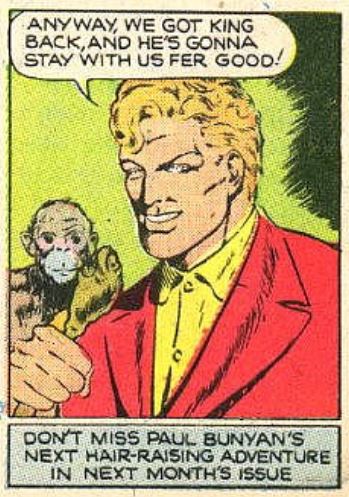
    What’s better than a regular two-fisted lumberjack protagonist? Paul Bunyan himself, that’s who. This version of Bunyan works in a modern-day lumber camp and has been toned down a bit with the suggestion that he’s just some guy who was born in Maine and grew to a mere ten feet tall. His adventures aren’t that much different than those of other lumberjack heroes, but there is something about an enormous man with a giant blue ox that add a bit of spice to the proceedings. (National Comics 001, 1940)

    (Bunyan gets an ape-man sidekick named King for a couple of issues and this is the best place I could think of to note that (National Comics 006, 1940))

    Wonder Boy:

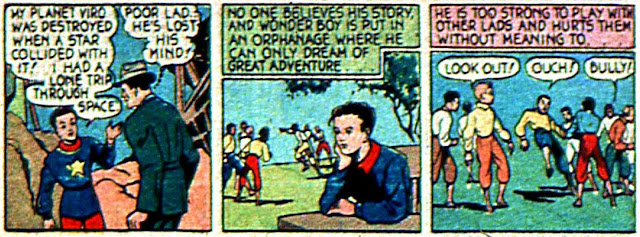
    Wonder Boy is an alien from the planet Viro who is a take on the Superman origin (last survivor of a destroyed planet rocketed to Earth where he is superhuman in comparison to the locals) while simultaneously being a prototype of Superboy (special super-powered boy who can only do good and is loved by all the world). DC Comics bought the rights to him along with all of the other Quality characters but has never seen fit to use him for anything, which I suppose is reasonable. (National Comics 001, 1940)

    Quicksilver:

    He’s got a lot of personality, that Quicksilver. Like other Golden Age super speedsters he handily outclasses most of his opponents and so the main draw is watching just how stylishly he beats them up. Much much later, Quicksilver will be brought back under the name Max Mercury and incorporated into the Flash family but that’s more than a few years out yet. (National Comics 005, 1940)

    the Phantom Knight:

    The Phantom Knight, aka Prince Philip of Kyle, is a very fun concept! As presented in his initial appearance, Philip is a real jerk, a man who cares about nobody and nothing but his horse Lightning.

    Philip is mean, vengeful, faithless and murderous. He kills two men in what were supposed to be bloodless contests because he felt that they insulted them. He joins and then deserts what is presumably the First Crusade, which could be a good act except that he deserts because there isn’t enough slaughtering and he gets bored.

    Philip eventually meets his end at the tusks of a wild boar and finds himself denied access to the afterlife until he makes up for his life of extreme dickishness, so he returns to Earth to do good as the Phantom Knight!.

    Now, here’s the problem: the Phantom Knight appeared twice, in OK Comics 001 and 002, and OK Comics 002 is not available to read anywhere that I know to look (well, there is a copy on ebay right now but I’m not prepared to pay $500 Canadian for the privilege). Thus, all that we really know about the Phantom Knight is that he was a colossal ass in life and now roams the mortal realm as a tormented spirit doomed to do good deeds. Is he still an ass? Is he operating in his home time period or has he been brought to the present – the location of Kyle is never established beyond being in Central Europe, so if he is operating in the modern day there’s a decent chance he fought some Nazis. (OK Comics 001, 1940)

  • MINOR SUPER-VILLAIN 680: MADAMOISELLE MORGUE

    (National Comics 006, 1940)

    Madamoiselle Morgue is an interesting case, because technically she does not exist. I mean, technically none of the characters I write about here exist, but even within the fictional world within the story, she is a false person.

    See, Scar Celleni, big time New York gang boss, has decided that the key to success is to wage all-out war on the police and that the optimal first move in this war is to assassinate prominent police officer Sally O’Neil. Thankfully for Sally she is the protagonist of the strip and she is saved by the timely intervention of her police badge. Faking her death, Sally reinvents herself as French femme fatale Madamoiselle Morgue, with her three brothers and father serving as her gang of masked henchmen. Presumably non-speaking henchmen at that, as the O’Neil clan really put the Irish in “stereotypical Irish-American cops.”

    The Madamoiselle Morgue persona is not a particularly deep one, but it doesn’t really seem like it needs to be. Scar Celleni is more than willing to believe that his reputation precedes him to the extent that a domino-masked babe would come all the way from France to get in on his rackets.

    Would I describe the next part of the plan, in which Madamoiselle Morgue/ Sally O’Neil suggests that the combined gang rob a bank and then arrests everyone once they are inside, as entrapment? Yes, yes I would. It’s a really good gotcha moment, though.

  • MINOR SUPER-VILLAIN 680: MADAMOISELLE MORGUE

    (National Comics 006, 1940)

    Madamoiselle Morgue is an interesting case, because technically she does not exist. I mean, technically none of the characters I write about here exist, but even within the fictional world within the story, she is a false person.

    See, Scar Celleni, big time New York gang boss, has decided that the key to success is to wage all-out war on the police and that the optimal first move in this war is to assassinate prominent police officer Sally O’Neil. Thankfully for Sally she is the protagonist of the strip and she is saved by the timely intervention of her police badge. Faking her death, Sally reinvents herself as French femme fatale Madamoiselle Morgue, with her three brothers and father serving as her gang of masked henchmen. Presumably non-speaking henchmen at that, as the O’Neil clan really put the Irish in “stereotypical Irish-American cops.”

    The Madamoiselle Morgue persona is not a particularly deep one, but it doesn’t really seem like it needs to be. Scar Celleni is more than willing to believe that his reputation precedes him to the extent that a domino-masked babe would come all the way from France to get in on his rackets.

    Would I describe the next part of the plan, in which Madamoiselle Morgue/ Sally O’Neil suggests that the combined gang rob a bank and then arrests everyone once they are inside, as entrapment? Yes, yes I would. It’s a really good gotcha moment, though.

  • MINOR SUPER-VILLAIN 678: AMNOZO

    (National Comics 003, 1940) 

    Cyclone is an extremely minor Quality Comics future spaceman hero of the year 3000 who, in National Comics 001, participates in a competition between the planets of the solar system to see which one gets to colonize the newly discovered planet Vito. He wins of course, and the remainder of his four appearances are spent dealing with various threats to the new colony, including at least one civilization native to the planet, because colonialism. Do they leave once they realize that the planet is not, in fact, free real estate? Reader, they do not.

    But enough interpreting space opera through a historical lens, check out Cyclone’s sky skis, possibly the greatest personal flight device in the history of sci fi: little planes that you strap to your feet! And as a bonus, what is possibly the most appetizing food pill I have ever seen.

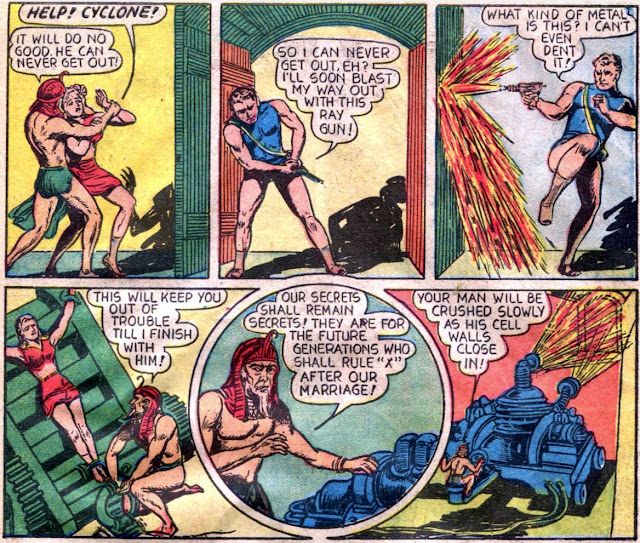
    Cyclone’s explorations are interrupted when he and his paramour Joy Sue Mary stumble upon an ancient, Ancient Egyptian style tomb, remnant of yet another civilization endemic to this uninhabited, ready-to-colonize planet. Even more troubling: the tomb’s occupant is not a mummy but Amnozo, a living man! He’s been waiting for people to show up so that he could… rule them? It’s a bit unclear.

    What is clear is that Amnozo is pulling the classic Creep’s Gambit of attempting to kill off the male protagonist so that he can capture and “romance” (or in this case “marry”) the female protagonist – we’ve seen it all a thousand times before. This is however a very nice rendition of the crushy room style of deathtrap.

    Amnozo fold like a house of cards once Cyclone’s troops show up to see what happened to him, despite a last-ditch attempt to roast them all with sick blue flame. What an achievement: waiting 4000 years only to end up rotting in whatever repurposed woodshed Cyclone’s colonial government is using as a jail just because you couldn’t not be a horrible creep to the first woman you saw.

    Also: does Amnozo’s loincloth not have a back?

  • MINOR SUPER-VILLAIN 677: MARS

    (National Comics 001, 1940) 

    Once Jock Kellog decides to turn his back on his playboy ways and put his inherited magic cloak to use as Merlin the Magician, he really goes for it. He hits the battlefields of WWII to aid the beleaguered soldiers of the front and ultimately rises into the realm of the gods to confront Mars, God of War and Destruction himself. 

    Mars turns out to be a huge jerk bully who is inciting nations to fight for his own amusement – a bit more Ares than Mars to be honest but I’ll let it go.

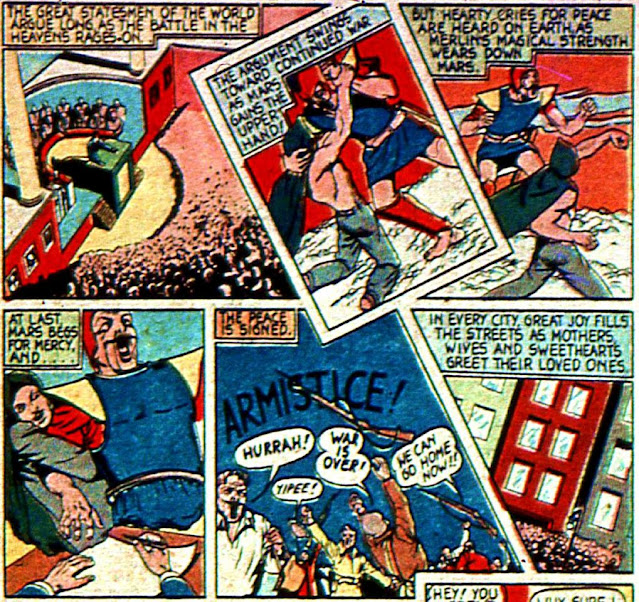
    Eventually, Merlin and Mars engage in Thrilling Hand to Hand Combat with the continuation of the war as the stakes, and after some back and forth that is cleverly mirrored in the progress of some armistice talks, Merlin wins! World War Two is over! As usual, this kind of “war can and will be avoided” story is very depressing in hindsight.

    But wait, there’s more! As in any story involving gods, demons and so forth, there is a high chance of some of my favourites the anthropomorphic personifications showing up, and show up they do! First off, Merlin encounters the embodiment of Peace chained to a bunch of weaponry like something out of a political cartoon and pledges to free her.

    Merlin also has to battle Mars’ henchmen Hunger and Poverty before he can get to the main event, and while there is a certain logic to the two of them making a person more susceptible to being either the perpetrator or victim of war I am sad that they don’t have a bit more allegorical oomph. Why couldn’t Hunger use those big fangs of his to sap Merlin’s life force or something? Still, even a bargain basement anthropomorphic personification is an anthropomorphic personification and I love me some anthropomorphic personifications. Hunger and Poverty can stay. The guys, not the things that they stand for. Those suck.

  • MINOR SUPER-HERO ROUND-UP 031

    MINOR SUPER-HERO ROUND-UP 031

    Great guns! More of them?

    the Masked Angel:

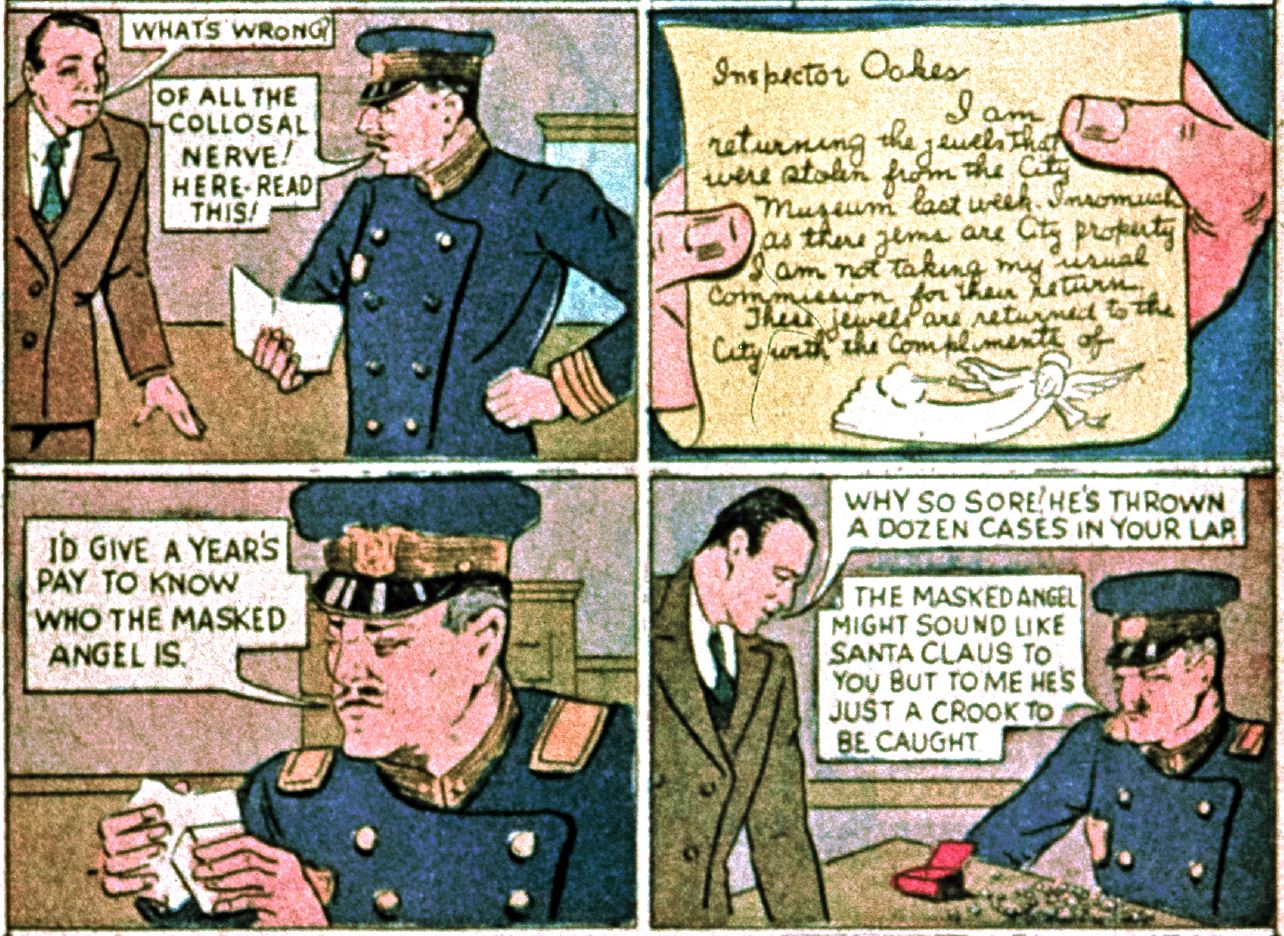
    Steve Oakes, wealthy playboy just so happens to also be the Masked Angel, vigilante feared by the underworld and wanted by the police.

    Steve’s father Detective Inspector John Oakes was murdered by crooks, so the Masked Angel act is his way of getting back at the criminal fraternity. It also seems to be a way to troll his brother, Detective Inspector John Oakes II, who is an asshole and who hates the Masked Angel in your classic way that a police officer does when they’re part of a vigilante’s supporting cast. Also please note the fun “angel shooting a gun” signature on the Masked Angel’s taunting note. (Miracle Comics 001 1940)

    Uncle Sam:

    We’re skirting the edge of what might be considered “minor” here, at least to DC Comics fans, but I have no Median Super-Hero category and however you slice it your parents almost certainly have not heard of him so here goes:

    Uncle Sam is the physical embodiment of the patriotic ideal of the United States: good, kind, powerful and just. He emerges to lend a physical hand in times of turmoil by inhabiting of reshaping the body of a recently slain patriot.

    This time around, Uncle Sam is (implicitly, all of this isn’t really spelled out until later) reborn from the death of Ezra Smith, who stands up to fascist agitators the Purple Shirts and gets a bullet in the back for his trouble. He sticks around to beat Axis ass for the duration of the war and then is not seen again until DC integrates the Quality characters into Earth-2 continuity in the 1970s. (National Comics 001, 1940)

    National Comics 005 expands the Uncle Sam lore slightly, firstly by making it a bit more explicit that he incorporates the spirits of dying patriots into himself with what is perhaps the initial time he did so, when a man named Sam sacrifices his own life to advance the cause during the American Revolution.

    Secondly, Sam is seen merging with a living patriot named Samuel in order to help drive the fascist Black Legion out of Glen Valley. Is this a common event? Does Uncle Sam roam the land absorbing patriots? Who can say, but it certainly would put a new spin on the character.

    Buddy Smith:

    When Ezra Smith is murdered by the Purple Shirts, his grandson Buddy is left alone, presumably some sort of double-orphan. He is almost immediately found, shamed for crying, and adopted by Uncle Sam (and hopefully the near immediate recovery Buddy has from the grief of seeing his grandfather gunned down in front of his eyes is a function of Uncle Sam being partially Ezra Smith and not some sort of deep traumatic repression left to fester in his soul).

    Buddy fills a pretty standard kid sidekick role: getting into trouble, getting Uncle Sam out of trouble, inventing things, befriending people, spotting clues, etc. He is unusual in that he is one of the few kid sidekicks who is a proper kid as opposed to being a young teenager (I know the common wisdom is that Dick Grayson was eight when he became Robin but that’s mostly because Golden Age artists – and particularly Bob Kane – were mostly very bad at drawing kids. Robin was absolutely supposed to be somewhere in the 12-15 range when he debuted). He’s also notable for – as far as I know – never ever showing up again post-Quality, not even in that event earlier this year that was specifically focused on bringing back all the old (and new) Golden Age kid sidekicks. Maybe Uncle Sam ate absorbed him once he got old/patriotic enough. (National Comics 001, 1940)

    Merlin the Magician:

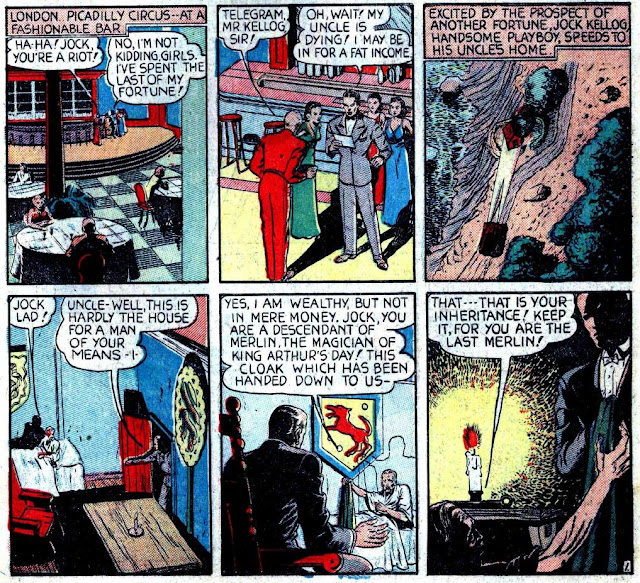
    Jock Kellog, a wealthy playboy in the classic mold, spends the last of his family fortune on the same day he is summoned to the bedside of his sole relative, an unnamed uncle. Instead of the fat stacks of cash that he is hoping for, Kellog comes away with a cloak and the knowledge that he is supposedly the last descendant of Merlin of Arthuriana fame.

    It turns out that he is in fact the last descendant of Merlin, of course, and that the cloak is a source of unlimited magical power in the grand tradition of mystic super-heroes like Zatara. Lucky for the world at large, the application of vast power has the opposite of its usual effect on the young wastrel and Jock devotes his newfound power to the defense and betterment of humanity. (National Comics 001, 1940)

  • FASCIST GOON CLEARING HOUSE 007

    Once again we must discuss the fascists.

    The Black League are a pretty regular-style gang of fifth columnists with two points of distinction: 1) they call one another “Black One”, which is kind of fun and 2) they are trying to steal this completely awesome WWII mech suit and get beat up by Dick Cole, Wonder-Boy for their efforts. (Blue Bolt v1 011, 1941)

    The nation of Bundonia deploys this crack squad of idiots, the Bundsters, to Hollywood to prevent film star Harly Shaplyn from filming the MLJ universe’s version of the Great Dictator but they end up getting beaten up by Rang-a-Tang the Wonder Dog, child actor Richy Waters and a bunch of Boy Scouts. (Blue Ribbon Comics 006, 1940)

    The Young Bundists were just that: a junior version of the German-American Bund. They made the mistake of recruiting naif/ agent of chaos Ty-Gor and the adult leadership ended up jailed while the youths decided to join the Boy Scouts instead. (Blue Ribbon Comics 014, 1941)

    The Purple Shirts are on the one hand a pretty rote version of the American fascist movement working with foreigners of ambiguous origin in order to weaken the US from within and allow leader Angel Cobra and his decidedly Hitlerian lieutenant Scar to take over. On the other hand they have a real place in comics history that their contemporaries never quite manage to match, due to the fact that they are the ones who kill patriot Ezra Smith and trigger his incarnation as the latest version of Uncle Sam. It’s not much of a legacy but it’s better than most of these fascist shitbirds get.

    The Purple Shirts also manage to briefly capture FDR! (National Comics 001, 1940)

  • NOTES – NOVEMBER 2024

    Honours: 

    Wonder Boy is generically honoured by all of Europe for stopping a Mongol invasion. (National Comics 001, 1940)

    Panel Fun:

    I don’t normally have enough time or inclination to read the text portions of old comics but I do often enjoy the illustrations accompanying them, especially including this cake man who menaces the Yankee Doodle Boy, whoever he is. (National Comics 006, 1940)
  • MINOR SUPER-HERO ROUND-UP 014

    Some real niche characters this time.

    the Lone Star Rider:

    An Old West hero so generic he only appeared once and never even got to track down the owlhoots who killed his parents in order to steal their land. Good gloves. (Smash Comics 002, 1939)

    Shock Gibson:

    Like Barry Allen after him, Charles (later Robert) Gibson is a young scientist working late into a stormy night when he is simultaneously struck by lightning and bathed in chemicals. Though he is called the Human Dynamo, for the first chunk of his career he functions as more of a Human Battery who stores an electrical charge that can be used to fuel various superhuman feats – super-strength, super-jumping (later full-on flight), and a shocking grasp.

    Shock Gibson goes through more than a few costume changes over the years – sadly this goofy helmet is axed during the first one – but one consistent element in his design is lotsa cool electricity crackle when he uses his powers. (Speed Comics 001, 1939)

    Shock Gibson UPDATE 1940: He loses the hat.

    the Man With 1000 Faces:

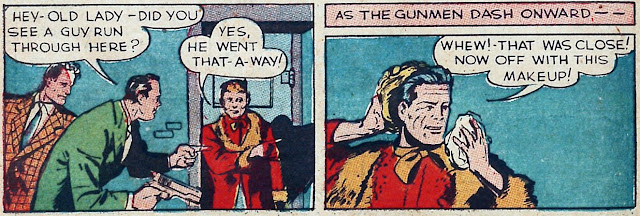
    Ted Parrish, famous film star, is bored with his humdrum life and so turns his considerable talent for quickchange artistry and disguise to the task of crimefighting. Just where he gets all of his accessories from is not elaborated on, so it’s equally likely that he scavenges them from the environment as it is that he just hauls around an enormous hockey bag full of clothing etc everywhere he goes.

    Parrish’s mission is obviously hampered somewhat by the fact that Los Angeles’ criminal fraternity knows that the Man With 1000 Faces exists and they should be on the lookout for him. How did they find out? Did Parrish blab to up the challenge and excitement of it all? (Speed Comics 001, 1939)

    the Wizard:

    Blane Whitney, AKA the Wizard, is the latest in seven generations of Whitneys (some of whom were also called the Wizard) to dedicate their lives in patriotic service to the USA. Plus he was a child prodigy who was charged to use his abilities to better mankind by Woodrow Wilson. Plus he’s an inventive genius in virtually all fields, particularly various forms of engineering. Plus he has nearly superhuman physical abilities and a mind so highly developed that it is superhuman in that he can employ remote viewing to locate dangers and clues.

    The Wizard was a pretty big player at MLJ in the 40s but has largely been abandoned in the various attempts to revive the MLJ characters at Archie and elsewhere – his biggest post-Golden Age appearance that I am aware of was as a super-villain fighting the Mighty Crusaders in the 60s. What does this say about the character – that he’s perfectly serviceable but not very conceptually exciting? Yes, I reckon that sums him up. (Top-Notch Comics 001, 1939)

    UPDATE 1940a

    UPDATE 1940b