The Curse of Skeleton Munroe

Category: Doc Strange

  • CATALOGUE OF WOUNDS 014

    I’ve finally caught up on all the backlogged wounds! Only new wounds for the catalogue going forward.

    the Dart:

    The Dart has come all the way from Ancient Rome to the present day (1940) only to be shot in the left arm. (Weird Comics 006, 1940)

    Doc Strange:

    Though the text box says that Doc Strange is “riddled with bullets” in this exchange, the subsequent first aid suggests that his left arm bore the brunt of the damage. (Thrilling Comics 001, 1940)

    the Falcon:

    The Falcon gets a classic head creasing. (Human Torch v1 002, 1940)

    Ferret:

    Despite the fact that these crooks manage to capture Ferret and force him to remove his bulletproof vest, they not only then choose to shoot him in the head but fail to actually shoot him in the head fatally and instead do a classic skull crease. (Marvel Mystery Comics v1 008, 1940)

    the Flame:

    The Flame gets in on the classic skull crease game. (Wonderworld Comics 018, 1940)

    the Masked Rider:

    Not to be left out, the Masked Raider sustains a head crease, classic. (Startling Comics 001, 1940)

    And again a few issues later. (Startling Comics 004, 1940)

    the Spirit:

    The Spirit (who I’m sure will be a frequent visitor to the Catalogue of Wounds) is shot in the left shoulder by Dr Cobra. (Spirit Section, June 9, 1940)

    A few months later: shot in the right shoulder. (The Spirit Section, September 22, 1940) 

    And a few months after that, the right shoulder again, this time by the Black Queen. (The Spirit Section, November 10, 1940)

    Thor, God of Thunder:

    Thor’s alter identity of Grant Farrel is shot in the back, wounding him badly enough that it takes weeks for him to recover. (Weird Comics 003, 1940)

    Yarko the Great:

    Even Yarko’s great magic cannot save him from occasionally being shot in the right arm. (Wonderworld Comics 004, 1940)

  • CATALOGUE OF WOUNDS 014

    I’ve finally caught up on all the backlogged wounds! Only new wounds for the catalogue going forward.

    the Dart:

    The Dart has come all the way from Ancient Rome to the present day (1940) only to be shot in the left arm. (Weird Comics 006, 1940)

    Doc Strange:

    Though the text box says that Doc Strange is “riddled with bullets” in this exchange, the subsequent first aid suggests that his left arm bore the brunt of the damage. (Thrilling Comics 001, 1940)

    the Falcon:

    The Falcon gets a classic head creasing. (Human Torch v1 002, 1940)

    Ferret:

    Despite the fact that these crooks manage to capture Ferret and force him to remove his bulletproof vest, they not only then choose to shoot him in the head but fail to actually shoot him in the head fatally and instead do a classic skull crease. (Marvel Mystery Comics v1 008, 1940)

    the Flame:

    The Flame gets in on the classic skull crease game. (Wonderworld Comics 018, 1940)

    the Masked Rider:

    Not to be left out, the Masked Raider sustains a head crease, classic. (Startling Comics 001, 1940)

    And again a few issues later. (Startling Comics 004, 1940)

    the Spirit:

    The Spirit (who I’m sure will be a frequent visitor to the Catalogue of Wounds) is shot in the left shoulder by Dr Cobra. (Spirit Section, June 9, 1940)

    A few months later: shot in the right shoulder. (The Spirit Section, September 22, 1940) 

    And a few months after that, the right shoulder again, this time by the Black Queen. (The Spirit Section, November 10, 1940)

    Thor, God of Thunder:

    Thor’s alter identity of Grant Farrel is shot in the back, wounding him badly enough that it takes weeks for him to recover. (Weird Comics 003, 1940)

    Yarko the Great:

    Even Yarko’s great magic cannot save him from occasionally being shot in the right arm. (Wonderworld Comics 004, 1940)

  • MINOR SUPER-VILLAIN 830: ROBERT W MARSH

    (Thrilling Comics 010, 1940)

    Fifth column activities are wreaking havoc on the US! Why, it’s so bad that the new National Defense Building has been bombed! Doc Strange is called in along with a crack team of industrialists to help solve the problem, and is pointed toward fellow committee member Henry Dallas by yet another member, Robert W Marsh. Could this be so easy a problem to solve?

    Henry Dallas kills himself rather than own up to working with the Nazis against American interests, but Doc Strange is able to trace his business dealings to the defunct Mammoth Automobile factory in the South, where he discovers a fascist tank-manufacturing setup. He also takes an explosive anti-tank shell to the back of the head, which is immaterial to the story, but it is fun to occasionally highlight just how powerful a super-hero is.

    Strange finally comes face to face with the leader of this operation (conveniently called the Leader) after both he and Virginia Thompson are captured by them, and unmasks him within minutes, revealing him to be… Robert W Marsh, who is coincidentally also the only other named character in the comic. I gotta say, I wish that the Leader facade had been maintained for longer, both because I always prefer referring to a guy by a codename rather than by what’s on his birth certificate, but also because that mask is a pretty sweet little number and I wish that Marsh had a reason to keep wearing it.

    Doc and Virginia of course escape from Marsh and prevent his bid to take over the US by bombing Washington DC into dust, but the former Leader is pretty conspicuously not among the casualties of that battle. And well he shouldn’t be, because he is also the antagonist of the next Doc Strange story:

    In Thrilling Comics 011, Marsh takes over the… Central?… American nation of Panamela to use as a staging area for another attempt to take over the US.

    (side note: it is pretty remarkable that Marsh is just a straight-up Nazi in 1940, albeit one with a reversed swastika. I suppose it’s possible that this is a small-n nazi, as a stand-in for fascist) 

    Marsh’s plan revolves around attacking the US using the Panamelan fleet and some new super-explosive artillery shells, but he is foiled when Doc Strange sabotages the explosive at the production stage. Pop! Plink!

    Though his fleet is blasted into oblivion by the US Navy, Marsh lives to fight another day. 

    I’ll be honest, I’m tired of the guy and I almost included his third appearance here to get him out of the way, even though it takes place in 1941. But when I started reading it to do just that I was startled to find out that it’s fun! There isn’t even any naval combat! Thus, I’m going to leave it as a treat for myself in the future.

  • MINOR SUPER-VILLAIN 830: ROBERT W MARSH

    (Thrilling Comics 010, 1940)

    Fifth column activities are wreaking havoc on the US! Why, it’s so bad that the new National Defense Building has been bombed! Doc Strange is called in along with a crack team of industrialists to help solve the problem, and is pointed toward fellow committee member Henry Dallas by yet another member, Robert W Marsh. Could this be so easy a problem to solve?

    Henry Dallas kills himself rather than own up to working with the Nazis against American interests, but Doc Strange is able to trace his business dealings to the defunct Mammoth Automobile factory in the South, where he discovers a fascist tank-manufacturing setup. He also takes an explosive anti-tank shell to the back of the head, which is immaterial to the story, but it is fun to occasionally highlight just how powerful a super-hero is.

    Strange finally comes face to face with the leader of this operation (conveniently called the Leader) after both he and Virginia Thompson are captured by them, and unmasks him within minutes, revealing him to be… Robert W Marsh, who is coincidentally also the only other named character in the comic. I gotta say, I wish that the Leader facade had been maintained for longer, both because I always prefer referring to a guy by a codename rather than by what’s on his birth certificate, but also because that mask is a pretty sweet little number and I wish that Marsh had a reason to keep wearing it.

    Doc and Virginia of course escape from Marsh and prevent his bid to take over the US by bombing Washington DC into dust, but the former Leader is pretty conspicuously not among the casualties of that battle. And well he shouldn’t be, because he is also the antagonist of the next Doc Strange story:

    In Thrilling Comics 011, Marsh takes over the… Central?… American nation of Panamela to use as a staging area for another attempt to take over the US.

    (side note: it is pretty remarkable that Marsh is just a straight-up Nazi in 1940, albeit one with a reversed swastika. I suppose it’s possible that this is a small-n nazi, as a stand-in for fascist) 

    Marsh’s plan revolves around attacking the US using the Panamelan fleet and some new super-explosive artillery shells, but he is foiled when Doc Strange sabotages the explosive at the production stage. Pop! Plink!

    Though his fleet is blasted into oblivion by the US Navy, Marsh lives to fight another day. 

    I’ll be honest, I’m tired of the guy and I almost included his third appearance here to get him out of the way, even though it takes place in 1941. But when I started reading it to do just that I was startled to find out that it’s fun! There isn’t even any naval combat! Thus, I’m going to leave it as a treat for myself in the future.

  • MINOR SUPER-VILLAIN 829: LOBELO

    (Thrilling Comics 008, 1940) 

    Lobelo is a modern day pirate, as you might guess from the splash panel above, and while my strong pro-pirate bias means that he was an easy inclusion in the ranks of the minor super-villain he is also a source of great frustration to me.


    First, though, I will note one thing that I really like about Lobelo and that is his array of costumes. Not only does he wear two distinct pirate outfits during the course of the adventure but he wears a separate classic early-1940s suit-cape-and-mask number while he is robbing the Metroploitan Museum in New York. This is clearly a man who loves an outfit – it’s like he’s padding out an action figure line over here.

    My problem with Lobelo is that he goes into piracy because he is the descendant of the famous 16th Century pirate Redhand. He sets up his headquarters on Redhand’s Crossbones Island and he is hunting for Redhand’s treasure with the help of Redhand’s map, which he stole from the museum. So why the heck doesn’t he call himself Redhand, or Redhand II, or something other than his own last name? The gall of it!

    (I’m also somewhat put out that the comic features a costume party and Doc Strange attends in a tuxedo rather than his super-suit. I suppose that Lobelo is attending in (one of) his super-villain outfit(s) at the very least)

    Lobelo has a pretty good run thanks to some poison he feeds Doc Strange at the party having a long-term weakening effect but ultimately comes up against the simple fact that he is a man armed with a sword versus a man who is completely invulnerable to harm and able to powerbomb a battleship. Lobelo is so outmatched here that maybe Doc Strange doesn’t need to kill him like a bear swatting a salmon, and yet he does. So long, Redhand Lobelo.

  • MINOR SUPER-VILLAIN 826: THE BIG BOSS

    (Thrilling Comics 005, 1940)

    Things are bad in New York City: the city is corrupt seemingly from top to bottom, civic leader Henry Adams has had enough of it, and his zeal is infectious: Doc Strange sets out to clean up the municipal landscape and beats up a wide variety of crooked politicians and businessmen, including:

    – District Attorney Big Bill Roberts

    – Lawyer Ollie Saunders 

    – Contractor Alfred Quinn

    – Brewer Von Strohm

    – a bunch of unnamed gangsters and arsonists 

    Almost all of them (save Roberts and the odd gangster) end up dead, which leaves Doc Savage to find the head honcho, the Bog Boss, and put an end to the source of the corruption.

    The Big Boss makes a valiant attempt to turn Strange’s planned ambush against him, but even a very large knife is never going to be enough for that, and he is swiftly subdued and unmasked as – wouldn’t you know it – civic leader Henry Adams, who’s tough-on-crime act was a mere facade calculated to throw suspicion off of himself. 

  • MINOR SUPER-VILLAIN 823: ELECTRU

    MINOR SUPER-VILLAIN 823: ELECTRU

    (Thrilling Comics 004, 1940) 

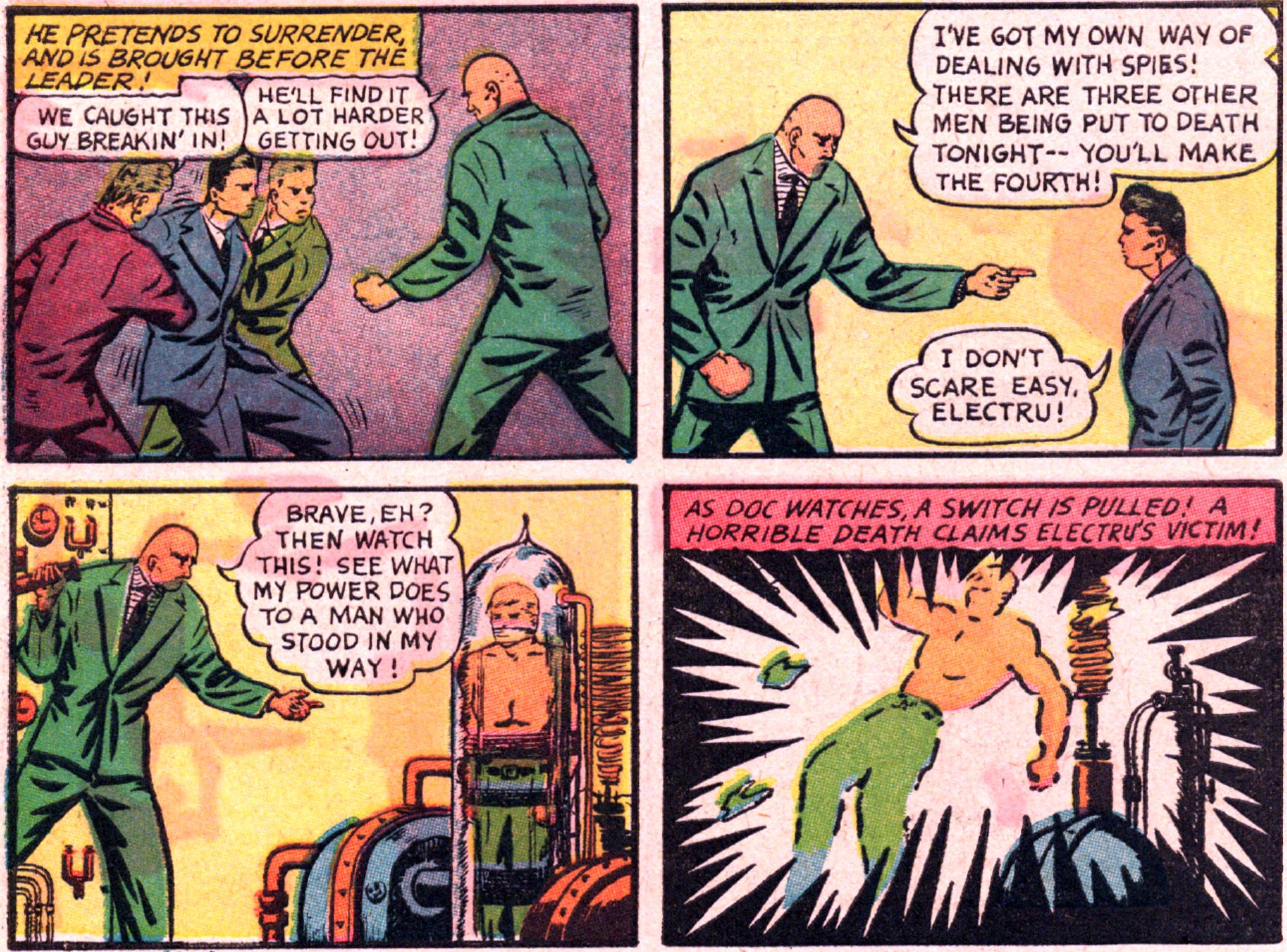
    Electru, aka the Giant Electru, is a giant guy with electrical powers. He also has a large gang armed with various electric ray guns and so forth. There’s not a lot to explore about him if I’m honest, but he does inspire a few questions:

    1. Just where did Electru come from? We never get an idea of how Electru acquired his great size, his incredible strength or his control over electricity. Are they as a result of his mastery of such things as electric ray guns and broadcast power or the inspiration for his research into them? Did Electru develop his gang’s technology at all or is there some poor uncredited criminal scientist somehwere? No answers are forthcoming. Also please note that Electru is robbing the NYC Subtreasury in the top set of panels.

    2. Just what was Electru up to? While the bulk of Electru’s efforts were directed at bank robbery, there is the possibility that he had some greater aim in mind, as his first act is to attack the Panama Canal and he eventually steals an entire cruiser from the US Navy. Is all this in aid of more plundering or was Electru setting his sights on conquest? No answers are forthcoming. (please also note the one glimpse we get of Electru’s cool electricity-themed island covered in power lines. This is some top-notch environmental theming)

    3. Why the heck does Doc Strange take so long to beat this guy up? I know that the real reason for this is “because of story pacing” but this is an especially egregious case of the hero just letting the villain go on with his day until the time seems right to sock him in the nose. I count four separate times that Doc Strange was within punching distance of Electru without taking his shot, only one of which is justified by a threat to Virginia Thompson’s life. Get your head in the game, Doc!

    Doc Strange does eventually get his dander up/ the story does eventually reach its required pagecount, and Electru ends up being ironically electrocuted when Doc punches him into his own equipment. Live by the electricity; die by the electricity, I guess.

  • MINOR SUPER-VILLAIN 821: KONG

    (Thrilling Comics 003, 1940)

    I can’t really devote a lot of energy to Kong because he just kind of makes me tired, conceptually. He’s a Yellow Peril dictator who has devoted a fair amount of time and resources to stealing both military secrets and entire scientists from the US as a part of his bid for world domination, opposed only by Doc Strange and his companion Virginia Thompson. All very exciting stuff in theory, but it all resolves into a kind of mush – it’s not even as racist as it could be, which is good but not remarkable.

    In the spirit of writing something interesting, here are the good parts of Kong’s story: 

    1. Location: Kong is the dictator of the Asian kingdom of Kachukuo, which was pretty fun to recognize as a stand-in for Manchukuo, the Chinese puppet-state established by the Japanese in 1932. I’m always chuffed to see Manchukuo come up both because it doesn’t really do so very often and because I managed to get pretty far into adulthood before I learned about this entire country, and the joy of learning about it is still fresh in my mind. Not that the history of Manchukuo itself is particularly joy-inspiring, but learning is learning.

    2. Rays. I like Kong’s big chunky ray technology. He’s got a red ray that brings the scientists out of the suspended animation he put them in for transport, a blue mind control ray (blue and red seem to come from the same machine) and a green death ray. What can I say, I like a ray, and I like colours.

    3. Wild Hill Warriors. At one point Kong tries to get rid of Doc Strong by subjecting him to gladiatorial combat and I just really like the fact that he managed to scare up some Germanic warriors fresh from the sack of Rome for the task. They don’t do very well but they’re fun!

    That’s about it for Kong. Doc Strange inspires a revolution in Kachukuo, chucks the dictator into his own chemical soup and thaws out the scientists with a little Alosun, bish bash bosh, start the countdown to the next Fu Manchu knockoff showing up.

  • MINOR SUPER-VILLAIN 818: THE FACELESS PHANTOM

    (Thrilling Comics 001, 1940) 

    Here’s a nice picture of the Faceless Phantom from his second appearance, before we delve into the muddy fiche images of his first.

    Scientific hero Doc Strange is just walking down the street one day when he hears a cry for help that leads him to an encounter with his first super-villain (the Faceless Phantom) as well as his long-term love interest (Virginia Thompson). The Faceless Phantom, it turns out, has just kidnapped Virginia’s father Professor Thompson in an attempt to get him to reveal the secret of his Delta Ray gun, which is a good old-fashioned sci-fi death ray.

    What follows is an astonishingly long (for a Golden Age story – 37 pages!) chase sequence, as Doc Strange, Virginia and New York Police Commissioner Baxter pursue the Faceless Phantom and Professor Thompson to the Central American republic of San Pedro and back. Along the way both Virginia and Baxter are captured and rescued and captured again, Doc fist fights multiple animals (a shark, a boa constrictor, crocodiles, a tiger, a pit full of cobras, an octopus and a gorilla), and Doc acquires several temporary companions, including:

    -Togo, hired as a bodyguard for Virginia; ultimately revealed to be an agent of (implicitly) the Chinese government looking to acquire the Delta Ray

    -Parker, a seaplane pilot who shuttles Doc around for the middle part of the story until he is almost killed in a plane crash and left behind in Florida

    -Jerry Adams, a newsie who Doc helps with his mortgage during a brief spell of train crash-induced amnesia

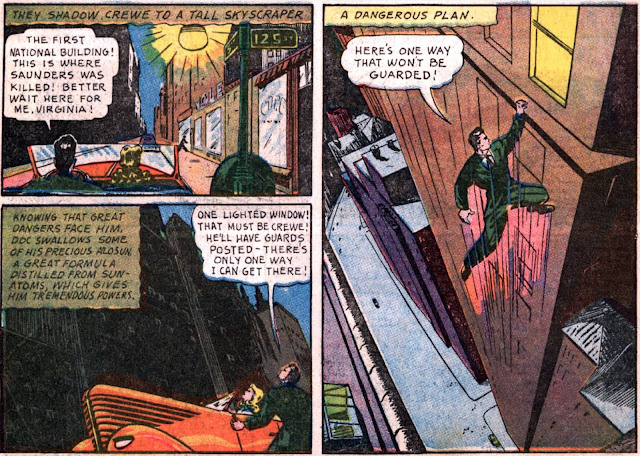
    Things eventually come to a head back in NYC where they started, with the Faceless Phantom armed not only with the Delta Ray but a stolen supply of Alosun, the “distillation of sun-atoms” that gives Doc Strange his super powers. Thus equipped, the Phantom and his men have effectively taken over the city.

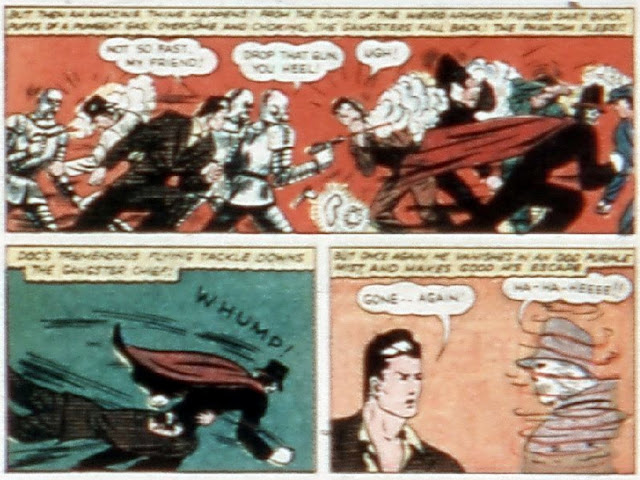
    In order to combat a gang of death ray-wielding gangsters all hopped up on super serum, Doc really hunkers down and gets inventing. He comes up with two key bits of technology: suits of death ray-proof armour for a special detail of police officers to wear and a gas that neutralizes the effects of Alosun (something which one might reasonably expect to crop up to bite him in the ass in the future but not so, as far as I can tell). The subsequent gang round-up is almost 100% effective, with the exception being that the Faceless Phantom pulls his signature trick and disappears in a cloud of purple mist.

    Thanks to his Alosun-enhanced senses, this time when the Faceless Phantom disappears Doc is able to identify that he is doing so using an Ancient Egyptian alchemical preparation called Kalodin, and thanks to his well-stocked library he is then able to find a book that tells him how to counter Kalodin’s effects. Thus, the next time the Phantom tries to do a runner he gets a face full of reagent, followed by a sock to the jaw.

    The Faceless Phantom is unmasked, and surprising no one with any degree of genre savvy he turns out to be Police Commissioner Baxter, the character who tagged along with Doc throughout the adventure and mostly got kidnapped over and over again while the Phantom somehow learned all of Doc’s secrets. But he’s been caught and the long nightmare is finally over.

    OR IS IT? No, it isn’t, because Baxter still had some Alosun hidden away for a rainy day and he gets ahold of it just in time to ruin is own execution, thanks to a crooked prison guard. Side note: Baxter’s tattered clothing in the above panels is not as a result of his escape attempt – he was dressed in them already when he was led in. Was this some sort of attempt to save money on prison uniforms by giving condemned men the worst one or something?

    Baxter resumes his life as the Faceless Phantom, pledging to make the whole country pay. Thanks to his Kalodin-derived invisibility and his residual Alosun strength he is able to form a gang and start up a crime spree with great alacrity.

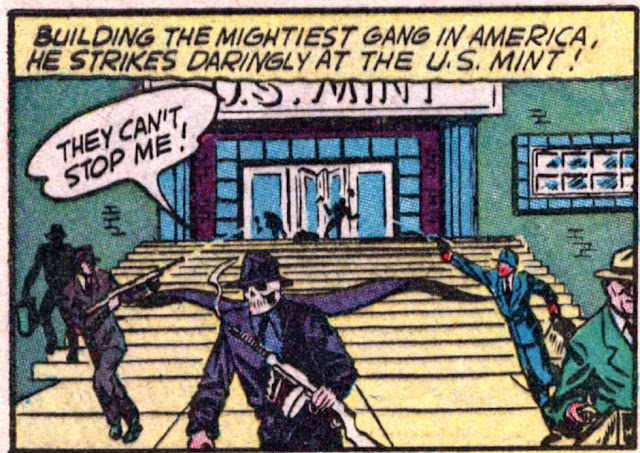
    As is often the case, a successful crimewave becomes a systematic campaign of terror and looting becomes a plan to take over the US by kidnapping the entire Senate. This is the point at which Doc Strange catches up with the Phantom – that’s him in the lower right in gangster cosplay – and strikes back by packing the Senate galleries with gun-toting lawmen who engage the Faceless Phantom gang in what I would call an irresponsibly large gun battle. No senator catches a stray bullet on panel though, so I guess you could call the operation a success.

    Things come to a head on the wing of a plane in which the Faceless Phantom is escaping with a re-re-re-kidnapped Virginia. Though both hero and villain are juiced up on Alosun, Doc wins out in the end and punches the Phantom clean off of the plane, at which point he dusts off his hands and declares that the Faceless Phantom is finally dead, despite the fact that his own Alosun-powered body has survived similar falls on many occasions. Will this come back to bite Doc Strange in the ass? Only in that he will be more surprised than he should be when the Phantom returns in 1942. 

  • MINOR SUPER-HERO ROUND-UP 055

    Some more super-folk for your delectation. 

    Doc Strange:

    Doc Strange (called “Dr Strange” for the first half dozen or so of his appearances, but why cause unnecessary confusion) is an almost prototypical scientist-hero: no real origin beyond being a well-known brilliant scientist who is primed and ready for adventure having just perfected Alosun, a “formula distilled from sun-atoms.” After taking his first dose of Alosun in his initial adventure, Strange has super-strength and invulnerability sufficient to take on an entire gang single-handed, and if he takes a supplemental dose he becomes exponentially more powerful.

    Doc’s sidekick Mike won’t be showing up until 1942, but in the meantime his fiance Virginia Thompson (as so often is the case, the woman he rescues during his first super-heroic adventure) acts as his adventuring companion/frequent kidnap victim in the meantime.


    In Thrilling Comics 007 Doc Strange mixes up a new formulation of Alosun that completes his powerset by allowing him to fly while under its effects. This is also the issue in which he stops fighting crime in suits and adopts his classic red t-shirt/blue jodhpurs/brown boots look. 

    Finally, I’ve noticed a lot of sites listing his name as “Hugo Strange” or “Thomas Hugo Strange” and while the Thomas is definitely an Alan Moore addition from Tom Strong I can only report that the Hugo has not yet appeared in the 1940 issues of Thrilling. (Thrilling Comics 001, 1940) 

    the Ghost:

    Young George Chance is orphaned in India and so is of course raised by yogis. He learns all of their magical secrets and is eventually sent out into the world to fight crime, as I assume all yogis are. I must say that it is something of a change of pace to see a magic-man come into his powers in India after such a long string of Tibetan origins.

    Like most magical heroes, the Ghost is a nigh-omnipotent force of nature who can be stopped only by a sneaky blow to the head, and even then only temporarily. His adventures are distinguished by the fact that his long-time foe is Professor Fenton, a scientist who has developed time travel technology, so the Ghost’s adventures are distinguished by the sheer variety of times and places he ends up.

    The Ghost takes his name from his early habit of painting his face (all the way to the back of his neck!) so as to resemble a skeleton while he is fighting crime. Sadly though the name sticks the look doesn’t. 

    In Thrilling Comics 008, the Ghost travels back to Revolutionary America and meets a patriotic woman named Betty Morris who ends up coming back to the 20th Century with him as his companion/love interest. I keep seeing claims online that she is his wife, but strongly suspect that that is another swipe from Alan Moore’s version of the characters. (Thrilling Comics 003, 1940)

    the Lone Eagle: 

    Another classic example of a pilot-hero-with-a-cool-name and not much else going on. The Lone Eagle does seem to have been a World War I veteran, which I always like to note. (Thrilling Comics 003, 1940)

    the Woman in Red: 

    The Woman in Red (an extremely good name) has what just might be the simplest origin story in comics: she is really Peggy Allen, undercover police officer, and the Woman in Red disguise is her way of investigating crimes without blowing her cover if she is caught snooping around. See? Simple! 

    Woman in Red mysteries tend to be structured as whodunnit murder mysteries, which I obviously like, and so Peggy is also frequently wanted by her comic foil, the bumbling Inspector Cavanaugh, as a suspect because he sees her creeping around the crime scene and doesn’t have a lot of critical thinking skills. (Thrilling Comics 002, 1940)