The Curse of Skeleton Munroe

Category: media in comics

  • MEDIA IN COMICS 007

    We’ve got some real early media for you today, so get ready for the crustiest scans of microfiche you ever saw.

    Movies:

    Steve Rogers and Bucky almost get to the movies to see a flick called Million Dollar Robbery before being interrupted by a real, if smaller-scale, robbery. BONUS: a classic case of real movies stars barely obfuscated by having their first names swapped, in Humphrey Raft and George Bogart, aka George Raft and Humphrey Bogart. (Captain America Comics 004, 1941)

    Hired to look into dirty dealings on the Stupendous Films lot, Slam Bradley and Shorty Morgan go undercover as stunt doubles. The comedy film that Shorty works on is never named, but Slam briefly works on a film called Jungle Man. (Detective Comics v1 004, 1937)

    Larry Steele’s own investigations into a series of high-profile kidnappings take him to the set of Too Much Money, a movie we never learn anything about. (Detective Comics v1 005, 1937)

    It’s just barely possible to make out that this movie that the Radio Squad boys watch is called The Fighting Cop. A bit on the nose, boys! (More Fun Comics 038, 1938)

    Music:

    Detective Bruce Nelson investigates a series of murders committed on stage while each victim was singing the same song. That song was originally called “The Night is Blue,” but is now known as “The Song of Death.” (Detective Comics 020, 1938)

    In Action Comics 006, a grifter named Nick Williams falsifies some contracts and begins licensing Superman’s name all over town, and one of the results of this is a song! Specifically, a big band tune called “You’re a Superman!”

    I wouldn’t call it the greatest song ever written (no song should include the word “resistless,” for example), but it’s not entirely terrible. (Action Comics v1 006, 1938)

    Newspaper Columns:

    Written by Paul Revere Sr, ultra-patriot and father to comic book adventure kid Paul Revere Jr, “America Awake!” is one of those exciting titles that works for an anti-Nazi column in 1941 and also potentially for a pro-Nazi one in the present. (Banner Comics 003, 1941)

    Jay Garson Jr, aka the Ragman, wrote his “Crime Does Not Pay” column right up until someone tried to kill him for it and he was forced to fake his own death. And then kept on writing it for a while afterward, seemingly mostly in order to give his old editor a hard time. (Cat-Man Comics 001, 1941)

    Radio Shows:

    In addition to “You’re a Superman!” Nick Wilson’s Superman-licensing deals included a Superman radio show, meaning that the DC Universe had one a full two years before we did.

    Wilson also mentions having sold movie and comic book rights, but as he is beaten up and forced to stop his scheme by the real Superman not long after this conversation it’s likely that those never saw the light of day. (Action Comics v1 006, 1938)

    Theatre:

    Slam Bradley and Shorty Morgan investigate the crimes of the Broadway Bandit by getting jobs on Broadway, specifically as tap dancers in a production called Love on Ice that despite its name seems to be a variety show rather than anything with a discernible plot. (Detective Comics v1 016, 1938)

    Renick’s Frolics, the show in which “The Song of Death” appears, is another of these variety productions. (Detective Comics v1 020, 1938)

    We learn nothing about Darkest Dawn other than the fact that someone is trying to kill the lead actress and Nadir, Master of Magic, is on the case. (New Adventure Comics 028, 1938)

  • MEDIA IN COMICS 007

    We’ve got some real early media for you today, so get ready for the crustiest scans of microfiche you ever saw.

    Movies:

    Steve Rogers and Bucky almost get to the movies to see a flick called Million Dollar Robbery before being interrupted by a real, if smaller-scale, robbery. BONUS: a classic case of real movies stars barely obfuscated by having their first names swapped, in Humphrey Raft and George Bogart, aka George Raft and Humphrey Bogart. (Captain America Comics 004, 1941)

    Hired to look into dirty dealings on the Stupendous Films lot, Slam Bradley and Shorty Morgan go undercover as stunt doubles. The comedy film that Shorty works on is never named, but Slam briefly works on a film called Jungle Man. (Detective Comics v1 004, 1937)

    Larry Steele’s own investigations into a series of high-profile kidnappings take him to the set of Too Much Money, a movie we never learn anything about. (Detective Comics v1 005, 1937)

    It’s just barely possible to make out that this movie that the Radio Squad boys watch is called The Fighting Cop. A bit on the nose, boys! (More Fun Comics 038, 1938)

    Music:

    Detective Bruce Nelson investigates a series of murders committed on stage while each victim was singing the same song. That song was originally called “The Night is Blue,” but is now known as “The Song of Death.” (Detective Comics 020, 1938)

    In Action Comics 006, a grifter named Nick Williams falsifies some contracts and begins licensing Superman’s name all over town, and one of the results of this is a song! Specifically, a big band tune called “You’re a Superman!”

    I wouldn’t call it the greatest song ever written (no song should include the word “resistless,” for example), but it’s not entirely terrible. (Action Comics v1 006, 1938)

    Newspaper Columns:

    Written by Paul Revere Sr, ultra-patriot and father to comic book adventure kid Paul Revere Jr, “America Awake!” is one of those exciting titles that works for an anti-Nazi column in 1941 and also potentially for a pro-Nazi one in the present. (Banner Comics 003, 1941)

    Jay Garson Jr, aka the Ragman, wrote his “Crime Does Not Pay” column right up until someone tried to kill him for it and he was forced to fake his own death. And then kept on writing it for a while afterward, seemingly mostly in order to give his old editor a hard time. (Cat-Man Comics 001, 1941)

    Radio Shows:

    In addition to “You’re a Superman!” Nick Wilson’s Superman-licensing deals included a Superman radio show, meaning that the DC Universe had one a full two years before we did.

    Wilson also mentions having sold movie and comic book rights, but as he is beaten up and forced to stop his scheme by the real Superman not long after this conversation it’s likely that those never saw the light of day. (Action Comics v1 006, 1938)

    Theatre:

    Slam Bradley and Shorty Morgan investigate the crimes of the Broadway Bandit by getting jobs on Broadway, specifically as tap dancers in a production called Love on Ice that despite its name seems to be a variety show rather than anything with a discernible plot. (Detective Comics v1 016, 1938)

    Renick’s Frolics, the show in which “The Song of Death” appears, is another of these variety productions. (Detective Comics v1 020, 1938)

    We learn nothing about Darkest Dawn other than the fact that someone is trying to kill the lead actress and Nadir, Master of Magic, is on the case. (New Adventure Comics 028, 1938)

  • MEDIA IN COMICS 006

    Now that’s entertainment. 

    Magazines: 

    Are magazine titles in comics more likely to be plays on real ones than other forms of media? Perhaps. We’ll just have to see how many variations on Life and Time we can find over the years. Pretending to work for Living has enough caché that it gets these fascists into a secure aircraft plant – how long has it been since magazines were so relevant? (Big Shot Comics 014, 1941)

    Movies:

    I never actually mentioned it in the entry on the Hunchback of Hollywood, but the anti-Nazi movie that incites the story’s action is called The Tyrant. Featuring Steve Rogers, Bucky Barnes and Sergeant Duffy in minor roles! (Captain America Comics 003, 1941)

    Rang-a-Tang the Wonder Dog’s boy companion Richy (the Amazing Boy) never seemed to be that impressive to me, but Hollywood disagreed and he was made both the star and subject of a film called Riverfront Richy with lots of animal stunts. (Blue Ribbon Comics 011, 1941)

    There’s never any real indication of what Scoopin’ Jive is about – music seems likely – but it’s such a baffling name for a movie that I must celebrate it (Crackajack Funnies 036, 1941)

    Similarly, we never really learn what Wings Aflutter is about, other than being a “new Navy Air smash hit” with a terrible name. (Jumbo Comics 034, 1941)

    Theatre:

    Minor super-villain the Black Death of course takes his costume and MO from a character in a stage production called The Black Death. There’s not quite enough of the play’s plot in the story to know if the fictional Black Death is supposed to be a metaphor or something or some sort of slasher movie killer as it appears. I sincerely hope it’s the latter. (Thrilling Comics 010, 1940)

    One of Professor X’s attempts to get Sub-Zero involves attacking him in the audience of a big stage musical that his girlfriend Mary is appearing in as part of the “Living Chandelier”. “George Whyte’s Sandels” is a very specific-seeming reference, but I am unable to easily connect it to a show of the era. (Blue Bolt v1 006, 1940)

    Fuller Spunk, former star of stage and now Holmes-inspired detective, starred in the evocatively-named shows Hector’s Last Gulp and The Gripes of Raft. (Hyper-Mystery Comics 001, 1940)

    Waltz of the Vampires is a ballet performance that is narratively used to set off vampire Carlos Hubbelo’s bloodlust, but more importantly, it kind of rules? Comic book media is so often a version of something from the real world that it’s always very fun to see something like this that (as far as I can tell) is just a sincere depiction of a vampire ballet. (Blue Ribbon Comics 011, 1941)

  • MEDIA IN COMICS 005

    This is the stuff that my counterpart in a comic book universe is writing his little blogs about.

    Movies:

    Not only does this theatre feature an appearance by Lady Luck (an impostor, alas), but it has screenings of Boris Scarloff in Mummy Blood and Myrna Powell and William Loy in Thinner than the Thin Man! (Lady Luck, the Spirit Section 1940)

    The villainous Comrade Ratski might have founded Ratski Productions and filmed his opus The Great War as a cover for his espionage activities, but was it a real movie? Was he filming all of his crimes and if so who has the footage? (Speed Comics 009, 1940) 

    Ted Parrish, aka the Man With 1000 Faces stars in Thundering Hoofs, which might appear to be a generic Western to you and I but which nets him the 1941 Oscar for Best Actor – sorry, Jimmy Stewart. (Speed Comics 010, 1940)

    This is another Ted Parrish feature(, and though the title is partially obscured by that rude talking kid I am familiar enough with 1940s parody title conventions to confidently state that it is Went with the Gale. (Speed Comics 008, 1940)

    Newspaper Columns:

    “John Perry In the News,” with its sassy little “Perry Says….” opening is said to be and written like a gossip column but like Bob Phantom before him John “the Black Fury” Perry seems to mostly write about crime. Also please note that both of these clippings have “Daily Standard” down the side even though Perry is consistently said to work for the Daily Clarion. (Fantastic Comics 017, 1941)

    Martin Mitchell is another of these gossip columnist/ hard-core investigative journalist types, only he isn’t a super-hero and so when he starts writing about ongoing criminal activity in “Martin Mitchell About Town” he just gets murdered. (Rocket Comics 003, 1940)

    We don’t get anything more about “The Tattler” than its title, and even that is concealed beneath part of the Press Guardian’s name. Maybe Ted McCoy needs to dig up some hotter gossip. (Pep Comics 001, 1940)

    Radio: 

    Martin Mitchell (America’s most popular columnist!) also has a radio show, and since we never learn its name I’m going to assume that it is also named Martin Mitchell About Town. (Rocket Comics 003, 1940)

    We don’t learn too much about The Brady’s Better Bacon Program due to its star Biff Crossley being mixed up in a string of high-profile murders, but it certainly is well-attended. And it has a full orchestra!(Pep Comics 008, 1940)

    Theatre: 

    Tobacco Turnpike is one of those murder mystery plays that are so beloved of comic and television writers because of dramatic potential inherent in someone being murdered on-stage at the same time as they are supposed to be pretending to be murdered, as happens several times in this story before the Shield gets involved and reveals that the director is responsible and is trying to tank the play because he has sold half stakes in the play to at least four men and doesn’t want to pay out or go to jail.

    Tobacco Turnpike is such a specific name that I was sure that it was a reference to something. I almost gave up the quest for knowledge after my third unsuccessful search for a production of Cigarette Junction, before finally narrowing it down to a play called Tobacco Road. (Shield-Wizard Comics 002, 1940)

  • MEDIA IN COMICS 004

    It’s an all-movies episode of Media in Comics!

    Movies:

    London Strikes Back – Hard! is the film follow-up to London Can Take It, with both featuring an actor playing costumed vigilante London and the narration of Marc Holmes, London’s secret identity. As a bonus, please note the wild nasal apparatus that Imperial Studios required to put a toothbrush mustache on the actor playing Hitler. (Daredevil Comics 005, 1941)

    We don’t too much of the action of Wild Mesa as it is filmed on the ranch of cowboy hero Bull’s-Eye Bill, as the issues in question are much more concerned with the interpersonal conflict between Bill and film star Tex O’Conner. Seems to be a regular-ass Western. (Target Comics v1 009, 1940)

    And now for some more Fantastic Feature Films content, as discussed in the last Media in Comics round-up: 

    Musical genius Gorevski, driven mad by a progressive paralysis in his right arm and the perceived infidelity of his wife, turns his strange musical abilities to crime in The Music Monster. (Target Comics v1 004, 1941)

    Big city gangsters steal a rain-making machine and get mixed up in backwoods hijinks in the execrable hillbilly comedy Ezekiel’s Ark. (Target Comics v1 005, 1941) 

    The Blue Zombie, a film about mad science being turned against warmongers, turned up in a minor super-hero round-up a while back. (Target Comics v1 006, 1941)

    The House of Horror is kind of a horror movie and kind of a crime movie, about a young couple who stumble into a gang hideout while visiting a relative and get fake haunted. (Target Comics v1 007, 1941)

    In Wedding Present, a gangster tries to go straight for love, only to be dragged back in and ultimately meet his end thanks to his own twisted mind. (Target Comics v1 008, 1941)

    Boomerang is the tale of a heroic reporter fighting to clear his lover’s father from a political frameup (the boomerang in question being the fact that the source of the smear campaign has his own career ruined). (Target Comics v1 009, 1941)

    Sword of Destiny is a very weird horror movie in which an American couple buy a house that once belonged to Mexican war hero General Santa Guerrero, only to find that instead of dying twenty years earlier as everyone had believed he had instead been trapped in the building’s basement, eating rats and house painters. The titular sword of destiny is Guerrero’s own that had been left hanging over the fireplace and is ultimately used to slay him. (Target Comics v1 010, 1941)

    Oddly featured just two issues after the last one, this Boomerang is a story about a man trying to commit the perfect murder and then himself dying when rigor mortis causes his victim to posthumously shoot him back. (Target Comics v1 011, 1941)

  • MEDIA IN COMICS 003

    We’ve hit a rich seam of comic book movies this time, by Jove.

    Movies:

    Eaglets of America is a film about flying cadets, filmed at the same field that aspiring pilot Lucky Byrd trains at. There is some unpleasantness with a lecherous leading man, alas, but it all gets sorted by the end. (Target Comics v1 002, 1940)

    The 1933 film the Prizefighter and the Lady, starring boxer Max Baer opposite Myrna Loy, was a real touchstone back during the heyday of boxing comics. Given enough appearances, and boxer would end up in Hollywood in a sports romance with a variably terrible name. Hot Fists and Hot Lips, starring Kayo Ward, might just have the worst title of them all. (Pep Comics 008, 1940)

    Much like all those times that two volcano movies or two asteroid movies come out in quick succession, Miracle Movies and Bee Pictures are each working on a “lion picture” at the same time, only while Leo, King of Beasts makes it to theatres o sink or swim on its own merit, Jungle King is never completed due to the fact that its producer resorts to murder to get his movie out first. (Fight Comics 007, 1940)

    There’s no romance plot (on-panel, at least), but Pardon My Glove starring Kayo Kirby is absolutely another riff on The Prizefighter and the Lady. (Fight Comics 004, 1940)

    The Mad Martian may not get anything approaching a plot synopsis, but it has the distinction of being the inspiration for villain Red Dugan to commission the creation of a monstrous minion. (Blue Ribbon Comics 003, 1940)

    Though it was announced as being the subject of the next instalment of actress Diana Deane’s comic, War Nurse never actually appeared due to the strip being cancelled. A shame as I was really curious about the amount of dripping blood and what that might presage. (Funny Pages v1 004, 1940) 

    Like long-running comic strip Minute Movies, the concept of ‘Fantastic Feature Films’ is that of a series of movies acted by a recurring stable of actors. It’s a very fun idea that only lasts a double handful of issues, alas.

    The plot of Dance of Death involves a plot to assassinate a Hitler analog using an exotic dancer’s prop bubble that has been filled with gas. Interestingly, the plot is less concerned with making sure that the plot succeeds than it is with trying to foil it so that the dancer doesn’t get into trouble. (Target Comics v1 003, 1940)

    Devil’s Dust concerns an outcast Frenchman whose harsh treatment has made him a misanthrope and who only turns his supply of metal-dissolving dust to the cause of world peace after a gregarious American calls him “pal.” (Target Comics v1 002, 1940)

    The Maskless Axeman is a very strange film about a tuxedo-clad executioner who works for a Hitler analog and who driven mad by a fake haunting in order to save the life of a dancer accused of spying. (Target Comics v1 001, 1940)

    Radio:

    I like a good DJ name, and I appreciate just how tired “Stay-Up Dan, the All-Night Music Man” looks. (The Face 001, 1941)

  • MEDIA IN COMICS 002

    Fictional books, fictional movies, fictional stage shows: it’s media in comics time! 

    Books:

    Dexter, a friend of Ellsworth “the Sphinx” Forrester, has written a book titled Who’s Who in Murder which is one of those grand exposes that causes everyone in crimedom to attempt to kill the author before they can publish. That’s gotta be great publicity. (Exciting Comics 010, 1941)

    While Guns Make Dust is very plot relevant in this Ellery Queen mystery, as a doped-up stamp thief hides his prize in one of three copies in a local bookstore and subsequently murders several people in search of the right one, we never learn much about the book itself. I think it’s a Western, personally. (Crackajack Funnies 024, 1940)

    We learn even less about Life of Lee, the book that gives DA Tom Kerry the idea that solves a big murder case. Could this be a biography perhaps? Of Robert E. Lee? (Big Shot Comics 007, 1940)

    As we have established, there are many faux Hitlers in comics. Much more rare is the Hitler-alike who has written his own Mein Kampf analog, but such a one is Nargoff, aka the Leader, whose book The New Order is ultimately weaponized against him by the Spirit. (The Spirit, “The Leader,” 29 December, 1940)

    Magazines:

    Roving photographer Fran Frazer works for Strife magazine, an obvious play on LIFE but one which neatly justifies the action-packed lifestyle of the comic book photog. (Top-Notch Comics 009, 1940)

    Movies:

    Real-life animal trainer Clyde Beatty plays some role in the fictional film Jungle Drama, but what it is we cannot say, other than the fact that it involves a lion. (Crackajack Funnies 023, 1940)

    “Gabby Scoops” was a short-lived strip that was an awkward hybrid of goofy humour and crime action that ended after the titular hero went Hollywood and starred in the movie It’s a Scoop! (Crackajack Funnies 030, 1940)

    Shadow Devils, an espionage thriller with an unusual name, is one of those comic book movies that goes on shooting even after female lead Norda Noll is shot dead on-camera. Detective Charlie Chan eventually sorts it all out: it’s all about horse racing somehow. (Big Shot Comics 001, 1940)

    Dick Cole, aka the Wonder Boy, is roped into doing the stunts for a movie called Shining Star over his summer vacation. Interpersonal conflicts and murder attempts stretch the filming over a couple of issues, but it does eventually get made. It’s even well received, despite being an incoherent hodgepodge of action setpieces! (Blue Bolt v1 005, 1940)

    Theatre:

    Like the movie that finishes production despite death an calamity, the play that continues its run while actor after actor is killed on stage is a real staple of the Golden Age mystery comic. Espionage is such a play, albeit with only one murder and a series of near-misses as the show’s conductor fires poisoned darts out of his baton at those who he sees as standing between him and his love of the female lead. (Keen Detective Funnies v2 007, 1939)

  • MEDIA IN COMICS 001

    I’ve often mentioned how comics as a medium has a grand tradition of not using the real names for people (see about half the entries in our collection of Real Folk in comics) places (see the grand list of fictional countries on every continent of our list of Locations) and things, so I hope that it won’t surprise you when I say that they make up all the media, too. And since I have a big list of all the made-up books, newspaper columns, stage shows and movies sitting around already I figured I should share.

    Movies:

    Lover Mine (Funny Picture Stories v2 005, 1938)

    Flying Cadets, Colossal Pictures, stunts by the Four Aces (The Funnies 021, 1938)

    Star-Dust (Funny Picture Stories v3 002, 1939)

    War Eagles, Colossal Studios (Keen Detective Funnies v2 006, 1939)

    Pilots All, Mammoth Film Company (Keen Detective Funnies v2 010, 1939)

    The Mystery of the Creeping Spook, Superbo Pictures (Keen Detective Funnies v2 011, 1939)

    White Goddess (Funny Pages v3 008 1939) 

    Newspaper Columns:

    “On Broadway” by Walt “Bob Phantom” Whitney. (Blue Ribbon Comics 002, 1939)

    Plays:

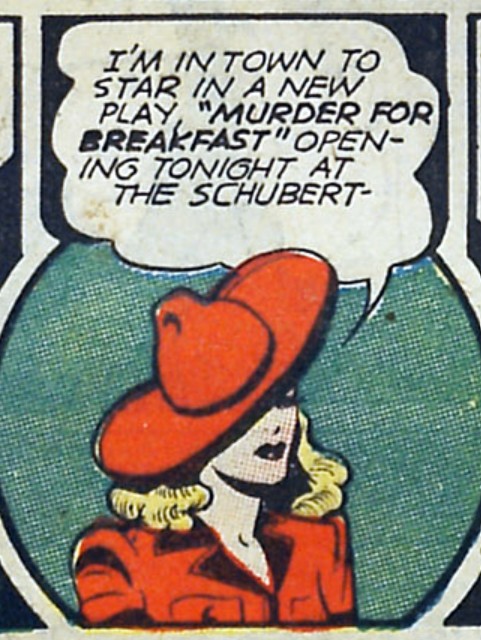
    “Murder for Breakfast”, starring Kay Kenyon, one of Presto Martin’s many Hollywood friends. (Silver Streak Comics 010, 1941)

    Songs:

    “Boogie-Woogie Blast” (Champion Comics 002, 1939)

  • MEDIA IN COMICS 001

    MEDIA IN COMICS 001

    I’ve often mentioned how comics as a medium has a grand tradition of not using the real names for people (see about half the entries in our collection of Real Folk in comics) places (see the grand list of fictional countries on every continent of our list of Locations) and things, so I hope that it won’t surprise you when I say that they make up all the media, too. And since I have a big list of all the made-up books, newspaper columns, stage shows and movies sitting around already I figured I should share.

    Movies:

    Lover Mine (Funny Picture Stories v2 005, 1938)

    Flying Cadets, Colossal Pictures, stunts by the Four Aces (The Funnies 021, 1938)

    Star-Dust (Funny Picture Stories v3 002, 1939)

    War Eagles, Colossal Studios (Keen Detective Funnies v2 006, 1939)

    Pilots All, Mammoth Film Company (Keen Detective Funnies v2 010, 1939)

    The Mystery of the Creeping Spook, Superbo Pictures (Keen Detective Funnies v2 011, 1939)

    White Goddess (Funny Pages v3 008 1939) 

    Newspaper Columns:

    “On Broadway” by Walt “Bob Phantom” Whitney. (Blue Ribbon Comics 002, 1939)

    Plays:

    “Murder for Breakfast”, starring Kay Kenyon, one of Presto Martin’s many Hollywood friends. (Silver Streak Comics 010, 1941)

    Songs:

    “Boogie-Woogie Blast” (Champion Comics 002, 1939)