The Curse of Skeleton Munroe

Category: pilot

  • MINOR SUPER-HERO ROUND-UP 041

    Another assortment of guys for your delectation.

    the Sky Wolf:

    Just another masked pilot in a souped-up named plane (originally the Silver Bullet, followed by the Golden Bullet), the Sky Wolf loses both his place in Silver Streak Comics and his plane’s name to fellow pilot Cloud Curtis once 1941 rolls around, and to add insult to injury, in 1942 the far more successful character of Skywolf debuts over at Hillman, ensuring that he doesn’t even have good SEO. (Silver Streak Comics 004, 1940)

    Whiz, King of Falcons:

    The Silver Streak is not immune to the sting of pride, so when aviator Sir Cedric Baldwin challenges him to a race around the world to prove who is the fastest man on Earth, he accepts, and is of course fast enough that he not only wins but is able to have a very culturally-sensitive adventure in Saudi Arabia along the way. Silver Streak is knocked out and captured at one point, and the falconry-obsessed villain takes advantage of this to inject his favourite bird with some super-fast blood. 

    Astonishingly, this works, despite our only account of the Silver Streak’s origin being as a result of hypnotic conditioning coupled with a near-death experience – perhaps the hypnosis was so deep that it mesmerized his very blood? That would explain the falcon’s immediate shift in loyalty from its owner to its super-heroic blood doner, at least.

    “Whiz, King of Falcons” is technically not this guy’s name until Silver Streak Comics 007, which was published in 1941, but I reckon that calling him “Unnamed Falcon Companion” here and then correcting it in six months’ time would be extremely wilfully obtuse of me. (Silver Streak Comics 006, 1940)

    UPDATE 1941 

    the Daredevil:

    The Daredevil is Bart Hill, a vigilante in the Batman mould, having lost his parents to a gang of crooks and subsequently vowed to revenge himself on crime. Further, those same crooks tortured Bart himself, rendering him mute in the process, and due to a boomerang-shaped brand they left on his chest he devoted himself to the study of the weapon, adopting it as one of his heroic signatures. The Daredevil is one of the longer-running non-Marvel or DC/Fawcett/Quality characters of the Golden Age so he will be making a few appearances here going forward, but there are a few notable things about him:

    – his origin will undergo some revision between his first and second appearances, most notably the fact that his muteness is discarded – presumably to enable for easier storytelling

    – his costume is also somewhat revised, which is fun particularly because, like his Silver Age namesake, he switches from a yellow to a red colour scheme

    – this Daredevil’s Golden Age popularity, combined with his public domain status, means that he’s a popular choice for modern revivals, but the fact that there is a currently-published character with the same name (and owned by Disney, to boot) means that nobody dares to actually call him Daredevil in their stories and so the more recent versions of him have a wide range of variably terrible alternate names including the Death Defying ‘Devil, the Daring Devil and Doubledare. (Silver Streak Comics 006, 1940)

    UPDATE 1941 

    Iron Vic:

    Iron Vic is a frustrating beast. He first appears as a mostly-dead body washing up near the island laboratory of Professor Carvel, who applies a “certain rare serum” to the task of saving his life before dropping dead from the strain. Vic, as the man comes to be known, is rendered both amnesiac and superhuman by the process. He has one proper super-heroic adventure against Carvel’s old colleague Dr Spagna before the strip transitions into one primarily about baseball (and in case you’re wondering there is no mention of the ethical quandary that a superhuman participating in regular human sports would cause). The really frustrating part is that Dr Spagna implies that he knows something about Iron Vic, but the Spagna story is never actually resolved anywhere. Vic is merely an amnesiac baseball player until I think he enters the Army at some point? WHERE OH WHERE IS MY RESOLUTION (Single Series 022, 1940)

  • MINOR SUPER-HERO ROUND-UP 005

    All Columbia Comic Corporation edition!

    Skyman: 

    Skyman (properly the Skyman but it just doesn’t scan for me) is a pilot hero, normally a ho-hum sort of character for me. But between his sci-fi super plane (the Wing), his blood-freezing stun ray (the Stasimatic) and his cool on-the-edge-of-being-too-busy costume there’s just enough super-hero peanut butter mixed in with the pilot chocolate to make it appealing (bonus running list of Skyman’s super science: atomic explosives, invisible glass phonograph, disitegrator ray, explosives-detonating ray and a ray that fuses gun barrels shut)

    After a few issues we learn that the Skyman is actually Allan Turner, wealthy good-for-nothing playboy who lost his parents to a plane crash when he was a child. If the Bruce Wayne parallel was 1:1 he would have grown up to become a noted slayer of planes, but that’s a villain’s origin. Instead, Allan Turner dresses up as a plane to fight criminals. It doesn’t make quite as much narrative sense as Batman does but it’s probably more fun to read than the other way around.

    Early Skyman also might just hold the record for the most overinflated torso in comics outside of parody characters. He gets a bit more proportional eventually but for a while there you’re concerned for his ability to live a normal life.

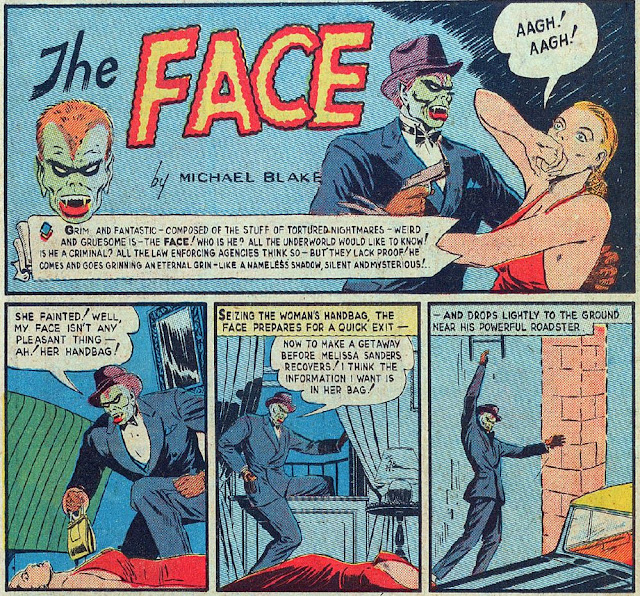
    the Face:

    The Face, like a lot of early comics heroes, draws a lot of elements from the pulps: a tuxedo-clad hero drives around in a souped up roadster fighting crime with his fists and an automatic – a pretty regular early super-guy. Even his secret identity of Tony Trent, radio station owner/ radio announcer is in the pulp-adjacent character wheelhouse.

    It was very exciting to me when I realized that the Face’s face is frequently referred to as a rubberoid mask, my favourite term for the kind of masks that only exist in comic books – perfectly realistic and naturalistic but also very easy to don and doff. This particular mask was made specially for Tony Trent by someone whose other major characteristic is being dead, which is apparently a combination that makes Trent feel quite jolly.

    Weirdly, in Big Shot Comics 006, the Face has a new, slightly less grotesque mask. No word on where he got this one but he goes back to the original pretty quickly.

    Marvelo, Monarch of Magicians:

    Created by Fred Guardineer, who also created Zatara over at DC Comics, Marvelo is… extremely similar to Zatara. Aside from their different approaches to dressing like a stage magician, I’d say that there are two slight differences between the characters: 

    1. Rather than speaking backward to cast spells, Marvelo shouts “Kalora!” as an all-purpose magic word.

    2. Marvelo’s manservant Zee is just a hair more racist than Zatara’s manservant Tong. It’s pretty close but I reckon Zee takes it.

    Big Shot Comics 017 reveals that Marvelo is the son of the ruler of the generically foreign South Pacific island of Brahama (hell on autocorrect). This doesn’t seem to have anything to do with him being a magic man but it’s nice to know. (Big Shot Comics 001, 1940)

    the Cloak:

    Jeff Cardiff, Spy Chief was a feature in Big Shot Comics from issue 1 (well, it was Jeff Cardiff, Spy-Master for the first issue or two but the point stands) with all kinds of foiled plots and plans and spies of both the vaguely fascist and vaguely communist varieties. In Issue 15, however, the spies adopt the reasonable policy of attempting to shoot on sight the man who has foiled so many of their plans and a wounded Jeff Cardiff goes to recuperate at his brother’s house.

    Long story short, Jed Cardiff is a coal magnate with a collection of “adventure curios”, including the namesake cloak of Revolutionary War-era costumed spy the Cloak and it being 1941 and a comic book, Jeff immediately adopts the Cloak identity as his own. It’s a fairly basic costumed hero shtick but I appreciate the effort and it’s always nice to see a more elaborate cape and cowl getup now and then. (Big Shot Comics 015, 1941)

    The original Cloak eventually shows up in a flashback and it turns out that his impact on the history of the American Revolution is only slightly less impactful than Superboy’s in the 1949 story in which he goes back in time and takes part in about half the major events of the war. I must say that I do love a retcon of a historical event. (Big Shot Comics 021, 1942)

  • MINOR SUPER-HERO ROUND-UP 005

    All Columbia Comic Corporation edition!

    Skyman: 

    Skyman (properly the Skyman but it just doesn’t scan for me) is a pilot hero, normally a ho-hum sort of character for me. But between his sci-fi super plane (the Wing), his blood-freezing stun ray (the Stasimatic) and his cool on-the-edge-of-being-too-busy costume there’s just enough super-hero peanut butter mixed in with the pilot chocolate to make it appealing (bonus running list of Skyman’s super science: atomic explosives, invisible glass phonograph, disitegrator ray, explosives-detonating ray and a ray that fuses gun barrels shut)

    After a few issues we learn that the Skyman is actually Allan Turner, wealthy good-for-nothing playboy who lost his parents to a plane crash when he was a child. If the Bruce Wayne parallel was 1:1 he would have grown up to become a noted slayer of planes, but that’s a villain’s origin. Instead, Allan Turner dresses up as a plane to fight criminals. It doesn’t make quite as much narrative sense as Batman does but it’s probably more fun to read than the other way around.

    Early Skyman also might just hold the record for the most overinflated torso in comics outside of parody characters. He gets a bit more proportional eventually but for a while there you’re concerned for his ability to live a normal life.

    the Face:

    The Face, like a lot of early comics heroes, draws a lot of elements from the pulps: a tuxedo-clad hero drives around in a souped up roadster fighting crime with his fists and an automatic – a pretty regular early super-guy. Even his secret identity of Tony Trent, radio station owner/ radio announcer is in the pulp-adjacent character wheelhouse.

    It was very exciting to me when I realized that the Face’s face is frequently referred to as a rubberoid mask, my favourite term for the kind of masks that only exist in comic books – perfectly realistic and naturalistic but also very easy to don and doff. This particular mask was made specially for Tony Trent by someone whose other major characteristic is being dead, which is apparently a combination that makes Trent feel quite jolly.

    Weirdly, in Big Shot Comics 006, the Face has a new, slightly less grotesque mask. No word on where he got this one but he goes back to the original pretty quickly.

    Marvelo, Monarch of Magicians:

    Created by Fred Guardineer, who also created Zatara over at DC Comics, Marvelo is… extremely similar to Zatara. Aside from their different approaches to dressing like a stage magician, I’d say that there are two slight differences between the characters: 

    1. Rather than speaking backward to cast spells, Marvelo shouts “Kalora!” as an all-purpose magic word.

    2. Marvelo’s manservant Zee is just a hair more racist than Zatara’s manservant Tong. It’s pretty close but I reckon Zee takes it.

    Big Shot Comics 017 reveals that Marvelo is the son of the ruler of the generically foreign South Pacific island of Brahama (hell on autocorrect). This doesn’t seem to have anything to do with him being a magic man but it’s nice to know. (Big Shot Comics 001, 1940)

    the Cloak:

    Jeff Cardiff, Spy Chief was a feature in Big Shot Comics from issue 1 (well, it was Jeff Cardiff, Spy-Master for the first issue or two but the point stands) with all kinds of foiled plots and plans and spies of both the vaguely fascist and vaguely communist varieties. In Issue 15, however, the spies adopt the reasonable policy of attempting to shoot on sight the man who has foiled so many of their plans and a wounded Jeff Cardiff goes to recuperate at his brother’s house.

    Long story short, Jed Cardiff is a coal magnate with a collection of “adventure curios”, including the namesake cloak of Revolutionary War-era costumed spy the Cloak and it being 1941 and a comic book, Jeff immediately adopts the Cloak identity as his own. It’s a fairly basic costumed hero shtick but I appreciate the effort and it’s always nice to see a more elaborate cape and cowl getup now and then. (Big Shot Comics 015, 1941)

    The original Cloak eventually shows up in a flashback and it turns out that his impact on the history of the American Revolution is only slightly less impactful than Superboy’s in the 1949 story in which he goes back in time and takes part in about half the major events of the war. I must say that I do love a retcon of a historical event. (Big Shot Comics 021, 1942)

  • MINOR SUPER-VILLAIN 469: THE GREAT ONE

    (Amazing-Man Comics 013, 1940)

    The Great One is a real testament to the fact that style is far more important than substance when it comes to super-villainy. On a purely objective level the Great One is average at best, with an entry-level costume and a scheme that was old back in the days of the pulps. But it’s the style that makes the villain, and if the Great One has anything , it’s style.

    The Great One’s scheme involves using a submersible aircraft carrier as a base of operations to capture planes using a magnetic tractor ray, then hypnotizing their crews into serving him as an army of loyal minions. If this happened in real life it would obviously be the news of the century but in any comic book universe it’s strictly cliche.

    But the Great One is making it work! He speechifies, he dresses his pilots up in weird brown sack uniforms, he names his submersible aircraft carrier “Eurania, the Floating Continent”. He’s such a grandiose, self-assured ass of a villain that I’m a bit surprised that he bothers to hold the Scarlet Ace at bay with a gun rather than trying to bluff him with sheer personality.

    The Great One’s downfall comes in two parts: first, after the Scarlet Ace discovers that the pilots can be shaken out of their mind control via a good sock to the jaw, he makes the key mistake jaw ordering them to beat him up rather than, say, employing firearms to take him out. As freed pilots join in the jaw-socking, all are freed with an exponential swiftness.

    The second part is unavoidable. There is no way that the Great One that so endeared himself to me would not do something as foolhardy as stand up in his biplane to gloat over his impending victory over the Scarlet Ace. I salute thee, Great One, a bombastic idiot to the end.

  • MINOR SUPER-VILLAIN 469: THE GREAT ONE

    (Amazing-Man Comics 013, 1940)

    The Great One is a real testament to the fact that style is far more important than substance when it comes to super-villainy. On a purely objective level the Great One is average at best, with an entry-level costume and a scheme that was old back in the days of the pulps. But it’s the style that makes the villain, and if the Great One has anything , it’s style.

    The Great One’s scheme involves using a submersible aircraft carrier as a base of operations to capture planes using a magnetic tractor ray, then hypnotizing their crews into serving him as an army of loyal minions. If this happened in real life it would obviously be the news of the century but in any comic book universe it’s strictly cliche.

    But the Great One is making it work! He speechifies, he dresses his pilots up in weird brown sack uniforms, he names his submersible aircraft carrier “Eurania, the Floating Continent”. He’s such a grandiose, self-assured ass of a villain that I’m a bit surprised that he bothers to hold the Scarlet Ace at bay with a gun rather than trying to bluff him with sheer personality.

    The Great One’s downfall comes in two parts: first, after the Scarlet Ace discovers that the pilots can be shaken out of their mind control via a good sock to the jaw, he makes the key mistake jaw ordering them to beat him up rather than, say, employing firearms to take him out. As freed pilots join in the jaw-socking, all are freed with an exponential swiftness.

    The second part is unavoidable. There is no way that the Great One that so endeared himself to me would not do something as foolhardy as stand up in his biplane to gloat over his impending victory over the Scarlet Ace. I salute thee, Great One, a bombastic idiot to the end.

  • MINOR SUPER-VILLAIN 468: THE GHOST

    (Amazing-Man Comics 013, 1940)

    In Amazing-Man Comics 010 Minimidget and Ritty accidentally get shot to the Belgian Congo on a guy’s homemade rocket (as you do) and the subsequent issues have been a series of trials and tribulations as they make their way back home. The Ghost is another one of those, but a fun one – not racist at all, for one thing!

    I may not have much regard for pilot-heroes but air pirates are another matter, and that’s just what the Ghost is, complete with all the good good accessories: custom planes with little ghosts painted on them, a hidden airfield, costumed henchmen dressed in a less-cool version of his own costume, a bombastic attitude… he’s the complete package for a one-off villain. The only sour note is his name – the Ghost is a perfectly fine name on its own but several people refer to him as a “sky way robber” and the Skyway Robber is a much better name for an air pirate.

    (it’s hard to tell with the state of search engines nowadays but it seems like “the Skyway Robber” has only been used as a name for a card in Magic: the Gathering. A shame!)

    The Ghost dies somewhat ignominiously when his plane is tripped. That’s life as a comic book villain, I guess.

  • MINOR SUPER-VILLAIN 434: THE PHANTOM OF THE SKY

    (Popular Comics 046, 1939)

    The Phantom of the Sky (AKA the Phantom Sky Raider AKA the Black Phantom) is a mysterious pilot who has been flying around the American West, viciously attacking and shooting down civilian planes and painting a skull-and-crossbones calling card on them. He turns out to be a nameless French WWI flying ace, shot down and left for dead but actually just trapped in a delusion of an unending war in which he is essentially conducting guerrilla air combat. He proves elusive but eventually the Masked Pilot and his pal Tom shoot him down. He does manage to survive the crash, so hopefully he got some help for his nightmare existence.

    Here’s where I thought I might say something about the Masked Pilot but… he’s just a pilot hero. He flies around with Tom and solves problems with his plane. You might think that he wears a face-concealing mask because he’s horribly deformed but no, he wears a regular domino in his civilian getup so it’s just an affectation. I suppose a pilot with a gimmick is technically better than one without, but only just.

  • MINOR SUPER-VILLAIN 430: THE DEVIL

    (Mystery Men Comics 007, 1940) 

    I can’t help but love this guy: yes he’s a cheap extortionist who gives himself a scary name to enhance his death threats but he goes to the trouble of dressing up in a devil outfit even while sneaking around so that nobody can see him. And since he’s the antagonist of a Wing Turner story and Wing Turner is a pilot-detective, the Devil is flying around in a fighter plane dressed in little horns and red briefs (and appears to be barefoot, which must be uncomfortable if flying a plane involves working any pedals). There’s just something about a costumed pilot that is wildly endearing.

    The Devil of course turns out to be Baldy Barry, a regular extortionist who jumps into a lava pit rather than be caught. Over the top for an extortion charge I reckon, but at least he was on brand to the end.

  • MINOR SUPER-VILLAIN 321: THE BLACK ACE

    (Daring Mystery Comics 006, 1940)

    The costumed fighter pilot might just be one of the most basic levels of super-villain. Here we have the Black Ace, Nazi and foe of the Flying Flame. He has a tower with an anti-aircraft vibrational cannon in it and a plane with a skull and crossbones on it. He gets shot down at the end of the story. FIN

  • SEMI-MINOR SUPER-HEROS: FIGHTER PILOT EDITION

    Conundrum: Golden Age fighter pilot characters are essentially a very minor subset of super-heroes, and they are also very boring to me. I  feel a compulsion to write something about them and also to slump sideways in my seat when contemplating their existence.

    Solution: since the only really interesting thing about them is their cool names, I will list those.

    the Flying Flame (Daring Mystery Comics 006, 1940)

    the Flying Fox (More Fun Comics 037, 1938)

    the Hell Diver (Hit Comics 014, 1941)

    the Scarlet Ace (Amazing-Man Comics 013, 1940)

    the Sky Devils (Daring Mystery Comics 002, 1940)

    the Spitfire (Crack Comics 015, 1941)

    the War Bird (Slam-Bang Comics 003, 1940)