The Curse of Skeleton Munroe

Category: crime orphan

  • MINOR SUPER-HERO ROUND-UP 095

    There really are a lot of these guys, aren’t there?

    Hurricane:

    As presented, Hurricane is a real mythological mash-em-up: “son of Thor” but also “last descendant of the Ancient Greek immortals,” and arch-enemy to the Roman god Pluto. Pantheism, baybee!

    Hurricane’s whole deal is in being super fast, like mythically fast. The fact that he has a divine opponent is quite nice, in that it offsets some of the tendency of speedster characters to walk all over their opponents as can be seen above.

    As befits a divine being with such a diverse background, Hurricane also has a Swiss Army Knife of as-needed powers, including weather control, flight, invisibility and changing into his super-suit in a flash of radiance. His signature (non-speed-related) power is the ability to stick a couple of little wings onto an object or person to give them the power of super-fast flight while looking cute.

    Hurricane is one of several older characters to eventually be retconned as former identities of Makkari of the Eternals, but we will deal with that if we ever get to the mid-70s. (Captain America Comics 001, 1940)

    Categorized in: Origin (Deities), Powers (Super Speed, Various), Weather (Hurricanes)

    Tuk:

    Speaking of retcons, here we have Tuk, Caveboy, hero of the year 50 000 BCE! Orphaned as a baby and raised by Ak, last of the Shaggy Ones, Tuk (referred to throughout as one of the Hairless Ones, natch) is the child of two mysterious figures who Ak believed to be some sort of divine being, but who refer to themselves as exiles from a place called “Attilan.” 

    The real-world explanation for this is surely that Jack Kirby liked the idea of an ancient and mysterious super-kingdom with a name that could have eventually mutated into “Atlantis” over time and used it more than once. The rise of continuity perverts and the fact that Kirby also used Attilan as the name of the Inhumans’ home city means that Tuk has now been given the status of first generation Inhuman offspring, and his eventual interbreeding with early humanity is part of the reason that they are so genetically flexible and keep developing super powers all over the place.

    Tuk is joined on his travels by Tanir, a Cro-Magnon man and the very first archery-based super-adventurer, at least chronologically. While Tuk has been minorly enshrined in Marvel Comics history, Tanir has largely been ignored, and that’s a shame. (Captain America Comics 001, 1940)

    Categorized in: Origin (Heroes of the Past, Human Offshoots), Power (Weapons Masters (Bow))

    Father Time:

    It’s Father Time! Possibly my favourite under-used Golden Age Marvel super-hero!

    Father Time is really Larry Scott, a man whose father John is found guilty of murder and fast-tracked for execution, quite possibly because he keeps saying that he is innocent. In a series of events that hopefully ends up haunting that judge for the rest of his days, Larry manages to acquire the evidence to prove that his father is innocent, only to arrive mere moments too late to save him.

    Larry’s takeaway from all this is that time is always on the side of crooks rather than the law, and so he sets out to re-balance things by adopting the costumed persona of Father Time and beating criminal ass. It’s a simple but effective origin, if much more pro-legal system than one might otherwise expect. 

    Some notable Father Time innovations: the use of a scythe as both a throwing weapon and urban traversal aid, an extremely unique mask design (eyebrow to upper lip with a full nose cutout!) complimenting a decent over-all look, and the use of a calling card in the form of a clock face with an attached skull and crossbones. (Captain America Comics 006, 1941)

    Categorized in: Abstract Concepts (Time), Famous Figures (Father Time), Origin (Motivated by Loss)

    Spy Fighter **UPDATE**:

    Despite the fact that I am a spreadsheet-keeping, blog-writing, categorization fan, I do in fact think that a slavish dedication to continuity can stifle creativity. So what if the details of a character’s backstory are inconsistent across appearances as long as it’s all fun, right? That said… this “Spy Fighter” episode is set in 2041 CE, while the first one is set in 1997 CE, meaning that poor Saber here has been battling the enemies of Greater America for 44 long years. He still looks great, though. (Fight Comics 012, 1941)

    While Fight Comics 013 continues this trend with a story set in 2042 (45 years!), the final three Spy Fighter stories abandon the science fiction and super-hero aspects of the character altogether. The Spy Fighter in Fight Comics 014 through 016 is effectively a separate character who is a non-powered espionage agent supporting the Allied forces in Egypt and the surrounding region – a true fall from grace for an interestingly weird character.
  • MINOR SUPER-HERO ROUND-UP 088

    MINOR SUPER-HERO ROUND-UP 088

    To continue my recent trend, 3/4 of these characters are very unlikely to appear in a modern Marvel comic and the fourth is decently likely to.

    Mr Million:

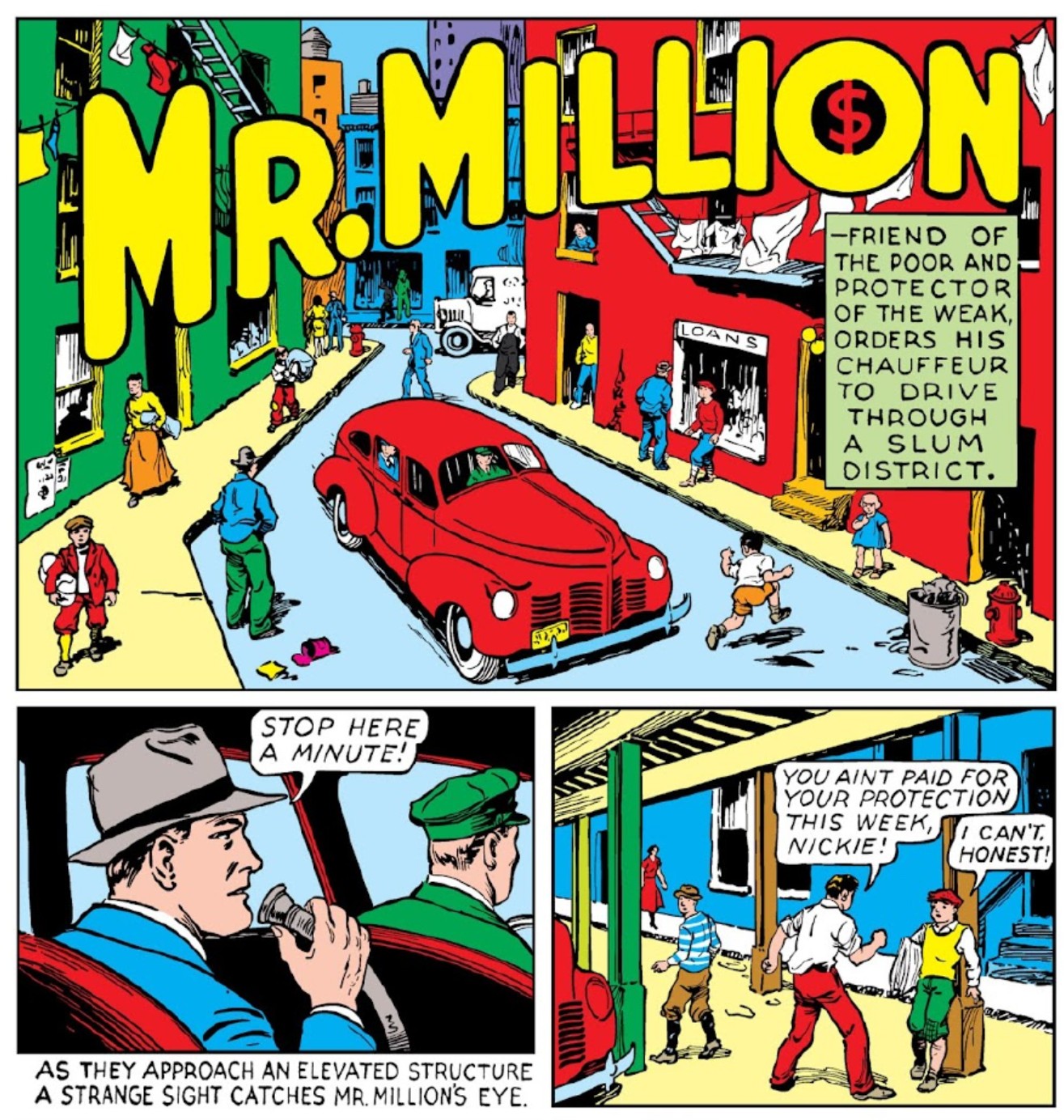
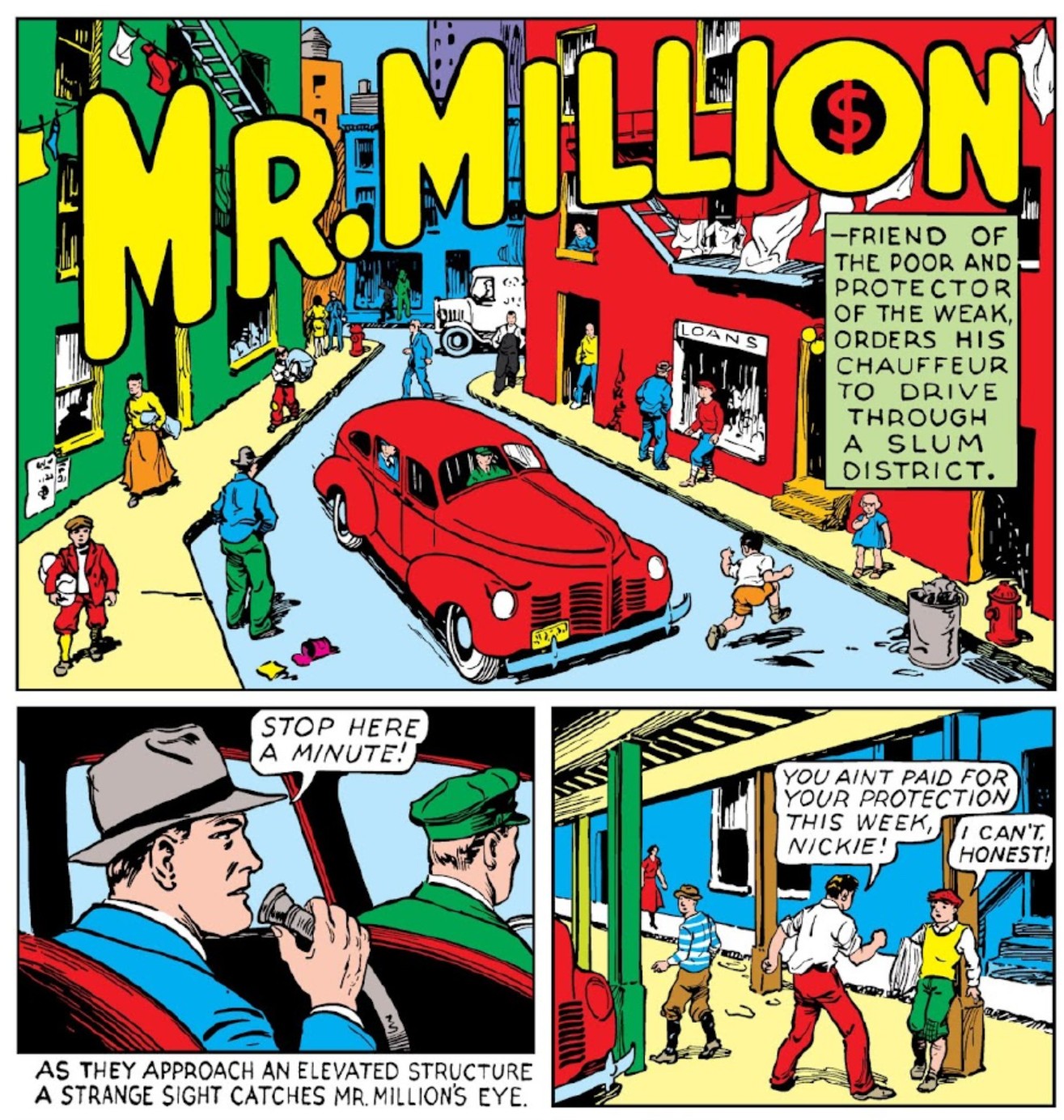
    Mr Million is kind of what everyone yaps about wanting Bruce Wayne to be: a rich guy who uses his money to help people instead of beating people up, and while that might be better for society in this completely fictional version of New York City it’s pretty boring to read about. But this one orphan kid is no longer being bullied and his child labour is netting him enough to support his sick mother, so that’s something, I guess. (Daring Mystery Comics 007, 1941)

    Categorized in: Alphanumeric (a Million), Generica (Misters)

    Captain Daring:

    Captain Daring is the square-jawed hero of America in the year 3051 CE, and while short-lived sci-fi adventurers are so plentiful in both the Golden and Silver Ages that I don’t usually bother with them, this is another early Jack Kirby strip. As such, you get the fun of spotting the first-draft versions of things that he will come back to throughout his career, like the cast of differently-shaped background characters above, or the cool armour that everyone sports.

    The technology isn’t quite as ornate as it will get but you can see the base structures that Kirby will build upon.

    And of course there is Kirby’s love of a tough woman and (less common but still something that he will return to) his fondness for dog cavalry.

    Captain Daring himself is notable for facing both a Hitler-inspired subterranean Fuehrer and Hitler himself, but sadly is dropped from Daring Mystery Comics while he is mind-controlled by the latter. I can’t believe that they made Captain Daring a Nazi, etc. (Daring Mystery Comics 007, 1941)

    Categorized in: Generica (Captains), Language (Superlatives – Daring), Origins (Heroes of the Future)

    the Challenger:

    Bill Waring is a physically-unimposing young law student who is almost killed when his father attempts to expose a city-wide corruption scandal and is gunned down in the street. Swearing vengeance, Bill sets out to learn everything he needs to become a crime fighter.

    Waring travels the world, mastering among many other things the secrets of: jujutsu, chemistry, nerve control, fencing, the rifle, aerial combat, boxing, swimming, baseball, football and most useful of all, polo. He’s the complete crimefighting package!

    Finally prepared, Bill dons a costume that is simultaneously kind of cool- and quite goofy-looking (I thought for sure that that little white dot in the centre of his mask was meant to be his nose poking out but I checked the original art and even there it’s just a weird white dot) and confronts Dram, the gang boss responsible for his father’s death. His name, it turns out, is in reference to his habit of challenging crooks to single combat that is sometimes, as in Dram’s case, to the death. The Challenger moves over to Mystic Comics after his first appearance, so we will be seeing him again in a few months to find out if he keeps this habit up. (Daring Mystery Comics 007, 1941)

    Categorized in: Activities (Duelling), Origins (Crime Orphans), Powers (Martial Artists, Weapons Masters)

    Citizen V:

    Citizen V is in reality British Army Lieutenant John Watkins, who is seemingly killed during the evacuation at Dunkirk but is only mostly dead. After being nursed back to help by a kindly French fisherman, Watkins makes his way back to England and is recruited as an officially sanctioned costumed agent to head back into Axis-occupied territory and incite rebellion.

    Watkins’ Citizen V uniform is interesting for being one of the few super-hero costumes to incorporate Morse code (just above the “V” on his chest) and is also a fine example of how some design choices just don’t work. If there is a super suit out there that looks good with both long sleeves and short shorts, it isn’t this one. More modern depictions of the character lean into the “military uniform” aspect of the look more and give him pants. It’s a bit less super-hero-y but much nicer looking.

    Though Watkins does punch plenty of Nazis (and Hitler himself!) in the snoots, the main focus of his mission is in promoting the “V for Victory” campaign, a real-life thing that actually happened in occupied Europe, and which characters such as the Silver Streak and London were also involved in in their respective comics.

    Citizen V is of course most well-known today for having been murdered by Baron Zemo, who stole the identity for use as the leader of the first Thunderbolts team. He also has a surprisingly extensive collection of successors, all of whom unfortunately seem to prefer the terrible Zemo version of the costume, which I had always assumed was purposefully designed to look like an exercise in patriotic bad taste but which is evidently preferable to wearing a little service cap. (Daring Mystery Comics 008, 1942)

    Categorized in: Alphanumeric (V), Generica (Citizens), Origin (Faked Own Death)

  • MINOR SUPER-HERO ROUND-UP 088

    MINOR SUPER-HERO ROUND-UP 088

    To continue my recent trend, 3/4 of these characters are very unlikely to appear in a modern Marvel comic and the fourth is decently likely to.

    Mr Million:

    Mr Million is kind of what everyone yaps about wanting Bruce Wayne to be: a rich guy who uses his money to help people instead of beating people up, and while that might be better for society in this completely fictional version of New York City it’s pretty boring to read about. But this one orphan kid is no longer being bullied and his child labour is netting him enough to support his sick mother, so that’s something, I guess. (Daring Mystery Comics 007, 1941)

    Categorized in: Alphanumeric (a Million), Generica (Misters)

    Captain Daring:

    Captain Daring is the square-jawed hero of America in the year 3051 CE, and while short-lived sci-fi adventurers are so plentiful in both the Golden and Silver Ages that I don’t usually bother with them, this is another early Jack Kirby strip. As such, you get the fun of spotting the first-draft versions of things that he will come back to throughout his career, like the cast of differently-shaped background characters above, or the cool armour that everyone sports.

    The technology isn’t quite as ornate as it will get but you can see the base structures that Kirby will build upon.

    And of course there is Kirby’s love of a tough woman and (less common but still something that he will return to) his fondness for dog cavalry.

    Captain Daring himself is notable for facing both a Hitler-inspired subterranean Fuehrer and Hitler himself, but sadly is dropped from Daring Mystery Comics while he is mind-controlled by the latter. I can’t believe that they made Captain Daring a Nazi, etc. (Daring Mystery Comics 007, 1941)

    Categorized in: Generica (Captains), Language (Superlatives – Daring), Origins (Heroes of the Future)

    the Challenger:

    Bill Waring is a physically-unimposing young law student who is almost killed when his father attempts to expose a city-wide corruption scandal and is gunned down in the street. Swearing vengeance, Bill sets out to learn everything he needs to become a crime fighter.

    Waring travels the world, mastering among many other things the secrets of: jujutsu, chemistry, nerve control, fencing, the rifle, aerial combat, boxing, swimming, baseball, football and most useful of all, polo. He’s the complete crimefighting package!

    Finally prepared, Bill dons a costume that is simultaneously kind of cool- and quite goofy-looking (I thought for sure that that little white dot in the centre of his mask was meant to be his nose poking out but I checked the original art and even there it’s just a weird white dot) and confronts Dram, the gang boss responsible for his father’s death. His name, it turns out, is in reference to his habit of challenging crooks to single combat that is sometimes, as in Dram’s case, to the death. The Challenger moves over to Mystic Comics after his first appearance, so we will be seeing him again in a few months to find out if he keeps this habit up. (Daring Mystery Comics 007, 1941)

    Categorized in: Activities (Duelling), Origins (Crime Orphans), Powers (Martial Artists, Weapons Masters)

    Citizen V:

    Citizen V is in reality British Army Lieutenant John Watkins, who is seemingly killed during the evacuation at Dunkirk but is only mostly dead. After being nursed back to help by a kindly French fisherman, Watkins makes his way back to England and is recruited as an officially sanctioned costumed agent to head back into Axis-occupied territory and incite rebellion.

    Watkins’ Citizen V uniform is interesting for being one of the few super-hero costumes to incorporate Morse code (just above the “V” on his chest) and is also a fine example of how some design choices just don’t work. If there is a super suit out there that looks good with both long sleeves and short shorts, it isn’t this one. More modern depictions of the character lean into the “military uniform” aspect of the look more and give him pants. It’s a bit less super-hero-y but much nicer looking.

    Though Watkins does punch plenty of Nazis (and Hitler himself!) in the snoots, the main focus of his mission is in promoting the “V for Victory” campaign, a real-life thing that actually happened in occupied Europe, and which characters such as the Silver Streak and London were also involved in in their respective comics.

    Citizen V is of course most well-known today for having been murdered by Baron Zemo, who stole the identity for use as the leader of the first Thunderbolts team. He also has a surprisingly extensive collection of successors, all of whom unfortunately seem to prefer the terrible Zemo version of the costume, which I had always assumed was purposefully designed to look like an exercise in patriotic bad taste but which is evidently preferable to wearing a little service cap. (Daring Mystery Comics 008, 1942)

    Categorized in: Alphanumeric (V), Generica (Citizens), Origin (Faked Own Death)

  • MINOR SUPER-HERO ROUND-UP 084

    MINOR SUPER-HERO ROUND-UP 084

    Obscure Marvel super-heroes, you say? But of course!

    Monako, Prince of Magic:

    Monako is a classic comic book magic hero in the Zatara vein, right down to the top hat, tuxedo and little mustache, though he does eventually switch to wearing a fez. His major distinction from his legion of peers is that he was brought back in a fairly recent Doctor Strange run, though as is so often the case he was dug up only to be horribly killed off.

    Monako gets an origin story in Daring Mystery Comics 004, in which he is orphaned when an Indian group referred to only as “the Cruel Tribe” ritually explode the entire caravan that he and his parents were travelling in as missionaries (this at least gives us an answer to the perennial question of why bring your young child along on such a dangerous journey: because missionaries).

    Young Monako (a last name? a stage name?) inexplicably survives the conflagration and is subsequently adopted by the chief of the Cruel Tribe, who teaches him the ways of magic. Just why he does this is not explored and will never be, because the British eventually show up to massacre the entire village and send young Monako back to England. Were he a going concern for the seventy-odd years between his final Golden Age appearance and his death, I’m sure that the question of just how a whole group of people with powers similar to the nigh-omnipotent Monako were killed with simple firearms, but alas, such was not the case. (Daring Mystery Comics 001, 1940)

    Categorized in: Locations (Unrelated Name), Power Categories (Magic), Royalty (Princes)

    Phantom of the Underworld: 

    “Doc” Denton is a surgeon-turned-detective who helps the police round up a gang boss named Perrone in his sole recorded adventure. I one hundred percent am including him here because “Phantom of the Underworld” is such a terrific name, even if nobody calls him that in-story. (Daring Mystery Comics 001, 1940)

    Categorized in: Day Jobs (Private Detectives), Locations (the Underworld), Supranormal Beings (Phantoms)

    Trojak the Tiger Man: 

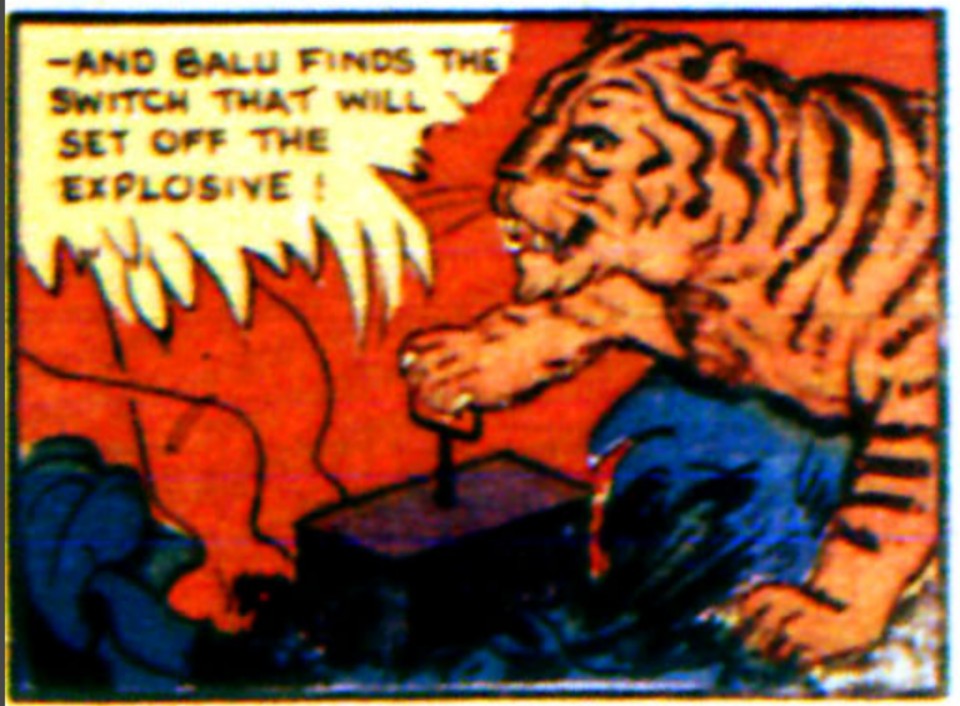
    Trojak, orphaned son of a jungle explorer who made the inexplicable yet very popular decision to bring a baby along with him on his travels (perhaps as a difficulty boost? Was Trojak’s father a gamer?), has grown up among a tribe his father died in defense of. As is so often the case in adventure literature, being a white guy in the jungle has made Trojak both stronger and cooler than everyone else, plus he can talk to animals like Balu, his geographically-anomalous tiger companion. (Daring Mystery Comics 002, 1940)

    (he is a very intelligent tiger)

    Categorized in: Animals (Tigers), Generica (Mans), Origin (Orphan Raised in Jungle)

    Tigerman:

    “Trojak the Tiger Man” becomes “Tigerman” for its final instalment, and it’s a bit of a toss-up on whether the two characters are supposed to be the same or not. Both Trojak and Tigerman are orphaned youths who were raised by jungle tribe and who now adventure while in the company of a tiger named Balu, sure, but crucially “Trojak” is set in Africa while the Tigerman roams India. You’d be forgiven for assuming that Tigerman was Indian but no, he’s American by birth – he’s just the rare near-naked jungle guy who has the ability to get a tan. 

    The one thing that could have cleared up the mystery of whether these two are the same guy or not would be more adventures featuring either one of them and sadly there are no more (Daring Mystery Comics 006, 1940)

    Categorized in: Animals (Tigers), Generica (Mans), Origin (Orphan Raised in Jungle) 

    K-4 and his Sky Devils:

    K-4 is the code name of a “flying spy,” and WWI/Spanish Civil War fighter ace (the youngest WWI ace, according to the text box, which would make him at most 18 as far as I can tell) who leads the Sky Devils, comprised of fellow WWI ace René d’Auvergne and makeup expert Ronald Wolverstone-Clodd. Some of the usual fun of the multinational team set-up is missing here because K-4 spends a lot of his time doing solo missions. (Daring Mystery Comics 002, 1940)

    Categorized in: Alphanumeric (K, 4), Origins (WWI vets), Supranormal Beings (Devils)

  • MINOR SUPER-HERO ROUND-UP 074

    Some more of those “minor super-heroes” you like so much. 

    the Cat-Man **Update**:

    Hey, it’s the Cat-Man! As you may or may not recall, the Cat Man (sans hyphen) debuted in Crash Comics Adventures in 1940 and was the only survivor of that comics short run. The most obvious change to his character is his costume, which goes from its former jungle chic look through a blue-and-orange phase  before settling on the orange-and-darker orange look that he will stick with for the rest of his career.

    In addition to the costumes and the hyphen, Cat-Man got a slight tweak to his origin: rather than being orphaned by a hostile tribe in India, David Merrywether’s parents are now said to have been killed by bandits in Burma. David also has a job now: he’s a private detective for the first four issues of Cat-Man Comics, after which he enlists and becomes a lieutenant in the US Army.

    The Cat-Man also gets a couple of new powers in 1941: he is able to see otherwise-invisible radiation and displays some degree of super strength.

    Finally: his nine lives. Though he still has this power, David manages to only die once during the whole of 1941, bringing his total remaining lives down to six.

    the Kitten: 

    Actually, not quite finally, as this is also the year that the Cat-Man gets a sidekick. While en route to investigate a series of train explosions, Lt David “the Cat-Man” Merrywether picks up a hitchhiking man and his niece. The man turns out to be a real scumbag, but the girl, named Katie Conn, turns on her uncle rather than see him rob and possibly murder Merrywether. Once the uncle is tossed in the hoosegow it’s a classic case of a child just entering a super-hero’s orbit and getting auto-adopted.

    Katie turns out to be the orphaned child of a pair of circus acrobats, which as we know is a perfect background for a potential super-hero’s sidekick to have. She also appears to be a few years younger than your typical kid sidekick – if they average in at about 13-15 I’d call her 11 or 12, though as usual the limitations of Golden Age art make estimating the age of kids difficult at best.

    Merrywether does his best to conceal his dual identity from his new ward but doesn’t quite manage it, and her self-assigned new role as the Cat-Man’s sidekick is announced in the final panel of the last Cat-Man story of 1941. More specifics on her in action as a sidekick in 1942. I will say that it’s nice to see a kid sidekick with both a costume and a code name. (Cat-Man Comics 005, 1941)

    Blaze Baylor: 

    Blaze Baylor is the son of the famous fire chief Smoky Baylor, who was killed by arsonists, and who is now a very specific anti-arson crimefighter. Though the name of the strip is “‘Blaze’ Baylor and the Arson Ring,” there is no indication in any of his adventures that the arsonists he battles are connected to one another in any way. (Cat-Man Comics 001 1941)

    Dr Diamond: 

    Dr Drake Gorden is bound for the South Seas when the freighter he is travelling on is sunk by a waterspout. He passes out after washing up on a beach at the base of an unscaleable cliff and is carried off by an eagle that takes him to the home of a frankly weird guy who has dressed him in a generic super-hero costume.

    This never-named man explains that thirty years prior he had come into possession of a legendary black diamond that conferred great physical power to its wielder, and that he had retired to the island to await the arrival of someone worthy enough to receive it. Dr Gorden, a man who he just met and who has spoken all of thirty-three words to him, several of which were to refer to a pair of brown pants as his “American clothes,” is his pick.

    Whatever the opposite of the Refusal of the Call part of the Hero’s Journey is, that’s what Dr Gorden has. He immediately renames himself Dr Diamond and launches into a monologue about just how hard he’s going to bust up crime that is so over the top that it would make me personally reconsider giving him any sort of power whatsoever. Despite my misgivings, Dr Diamond does an adequate job of using the powers conferred by the gem (super strength, enhanced speed, some degree of invincibility) to battle crime for four issues before fading into the mists of obscurity. (Cat-Man Comics 001, 1941) 

  • MINOR SUPER-HERO ROUND-UP 074

    Some more of those “minor super-heroes” you like so much. 

    the Cat-Man **Update**:

    Hey, it’s the Cat-Man! As you may or may not recall, the Cat Man (sans hyphen) debuted in Crash Comics Adventures in 1940 and was the only survivor of that comics short run. The most obvious change to his character is his costume, which goes from its former jungle chic look through a blue-and-orange phase  before settling on the orange-and-darker orange look that he will stick with for the rest of his career.

    In addition to the costumes and the hyphen, Cat-Man got a slight tweak to his origin: rather than being orphaned by a hostile tribe in India, David Merrywether’s parents are now said to have been killed by bandits in Burma. David also has a job now: he’s a private detective for the first four issues of Cat-Man Comics, after which he enlists and becomes a lieutenant in the US Army.

    The Cat-Man also gets a couple of new powers in 1941: he is able to see otherwise-invisible radiation and displays some degree of super strength.

    Finally: his nine lives. Though he still has this power, David manages to only die once during the whole of 1941, bringing his total remaining lives down to six.

    the Kitten: 

    Actually, not quite finally, as this is also the year that the Cat-Man gets a sidekick. While en route to investigate a series of train explosions, Lt David “the Cat-Man” Merrywether picks up a hitchhiking man and his niece. The man turns out to be a real scumbag, but the girl, named Katie Conn, turns on her uncle rather than see him rob and possibly murder Merrywether. Once the uncle is tossed in the hoosegow it’s a classic case of a child just entering a super-hero’s orbit and getting auto-adopted.

    Katie turns out to be the orphaned child of a pair of circus acrobats, which as we know is a perfect background for a potential super-hero’s sidekick to have. She also appears to be a few years younger than your typical kid sidekick – if they average in at about 13-15 I’d call her 11 or 12, though as usual the limitations of Golden Age art make estimating the age of kids difficult at best.

    Merrywether does his best to conceal his dual identity from his new ward but doesn’t quite manage it, and her self-assigned new role as the Cat-Man’s sidekick is announced in the final panel of the last Cat-Man story of 1941. More specifics on her in action as a sidekick in 1942. I will say that it’s nice to see a kid sidekick with both a costume and a code name. (Cat-Man Comics 005, 1941)

    Blaze Baylor: 

    Blaze Baylor is the son of the famous fire chief Smoky Baylor, who was killed by arsonists, and who is now a very specific anti-arson crimefighter. Though the name of the strip is “‘Blaze’ Baylor and the Arson Ring,” there is no indication in any of his adventures that the arsonists he battles are connected to one another in any way. (Cat-Man Comics 001 1941)

    Dr Diamond: 

    Dr Drake Gorden is bound for the South Seas when the freighter he is travelling on is sunk by a waterspout. He passes out after washing up on a beach at the base of an unscaleable cliff and is carried off by an eagle that takes him to the home of a frankly weird guy who has dressed him in a generic super-hero costume.

    This never-named man explains that thirty years prior he had come into possession of a legendary black diamond that conferred great physical power to its wielder, and that he had retired to the island to await the arrival of someone worthy enough to receive it. Dr Gorden, a man who he just met and who has spoken all of thirty-three words to him, several of which were to refer to a pair of brown pants as his “American clothes,” is his pick.

    Whatever the opposite of the Refusal of the Call part of the Hero’s Journey is, that’s what Dr Gorden has. He immediately renames himself Dr Diamond and launches into a monologue about just how hard he’s going to bust up crime that is so over the top that it would make me personally reconsider giving him any sort of power whatsoever. Despite my misgivings, Dr Diamond does an adequate job of using the powers conferred by the gem (super strength, enhanced speed, some degree of invincibility) to battle crime for four issues before fading into the mists of obscurity. (Cat-Man Comics 001, 1941) 

  • SUPER-HERO FILE 002: CAPTAIN MARVEL JUNIOR

    SUPER-HERO FILE 002: CAPTAIN MARVEL JUNIOR

    (Whiz Comics 025, 1941)

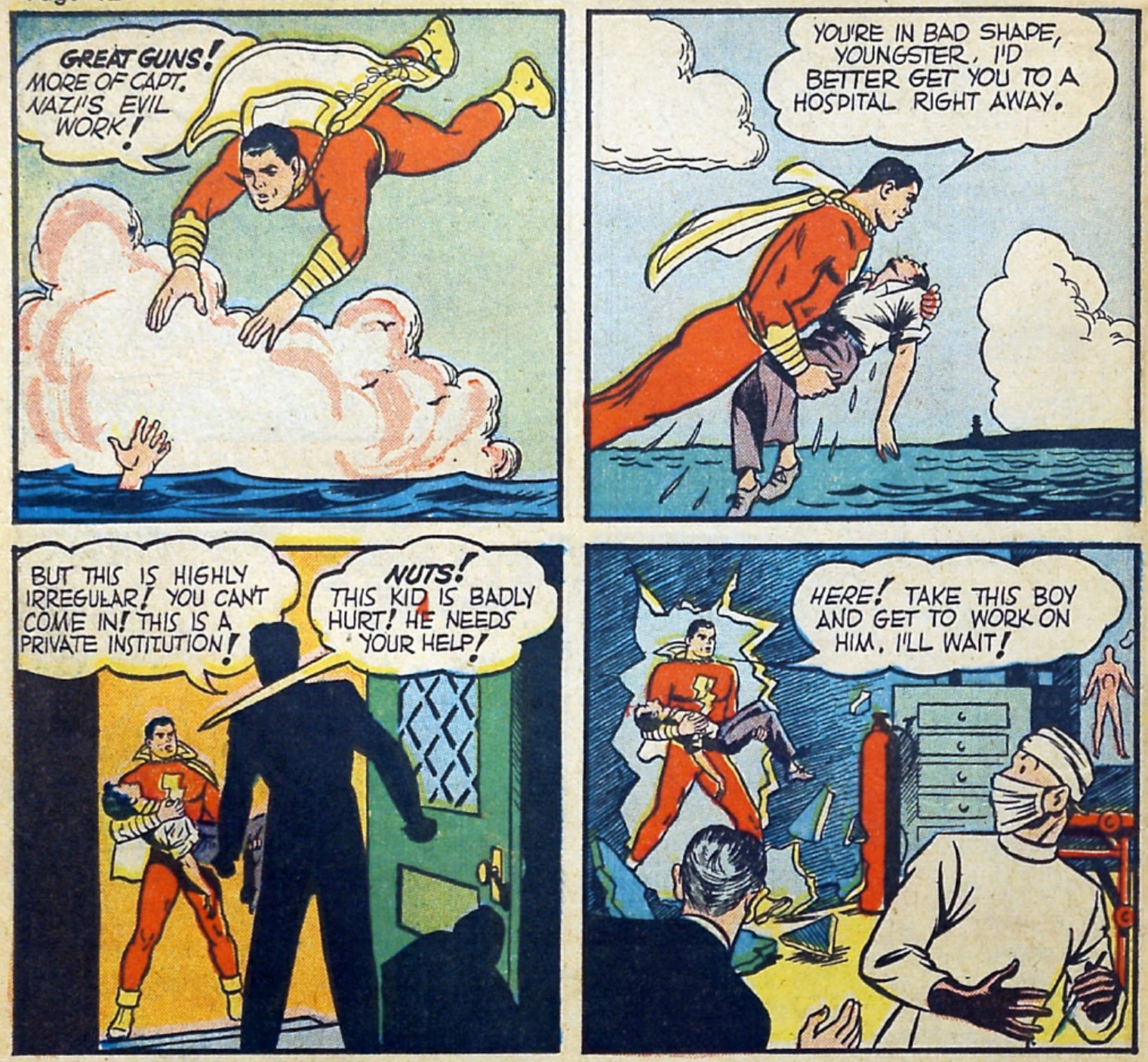
    After the vile Captain Nazi is knocked into New York Fawcett City Harbor during a battle with Captain Marvel, he is pulled from the water by young Freddy Freeman and his grandfather and immediately rewards their good deed by murdering them both. Or so he thinks! It turns out that Freddy is merely grievously injured, and Captain Marvel is able to bring him to a hospital for care.

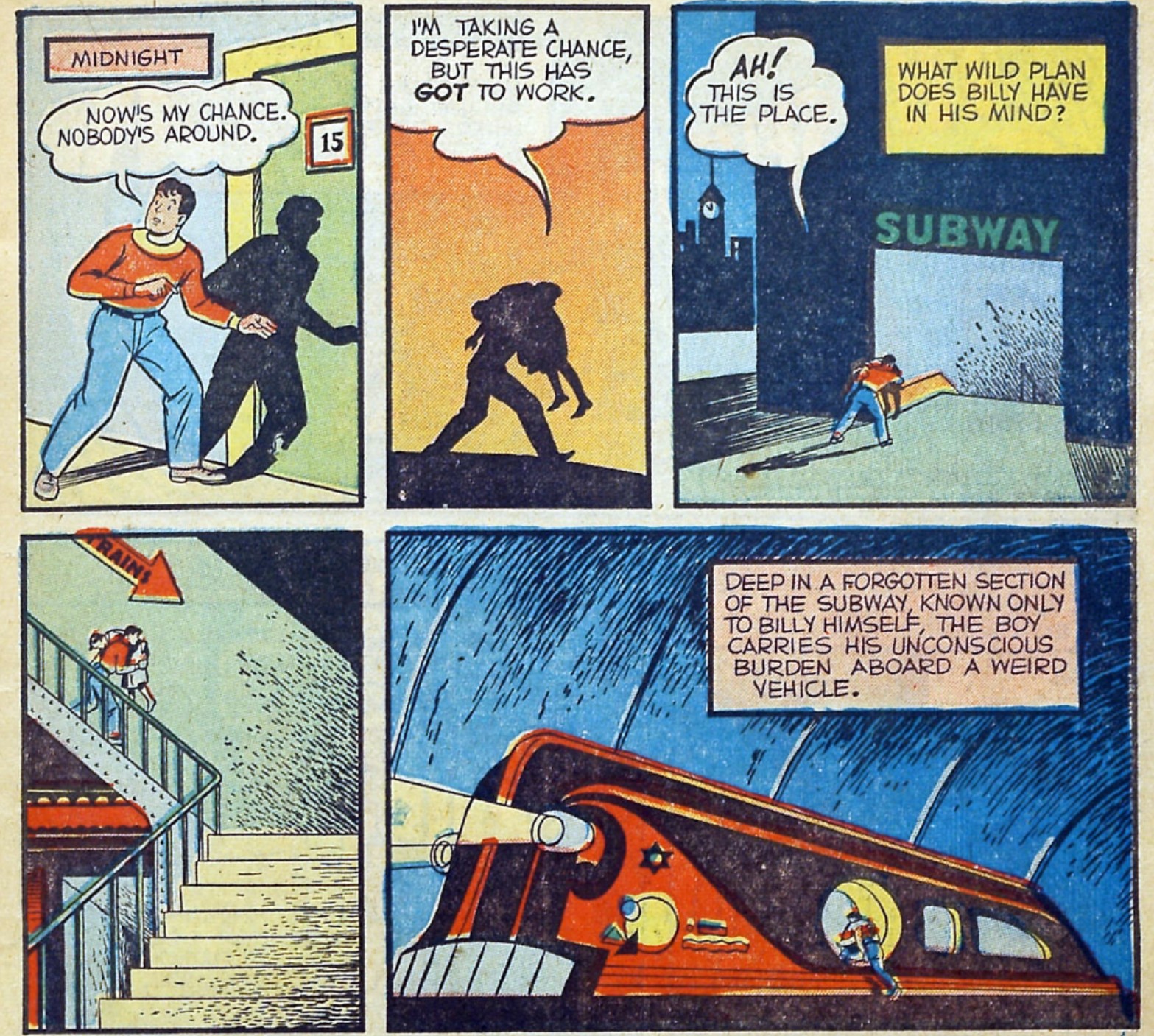
    Informed that Freddy is not expected to live through the night, Billy Batson makes the decision to bring him to the secret underground realm of the wizard Shazam in hopes that he might be able to do something for him. The wizard’s shade is summoned via an apparently mystical brazier (and hey, I think that this is Shazam’s first appearance since he was squashed by that huge block of stone during Billy’s origin!) but rather than help Freddy, Shazam places the onus of doing so on Captain Marvel’s shoulders.

    In practical terms, this means that rather than SHAZAM, the newly-minted Captain Marvel Junior says “Captain Marvel” to transform, which as many have pointed out before me means that he cannot actually say his own name without changing identities. Does the fact that Captain Marvel can do this ever come up again? Perhaps it ties in to the more modern conception of him as a sort of larval being who will eventually evolve into a new wizard, but I’m not sure if it come up in the intervening decades.

    Perhaps my favourite thing about Captain Marvel Junior is that since his comics were not drawn by CC Beck they have a different style to them and that when the Marvel Family are all together they emphatically do not adjust this. Everyone else (except perhaps Mary Marvel) is running around with that clean art style with those little black eyes and Cap Jr just keeps on looking like a young Elvis. It’s always fun!

    UPDATES: 

  • SUPER-HERO FILE 002: CAPTAIN MARVEL JUNIOR

    SUPER-HERO FILE 002: CAPTAIN MARVEL JUNIOR

    (Whiz Comics 025, 1941)

    After the vile Captain Nazi is knocked into New York Fawcett City Harbor during a battle with Captain Marvel, he is pulled from the water by young Freddy Freeman and his grandfather and immediately rewards their good deed by murdering them both. Or so he thinks! It turns out that Freddy is merely grievously injured, and Captain Marvel is able to bring him to a hospital for care.

    Informed that Freddy is not expected to live through the night, Billy Batson makes the decision to bring him to the secret underground realm of the wizard Shazam in hopes that he might be able to do something for him. The wizard’s shade is summoned via an apparently mystical brazier (and hey, I think that this is Shazam’s first appearance since he was squashed by that huge block of stone during Billy’s origin!) but rather than help Freddy, Shazam places the onus of doing so on Captain Marvel’s shoulders.

    In practical terms, this means that rather than SHAZAM, the newly-minted Captain Marvel Junior says “Captain Marvel” to transform, which as many have pointed out before me means that he cannot actually say his own name without changing identities. Does the fact that Captain Marvel can do this ever come up again? Perhaps it ties in to the more modern conception of him as a sort of larval being who will eventually evolve into a new wizard, but I’m not sure if it come up in the intervening decades.

    Perhaps my favourite thing about Captain Marvel Junior is that since his comics were not drawn by CC Beck they have a different style to them and that when the Marvel Family are all together they emphatically do not adjust this. Everyone else (except perhaps Mary Marvel) is running around with that clean art style with those little black eyes and Cap Jr just keeps on looking like a young Elvis. It’s always fun!

    UPDATES: 

  • MINOR SUPER-HERO ROUND-UP 068

    MINOR SUPER-HERO ROUND-UP 068

    A few classic minor super-heroes. Bulletman and Bulletgirl in particular have just barely managed not to remain relevant – I suppose the pointy helmet is too much of a hurdle for the modern audience.

    Bulletman: 

    Jim Barr is perhaps the most thoroughly-motivated super-hero of the Golden Age. He is:

    a. from a long line of police officers

    b. the son of a famed police officer who was murdered for being too good a cop and who

    c. told the young Jim that he must become a police officer while on his death bed 

    d. and after all that he was too scrawny and bookish to be a cop and so had to settle for being a forensic scientist

    Jim ends up working in his father’s old station under the command of Sergeant Kent, a pro-torture bully who is often held up as the greatest of all the cops in the city, and who is also the father of love interest Susan Barr. 

    Jim’s personal project is a serum that will destroy “all germs and toxins” in the human body, including that which he believes to be the source of crime and violence. He chooses to test this serum out on himself and his body, freed from a variety of invisible ailments, develops into a physical paragon over the course of a night’s sleep.

    (Sergeant Kent really earns his reputation as a great police officer by failing to notice that his colleague has basically doubled in size over night. In his defense, Jim is wearing big clothes)

    Jim decides that the best way to use this new power is to operate outside of the law, probably due to all of his time hanging around with top cop Kent. He uses his now super intelligence to build the Gravity-Regulator Helmet, which allows him to fly and also generates a force field that augments his natural resilience to make him nigh-invulnerable and able to smash through things head-first (I swear that somewhere I read a story in which it was explained that it made him bulletproof by drawing the bullets to the helmet but danged if I can find it now.). His costume, yellow jodhpurs and all, is assembled out of things that were lying around at the police station, no mention of where. (Nickel Comics 001, 1940)

    If I had to classify Bulletman’s personality, I would go with “extremely no-nonsense” or maybe “wooden, which is why it is important that he is eventually joined by his female counterpart: 

    Bulletgirl: 

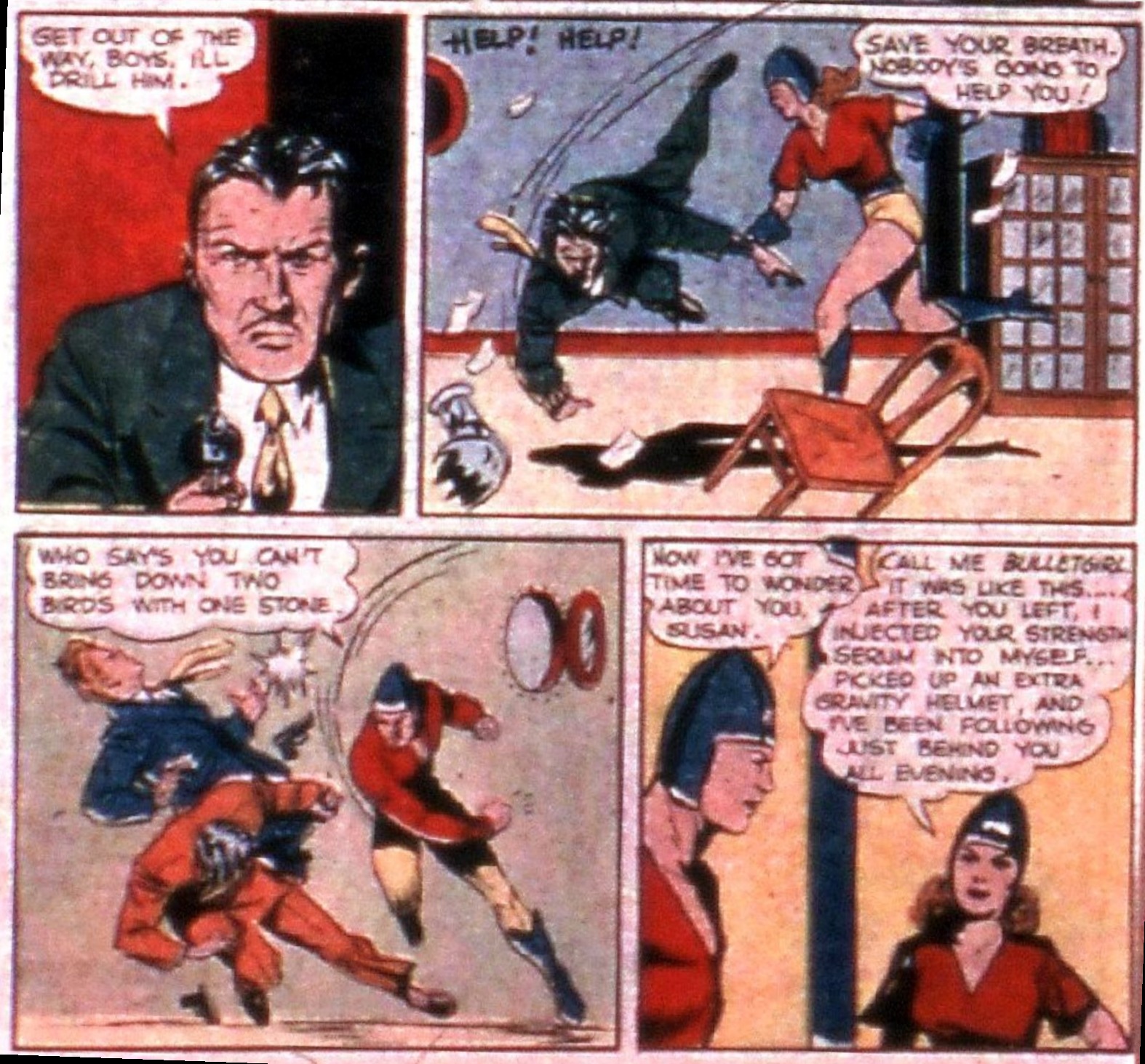
    Bulletgirl is the aforementioned Susan Kent, daughter to good cop/bad cop Sergeant Kent and member of Bulletman’s supporting cast from the beginning. For about the first year of Bulletman’s adventures she fills a low-effort version of the Lois Lane role: curious about the hero’s identity but not especially proactive about trying to uncover it. She also gets kidnapped and targeted for death a lot thanks to her father’s skill at making enemies. Then, in Master Comics 012, Bulletman is knocked out in a collision with Triple Threat’s super vehicle and Susan learns that he is actually Jim Barr. Jim obligingly tells Susan the secret of his origin but resolutely refuses to consider teaming up with her.

    Susan of course injects herself with the serum and crabs a spare Gravity-Regulator Helmet and costume (though she goes for hot pants over jodhpurs) the instant that Bulletman is out of the room, and This is a very good illustration of why I am so fond of Bulletgirl: she has all of the personality that Bulletman lacks. She’s scrappy and quippy and after an issue or two of “too dangerous for girls” chauvinism from Jim is a full partner in the superheroic exercise. She does get kidnapped and left behind a bit more than I’d like but that’s comic books in a nutshell. 

    In conclusion: Bulletgirl! (Master Comics 013, 1941)

    Minute-Man: 

    Like Jim Barr, Jack Weston is the son of a dead hero, though Jack’s father Robert Weston died during the Battle of Chateau-Thierry in World War I. We don’t get nearly as much background on Jack, other than the fact that he was raised by his father’s friend General Milton, but thanks to Milton, Jack becomes Minute-Man, a patriotic super-hero, in what is kind of presented as a draft.

    Jack is sent to join the Army as a lowly Private so that he can keep an eye out for sabotage and espionage affecting the armed forces. Despite having no super serum or particular special training, he proves to be physically near-superhuman as he engages a variety of costumed and non-costumed foes over the course of his mid-length career.

    Minute-Man also dabbles in leaving calling cards, which I always like to make note of. (Master Comics 011, 1941)

    Doctor Voodoo **UPDATE**: 

    In Whiz Comics 017, Doctor Voodoo returns home to find that Maxinya (the Heaven-Woman, natch) has gone missing. He tracks her abductors through the jungle until he comes across their destination: a European castle, smack in the middle of the Amazon. 

    The mystery deepens as Voodoo enters the castle and finds what seems to be an entire Medieval court, headed by the boorish King Richard, who seeks his aid in conquering the jungle. 

    Doctor Voodoo refuses to help King Richard, and so is forced to meet the knight Sir Ganal in combat. Voodoo prevails and wins Ganal over to his side, complete with a promise to reveal the origin of the castle’s presence in the jungle. Alas, this shall never come to pass, because the story does a hard pivot in the next issue. 

    King Richard plays the whole jungle conquest/attempted murder thing off as if it was some sort of test, and sends Doctor Voodoo off to meet with his court wizard. He. in turn, transports Voodoo back in time to the 1400s or thereabouts to retrieve a magical McGuffin called the Golden Flask, with another promise to explain what this whole affair is about once he returns.

    Unfortunately for all us completionists out there, the explanation never comes because Doctor Voodoo never returns. He bops around the oceans for about a year and actually does manage to get his hands on the Golden Flask but his feature is cancelled before he can return it to the wizard and find out just what the heck is going on. Maxinya is waiting for him still, presumably. (Whiz Comics 018, 1941)

  • MINOR SUPER-HERO ROUND-UP 065

    Our themes today are “scarlet,” “family tragedy,” and “inadvisable human experimentation.”

    Mr Scarlet: 

    Brian Butler, NYC* district attorney,** is frustrated by the limitations inherent in working within the law and so like so many of his peers adopts a costumed identity in order to get the better of crime via acrobatics and punching. A classic origin, but Mr Scarlet’s real claim to fame is in being created by Jack Kirby (with Ed Herron) and thus starting off with a real dose of comic book charisma that subsequent artist Jack Binder manages to keep going – both, for example, illustrate his acrobatic explots with such flair that to this day people assume that he’s meant to be flying.

    * although it’s referred to as “Gotham City” in the one caption that names his location, I simply must assume that it’s meant to be the NYC nickname rather than some Earth-S version of Batman’s hometown, earlier than both concepts even exist.

    ** he’s pretty consistently called a “special prosecutor”, but there’s just enough evidence to clarify that he’s a DA rather than an impartial lawyer brought in to prosecute cases involving possible conflicts of interest, which I just learned is what a special prosecutor is.

    Brian Butler’s secretary/love interest Cherry Wade learns his secret in Mr Scarlet’s first published adventure, and I must say as always that I appreciate a Golden Age comics with a straightforward hero romance to contrast with the widespread aping of the Clark Kent/Lois Lane situation. Even if it is an HR nightmare. (Wow Comics 001, 1940)

    Atom Blake, Boy Wizard: 

    Atom Blake, a youngster attending Lincoln High in Collegetown, USA, is curious about why he has a different last name than the people who are raising him, and perhaps more pointedly, why his is physically and mentally superhuman. His foster father, Professor Joseph Page, has the answer in the form of a note left for Atom by his biological father, Stuart Blake. Written in a mathematical code that Atom is instinctively able to read, the note tells of the elder Blake’s experiments in creating a super-element composed of all 93 known regular elements* and how the infant Atom was given treatments to make him super-human enough to utilize the power of the super-element (called sun-metal in later Atom Blake stories but not here) without evaporating like Blake Sr’s poor experimental orangutan.

    *always a good bit when it crops up. I just looked up the history of the discovery of elements to see how long the count of 93 was good for and it looks like about 4 years, though plutonium was discovered in 1941 but kept secret until 1948. More impressive is the fact that at least four of the elements known in 1940 weren’t yet discovered in 1923 when Blake did his work!

    An encounter between Atom and some bank robbers soon reveals that the super-element was stored in the ring that Stuart Blake left with Atom as a baby, and he gains access to a suite of deus ex machina powers. Will this sixteen or seventeen year old boy be able to deal with unlimited power in a healthy way? Stay tuned! (Wow Comics 001, 1940)

    UPDATE 1941 

    Steel Sterling: 

    John Sterling is your classic crime orphan: after losing his father to gangsters at a young age, he devotes his life to battling crime. But rather than become a living weapon through intense training, Sterling takes a note from his father’s death by gunfire and spends his formative years developing a chemical treatment that will give his body the properties of steel, dramatically catalyzed by a dip into a vat of molten metal in a sequence with more on-panel male nudity than you usually see. Please also note the final panel above, which showcases Sterling’s weird riveted metal briefs.

    And Sterling isn’t just blowing smoke about having all the properties of steel: in addition to being bulletproof and super strong thanks to his new density, he also has the magnetic properties of the alloy, which he, like many of his magnetic brethren, employs to fly around by “magnetizing himself to” various things. Later this is rounded up to simply being able to fly and thank goodness for that.

    Finally, Steel Sterling has one of the better secret identities, as he establishes private detective John Sterling as his own twin brother (and also as a sort of cowardly jerk so that he can establish the usual Lois Lane/Clark Kent dynamic with love interest Dora Cummings). (Zip Comics 001, 1940)

    the Scarlet Avenger: 

    I know I bagged on the Defender for just being the Avenger with the serial numbers filed off, but dang it if the Scarlet Avenger doesn’t feel even more like someone just took Richard Benson out back and slapped a little red paint on him. Real name Jim Kendall, the Scarlet Avenger loses his wife and child as a result of a gold robbery on the airplane they are riding in. Kendall alone survives the subsequent crash but loses the ability to form facial expressions, leading to his nickname as The Man Who Never Smiles. 

    The Scarlet Avenger’s calling card, seen above making the text box hard to read, is a flaming arrow for no discernible or stated reason. Later on it is often depicted with a decorative skull.

    The Scarlet Avenger lacks the ability to reshape his facial features that his inspiration possessed, and instead of being a master of disguise is more of a gadgeteer, variously employing a paralysis ray, bulletproof cloak, electrically wired suit that allows him to deliver lethal shocks, mind reading device, compact miniature parachute, shoe knife, personal smokescreen, rocket car and rocket ship in his pursuit of justice. 

    The other point of similarity between the Scarlet and regular Avengers is the extensive network of agents that both employ, though the Scarlet Avenger’s narrows somewhat over time as he begins a romantic relationship with Inez Courtney, aka Operative 1. More trouble for HR.  (Zip Comics 001 1940)