The Curse of Skeleton Munroe

Category: Ghost

  • MINOR SUPER-VILLAIN 827: MORGAN LE FAY

    MINOR SUPER-VILLAIN 827: MORGAN LE FAY

    (Thrilling Comics 005, 1940) 

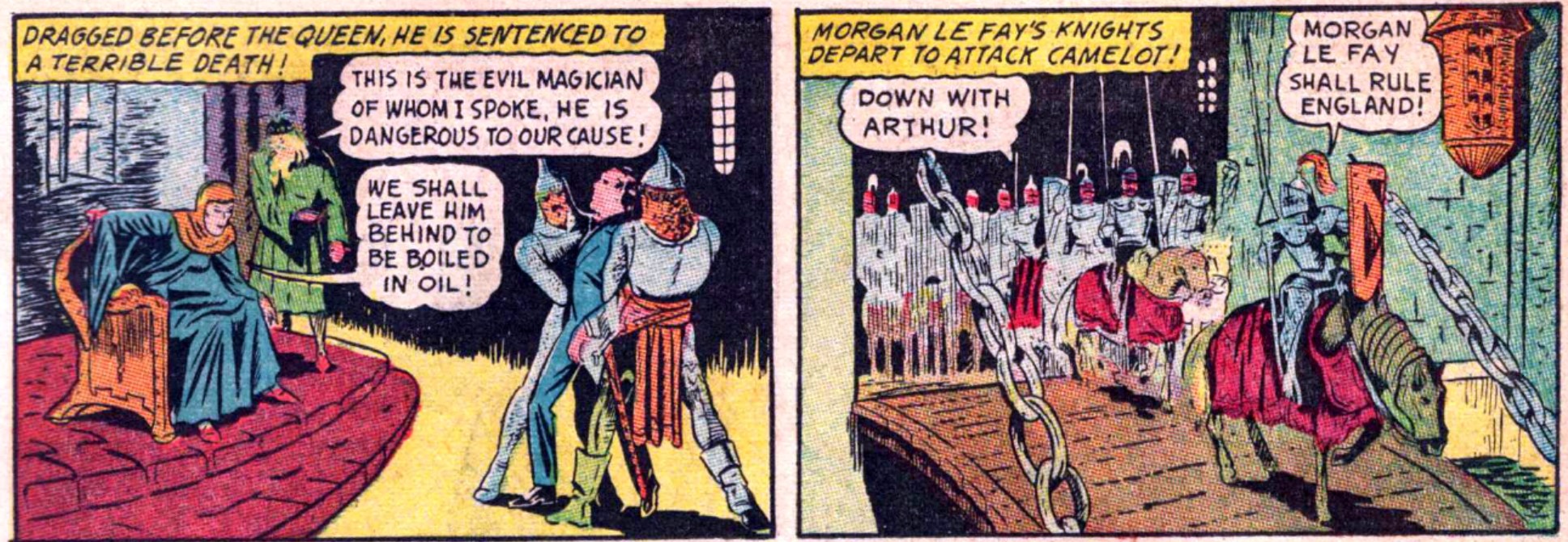
    Sometimes when I’m writing the original drafts of these entries I’m tired or rushed or the like and I go into Extreme Shorthand Mode, and sometimes that version of the writeup is very charming to me when I come back to it a couple of weeks later. Which is all to say that the younger, rushed version of me wrote “merlin stung by brutal own” to describe how the venerable wizard took being exposed as a fraud by the Ghost during one of his time-travel adventures, and I think it captures something. Is it enough to explain Merlin selling out Camelot to Morgan le Fay? Probably not, but it clearly was in the eyes of a 1940s comics book writer.

    Don’t worry, however, because the Ghost is still on hand and is most certainly not a charlatan. He conjures up a big pile of machine guns and grenades for the Knights of the Round Table, and s my past self put it: “modern weapons vs medieval is okay if its vs bad guys.”

  • REAL PERSON ROUND-UP 016

    REAL PERSON ROUND-UP 016

    Are you ready for some comic book versions of real life and fictional people? I sure hope so! 

    Adolf Hitler:  

    Premier Grahvin of the fictional African country of Cadiwa is a pretty broad pastiche of the Axis leaders, but the sheer speed at which he accelerates into full-blown dictator mode (before Mr Mystic turns up to reveal that he had not, in fact killed the king of Cadiwa and was not, in fact, in charge) must be highlighted. (The Spirit Section, 21 July, 1940)

    Likewise, Karoly Gore is an Axis dictator pastiche from a Mr Mystic story a few weeks earlier (but I read them out of order so it’s okay) (The Spirit Section, 9 June, 1940) 

    Axtrol here is a third in our series of Axis dictator pastiches, and he’s possibly the biggest shithead of the bunch. (The Spirit, “Dr Prince von Kalm”, 17 November, 1940)

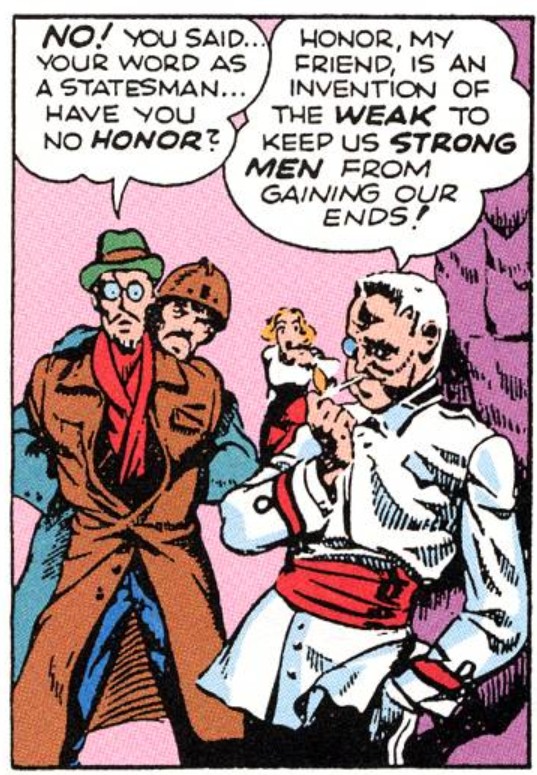
    Nargoff, aka the Leader, is either a would-be North American dictator or the agent of a European one looking to set up a local franchise. Either way, the Spirit burns down his fake island/submarine base and then engineers a situation in which the might-makes-right philosophies espoused in Nargoff’s book “The New Order” are explored by way of Nargoff and his burly assistant Max being stranded on a small boat in the Caribbean with a limited amount of water. (The Spirit, “The Leader”, 29 December, 1940)

    Don Juan: 

    Mr Mystic and his fiance Elena encounter a whole castle full of ghosts in the woods of Spain, among whom is the spirit of the entirely fictional man Don Juan, who mistakes Elena for his missing wife Ysabel and almost kills her before himself being double-killed by Mystic. (The Spirit Section, 15 December, 1940)

    Khufu aka Cheops: 

    When Mr Mystic decides to go back in time to the creation of the Great Pyramid of Giza, he is mistaken for the god Ammon Ra and of course just immediately gets his grubby little mitts all over the progress of history. It’s kind of okay, though, because the history he’s in seems to already be a big mess – for instance, while Pharaoh Cheops is indeed the ruler supposed to have commissioned the building of the Great Pyramid c. 2600 BCE, the Babylonian invasion they’re worried about is tricky because a) Babylonia is dated from 1890 BCE b) the earliest Nebuchadnezzar I can find ascended to the throne in 1121 BCE and c) given the cultural milieu that this comic was written in they’re probably talking about Nebuchadnezzar II, the one from the Bible, who did invade Egypt a couple of times but didn’t come to power until 605 BCE. Like I said: a real mess. Plus, Amun didn’t even become associated with Ra until the 16th Century BCE!

    There’s also this guy, Prince Sargon of Babylonia, and while there’s a part of me that wants to say that he’s supposed to be Sargon II (the most famous Sargon, 722 BCE), I don’t reckon that Bob Powell, mad as he was with creative power when he wrote this story, would make someone the son of someone else born a hundred years after them. Right? (Sargon does return as a time-travelling mummy out for revenge in the next installment of Mr Mystic but this alas does nothing to clear up the puzzle of his identity) (The Spirit Section, 29 September 1940)

    Misc Arthurian Figures: 

    During one of his jaunts into the past, the Ghost finds himself in Camelot, where he meets a very small selection of Arthurian figures (all of the big name knights are away on the Crusades, we are told). These include Sir Kay, who acts like a weird creep (accurate) and gets beaten up for his efforts, King Arthur, an amiable doormat, and Merlin the Magician, who is portrayed as a fraud with no magical power who sells out Arthur as soon as he gets the chance. An interesting choice for a comic about a magic man, but perfectly in keeping with 1940s secular values. (Thrilling Comics 005, 1940) 

    Myrna Loy & William Powell: 

    A simple flip of the last names renders Myrna Loy and William Powell into Myrna Powell and William Loy on this marquee, with a bonus “Boris Scarloff” for Boris Karloff. (The Spirit Section, 10 November, 1940)

    Ty Cobb: 

    If there’s anything more tedious than a 1940s sports comic it’s a 1940s hillbilly comic, so trust me when I say that this one-off about a baseball-playing hillbilly named Obadiah “Pie” Gobb is one of the the worst things I have ever read. 

    What’s even more egregious is the fact that while Pie Gobb and his new teammate Moe de Muggio (the World’s Greatest Slugger, thanks to the fact that he eats his Fleeties every morning) are easy to identify as Ty Cobb and Joe DiMaggio, respectively, the rest of his team also have goofy names but as far as I can tell none of them are also puns on famous baseball players, meaning that I just spent all that time playing rhyming games on Wikipedia for no reason. (The Funnies 047, 1940)
  • REAL PERSON ROUND-UP 016

    REAL PERSON ROUND-UP 016

    Are you ready for some comic book versions of real life and fictional people? I sure hope so! 

    Adolf Hitler:  

    Premier Grahvin of the fictional African country of Cadiwa is a pretty broad pastiche of the Axis leaders, but the sheer speed at which he accelerates into full-blown dictator mode (before Mr Mystic turns up to reveal that he had not, in fact killed the king of Cadiwa and was not, in fact, in charge) must be highlighted. (The Spirit Section, 21 July, 1940)

    Likewise, Karoly Gore is an Axis dictator pastiche from a Mr Mystic story a few weeks earlier (but I read them out of order so it’s okay) (The Spirit Section, 9 June, 1940) 

    Axtrol here is a third in our series of Axis dictator pastiches, and he’s possibly the biggest shithead of the bunch. (The Spirit, “Dr Prince von Kalm”, 17 November, 1940)

    Nargoff, aka the Leader, is either a would-be North American dictator or the agent of a European one looking to set up a local franchise. Either way, the Spirit burns down his fake island/submarine base and then engineers a situation in which the might-makes-right philosophies espoused in Nargoff’s book “The New Order” are explored by way of Nargoff and his burly assistant Max being stranded on a small boat in the Caribbean with a limited amount of water. (The Spirit, “The Leader”, 29 December, 1940)

    Don Juan: 

    Mr Mystic and his fiance Elena encounter a whole castle full of ghosts in the woods of Spain, among whom is the spirit of the entirely fictional man Don Juan, who mistakes Elena for his missing wife Ysabel and almost kills her before himself being double-killed by Mystic. (The Spirit Section, 15 December, 1940)

    Khufu aka Cheops: 

    When Mr Mystic decides to go back in time to the creation of the Great Pyramid of Giza, he is mistaken for the god Ammon Ra and of course just immediately gets his grubby little mitts all over the progress of history. It’s kind of okay, though, because the history he’s in seems to already be a big mess – for instance, while Pharaoh Cheops is indeed the ruler supposed to have commissioned the building of the Great Pyramid c. 2600 BCE, the Babylonian invasion they’re worried about is tricky because a) Babylonia is dated from 1890 BCE b) the earliest Nebuchadnezzar I can find ascended to the throne in 1121 BCE and c) given the cultural milieu that this comic was written in they’re probably talking about Nebuchadnezzar II, the one from the Bible, who did invade Egypt a couple of times but didn’t come to power until 605 BCE. Like I said: a real mess. Plus, Amun didn’t even become associated with Ra until the 16th Century BCE!

    There’s also this guy, Prince Sargon of Babylonia, and while there’s a part of me that wants to say that he’s supposed to be Sargon II (the most famous Sargon, 722 BCE), I don’t reckon that Bob Powell, mad as he was with creative power when he wrote this story, would make someone the son of someone else born a hundred years after them. Right? (Sargon does return as a time-travelling mummy out for revenge in the next installment of Mr Mystic but this alas does nothing to clear up the puzzle of his identity) (The Spirit Section, 29 September 1940)

    Misc Arthurian Figures: 

    During one of his jaunts into the past, the Ghost finds himself in Camelot, where he meets a very small selection of Arthurian figures (all of the big name knights are away on the Crusades, we are told). These include Sir Kay, who acts like a weird creep (accurate) and gets beaten up for his efforts, King Arthur, an amiable doormat, and Merlin the Magician, who is portrayed as a fraud with no magical power who sells out Arthur as soon as he gets the chance. An interesting choice for a comic about a magic man, but perfectly in keeping with 1940s secular values. (Thrilling Comics 005, 1940) 

    Myrna Loy & William Powell: 

    A simple flip of the last names renders Myrna Loy and William Powell into Myrna Powell and William Loy on this marquee, with a bonus “Boris Scarloff” for Boris Karloff. (The Spirit Section, 10 November, 1940)

    Ty Cobb: 

    If there’s anything more tedious than a 1940s sports comic it’s a 1940s hillbilly comic, so trust me when I say that this one-off about a baseball-playing hillbilly named Obadiah “Pie” Gobb is one of the the worst things I have ever read. 

    What’s even more egregious is the fact that while Pie Gobb and his new teammate Moe de Muggio (the World’s Greatest Slugger, thanks to the fact that he eats his Fleeties every morning) are easy to identify as Ty Cobb and Joe DiMaggio, respectively, the rest of his team also have goofy names but as far as I can tell none of them are also puns on famous baseball players, meaning that I just spent all that time playing rhyming games on Wikipedia for no reason. (The Funnies 047, 1940)

  • MINOR SUPER-VILLAIN 825: PROFESSOR FENTON

    (Thrilling Comics 004, 1940) 

    A wave of kidnappings is sweeping the US! Important men are disappearing left and right! Never fear, however, for the Ghost is on the case, and thanks to his magical acumen he is able to trace the latest kidnappee to the mysterious mansion lair of the culprit: the pompadoured scientist known as Professor Fenton! 

    Professor Fenton’s plan turns out to be unusually, even impractically complicated. To whit: 

    1. kidnap all of America’s Important Men

    2. stash the Important Men in various historical periods using a time machine

    3. take over the US (though unstated, the lack of Important Men is probably part of the prep for this step)

    4. bring back the Important Men, who will be forced to serve Fenton in this new regime

    The Ghost is of course opposed to this plan, and proceeds to rescue the first batch of Important Men from the past. But there is a problem! The Ghost does not know where or when the other men are stashed, plus he suspects that Fenton would rather destroy his own time machine than see them rescued. This sets up the ongoing Ghost/Fenton dynamic for the next few issues, as the Ghost arranges various ruses and schemes in order to be sent in time to rescue Fenton’s victims while keeping Fenton himself in the dark.

    Some of Fenton’s temporal kidnap setups include:

    A prehistoric past rich with both dinosaurs and early man. The Ghost recruits a tribe of Piltdown Men to battle Professor Fenton’s Neanderthal followers. (Thrilling Comics 004, 1940)

    A castle in Arthurian England, that the Ghost storms with the help of the Knights of the Round Table, armed with magically-created machine guns. (Thrilling Comics 005, 1940)

    Just an inn in the middle of Commonwealth-era London. The innkeeper is clearly a local, so of course I am very curious about how the Fenton’s recruitment process goes – does he just appear in people’s houses until he finds one willing to hold prisoners for cash, no questions asked?  (Thrilling Comics 006, 1940)

    This issue is also the first time that Fenton tries to get his chosen nom de guerre, “Dictator F” going, but it never quite manages to get traction. He does keep trying!

    Fenton’s temporal hiding places have one important criteria: they act as a fixed point in time and space that he can target with his time beam. This is why this next one being in the ship, a notoriously mobile space, is strange. Sure, Professor Fenton has paid off the owners of the vessel not to go anywhere, but if he had bothered to take a look at the ship’s name he might have noted that it was in fact the Santa Maria, of Christopher Columbus fame, and concluded that he might be better off storing his victims elsewhere. 

    The Ghost and these two Important Men end up making the journey to the New World with Columbus before heading home. Considering the fact that Fenton-style time travel is depicted as if the same amount of time is taking place in the present as the past, this really throws the Ghost timeline out of whack with the real world. (Thrilling Comics 007, 1940)

    Fenton finally starts working toward his conquest of the present by stealing an electrical ray weapon that he stashes in Ancient Rome, c.64 CE, which inadvertently leads to the Great Fire of Rome. (Thrilling Comics 008, 1940)

    Fenton’s final foray into his kidnapping plan (for 1940, at least) involves hotshot bacteriologist Tom Rollins, who is stashed in Colonial America, 1776, while his stockpile of diseases is unleashed on the public in an attempt to blackmail Rollins’ home city of Duquesne. The Ghost not only rescues Rollins but helps Washington cross the Delaware and also meets his long-time love interest Betty Morris, a Revolutionary spy who decides to ditch the humdrum 1770s for the exciting 1940s. (Thrilling Comics 009, 1940)
    From Thrilling Comics 010 on, the Ghost basically just lets Professor Fenton, a multiple-time mass murderer and mass-kidnapper, remain at large so that he can sneak into Fenton’s lab and use his time machine whenever he wants. I’m sure that if someone pointed that out then the Ghost would say something about there still being some Important Men to be saved, but I’m not sure if they’re worth the body count.

  • MINOR SUPER-HERO ROUND-UP 055

    Some more super-folk for your delectation. 

    Doc Strange:

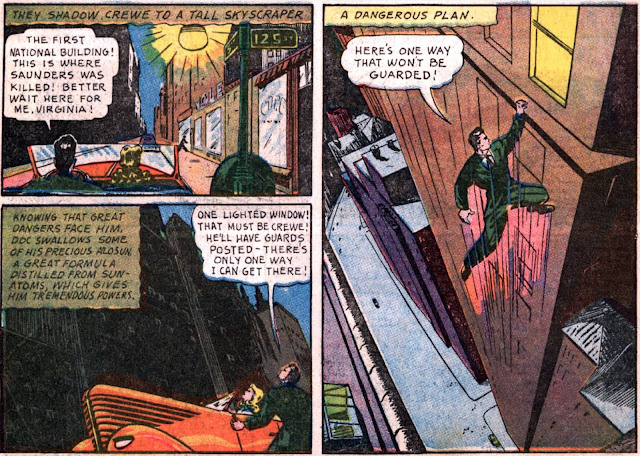
    Doc Strange (called “Dr Strange” for the first half dozen or so of his appearances, but why cause unnecessary confusion) is an almost prototypical scientist-hero: no real origin beyond being a well-known brilliant scientist who is primed and ready for adventure having just perfected Alosun, a “formula distilled from sun-atoms.” After taking his first dose of Alosun in his initial adventure, Strange has super-strength and invulnerability sufficient to take on an entire gang single-handed, and if he takes a supplemental dose he becomes exponentially more powerful.

    Doc’s sidekick Mike won’t be showing up until 1942, but in the meantime his fiance Virginia Thompson (as so often is the case, the woman he rescues during his first super-heroic adventure) acts as his adventuring companion/frequent kidnap victim in the meantime.


    In Thrilling Comics 007 Doc Strange mixes up a new formulation of Alosun that completes his powerset by allowing him to fly while under its effects. This is also the issue in which he stops fighting crime in suits and adopts his classic red t-shirt/blue jodhpurs/brown boots look. 

    Finally, I’ve noticed a lot of sites listing his name as “Hugo Strange” or “Thomas Hugo Strange” and while the Thomas is definitely an Alan Moore addition from Tom Strong I can only report that the Hugo has not yet appeared in the 1940 issues of Thrilling. (Thrilling Comics 001, 1940) 

    the Ghost:

    Young George Chance is orphaned in India and so is of course raised by yogis. He learns all of their magical secrets and is eventually sent out into the world to fight crime, as I assume all yogis are. I must say that it is something of a change of pace to see a magic-man come into his powers in India after such a long string of Tibetan origins.

    Like most magical heroes, the Ghost is a nigh-omnipotent force of nature who can be stopped only by a sneaky blow to the head, and even then only temporarily. His adventures are distinguished by the fact that his long-time foe is Professor Fenton, a scientist who has developed time travel technology, so the Ghost’s adventures are distinguished by the sheer variety of times and places he ends up.

    The Ghost takes his name from his early habit of painting his face (all the way to the back of his neck!) so as to resemble a skeleton while he is fighting crime. Sadly though the name sticks the look doesn’t. 

    In Thrilling Comics 008, the Ghost travels back to Revolutionary America and meets a patriotic woman named Betty Morris who ends up coming back to the 20th Century with him as his companion/love interest. I keep seeing claims online that she is his wife, but strongly suspect that that is another swipe from Alan Moore’s version of the characters. (Thrilling Comics 003, 1940)

    the Lone Eagle: 

    Another classic example of a pilot-hero-with-a-cool-name and not much else going on. The Lone Eagle does seem to have been a World War I veteran, which I always like to note. (Thrilling Comics 003, 1940)

    the Woman in Red: 

    The Woman in Red (an extremely good name) has what just might be the simplest origin story in comics: she is really Peggy Allen, undercover police officer, and the Woman in Red disguise is her way of investigating crimes without blowing her cover if she is caught snooping around. See? Simple! 

    Woman in Red mysteries tend to be structured as whodunnit murder mysteries, which I obviously like, and so Peggy is also frequently wanted by her comic foil, the bumbling Inspector Cavanaugh, as a suspect because he sees her creeping around the crime scene and doesn’t have a lot of critical thinking skills. (Thrilling Comics 002, 1940) 

  • NOTES: JULY 2025

    The Fates of Various Nazi Warships: 

    Given the penchant for featuring even quite famous and obvious things under false names in comics, I always end up noticing when something or someone shows up under their own moniker, which is why I was very surprised when Royal Navy submarine captain Tom Niles, aka the Undersea Raider, is responsible for sinking several real Nazi warships in this 1940 comic. The casualties include the cruiser Admiral Scheer (sunk in 1945 in our world) and the battleships Bismarck (scuttled in 1941), and Scharnhorst (sunk in 1943). I had thought that the Admiral Graf Spee was another of these anachronistically early kills, but this depiction of it’s scuttling off of Montevideo, Uruguay is broadly accurate, except that it happened in 1939. A wild time for naval combat. (Thrilling Comics 004, 1940)

    The Fate of Rome:

    Specifically, the fate of Rome during the Great Fire of 64 CE. There are a lot of theories about how and why the fire was started, but very few of them revolve around it accidentally being started by magician/adventurer the Ghost and his companions while attempting to escape Emperor Nero’s soldiers with the help of an electric ray projector. (Thrilling Comics 008, 1940) 

    Honours – Doc Strange: 

    Doc Strange is given an unspecified medal by FDR for foiling a plot to bomb Washington DC. (Thrilling Comics 010, 1940) 

    The next issue, Doc gets a parade for saving NYC from being bombed into dust. (Thrilling Comics 011, 1940) 

    Honours – the Firefly: 

    Harley “the Firefly” Hudson was Intercollegiate Pole Vault Champion during his time at NYU – plus he went to NYU! Very exciting to know exactly where a super-hero got his education. (Top-Notch Comics 009, 1940) 

    Honours – Fran Frazer: 

    Magazine photographer Fran Frazer receives a medal from the country of Murania for preventing a Nazi invasion. (Top-Notch Comics 010, 1940) 

    Alternate Identity: 

    Doc Strange, while suffering from amnesia, boxes world heavyweight champion Bull Gallagher under the identity of the Unknown. (Thrilling Comics 001, 1940) 

  • MINOR SUPER-VILLAIN 468: THE GHOST

    (Amazing-Man Comics 013, 1940)

    In Amazing-Man Comics 010 Minimidget and Ritty accidentally get shot to the Belgian Congo on a guy’s homemade rocket (as you do) and the subsequent issues have been a series of trials and tribulations as they make their way back home. The Ghost is another one of those, but a fun one – not racist at all, for one thing!

    I may not have much regard for pilot-heroes but air pirates are another matter, and that’s just what the Ghost is, complete with all the good good accessories: custom planes with little ghosts painted on them, a hidden airfield, costumed henchmen dressed in a less-cool version of his own costume, a bombastic attitude… he’s the complete package for a one-off villain. The only sour note is his name – the Ghost is a perfectly fine name on its own but several people refer to him as a “sky way robber” and the Skyway Robber is a much better name for an air pirate.

    (it’s hard to tell with the state of search engines nowadays but it seems like “the Skyway Robber” has only been used as a name for a card in Magic: the Gathering. A shame!)

    The Ghost dies somewhat ignominiously when his plane is tripped. That’s life as a comic book villain, I guess.

  • MINOR SUPER-VILLAIN 448: THE GHOST

    (Mystery Men Comics 027, 1941)

    As is so frequently the case, this here ghost is in fact an elaborate hoax carried out to keep people away from a particular location. This time it’s a gang of smugglers operating out of an old abandoned inn evocatively named “the Tombstones” by the locals. The Green Mask makes short work of these rascals despite the extra effort they put in, including wholesale grave robbing in order to keep themselves stocked up with enough spooky skeletons to scare off the rubes.

  • MINOR SUPER-VILLAIN 448: THE GHOST

    (Mystery Men Comics 027, 1941)

    As is so frequently the case, this here ghost is in fact an elaborate hoax carried out to keep people away from a particular location. This time it’s a gang of smugglers operating out of an old abandoned inn evocatively named “the Tombstones” by the locals. The Green Mask makes short work of these rascals despite the extra effort they put in, including wholesale grave robbing in order to keep themselves stocked up with enough spooky skeletons to scare off the rubes.

  • MINOR SUPER-VILLAIN 134: THE GHOST

    (Action Comics v1 039, 1941)

    The Ghost is one of Superman’s earliest superpowered foes, being Brett Bryson, a chemist who was accidentally irradiated while conducting an experiment and, having found himself with both a burning radium touch and a short time left to live, set out to steal enough in the time he had left to provide for his family once he was finally gone.

    But there is a twist to the Ghost’s story! The lab accident? Planned by Bryson’s greedy partners! The stolen money? Was never going to be delivered to Bryson’s family! I like this because this is the earliest example of the On Purpose Lab Accident Origin that I’m aware of in comics and that’s a reasonably common origin! (Brett Bryson does not like it and murders his partner before dying himself)