The Curse of Skeleton Munroe

Category: Mr Scarlet

  • MINOR SUPER-VILLAIN 890: THE BLACK CLOWN

    (Wow Comics 003, 1940)

    The circus is in town! And in what must be a complete coincidence, a circus-themed villain murders a prominent banker using a python! And did I mention that the circus has a big box full of pythons as one of its attractions? 

    As someone who sincerely enjoys clown- and circus-themed villains despite having no particular affection for either in real life I have to say: do a bit better, the Black Clown. Like, try a bit harder to conceal just exactly who you are. Especially don’t leave a note on the body of the banker you just murdered that basically says “I did this because you didn’t give me, a clown-man, a business loan.” Plausible deniability, man.

    He does have a great Evil Clown costume, though.

    I’ll give the Black Clown this: at least he tries to rob the bank after revenge-killing the banker rather than merely exult in the downfall of his enemy. This robbery is also where we learn that the Black Clown has a whole circus of crime thing going on to match his theme, as he employs a sideshow thin man to slip through the bank’s bars and let the rest of the crew in.

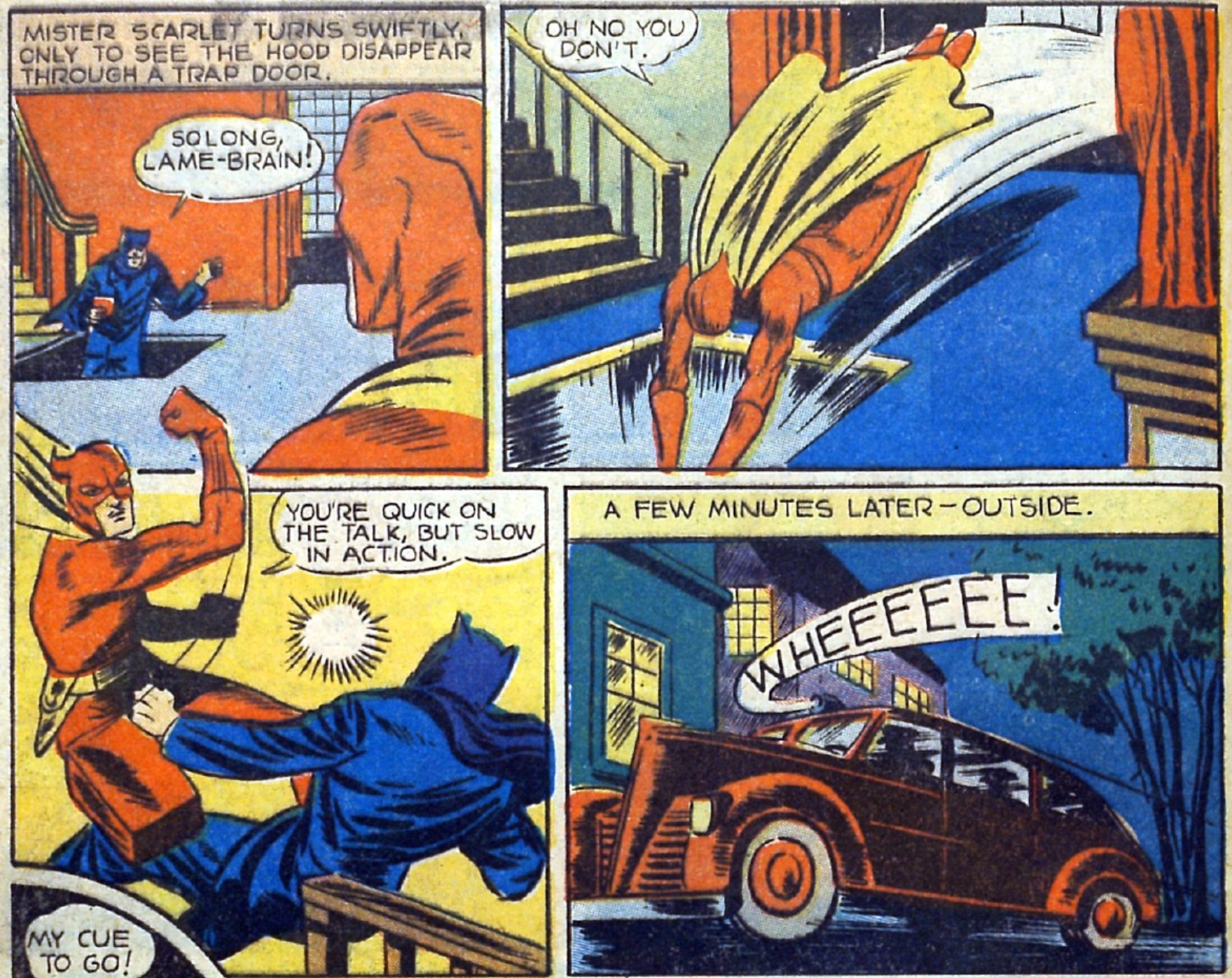
    Though Mr Scarlet interrupts the robbery he is unable to prevent the Black Clown and his crew from escaping, as he is being crushed to death by a python at the time. Or is he? No, he is too strong.  

    The Black Clown next attempts to murder Petrie, the partner of the first victim, but at this point we are firmly in the part of the comic where the hero has the villain in his sights and none of his schemes shall profit. The Black Clown escapes with the help of some acrobats and Petrie lives on to deny loans another day.

    Probably the most interesting thing about this sequence is that the Black Clown gains entrance to Petrie’s apartment via a fellow named Tiny Tom who slips through the transom and opens the door. Given the name and the theme of the gang (and the initial shot of his legs as they slip out of sight) one would expect Tiny Tom to perhaps be little person of some kind, perhaps a sideshow performer, but he’s on-hand throughout the fight in Petrie’s apartment (that’s him in the blue suit) and he’s just about half a head shorter than everyone else. Is it just a particularly rough nickname or did the initial Tiny Tom concept get lost in the shuffle?

    Hearkening back to my initial critique of the Black Clown: it is in fact so obvious who this guy is that Mr Scarlet has to be interrupted twice in two different conversations over the course of three panels rather than learn it too early. And he doesn’t bother to ask Mr Petrie to shout it at him on the way out the door.

    After a final battle with a sideshow wild man and a chase through the trapezes the Black Clown is finally captured and OF COURSE it turns out to be Henry Parrish, the circus owner, who is OF COURSE mad about a rejected business loan. CHOOSE YOUR SUPER-VILLAIN THEME MORE WISELY is what I’m trying to get at.

    REVENGE KILLER SCORE: 1/2 

  • MINOR SUPER-VILLAIN 889: THE BLACK THORN

    (Wow Comics 003, 1941)

    Inventor Phineas Cox has created a mummy ray, which is a device that fires a beam that instantly mummifies living tissue, a horrible thing that could only be used ethically by the mortuary and possibly the jerky industries. Cox intends for the weapon to be used in the defense of the United States, and to that end takes it not to the military but to something called the Defend America League, where he is somewhat predictably thrown out on his ear. 

    Phineas Cox vows to show America what he’s made of, and that very evening the Black Thorn makes his debut by desiccating an innocent woman. Why call yourself the Black Thorn when your main gimmick is a mummy ray? My guess is that the ray is a late addition to what was an already thought-out alter ego – I mean, just look at that costume! It’s not my favourite outfit of the Golden Age, but it definitely lacks some of the sense of just having been thrown together out of things that were already in the attic that some of them do.

    The Black Thorn’s schemes are, true to Cox’ pronouncement, decidedly anti-American: he steals defense funds from a bank and blows up an arsenal, leaving a trail of mummies in his wake. He’d have kept on going, too, only it is at this point that Mr Scarlet gets involved.

    Mr Scarlet himself almost gets mummified on two occasions but the Black Thorn shoots at the wrong prone figure in the dark the first time and falls for a decoy the second time, and since the both the misidentified target and decoy were the body of the slain bank guard, this means that the poor guy ends up being triple-mummified, which is a small consolation but has to be some kind of record.

    Please also note the Black Thorn using his horned headpiece as a weapon against Mr Scarlet. It’s nice to see something  seemingly purely ornamental like that see practical use. 

    In the end, the Black Thorn turns out not to be Phineas Cox but Henry Hawley, the leader of the Defend America League, which savvy readers might have already spotted as a fascist organization based on the ostentatiously patriotic name alone. Hawley had not, in fact thought Cox to be a nutjob but instead imprisoned him and stolen his invention for used in his campaign against America, and he would’ve gotten away with it if it hadn’t been for that pesky Mr Scarlet.

    Though Mr Scarlet busts up the mummy ray and tells Cox not to even think about building another one, the Black Thorn will return, and he will be mummifying his foes. Somehow.

  • MINOR SUPER-HERO ROUND-UP 067

    Something for everyone* in this one.

    *not really. 

    Zambini the Miracle Man: 

    Zambini the Miracle Man, aka Zambini the Great, is your fairly typical comic book magic man, albeit a bit more flamboyantly dressed than even that crowd normally are.

    Though Zambini has a lot of the regular magic abilities of his peer group his signature trick involves his magical Boomerang Amulet, which causes evil to rebound on its sender. This takes forms as diverse as a cobra returning to the one who released it to bombs flying back up to the plane that dropped them to magic spells rebounding on their casters. 

    (please also note the final panel above, in which Zambini is being made a Knight of Ritania, which I here recognize as an honour)

    Finally, while I generally do enjoy when a magic user has a weakness to counter their nigh-omnipotence, Zambini might just have the worst one in comics: the touch of a human hand renders him completely powerless and unable to resist, to the point that this Hundanian spy is able to gently lead him to their headquarters and he is only saved when her boss gets jealous – thank heavens that Hundania doesn’t have a robust anti-workplace romance policy. This weakness kind of falls by the roadside as time goes on but does occasionally crop up now and then in horrible ways. (Zip Comics 001, 1940)

    Perhaps the most interesting thing about Zambini is his magical system: for his first two appearances he casts spells by spouting nonsense words (as far as I can tell), but from Zip Comics 003 onward, he uses a version of Ubbi Dubbi that involves inserting the syllable “ab” instead of “ub”. I don’t know if it’s strictly better than speaking backward, Zatara style, but it certainly is unique.

    Atom Blake, Boy Wizard **UPDATE**:

    I had read the 1940-1941 issues of Wow Comics before embarking on my great comics-reading project, so I already knew going in that Atom Blake would essentially speed-run the process of getting tired of living among mere mortals and heading off into space, Dr Manhattan style, but I had forgotten that he is doing so in order to look for his long-lost father. Also, while I did remember that Blake duplicated himself before setting out I had misremembered it as him leaving behind a non-super version of himself on Earth while the superhuman part set off for adventure. What I’m saying here is that the version of Atom Blake that I had remembered is way more interesting than the actual character. (Wow Comics 002, 1941) 

    the Hunchback: 

    The Hunchback is in actuality wealthy playboy Allan Lanier, who became obsessed with the figure of Quasimodo after seeing the 1939 film version of the Hunchback of Notre Dame (or possibly a literal picture of the character – the text box isn’t 100% clear) and combined that with his interest in wiping out crime to become a weird spectre of the night, Batman-style.

    Lanier is refreshingly up-front about his interest in criminology, to the extent that he is seen droning on and on about it before a date with his fiance Betty Brenton. I don’t know if I’d like every fellow with a secret identity to abandon the “disaffected socialite” act, but it is nice to see the odd one do without it and just be a weird eccentric.

    The Hunchback really leans into two specific aspects of his inspiration: he is absurdly acrobatic, and he metes out insane and terrifying violence to his foes. The latter has git to be one of the better justifications for the dread a masked figure of the night inspires among the criminal fraternity.

    We’re on a bit of a run of characters who share their secret identity with their love interest and Alan Lanier is one of them: his fiance Betty has to be told before she will let the Hunchback help her (this might be the downside of the whole “reputation for insane violence” thing). (Wow Comics 002, 1941)

    In the Hunchback’s second adventure, in Wow Comics 003, Lanier switches to a slightly more conventional super-hero outfit. It’s a generic but not terrible design, and I always appreciate a character making a bold hat choice, but I think that it is perhaps a bit too twee for a character who is supposed to be some sort of rampaging engine of madness and destruction. The old uniform came back out of the closet for the Hunchback’s remaining appearances.

    Pinky the Whiz Kid: 

    Pinky the future Whiz Kid (not technically called that until 1942, but whatever, we’re loose and goosey around here) is already a fan of Mr Scarlet before he is rendered a crime orphan by the villainous Mr Hyde (upcoming), who seemingly randomly murders his mother.

    Pinky ends up at Oaklawn Orphanage, which just so happens to be run by Mr Hyde’s alter ego, Dr Jelke. When Hyde/Jelke and Mr Scarlet inevitably clash, Pinky is right there in his homemade sidekick costume to help out.

    Pinky is adopted by District Attorney Brian Butler, ostensibly to keep him out of trouble, but since Pinky has worked out that Brian is secretly Mr Scarlet he is able to blackmail him into becoming his sidekick. It sounds more sinister than it reads, honestly.

    The real downside to Mr Scarlet getting a sidekick is that Miss Wade, formerly a romantic sparring partner for Brian and occasional daring assistant in her own right, is relegated to the role of scolding caretaker as she sensibly attempts to prevent a teenager from flinging himself into danger. It’s a real loss to the comic.(Wow Comics 004, 1941)

  • MINOR SUPER-VILLAIN 886: THE HORNED HOOD

    MINOR SUPER-VILLAIN 886: THE HORNED HOOD

    (Wow Comics 002, 1941) 

    If a comic story opens on a description of a gem or art object like the Maharajah Jewel here the you can be sure that that item is about to be stolen by a nefarious individual. It’s just science!

    Sure enough, no sooner does Professor Cadiz finish his lecture on the gem and its provenance than rictus grin-sporting gang boss the Horned Hood is sending two of his top men into the Upstate Museum to grab the swag, and even though Mr Scarlet intervenes, the Horned Hood manages to scuttle out a side door with the jewel in the commotion.

    Ultimately, the Horned Hood might be the greatest degree of style over substance that we’ve encountered in a while, as seen in the extreme brevity of his battle with Mr Scarlet. And no wonder, because the Horned Hood turns out to be Professor Cadiz, the only possible suspect (because he his the only named character who doesn’t already work for the Horned Hood) and a real power nerd. 

  • MINOR SUPER-VILLAIN 885: THE GHOST

    (Wow Comics 002, 1941) 

    After a particularly fraught meeting of the Orphan Society, at which the charity’s president Henry Suffridge accuses everyone present of potentially being responsible for some recent embezzlement, board member Jones is accosted by some spooky scary ghosts and skeletons while muttering to himself on his way home. They warn him in no uncertain terms to leave town – is he the embezzler, being punished for his misdeeds by the spirits of the dead?

    No he is not, as it turns out, because Mr Scarlet is on hand to demonstrate that these are in fact fully tangible, fully punchable goons in sheets and skeleton costumes with a layer of phosphorescent paint over top (specifically radium paint, in fact. Woof, as if being a costumed henchman wasn’t enough, now there’s an increased cancer risk?)

    The point of the whole charade is to scare Jones into leaving town because he knows who is responsible for the embezzlement. Are ghosts and skeletons better at doing that than a dozen large men with guns? The Ghost is betting that they are!

    And just who is this Ghost? Why, it’s Henry Suffridge, literally the only other named character in the story! Well, I guess there were fellow Orphan Society board members Crane and Petrie but considering that they each showed up for about one and a half panels I think that we can safely say that they were outside of the suspect pool. Ultimately, it’s a lot of grandiose window-dressing for a grubby little crime, done poorly. For shame, Ghost.

  • MINOR SUPER-VILLAIN 884: DOCTOR DEATH

    (Wow Comics 002, 1941)

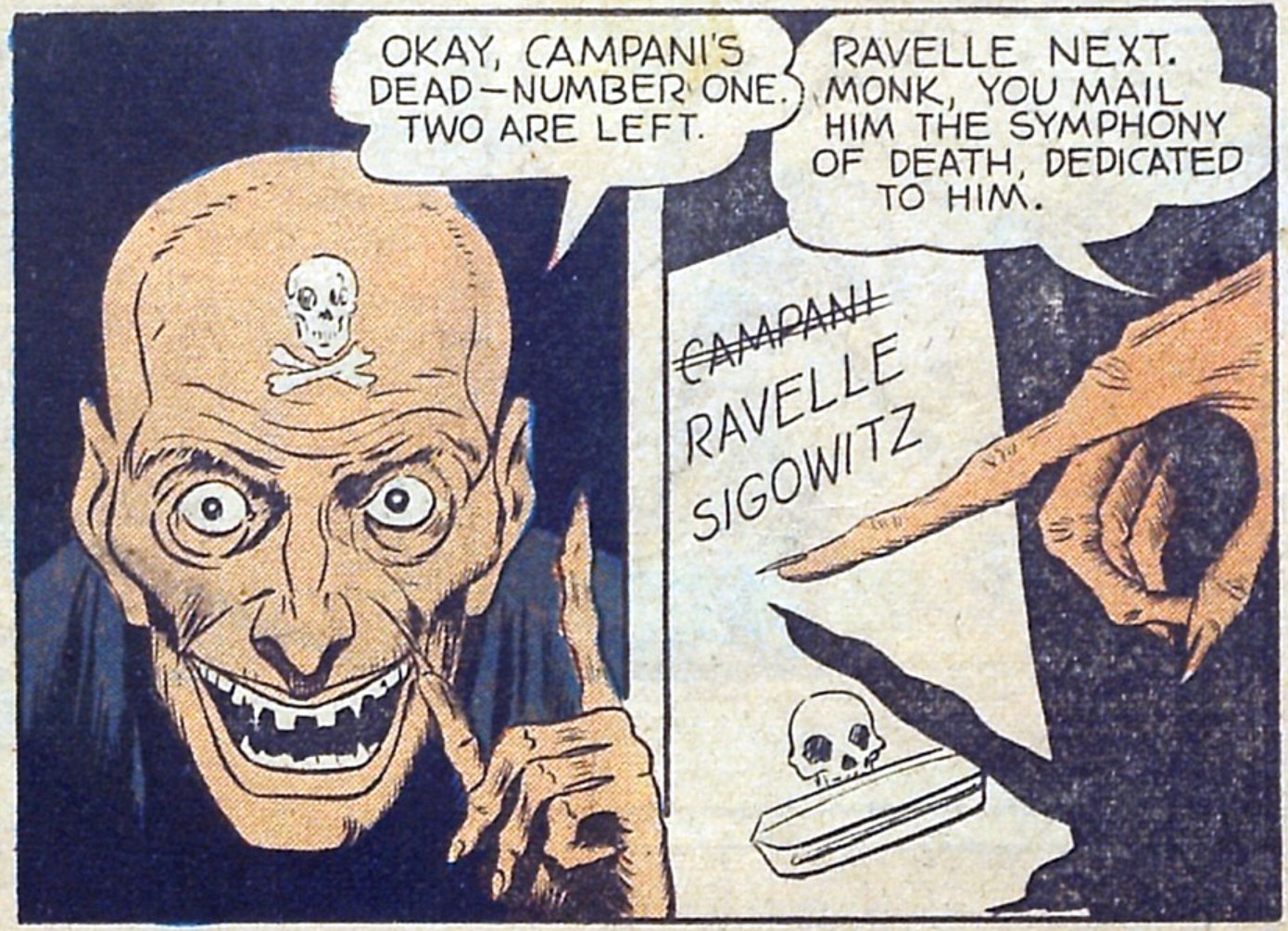
    We open as concert pianist Campani plays the “Symphony of Death,” a piece of music anonymously dedicated to him, only to die at its conclusion. What will eventually become clear is that the sheet music he was reading from was coated in poison and slightly stuck together so that Campani would need to lick his finger in order to turn the pages, thus poisoning himself in the process.

    This is a pretty good plan! If pulled off carefully, it might even be done so anonymously that the perpetrator would be effectively untraceable. There’s no chance of that, however, because said perpetrator is in fact a comic book super-villain who calls himself Doctor Death and who has all of the subtlety of his kind. Not only does he have a goon conspicuously parked outside Campani’s apartment to report back on the whether the scheme has worked, but the day before he sent a threatening note to Campani, complete with signature and little skull and coffin illustrations.

    (as can be seen in the note above, even though Doctor Death does music-based crimes and is kind of dressed like a concert musician his actual theme is that of a medical doctor. It’s a bit of a muddle)

    Doctor Death’s next stated target is another musician, Ravelle, and though Mr Scarlet prevents Ravelle’s copy of the “Symphony of Death” from being mailed to him this doesn’t stop Doctor Death; he just goes to Ravelle’s house, and when Mr Scarlet shows up there he gets captured and slated to die as well.

    Doctor Death of course does not contend with the fact that while Mr Scarlet is technically not a super-human he is nonetheless a super-hero and thus able to, for instance, lift a grand piano over his head and throw it at Doctor Death’s body. Among other things, this splits the Doctor Death mask asunder, revealing that the villain is in fact… Ravelle! 

    It turns out that Ravelle was recently fired and presumably replaced by Campani and his response to this insult was to turn to elaborate murder plots for solace. The attempt on Ravelle’s own life was a bluff designed to draw suspicion away from himself that was repurposed into a trap for Mr Scarlet. But what of Sigowitz, the third name on the revenge list? Alas, we shall never know.

  • MINOR SUPER-VILLAIN 884: DOCTOR DEATH

    MINOR SUPER-VILLAIN 884: DOCTOR DEATH

    (Wow Comics 002, 1941)

    We open as concert pianist Campani plays the “Symphony of Death,” a piece of music anonymously dedicated to him, only to die at its conclusion. What will eventually become clear is that the sheet music he was reading from was coated in poison and slightly stuck together so that Campani would need to lick his finger in order to turn the pages, thus poisoning himself in the process.

    This is a pretty good plan! If pulled off carefully, it might even be done so anonymously that the perpetrator would be effectively untraceable. There’s no chance of that, however, because said perpetrator is in fact a comic book super-villain who calls himself Doctor Death and who has all of the subtlety of his kind. Not only does he have a goon conspicuously parked outside Campani’s apartment to report back on the whether the scheme has worked, but the day before he sent a threatening note to Campani, complete with signature and little skull and coffin illustrations.

    (as can be seen in the note above, even though Doctor Death does music-based crimes and is kind of dressed like a concert musician his actual theme is that of a medical doctor. It’s a bit of a muddle)

    Doctor Death’s next stated target is another musician, Ravelle, and though Mr Scarlet prevents Ravelle’s copy of the “Symphony of Death” from being mailed to him this doesn’t stop Doctor Death; he just goes to Ravelle’s house, and when Mr Scarlet shows up there he gets captured and slated to die as well.

    Doctor Death of course does not contend with the fact that while Mr Scarlet is technically not a super-human he is nonetheless a super-hero and thus able to, for instance, lift a grand piano over his head and throw it at Doctor Death’s body. Among other things, this splits the Doctor Death mask asunder, revealing that the villain is in fact… Ravelle! 

    It turns out that Ravelle was recently fired and presumably replaced by Campani and his response to this insult was to turn to elaborate murder plots for solace. The attempt on Ravelle’s own life was a bluff designed to draw suspicion away from himself that was repurposed into a trap for Mr Scarlet. But what of Sigowitz, the third name on the revenge list? Alas, we shall never know.

  • MINOR SUPER-HERO ROUND-UP 065

    Our themes today are “scarlet,” “family tragedy,” and “inadvisable human experimentation.”

    Mr Scarlet: 

    Brian Butler, NYC* district attorney,** is frustrated by the limitations inherent in working within the law and so like so many of his peers adopts a costumed identity in order to get the better of crime via acrobatics and punching. A classic origin, but Mr Scarlet’s real claim to fame is in being created by Jack Kirby (with Ed Herron) and thus starting off with a real dose of comic book charisma that subsequent artist Jack Binder manages to keep going – both, for example, illustrate his acrobatic explots with such flair that to this day people assume that he’s meant to be flying.

    * although it’s referred to as “Gotham City” in the one caption that names his location, I simply must assume that it’s meant to be the NYC nickname rather than some Earth-S version of Batman’s hometown, earlier than both concepts even exist.

    ** he’s pretty consistently called a “special prosecutor”, but there’s just enough evidence to clarify that he’s a DA rather than an impartial lawyer brought in to prosecute cases involving possible conflicts of interest, which I just learned is what a special prosecutor is.

    Brian Butler’s secretary/love interest Cherry Wade learns his secret in Mr Scarlet’s first published adventure, and I must say as always that I appreciate a Golden Age comics with a straightforward hero romance to contrast with the widespread aping of the Clark Kent/Lois Lane situation. Even if it is an HR nightmare. (Wow Comics 001, 1940)

    Atom Blake, Boy Wizard: 

    Atom Blake, a youngster attending Lincoln High in Collegetown, USA, is curious about why he has a different last name than the people who are raising him, and perhaps more pointedly, why his is physically and mentally superhuman. His foster father, Professor Joseph Page, has the answer in the form of a note left for Atom by his biological father, Stuart Blake. Written in a mathematical code that Atom is instinctively able to read, the note tells of the elder Blake’s experiments in creating a super-element composed of all 93 known regular elements* and how the infant Atom was given treatments to make him super-human enough to utilize the power of the super-element (called sun-metal in later Atom Blake stories but not here) without evaporating like Blake Sr’s poor experimental orangutan.

    *always a good bit when it crops up. I just looked up the history of the discovery of elements to see how long the count of 93 was good for and it looks like about 4 years, though plutonium was discovered in 1941 but kept secret until 1948. More impressive is the fact that at least four of the elements known in 1940 weren’t yet discovered in 1923 when Blake did his work!

    An encounter between Atom and some bank robbers soon reveals that the super-element was stored in the ring that Stuart Blake left with Atom as a baby, and he gains access to a suite of deus ex machina powers. Will this sixteen or seventeen year old boy be able to deal with unlimited power in a healthy way? Stay tuned! (Wow Comics 001, 1940)

    UPDATE 1941 

    Steel Sterling: 

    John Sterling is your classic crime orphan: after losing his father to gangsters at a young age, he devotes his life to battling crime. But rather than become a living weapon through intense training, Sterling takes a note from his father’s death by gunfire and spends his formative years developing a chemical treatment that will give his body the properties of steel, dramatically catalyzed by a dip into a vat of molten metal in a sequence with more on-panel male nudity than you usually see. Please also note the final panel above, which showcases Sterling’s weird riveted metal briefs.

    And Sterling isn’t just blowing smoke about having all the properties of steel: in addition to being bulletproof and super strong thanks to his new density, he also has the magnetic properties of the alloy, which he, like many of his magnetic brethren, employs to fly around by “magnetizing himself to” various things. Later this is rounded up to simply being able to fly and thank goodness for that.

    Finally, Steel Sterling has one of the better secret identities, as he establishes private detective John Sterling as his own twin brother (and also as a sort of cowardly jerk so that he can establish the usual Lois Lane/Clark Kent dynamic with love interest Dora Cummings). (Zip Comics 001, 1940)

    the Scarlet Avenger: 

    I know I bagged on the Defender for just being the Avenger with the serial numbers filed off, but dang it if the Scarlet Avenger doesn’t feel even more like someone just took Richard Benson out back and slapped a little red paint on him. Real name Jim Kendall, the Scarlet Avenger loses his wife and child as a result of a gold robbery on the airplane they are riding in. Kendall alone survives the subsequent crash but loses the ability to form facial expressions, leading to his nickname as The Man Who Never Smiles. 

    The Scarlet Avenger’s calling card, seen above making the text box hard to read, is a flaming arrow for no discernible or stated reason. Later on it is often depicted with a decorative skull.

    The Scarlet Avenger lacks the ability to reshape his facial features that his inspiration possessed, and instead of being a master of disguise is more of a gadgeteer, variously employing a paralysis ray, bulletproof cloak, electrically wired suit that allows him to deliver lethal shocks, mind reading device, compact miniature parachute, shoe knife, personal smokescreen, rocket car and rocket ship in his pursuit of justice. 

    The other point of similarity between the Scarlet and regular Avengers is the extensive network of agents that both employ, though the Scarlet Avenger’s narrows somewhat over time as he begins a romantic relationship with Inez Courtney, aka Operative 1. More trouble for HR.  (Zip Comics 001 1940)

  • NOTES – OCTOBER 2025

    Cops Shooting Fleeing Suspects in the Back: 

    I’ll grant these cops this: Steel Sterling did just steal one of their motorcycles. I still don’t think that that warrants a  “SHOOT TO KILL!” and three bullets in the back. (Zip Comics 001, 1940)

    Even less of a reason to shoot someone in the back: because you heard a different person shooting at them and assumed that they were a thief. Both because you are wrong and the person you are shooting at is actually super-hero Mr Satan and because theft is not punishable by death. (Zip Comics 007, 1940) 

    Not only do the cops try to blow the Scarlet Avenger away here, but they also allow real culprit Mr Nimbus to make a getaway. (Zip Comics 009, 1940) 

    Honours: 

    Rambunctious pilots Tim and Tom Shane, aka the Devils Twins, are decorated for valour. (Zip Comics 001, 1940)

    Super-Heroes Going to Costume Parties as Themselves: 

    Dudley Bradshaw, aka Mr Satan, attends a very costume-heavy Mardi Gras parade in costume as himself. (Zip Comics 005, 1940)

    Both Mr Scarlet and his enemy Bluebeard attend the same costume party in character. (Wow Comics 004, 1941)

    (Pinky is there too, of course) 

    Vigilante also attended a costume party as himself in 1941 and I completely neglected to note it before now. (Action Comics v1 042, 1941) 

  • NOTES – OCTOBER 2025

    Cops Shooting Fleeing Suspects in the Back: 

    I’ll grant these cops this: Steel Sterling did just steal one of their motorcycles. I still don’t think that that warrants a  “SHOOT TO KILL!” and three bullets in the back. (Zip Comics 001, 1940)

    Even less of a reason to shoot someone in the back: because you heard a different person shooting at them and assumed that they were a thief. Both because you are wrong and the person you are shooting at is actually super-hero Mr Satan and because theft is not punishable by death. (Zip Comics 007, 1940) 

    Not only do the cops try to blow the Scarlet Avenger away here, but they also allow real culprit Mr Nimbus to make a getaway. (Zip Comics 009, 1940) 

    Honours: 

    Rambunctious pilots Tim and Tom Shane, aka the Devils Twins, are decorated for valour. (Zip Comics 001, 1940)

    Super-Heroes Going to Costume Parties as Themselves: 

    Dudley Bradshaw, aka Mr Satan, attends a very costume-heavy Mardi Gras parade in costume as himself. (Zip Comics 005, 1940)

    Both Mr Scarlet and his enemy Bluebeard attend the same costume party in character. (Wow Comics 004, 1941)

    (Pinky is there too, of course) 

    Vigilante also attended a costume party as himself in 1941 and I completely neglected to note it before now. (Action Comics v1 042, 1941)