The Curse of Skeleton Munroe

Category: Robin

  • MEDIA IN COMICS 016

    MEDIA IN COMICS 016

    Production on these Media in Comics showcases must sadly slow down now, for I have worked my way through my backlog. As evidence of this, today we are showcasing some magical books, which are genrally unique items that fall under nobody’s definition of mass media but which I want to include anyway, for fun’s sake.

    Books of Magic:
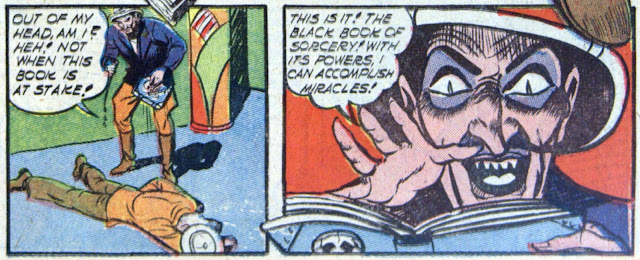
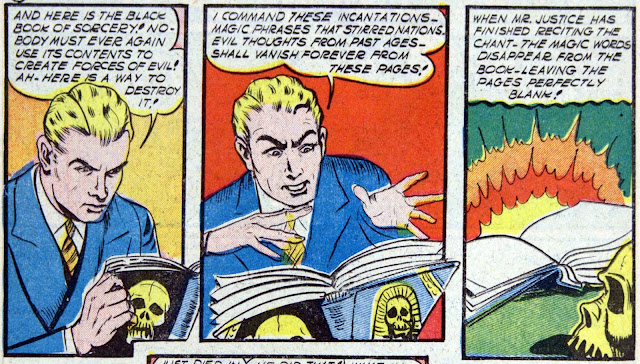
    You all remember the fabled Black Book of Sorcery that the wicked Egyptologist Ford committed all those murders for, well here it is! Until Mr Justice wipes its pages with a convenient self-destruct spell contained within it, that is.

    Origin: Ancient Egyptian 

    Status: Destroyed (Jackpot Comics 003, 1941)
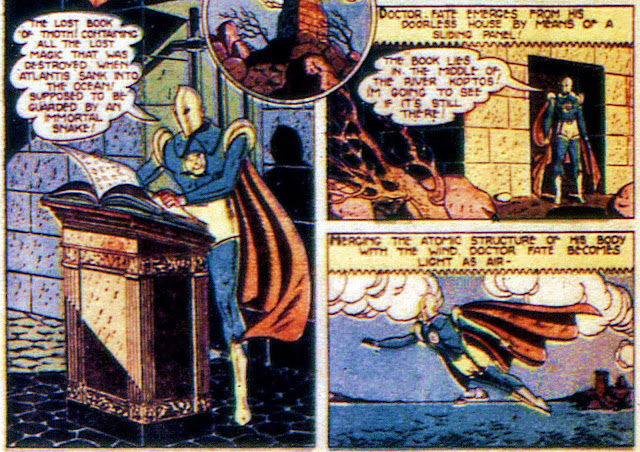
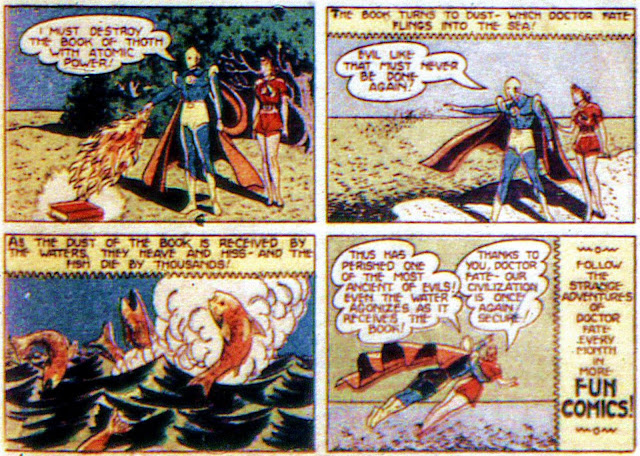
    The Lost Book of Thoth, containing all the magics of sunken Atlantis, is supposed to rest on the bottom of the Nile under the watchful eye of an immortal serpent. The plans of mice and men and whoever is in charge of everlasting snakes often go astray, alas, and the book is stolen by an unnamed mage and nearly used to destroy the world. Having solved that particular problem, Dr Fate doesn’t take any chances and reduces the book to a powder.

    Origin: Ancient Atlantis

    Status: Destroyed (More Fun Comics 058, 1941)
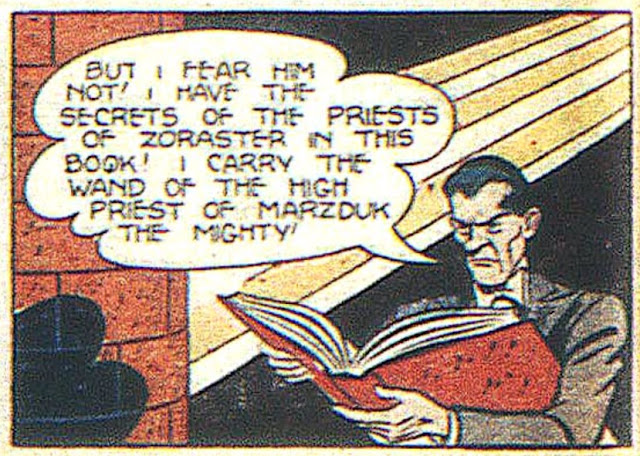
    The Secrets of the Priests of Zoraster (sic) might not be the official title of the book used by Haldane the Sorcerer, but it’s a pretty good title for a made-up book of magic and we have no other options. This one gets left behind in a secret passage rather than being destroyed, so it’s technically up for grabs.

    Origin: Persian? 

    Status: Extant (More Fun Comics 063, 1941)
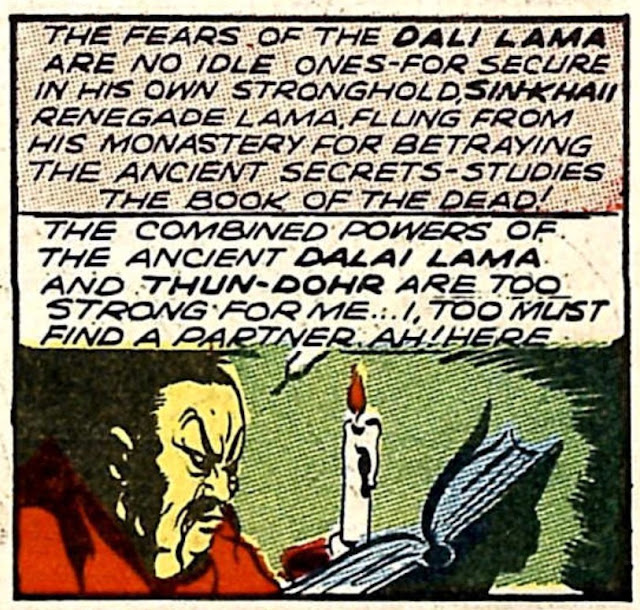
    Though Sin Khaii is an apostate Tibetan Buddhist, the Book of the Dead that he is referencing here is more likely to be the Egyptian on than the Tibetan, as he is using it to research the Black Pharaoh. He also casts spells out of it later!

    Origin: Ancient Egyptian 

    Status: Extant (Silver Streak Comics 014, 1941) 

    Theatre:
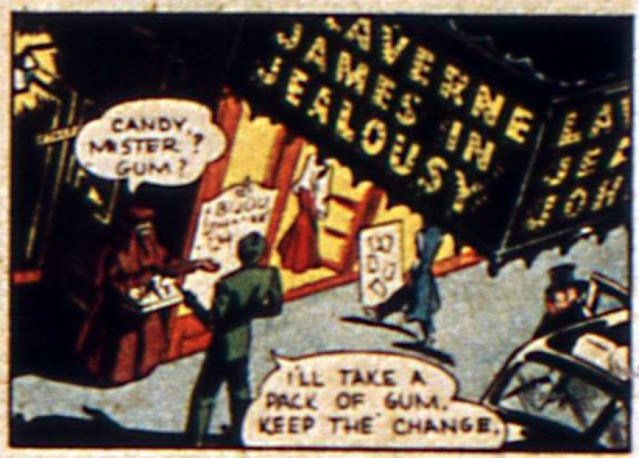
    Detective Larry Steele is called to the set of Jealousy to look into threats against star Laverne James, and then stays to solve the murder of Laverne James. More interesting than the murder mystery, however, is the mystery of just what is going on in this production.
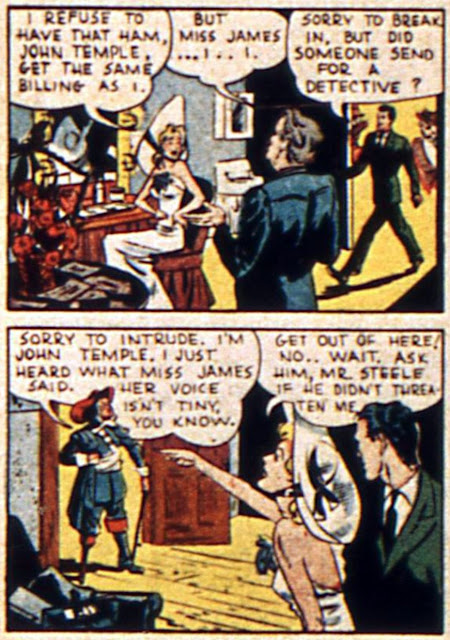
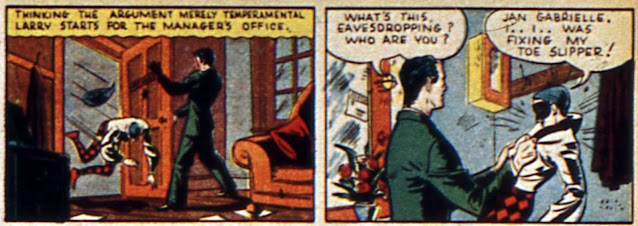
     

    We don’t actually see any of the on-stage action, but the costuming is extremely intriguing: James’ co-stars John Temple and Jan Gabrielle are dressed like off-model commedia dell’arte characters, while she looks more like a character from a Southern Gothic. Finally we have Peggy, who is part of the chorus line and is dressed like she is in a high-budget napkin advertisement. It’s a baffling selection. (Detective Comics v1 047, 1941) 
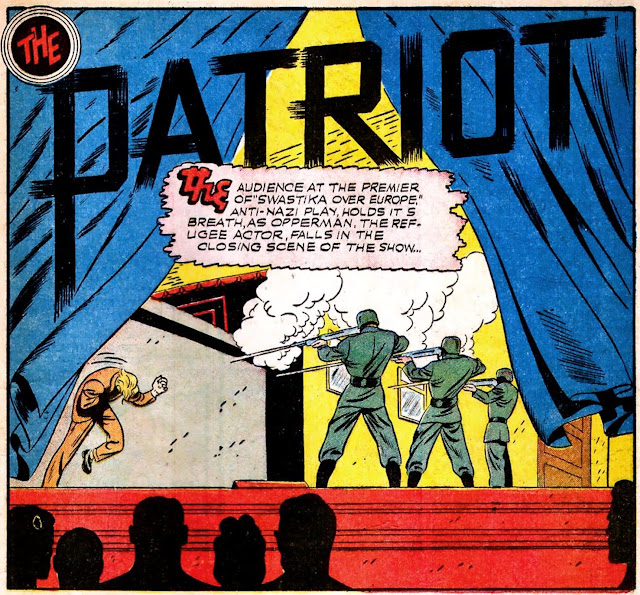
    Swastika Over Europe is a play designed to rally American support for the beleaguered nations of the Continent and as such is a target for sabotage by Nazi fifth columnists, as seen here when lead actor Opperman is murdered on-stage. (Marvel Mystery Comics v1 023, 1941)
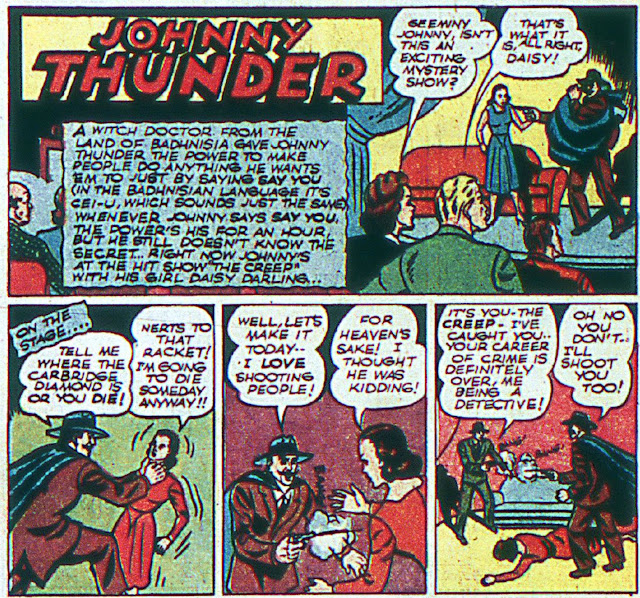
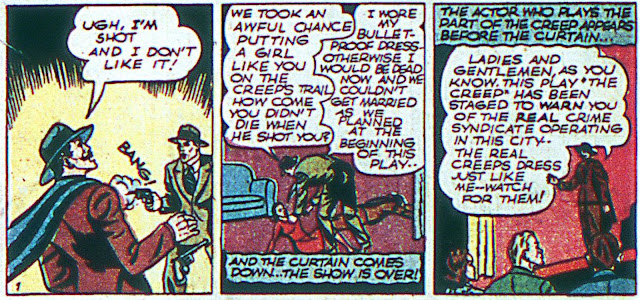
    Here we have The Creep, a play written expressly to warn the people of NYC about the threat of Crime & Corruption, Inc. I guess it works, because Johnny Thunder slapsticks them out of existence. (Flash Comics 013, 1941)
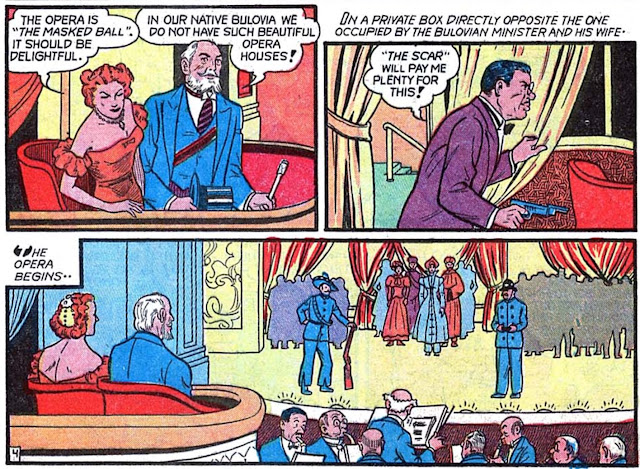
    Ordinarily getting such a good view of the stage would be very exciting to me as it would be a chance to divine some information about the production. Alas, this is an opera called The Masked Ball and so the only thing we can learn is that someone at the titular ball has come dressed as a police officer. (More Fun Comics 067, 1941)
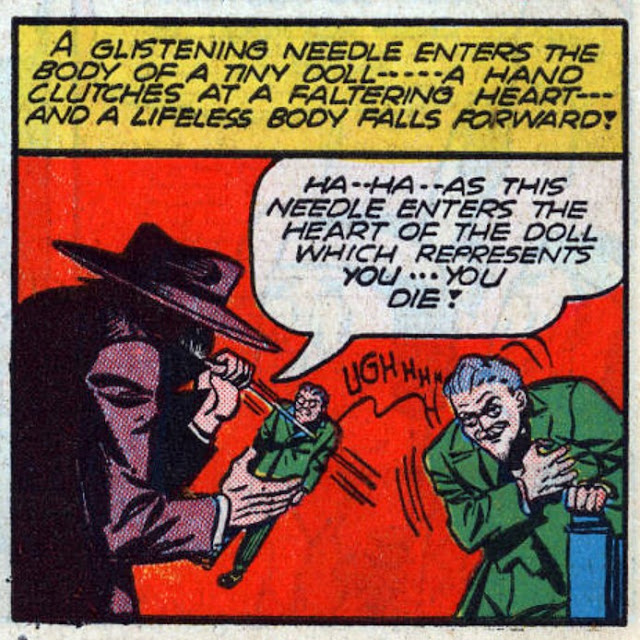
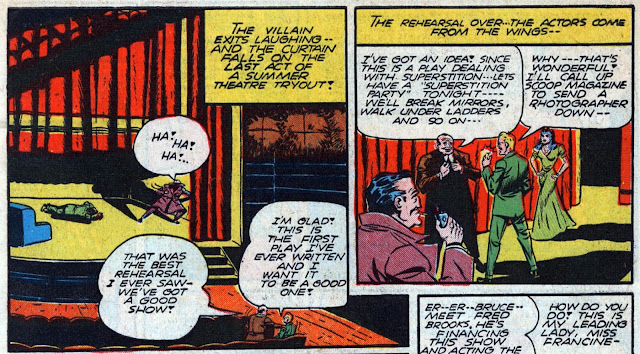
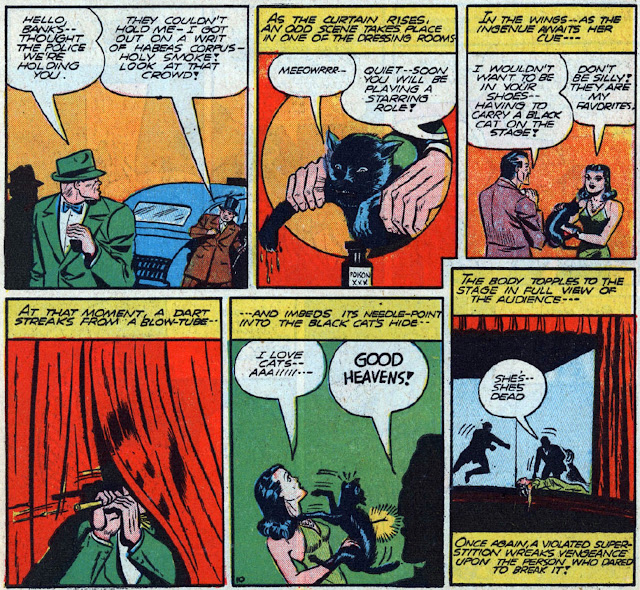
    The Superstition Murders is of course the play written by Johnny Glim the alter ego of the villainous Masked Man, who commits a series of superstition-themed murders in the hopes of tanking the production and thus securing the movie rights for his work. Though the motivation for the fictional killer is unrevealed, this seems to essentially be what the play is about as well. (Batman Comics v1 008, 1941)
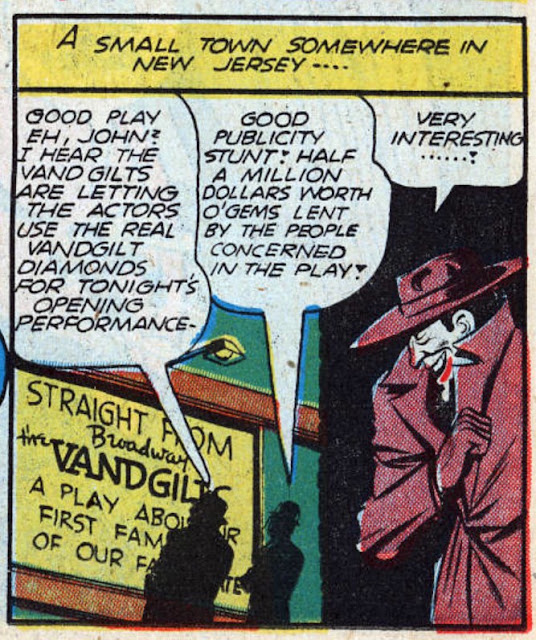
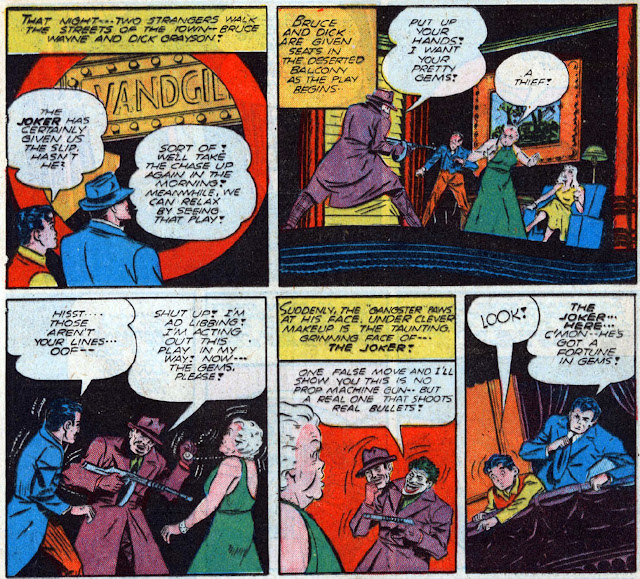
    Though there are many fine plays about the lives of the wealthy, there is no way The Vandgilts, about a real-life family who are on good enough terms with the production to lend them half a million dollars worth of jewellery, isn’t complete sycophantic mush. Luckily the Joker spices things up by robbing the actors mid-performance. (Batman Comics v1 008, 1941)

  • MEDIA IN COMICS 012

    It’s a very literary day here in Media in Comics Land.

    Books:

    There are many potential reasons to get into super-science and super-crime, but “reading a get-rich-quick scheme in a book” is one of the better ones, as demonstrated by Wizard Wells foe Mota here and his copy of Cash in Chemistry. (Crack Comics 010, 1941) 

    Crime in the Afternoon (A J.J. van Snyde Detective Novel), enjoyed here by Nickolas, henchman to Black Condor foe the Sophisticated Lady. (Crack Comics 010, 1941)

    This book, The Ritual, has the cover of a murder mystery or other popular bit of fiction, but seeing as the man reading it is a fanatical leopard-worshipper we must allow for it being something a bit more sinister, such as instructions of conducting a human sacrifice. (Jungle Comics 020, 1941)

    As covered in the Bram Thirla entry, Billy Batson learns about the dos and don’ts of vampire hunting from a book called The Vampire Legend, written by HP Lovecraft. A different Lovecraft, perhaps, or did the regular one go in for a bit more of a reference works-based career in the Fawcett Reality? (Captain Marvel Adventures 001, 1941)

    This particular comic adventure involves Darrell “Doll Man” Dane taking exception with the fact that some roughneck are using his local library. While I must decry the classism on display here, I must also begrudgingly acknowledge that Doll Man was right: these guys were learning for all the wrong reasons, specifically as part of a school of crime that the diminutive super-hero later breaks up. 

    Titles on display include: The Art of Murder, Famous Crimes, How to Win Friends, Jiu-Jitsu, Right and Wrong and The Way of All Flesh. (Feature Comics 047, 1941)

    Comics:


    Golden Age comics companies loved to depict their characters reading their own comics, which is why it is not at all unusual that Doiby Dickles here is reading a copy of Flash Comics in an issue of All-American. What is unusual is that rather than describing one of the actual features in Flash, Doiby has apparently been reading some alternate version of the book that exists in the DCU and involves a character named “Colosso.” (All-American Comics 032, 1941)

    Magazines:

    Though modern depictions of the original Dr Mid-Nite tend to categorize him as a crime novelist, his original job post-blindness was in writing for the crime pulps, and more precisely for Crime and Detective Tales. (All-American Comics 025, 1941)

    Freedom Magazine is one of those patriotically-named publications that any good citizen of the 21st Century must immediately suspect of being a cynical way to whitewash fascism, but no, this one seems to be on the up-and-up. They give Les Watts, Radio Amateur a prize for being a cool teen!. (Flash Comics 023, 1941)

    Peep Magazine, on the other hand, is merely concerned with the news, and is willing to help out patriotic hero Don Glory to get it. (Hit Comics 011, 1941)

    It’s possible that Scoop Magazine is entertainment-focused, as they send a photographer to cover this publicity-stunt party in support of a play by a new writer. A party that inspires the Masked Man’s murder spree! (Batman Comics 008, 1941)

    Movie Mag and Screen Stars are just two of the publications covering the meteoric rise of movie star Portia Storme, aka Julie Madison, the former fiance of Bruce Wayne. (Detective Comics 049, 1941)

  • MEDIA IN COMICS 012

    It’s a very literary day here in Media in Comics Land.

    Books:

    There are many potential reasons to get into super-science and super-crime, but “reading a get-rich-quick scheme in a book” is one of the better ones, as demonstrated by Wizard Wells foe Mota here and his copy of Cash in Chemistry. (Crack Comics 010, 1941) 

    Crime in the Afternoon (A J.J. van Snyde Detective Novel), enjoyed here by Nickolas, henchman to Black Condor foe the Sophisticated Lady. (Crack Comics 010, 1941)

    This book, The Ritual, has the cover of a murder mystery or other popular bit of fiction, but seeing as the man reading it is a fanatical leopard-worshipper we must allow for it being something a bit more sinister, such as instructions of conducting a human sacrifice. (Jungle Comics 020, 1941)

    As covered in the Bram Thirla entry, Billy Batson learns about the dos and don’ts of vampire hunting from a book called The Vampire Legend, written by HP Lovecraft. A different Lovecraft, perhaps, or did the regular one go in for a bit more of a reference works-based career in the Fawcett Reality? (Captain Marvel Adventures 001, 1941)

    This particular comic adventure involves Darrell “Doll Man” Dane taking exception with the fact that some roughneck are using his local library. While I must decry the classism on display here, I must also begrudgingly acknowledge that Doll Man was right: these guys were learning for all the wrong reasons, specifically as part of a school of crime that the diminutive super-hero later breaks up. 

    Titles on display include: The Art of Murder, Famous Crimes, How to Win Friends, Jiu-Jitsu, Right and Wrong and The Way of All Flesh. (Feature Comics 047, 1941)

    Comics:


    Golden Age comics companies loved to depict their characters reading their own comics, which is why it is not at all unusual that Doiby Dickles here is reading a copy of Flash Comics in an issue of All-American. What is unusual is that rather than describing one of the actual features in Flash, Doiby has apparently been reading some alternate version of the book that exists in the DCU and involves a character named “Colosso.” (All-American Comics 032, 1941)

    Magazines:

    Though modern depictions of the original Dr Mid-Nite tend to categorize him as a crime novelist, his original job post-blindness was in writing for the crime pulps, and more precisely for Crime and Detective Tales. (All-American Comics 025, 1941)

    Freedom Magazine is one of those patriotically-named publications that any good citizen of the 21st Century must immediately suspect of being a cynical way to whitewash fascism, but no, this one seems to be on the up-and-up. They give Les Watts, Radio Amateur a prize for being a cool teen!. (Flash Comics 023, 1941)

    Peep Magazine, on the other hand, is merely concerned with the news, and is willing to help out patriotic hero Don Glory to get it. (Hit Comics 011, 1941)

    It’s possible that Scoop Magazine is entertainment-focused, as they send a photographer to cover this publicity-stunt party in support of a play by a new writer. A party that inspires the Masked Man’s murder spree! (Batman Comics 008, 1941)

    Movie Mag and Screen Stars are just two of the publications covering the meteoric rise of movie star Portia Storme, aka Julie Madison, the former fiance of Bruce Wayne. (Detective Comics 049, 1941)

  • REAL PERSON ROUND-UP 028

    Mostly a case of the Usual Suspects today here in the Real Person Round-Up, I’m afraid.

    Adolf Hitler:

    The bulk of the comic this panel comes from is MIA as far as people without hundreds of dollars of Buy Golden Age Comics money are concerned, and this is the only real look we get of this slightly off-brand Hitler and Goering. I might not have bothered to include them here devoid of other context except for…

    … the splash page for the story, featuring our Hitler-alike in a beast-man form and commanding a horde of Hitlerian minions that are probably both allegorical but which are very representative of the “mad-dog” framing that he was being given in a lot of the comics of the time. Presumably air ace Bill Barnes really scuttles his plans. (Bill Barnes America’s Air Ace Comics 002, 1941)

    This husky Hitler look-alike is the head of a fascist force that almost manages to destroy the US military presence in Alaska but is himself destroyed by the Liberty Guards. (Man of War Comics 001, 1941)

    Here time/space traveller Whiz Wilson encounters a particularly low-rent Hitler-alike named Raggo. (Lightning Comics v1 006, 1941)

    Cordell Hull:

    When Bill Barnes needs two hundred jeeps to defend the Panama Canal, who does he call? Secretary of State Cordell Hull, that’s who! (Bill Barnes, America’s Air Ace Comics 005, 1941)

    Franklin Roosevelt:

    A more on-model  (and more face-forward) version of Roosevelt than we usually see in comics learns of the existence of the Liberty Scouts from their sponsor, retired patriotic millionaire Patrick Henry (who named himself such after immigrating to the US as a young man). (Liberty Scouts Comics 002, 1941)

    FDR returns in the second Liberty Scouts comic to tour the very on-the-nose Fort America (Liberty Scouts Comics 003, 1941)

    Hermann Goering:

    Orders the destruction of Bill Barnes. (Bill Barnes America’s Air Ace Comics 004, 1941)

    Hollywood Shuffle:

    It’s another classic case of mixing up first and last names of movie stars to make all-new ones, in this case Tyrone Taylor (Tyrone Power/ Robert Taylor, probably), and Myrna Rogers (Myrna Loy/ Ginger Rogers, almost certainly). (Detective Comics v1 046, 1940)

    Leopard Men:

    Since I recently realized that I had failed to be curious enough and that the Leopard Men were not just a fanciful idea that people kept coming up with but in fact a vilified version of real African secret societies, they now get a place in the Real Person Round-Up. These particular Leopard Men are just as bloodthirsty and savage as the rest of their fictional ilk, but are distinguished by being some of the few to not wear some sort of leopard-head cowl. Possibly because the Red Panther already has that bit of fashion sewn up. (Jungle Comics 020, 1941)

  • REAL PERSON ROUND-UP 028

    Mostly a case of the Usual Suspects today here in the Real Person Round-Up, I’m afraid.

    Adolf Hitler:

    The bulk of the comic this panel comes from is MIA as far as people without hundreds of dollars of Buy Golden Age Comics money are concerned, and this is the only real look we get of this slightly off-brand Hitler and Goering. I might not have bothered to include them here devoid of other context except for…

    … the splash page for the story, featuring our Hitler-alike in a beast-man form and commanding a horde of Hitlerian minions that are probably both allegorical but which are very representative of the “mad-dog” framing that he was being given in a lot of the comics of the time. Presumably air ace Bill Barnes really scuttles his plans. (Bill Barnes America’s Air Ace Comics 002, 1941)

    This husky Hitler look-alike is the head of a fascist force that almost manages to destroy the US military presence in Alaska but is himself destroyed by the Liberty Guards. (Man of War Comics 001, 1941)

    Here time/space traveller Whiz Wilson encounters a particularly low-rent Hitler-alike named Raggo. (Lightning Comics v1 006, 1941)

    Cordell Hull:

    When Bill Barnes needs two hundred jeeps to defend the Panama Canal, who does he call? Secretary of State Cordell Hull, that’s who! (Bill Barnes, America’s Air Ace Comics 005, 1941)

    Franklin Roosevelt:

    A more on-model  (and more face-forward) version of Roosevelt than we usually see in comics learns of the existence of the Liberty Scouts from their sponsor, retired patriotic millionaire Patrick Henry (who named himself such after immigrating to the US as a young man). (Liberty Scouts Comics 002, 1941)

    FDR returns in the second Liberty Scouts comic to tour the very on-the-nose Fort America (Liberty Scouts Comics 003, 1941)

    Hermann Goering:

    Orders the destruction of Bill Barnes. (Bill Barnes America’s Air Ace Comics 004, 1941)

    Hollywood Shuffle:

    It’s another classic case of mixing up first and last names of movie stars to make all-new ones, in this case Tyrone Taylor (Tyrone Power/ Robert Taylor, probably), and Myrna Rogers (Myrna Loy/ Ginger Rogers, almost certainly). (Detective Comics v1 046, 1940)

    Leopard Men:

    Since I recently realized that I had failed to be curious enough and that the Leopard Men were not just a fanciful idea that people kept coming up with but in fact a vilified version of real African secret societies, they now get a place in the Real Person Round-Up. These particular Leopard Men are just as bloodthirsty and savage as the rest of their fictional ilk, but are distinguished by being some of the few to not wear some sort of leopard-head cowl. Possibly because the Red Panther already has that bit of fashion sewn up. (Jungle Comics 020, 1941)

  • MEDIA IN COMICS 011

    I’ve heard of comics in the media, but media in comics?

    Books:

    This book is only our second example of a piece of media called Crime Does Not Pay! but I am confident in predicting that that particular phrase – the regular shouting of which appears to be the major means by which people in the 1940s discouraged children from adopting a life outside the law – is going to be the one we see the most as time goes on.

    We don’t learn too much about the contents of this particular book, but it makes a decent projectile for Robin here. (Detective Comics v1 050, 1941)

    Spider Craft, on the other hand, is pretty clearly just a reference book on spiders, albeit one with a very charming name. (Detective Comics v1 057, 1941)

    Movies:

    While attending to his extremely unruly supporting cast, Captain Terry Thunder happens upon a movie improbably being shot in North Africa in 1941. This movie is unnamed, but G.G., the director, is also responsible for the film Lost Souls, about which nothing else is known. (Jungle Comics 020, 1941)

    Radio:

    Radio Quiz show How Do You Know is your place to try your luck at winning two dollars and a big double box of Kracked Korn in a knock down quiz-off against Dolliver King. (Feature Comics 034, 1940)

    If there’s one kind of radio program that comic books love the most it’s the “man on the street” style with their handy remote microphone for all your evidence-gathering or (as seen here) confession-broadcasting needs. This particular show is called Public Opinion. (Nickel Comics 004, 1940)

    Theatre:

    The Fancy Follies of 1940 is a revue-style show that is the site of the first in a series of entertainment industry murders investigated by the Flash. (Flash Comics 002, 1940)

    Billed as a musical, In the Groove is another show plagued by crime. The Purple Trio clear things up after they manage to scrape together enough dough to get inside. (Smash Comics 015, 1940)

    Thanks to the fact that they had to pose as performers to solve the In the Groove case, the Purple Trio get their own self-titled show. The Purple Trio show probably involves more than the acrobatics we see here, but that’s all that the group gets through in this issue before they realize that a) one man has bought out the entire theatre and b) he has been murdered. (Smash Comics 016, 1940)

    This backstage conversation is all we get to see of the melodrama Remote Control, which is a real shame. What does a play with that title look like in 1940? (Crack Comics 008, 1940)

    Finally we have The Totsy Revue, attended by Johnny Thunder in one of his many attempts to impress the ever-fickle Daisy Darling, thanks to a tip that the show’s headliner Hoco tThe One and Only) is passing counterfeit money as part of his act. (Flash Comics 008, 1940)

  • MEDIA IN COMICS 010

    Is the media in comics any good, do you think? Do super-heroes get to watch good movies?

    Movies:

    Arizona Nights is a Western being produced by King Studios when a climactic gunfight scene is used as cover for a real-life murder. Detective Sergeant Carey clears up the mystery (it was the cameraman) but we never learn if the footage of a man dying in real life was used for the added verisimilitude. (More Fun Comics 052, 1940)

    Call of the North, a Mounted Police picture by Pioneer Films, is not marred by murder, but if the Quality Universe IMDb userbase is on the ball the trivia section for the movie includes the fact that several of the mountie actors were used as backup by RCMP Sergeant Reynolds in the apprehension of a kidnapper. (Feature Comics 037, 1940)

    Dread Castle has a place in comic book history as the film that drove Basil Karlo over the edge and into the persona of Clayface, as he saw the attempt to remake a movie that he saw as one of his greatest roles as an insult to him personally. Both Dread Castles are medieval films about a murderous hunchback called the Terror – not a terribly exciting prospect without the excitement of all the real-life murder that went on during production of the second one. (Detective Comics v1 040, 1940)

    The other Basil Karlo role that we learn about in his initial appearance is the one that he takes his criminal moniker and appearance from, a movie seemingly also called Clayface. (Detective Comics v1 040, 1940)

    Music:

    Is “Star Dust” Clark Kent’s favourite song as he claims it is while big-dogging this club maître d’? I sure hope so. No idea what kind of song it is, but you can slow dance to it. (Superman Comics v1 007, 1940)

    Newspaper Columns:

    “Town Talk” is the kind of snotty gossip column that inspired a thousand murder mystery plots. In this case, columnist Walt Willard turns up dead and Steel Sterling has to comb through the wealth of suspects to figure out whodunnit. (Jackpot Comics 004, 1941)

    “Around the Town with Joe E. Brown” is your standard gossip column-as-exposition-vector, though why the writer has the same name as an old-time film comedian is unknown to me. (Special Edition Comics 001, 1940)

    Paul Pryer, writer of the imaginatively-titled “Paul Pryer’s Column” is one of those comic book celebrities who I am certain is based on a real person, but whether it’s just someone like Walt Winchell or there’s a Paul Prowler out there just waiting for me to learn about him is up to chance. (All-Star Comics 003, 1940) 

    Meanwhile: “Society,” the most pragmatically-named society column of all time. (Batman Comics v1 001, 1940)

    We don’t get to actually see “Tom Peeping’s Column” in this Minute Movies strip, but I like to imagine that it features a cheeky little cartoon of the writer with big binoculars at the top. (Flash Comics 004, 1940)

    Newsreels:

    I don’t know enough about newsreels to know if they normally had titles, but the Ace Films company is trying to capitalize on their beautiful camerawoman “Dot Daring,” aka Beautia Sivana and so chooses to call this one Flirting with Death. (Whiz Comics 010, 1940)

  • MEDIA IN COMICS 009

    MEDIA IN COMICS 009

    I hope you like media from comics, because I certainly do and I am going to keep doing these.

    Comics:

    Bullied bootblack Timothy Smith just wants to buy a comic book with his last nickel and he has a whole selection of Fox Features titles to choose from, but what draws his eye is a book called The Land of Magic, a comic so fantastical and majestical that he wishes himself away to live inside its pages the next time he gets beaten up. (Green Mask v1 007, 1941)

    We never actually see the Colossal Guy comic book, but this Colossal Guy superfan is evidence enough that he is a character with get-up and go. Enough to inspire Captain Bruce Blackburn to invent his alter ego of the Destroying Demon, in fact. (Feature Comics 039, 1940)

    “Ripley’s Believe it or Not” had enough cultural caché in its time that there are innumerable plays on it in comics, just as there were imitators in real life. These mostly differ by how successful a play on the name they have: “Don’t You Doubt It,” as consulted by Eve Colby as part of one of Spy Smasher’s cases, is about average. (Whiz Comics 005, 1940)

    Magazines:

    I have a lot of affection for the concept behind Jim Dolan, two-fisted magazine editor, who solves crimes and then writes about them for Daring Detective Magazine. The magazine itself is fine. (Slam-Bang Comics 001, 1940)

    Movies:

    We never learn more about The Big Snatch other than that it is a mystery thriller. The big joke here is of course that the star of the film is comics creator Joe Devlin. (Smash Comics 014, 1940)

    Likewise, we never learn much about the Western Hearts of the Range other than the fact that it starred the blowhard Sheriff O’Toole. (All-American Comics 021, 1940)

    Melody of 1941 here is likely a play on Broadway Melody of 1940 and as such a musical, and stars a couple of classic mixed-up name actors in Tyrone Taylor (Tyrone Power/ Robert Taylor) and Myrna Rogers (Myrna Loy/ Ginger Rogers). (Detective Comics v1 046 1940)

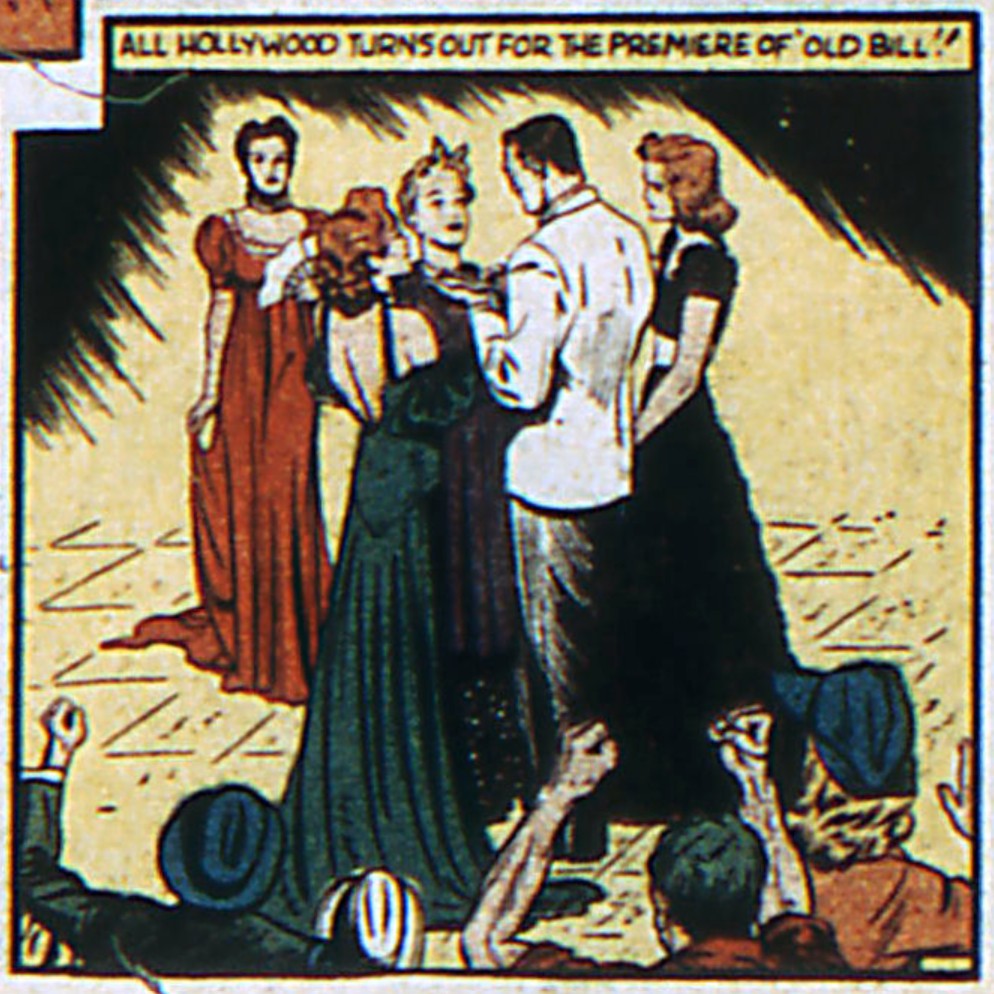
    We have no information at all about Old Bill. It has a pretty big premiere for a movie with such a drab name, so it must have something going for it. (Action Comics v1 028, 1940)

    Oriental Horror is the name of the hit movie that made Barry Moore’s name just before he quit acting, moved back to Center City to become a police scientist and adopted the identity of the Scarlet Seal based on the yellowface character he played in the movie. I would venture a guess that the film is not considered an enduring classic in the present day DC Universe. (Smash Comics 016, 1940)

    She Made Him Love Her! is the name of a romantic movie attended by Sisty and Dinky, aka the daughter of the future Red Tornado and the brother of teen cartoonist Scribbly, aka the future Cyclone Kids, after the former falls in undying love with the latter. And to be fair to her the duo are canonicall later married, so this is a proven tactic. Eventually.

    The movie itself might be loosely based on the film They Knew What They Wanted, or I might be grasping at straws. (All-American Comics 012, 1940)

  • MEDIA IN COMICS 008

    MEDIA IN COMICS 008

    We’re not out of the extremely crusty scan woods yet, but the media of comics must be recorded, folks. Hang in there.

    Books:

    When Diamond Jack defeats his early foe the Witch and transforms her book of magic into 1000 Ways to Cook Spinach, there is one big unanswered question: did this spinach cookbook already exist or did his ring magically compile 1000 recipes on its own? (Slam-Bang Comics 001, 1940)

    Early Batman foe the Wolf, meanwhile, got his start after suffering a head trauma and fixating on the crime thriller he was reading, titled The Crime Master. (Batman Comics v1 002, 1940)

    Human Knowledge, a book compiled by the sinister Professor Universe that contains “every fact known to man” is used by Slaughter Slade to imbue his assistant Dr Allirog with the mind of a human genius. (Special Edition Comics 001, 1940)

    Usually when you hear about a reclusive scholar writing a book about how “sinister persons or forces plan to deliberately stave off the return of national prosperity” you’re in for some paranoid fascist rantings, but in this case it’s the early 40s, so the sinister forces discussed in Prosperity’s Foe *are* the fascists. (Superman Comics 004, 1940)

    Wretched Marine character Strut Warren attempts to peddle a book called The Jolly Homemakers’ Manual around Bali in an attempt to win a prize, a typically tiresome adventure for the character. (Fight Comics 016, 1941)

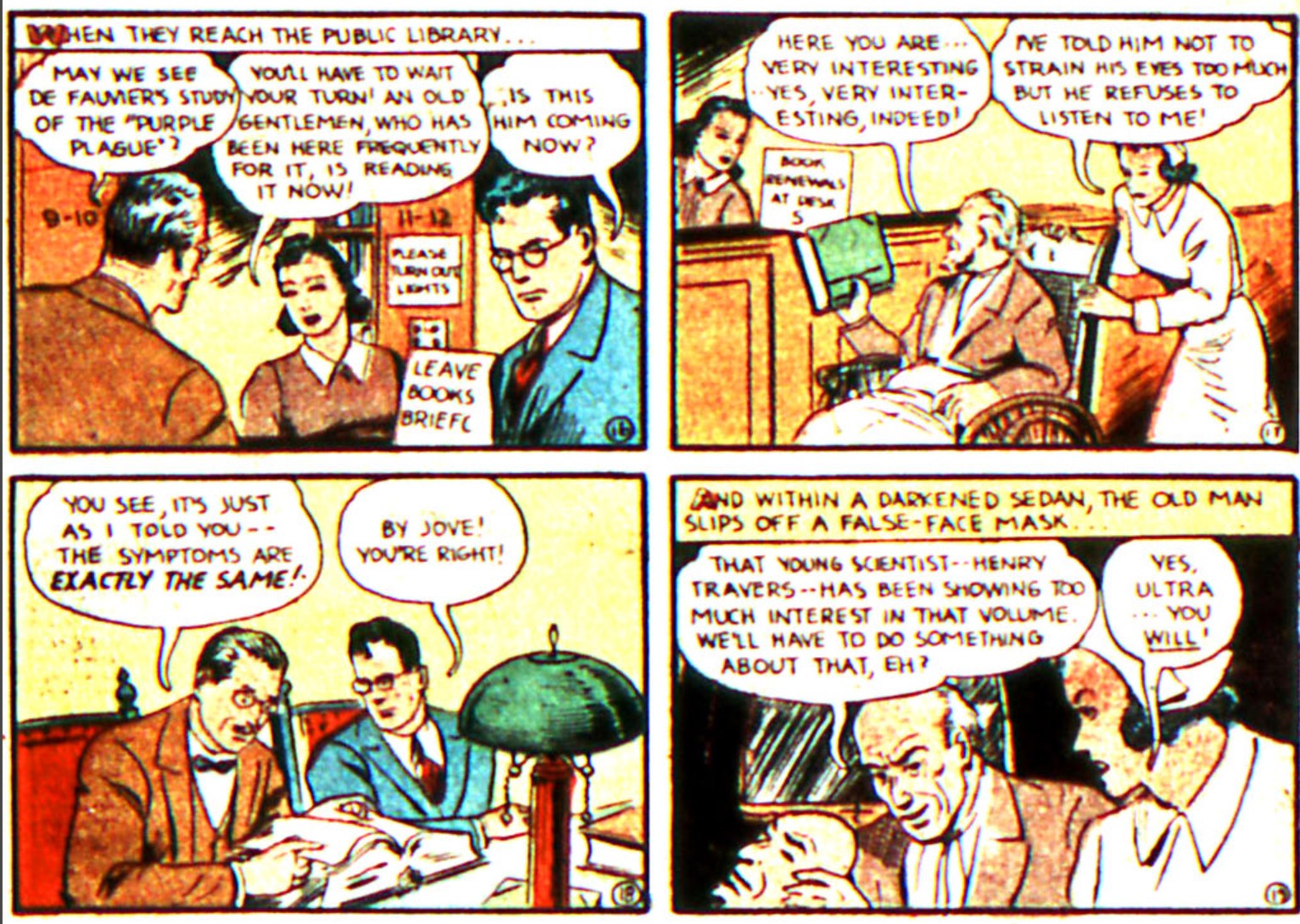
    When a mysterious virus called the Purple Plague starts ravaging Metropolis, Clark Kent and his pal Professor Henry Travers his the library to research a historical instance of the same disease, in a book also called The Purple Plague. It turns out that the Ultra Humanite had also checked out the same book and that it had given him the idea to unleash the modern plague in imitation of the original. (Action Comics v1 019, 1939)

    Movies:

    Air Circus is a airplane stunt-heavy film that is plagued by accidents while filming until pilot Gary Hawkes gets involved and exposes the scheming director’s plot to scuttle the production and then turn a quick buck by buying up the incomplete footage. (More Fun Comics 039, 1939)

    Its the same old story: a film called The General’s Daughter shoots some scenes at the Army installation where Skip Schuyler works, there’s a series of incidents and then Skip has to save the day. Not too sure what the movie is supposed to be about. (Adventure Comics 043, 1939)

    It may be the crustiest and crunchiest lowest quality scan here, but Public Enemy #13 is a pretty fun name for a movie and I think that that makes up for it, at least a little. (More Fun Comics 040, 1939)

    Newspaper Columns:

    “Around the Avenue” is one of those old-school society gossip columns that they used to have in papers, and while Rennie McCavoy here is playing into Wesley Dodds’ hands by writing him up as a wild party dude/ potential victim for the story’s villain, it’s hard to respect the journalistic effort involved in seeing a guy being quietly drunk at a nightclub and pouncing on him like this. (Adventure Comics 044, 1939)

  • CATALOGUE OF WOUNDS 001

    CATALOGUE OF WOUNDS 001

    Among the many things that I have found interesting enough to keep track of over the years is just how many times super-heroes get wounded while going about their business. What does a shoulder look like after it’s been shot a dozen times, for example? If I had been really on the ball I would have also been noting every time someone was knocked out with a blow to the head as well, but we can’t all be perfect.

    Full catalogue here, such as it is. 

    the Angel:

    The Angel chars his own hands at least a bit while escaping from some ropes. (Marvel Mystery Comics v1 008, 1940) 

    The Angel is wounded and probably shot while escaping from an ambush by the Cat’s Paw’s men (Marvel Mystery Comics v1 019, 1941)

    Batman:

    Batman is shot in the left shoulder during an altercation with the Wolf’s men. (Batman Comics v1 002, 1940)

    Shot in the right shoulder by a fleeing crook. (Batman Comics v1 004, 1940)

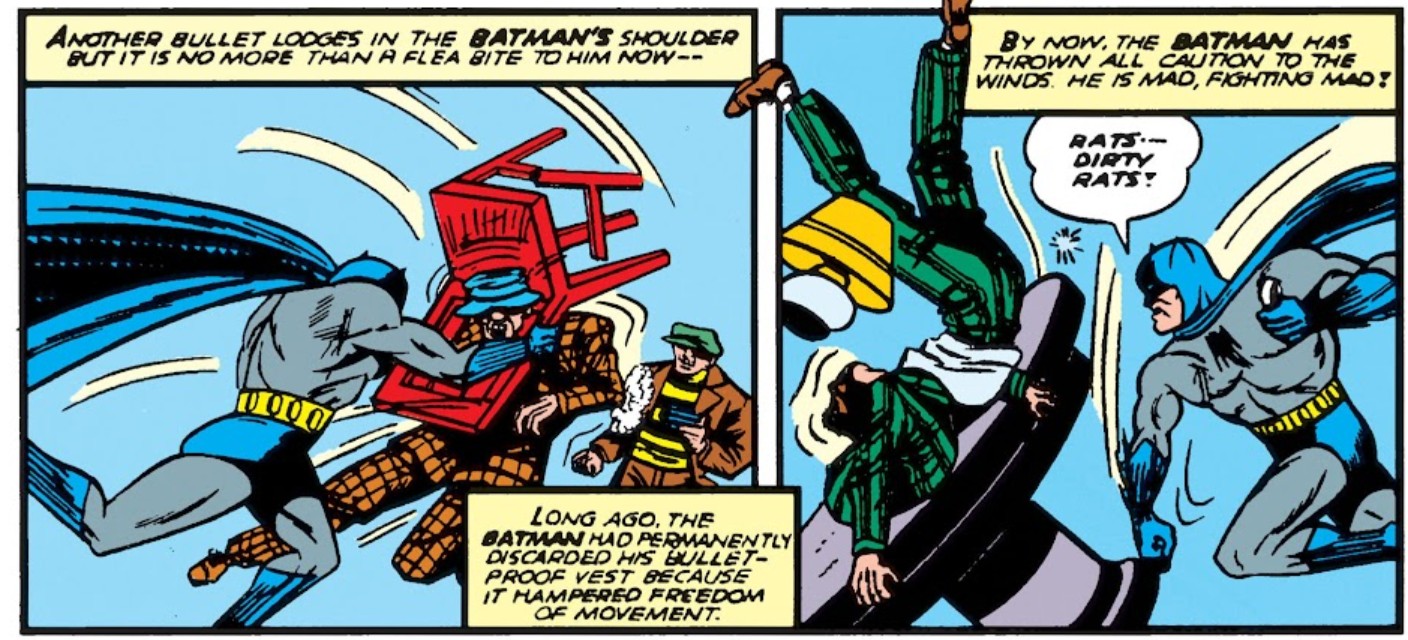
    While attacking a criminal hideout in a berserker rage, Batman is shot twice in the right shoulder and has a bullet glance off his ribs. (Batman Comics v1 005, 1941)

    Pirate Hook Morgan slashes Batman across the chest and hooks him in the left shoulder. (Detective Comics v1 054, 1941)

    Black Condor: 

    Black Condor is shot in the back by the Sapphire King’s men. (Crack Comics 005, 1940)

    Blackhawk:

    Blackhawk’s arm is non-specifically injured after an attack on Blackhawk Island. (Military Comics 001, 1941)

    the Deacon:

    The Deacon is shot in the right arm by the cops. (Cat-Man Comics 001, 1941) 

    Robin:

    Robin is beaten nearly to death by some gangsters (triggering Batman’s berserker attack above). (Batman Comics v1 005, 1941)