The Curse of Skeleton Munroe

Category: radioactive mutate

  • MINOR SUPER-HERO ROUND-UP 101

    It’s a big year for the jungle-based heroes of Fiction House, and also Radior is here.

    Camilla, Queen of the Lost Empire **UPDATE**:

    1941 is the year of change for Camilla. First off, she faces a series of threats to the Lost Empire itself, beginning when an evil magician nearly conquers and partially razes the city. (Jungle Comics 014, 1941)

    Next issue, the otherwise-unremarkable lech Prince Renardo finishes the job and burns the city to the ground as part of an attempt to win Camilla’s hand in marriage. Camilla and her surviving citizens rebuild but it is a far less grand affair, being more of a wooden stockade. (Jungle Comics 015, 1941)

    Perhaps inspired by the radical change in circumstances, Camilla and her subjects adopt a sort of retro-Norse style in keeping with their ancestry. Camilla’s lover Sir Champion disappears from the narrative at this point, never to be seen again. (Jungle Comics 016, 1941)

    The Viking revival among the people of the Lost Empire really takes off, and soon Camilla and her new paramour Erik are sailing around in longships having adventures with the seemingly endless variety of anachronistic societies littering the Central African jungle. This state of affairs continues for the remainder of 1941, as does Camilla’s insistence on wearing one of the most improbable bikini-chestplates in the history of fantasy illustration. How is it held on? (Jungle Comics 018, 1941)

    Fantomah **UPDATE**: 

    Following the departure of Fletcher Hanks, Fantomah too goes through some changes (and will continue to do so for a while yet). The first stage of this sees her lose a fair portion of her magical power, most importantly including her signature skull-faced “this means war” form. She also drops her black nightie look in favour of a more traditional jungle heroine’s one-piece, albeit made of leaves rather than the more typical animal skins. (Jungle Comics 017, 1941)

    By the end of 1941, Fantomah has become a mostly-regular jungle heroine. She has a panther pal named Fury, an orphan boy companion named Ken, and though she still busts out the odd magical ability – about once per adventure on average –  her supernatural power pales in comparison to the Hanks days. 

    Fantomah’s outfit has continued to evolve over the course of the year: from a green costume made of leaves to a pale blue one made of leaves to a more typical jungle one-piece that merely has the outline of something made of leaves. I can only assume that this change was a present from the (unknown!) artist to themself. (Jungle Comics 024, 1941)

    the Red Panther:

    Our final jungle makeover goes to the Red Panther, who adopts a sporty cowl-and-loincloth look to replace his more traditional super-hero outfit. His adventures don’t change as much as Fantomah or Camilla’s due to the fact that (barring the odd jaunt into outer space) he was about two steps away from being a Tarzan clone to begin with. The only real difference between the Old and New Look Red Panthers is in the latter’s increased use of panther companions to do his dirty work. (Jungle Comics 019, 1941)

    Radior:

    Radior, the X-Ray Powerman, is super strong, bulletproof, can fly, can hear radio waves, see through solid matter, and can transmit images directly into the human mind – a pretty thoroughly superhuman fellow. And just how did he get this way? Why, because his father, the famous Professor Kennedy, disappeared from public view when his son was born and spent the next twenty years feeding Radior as much radium as he could get his hands on. And while we might decry this as irresponsible parenting… hey, it worked! The kid grew up into a radiation and radio-themed superman!

    Sadly Radior only made the one appearance, in the oddball Key Ring Comics, a one-off collection of hole-punched and spot-coloured stories that it is very hard to find any real information about. (Key Ring Comics, 1941) 

  • MINOR SUPER-HERO ROUND-UP 083

    MINOR SUPER-HERO ROUND-UP 083

    Oh boy! Minor super-heroes!

    13: 

    13 (aka Thirteen, although the numerical version of the name is the official one) is the alias of Harold Higgins, whose life has been haunted by a series of misfortunes related to the number thirteen. A timeline of some of them:

    February 13, 1940: Harold’s brother Bob dies in a plane crash.

    March 13, 1940: Harold loses his life savings in the stock market.

    May 13, 1940: Harold’s sister Margy is paralyzed in a car accident.

    July 13, 1940: Harold’s father is lost at sea.

    September 13, 1940: Harold’s fiance is killed in a hit and run.

    April 13, 1941: Harold loses his job as a reporter to a crooked editor looking to cover up a story. 

    All of this (and more! A text story in Daredevil Comics 005 adds the facts that he was born on Friday the 13th, that minor tragedies like a broken leg or academic failure had frequently befallen him on the 13th of any given month and that at his thirteenth birthday party his childhood sweetheart Helen was killed by a falling chandelier) has clearly preyed on Harold’s mind, to the point that he is finding the number everywhere including his own name.

    Rather than, say, moving to a small shack in the woods to keep others safe from his constant misfortune, Harold decides to weaponize his bad luck by bringing it to criminals via his fists. Does this work, logically? Not really, but it’s a decent enough comic book origin.

    Like many super-heroes and villains, 13 flirts with the idea of leaving a calling card in his first adventure but doesn’t maintain the practice. In this case, it’s a calendar page with the 13th of the month circled. (Daredevil Comics 003, 1941)

    Finally, a couple of minor things about 13: In Daredevil Comics 004 we learn that like many of his peers he wears his costume under his clothes for quick-change action. Intriguingly, the above panel seems to imply that this includes his mask, which appears to be either acting as a liner for his hat or worn as a kind of bandana under it.

    Finally, in Daredevil Comics 006, 13 moves from the super-hero crammed streets of NYC to the lesser-served Boston.

    Categorized in: Abstract Concepts (Luck), Accessories (Calling Cards), Alphanumeric (Thirteen)

    Jinx: 

    Recently orphaned Darrel Creig has just inherited the family steel fortune, something that rankles his guardian, uncle and the only other potential heir Moldon Creig. Thus, a family outing to the Statue of Liberty, where Moldon and Darrel’s tutor Travers expedite the inheritance process by tossing him off the statue’s torch.

    Luckily for young Darrel, 13 happens to be present to stop an unrelated attempt to bomb the statue, and after saving the lad the two of them beat up Moldon and Travers and hand them over to the authorities.

    As we all know, if a costumed vigilante happens across an orphaned boy who can throw a punch they are allowed to keep them, which is just what happens with 13 and Darrel, and though Darrel’s connection to the bad luck theme is much more tenuous than Higgins (he is an orphan, if a wealthy one, and he is the very spooky age of thirteen years old) he is promptly given a slightly worse costume than 13’s and anointed as his sidekick Jinx. (Daredevil Comics 005, 1941)

    Categorized in: Abstract Concepts (Luck), Day Job (High School Students), Origin (Sidekicks)

    the Ghost: 

    The Ghost is a super-hero who seemingly exists solely to combat the menace of the Claw as he troubles America’s shores once more, Daredevil having moved on to less stressful pursuits.

    Though presented as a normal human man, the Ghost not only has the acrobatic prowess necessary to fight a giant across the rooftops of New York City but enough stamina to do so for seven hours straight. In their first encounter he manages to drive the Claw away by simply punching him thousands of times.

    The Ghost’s origin is unrevealed as of his final 1941 appearance but rest assured: we will learn it in 1942 (spoiler: it is not very interesting). (Daredevil Comics 005, 1941)

    Categorized in: Origin (Unknown), Supranormal Beings (Ghosts)

    the Fiery Mask: 

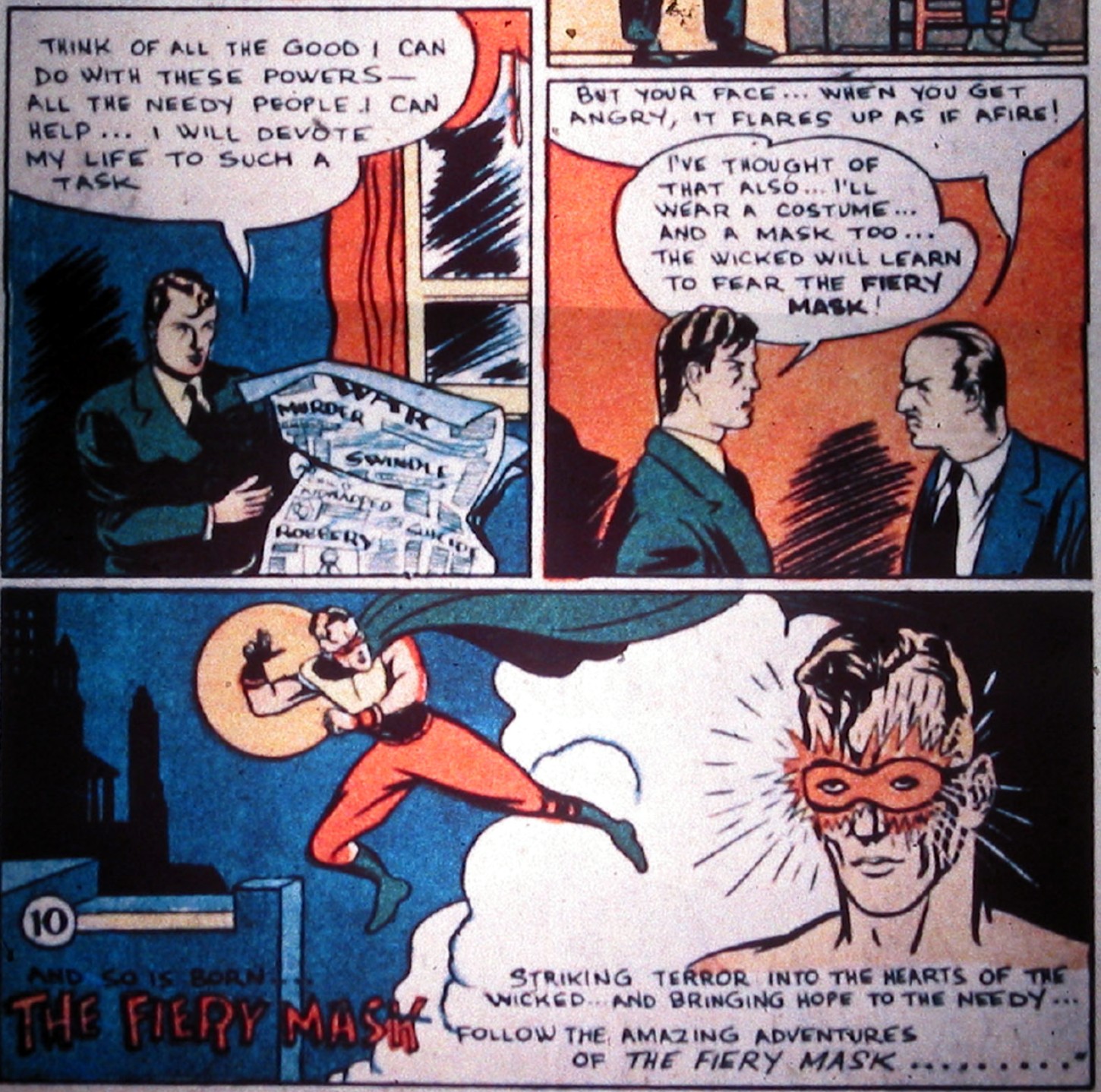
    The Fiery Mask! A hero whose modern depictions have consistently involved a morning star despite only ever actually wielding on on this cover. I’m not complaining, mind you – it’s just interesting to note where things come from.

    The Fiery Mask is in reality Jack Castle, a young doctor who accidentally tracks down the lair of the villainous Zombie Master and is in quick order captured and subjected to the fiend’s mind control device. Jack manages to resist the device long enough to enrage the Zombie Master, and in an effort to boost the power and overcome this resistance he causes it to explode.

    The strange energies given off by the device cause Jack to develop strange abilities, the most striking of which is a fiery glow that plays around his face when he is worked up, and which gives him his super moniker. He also has an invulnerability to heat and flame, a fiery touch and a range of non-heat-related powers like super strength, super breath and a hypnotic gaze. Also his origin is later heavily revised, but we can save that for the hundred years or so it will take to get to The Twelve. (Daring Mystery Comics 001, 1940)

    Categorized in: Elements (Fire), Objects (Masks), Origin (Radioactive Mutate)

  • MINOR SUPER-HERO ROUND-UP 083

    MINOR SUPER-HERO ROUND-UP 083

    Oh boy! Minor super-heroes!

    13: 

    13 (aka Thirteen, although the numerical version of the name is the official one) is the alias of Harold Higgins, whose life has been haunted by a series of misfortunes related to the number thirteen. A timeline of some of them:

    February 13, 1940: Harold’s brother Bob dies in a plane crash.

    March 13, 1940: Harold loses his life savings in the stock market.

    May 13, 1940: Harold’s sister Margy is paralyzed in a car accident.

    July 13, 1940: Harold’s father is lost at sea.

    September 13, 1940: Harold’s fiance is killed in a hit and run.

    April 13, 1941: Harold loses his job as a reporter to a crooked editor looking to cover up a story. 

    All of this (and more! A text story in Daredevil Comics 005 adds the facts that he was born on Friday the 13th, that minor tragedies like a broken leg or academic failure had frequently befallen him on the 13th of any given month and that at his thirteenth birthday party his childhood sweetheart Helen was killed by a falling chandelier) has clearly preyed on Harold’s mind, to the point that he is finding the number everywhere including his own name.

    Rather than, say, moving to a small shack in the woods to keep others safe from his constant misfortune, Harold decides to weaponize his bad luck by bringing it to criminals via his fists. Does this work, logically? Not really, but it’s a decent enough comic book origin.

    Like many super-heroes and villains, 13 flirts with the idea of leaving a calling card in his first adventure but doesn’t maintain the practice. In this case, it’s a calendar page with the 13th of the month circled. (Daredevil Comics 003, 1941)

    Finally, a couple of minor things about 13: In Daredevil Comics 004 we learn that like many of his peers he wears his costume under his clothes for quick-change action. Intriguingly, the above panel seems to imply that this includes his mask, which appears to be either acting as a liner for his hat or worn as a kind of bandana under it.

    Finally, in Daredevil Comics 006, 13 moves from the super-hero crammed streets of NYC to the lesser-served Boston.

    Categorized in: Abstract Concepts (Luck), Accessories (Calling Cards), Alphanumeric (Thirteen)

    Jinx: 

    Recently orphaned Darrel Creig has just inherited the family steel fortune, something that rankles his guardian, uncle and the only other potential heir Moldon Creig. Thus, a family outing to the Statue of Liberty, where Moldon and Darrel’s tutor Travers expedite the inheritance process by tossing him off the statue’s torch.

    Luckily for young Darrel, 13 happens to be present to stop an unrelated attempt to bomb the statue, and after saving the lad the two of them beat up Moldon and Travers and hand them over to the authorities.

    As we all know, if a costumed vigilante happens across an orphaned boy who can throw a punch they are allowed to keep them, which is just what happens with 13 and Darrel, and though Darrel’s connection to the bad luck theme is much more tenuous than Higgins (he is an orphan, if a wealthy one, and he is the very spooky age of thirteen years old) he is promptly given a slightly worse costume than 13’s and anointed as his sidekick Jinx. (Daredevil Comics 005, 1941)

    Categorized in: Abstract Concepts (Luck), Day Job (High School Students), Origin (Sidekicks)

    the Ghost: 

    The Ghost is a super-hero who seemingly exists solely to combat the menace of the Claw as he troubles America’s shores once more, Daredevil having moved on to less stressful pursuits.

    Though presented as a normal human man, the Ghost not only has the acrobatic prowess necessary to fight a giant across the rooftops of New York City but enough stamina to do so for seven hours straight. In their first encounter he manages to drive the Claw away by simply punching him thousands of times.

    The Ghost’s origin is unrevealed as of his final 1941 appearance but rest assured: we will learn it in 1942 (spoiler: it is not very interesting). (Daredevil Comics 005, 1941)

    Categorized in: Origin (Unknown), Supranormal Beings (Ghosts)

    the Fiery Mask: 

    The Fiery Mask! A hero whose modern depictions have consistently involved a morning star despite only ever actually wielding on on this cover. I’m not complaining, mind you – it’s just interesting to note where things come from.

    The Fiery Mask is in reality Jack Castle, a young doctor who accidentally tracks down the lair of the villainous Zombie Master and is in quick order captured and subjected to the fiend’s mind control device. Jack manages to resist the device long enough to enrage the Zombie Master, and in an effort to boost the power and overcome this resistance he causes it to explode.

    The strange energies given off by the device cause Jack to develop strange abilities, the most striking of which is a fiery glow that plays around his face when he is worked up, and which gives him his super moniker. He also has an invulnerability to heat and flame, a fiery touch and a range of non-heat-related powers like super strength, super breath and a hypnotic gaze. Also his origin is later heavily revised, but we can save that for the hundred years or so it will take to get to The Twelve. (Daring Mystery Comics 001, 1940)

    Categorized in: Elements (Fire), Objects (Masks), Origin (Radioactive Mutate)

  • MINOR SUPER-HERO ROUND-UP 065

    Our themes today are “scarlet,” “family tragedy,” and “inadvisable human experimentation.”

    Mr Scarlet: 

    Brian Butler, NYC* district attorney,** is frustrated by the limitations inherent in working within the law and so like so many of his peers adopts a costumed identity in order to get the better of crime via acrobatics and punching. A classic origin, but Mr Scarlet’s real claim to fame is in being created by Jack Kirby (with Ed Herron) and thus starting off with a real dose of comic book charisma that subsequent artist Jack Binder manages to keep going – both, for example, illustrate his acrobatic explots with such flair that to this day people assume that he’s meant to be flying.

    * although it’s referred to as “Gotham City” in the one caption that names his location, I simply must assume that it’s meant to be the NYC nickname rather than some Earth-S version of Batman’s hometown, earlier than both concepts even exist.

    ** he’s pretty consistently called a “special prosecutor”, but there’s just enough evidence to clarify that he’s a DA rather than an impartial lawyer brought in to prosecute cases involving possible conflicts of interest, which I just learned is what a special prosecutor is.

    Brian Butler’s secretary/love interest Cherry Wade learns his secret in Mr Scarlet’s first published adventure, and I must say as always that I appreciate a Golden Age comics with a straightforward hero romance to contrast with the widespread aping of the Clark Kent/Lois Lane situation. Even if it is an HR nightmare. (Wow Comics 001, 1940)

    Atom Blake, Boy Wizard: 

    Atom Blake, a youngster attending Lincoln High in Collegetown, USA, is curious about why he has a different last name than the people who are raising him, and perhaps more pointedly, why his is physically and mentally superhuman. His foster father, Professor Joseph Page, has the answer in the form of a note left for Atom by his biological father, Stuart Blake. Written in a mathematical code that Atom is instinctively able to read, the note tells of the elder Blake’s experiments in creating a super-element composed of all 93 known regular elements* and how the infant Atom was given treatments to make him super-human enough to utilize the power of the super-element (called sun-metal in later Atom Blake stories but not here) without evaporating like Blake Sr’s poor experimental orangutan.

    *always a good bit when it crops up. I just looked up the history of the discovery of elements to see how long the count of 93 was good for and it looks like about 4 years, though plutonium was discovered in 1941 but kept secret until 1948. More impressive is the fact that at least four of the elements known in 1940 weren’t yet discovered in 1923 when Blake did his work!

    An encounter between Atom and some bank robbers soon reveals that the super-element was stored in the ring that Stuart Blake left with Atom as a baby, and he gains access to a suite of deus ex machina powers. Will this sixteen or seventeen year old boy be able to deal with unlimited power in a healthy way? Stay tuned! (Wow Comics 001, 1940)

    UPDATE 1941 

    Steel Sterling: 

    John Sterling is your classic crime orphan: after losing his father to gangsters at a young age, he devotes his life to battling crime. But rather than become a living weapon through intense training, Sterling takes a note from his father’s death by gunfire and spends his formative years developing a chemical treatment that will give his body the properties of steel, dramatically catalyzed by a dip into a vat of molten metal in a sequence with more on-panel male nudity than you usually see. Please also note the final panel above, which showcases Sterling’s weird riveted metal briefs.

    And Sterling isn’t just blowing smoke about having all the properties of steel: in addition to being bulletproof and super strong thanks to his new density, he also has the magnetic properties of the alloy, which he, like many of his magnetic brethren, employs to fly around by “magnetizing himself to” various things. Later this is rounded up to simply being able to fly and thank goodness for that.

    Finally, Steel Sterling has one of the better secret identities, as he establishes private detective John Sterling as his own twin brother (and also as a sort of cowardly jerk so that he can establish the usual Lois Lane/Clark Kent dynamic with love interest Dora Cummings). (Zip Comics 001, 1940)

    the Scarlet Avenger: 

    I know I bagged on the Defender for just being the Avenger with the serial numbers filed off, but dang it if the Scarlet Avenger doesn’t feel even more like someone just took Richard Benson out back and slapped a little red paint on him. Real name Jim Kendall, the Scarlet Avenger loses his wife and child as a result of a gold robbery on the airplane they are riding in. Kendall alone survives the subsequent crash but loses the ability to form facial expressions, leading to his nickname as The Man Who Never Smiles. 

    The Scarlet Avenger’s calling card, seen above making the text box hard to read, is a flaming arrow for no discernible or stated reason. Later on it is often depicted with a decorative skull.

    The Scarlet Avenger lacks the ability to reshape his facial features that his inspiration possessed, and instead of being a master of disguise is more of a gadgeteer, variously employing a paralysis ray, bulletproof cloak, electrically wired suit that allows him to deliver lethal shocks, mind reading device, compact miniature parachute, shoe knife, personal smokescreen, rocket car and rocket ship in his pursuit of justice. 

    The other point of similarity between the Scarlet and regular Avengers is the extensive network of agents that both employ, though the Scarlet Avenger’s narrows somewhat over time as he begins a romantic relationship with Inez Courtney, aka Operative 1. More trouble for HR.  (Zip Comics 001 1940)

  • MINOR SUPER-HERO ROUND-UP 039

    MINOR SUPER-HERO ROUND-UP 039

    We’re reading Shield-Wizard Comics, bay-bee, so here’s some stuff about the Shield and the Wizard.

    the Shield UPDATE:

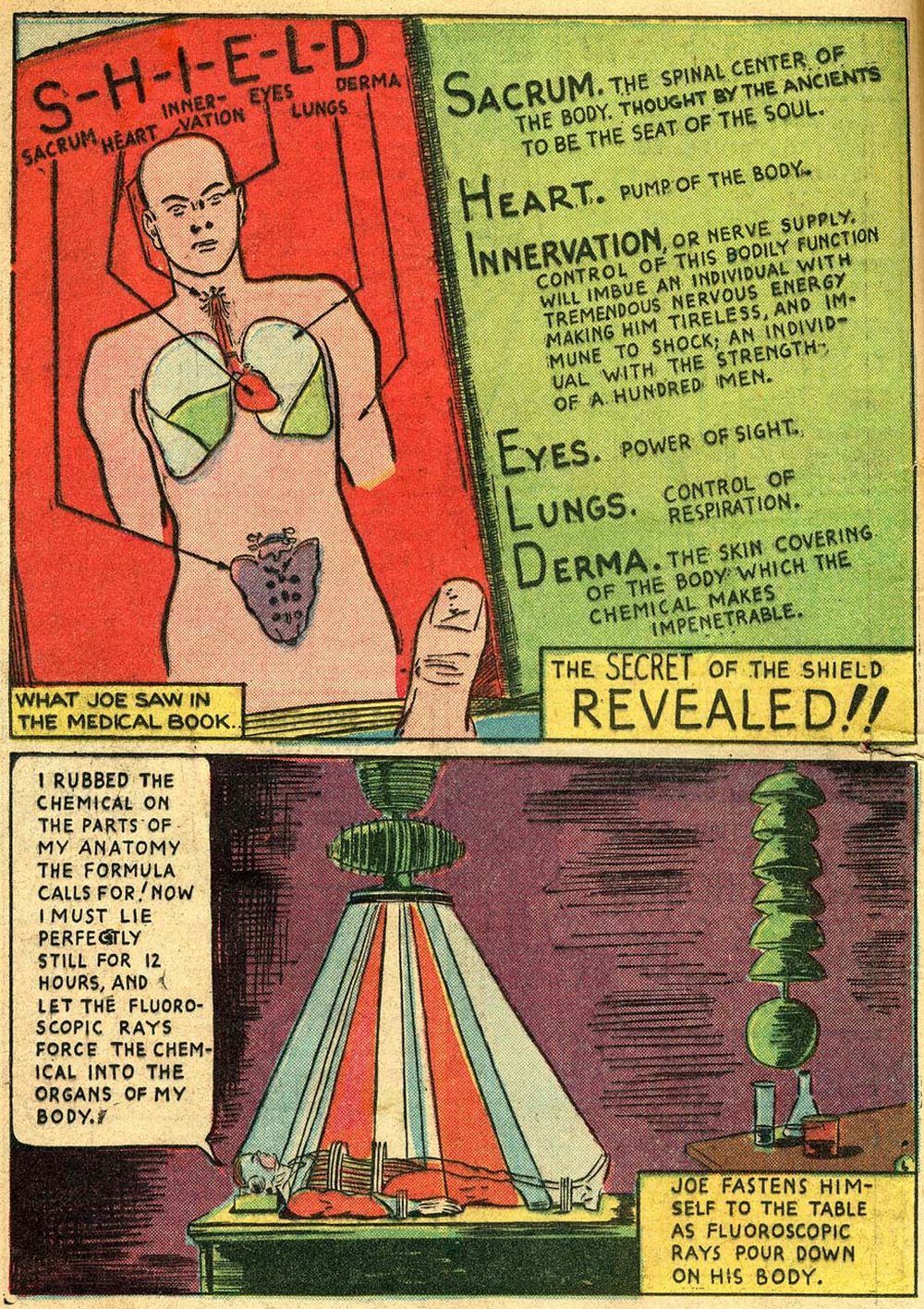
    In our original write-up of the Shield, we noted that the origin of his powers shifted from being solely down to his super-suit to being more of an ingrained thing over time, and the time is now! Yes, Shield-Wizard Comics 001 provides a slightly tweaked version of the Shield’s origin, in which Joe Higgins’ father Tom was not just a US Army Intelligence agent but a gifted scientist who discovered the secret of inducing superpowers but died juuuust before being able to tell Joe the full secret.

    Joe grows up to become a chemist himself but remains puzzled by his father’s last instructions to remember “anatomy formula S•H•I•E•L•D,” and with good reason, because it’s a nonsense jumble of anatomical parts that must have been put together only in the specific medical textbook that Joe eventually finds it in. But hey, he needed to find out where exactly to rub the chemical formula, and how would he otherwise know that it boiled down to “your eyes and skin, but especially the skin over your chest and groin” without that handy mnemonic device?

    The all-white costume that Joe is sporting before he settles down for a 12-hour session under the fluoroscopic ray shows up in at least a few retellings of the Shield’s origin going forward and I always thought that it was a pretty snappy look. Unfortunately, the rays dye his suit (and possibly his limbs?) in patriotic colours and so we get a red-white-and-blue Shield rather than merely a white one.

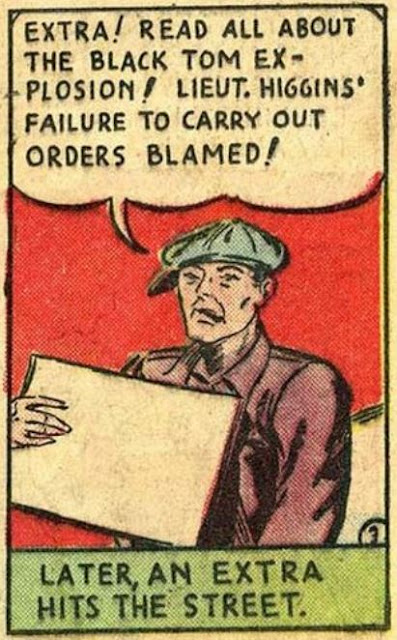
    The other tweak to the Shield’s origin is that rather than merely dying in the Black Tom Explosion of 1916, Tom Higgins is blamed for it, so the Shield now not only has a Batman-style motivation (spies killed my dad and now I must battle espionage) but also a Geoff Johns-Barry Allen-Flash one (I fight crime as part of my attempt to clear my father’s name). Thankfully, his first case involves rounding up the very German Hans Fritz and forcing him to confess, thus clearing Tom Higgins’ name without it becoming a whole thing. (Shield-Wizard Comics 001, 1940)

    the Wizard I:

    In the original account of the Wizard’s origin in Top-Notch Comics 001, the Whitney family’s close connection to American history is pretty thoroughly emphasized, with Whitneys present and getting things done at all major American wartimes. Well, Shield-Wizard Comics took up that gauntlet and ran with it: John Whitney organized the Mayflower expedition, and his son John Whitney organized the first Thanksgiving, and his son or grandson John Whitney thought up the idea of uniting the colonies. 

    But that wasn’t all: the third John Whitney’s son Blane (the main line of Whitneys only have time for three male names: John, Blane and Grover. All other named Whitneys are from dead end branches of the family tree, it seems) is just as super-human as his descendant, and in fact was the first of a line of Whitney family superhumans to call themself the Wizard (adopted as an ironic name after John Whitney was burned at the stake for witchcraft after acting on his son’s extrasensory visions to protect the colonies).

    The Wizard ends up making quite a big difference in the tides of the American Revolution, including:

    – informing Paul Revere that the British were approaching Concord and lighting the “one if by land, two if by sea” lanterns

    – showing up to participate in the fighting at Concord and turning the tide

    – wielding a cannon as a sidearm in the Battle of Bunker Hill and again at the Battle of Saratoga

    – saving Nathan Hale from being executed as a spy only not really because he chooses to die and be an inspiration instead

    – orchestrating the crossing of the Delaware and the surprise attack on the Hessian forces

    -very nearly getting Benedict Arnold before he gets away to join the British forces

    – proving instrumental in the capture of Major André

    – participating in several key battles, including the charge of Mad Anthony Wayne and the defeat of Cornwallis

    – orchestrating the support of the French for the revolution

     This original Wizard also creates a number of anachronistic inventions, including:

    – a glider that seems to function a bit more like a full-fledged airplane

    – a steam powered speedboat

    – something in between a deep sea diving rig and a scuba suit

    – a machine gun

    – radio communication

    – an electrified, battery-powered suit

    – a self-propelled sled

    – a tiny high-powered cannon

    All in all, the tale of the original Wizard holds up as a classic of the form, with the form being “super-heroes added to historical events.” Comics love to showcase the great moments of US history in particular, but as a comic book must prioritize action, any super-heroic character who is present must have an extraordinary amount of influence on history. It’s great! (Shield-Wizard Comics 001, 1940)

    the Wizard II:

    The second Wizard, like his father the original Wizard, is essentially a carbon copy of the modern character in appearance, name (Blane Whitney, natch) and abilities. Blane Whitney II also takes after his father in his commitment to inserting himself into important US historical events, including:

    – participating in various military engagements, including the defeat of the HMS Gurrierre, the Battle of Lake Erie, the Battle of the Thames (I think?) and the Battle of Bladensburg

    – saving William Henry Harrison from an assassination attempt

    – almost preventing the burning of the White House by the British

    – planning the defense of Fort McHenry and then participating in it

    – accidentally enabling Francis Scott Key to get inspired to write the Star-Spangled Banner

    This Wizard also has a lot of ahead of its time technology, including:

    – a version of his father’s glider

    – smoke (possibly tear gas) grenades

    – a dang tank

    The second Wizard obviously has less of a direct impact on the events of US history, if only because the War of 1812 has fewer Stand Up and Cheer moments than its predecessor. Still, he’s in there, and there’s every indication that we’d continue on to see a Civil War Wizard and a World War I Wizard and so forth, and the stated reason that we don’t see them is that as of Shield-Wizard Comics 003, the Wizard’s sidekick Roy the Super-Boy was too popular to not feature and so it was contemporary Wizard from then on out. (Shield-Wizard Comics 002, 1940)

    And speaking of Roy the Super-Boy:

    Tommy the Super-Boy:

    A part of any big project is choosing a methodology and then sticking to it and as my project is “reading all comics, in order” I had to figure out what “in order” meant. And while doing things in a month by month basis might be more true to the spirit of the experience, for my own sanity I opted to go alphabetical by year instead – the prep work alone for that other method hurts my head a bit to contemplate.

    All that is by way of explaining that Tommy, “the Original Super-Boy of History” (aka the original wonder-boy according to that one panel) is a retroactively created predecessor of the Wizard’s sidekick Roy the Super-Boy, who we will not meet until I have read the around 180 other comics between Shield-Wizard Comics 002 and Top-Notch Comics 008. He’s your classic orphan kid who gets to hang around a super-hero because he’s scrappy, and it turns out that that’s not unheard-of in historical youths.

    This particular scrappy kid, Tommy by name, is peeling potatoes when he meets an incognito Blane Whitney II and ends up discovering his secret identity after the Wizard participates in a sea battle and Tommy runs off afterward to berate Blane for cowardice, like a normal person does. And once you have discovered a super-hero’s identity, you get to become a super-hero! If you are a scrappy kid, of course. (Shield-Wizard Comics 002, 1940)

  • MINOR SUPER-HERO ROUND-UP 027

    Guess what? More minor super-heroes, that’s what.

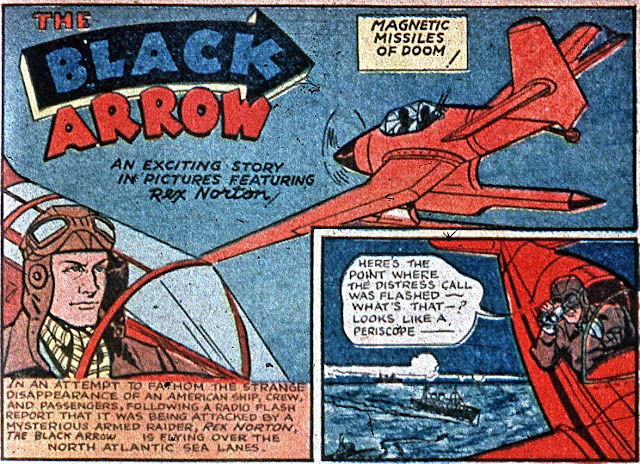
    the Black Arrow:

    Black Arrow, aka Rex Norton, is a detective/pilot, ho-hum. As per standard he has a great codename. (Green Giant Comics 001, 1940)

    the Researcher:

    A dapper super-scientist armed with x-ray flashlights, paralysis-inducing walking sticks and mind-reading rays. Perhaps the most charming thing about him is that everyone from his enemies to his friends to his lab assistant/love interest refer to him solely as “the Researcher.” (Green Giant Comics 001, 1940)

    the Green Mask:

    The Green Mask started out in Mystery Men Comics as your standard Green Hornet or Crimson Avenger style masked vigilante: capable with his fists and with a gun but otherwise an ordinary if unnamed human man, believed by the police and the underworld to actually be a crook and thus hunted by both, the works. 

    After about a year and a half, he got a bit of a revamp: the Green Mask is now Michael Shelby, son of Senator Shelby, enemy of crime. In an attempt to prevent the Senator from introducing a law that would make crime illegal, gangsters gun him down and shoot up Michael in the process. Lucky for him, family friend Professor Lascomb is present and has a healing vita-ray machine at his disposal – Michael’s life is saved and as happy side effect he is given the power of flight and some ill-defined enhanced physical abilities. His crimefighting career is much the same as before but without the ire of the police. 

    (Like Fox Features’ other big non-Blue Beetle heroes Samson and the Flame, in 1941 the Green Mask gets a bit more of a supporting cast, in his case wealthy socialite Olivia Tracy and her bumbling chauffeur Peters. Like Samson and the Flame this didn’t save him from oblivion when Fox had its troubles in 1942-1943 but unlike them he did return eventually. Kind of) (Mystery Men Comics 001, 1939/ Green Mask v1 001, 1940)

    Domino the Miracle Boy:

    In the same story in which the Green Mask becomes super-powered Michael Shelby (and also Michael Shelby becomes the Green Mask) an unnamed youngster is blown up by a grenade and must be healed by Professor Lascomb’s vita-ray. This youth was called Don (no last name forthcoming) and wasn’t just a blown-up teen but a blown-up teen orphan and so was summarily adopted by Michael Shelby. Domino’s powers are a little less extensive than the Green Masks, as Prof Lascomb foolishly fixed the vita-ray machine’s short circuit in between the two being treated, the main upshot of which is that Domino doesn’t seem to be able to fly but rather gets around on a rope tied to a boomerang. (Green Mask Comics v1 001, 1940)

    Update 1941

  • MINOR SUPER-VILLAIN 513: DOKTOR KARNO AND SIMBA

    (Blue Bolt v2 001, 1941)

    Twelve issues into the story of Dick Cole, Wonder-Boy, a wrinkle is introduced: another Wonder-Boy! And rather than the usual thing where an evil lab assistant etc. steals Professor Blair’s research for his own use, this story introduces the concept of the double-thought wave. This is a theory that all the times in history that two people have had the same idea at the same time are not as a result of coincidence but rather some sort of psychic connection and thus when Professor Blair had his idea to raise a perfect boy the villainous Doktor Karno in Vienna had it too, and while Blair raises Dick to be a paragon of virtue, Karno is raising his Wonder-Boy Simba to be the perfect criminal.

    This would be a parable of nurture over nature if Simba wasn’t also specified to be the orphan child of two convicted murderers by the very chatty nun that Karno gets him from. As it stands we have two Wonder-Boys, ignorant of one another, one min/maxed for physical prowess and one with a more morality-heavy build.

    Eventually, Karno and Simba hit the Big Apple and are immediately made aware of Dick’s exploits. Simba has an immediate hatred for Dick so they hit upon the idea of doing some robberies while dressed as him – frame your rival/ make a few bucks at the same time!

    The first hint of a rift in the Doktor Karno/ Simba team come when Simba is so taken with Dick Cole’s military school uniform that he insists on joining the school himself.

    Meanwhile, Dick is subjected to torture by the local idiot cops until they bother to check his alibi and learn that it is watertight. His initial effort having failed, Simba settles in at Farr Military Academy in what amounts to a bully role with occasional forays into crime with Doktor Karno. In both capacities he regularly gets beaten up by Dick Cole.

    Eventually, one of those beatings must have knocked something loose, because Simba realizes that what he really wants is not to destroy Dick Cole but befriend him. 

    To that end, Simba tries to reform but Karno blackmails him into one last job, with the clear implication that this will continue ad nauseam. Simba confesses to Dick who helps him go straight – he’s put on probation in the school’s care and Karno is arrested. A happy ending for all!

    BUT HOLD ON KARNO GETS OUT and uses brain surgery to return Simba to his former amoral state!

    Simba is almost doomed to be Karno’s criminal tool forever but lucky for him Dick gets word, stops him from stealing a mess of radium and forces Karno reverse the operation. Karno is sent packing and the next time he’s heard from it’s because he’s died. Finally a happy ending for everyone! Except Doktor Karno!

    Going forward in the Dick Cole strip, Simba is just part of the gang – I just checked and he’s in Blue Bolt v10 002, the final issue of the series. Just a second super-powered boy palling around with the first one, though given Novelty Press’ commitment to removing all elements of unreality from their comics Simba is eventually just a regular guy with a very weird backstory. Still, it’s all very wholesome, although my Been On the Internet Too Much sense tells me that if it were a thing today I’ll bet the shippers would have their filthy mitts all over its unintentional homoeroticism.

  • MINOR SUPER-VILLAIN 513: DOKTOR KARNO AND SIMBA

    (Blue Bolt v2 001, 1941)

    Twelve issues into the story of Dick Cole, Wonder-Boy, a wrinkle is introduced: another Wonder-Boy! And rather than the usual thing where an evil lab assistant etc. steals Professor Blair’s research for his own use, this story introduces the concept of the double-thought wave. This is a theory that all the times in history that two people have had the same idea at the same time are not as a result of coincidence but rather some sort of psychic connection and thus when Professor Blair had his idea to raise a perfect boy the villainous Doktor Karno in Vienna had it too, and while Blair raises Dick to be a paragon of virtue, Karno is raising his Wonder-Boy Simba to be the perfect criminal.

    This would be a parable of nurture over nature if Simba wasn’t also specified to be the orphan child of two convicted murderers by the very chatty nun that Karno gets him from. As it stands we have two Wonder-Boys, ignorant of one another, one min/maxed for physical prowess and one with a more morality-heavy build.

    Eventually, Karno and Simba hit the Big Apple and are immediately made aware of Dick’s exploits. Simba has an immediate hatred for Dick so they hit upon the idea of doing some robberies while dressed as him – frame your rival/ make a few bucks at the same time!

    The first hint of a rift in the Doktor Karno/ Simba team come when Simba is so taken with Dick Cole’s military school uniform that he insists on joining the school himself.

    Meanwhile, Dick is subjected to torture by the local idiot cops until they bother to check his alibi and learn that it is watertight. His initial effort having failed, Simba settles in at Farr Military Academy in what amounts to a bully role with occasional forays into crime with Doktor Karno. In both capacities he regularly gets beaten up by Dick Cole.

    Eventually, one of those beatings must have knocked something loose, because Simba realizes that what he really wants is not to destroy Dick Cole but befriend him. 

    To that end, Simba tries to reform but Karno blackmails him into one last job, with the clear implication that this will continue ad nauseam. Simba confesses to Dick who helps him go straight – he’s put on probation in the school’s care and Karno is arrested. A happy ending for all!

    BUT HOLD ON KARNO GETS OUT and uses brain surgery to return Simba to his former amoral state!

    Simba is almost doomed to be Karno’s criminal tool forever but lucky for him Dick gets word, stops him from stealing a mess of radium and forces Karno reverse the operation. Karno is sent packing and the next time he’s heard from it’s because he’s died. Finally a happy ending for everyone! Except Doktor Karno!

    Going forward in the Dick Cole strip, Simba is just part of the gang – I just checked and he’s in Blue Bolt v10 002, the final issue of the series. Just a second super-powered boy palling around with the first one, though given Novelty Press’ commitment to removing all elements of unreality from their comics Simba is eventually just a regular guy with a very weird backstory. Still, it’s all very wholesome, although my Been On the Internet Too Much sense tells me that if it were a thing today I’ll bet the shippers would have their filthy mitts all over its unintentional homoeroticism.

  • MINOR SUPER-HERO ROUND-UP 006

    MINOR SUPER-HERO ROUND-UP 006

    Minor super-heroes need to be rounded up now and then.

    Blackstone the Magician: 

    There are a fair number of comic versions of real life people: movie cowboys by the dozen, big game tracker Clyde Beatty a couple of times, etc. Not too many of them quite cross over into the super-hero side of things, but here we have magician Harry Blackstone Sr, who absolutely did (Blackstone is also a great example of someone who was at one point wildly famous and has now receded far enough from the public consciousness that you might not have heard of him unless you’re really into the Dresden Files).

    Blackstone’s adventures fall more into the Action-Packed World Travel to Places Where Ethnics Live category of comics, with the gimmick that he uses stage magic to overcome various obstacles. But stage magic in a controlled environment using your own props and ad hoc stage magic using random items out in the world are different things, comic! (Super-Magic Comics 001, 1941)

    Black Fury:

    Rex King is an adventurer who spares the life of a panther in the jungles of Borneo because it has a white star marking on its throat. Later, that same panther saves Rex from a leopard attack and he takes this as a some grand life lesson about how animals can be full of humanity while men are bestial – long story short, he dresses up like something halfway between Black Condor and Wildcat and teams up with the panther (now named Kato) to beat up evil. (Super-Magic Comics 001, 1941)

    the Blue Bolt:

    Harvard University student Fred Parrish had the misfortune to be struck by lightning twice in the same storm, the second time while he was attempting to fly his light aircraft for help. Lucky for him, he crashed near the underground lair of Doctor Bertoff, a scientist looking for just such a lightning-charged person to experiment on and empower to fight in his ongoing war of Bertoff’s land of Deltos with the Green Sorceress and her kingdom of Voltor (later sumply “Bertoff’s Scientific City” vs “the Green Kingdom”).

    Blue Bolt was a willing conscript in this war, although he tempered Bertoff’s bloodthirstiness somewhat by seeking to reform the Green Sorceress rather than kill her outright, destroy her kingdom and salt the earth. This could be traced to a “don’t hit girls 1940s sense of fair play and also because he had the hots for her.

    Up to Blue Bolt v1 010 the Blue Bolt comic was written by Joe Simon and drawn by Jack Kirby and it was full of all kinds of crazy fun sci-fi malarky. Sadly, the instant they left to create Captain America it all went out the window and Blue Bolt became a regular-syle super-hero fighting Nazis on the boring old surface of the planet.

    For a few issues, Blue Bolt follows his kid brother Kip Parrish around as he serves with the RAF but this gets boring after a while and he heads back to the States. Once the US enters the war he ditches the costume entirely and seemingly forgets that he has super-powers and becomes a regular-style soldier with the unusual name Blue Bolt. Ho hum.

    This, by the way, is part of a pattern with the good folks at Novelty Press. They had it in their heads that their readers didn’t want stories that were “too fantastic” and this was reinforced by their letters page which every month featured missives from little killjoys asking for more boy inventors and fewer giant robots. I assume that these kids grew up to be the people hectoring DC every time Batman cracked a joke in the 60s and 70s and that their children form the vanguard of the “gritty realism” movement.

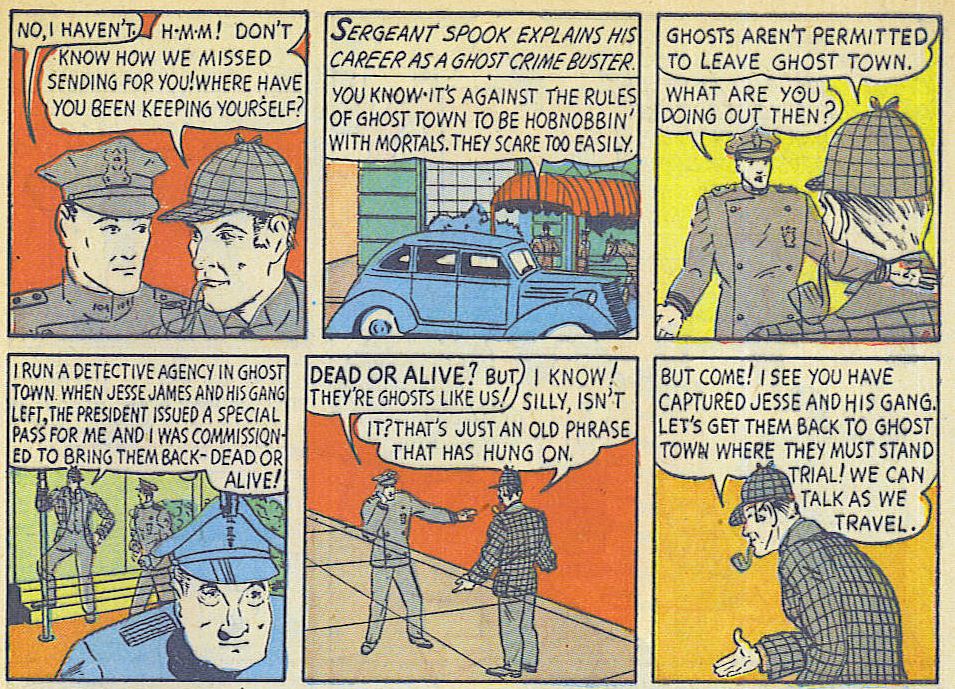
    Sergeant Spook:

    Sergeant Spook here started out as a cop already named Sergeant Spook in a clear case of nominative determinism. After blowing himself up with a carelessly placed pipe in perhaps the least dramatic origin of any of the surprisingly large number of dead police officers to return as undead super-heroes, he basically just carries on as normal. He’s intangible and invisible, per regular ghost rule, but can interact with the material world just fine. (Blue Bolt v1 001)

    Then, in Blue Bolt v1 006 Sergeant Spook meets legally-distinct-from-Sherlock-Holmes ghost detective Dr Sherlock, who informs him that not only is he not unique but that there is a large community of ghosts that he is flouting the rules of by for instance beating the tar out of gangsters who can neither see nor touch him. He relocates to Ghost Town and becomes the de facto troubleshooter of its President, George Washington until rounding up the ghosts of dead troublemakers begins to get stale, at which point Spook heads back to the mortal world to deal with human/ghost conflicts.

  • MINOR SUPER-VILLAIN 354: THE MASKED MAN

    (Master Comics 015, 1941)

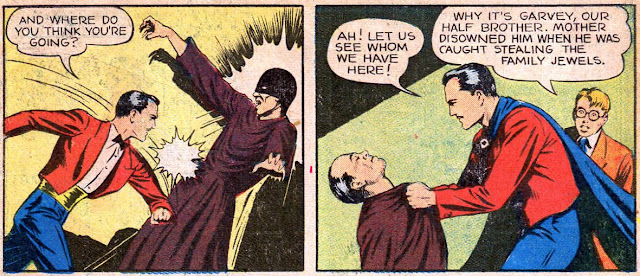
    This really illustrates how the life of a mysterious adventurer is different from that of the rest of us: while driving through Florida, Zoro the Mystery Man stops at a random mansion, is rebuffed when he seeks admittance, and decides to snoop around. While you or I might discover, say, a private birthday party or merely a normal family who don’t particularly want to entertain every stranger who knocks on their door, Zoro instead finds a masked figure who is busily mutating the mansions inhabitants into ape-men. I guess once it happens to you a couple of times you just get an instinct for it?

    Hi-jinks of course ensue, culminating in the revelation that the culprit is Garvey, the black sheep of the family who presumably chose the ape-man route of seeking revenge because it was cooler than merely shooting up the joint. The point is, his name is Garvey Rantrill.