The Curse of Skeleton Munroe

Category: judge and jury revenge killer

  • MINOR SUPER-VILLAIN 504: PROFESSOR X

    (Blue Bolt v1 005, 1940)

    Professor X has two of my favourite qualities in a minor super-villain: a famous name and a prior history. The first is the same kind of fun as when my friend named his cat after me. “What do you mean Professor X keeps getting up on the counter to steal ham?”

    I really love his Prohibition-Era villainy as well, particularly as I had it in my head that he specifically was a bootlegger and thus that all of his great inventions were in service of that – dirigibles full of Canadian whiskey? The axe-proof barrel? The mighty Beer-Bot? Fun stuff. The suicide vest, by contrast is a bit much and not particularly fun, but does establish his bona fides as a legitimate threat.

    Prof. X is on a classic Judge and Jury Revenge Killer tear, targeting Hogan, the cop who brought him in and Johnson, the lawyer who put him away, who since then has become the District Attorney of Centro and close personal friend of local super-hero Sub-Zero.

    Due to this last fact Professor X is forced to turn his genius to the creation of anti-Sub-Zero weaponry, including cold-proof cars, an unfreezable gun that fires superheated bullets and his iconic costume which – you guessed it – is insulated  and renders him immune to Sub-Zero’s freezing powers. And he almost manages to beat Sub-Zero! His only mistake is in having uninsulated water pipes in his secret lair and leads to him being sent to jail inside a large block of ice.

    Professor X returns in the next issue in an attempt to finish getting revenge on DA Johnson as well as new target Sub-Zero (he also tries to kill Sub-Zero’s girlfriend Mary but I don’t think he has a specific grudge against her), and this time he’s accompanied by a costumed henchman named Rat. Once again he very nearly pulls it off but this time his fatal flaw is a lot more fatal, as he misjudges a jump during his escape and does a header out a fourth story window. An ignominious end to be sure.

    JUDGE AND JURY REVENGE KILLER SCORE: 1/3

    But death is not the end for Professor X! Blue Bolt v1 007 features a gambler named Rocky Garret who has acquired the Professor’s anti-Sub-Zero tech as insurance against interference in his baseball-fixing scheme (and it’s a good idea for him to do so, as his scheme is Not Very Good – a lot of it is literally just putting the wrong numbers on the scoreboard which… isn’t good.  It’s a bad plan.)

    Sadly this is it as far as Professor X’s legacy goes. I was kind of hoping that Sub-Zero would be confronted with a guy in a mesh bodysuit every now and again going forward, but alas, it was not meant to be.

  • MINOR SUPER-VILLAIN 492: THE BLUE DEATH KILLER

    (Big Shot Comics 006, 1940)

    Someone is killing old policemen! And furthermore, they’re doing it in such a way that their skin is tinted blue as they die! Unsurprisingly, this ends up being called the Blue Death. But Who is administering it, and why?

    It’s a short story, so we find out pretty quickly that the culprit is one Doctor Swanson and he’s getting revenge on the eight police officers who arrested him twenty-three years earlier, using special arsenic/ phosphorous/ radium darts. What was he arrested for? What is he a doctor of? These questions are not answered before he is killed in a shootout with gunslinging District Attorney Tom Kerry.

    Spotlight On: the article on Swanson’s initial arrest including the partial text “… throat cut… eyes… gouged out… tongue… pulled out…” It really was a heck of an arrest.

    JUDGE AND JURY ARRESTING OFFICER REVENGE KILLING SCORE: 3/8

  • MINOR SUPER-VILLAIN 372: THE GHOST OF TRIGGER DANIELS

    (More Fun Comics 063, 1941)

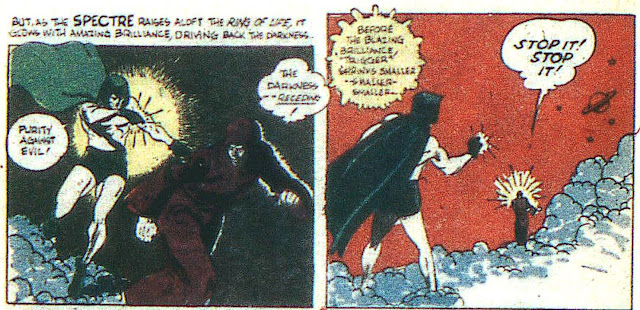
    Trigger Daniels is a hitman in the employ of gang boss Bugs O’Leary who gets sent up for the murder of a local philanthropist and swears revenge on all who had a part in his fate just before being executed. This is a pretty standard setup to a comic book story and usually involves  lot of faked deaths and/or secret twins and/or scientists with cashflow problems and innovative ideas about brain transplants/ reviving the dead. Trigger Daniels stands out because he represents the first time I have encountered such a person just… coming back as a ghost. I’m sure it’s happened in other comics but I do not recall any examples.

    And he doesn’t just come back as a regular-style ghost either! No, he’s a Spectre- style “earth-bound spirit” with ghost powers sufficient to take out the average human. Golden Age Spectre comics never really flesh out the hows and whys of ghosts so it’s unclear if they all have powers or if Daniels is special somehow. He does have the ability to cloak himself in the “powers of darkness” in order to escape from the Spectre, which might point to some sort of grander evil backing him up, but if it does exist there are no further indications.

    In any case, the “powers of darkness” trick works only once as the second time Daniels tries it the Spectre remembers that he has the Ring of Life, mystical multitool that no ghost should leave home without. Daniels is swiftly banished or destroyed utterly.

    JUDGE AND JURY REVENGE KILLER SCORE: 3/5 –  Trigger Daniels set himself a fairly reasonable target and even managed to get his old gang boss, the prosecutor and the jury foreman but ultimately ran up against the fact that one of his intended victims was Jim “the Spectre” Corrigan and ghost or no ghost that’s a hard task to accomplish.

  • MINOR SUPER-VILLAIN 372: THE GHOST OF TRIGGER DANIELS

    (More Fun Comics 063, 1941)

    Trigger Daniels is a hitman in the employ of gang boss Bugs O’Leary who gets sent up for the murder of a local philanthropist and swears revenge on all who had a part in his fate just before being executed. This is a pretty standard setup to a comic book story and usually involves  lot of faked deaths and/or secret twins and/or scientists with cashflow problems and innovative ideas about brain transplants/ reviving the dead. Trigger Daniels stands out because he represents the first time I have encountered such a person just… coming back as a ghost. I’m sure it’s happened in other comics but I do not recall any examples.

    And he doesn’t just come back as a regular-style ghost either! No, he’s a Spectre- style “earth-bound spirit” with ghost powers sufficient to take out the average human. Golden Age Spectre comics never really flesh out the hows and whys of ghosts so it’s unclear if they all have powers or if Daniels is special somehow. He does have the ability to cloak himself in the “powers of darkness” in order to escape from the Spectre, which might point to some sort of grander evil backing him up, but if it does exist there are no further indications.

    In any case, the “powers of darkness” trick works only once as the second time Daniels tries it the Spectre remembers that he has the Ring of Life, mystical multitool that no ghost should leave home without. Daniels is swiftly banished or destroyed utterly.

    JUDGE AND JURY REVENGE KILLER SCORE: 3/5 –  Trigger Daniels set himself a fairly reasonable target and even managed to get his old gang boss, the prosecutor and the jury foreman but ultimately ran up against the fact that one of his intended victims was Jim “the Spectre” Corrigan and ghost or no ghost that’s a hard task to accomplish.

  • MINOR SUPER-VILLAIN 359: THE UNHOLY THREE

    (Master Comics 017-019, 1941)

    The Unholy Three! A little guy (Nosey), a huge guy (Brutus) and a gorilla (Herbert)!

    Oh and of course we must not forget the fourth member of the Unholy Three, their boss “Doctor” J. Twiddley Fairchild (quotation marks his). Details in the actual story are sketchy but it seems as if Fairchild was jailed for larceny, escaped, assembled the other three as his minions and set out to get revenge on those who were responsible for his imprisonment – in other words an old fashioned Judge and Jury Revenge Killing scheme.

    This is where things get a bit annoying for me personally. JaJRK schemes are quantifiable based on the number of attempted slayings divided by the number of successful ones. The problem is that while we know that the Unholy Three end up killing all but one of their targets we do not in fact have any idea of how many targets there were – it’s more than three but up to something like twenty+ if the defense team and witnesses are included.

    Sadly then, JUDGE AND JURY REVENGE KILLING SCORE: n-1/n

    The Unholy Three (all four of them) end up getting caught by Bulletman and Bulletgirl before managing to finish off the last of their targets, but someone at Master Comics must have liked them because they returned for a two-issue story. Too bad for J. Twiddley Fairchild: he didn’t make it out of the initial jailbreak alive. Leadership of the group passed to Nosey and Bulletman became the new target for revenge.

    The actual action is whatever – the Unholy Three kidnap Bulletgirl and try to kill them both with a deathtrap and the second part opens with Bulletman thinking that Bulletgirl has died while the Unholy Three think that Bulletman has. This doesn’t really go anywhere interesting.

    Ultimately the Three attempt to flee the country and Bulletman kicks them off a cliff to their demise.

    OR DOES HE? Because the Unholy Three are collectively our second villain to be resurrected off-panel in time to sign the Crime Exchange petition. Like Mr Murder they never appear again but just knowing that two guys and a gorilla are out there somewhere is enough for me.

  • MINOR SUPER-VILLAIN 335: THE THREAT

    (All-Flash 002, 1941) 

    The Threat is an example of a type of morality tale that was very popular in 40s and 50s comic books but never really went out of style: a tale of promise squandered in service to a life of crime. In this case, the subject is a crook named Tough Joe Connor, who swears revenge on Jim Kelley, the prosecutor who sent him to jail for ten years. 

    My summarizing powers are not up to this task, ergo, a timeline:

    1911 CE:

    -Jim Kelley sends Tough Joe Connor to jail. Connor swears revenge.

    -believing that Kelley got the better of him because he was more clever, Connor devotes himself to study.

    1917 CE:

    -Connor has become a model prisoner. He is a qualified lawyer, doctor and research scientist specializing in chemistry and physics. He is paroled 4 years early. On the outside, he is already wealthy due to research he did in prison.

    -Connor goes to visit Kelley. Ostensibly a good will visit, it is actually in order to provide an alibi: when thugs he has hired burst in and steal Kelley’s newborn baby, Connor takes a carefully choreographed bullet to the arm while “attempting to stop them”.

    -Connor meets and falls in love with a woman named Annie Crowley. They marry and he briefly goes straight (but keeps the baby).

    1923 CE:

    -Annie dies (possibly in childbirth, as they have a daughter). Connor resumes his quest for revenge and begins telling the boy, Roy, that Kelley killed his mother in order to turn him into a weapon against his own father.

    1937 CE:

    -Connor has consolidated underworld power in the region, becoming the Threat. He makes his first attempt on the life of now-Mayor Jim Kelley but both his criminal activities and his murder attempt are disrupted by the Flash. Roy heads to the family farm to lie low with his step-sister Ann.

    1941 CE:

    -The Threats’s power continues to grow. A second attempt on Mayor Kelley’s life ends with Joe Connor back in prison as one of his own henchmen.

    -Connor escapes in an old lye barrel. Severely burned, missing an eye, he adopts a series of new identities: an unnamed garage owner, plastic surgeon Doctor Cravath, mechanic Jake Boles. He finds Roy hiding out in the country and together they make an attempt on gubernatorial candidate Kelley’s life but once more the Flash steps in.

    -Connor makes one last push to kill now-Governor Kelley: he breaks Roy out of prison and arranges a big confrontation. All is for naught, as the Flash, Joan Williams and Ann Connor have pieced together the clues and revealed to Roy his real parentage. Faced with this and the futility of his life of revenge, Connor smokes a poisoned cigarette and dies.

    -Roy and Ann are now in love, which happens in these kinds of Secret Step-Sibling situations an unsettling amount.

    There are several interesting things about this sequence of events. The first, as seen above, is that young Roy, at age 5, chooses the name Roy Revenge for himself as part of his vendetta and keeps using it into his mid-twenties. It is, frankly, great – it’s exactly the kind of henchman name that a villain called the Threat would assign in a campy 60s comic, but earnestly, in the 40s.

    The second involves the fact that at this point Keystone City is not a thing and the Flash explicitly lives in New York City, which means that Jim Kelley was presumably Mayor of NYC (eroding La Guardia’s term by about four years) and Governor of New York (impacting Herbert H. Lehman).

    Meanwhile, the chronology of the story is fairly tentative – the actual timeframes are correct, but the dates are speculative. The crucial point is that four-year gap between Roy Revenge”s first attempt on Kelley’s life and the remainder of the story: as presented the bulk of the story is set in 1941, the year of publication, but the Flash is running around three years earlier than previously established. BUT! if we start the story in 1941 the bulk of the action takes place in 1945, which is even more temporally messy. Fun stuff for the old timeline!

    The Threat, ultimately, is a bit of a nothing villain but I like him nonetheless. Too bad about the wasted life, better luck next time, Joe.

    JUDGE AND JURY REVENGE KILLER SCORE: 0/1 

    (I know, he’s focused on the lawyer, but “judge and jury and prosecutor revenge killer” is just too long and even then someone is going to go after the witnesses and bailiffs. Better to be succinct)

  • MINOR SUPER-VILLAIN 335: THE THREAT

    (All-Flash 002, 1941) 

    The Threat is an example of a type of morality tale that was very popular in 40s and 50s comic books but never really went out of style: a tale of promise squandered in service to a life of crime. In this case, the subject is a crook named Tough Joe Connor, who swears revenge on Jim Kelley, the prosecutor who sent him to jail for ten years. 

    My summarizing powers are not up to this task, ergo, a timeline:

    1911 CE:

    -Jim Kelley sends Tough Joe Connor to jail. Connor swears revenge.

    -believing that Kelley got the better of him because he was more clever, Connor devotes himself to study.

    1917 CE:

    -Connor has become a model prisoner. He is a qualified lawyer, doctor and research scientist specializing in chemistry and physics. He is paroled 4 years early. On the outside, he is already wealthy due to research he did in prison.

    -Connor goes to visit Kelley. Ostensibly a good will visit, it is actually in order to provide an alibi: when thugs he has hired burst in and steal Kelley’s newborn baby, Connor takes a carefully choreographed bullet to the arm while “attempting to stop them”.

    -Connor meets and falls in love with a woman named Annie Crowley. They marry and he briefly goes straight (but keeps the baby).

    1923 CE:

    -Annie dies (possibly in childbirth, as they have a daughter). Connor resumes his quest for revenge and begins telling the boy, Roy, that Kelley killed his mother in order to turn him into a weapon against his own father.

    1937 CE:

    -Connor has consolidated underworld power in the region, becoming the Threat. He makes his first attempt on the life of now-Mayor Jim Kelley but both his criminal activities and his murder attempt are disrupted by the Flash. Roy heads to the family farm to lie low with his step-sister Ann.

    1941 CE:

    -The Threats’s power continues to grow. A second attempt on Mayor Kelley’s life ends with Joe Connor back in prison as one of his own henchmen.

    -Connor escapes in an old lye barrel. Severely burned, missing an eye, he adopts a series of new identities: an unnamed garage owner, plastic surgeon Doctor Cravath, mechanic Jake Boles. He finds Roy hiding out in the country and together they make an attempt on gubernatorial candidate Kelley’s life but once more the Flash steps in.

    -Connor makes one last push to kill now-Governor Kelley: he breaks Roy out of prison and arranges a big confrontation. All is for naught, as the Flash, Joan Williams and Ann Connor have pieced together the clues and revealed to Roy his real parentage. Faced with this and the futility of his life of revenge, Connor smokes a poisoned cigarette and dies.

    -Roy and Ann are now in love, which happens in these kinds of Secret Step-Sibling situations an unsettling amount.

    There are several interesting things about this sequence of events. The first, as seen above, is that young Roy, at age 5, chooses the name Roy Revenge for himself as part of his vendetta and keeps using it into his mid-twenties. It is, frankly, great – it’s exactly the kind of henchman name that a villain called the Threat would assign in a campy 60s comic, but earnestly, in the 40s.

    The second involves the fact that at this point Keystone City is not a thing and the Flash explicitly lives in New York City, which means that Jim Kelley was presumably Mayor of NYC (eroding La Guardia’s term by about four years) and Governor of New York (impacting Herbert H. Lehman).

    Meanwhile, the chronology of the story is fairly tentative – the actual timeframes are correct, but the dates are speculative. The crucial point is that four-year gap between Roy Revenge”s first attempt on Kelley’s life and the remainder of the story: as presented the bulk of the story is set in 1941, the year of publication, but the Flash is running around three years earlier than previously established. BUT! if we start the story in 1941 the bulk of the action takes place in 1945, which is even more temporally messy. Fun stuff for the old timeline!

    The Threat, ultimately, is a bit of a nothing villain but I like him nonetheless. Too bad about the wasted life, better luck next time, Joe.

    JUDGE AND JURY REVENGE KILLER SCORE: 0/1 

    (I know, he’s focused on the lawyer, but “judge and jury and prosecutor revenge killer” is just too long and even then someone is going to go after the witnesses and bailiffs. Better to be succinct)

  • SUPER-VILLAIN YEARBOOK: THE JOKER 1940

    What did the Joker get up to in 1940?

    1. Batman Comics v1 001, ‘Untitled’ **first appearance**

    The Joker really hits the ground running in his first crime-outing. He establishes his character – prideful, mercurial and on-theme – and methods that are still in his repertoire to this day

    He indulges in the old standard of warning the police ahead of time, then killing his target and stealing their named gems (uh, this is a personal term for any gem famous enough to have a name, like the Hope Diamond. they make more frequent appearances in comics than real life, unsurprisingly). Not the most creative of crime sprees by his own eventual standard, but everyone has to start somewhere. He also murders a number of people who challenge him, including a gang boss and a judge who once sent him to jail (a perfect 1/1 judge and jury revenge slaying! Aim low, kids!).

    Also established this adventure: the smiling-death style of Joker Venom, as well as:

    …the classic hideous Joker calling card design.

    But despite racking up an impressive success rate and almost killing both Batman and Robin on several occasions, the Joker ends his first outing in the slammer.

    2. Batman Comics v1 001, ‘The Joker Returns’

    That’s right, the Joker makes his second appearance in the same issue as his first! They knew he was a hot property from the very start!

    After a very dramatic escape from prison and a relocation to his secret cemetery hideout, the Joker settles into his familiar pattern: a taunting message, then theft or the murder of his enemies. In achieving the latter, he employs two of my very favourite deathtraps in comics:

    To bump off the Chief of Police: a sound-activated poison dart launcher concealed in his telephone – and he activates it by shouting his own name real loud! Tremendous style points there.

    The second is just sharpened playing cars with poison on the edges, but again there’s some tremendous style on display in the commitment to the bit of having an entire pack of jokers. Completely worth going around to every gaming supply store in Gotham to buy packs of the same brand of cards.

    A minor point in this adventure is that it highlights that the Joker is primarily a jewel thief, something that I associate with the Golden Age version of the character but that might just be me extrapolating from this issue.

    And finally we have the death of the Joker, truly one of the great on-brand death scenes of all time as he gets stabbed while struggling over a knife with Batman. It was a good run but the Joker is dead.

    OR IS HE???

    3. Batman Comics v1 002, ‘Untitled’

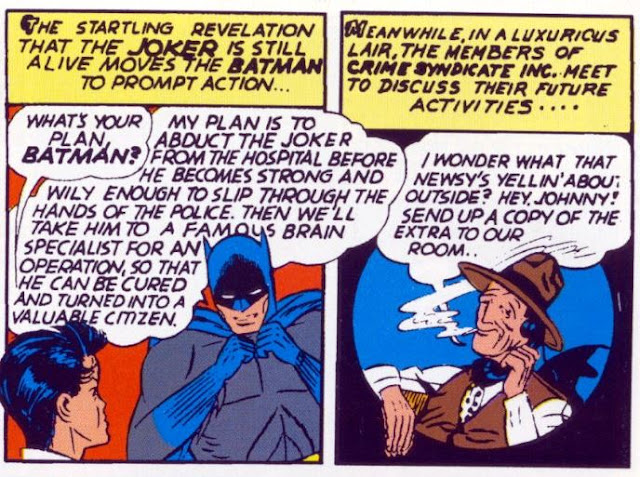
    Since the Joker actually survived the last issue, both Batman and the members of Crime Syndicate Inc  have the same idea: kidnap him while he’s being treated for his injuries, the former for some sort of gruesome lobotomy and the latter as a replacement for their recently deceased leader. More than half of the story is taken up with the dueling Joker kidnappings, after which he predictably betrays the crooks, strikes out on his own and ends up left for dead in a burning castle.

    More interesting to me is that this is the end of a sequence of events that, well, here’s a timeline:

    -Initial Joker crime spree. No time period is specified in the story but it seems a fairly rapid-fire series of crimes. Somewhere between 1 and 2 weeks, we’ll say. Joker is captured.

    -Two days later, Joker escapes. His crime spree resumes at the same pace, with at least two robberies occurring sequentially. Say another 1 to 2 weeks. Joker is seriously injured and rushed to hospital.

    -Crooks spirit Joker away following his treatment. His recovery lasts one week, after which he seemingly dies in a fire.

    What this all adds up to is a situation like Friday the Thirteenth 2 through 4, but whereas that was an astonishingly bloody weekend told over the course of three movies, this is the Joker committing at least 6 high-profile robberies and 13 murders over the course of one to two months! A huge debut for the big guy!

    4. Detective Comics v1 045, ‘The Case of the Laughing Death’

    Predictably, the Joker is not, in fact, dead! He remains alive to this day if you can believe it!

    He has, though, adopted a brand new modus operandi. Perhaps drawing on his brief time with Crime Syndicate Inc, he slips for the first time into an alter ego with the infuriating surname of Rekoj and forms a little gang of his own. Then, after his gang pulls a heist, he robs them as the Joker so that he doesn’t have to split the profits with them. IT’S A DUMB PLAN BUT IT WORKS.

    I’m willing to forgive, but only because of the great deathtraps, and this is a fun one: a record that releases Joker Toxin as it plays, thus killing even as its message is delivered. Insidious!

    At story’s end, the Joker is in the drink, presumed dead. For good? No.

    5. Batman Comics v1 004, ‘The Case of the Joker’s Crime Circus!’

    For his final outing of 1940, the Joker assembles another gang. This time, it’s one of my favourite styles of gang, the circus of crime! They specialize in casing wealthy patrons’ estates and manors and then using their circus skills to rob the various joints.

    Batman being Batman, he pieces together the clues and tracks down the Joker, who ends the adventure in the traditional manner by seemingly plummeting to his death.

    Body Count: at least 14

    End-of-year Status: Presumed Dead

  • SUPER-VILLAIN YEARBOOK: THE JOKER 1940

    What did the Joker get up to in 1940?

    1. Batman Comics v1 001, ‘Untitled’ **first appearance**

    The Joker really hits the ground running in his first crime-outing. He establishes his character – prideful, mercurial and on-theme – and methods that are still in his repertoire to this day

    He indulges in the old standard of warning the police ahead of time, then killing his target and stealing their named gems (uh, this is a personal term for any gem famous enough to have a name, like the Hope Diamond. they make more frequent appearances in comics than real life, unsurprisingly). Not the most creative of crime sprees by his own eventual standard, but everyone has to start somewhere. He also murders a number of people who challenge him, including a gang boss and a judge who once sent him to jail (a perfect 1/1 judge and jury revenge slaying! Aim low, kids!).

    Also established this adventure: the smiling-death style of Joker Venom, as well as:

    …the classic hideous Joker calling card design.

    But despite racking up an impressive success rate and almost killing both Batman and Robin on several occasions, the Joker ends his first outing in the slammer.

    2. Batman Comics v1 001, ‘The Joker Returns’

    That’s right, the Joker makes his second appearance in the same issue as his first! They knew he was a hot property from the very start!

    After a very dramatic escape from prison and a relocation to his secret cemetery hideout, the Joker settles into his familiar pattern: a taunting message, then theft or the murder of his enemies. In achieving the latter, he employs two of my very favourite deathtraps in comics:

    To bump off the Chief of Police: a sound-activated poison dart launcher concealed in his telephone – and he activates it by shouting his own name real loud! Tremendous style points there.

    The second is just sharpened playing cars with poison on the edges, but again there’s some tremendous style on display in the commitment to the bit of having an entire pack of jokers. Completely worth going around to every gaming supply store in Gotham to buy packs of the same brand of cards.

    A minor point in this adventure is that it highlights that the Joker is primarily a jewel thief, something that I associate with the Golden Age version of the character but that might just be me extrapolating from this issue.

    And finally we have the death of the Joker, truly one of the great on-brand death scenes of all time as he gets stabbed while struggling over a knife with Batman. It was a good run but the Joker is dead.

    OR IS HE???

    3. Batman Comics v1 002, ‘Untitled’

    Since the Joker actually survived the last issue, both Batman and the members of Crime Syndicate Inc  have the same idea: kidnap him while he’s being treated for his injuries, the former for some sort of gruesome lobotomy and the latter as a replacement for their recently deceased leader. More than half of the story is taken up with the dueling Joker kidnappings, after which he predictably betrays the crooks, strikes out on his own and ends up left for dead in a burning castle.

    More interesting to me is that this is the end of a sequence of events that, well, here’s a timeline:

    -Initial Joker crime spree. No time period is specified in the story but it seems a fairly rapid-fire series of crimes. Somewhere between 1 and 2 weeks, we’ll say. Joker is captured.

    -Two days later, Joker escapes. His crime spree resumes at the same pace, with at least two robberies occurring sequentially. Say another 1 to 2 weeks. Joker is seriously injured and rushed to hospital.

    -Crooks spirit Joker away following his treatment. His recovery lasts one week, after which he seemingly dies in a fire.

    What this all adds up to is a situation like Friday the Thirteenth 2 through 4, but whereas that was an astonishingly bloody weekend told over the course of three movies, this is the Joker committing at least 6 high-profile robberies and 13 murders over the course of one to two months! A huge debut for the big guy!

    4. Detective Comics v1 045, ‘The Case of the Laughing Death’

    Predictably, the Joker is not, in fact, dead! He remains alive to this day if you can believe it!

    He has, though, adopted a brand new modus operandi. Perhaps drawing on his brief time with Crime Syndicate Inc, he slips for the first time into an alter ego with the infuriating surname of Rekoj and forms a little gang of his own. Then, after his gang pulls a heist, he robs them as the Joker so that he doesn’t have to split the profits with them. IT’S A DUMB PLAN BUT IT WORKS.

    I’m willing to forgive, but only because of the great deathtraps, and this is a fun one: a record that releases Joker Toxin as it plays, thus killing even as its message is delivered. Insidious!

    At story’s end, the Joker is in the drink, presumed dead. For good? No.

    5. Batman Comics v1 004, ‘The Case of the Joker’s Crime Circus!’

    For his final outing of 1940, the Joker assembles another gang. This time, it’s one of my favourite styles of gang, the circus of crime! They specialize in casing wealthy patrons’ estates and manors and then using their circus skills to rob the various joints.

    Batman being Batman, he pieces together the clues and tracks down the Joker, who ends the adventure in the traditional manner by seemingly plummeting to his death.

    Body Count: at least 14

    End-of-year Status: Presumed Dead

  • MINOR SUPER-VILLAIN 175: THE MAN WITHOUT A FACE

    (Bulletman 002, 1941) 

    Gangster Scar Malone was convicted of murder and sentenced to the electric chair. He swore revenge against the judge and jury, as you do. And once you’ve done that kind of thing, you only have a few options: fake your own death so you can come back as a fake ghost to kill your enemies; arrange for your body to be taken to a scientist or magic man for post execution revival so you can slay your enemies; have your secret twin pose as your vengeful spirit to kill your enemies, or do what Malone opts for: simply escape while on the way from trial to prison, (optionally searing your face off with hot steam while doing so) and come back months later to kill your enemies.

    If I’m to judge (haha) a judge and jury revenge killer’s relative quality, it’s going to be a numbers game – just how many of their self-assigned targets did they manage to take out. Even though he was a master of escape and disguise, the Man Without a Face managed a mere 2/13 or 15% before being thrown off a roof by Bulletman. A poor showing indeed.