The Curse of Skeleton Munroe

Category: Mr Mystic

  • DIVINE ROUND-UP 005

    Once again we add to the scriptures. 

    the Shadowman: 


    Like his predecessor/inspiration Yarko the Great, Mr Mystic also has a semi-friendly/ semi-adversarial relationship with the personification of death. In this case, Death is a guy in a cool suit with a half-cape, and he is called the Shadowman, presumably because of his perpetually-in shadow face.

    The Shadowman’s first couple of appearances cast him as a mysterious stranger who helps Mr Mystic in his battle against various evils (including scientist Ghantse, who the Shadowman seems to work for in his initial appearance). At this point the Shadowman is merely a mysterious man who has a miraculous ability to survive the most deadly of situations.

    In the 17 November 1940 Spirit Section, Mr Mystic ventures into the Land of Mythology on a quest for the Ring of the Gods, which turns out to be held by Death. This version of Death is a traditional Grim Reaper style skeleton in a robe, and he swears vengeance on Mr Mystic for the theft of the ring. 

    The Grim Reaper version of Death is never explicitly tied to the Shadowman, and it’s possible that they were intended to be different in some fundamental way – different aspects of death, perhaps. The Whole Ring of the Gods incident is not brought up by the Shadowman the next time he meets Mr Mystic (1 December 1940), so Mystic might be off the hook for that. It’s a bit of a moot point, however, as this installment of “Mr Mystic” is all about him saving the life of a little girl named Joan Barton, and it allows us to get more of a grip on the Shadowman’s code: he objects to bot murder and life-saving interventions as equally disruptive to the natural order. Mr Mystic now has two threats from Death hanging over him. 

    (this episode also establishes the deal with the Shadowman’s shadowy face: if you look at it sans shadow, you die) 

    The second-to-final Mr Mystic comic of the year (22 December 1940) features the Shadowman’s revenge on Mystic: he is going to seduce/kill his fiance Elena.

    While the Shadowman seems to have access to some sort of primordial seductive power relating to the inevitable entropic march toward the grave, he is not above employing cheap romantic comedy plot devices to drive a wedge between the lovers.

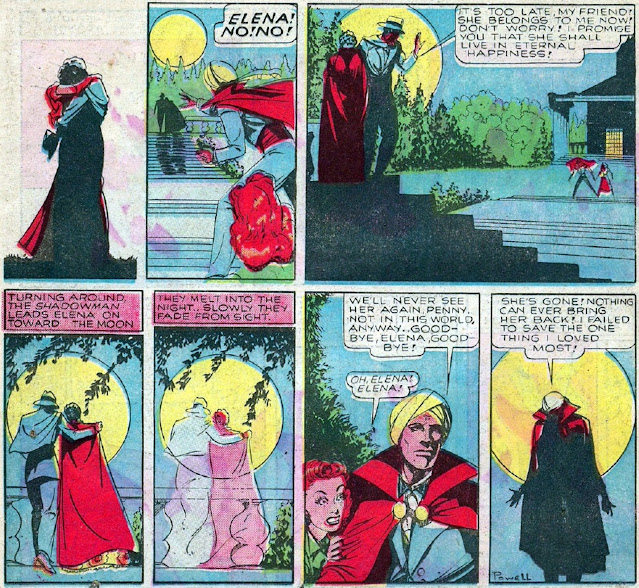
    Death is the inevitable winner of the contest, of course, and Elena goes off with him to… the afterlife? His home? Are they married now or is she just dead? We shall never know, alas, though we will see the Shadowman again.

    God Style: real anthropomorphic personification (The Spirit Section, 22 September, 1940)

    Jwang Tyoy:

    We don’t get a lot of the teachings of Jwang Tyoy beyond the fact that he is the god of a South American “anti-civilization” cult. The focus of the comic is much more focused on the very off-model pterodactyls that the cult leader uses to do he bidding, and for good reason!

    God Style: idol (Shadow Comics v1 004, 1940) 

    Kutu: 

    Kutu, aka Tuku, is possibly a moon god, definitely South American, and has the traditional jewel socketed into his idol for adventurers to steal and get into Big Trouble. 

    God Style: idol (Comics Magazine 002, 1936)  

    Nahapatan: 

    Nahapatan, the Golden Idol, is housed in a hidden Aztec city, where it is the subject of active worship. Does this stop Professor Roberts, his nephew Tim and adventurer Ken Masters from barging in and stealing it to put in Robert’s museum? It does not.

    God Style: idol (Masked Marvel 001, 1940)

  • MINOR SUPER-VILLAIN 817: ELENA

    (The Spirit Section, 9 June, 1940)

    Elena is Mr Mystic’s recurring female foe, the Tigress to his Zatara. Unlike the Tigress, however, Elena isn’t in it for the money but rather as an agent of chaos out to maximize the amount of war and bloodshed in the world, as in her first appearance, in which she is acting as the power behind the throne of fascist dictator Karoly Gore.

    The final confrontation between Elena and Mr Mystic is also the introduction of the concept that two magic users are unable to affect one another via magic, which is foundational to the Mr Mystic mythos and also a pretty good way to make your wizard duels more likely to be fist fights if that’s what you like to draw. Don’t worry about Elena in that last panel – it’s a deceptively short cliff, and Mr Mystic collars her soon after this jump.

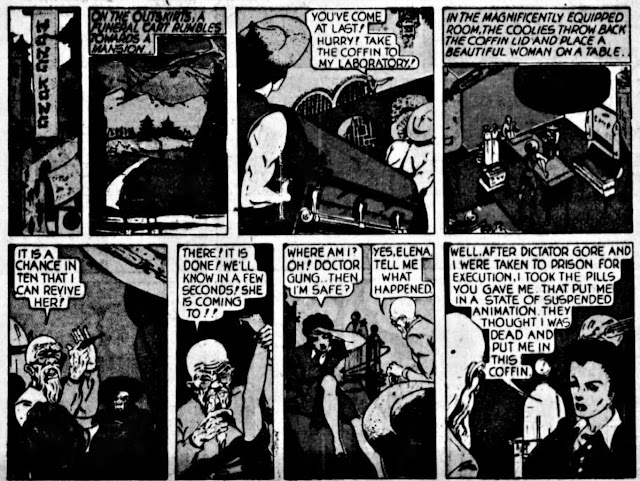
    Though she is set to be executed for her role in Karoly Gore’s administration, Elena escapes by means of some death-feigning pills provided by her old friend Dr Gung, and hopefully it’s the kind of fake death that put you in a coma of some sort because she has to be shipped from Central Europe to Hong Kong before Gung can wake her up and that would be a heckuva long time to stare at the inside of a coffin lid. Though Mr Mystic shows up soon after Elena to harsh the vibe, he focuses a bit more on Dr Gung’s unholy experiments than making sure that she doesn’t get away. Dr Gung WILL RETURN in the next Mad and Criminal Scientist Round-Up.

    Elena returns a few weeks later to interfere in the politics of the… Asian? country of Cadiwa, which is styled as India-ajacent, yes, but whose premier meets up with Elena in Nigeria and so, given the lack of any other geographic hints, I keep wanting to say is in Africa. This appearance marks the beginning of a potential romance between Elena and Mr Mystic, expressed by both when Elena is wounded while trying to escape.

    Budding romance or not, the next time that Mr Mystic pops in to check up on her he finds that she has been up to her old chaotic tricks and has been influencing King Bahroud of Cadiwa to declare war on his neighbours, thus ending centuries of peace. Clearly, this cannot stand. 

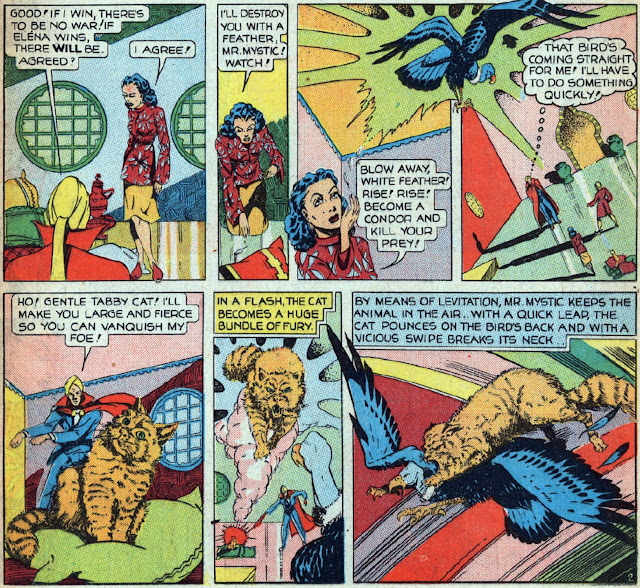
    Mr Mystic and Elena bicker their way into a magical duel, and while I said earlier that magic-users not being able to affect one another with their spells led to a lot of fist fights, that was only a partial truth, because it also leads to this kind of magical battle in which each party summons proxies, such as Mr Mystic’s giant kitty cat, to fight on their behalf. 

    Elena is defeated and reveals that her magic was granted to her by a “Cardin the Terrible” on the condition that she never lose a magical duel. Which she has just done, so bye-bye magical powers. Further, losing her magic causes Elena to turn into a small child.

    Now… there is an important question about this whole situation that is never actually answered: does Elena turn into a child as a part of the “lose a duel; lose your powers” curse as a cheeky little joke by Cardin the Terrible or because she was a child given the form of an adult as part of getting those powers? This is important mainly because Mr Mystic returns her to her adult form at the end of the episode and then they basically immediately become engaged, and it’s a very different situation, depending. 

    Cardin the Terrible himself shows up in the next installment, looking to torture Elena to death for failure, but we don’t learn too much more about him than this classic Bad Boss behaviour. Just why did he send an agent out into the world to spread chaos and war? Not a clue. What is certain however is that Mr Mystic totally murderizes him, which weirdly would indicate that he was less magical than his own protege.

    Elena spends the remainder of 1940 keeping her head down as Mr Mystic’s companion/fiance, though she does spend some time in the future as a captive of the Moon King and almost getting murdered in place of the Goddess of Fire.

    Elena’s run in the Spirit Section and as Mr Mystic’s fiance comes to an end in the second-to-last episode of the year, on 22 December, 1940. Mr Mystic had butted heads with his occasional ally/personification of death/future Divine Round-Up subject the Shadowman a few times in the weeks leading up to this, and the Shadowman’s response was to take away the thing that Mr Mystic loved best, i.e., Elena. There’s some pretty heavy allegory work going on that makes it unclear if Elena has fallen in actual love with the Shadowman and gone to live with him in the afterlife, or if the whole thing is just standing in for her dying and the love that Elena is expressing is just an expression of the natural cycle of life and death. Either way, Mr Mystic is sad, but worry not: he’s standing next to his new love interest Penny Douglas in that second last panel. The man move fast!

    So here’s to Elena, a fun villain and adequate supporting cast member who I hope is somewhere in a loving relationship with Death. Eat your heart out, Thanos.

  • DIVINE ROUND-UP 004

    Can you ever have enough made-up gods? 

    the Goddess of Fire: 

    Crooks Raoul and Victor Ladron hatch a scheme while hiding out on the South Pacific island of Kumoni: since the idol of the local Goddess of Fire looks identical to former super-villain Elena they will engineer her kidnapping, hypnotize her into impersonating the goddess and then kill her to prove that they are more powerful than her and thus deserve to make off with the temple gold. This plan is of course complicated by the fact that Elena is engaged to the nigh-omnipotent super-hero Mr Mystic, and the Ladrons meet a fiery end. 

    God style: idol only (The Spirit Section, 3 November, 1940)

    the Gansha:

    Adam Starr of the Space Legion is on the hunt for space pirate extraordinaire Black Michael, and no mealy-mouthed warning about a “water-god” who has “destroyed all who ventured near his cursed waters” for “untold ages” is going to stop him from searching the Martian canals.

    Starr’s manly skepticism doesn’t pay off this time, as Gansha the Water-God turns out not only to be real but to be a monstrous carnivorous fish that almost devours both him and his submersible without even needing to chew.

    Sadly for monster fans and fish fans alike, Gansha is unceremoniously blown to smithereens when Black Michael attempts to use it as a deathtrap to get rid of Starr without checking to see if he might have a ludicrously overpowered atomic sidearm on his person. Presumably the Martians are happy – the ones who like boat rides and don’t belong to any kind of Gansha-worshipping sect, at least.

    God style: animist (Crash Comics Adventures 003, 1940) 

    Golo:

    We get little in the way of detail on Golo, save that they are worshipped “from Ubangi to the Sudan” and that displaying a Golo fetish can grant safe passage in those areas. And that adventurer Ted Crane thinks it’s all poppycock, of course.

    God style: idol only (Exciting Comics 005, 1940) 

    the Ice Gods: 

    Stuart Taylor and his pals have been time travelling again, and this time they’ve ended up in the clutches of a prehistoric trip at the surprisingly rapid dawn of the last Ice Age, the environmental effects of which have been personified as the malevolent Ice 

    God style: animist (Jumbo Comics 028, 1941)

  • ALIENS AND SO FORTH ROUND-UP 005

    We got your aliens, plus some so forth. 

    Moon Men: 

    The Moon Men of 2050 CE seem to be just another part of the future Solar System society until they enter an alliance with magic super-crook Sarku so that their Moon King Tan Tan can meet his historical crush Elena. This of course brings them into conflict with Mr Mystic, as Elena is his fiance and he’s just not that into her being kidnapped into the future. 

    The Moon Men also have very upsetting feet. (The Spirit Section, 1 September, 1940)

    the Alligator-Men: 

    A lot of the Earth-based entries on the big list of aliens and such that I refer back to to while make these could best be described as “human offshoots,” little pockets of humanity that have developed in isolation until they are something other than regular. I had a little debate about whether to include the Alligator-Men because they didn’t seem other enough, but then I came to my senses. A whole society of guys who live in a cave somewhere in Brazil and dress in what must be wildly smelly lizard man costumes 24/7? Even if in-story they turned out to be a bunch of cosplaying accountants (spoiler: they didn’t) that’s worthy of comment. (Amazing-Man Comics 017, 1940)
    Ape Men: 

    And speaking of isolated populations of weirdos, ape men/ape-men/apemen and other missing link-style hominids are some of the most common. This particular group are from Malaysia and seem to be reasonably chill until Dr Fung and his pal Dan show up while following rumours pointing to the location of a lost heiress. Things get a bit too macho (and the old question of just what “white” means in 40s comics rears its ugly head once more) and Dr Fung and Dan have to shoot their way out. It’s all very rude, frankly. (Wonderworld Comics 005, 1939)

    Ape-Men & Lizard-Men: 

    The Diamond Empire is a hidden civilization probably somewhere in Asia, located in an improbably large inaccessible region hemmed in by mountains – there’s a reason that so many hidden kingdoms are underground, after all. It’s a bit more plausible to have an implausibly large area underground and hidden than as a conspicuous blank spot on a map.

    In any case, the lands around the Diamond Empire are like most other terrae incognitae in genre fiction, in that they are populated with a variety of humanoid civilizations, including Hawkmen, Batmen, and today’s focus, warring nations of Lizard-Men and Ape-Men. The Lizard-Men sadly get the short end of the stick characterization-wise, being sneaking, cowardly ambushers with a uncomfortably horny king, but at least they have very cool faces – just love a black eye with a white pupil. 

    The Lizard-Men get beaten up and pushed in a river by their ancient foes the much less cool Ape-Men who then themselves capture the the Rocket and the Queen of Diamonds. These Ape-Men are just what they are billed as: apelike humans, though the yellow heads and weird dents on top of their skulls set them apart slightly, even if they look dumb. 

    There’s a lot of malarkey involving the Rocket taking on an Ape-Man named Ungar for the role of tribal chief, and we get a glimpse of the Ape-Men’s idea of how a trial by ordeal should work as the Rocket is made to enter the Cave of Horrors to prove his mettle, but eventually the majority of the Ape-Men just end up dumped into a chasm to their dooms. I assume that the Lizard-Men, merely damp, were very smug about this. (Pep Comics 004-005, 1940)

  • MINOR SUPER-VILLAIN 814: SARKU

    (The Spirit Section, 25 August, 1940)

    I’ve mentioned before that the foes faced by magical Golden Age super-heroes break down into roughly three types: 1) regular crooks who are there to be clowned upon, 2) legitimate threats with equivalent magical power of their own and 3) crooks with a little magical power, who provide a Iof a challenge but are ultimately also clowned upon. Sarku is the third type, and has set out, fresh out of prison, to get revenge on those who put him there. Also, like all magic users in “Mr Mystic,” Sarku has an innate resistance to magic that makes even low-level practicioners more of a challenge to Our Hero than they would be to a Zatara or a Yarko.

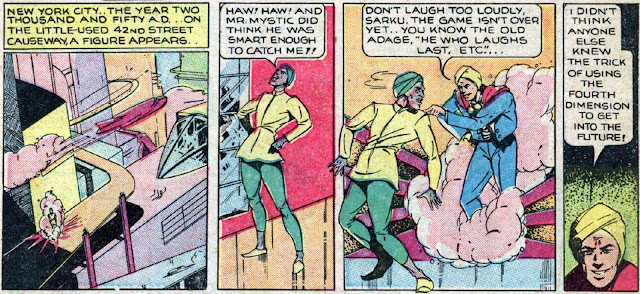
    By the time Mr Mystic has been brought in on the case, Sarku has already murdered the (police?) Commissioner of the unnamed Indian city he was incarcerated in and escaped via some handy teleportation magic. Though Mystic interrupts his attempt on the life of the French Consul, Sarku escapes again, this time into the far future world of 2050 AD.

    (just what had prevented him from time travelling or indeed merely teleporting out of his prison cell over the ten years of his incarceration is not elaborated upon. Perhaps he only just got the knack)

    Sarku does a bit of premature gloating before learning that Mr Mystic can also travel through time, and the two are quickly engaged in a high-speed rocket chase to the Moon. 

    Mystic ends up shooting Sarku down as they approach the Moon’s surface, and he makes the grim choice to pop his corpse into a handy corpse container (originally intended for the evocatively-named by alas never-seen “Moon King’s mummy”) as a sort of general warning to all would-be murderers who might be wandering around on the Moon. That’s it for Sarku!

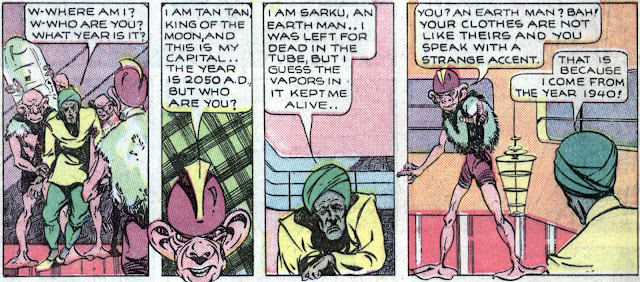
    But perhaps I spoke too soon! Sarku is back in the next “Mr Mystic” installment, and though we don’t get to see any mummies, we are treated to a Moon King, as a not-so-dead Sarku is brought before Tan Tan, King of the Moon by his subjects. It turns out that he wasn’t quite dead when Mr Mystic shoved him in that tube, which is great for him now but horrifying in retrospect.

    Tan Tan turns out to have a weird crush on the (to him) historical figure of Elena, former Mr Mystic villain and current Mr Mystic fiance (stay tuned for her entry), and trades Sarku a space fleet for her.

    Sarku’s attempt to get revenge on the entire population of Earth for a 1930-1940 AD prison sentence that almost nobody in 2050 AD would have been alive at the same time as, let alone had anything to do with, is foiled once again by Mr Mystic, who leaves nothing to chance this time as he socks Sarku out the spaceship’s hatch and into the void of space (Tan Tan, by contrast gets a mere sock in the jaw for his creepy Elena-napping. The perks of royalty, eh?).

    REVENGE KILLER SCORE: 1/2+

  • MINOR SUPER-VILLAIN 811: QUEEN RANA

    MINOR SUPER-VILLAIN 811: QUEEN RANA

    (The Spirit Section, 14 July, 1940)

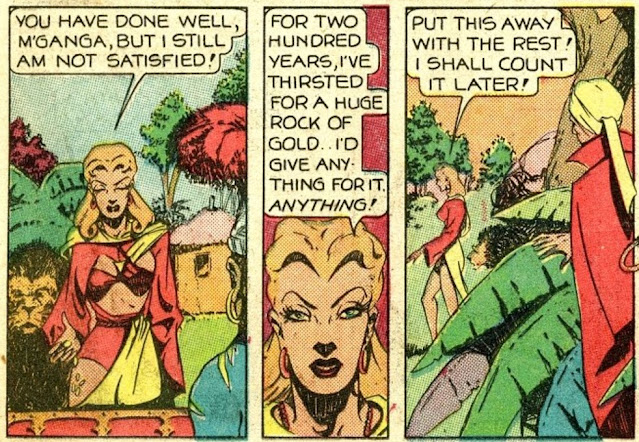
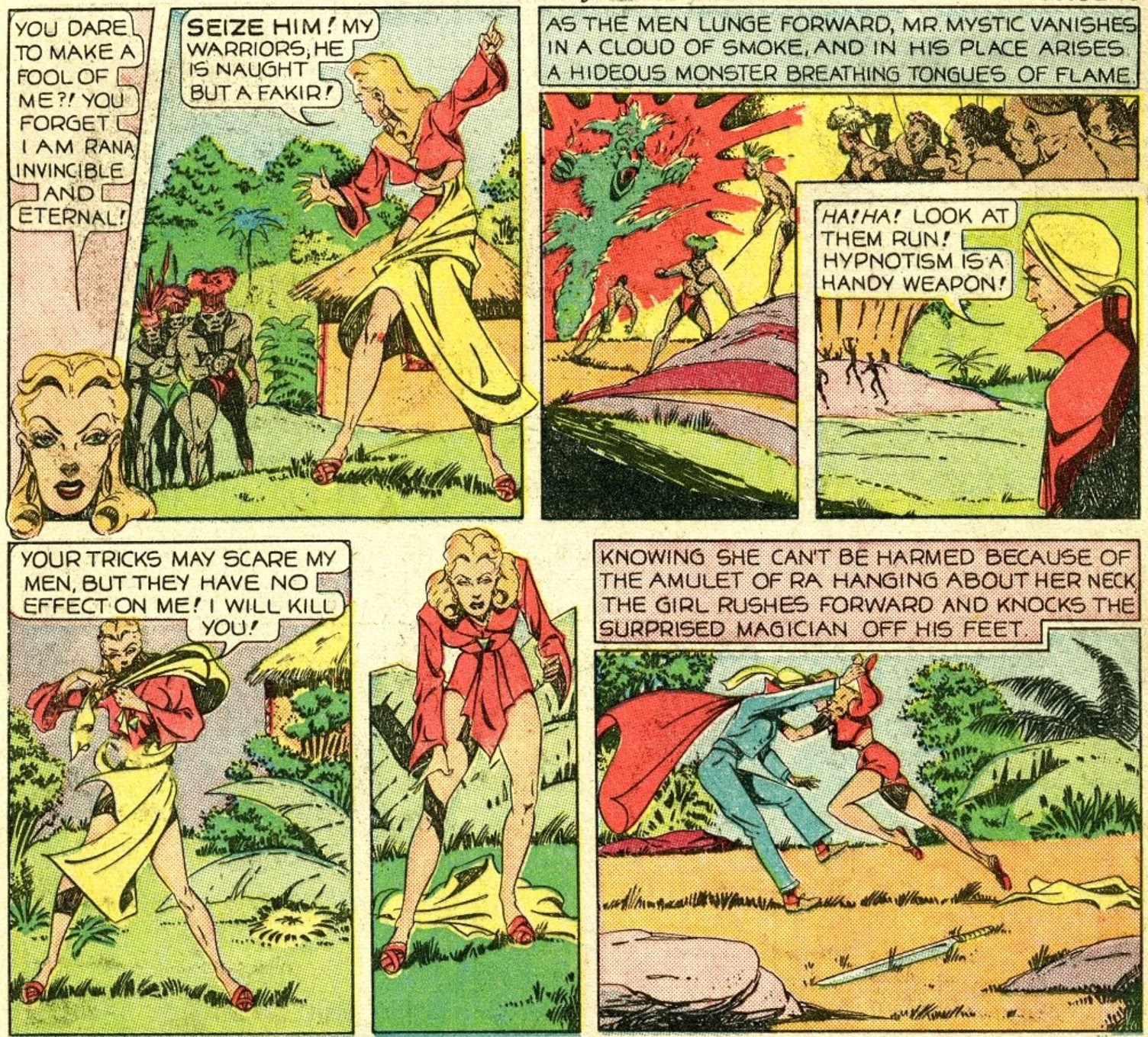
    Queen Rana is the bearer of the Amulet of Ra, a mystic artifact that grants immortality and invulnerability to the one who wears it. Rana’s one ambition in her immortal life is to have a “huge rock of gold” and to that end she has established herself as the ruler of a jungle tribe and turned them to banditry. Is this a good use of eternal life? No it is not. Is it likely to result in her getting a huge rock of gold? Almost certainly not. Is this the sort of ambition that, when achieved, is going to leave her feeling kind of hollow inside? Absolutely.

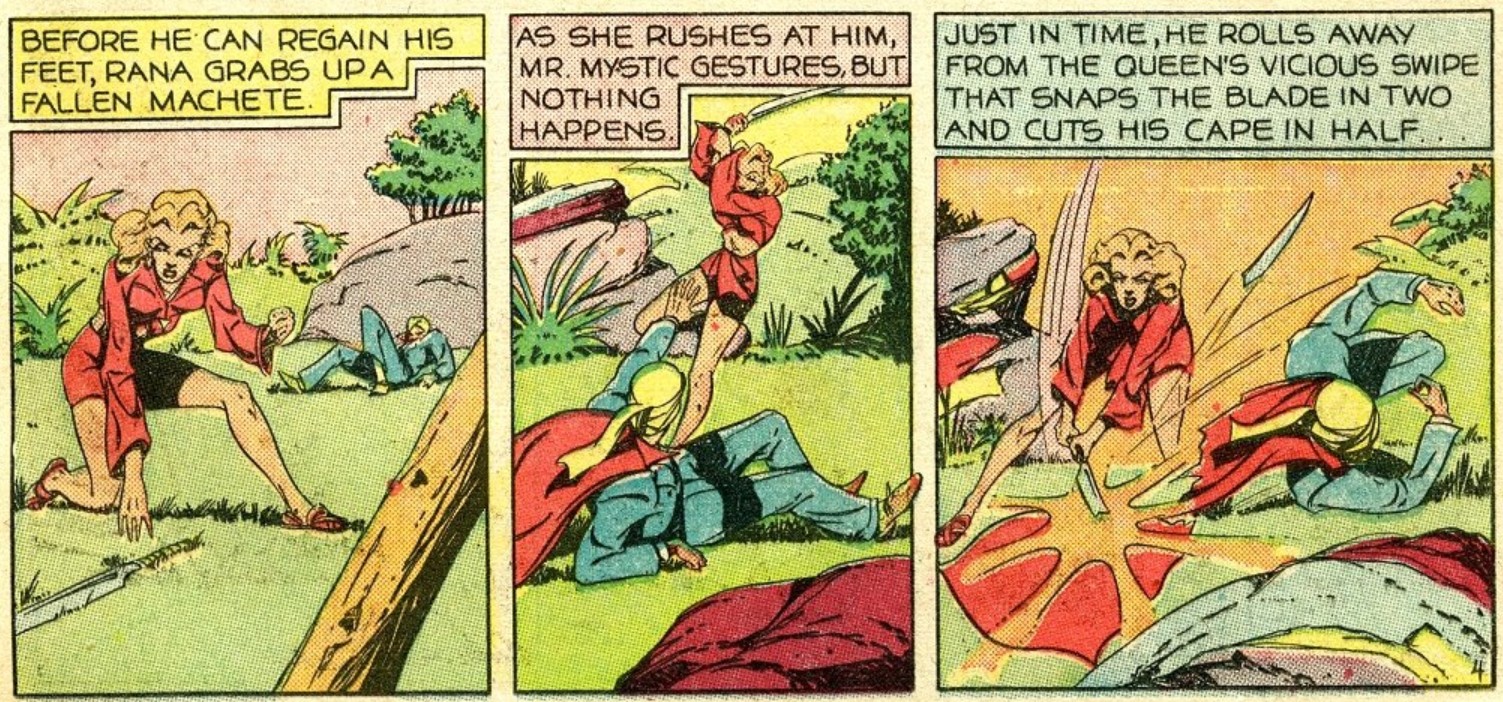
    Mr Mystic, at the behest of the council of Lamas who empowered him, sets off into the jungle to put a stop to Queen Rana and to destroy the Amulet of Ra, and here is where I personally developed a deep affection for Rana as a villain, because she approaches being immortal, invulnerable and, it turns out, immune to Mr Mystic’s magic as license to be just a complete roughneck brawler. She tackles Mystic and nearly cuts him in two while your typical comic book immortal would still be delivering their opening monologue about how lonely they get. It’s frankly the sort of behaviour we should see more in the immortal community.

    Unfortunately for me and my love of fun characters, the fact that Rana viewed immortality merely as an increased chance to get ahold of that big gold she coveted so much really did point to her being a dummy. Mr Mystic has basically no trouble at all in getting her to trade the Amulet of Ra for a big pile of gold that he, a man who she has seen create illusions mere minutes before has created out of thin air, and after that it’s all over, as Queen Rana’s two centuries of unaging catch up to her all at once. A sad end to a real scrapper of a character.

  • MINOR SUPER-VILLAIN 811: QUEEN RANA

    MINOR SUPER-VILLAIN 811: QUEEN RANA

    (The Spirit Section, 14 July, 1940)

    Queen Rana is the bearer of the Amulet of Ra, a mystic artifact that grants immortality and invulnerability to the one who wears it. Rana’s one ambition in her immortal life is to have a “huge rock of gold” and to that end she has established herself as the ruler of a jungle tribe and turned them to banditry. Is this a good use of eternal life? No it is not. Is it likely to result in her getting a huge rock of gold? Almost certainly not. Is this the sort of ambition that, when achieved, is going to leave her feeling kind of hollow inside? Absolutely.

    Mr Mystic, at the behest of the council of Lamas who empowered him, sets off into the jungle to put a stop to Queen Rana and to destroy the Amulet of Ra, and here is where I personally developed a deep affection for Rana as a villain, because she approaches being immortal, invulnerable and, it turns out, immune to Mr Mystic’s magic as license to be just a complete roughneck brawler. She tackles Mystic and nearly cuts him in two while your typical comic book immortal would still be delivering their opening monologue about how lonely they get. It’s frankly the sort of behaviour we should see more in the immortal community.

    Unfortunately for me and my love of fun characters, the fact that Rana viewed immortality merely as an increased chance to get ahold of that big gold she coveted so much really did point to her being a dummy. Mr Mystic has basically no trouble at all in getting her to trade the Amulet of Ra for a big pile of gold that he, a man who she has seen create illusions mere minutes before has created out of thin air, and after that it’s all over, as Queen Rana’s two centuries of unaging catch up to her all at once. A sad end to a real scrapper of a character.

  • MINOR SUPER-VILLAIN 809: GANGA LIN

    (The Spirit Section, 7 July, 1940)

    Our first Mr Mystic foe! Mystic’s old pal Mr Cooper brings him in because he’s worried about his daughter Erica’s involvement with a religious group (cult) called the Temple of Lin. It’s always a real toss-up whenever this kind of thing crops up as a comic book plot, between the cult being a total con job and it having some legitimate but sinister basis, and in this case it’s the latter. Mr Mystic goes to the Temple of Lin and after some enhanced interrogation (i.e. partially melting local Lin Temple head Mamsa Lin) learns that Erica Cooper has been mystically transported to the Paradise of Lin, a hidden city in the Himalayas.

    In the meantime, Erica has discovered that perhaps life in a cult isn’t all it’s cracked up to be, as she is horrified to learn that the Paradise of Lin has a kind of celestial “one in, one out” policy and that in order for her to enter requires the sacrifice of a slave girl. Also, they have slaves, which I would also call a red flag. Luckily for all the women involved in this little altercation, this is the point at which Mr Mystic appears to challenge the cult’s leader, the eight-foot tall mystic Ganga Lin, to a battle to the death.

    Mr Mystic and Ganga Lin engage in astral combat, much as Mystic’s inspiration Yarko the Great did with his foe Shaddiba, only even more homoerotically, with their fully nude and well-muscled astral forms clad only in their signature headwear. Mr Mystic of course comes out on top with a cool astral hawk-on astral deer kill, and he and Erica head back to the US, leaving only one question unanswered: did either of them think to free that poor slave girl/human sacrifice?

  • MINOR SUPER-HERO ROUND-UP 054

    Whoops there are two more super-heroes in the Spirit Section. Should have included them with the Spirit himself, tsk tsk. 

    Lady Luck: 

    The Spirit’s home, the “Spirit Section” of newspaper comics also included two other Will Eisner-created but not -written or -drawn characters, the first of whom is Lady Luck. In actuality wealthy socialite Brenda Banks, Lady Luck is a costumed vigilante out of boredom with the day-to-day of high society. She is wanted by the law and specifically by her civilian life love interest Police Chief Hardy Moore, a cop so dumb that not only is he about to send a woman to the electric chair for the murder of her still-living husband in the above set of panels but he also is unable to recognize the object of his affections under the brim of a big hat (in fairness to him he does mention that Brenda and Lady Luck are very similar looking but then turns out to be cartoonishly easy to fool). Lady Luck does a bit of globetrotting here and there, but her focus is mainly on high society crimes. Her adventures are a bit lighter than the Spirit’s, but not by too much. (The Spirit Section, 2 June, 1940) 

    Mr Mystic: 

    The thing about the Spirit Section is that people love the Spirit and so his two companions tend to be overshadowed, particularly when it comes to widely-available archival work: the Spirit was reprinted while Lady Luck and our new friend here Mr Mystic languished in obscurity, and while Lady Luck’s adventures were eventually reprinted in Smash Comics, the archival record of Mr Mystic is much spottier.

    Mr Mystic is supposedly a retooling of Eisner’s prior effort Yarko the Great, and I can see it – luckily for him he got the look of Yarko rather than the terrible naming sensibility. Mystic is (or was, presumably) an American diplomat who, like so many characters before and after him, acquired great mystical powers from the mysterious and spiritual residents of Tibet, specifically a “council of seven Lamas,” and brought them back to the US to be put to use in beating up ne’er-do-wells. 

    Mr Mystic is a magic-using super-hero, which means that he is a nigh-omnipotent force of nature only occasionally slowed down by a lucky bop on the bean from a crook. His major mark of distinction from his peers is a literal one: a mystic tattoo on his forehead, which would mean that he’s almost certainly the first person to have to field a lot of well-meaning concern over the effect that that sort of thing would have on his employability. (The Spirit Section, 2 June, 1940)

    ADDENDUM:

    After all my talk about how a lot of the non-Spirit related parts of the Spirit Section were unavailable I thought to double check, and I had forgot that yes, they are. Granted, it’s as medium-quality photocopies, but that’s better than nothing, right?

    Having rediscovered that fact, I went back and read the first Mr Mystic story, and was shocked and surprised to learn that rather than being a student of the occult who spent long years studying in Tibet, our unnamed hero is a cultural attache serving somewhere in presumably-Eastern Europe when he is blown very off-course while fleeing an Axis invasion force. He crashes in Tibet and is given the forehead brand/tattoo that I did not realize was the sole source of his power while still unconscious. The whole thing is a pretty far cry from what I had imagined his origin to be!

  • MINOR SUPER-HERO ROUND-UP 054

    Whoops there are two more super-heroes in the Spirit Section. Should have included them with the Spirit himself, tsk tsk. 

    Lady Luck: 

    The Spirit’s home, the “Spirit Section” of newspaper comics also included two other Will Eisner-created but not -written or -drawn characters, the first of whom is Lady Luck. In actuality wealthy socialite Brenda Banks, Lady Luck is a costumed vigilante out of boredom with the day-to-day of high society. She is wanted by the law and specifically by her civilian life love interest Police Chief Hardy Moore, a cop so dumb that not only is he about to send a woman to the electric chair for the murder of her still-living husband in the above set of panels but he also is unable to recognize the object of his affections under the brim of a big hat (in fairness to him he does mention that Brenda and Lady Luck are very similar looking but then turns out to be cartoonishly easy to fool). Lady Luck does a bit of globetrotting here and there, but her focus is mainly on high society crimes. Her adventures are a bit lighter than the Spirit’s, but not by too much. (The Spirit Section, 2 June, 1940) 

    Mr Mystic: 

    The thing about the Spirit Section is that people love the Spirit and so his two companions tend to be overshadowed, particularly when it comes to widely-available archival work: the Spirit was reprinted while Lady Luck and our new friend here Mr Mystic languished in obscurity, and while Lady Luck’s adventures were eventually reprinted in Smash Comics, the archival record of Mr Mystic is much spottier.

    Mr Mystic is supposedly a retooling of Eisner’s prior effort Yarko the Great, and I can see it – luckily for him he got the look of Yarko rather than the terrible naming sensibility. Mystic is (or was, presumably) an American diplomat who, like so many characters before and after him, acquired great mystical powers from the mysterious and spiritual residents of Tibet, specifically a “council of seven Lamas,” and brought them back to the US to be put to use in beating up ne’er-do-wells. 

    Mr Mystic is a magic-using super-hero, which means that he is a nigh-omnipotent force of nature only occasionally slowed down by a lucky bop on the bean from a crook. His major mark of distinction from his peers is a literal one: a mystic tattoo on his forehead, which would mean that he’s almost certainly the first person to have to field a lot of well-meaning concern over the effect that that sort of thing would have on his employability. (The Spirit Section, 2 June, 1940)

    ADDENDUM:

    After all my talk about how a lot of the non-Spirit related parts of the Spirit Section were unavailable I thought to double check, and I had forgot that yes, they are. Granted, it’s as medium-quality photocopies, but that’s better than nothing, right?

    Having rediscovered that fact, I went back and read the first Mr Mystic story, and was shocked and surprised to learn that rather than being a student of the occult who spent long years studying in Tibet, our unnamed hero is a cultural attache serving somewhere in presumably-Eastern Europe when he is blown very off-course while fleeing an Axis invasion force. He crashes in Tibet and is given the forehead brand/tattoo that I did not realize was the sole source of his power while still unconscious. The whole thing is a pretty far cry from what I had imagined his origin to be!