The Curse of Skeleton Munroe

Category: Register and Tribune Syndicate

  • CATALOGUE OF WOUNDS 014

    I’ve finally caught up on all the backlogged wounds! Only new wounds for the catalogue going forward.

    the Dart:

    The Dart has come all the way from Ancient Rome to the present day (1940) only to be shot in the left arm. (Weird Comics 006, 1940)

    Doc Strange:

    Though the text box says that Doc Strange is “riddled with bullets” in this exchange, the subsequent first aid suggests that his left arm bore the brunt of the damage. (Thrilling Comics 001, 1940)

    the Falcon:

    The Falcon gets a classic head creasing. (Human Torch v1 002, 1940)

    Ferret:

    Despite the fact that these crooks manage to capture Ferret and force him to remove his bulletproof vest, they not only then choose to shoot him in the head but fail to actually shoot him in the head fatally and instead do a classic skull crease. (Marvel Mystery Comics v1 008, 1940)

    the Flame:

    The Flame gets in on the classic skull crease game. (Wonderworld Comics 018, 1940)

    the Masked Rider:

    Not to be left out, the Masked Raider sustains a head crease, classic. (Startling Comics 001, 1940)

    And again a few issues later. (Startling Comics 004, 1940)

    the Spirit:

    The Spirit (who I’m sure will be a frequent visitor to the Catalogue of Wounds) is shot in the left shoulder by Dr Cobra. (Spirit Section, June 9, 1940)

    A few months later: shot in the right shoulder. (The Spirit Section, September 22, 1940) 

    And a few months after that, the right shoulder again, this time by the Black Queen. (The Spirit Section, November 10, 1940)

    Thor, God of Thunder:

    Thor’s alter identity of Grant Farrel is shot in the back, wounding him badly enough that it takes weeks for him to recover. (Weird Comics 003, 1940)

    Yarko the Great:

    Even Yarko’s great magic cannot save him from occasionally being shot in the right arm. (Wonderworld Comics 004, 1940)

  • CATALOGUE OF WOUNDS 014

    I’ve finally caught up on all the backlogged wounds! Only new wounds for the catalogue going forward.

    the Dart:

    The Dart has come all the way from Ancient Rome to the present day (1940) only to be shot in the left arm. (Weird Comics 006, 1940)

    Doc Strange:

    Though the text box says that Doc Strange is “riddled with bullets” in this exchange, the subsequent first aid suggests that his left arm bore the brunt of the damage. (Thrilling Comics 001, 1940)

    the Falcon:

    The Falcon gets a classic head creasing. (Human Torch v1 002, 1940)

    Ferret:

    Despite the fact that these crooks manage to capture Ferret and force him to remove his bulletproof vest, they not only then choose to shoot him in the head but fail to actually shoot him in the head fatally and instead do a classic skull crease. (Marvel Mystery Comics v1 008, 1940)

    the Flame:

    The Flame gets in on the classic skull crease game. (Wonderworld Comics 018, 1940)

    the Masked Rider:

    Not to be left out, the Masked Raider sustains a head crease, classic. (Startling Comics 001, 1940)

    And again a few issues later. (Startling Comics 004, 1940)

    the Spirit:

    The Spirit (who I’m sure will be a frequent visitor to the Catalogue of Wounds) is shot in the left shoulder by Dr Cobra. (Spirit Section, June 9, 1940)

    A few months later: shot in the right shoulder. (The Spirit Section, September 22, 1940) 

    And a few months after that, the right shoulder again, this time by the Black Queen. (The Spirit Section, November 10, 1940)

    Thor, God of Thunder:

    Thor’s alter identity of Grant Farrel is shot in the back, wounding him badly enough that it takes weeks for him to recover. (Weird Comics 003, 1940)

    Yarko the Great:

    Even Yarko’s great magic cannot save him from occasionally being shot in the right arm. (Wonderworld Comics 004, 1940)

  • MEDIA IN COMICS 005

    This is the stuff that my counterpart in a comic book universe is writing his little blogs about.

    Movies:

    Not only does this theatre feature an appearance by Lady Luck (an impostor, alas), but it has screenings of Boris Scarloff in Mummy Blood and Myrna Powell and William Loy in Thinner than the Thin Man! (Lady Luck, the Spirit Section 1940)

    The villainous Comrade Ratski might have founded Ratski Productions and filmed his opus The Great War as a cover for his espionage activities, but was it a real movie? Was he filming all of his crimes and if so who has the footage? (Speed Comics 009, 1940) 

    Ted Parrish, aka the Man With 1000 Faces stars in Thundering Hoofs, which might appear to be a generic Western to you and I but which nets him the 1941 Oscar for Best Actor – sorry, Jimmy Stewart. (Speed Comics 010, 1940)

    This is another Ted Parrish feature(, and though the title is partially obscured by that rude talking kid I am familiar enough with 1940s parody title conventions to confidently state that it is Went with the Gale. (Speed Comics 008, 1940)

    Newspaper Columns:

    “John Perry In the News,” with its sassy little “Perry Says….” opening is said to be and written like a gossip column but like Bob Phantom before him John “the Black Fury” Perry seems to mostly write about crime. Also please note that both of these clippings have “Daily Standard” down the side even though Perry is consistently said to work for the Daily Clarion. (Fantastic Comics 017, 1941)

    Martin Mitchell is another of these gossip columnist/ hard-core investigative journalist types, only he isn’t a super-hero and so when he starts writing about ongoing criminal activity in “Martin Mitchell About Town” he just gets murdered. (Rocket Comics 003, 1940)

    We don’t get anything more about “The Tattler” than its title, and even that is concealed beneath part of the Press Guardian’s name. Maybe Ted McCoy needs to dig up some hotter gossip. (Pep Comics 001, 1940)

    Radio: 

    Martin Mitchell (America’s most popular columnist!) also has a radio show, and since we never learn its name I’m going to assume that it is also named Martin Mitchell About Town. (Rocket Comics 003, 1940)

    We don’t learn too much about The Brady’s Better Bacon Program due to its star Biff Crossley being mixed up in a string of high-profile murders, but it certainly is well-attended. And it has a full orchestra!(Pep Comics 008, 1940)

    Theatre: 

    Tobacco Turnpike is one of those murder mystery plays that are so beloved of comic and television writers because of dramatic potential inherent in someone being murdered on-stage at the same time as they are supposed to be pretending to be murdered, as happens several times in this story before the Shield gets involved and reveals that the director is responsible and is trying to tank the play because he has sold half stakes in the play to at least four men and doesn’t want to pay out or go to jail.

    Tobacco Turnpike is such a specific name that I was sure that it was a reference to something. I almost gave up the quest for knowledge after my third unsuccessful search for a production of Cigarette Junction, before finally narrowing it down to a play called Tobacco Road. (Shield-Wizard Comics 002, 1940)

  • MAD AND CRIMINAL SCIENTIST ROUND-UP 019

    MAD AND CRIMINAL SCIENTIST ROUND-UP 019

    Science for all! Whether they want it or not! 

    Doctor Ivan has been pursuing a scheme in which he is systematically taking out insurance policies on everyone he knows and then having them murdered, and he is extremely smug about it. Now, I’m no expert in insurance fraud, but I have to say that I am certain that it requires a bit more subtlety than that, even if you’re doing it as a one-off. Forget the fact that the Flame shows up after the third murder; I would expect some raised eyebrows down at the insurance company after the second. (The Flame 003, 1940)

    Dr Gung is an old associate of magical arch-criminal Elena, and is the one who saves her from execution after the Karoly Gore affair by means of some death-simulating drugs. 

    Gung’s main line of inquiry is the use of his signature ray to destroy men’s minds and turn them into mindless robot soldiers, something that works perfectly well on regular guys sourced from the nearby populace but when tried on Mr Mystic goes badly enough that Dr Gung ends up shrunk to a few inches tall and then blown to smithereens along with his entire mansion. (The Spirit Section, 23 June 1940)

    Ghantse is one of those mad scientists who talk a lot about their grand plans but don’t actually get a chance to put them in motion, so it’s a real mystery whether he actually would have been able to fuse several human brains together into a single entity who would “know all” like he claimed or not, but he sure was willing to try. Along the way, he made two major mistakes: 1) targeting Mr Mystic for brain extraction and 2) somehow ending up with the Shadowman, the literal embodiment of death, on his payroll, the latter being compounded by the fact that the Shadowman hates Ghantse’s guts, and so not only releases Mr Mystic from his chemically-induced paralysis before Ghantse can extract his brain but also blows Ghantse’s entire base to kingdom come. (The Spirit Section, 22 September, 1940)

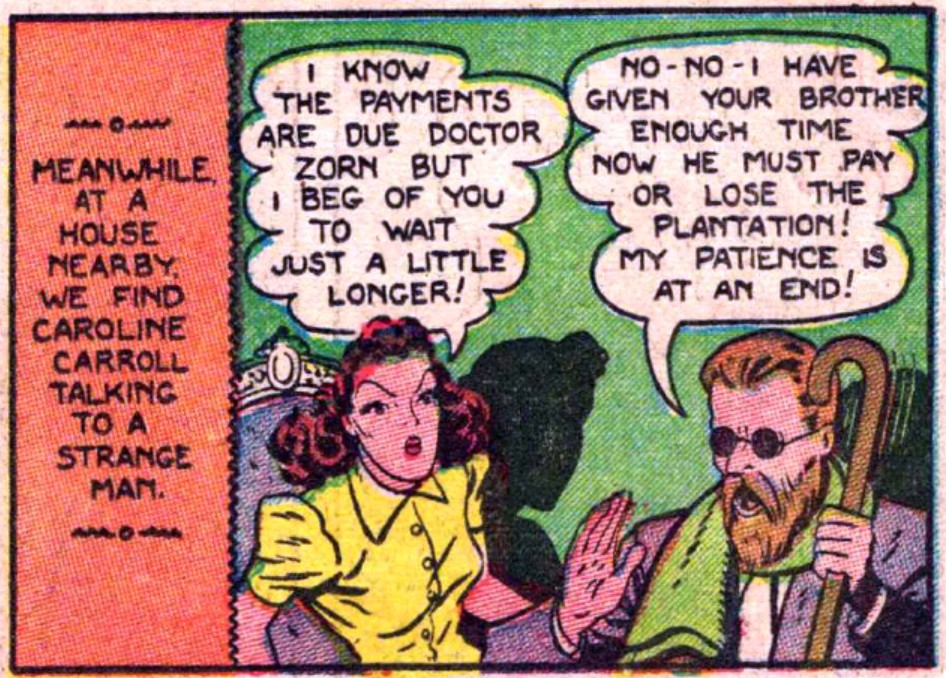
    Doctor Zorn, an eccentric roboticist living on Puerto Rico, is possibly the world record holder for escalation, as he manages to go from an argument about a late loan payment to unleashing his voice-controlled super robot (aka the Monster) to activating his lab’s self-destruct mechanism in the space of about half an hour. 

    Given that this is what he started shouting immediately after showing off his robot to a young woman, I do suspect that Doctor Zorn was primed for this kind of thing and was just looking for an excuse, like a man who has just bought a katana standing in his kitchen. (Thrilling Comics 005, 1940)

  • REAL PERSON ROUND-UP 016

    REAL PERSON ROUND-UP 016

    Are you ready for some comic book versions of real life and fictional people? I sure hope so! 

    Adolf Hitler:  

    Premier Grahvin of the fictional African country of Cadiwa is a pretty broad pastiche of the Axis leaders, but the sheer speed at which he accelerates into full-blown dictator mode (before Mr Mystic turns up to reveal that he had not, in fact killed the king of Cadiwa and was not, in fact, in charge) must be highlighted. (The Spirit Section, 21 July, 1940)

    Likewise, Karoly Gore is an Axis dictator pastiche from a Mr Mystic story a few weeks earlier (but I read them out of order so it’s okay) (The Spirit Section, 9 June, 1940) 

    Axtrol here is a third in our series of Axis dictator pastiches, and he’s possibly the biggest shithead of the bunch. (The Spirit, “Dr Prince von Kalm”, 17 November, 1940)

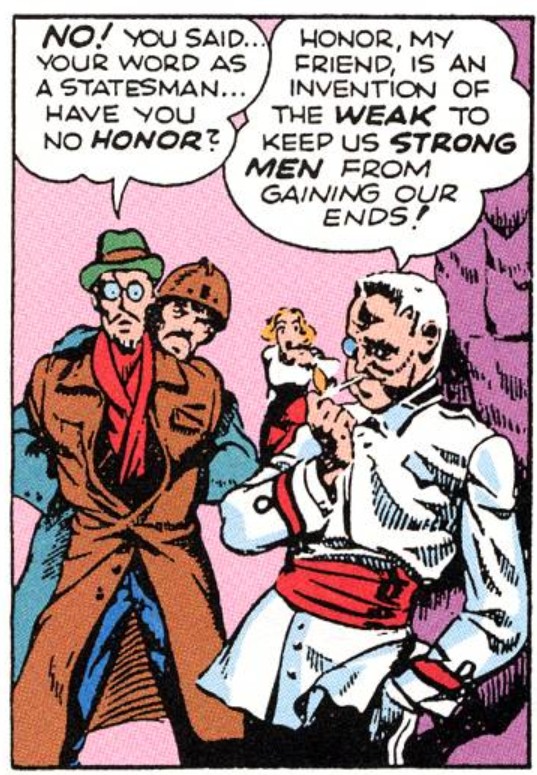
    Nargoff, aka the Leader, is either a would-be North American dictator or the agent of a European one looking to set up a local franchise. Either way, the Spirit burns down his fake island/submarine base and then engineers a situation in which the might-makes-right philosophies espoused in Nargoff’s book “The New Order” are explored by way of Nargoff and his burly assistant Max being stranded on a small boat in the Caribbean with a limited amount of water. (The Spirit, “The Leader”, 29 December, 1940)

    Don Juan: 

    Mr Mystic and his fiance Elena encounter a whole castle full of ghosts in the woods of Spain, among whom is the spirit of the entirely fictional man Don Juan, who mistakes Elena for his missing wife Ysabel and almost kills her before himself being double-killed by Mystic. (The Spirit Section, 15 December, 1940)

    Khufu aka Cheops: 

    When Mr Mystic decides to go back in time to the creation of the Great Pyramid of Giza, he is mistaken for the god Ammon Ra and of course just immediately gets his grubby little mitts all over the progress of history. It’s kind of okay, though, because the history he’s in seems to already be a big mess – for instance, while Pharaoh Cheops is indeed the ruler supposed to have commissioned the building of the Great Pyramid c. 2600 BCE, the Babylonian invasion they’re worried about is tricky because a) Babylonia is dated from 1890 BCE b) the earliest Nebuchadnezzar I can find ascended to the throne in 1121 BCE and c) given the cultural milieu that this comic was written in they’re probably talking about Nebuchadnezzar II, the one from the Bible, who did invade Egypt a couple of times but didn’t come to power until 605 BCE. Like I said: a real mess. Plus, Amun didn’t even become associated with Ra until the 16th Century BCE!

    There’s also this guy, Prince Sargon of Babylonia, and while there’s a part of me that wants to say that he’s supposed to be Sargon II (the most famous Sargon, 722 BCE), I don’t reckon that Bob Powell, mad as he was with creative power when he wrote this story, would make someone the son of someone else born a hundred years after them. Right? (Sargon does return as a time-travelling mummy out for revenge in the next installment of Mr Mystic but this alas does nothing to clear up the puzzle of his identity) (The Spirit Section, 29 September 1940)

    Misc Arthurian Figures: 

    During one of his jaunts into the past, the Ghost finds himself in Camelot, where he meets a very small selection of Arthurian figures (all of the big name knights are away on the Crusades, we are told). These include Sir Kay, who acts like a weird creep (accurate) and gets beaten up for his efforts, King Arthur, an amiable doormat, and Merlin the Magician, who is portrayed as a fraud with no magical power who sells out Arthur as soon as he gets the chance. An interesting choice for a comic about a magic man, but perfectly in keeping with 1940s secular values. (Thrilling Comics 005, 1940) 

    Myrna Loy & William Powell: 

    A simple flip of the last names renders Myrna Loy and William Powell into Myrna Powell and William Loy on this marquee, with a bonus “Boris Scarloff” for Boris Karloff. (The Spirit Section, 10 November, 1940)

    Ty Cobb: 

    If there’s anything more tedious than a 1940s sports comic it’s a 1940s hillbilly comic, so trust me when I say that this one-off about a baseball-playing hillbilly named Obadiah “Pie” Gobb is one of the the worst things I have ever read. 

    What’s even more egregious is the fact that while Pie Gobb and his new teammate Moe de Muggio (the World’s Greatest Slugger, thanks to the fact that he eats his Fleeties every morning) are easy to identify as Ty Cobb and Joe DiMaggio, respectively, the rest of his team also have goofy names but as far as I can tell none of them are also puns on famous baseball players, meaning that I just spent all that time playing rhyming games on Wikipedia for no reason. (The Funnies 047, 1940)

  • REAL PERSON ROUND-UP 016

    REAL PERSON ROUND-UP 016

    Are you ready for some comic book versions of real life and fictional people? I sure hope so! 

    Adolf Hitler:  

    Premier Grahvin of the fictional African country of Cadiwa is a pretty broad pastiche of the Axis leaders, but the sheer speed at which he accelerates into full-blown dictator mode (before Mr Mystic turns up to reveal that he had not, in fact killed the king of Cadiwa and was not, in fact, in charge) must be highlighted. (The Spirit Section, 21 July, 1940)

    Likewise, Karoly Gore is an Axis dictator pastiche from a Mr Mystic story a few weeks earlier (but I read them out of order so it’s okay) (The Spirit Section, 9 June, 1940) 

    Axtrol here is a third in our series of Axis dictator pastiches, and he’s possibly the biggest shithead of the bunch. (The Spirit, “Dr Prince von Kalm”, 17 November, 1940)

    Nargoff, aka the Leader, is either a would-be North American dictator or the agent of a European one looking to set up a local franchise. Either way, the Spirit burns down his fake island/submarine base and then engineers a situation in which the might-makes-right philosophies espoused in Nargoff’s book “The New Order” are explored by way of Nargoff and his burly assistant Max being stranded on a small boat in the Caribbean with a limited amount of water. (The Spirit, “The Leader”, 29 December, 1940)

    Don Juan: 

    Mr Mystic and his fiance Elena encounter a whole castle full of ghosts in the woods of Spain, among whom is the spirit of the entirely fictional man Don Juan, who mistakes Elena for his missing wife Ysabel and almost kills her before himself being double-killed by Mystic. (The Spirit Section, 15 December, 1940)

    Khufu aka Cheops: 

    When Mr Mystic decides to go back in time to the creation of the Great Pyramid of Giza, he is mistaken for the god Ammon Ra and of course just immediately gets his grubby little mitts all over the progress of history. It’s kind of okay, though, because the history he’s in seems to already be a big mess – for instance, while Pharaoh Cheops is indeed the ruler supposed to have commissioned the building of the Great Pyramid c. 2600 BCE, the Babylonian invasion they’re worried about is tricky because a) Babylonia is dated from 1890 BCE b) the earliest Nebuchadnezzar I can find ascended to the throne in 1121 BCE and c) given the cultural milieu that this comic was written in they’re probably talking about Nebuchadnezzar II, the one from the Bible, who did invade Egypt a couple of times but didn’t come to power until 605 BCE. Like I said: a real mess. Plus, Amun didn’t even become associated with Ra until the 16th Century BCE!

    There’s also this guy, Prince Sargon of Babylonia, and while there’s a part of me that wants to say that he’s supposed to be Sargon II (the most famous Sargon, 722 BCE), I don’t reckon that Bob Powell, mad as he was with creative power when he wrote this story, would make someone the son of someone else born a hundred years after them. Right? (Sargon does return as a time-travelling mummy out for revenge in the next installment of Mr Mystic but this alas does nothing to clear up the puzzle of his identity) (The Spirit Section, 29 September 1940)

    Misc Arthurian Figures: 

    During one of his jaunts into the past, the Ghost finds himself in Camelot, where he meets a very small selection of Arthurian figures (all of the big name knights are away on the Crusades, we are told). These include Sir Kay, who acts like a weird creep (accurate) and gets beaten up for his efforts, King Arthur, an amiable doormat, and Merlin the Magician, who is portrayed as a fraud with no magical power who sells out Arthur as soon as he gets the chance. An interesting choice for a comic about a magic man, but perfectly in keeping with 1940s secular values. (Thrilling Comics 005, 1940) 

    Myrna Loy & William Powell: 

    A simple flip of the last names renders Myrna Loy and William Powell into Myrna Powell and William Loy on this marquee, with a bonus “Boris Scarloff” for Boris Karloff. (The Spirit Section, 10 November, 1940)

    Ty Cobb: 

    If there’s anything more tedious than a 1940s sports comic it’s a 1940s hillbilly comic, so trust me when I say that this one-off about a baseball-playing hillbilly named Obadiah “Pie” Gobb is one of the the worst things I have ever read. 

    What’s even more egregious is the fact that while Pie Gobb and his new teammate Moe de Muggio (the World’s Greatest Slugger, thanks to the fact that he eats his Fleeties every morning) are easy to identify as Ty Cobb and Joe DiMaggio, respectively, the rest of his team also have goofy names but as far as I can tell none of them are also puns on famous baseball players, meaning that I just spent all that time playing rhyming games on Wikipedia for no reason. (The Funnies 047, 1940)

  • DIVINE ROUND-UP 008

    Some more dubious theology for you. 

    the Stone Tablet:

    The pompous jackasses at the British Archaeological Club really get Mr Mystic’s goat when they treat the theories of his friend Doctor Gadasky like trash, so he does the only sensible thing and uses his magic to travel back to 1 000 000 CE to see for himself. Gadasky claims that Cro-Magnons had a religion based around the worship of a stone tablet, and wouldn’t you know it, he’s right!

    Mr Mystic’s jaunt through time is about as well-considered as those things normally are, and he ends up causing the deaths of two Cro-Magnons, including the Stone Tablet’s keeper, plus the loss of the Tablet itself in a quicksand pit, which is a boon for Gadasky, as he is able to dig it up in the present and prove his theories. Take that, establishment jerks!

    Speaking of those theories, just where did they come from? Is the fact that Gada, the Stone Tablet’s guardian, is a dead ringer for Gadasky and that Gadasky carries an echo of the wound that killed Gada (reptile-bird beak to the skull) on his flesh an indication that the Tablet posesses some measure of actual power? Could be!

    God style: idol (the Spirit Section, 8 December, 1940)

    Oona, the Angry God: 

    Oona is the Angry God, a generically sinister Asian deity who requires the sacrifice of a good English girl now and then. Inspector Dayton is of course having none of that, particularly as the sacrifice happens to be his love interest Wini. Oona worship in England is ended at the barrel of a gun.

    God style: idol (Jumbo Comics 022, 1940) 

    Orga: 

    In a near-deserted lost city of gold, Sheena, Queen of the Jungle and her paramour Bob Reynolds come across an unnamed mad king and his court of trained gorillas. The King has been sacrificing travellers (and implicitly his own people, leading to the city’s depleted population) to his gods. I can only assume that the fantastic idol behind the king’s throne is a representation of Orga, the only god mentioned by name. 

    God style: idol (Jumbo Comics 009, 1939) 

    Orta the Sun-God: 

    Captured and sentenced to death by a Peruvian tribe, Marvelo, Monarch of Magicians pulls a variant on the old “we are divine beings, you primitives” gag by transforming his companion into a fireball. Is Orta the Sun-God something that Marvelo makes up on the spot or is he exploiting these (admittedly inhospitable) people’s extant beliefs? We shall never know.

    God style: fake (Big-Shot Comics 014, 1941) 

  • DIVINE ROUND-UP 008

    Some more dubious theology for you. 

    the Stone Tablet:

    The pompous jackasses at the British Archaeological Club really get Mr Mystic’s goat when they treat the theories of his friend Doctor Gadasky like trash, so he does the only sensible thing and uses his magic to travel back to 1 000 000 CE to see for himself. Gadasky claims that Cro-Magnons had a religion based around the worship of a stone tablet, and wouldn’t you know it, he’s right!

    Mr Mystic’s jaunt through time is about as well-considered as those things normally are, and he ends up causing the deaths of two Cro-Magnons, including the Stone Tablet’s keeper, plus the loss of the Tablet itself in a quicksand pit, which is a boon for Gadasky, as he is able to dig it up in the present and prove his theories. Take that, establishment jerks!

    Speaking of those theories, just where did they come from? Is the fact that Gada, the Stone Tablet’s guardian, is a dead ringer for Gadasky and that Gadasky carries an echo of the wound that killed Gada (reptile-bird beak to the skull) on his flesh an indication that the Tablet posesses some measure of actual power? Could be!

    God style: idol (the Spirit Section, 8 December, 1940)

    Oona, the Angry God: 

    Oona is the Angry God, a generically sinister Asian deity who requires the sacrifice of a good English girl now and then. Inspector Dayton is of course having none of that, particularly as the sacrifice happens to be his love interest Wini. Oona worship in England is ended at the barrel of a gun.

    God style: idol (Jumbo Comics 022, 1940) 

    Orga: 

    In a near-deserted lost city of gold, Sheena, Queen of the Jungle and her paramour Bob Reynolds come across an unnamed mad king and his court of trained gorillas. The King has been sacrificing travellers (and implicitly his own people, leading to the city’s depleted population) to his gods. I can only assume that the fantastic idol behind the king’s throne is a representation of Orga, the only god mentioned by name. 

    God style: idol (Jumbo Comics 009, 1939) 

    Orta the Sun-God: 

    Captured and sentenced to death by a Peruvian tribe, Marvelo, Monarch of Magicians pulls a variant on the old “we are divine beings, you primitives” gag by transforming his companion into a fireball. Is Orta the Sun-God something that Marvelo makes up on the spot or is he exploiting these (admittedly inhospitable) people’s extant beliefs? We shall never know.

    God style: fake (Big-Shot Comics 014, 1941) 

  • DIVINE ROUND-UP 007

    All of the following are from the “Mr Mystic” story in the Spirit Section for 17 November, 1940, in which Mr Mystic into the Land of Mythology to recover the Lost Ring of the Gods, an artifact that brings luck and happiness unless it is stolen by the one jealous god, upon which the bearer falls into eternal slumber. Since this has already happened to a young woman, Mystic is hoping that the recovery of the ring from the jealous god – see the Shadowman entry from a few Divine Round-Ups back – will help her out.

    All of these gods are part of the Greco-Roman Pantheon, which is what I call it when Greek and Roman gods are just kind of grouped together without rhyme or reason.

    the Goddess of the Gate: 

    Who knows what this god’s name really is. She welcomes Mr Mystic to the Land of the Gods and that’s about it. Even her name is based on Mr Mystic saying “she must have been the Goddess of the Gate” in the next panel. She is very helpful, which is something.

    Mars: 

    Mr Mystic’s first guide in the Land of Mythology is Mars, and an unusual version of him at that. Most 1940s depictions of Mars really lean in to his status as the god of war to depict him revelling in or even being the instigator of World War II, but this Mars is instead depressed by the indiscriminate slaughter of modern warfare. 

    “Susie”: 

    Who is “Susie” the Goddess of Knowledge? Athena or her mother Metis? Minerva? Is she from a third pantheon? Perhaps, but consulting a list of deities of knowledge really makes it clear that none of them naturally shorten to Susie. Is that the joke, like calling a fat guy Slim? Maddening stuff.

    Frustrating name aside, this Goddess of Knowledge is appropriately full of information, with some bonus sass and even a little horniness to round out her character.

    the Fates: 

    The concept of three goddesses weaving the thread of a man’s life crops up in Greek, Roman, and Norse mythology, and the question of where exactly these versions of them are from is neatly sidestepped by the fact that they call themselves Past, Present and Future in place of any of the names used in the original myths.

    You know, I just developed a theory: I think that when Bob Powell was writing this he just plain couldn’t find his dictionary or other reference book to look up the names of these gods and so he fudged it. Susie, sure. Past, Present and Future, sure. And it works! I’m sure that I’m the only person in history who tried to work out if Susie could plausibly be a nickname for an actual Goddess of Knowledge. Good job, Bob.

  • DIVINE ROUND-UP 006

    More gods means more options. 

    Katagwah, the Rain God: 

    An unseen Native American rain god whose most fanatical adherent is attempting to perform a human sacrifice to bring rain to the Mojave Desert when Mr Mystic steps in to help the intended victim’s brother put a stop to the ceremony. I felt certain that the story would end with a rainstorm brought on by Mystic chucking the aggressor into the sacrificial canyon, but no such luck.

    God style: invoked. (The Spirit Section, 18 August, 1940) 

    the Sacred Lion:

    Real-life big game trapper Clyde Beatty heads into the African jungle to prevent evil men from stealing the Sacred Lion God from the Ugandi Tribe who worship him. Not because it’s wrong to swan into someone else’s temple and steal their god, mind you, but rather because Beatty wants the Sacred Lion for his own circus.

    God style: animist (Crackajack Funnies 018, 1939) 

    the Living Tribe God: 

    Clyde Beatty is back again, in the Amazon jungle this time, and thanks to the machinations of his rival Bart Slay he almost gets eaten by/sacrificed to the Living Tribe God, an enormous tarantula. Strangely, even after clearing things up and avoiding death, Beatty doesn’t bother stealing this god to take home.

    God style: animist (Crackajack Funnies 037, 1941)

    Naga Goona: 

    Naga Goona, God of the Silvery Moon, is worshipped by the near-human Troglodytes of Matto Grosso. On the one hand, this is just another idol that a white explorer has to be saved from being sacrificed to, but on the other hand… just look at that face! Naga Goona might just be the most charmingly goofy-looking god on record, especially after his idol is animated by Marvelo, Monarch of Magicians and starts walking around and telling people off. 

    God style: idol (Big Shot Comics 010, 1941)