The Curse of Skeleton Munroe

Category: creep

  • MINOR SUPER-VILLAIN 615: SANGLOR

    MINOR SUPER-VILLAIN 615: SANGLOR

    (Fantastic Comics 007, 1940)

    Sanglor starts out strong. He immediately charms me with his aesthetic sense: his ‘Automatic Subplane’ spy drones are delightful, his ‘Flying Castle’ is simultaneously one of the most ridiculous and great-looking mobile bases I have ever seen and his costume manages to evoke the dress sense of a 1940s comic book movie villain in a way I have not seen since the Vampire, almost exactly 300 entries ago.

    He manages to mess things up almost immediately, of course. His plan is to take over the world by hypnotizing key politicians and diplomats etc., and then presumably induce them to shift the reins of political power his way. This is the kind of scheme that requires some degree of care to set up – you have to get all of your assets in place without causing undue suspicion, so having them for example act all weird and then disappear is problematic. People are noticing your plan, Sanglor.

    This is the first evidence of what I will call Sanglor Self-Sabotages. This one seems to stem from the fact that Sanglor works completely solo, without even a weird little lab assistant to test his hypnotic ray on to see if it makes people freak out in noticeable ways before using it in a sensitive espionage operation.

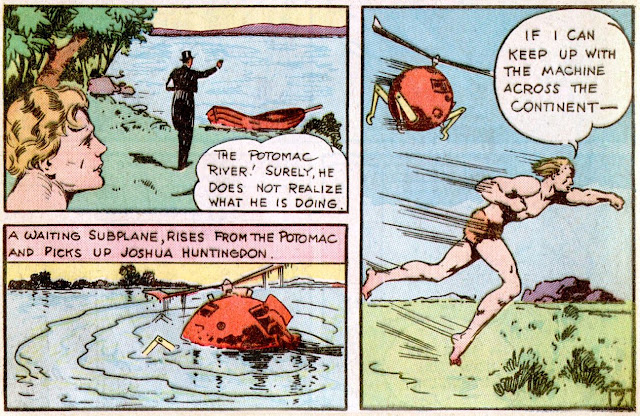
    The big upshot of this Sanglor Self-Sabotage is that Samson is on the case basically the instant that the scheme is put in motion

    The second Sanglor Self-Sabotage is an extension of the first: he has no real defenses. Once Samson makes his way to the Flying Castle his only real opposition is a crowd of tuxedo-clad diplomats flailing away with their soft fists.

    Sanglor does think to call out his drone army to deal with the intruder but they don’t seem to even be armed, despite their little gun barrels – they just fly at Samson until he smashes them all.

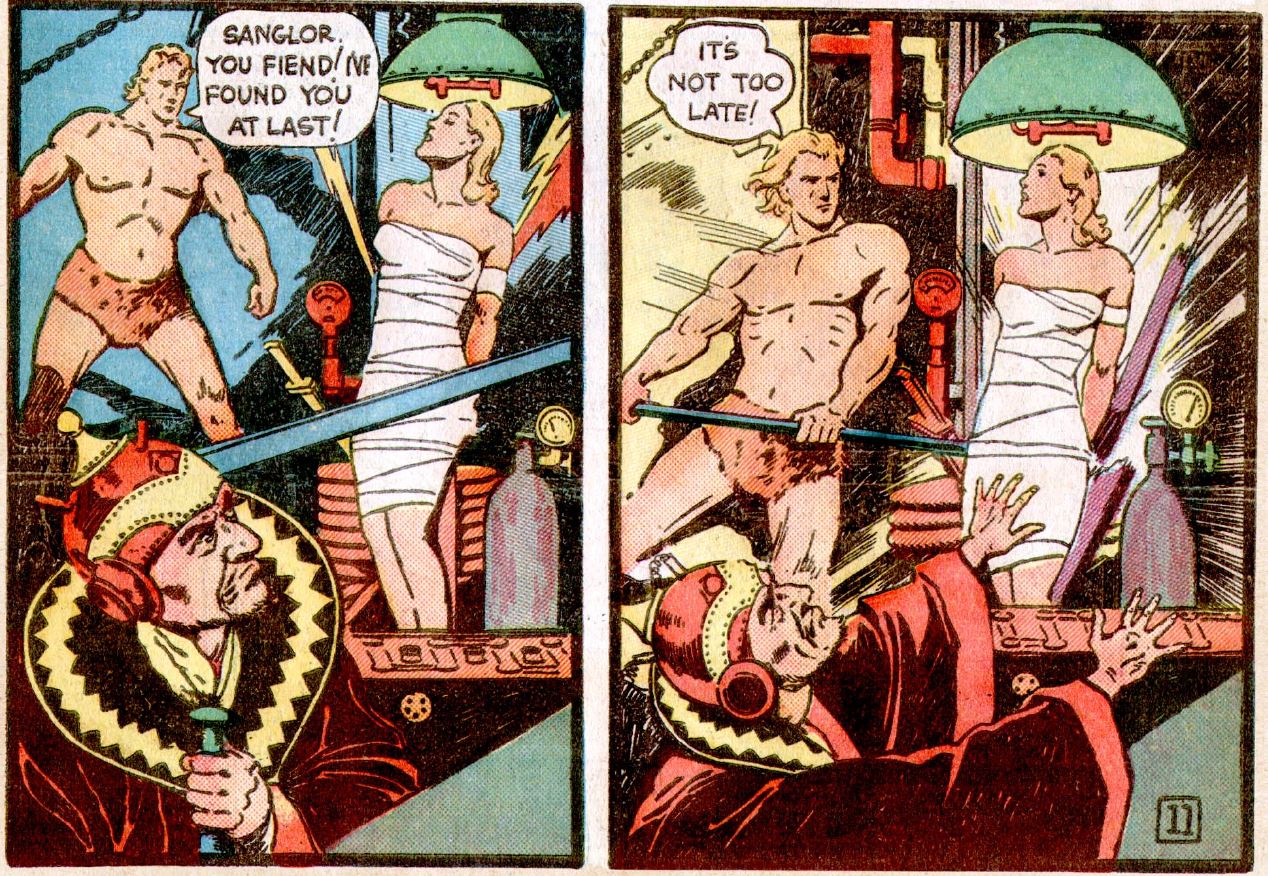
    The really big final Sanglor Self-Sabotage is revealed once Samson bursts into his inner sanctum: Sanglor is too busy being a weird creep to actively manage the defense of his headquarters. It’s not exactly clear what he’s doing with this young woman or who she is (it’s unlikely to be Miss Royce, a politician’s daughter in England and the only named female character in the story) but it’s real creep shit and it’s an unnecessary distraction from the approaching vigilante.

    Sanglor is probably still distracted as he flees through an industrial section of his base, because he can’t even run correctly – he manages to heave himself off what looks to be a pretty solid catwalk into the first available cauldron of boiling chemicals.

    I think that ultimately Sanglor serves as an object example of the need for villains to do a couple of trial runs before attempting world domination. If he’d attempted to take over a county or a small business first, maybe some of these kinks would’ve been worked out.

  • MINOR SUPER-VILLAIN 612: QUEEN IZZUKI

    (Fantastic Comics 006, 1940)

    The eminent scientist Dr Chandler is being held in Amazoland, home of the Amazons! The extremely diplomatic Captain “Ugh!” Kidd sets out to rescue him! 

    This is another one I might have skipped over if not for a couple of remarkable things, the first being that the poorly-named Amazon homeland seems to be just a country, somewhere in Asia if all the references to the Amazon’s eyes being almond-shaped (that’s not how Captain Kidd puts it, of course) are anything to go by. Are they just another lost jungle civilization and I’m reading too much into things or does Amazoland have a seat at the UN in a decade or so?

    The second thing is that this may be the least a character has sexualized a society of scantily-clad women in all of fiction. I’d blame it on the 40s obsession with male vs female roles but Captain Kidd doesn’t really say anything about that so I assume he’s just too racist to be attracted to Asian women.

    Queen Izzuki turns out to be an older woman who is obsessed with regaining her lost beauty and so has captured Dr Chandler to perform plastic surgery on her. Captain Kidd turning up is a bonus: free husband!

    Captain Kidd was already against this whole situation but the prospect of having to marry an old woman (an old Asian woman!) really galvanizes him. He does let Dr Chandler get shot with an arrow (fired by Izzuki, who’s not some layabout queen who doesn’t know how to shoot an arrow at someone) but he’s mostly okay afterward. They escape and Amazoland has to consider more conventional ways of attracting a plastic surgeon, like paying for their education in return for a certain number of years of service.

  • MINOR SUPER-VILLAIN 605: EELO THE FISH MAN

    (Fantastic Comics 005, 1940)

    I guess I have some initial sympathy for Eelo the Fish Man. It can’t be easy being a whatever-he-is in regular human society, let alone a resort island in the middle of the Indian Ocean. He might even be a sympathetic villain if literally his first act wasn’t to kidnap three women as breeding stock for his proposed new amphibian master race.

    Eelo’s plans also confound me: are they long or short term? He gasses on about creating a perfect amphibian race but that’s gotta take at least twenty years (setting aside unpleasant speculations about how one would scale up production in such an endeavour) but meanwhile he’s sinking entire resort islands for his own use. Is he merely counting on surface world society to not look for their island?

    A lot of my confusion about Eelo’s plans stems from the fact that the story never really goes into what exactly he represents. Is he a member of an underwater civilization and his henchmen (somewhat boringly called “the Amphibians” throughout) the same? Then why does he need to kidnap all those wives? Is he a human mutant? Then what are the Amphibians – costumed goons? Mutated goons? If they all stem from the same mutation source then why not just get a bunch of guys and run them through it?

    Regardless of his plans, origin or disposition, Eelo the Fish Man ends up just like so many Samson foes do: dead via the force of a big punch.

  • MINOR SUPER-VILLAIN 601: THE THINKER

    (Fantastic Comics 004, 1940) 

    After a couple of stories worth of interruptions, Space Smith and Dianna either finished the Brain off between issues or they and/or Fletcher Hanks forgot that he was an immanent threat to life on Earth because this issue finds them following a mysterious radio signal to sight-see a rare gold comet as it passes by the moon.

    Instead of watching the comet on its flyby, Space and Dianna are hit with a ray that disables their spaceship before being drawn to the surface. There they find themselves the captives of the Thinker and his army of headless goons. And here let me say that while it is not great that the Thinker’s only stated goal is to acquire Dianna as his “Empress-Goddess”, there is a clarity of purpose there that is a bit refreshing after seeing so many villains attempt to wed unwilling women as a mere opportunistic afterthought.

    Whether the Thinker had greater plans or if getting married to a woman and keeping her in a “flame-girdled Cage of Solitude” was his only goal in life will have to go unanswered because he learns the same hard lesson as so many other big-headed creeps in comics do: all of your big-head smart plans can be undone in an instant by some thoughtless violence. 

    RIP the Thinker: you should have controlled for muscleheads.

  • MINOR SUPER-VILLAIN 599: POSEIDA

    (Fantastic Comics 003, 1940)

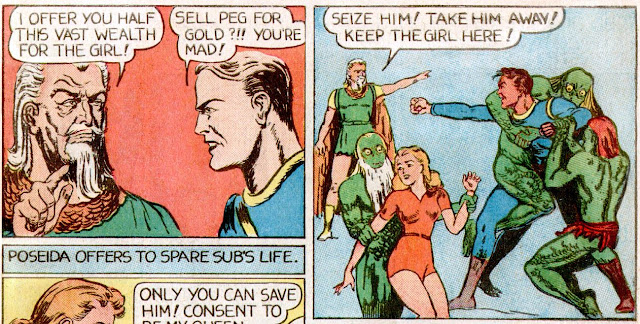
    Back to the adventures of Sub Saunders in the Year 10 000 CE! Naulus has been defeated and for their part in achieving that the US military, represented by Sub Saunders, have been promised untold subsea riches recovered from millennia of shipwrecks. The problem with this plan is that the riches are still just kind of out on the seafloor and more specifically that Poseida, ruler of the nearby city of Coralla, has decided to gather them up for himself.

    The impending diplomatic incident over the ownership of this treasure is forestalled by a different diplomatic incident as Poseida takes a shine to Sub Saunders’ fiancee Peg and attempts to woo her in the traditional manner of the villain: kidnapping and extortion. Is the fact that he seems to be the only human in a city of long-bearded Mermen any excuse for this? Not really but it does shed some light on his motivations.

    Poseida’s plan to win Peg’s love by placing Sub in danger fails when Sub utterly demolishes his giant spider crab foe and before long he has radioed Atlantis for help. The ensuing Frogman/ Merman battle is sadly only visible through the streaky windows of Poseida’s HQ. One good sock to the jaw and the treasure Peg is saved!

    There’s no follow-up on Poseida but as the leader of what seems to be a sovereign city-state he should be safe from prosecution for his crimes. He should count his lucky stars that he didn’t get blown up like Naulus.

  • MINOR SUPER-VILLAIN 578: SEMMURABI

    (Champion Comics 010, 1940)

    Have you ever wondered what happened to the Chaldeans, the ancient Mesopotamian people whose height was from the 9th to 6th centuries BCE, who were mentioned frequently in the Bible and whose name was lent to a Babylonian dynasty? Well wonder no longer! They were merely tucked away in a little hidden city less than a day’s travel via horse from Jerusalem! At least until 1940, that is, because that’s when the city’s leader, a fellow named Semmurabi, made the mistake of being too horny. Or maybe he’d been kidnapping clueless tourists (sincerely clueless: they were roped in by an offer to show them the remains of Noah’s Ark on Mt Arrarat) to add to his harem forever and this was just the first time he’d done it to someone who knew a super-hero.

    In Semmurabi’s defense (for not knowing to keep a lower profile, not for kidnapping women) this is a very early Dr Miracle adventure and he can be excused for assuming that he wouldn’t meet opposition from a tuxedoed magic-man (but again, he will not be excused for the kidnapping). This also might explain why he makes the classic mistake of challenging a more powerful opponent to a magical duel in the astral realm: because he simply didn’t know better.

    Ignorance is no excuse in magic as in law and Semmurabi meets his end in the depths of a star. Sorry, Chaldea. You were ruled by a dope and now you pass into history. (Champion Comics 010, 1940)

  • MINOR SUPER-VILLAIN 578: SEMMURABI

    (Champion Comics 010, 1940)

    Have you ever wondered what happened to the Chaldeans, the ancient Mesopotamian people whose height was from the 9th to 6th centuries BCE, who were mentioned frequently in the Bible and whose name was lent to a Babylonian dynasty? Well wonder no longer! They were merely tucked away in a little hidden city less than a day’s travel via horse from Jerusalem! At least until 1940, that is, because that’s when the city’s leader, a fellow named Semmurabi, made the mistake of being too horny. Or maybe he’d been kidnapping clueless tourists (sincerely clueless: they were roped in by an offer to show them the remains of Noah’s Ark on Mt Arrarat) to add to his harem forever and this was just the first time he’d done it to someone who knew a super-hero.

    In Semmurabi’s defense (for not knowing to keep a lower profile, not for kidnapping women) this is a very early Dr Miracle adventure and he can be excused for assuming that he wouldn’t meet opposition from a tuxedoed magic-man (but again, he will not be excused for the kidnapping). This also might explain why he makes the classic mistake of challenging a more powerful opponent to a magical duel in the astral realm: because he simply didn’t know better.

    Ignorance is no excuse in magic as in law and Semmurabi meets his end in the depths of a star. Sorry, Chaldea. You were ruled by a dope and now you pass into history. (Champion Comics 010, 1940)

  • MINOR SUPER-VILLAIN 577: THE BLACK LAMA

    (Champion Comics 010, 1940)

    It’s a small consolation but this guy isn’t actually a lama! Unlike the Mad Lama or the Four Lamas before him (and more than a few to come), this fellow is merely a bandit chief presumably called the Black Lama because he is Tibetan! It this better than a whole class of holy men being portrayed as evil scheming villains? A little! I also want to say that it’s because his headquarters are a former lamasery but I don’t know if I just made that up.

    The Black Lama is the third antagonist of twelve faced by adventurers Dash Dolan and Nalya Randolph (aka the Golden Goddess) on their quest to reunite the twelve diamonds known as the Dragon’s Teeth so that their patron Dr Ying can sell them and use the proceeds to defend China from a dastardly warlord. It’s a very video game or 80s cartoon setup: the two are taking the gems to sell when they are waylaid by the warlord’s soldiers and must use the Dragon’s Teeth as a distraction to save their lives. Twelve soldiers then grab one gem each and immediately scurry off to sell them to seemingly the most evil man they could think of, because each one is in the hands of a grade-A creep – most of them just kill the soldiers rather than pay them!

    The Black Lama is remarkable among this group mostly for his name – it’s that extra 5% that elevates him from mere villain to minor super-villain. Also he captures Nalya and attempts to marry her against her will, a classic villain move if ever there was one.

    The Lama has plans to dispose of Dash Dolan by dunking him into a cauldron of molten gold, This is a good and very gruesome deathtrap! It also should not surprise you to learn that the Black Lama himself meets his end in that very cauldron. You know what they say: you live by the cauldron of molten gold, you die by the cauldron of molten gold.

  • MINOR SUPER-VILLAIN 577: THE BLACK LAMA

    (Champion Comics 010, 1940)

    It’s a small consolation but this guy isn’t actually a lama! Unlike the Mad Lama or the Four Lamas before him (and more than a few to come), this fellow is merely a bandit chief presumably called the Black Lama because he is Tibetan! It this better than a whole class of holy men being portrayed as evil scheming villains? A little! I also want to say that it’s because his headquarters are a former lamasery but I don’t know if I just made that up.

    The Black Lama is the third antagonist of twelve faced by adventurers Dash Dolan and Nalya Randolph (aka the Golden Goddess) on their quest to reunite the twelve diamonds known as the Dragon’s Teeth so that their patron Dr Ying can sell them and use the proceeds to defend China from a dastardly warlord. It’s a very video game or 80s cartoon setup: the two are taking the gems to sell when they are waylaid by the warlord’s soldiers and must use the Dragon’s Teeth as a distraction to save their lives. Twelve soldiers then grab one gem each and immediately scurry off to sell them to seemingly the most evil man they could think of, because each one is in the hands of a grade-A creep – most of them just kill the soldiers rather than pay them!

    The Black Lama is remarkable among this group mostly for his name – it’s that extra 5% that elevates him from mere villain to minor super-villain. Also he captures Nalya and attempts to marry her against her will, a classic villain move if ever there was one.

    The Lama has plans to dispose of Dash Dolan by dunking him into a cauldron of molten gold, This is a good and very gruesome deathtrap! It also should not surprise you to learn that the Black Lama himself meets his end in that very cauldron. You know what they say: you live by the cauldron of molten gold, you die by the cauldron of molten gold.

  • MINOR SUPER-VILLAIN 569: NEPTINA

    (Champion Comics 002, 1939) 

    I can’t say for sure that whoever created Neptina sat down and said “I will make a lady version of Namor the Sub-Mariner” but it’s at least plausible. Neptina is the ruler of the undersea kingdom of Amloza, and has designs on a total conquest of the surface world as well as the depths.

    Neptina is, like Namor, a horny character. She captures US Navy Lieutenant Brad Fletcher early in her series and spends a considerable amount of mental, martial and political energy in subsequent installments in service of keeping him near her and away from other women.

    (note the little tuning fork thing that Neptina is holding – it works in concert with a telepathic receiver as a form of communication for the Fish-Men of Amloza. There are lots and lots of panels featuring characters who look like they’re playing with a toy from the 1920s when in fact they are talking to one another. It’s fun!)

    Neptina is shown to be a ruthless slaver with ranks of surface men pillaged from ships and equipped with gills in place of their human lungs. The reverse operation can be performed on Fish-Men to allow them to become fully amphibious, though the lungs involved must be harvested from a human. Neptina’s vanity is showcased when she demands that the lungs for her operation be harvested from a beautiful woman only. This also proves to be Neptina’s first major stumbling block, as Brad Fletcher immediately falls in love with movie star Norma Kane when she is brought to Amloza, and rescuing her is one of his major motivations for disrupting Neptina’s plans in early installments.

    More interesting than Neptina’s schemes is the biology of Amloza’s population. There appear to be at least two biological castes, with more humanoid Fish-Men Nobles like Brad Fletcher’s friend Gakk holding higher station than the fish-headed commoners (Neptina’s chief scientist Mogg is a regular Fish-Man and probably the most competent character in the comic, in a welcome nod to the foolishness of biological determinism).

    Complicating things further is the fact that the female population of Amloza appears to consist entirely of bodacious blonde babes in shell bras. If it were just Neptina I’d figure that she was a surface woman somehow elevated to the throne (the racial politics of the time would almost demand that a non-white/nonhuman group would instinctively subjugate themselves to a blonde bombshell), but this suggests the kind of sexual dimorphism we see in fantasy and sci-fi character design (mildly NSFW comic, but Oglaf as a whole is wildly NSFW).

    The other option, and the one I favour, is that the group represented by Neptina and the Fish-Men are two morphologically distinct but related species operating as a unified society – perhaps the Neptinans are naturally parthogenic (sp) which explains their seeming single gender, while the Fish-Men could lack any sexual dimorphism. The Fish-Men Nobles would thus represent hybrids of the two populations and thus their role as nobles could be seen as a bridge between the two.

    Speculative biology aside, here’s a timeline of Neptina’s deal:

    -after Brad Fletcher and Norma Kane escape, she acquires lungs from a second, less fortunate surface woman and makes her way to NYC.

    -while attempting to raise capital by selling some huge pearls, Neptina runs afoul of both the NYPD and a gang of crooks, who foolishly attempt to get rid of her via drowning and end up on the bottom of the harbour themselves.

    -the pearls in question are the sacred Tear Drops of Neptune and scientist Mogg, already a mite anti-monarchist in his leanings, embarks on a) a mission to recover them and b) an attempt to undermine Neptina’s plans of conquest.

    -also set against Neptina: Gakk the Fish-Man Noble and her own half-sister Mhersa, leader of a rebel group called the Maella.

    -Brad returns with a diplomatic envoy. Things are tense but civil until the surface folk help drive off an invasion by Dhakka Snail-Men. At this point, Neptina effectively reforms – Mogg has even seemingly forgiven her for making off with the sacred pearls. More dark: the US Government in the form of Brad Fletcher has forgiven her for the many crimes against its citizens in pursuit of a powerful alliance. 

    As 1940 closes, Brad, Norma, Neptina and Mogg are stranded mid-ocean and Mhersa has taken over Amloza. Will she be villainous enough to appear here? Find out when I make my way to the 1941 issues of Champ Comics!