The Curse of Skeleton Munroe

Category: Spy Smasher

  • MEDIA IN COMICS 015

    Comics love to have media in them, and I love telling you about those media.

    Music:

    Though the radio debut Roger Midas and His Melodeers is a hopeful sign for the relationship between former absentee workaholic father and snob Harvey Midas and his progeny, one can’t help but be a little cynical about the sudden success of a rich man’s passion project. (Detective Comics v1 047, 1941)

    When I detailed the musical output of the Murder Maestro in the last Media Round-Up I somehow missed that a) “I’m Getting Up in the World” was in fact written not by the Maestro but by Johnny Quick as part of a plan to trap the villain and b) it was performed by a radio ensemble called the Bandoliers. (More Fun Comics 072, 1941)

    Newspaper Columns:

    Golden Age Marvel Comics detective Ferret writes a column called “Crime Doesn’t Pay” for the Tribune. (Marvel Mystery Comics v1 004 1940)

    Radio:

    If Lester Pry’s radio gossip column is called anything other than “Lester Pry” then we get no indication of it in this Slam Bradley story. (Detective Comics v1 051, 1941)

    “The Scarlet Terror” is our first radio show featuring a pulp-style action hero, the eponymous “red-cloaked man from the planet Jupiter!” Sounds like a hoot. (Hit Comics 010, 1941)

    “The Happy Hour” features live music to delight all (but bemuse the Shining Knight). Just why the singer is dressed in a “hack comedian” outfit is unexplained but probably would have made sense to someone from the 1940s. Featuring the real-life novelty hit “the Hut-Sut Song.” (Adventure Comics 069, 1941)

    I assume that “Uncle Dan’s Kiddie Hour” is more than just a venue for sending messages to specific children over the airwaves, but that’s the part of the broadcast that we get to see as it is used by Spy Smasher as a semi-secure channel to convey information to Eve and Admiral Corby. (Whiz Comics 024, 1941)

    Alan “Green Lantern” Scott moves from radio engineer to radio presenter after his boss notices his pleasant voice and sticks him on “Man on the Street” duty. (Green Lantern v1 002, 1941)

    Further Apex Broadcasting System programming includes “What’s Your Trouble?” which involves a jury of smug-looking experts giving advice to those with problems (explained in All-American Comics 030 and then actually seen in action in Green Lantern v1 002, 1941)

    Apex also broadcasts “You the Public,” a forum for community members to tell their own stories, though only those stories that involve absolutely no controversy, as illustrated here by the unnamed Apex head choosing to let a huge slave ring go uncommented-upon rather than invite a bit of legal trouble. (All-American Comics 024, 1941)

    “You the Public” returns in All-American Comics 033 as the venue for a discussion of an ongoing conflict between unionizing cab drivers and the mob.
  • MEDIA IN COMICS 009

    MEDIA IN COMICS 009

    I hope you like media from comics, because I certainly do and I am going to keep doing these.

    Comics:

    Bullied bootblack Timothy Smith just wants to buy a comic book with his last nickel and he has a whole selection of Fox Features titles to choose from, but what draws his eye is a book called The Land of Magic, a comic so fantastical and majestical that he wishes himself away to live inside its pages the next time he gets beaten up. (Green Mask v1 007, 1941)

    We never actually see the Colossal Guy comic book, but this Colossal Guy superfan is evidence enough that he is a character with get-up and go. Enough to inspire Captain Bruce Blackburn to invent his alter ego of the Destroying Demon, in fact. (Feature Comics 039, 1940)

    “Ripley’s Believe it or Not” had enough cultural caché in its time that there are innumerable plays on it in comics, just as there were imitators in real life. These mostly differ by how successful a play on the name they have: “Don’t You Doubt It,” as consulted by Eve Colby as part of one of Spy Smasher’s cases, is about average. (Whiz Comics 005, 1940)

    Magazines:

    I have a lot of affection for the concept behind Jim Dolan, two-fisted magazine editor, who solves crimes and then writes about them for Daring Detective Magazine. The magazine itself is fine. (Slam-Bang Comics 001, 1940)

    Movies:

    We never learn more about The Big Snatch other than that it is a mystery thriller. The big joke here is of course that the star of the film is comics creator Joe Devlin. (Smash Comics 014, 1940)

    Likewise, we never learn much about the Western Hearts of the Range other than the fact that it starred the blowhard Sheriff O’Toole. (All-American Comics 021, 1940)

    Melody of 1941 here is likely a play on Broadway Melody of 1940 and as such a musical, and stars a couple of classic mixed-up name actors in Tyrone Taylor (Tyrone Power/ Robert Taylor) and Myrna Rogers (Myrna Loy/ Ginger Rogers). (Detective Comics v1 046 1940)

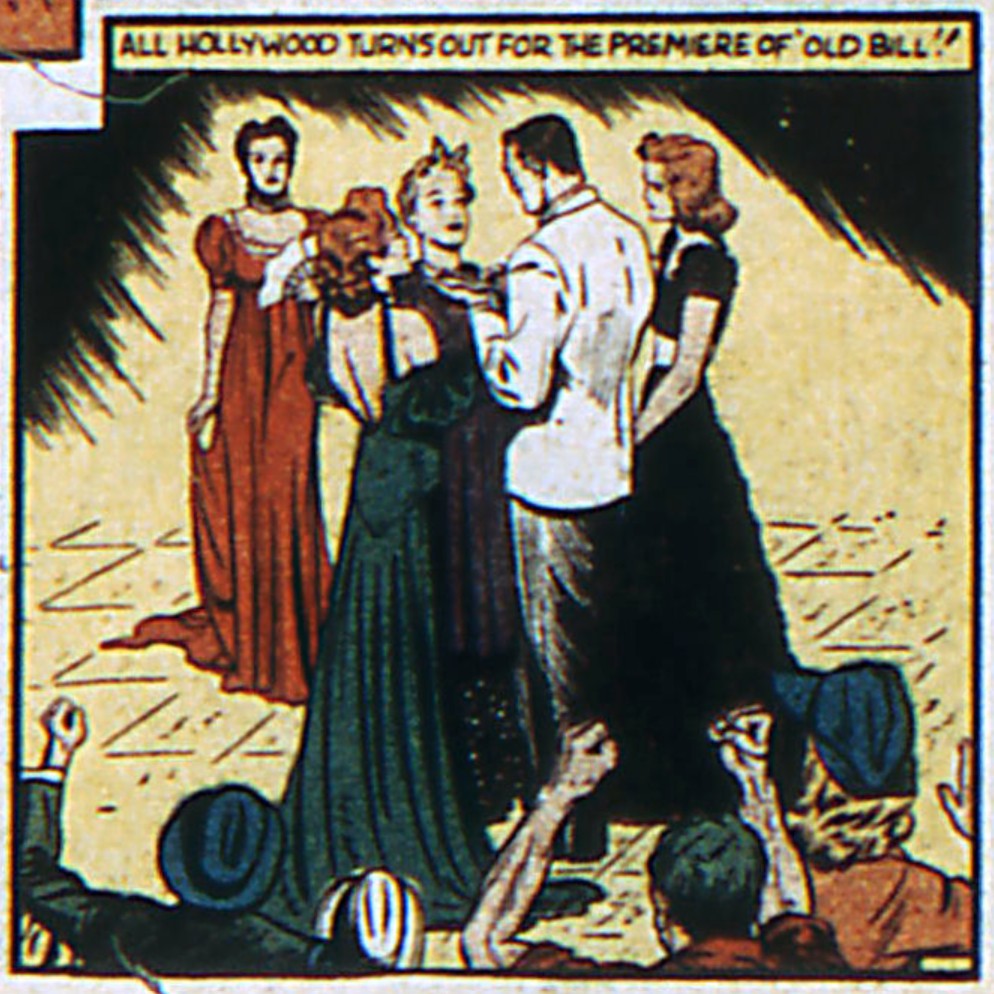
    We have no information at all about Old Bill. It has a pretty big premiere for a movie with such a drab name, so it must have something going for it. (Action Comics v1 028, 1940)

    Oriental Horror is the name of the hit movie that made Barry Moore’s name just before he quit acting, moved back to Center City to become a police scientist and adopted the identity of the Scarlet Seal based on the yellowface character he played in the movie. I would venture a guess that the film is not considered an enduring classic in the present day DC Universe. (Smash Comics 016, 1940)

    She Made Him Love Her! is the name of a romantic movie attended by Sisty and Dinky, aka the daughter of the future Red Tornado and the brother of teen cartoonist Scribbly, aka the future Cyclone Kids, after the former falls in undying love with the latter. And to be fair to her the duo are canonicall later married, so this is a proven tactic. Eventually.

    The movie itself might be loosely based on the film They Knew What They Wanted, or I might be grasping at straws. (All-American Comics 012, 1940)

  • PROBLEMATIC ROUND-UP 007

    Damn their problematic hides!

    Rango: 

    A former Vaudeville magician who employs a magical gem and some rubberoid mask blackface to establish himself as medicine man/bandit chief in Africa, Rango aka Harrigan is ultimately unmasked by Yarko the Great. (Wonderworld Comics 015, 1940) 

    Unnamed Witch Doctor: 

    This unnamed Haitian witch doctor has a very unusual scheme: blind entire American cities with a floating vision of some of his men and then loot those same cities of all of their diamonds. Why diamonds specifically? No clue. He is also notable for giving Zambini the Miracle Man a harder time than Satan himself, before eventually being killed, just like Satan himself. (Zip Comics 005, 1940)

    War Hatchet: 

    Fascist spies striking at the US by inciting Native American tribes to violence is unfortunately going to crop up more than a couple of times as we make our way through the comics of the Forties (and I reckon that the same plot will be recycled with Commie spies in the Fifties and Sixties, alas). This time, the plot is spearheaded by a fellow who calls himself War Hatchet, a European ex-pat turned bandit chief who has returned to the fold to do some espionage work for the dear old unnamed fatherland. 

    As is often the case, War Hatchet makes an okay argument for the colonized to rise up against their oppressors, only with a bunch of murder appended and the unspoken coda that there will be new oppressors later on. Spy Smasher not only stabs him to death but chucks him into a fire afterward. (Spy Smasher 001, 1941)

    the Yellow Horde: 

    The Yellow Horde is a gang of guys in cool looking yellow suits who break into defense plants and shoot poison gas balls everywhere. They turn out to be Chinese, and while the name is arguably in reference to the cool suits I just can’t bring myself to trust 1940s America not to get a little bit of racism in for fun.

    The Yellow Horde’s boss turns out to be an unnamed costumed Nazi who is pretending to be Chinese but also forcing the Horde into doing his bidding. why both? Who knows. Ultimately he gets beaten up by the Hood. (Cat-Man Comics 005, 1941)

  • PROBLEMATIC ROUND-UP 007

    Damn their problematic hides!

    Rango: 

    A former Vaudeville magician who employs a magical gem and some rubberoid mask blackface to establish himself as medicine man/bandit chief in Africa, Rango aka Harrigan is ultimately unmasked by Yarko the Great. (Wonderworld Comics 015, 1940) 

    Unnamed Witch Doctor: 

    This unnamed Haitian witch doctor has a very unusual scheme: blind entire American cities with a floating vision of some of his men and then loot those same cities of all of their diamonds. Why diamonds specifically? No clue. He is also notable for giving Zambini the Miracle Man a harder time than Satan himself, before eventually being killed, just like Satan himself. (Zip Comics 005, 1940)

    War Hatchet: 

    Fascist spies striking at the US by inciting Native American tribes to violence is unfortunately going to crop up more than a couple of times as we make our way through the comics of the Forties (and I reckon that the same plot will be recycled with Commie spies in the Fifties and Sixties, alas). This time, the plot is spearheaded by a fellow who calls himself War Hatchet, a European ex-pat turned bandit chief who has returned to the fold to do some espionage work for the dear old unnamed fatherland. 

    As is often the case, War Hatchet makes an okay argument for the colonized to rise up against their oppressors, only with a bunch of murder appended and the unspoken coda that there will be new oppressors later on. Spy Smasher not only stabs him to death but chucks him into a fire afterward. (Spy Smasher 001, 1941)

    the Yellow Horde: 

    The Yellow Horde is a gang of guys in cool looking yellow suits who break into defense plants and shoot poison gas balls everywhere. They turn out to be Chinese, and while the name is arguably in reference to the cool suits I just can’t bring myself to trust 1940s America not to get a little bit of racism in for fun.

    The Yellow Horde’s boss turns out to be an unnamed costumed Nazi who is pretending to be Chinese but also forcing the Horde into doing his bidding. why both? Who knows. Ultimately he gets beaten up by the Hood. (Cat-Man Comics 005, 1941)

  • FASCIST GOON CLEARING HOUSE 012

    I know we’re all tired of fascist, but these are fake, historical fascists who get beat up, so it’s cathartic at least. 

    the Blitzys:


    The Blitzys, aka the Yellowshirts, have a never-clearly-articulated plan to divide American society by beating people up for not joining the Army. I assume that there must be more to it than that but the focus of the adventure is not on Spy Smasher beating up these particular fascists (though beat them he does) but in avoiding them long enough to get to Washington and warn the President about this fifth column activity. (Whiz Comics 020, 1941)

    The Blitzys, armed with a completely silent bomber plane, continue to vex Spy Smasher and America on behalf of their boss the War Lord through to Whiz Comics 022, when their leader Kurt Bund is finally run to ground in his base underneath a local cemetery and properly walloped.

    Categorized in: Crime as Theme (Naziism), Objects (Shirts)

    the Ring:

    A gang of airplane saboteurs with so little assigned motivation that they might as well be in it for the love of the game, the Ring is undone by FBI agent Dick Star and his aide, the unusually-named Pinky Dink. (Bang-Up Comics 001, 1941)

    Categorized in: Generica (Rings), Ideologies (Crypto-Fascists)

    Unnamed Giant Robot Unit: 

    Eventually the comic timeline that I’m working on is going to get to the point that the US is World War II, and the flow of vague Nazi-adjacent antagonist groups is going to dry up and be replaced mainly with overt Nazi and Japanese super-villains. Does this mean the end of the Fascict Goon Round-Up? surely not, because there needs to be a place to document the weird over-the-top schemes that the comic book version of the Axis powers get up to.

    Take this one: two enormous robots rise out of the depth of New York Harbor and destroy a patrol boat before stomping into the city proper. 

    Then, after making their way downtown, they disgorge a bunch of Nazi soldiers to… do something. Honestly it’s unclear what these guys are up to and more to the point just what havoc they could raise that a giant Robot couldn’t. In any case they don’t have long on the ground before they are beaten up by the Flag-Man and Rusty. 

    All this action in the city is especially baffling as the actual plan is to blow up a chunk of the US fleet with a minefield. Maaaybe the idea is to draw them in with the giant robot attack? In any case, the Flag-Man steers one of the robots into the minefield and takes care of the entire problem with one huge explosion. (Captain Aero Comics 001, 1941)

    Categorized in: Accessories (Mecha)

    the Swastika Council:

    It’s not entirely clear just what kind of fascist group the Swastika Council is, thanks to the fact that their sole appearance concerns the fact that David Merrywether, aka the Cat-Man, is about to expose their membership to the papers and their efforts to prevent him from doing that. My money’s on them being some sort of fifth columnists. (Cat-Man Comics 004, 1941)

    Categorized in: Crime as Theme (Naziism), Generica (Councils)

  • FASCIST GOON CLEARING HOUSE 012

    I know we’re all tired of fascist, but these are fake, historical fascists who get beat up, so it’s cathartic at least. 

    the Blitzys:


    The Blitzys, aka the Yellowshirts, have a never-clearly-articulated plan to divide American society by beating people up for not joining the Army. I assume that there must be more to it than that but the focus of the adventure is not on Spy Smasher beating up these particular fascists (though beat them he does) but in avoiding them long enough to get to Washington and warn the President about this fifth column activity. (Whiz Comics 020, 1941)

    The Blitzys, armed with a completely silent bomber plane, continue to vex Spy Smasher and America on behalf of their boss the War Lord through to Whiz Comics 022, when their leader Kurt Bund is finally run to ground in his base underneath a local cemetery and properly walloped.

    Categorized in: Crime as Theme (Naziism), Objects (Shirts)

    the Ring:

    A gang of airplane saboteurs with so little assigned motivation that they might as well be in it for the love of the game, the Ring is undone by FBI agent Dick Star and his aide, the unusually-named Pinky Dink. (Bang-Up Comics 001, 1941)

    Categorized in: Generica (Rings), Ideologies (Crypto-Fascists)

    Unnamed Giant Robot Unit: 

    Eventually the comic timeline that I’m working on is going to get to the point that the US is World War II, and the flow of vague Nazi-adjacent antagonist groups is going to dry up and be replaced mainly with overt Nazi and Japanese super-villains. Does this mean the end of the Fascict Goon Round-Up? surely not, because there needs to be a place to document the weird over-the-top schemes that the comic book version of the Axis powers get up to.

    Take this one: two enormous robots rise out of the depth of New York Harbor and destroy a patrol boat before stomping into the city proper. 

    Then, after making their way downtown, they disgorge a bunch of Nazi soldiers to… do something. Honestly it’s unclear what these guys are up to and more to the point just what havoc they could raise that a giant Robot couldn’t. In any case they don’t have long on the ground before they are beaten up by the Flag-Man and Rusty. 

    All this action in the city is especially baffling as the actual plan is to blow up a chunk of the US fleet with a minefield. Maaaybe the idea is to draw them in with the giant robot attack? In any case, the Flag-Man steers one of the robots into the minefield and takes care of the entire problem with one huge explosion. (Captain Aero Comics 001, 1941)

    Categorized in: Accessories (Mecha)

    the Swastika Council:

    It’s not entirely clear just what kind of fascist group the Swastika Council is, thanks to the fact that their sole appearance concerns the fact that David Merrywether, aka the Cat-Man, is about to expose their membership to the papers and their efforts to prevent him from doing that. My money’s on them being some sort of fifth columnists. (Cat-Man Comics 004, 1941)

    Categorized in: Crime as Theme (Naziism), Generica (Councils)

  • GENERIC COSTUMED VILLAIN ROUND-UP 035

    GENERIC COSTUMED VILLAIN ROUND-UP 035

    Not every villain is super and they must learn to accept that.

    Miguel Greeze: 

    He may just be a regular style crooked gambler looking to murder Golden Arrow in order to win a bet, but Miguel Greeze here is decked out in too good a costume to just ignore. Plus it’s impressive that he can make his legs go like that. (Whiz Comics 023, 1941)

    Konrad Schtienker: 

    Fascist assassin Konrad Schtienker is all-in on a tobacco product theme: he uses a tobacco shop as his HQ, kills government agents via packets of the ominously-named Blood-Tipped brand cigarettes (not that the cigarettes do the killing – they just serve as a way to release a mosquito containing a serum that compels fatal bouts of sleepwalking into the targets’ rooms) and even employs single-shot cigar guns to get out of jams. Too bad for him that Spy Smasher doesn’t smoke. (Whiz Comics 023, 1941)

    Black Rufus: 

    There are three things to note about this fellow:

    1. His name is Black Rufus. It’s much more charming than menacing.

    2. I like his look. The hunched posture combined with the mantle/poncho/thing give him a real vulture-like air.

    3. He is the only villain faced by one-hit wonder the Rainbow, which I always find endearing. Did he ever get out of jail and take his revenge? We shall never know. (The Arrow 003, 1941)

    the Leader: 

    It’s time for yet another Nazi spymaster named the Leader! This Leader is a fellow named Phil Rogers, and he’s after a new super-bomb developed by one Professor Andrews for the US military, while wearing what I would describe as a charmingly homemade-looking hood if it didn’t have a swastika on the forehead. He fails of course, because he is entirely unprepared to deal with a completely invisible Solar, Master of Magic. (Captain Aero Comics 001, 1941)

  • MINOR SUPER-VILLAIN 910: HERR GLOOBELS

    (Whiz Comics 024, 1941)

    Herr Gloobels is a mysterious and somewhat gruesome figure who murders a motorcycle messenger in order to get ahold of some troop transport schedules and then murders a second one to get them again after Spy Smasher recovers them from the first theft. He does all of this using his Tornado Gun, a device that seems to be a ray gun but which actually fires beams of compressed air that can sink a ship as easily as perforate a hapless guard. 

    Herr Gloobels’ generally chaotic nature leaves us with a number of questions, the most narratively pressing of which is: is this guy a spy or what? There’s no real talk of the War Lord or any other Axis stand-in and Gloobels seems to be driven by scientific megalomania as much as any desire to advance the cause of world fascism. Maybe he’s just wacky.

    The second question is of course: what’s the deal with Gloobels’ assistant Hugo? Is he a trained gorilla? An ape-man? Something more racist? It’s never specified.

    Thirdly: just why does he look so much like a Basil Wolverton character in that last panel? Don’t get me wrong: it’s a good look! It’s just not quite what he looks like the rest of the time.

    After a spirited melee in Gloobels’ lighthouse HQ, Hugo ends up taking a Tornado Gun blast meant for Spy Smasher and is sent to his final reward. This seems to take the wind out of Gloobels’ sails and he surrenders without further incident – a surprising demonstration of affection for a henchman, particularly for a homicidal scientist type like Gloobels. The Tornado Gun is supposedly turned over to the US military for study, but as with all of these captured super-villain weapons they seemingly put their worst men on the job because the Allied forces continued to rely on plain old bullets.

  • MINOR SUPER-VILLAIN 903: SMASHER SPY

    (Whiz Comics 015, 1941)

    As seen in his recent update, Spy Smasher’s arch-foe the Mask eventually gets a bit too good at villainy for his own sake. While he succeeds at warping Spy Smasher’s mind and turning him against the US government that he once sought only to defend, the Mask’s enthusiasm means that he is a bit too loose with his commands to “Kill! Kill! Kill!” meaning that the first that Spy Smasher does is to kill the Mask.

    Spy Smasher’s fervour for his new mission is intense, driven as it is by the Mask’s mind control. He starts blowing up arsenals and machine gunning defense meetings across the country, much to the despair of his erstwhile allies Eve and Admiral Corby.

    Though he is mostly still called Spy Smasher throughout the four issues in which he is evilized, there are a couple of instances of “Smasher Spy” instead and so we shall be using that name for clarity’s sake.

    There’s a lot of cool and interesting stuff happening with regard to Smasher Spy: having a hero become a villain, having such a huge change to the status quo persist over several issues, plus the fact that Smasher Spy is technically a Captain Marvel villain due to the fact that Whiz Comics 016-018 are in fact a crossover event! How very exciting! 

    So: from Whiz Comics 016 to 018, both the “Captain Marvel” and “Spy Smasher” features are concerned with the ongoing efforts of the former to capture the latter and restore him to his heroic ways. A lot of it plays out like the above, with Captain Marvel showing up in time to foil but not capture Smasher Spy. Rather than detail each individual plot, here’s a list of Smasher Spy’s nefarious undertakings:

    – Organizing a mass breakout of Federal Penetentiary

    – Stealing plans from a defense committee meeting and leaving a bomb to kill the committee members

    – Delivering those plans to a fascist submarine (and then sinking that submarine when Captain Marvel turns out to be on board)

    – Stealing a super poison gas and attempting to wipe out the US Army with it

    – Kidnapping and hypnotizing a busload of factory workers into helping him develop super-weapons 

    – Building a fleet in order to conquer and destroy all national governments 

    – Attempted murders: Admiral Corby x2, Captain Marvel x5, Eve Corby x4, Sterling Morris x1

    – Misc destruction: one aircraft factory, two arsenals, two bridges, one dam, one train derailment, one warship sunk

    Captain Marvel eventually allows himself to be captured by Smasher Spy as an intelligence-gathering exercise and so finds out about the Mask’s hypno-chair/brain-o-graph when it is unsuccessfully used in an attempt to turn him evil too. (Whiz Comics 016, 1941) 

    Smasher Spy is also the inventor of the nefarious Banana Bomb, which he uses in one of his attempts to murder Eve Corby. (Whiz Comics 016, 1941)

    Perhaps the Smasher Spy’s greatest creation, this giant motorized lawnmower vehicle was intended to shred whole armies. Truly a magnificent entry into the ranks of the giant superweapon. (Whiz Comics 017, 1941)

    There’s only so long that even a crafty fellow like Smasher Spy can escape the World’s Mightiest Mortal, however, and after a quick Billy Batson trip up the Gyro-Sub’s torpedo tube he is in super-custody.

    In a last-ditch effort to stay true to his programming, Smasher Spy destroys the hypno-chair, but Captain Marvel’s determination to restore him is such that he unlocks a hitherto-unknown power of super-hypnosis and restores his mind by pure will alone.

     Smasher Spy is no more! A symbolic sunrise occurs as our heroes share a manly handshake! Huzzah!

  • MINOR SUPER-VILLAIN 044 UPDATE: THE MASK 1941

    Some highlights of the Mask‘s career c. 1941.

    The Mask starts off 1941 with a bag, quite literally, as he attempts to blow up a munitions factory with FDR inside of it. (Whiz Comics 012, 1941)

    He’s at it again in the next issue, with another plot to kill FDR – this time by dropping a time bomb on the roof of the White House. He’s an ambitious guy, the Mask. Fortunately for the President, he is also a guy who sets his bomb timers way to long, giving Spy Smasher plenty of time to defuse. (Whiz Comics 013, 1941)

    In his second-to-last appearance, the Mask uses mind control technology in concert with a huge goon named Grosso, to capture US officials and force them to divulge government secrets before sending them off to kill themselves. 

    This scheme is fairly air-tight and the Mask might have gotten away scot-free with a pocket full of secrets if he hadn’t gotten too greedy and kidnapped Eve Corby in an attempt to learn Spy Smasher’s secret identity from her. Spy Smasher shows up to prevent this and in the subsequent scuffle Grosso ends up in the hypno-chair, where he is given two commands: “kill Spy Smasher” and “Spy Smasher is the one in the white mask.” The Mask is then seemingly flung to his death. (Whiz Comics 014, 1941)  

    The next issue, however, we learn that he is alive after all! He is just very, very hurt! Despite this, the Mask captures Spy Smasher via ruse and finally learns his secret identity as Alan Armstrong! This is also incidentally the first time that we the reader learn that Armstrong is Spy Smasher, though as I have mentioned before he is literally the only possible suspect, assuming that he’s not just some guy.

    The Mask’s next move must have felt like a real no-brainer at the time: using the new and improved mind control device (the Brain-o-Graph, natch) he turns the former champion of the US Government into its enemy. This works, and Spy Smasher becomes the wicked Smasher Spy (something he is only actually called a couple of times, but a useful way to differentiate the good and evil versions of the character so I’m using it), and will remain that way for a while. The Mask’s triumph is tarnished somewhat by the fact that he went a little too hard on the brainwashing, meaning that he is the first victim of Smasher Spy’s murderous rampage. Proper safety procedures while creating unstoppable killing machines: they’re important. (Whiz Comics 015, 1941)