The Curse of Skeleton Munroe

Category: alien

  • MINOR SUPER-VILLAIN 727: VOLTON

    (Science Comics 006, 1940)

    In the Science Comics 005, Dynamo develops his Brain-Wave Trap helmet which allows him to read the minds of everyone on Earth. Now, only one issue later, we discover that the range of this device is in fact interstellar, and furthermore that Dynamo can travel to other stars, as he receives a call for help from King Berin of Betelguese (sic) and gets himself there almost instantly – that’s somewhere between four and six hundred light years, folks! 

    (assuming that this is the same Betelgeuse as we all know and love – aside from the fact that it’s spelled slightly differently, it’s pretty consistently referred to as a planet instead of a star. Whatever the case, it’s still an impressive expansion of the range of Dynamo’s power)

    Dynamo asserts his heroic privilege by instantly determining which of two warring forces to side with and drives Volton’s attacking army from the field. Luckily, Volton is indeed the evil one of the two, as evidenced by the very creepy way he goes about abducting King Berin’s daughter Princess Glama.

    Here’s where I lay out my real problem with Volton: when Dynamo first shows up, Volton is deploying his Lightning Men to attack King Berin’s fortifications with their Electrode and Lightning Guns, and even his dang name is Volton. In short, I though that he was going to be another electricity powered guy and that we would see Dynamo in some sort of electric duel or similar. Instead, Volton’s personal theme is way more vulture-centric and electricity just seems to be a hobby of his, to the extent that he doesn’t consider all of the ramifications of trying to electrocute a depowered Dynamo to death and ends up being firmly punched out by a repowered Dynamo.

    There follows a 2.5 page interlude featuring what I will call an inexplicable and disastrous decision by Dynamo, as he transport Volton back to Earth with him and offers him a second chance, only for Volton to immediately blow up an entire city while gearing up for an attempt to take over our planet. Like, one panel immediately. Just why did Dynamo do this? Pagecount, I assume.

    Dynamo’s faith in alternative forms of justice is forever shattered by this experience, and Volton quickly finds himself hurtling headfirst into a Betelguesian prison.

  • MAD AND CRIMINAL SCIENTIST ROUND-UP 015

    They can’t help themselves and/or they’re choosing to be horrible.

    Dr Zynnon has been asked along to help Dr Curan, his daughter Sandra and protagonist Buzz Crandall in their mission to prevent the Moon from exploding, presumably dooming us all. This turns out to be a Bad Choice, because unbeknownst to all, Dr Zynnon harbours a deep misanthropy and would love nothing more than for the world to be doomed.

    Despite the fact that I love not being scoured from the face of the planet by hurtling lunar debris I must give Zynnon credit for one of the most adorable doomsday devices ever conceived of: tiny moon lizard carrying vials of acid powerful enough to bring down the roof of the lunar cavern the bulk of the adventure takes place in. Powerful enough, that is, if they were delivered to the correct location. Which they weren’t, presumably because Zynnon didn’t bother to train or condition them in any way and just let loose as many lizards as he could smuggle onto the moon bathysphere under his coat. In the end, the only casualty of Zynnon’s plot was Zynnon himself. (Planet Comics 004, 1940)

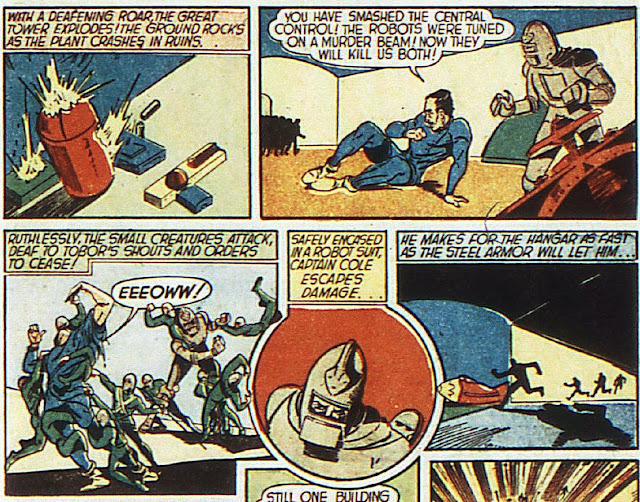
    Tobor the Evil is a Plutonian scientist who has been using an army of child-sized robots to steal Martian gold, with the end goal of conquering Mars and making it a Plutonian territory. With the help of Captain Nelson Cole of the Solar Force, he learns two important lessons about fielding robot armies: 1) don’t leave robot shells that can be repurposed into armour by your foes just lying around, and 2) if your robots have an “indiscriminate murder” setting, make sure to build in a failsafe that excludes yourself from the list of viable targets. (Planet Comics 008, 1940)

    Von Dorf, a mad physiologist and asylum escapee, was so singularly obsessed with the hybridization of humans and panthers that he kidnapped a nurse and turned her into Marga the Panther Woman. It’s likely that he would have his own numbered entry on the Minor Super-Villain list if literally the only other things he ever did weren’t a) get his ass kicked and b) blow himself up. Truly being part of an origin story is the most hazardous job in comics. (Science Comics 001, 1940)

    Dr Passendorf here managed to perfect the quite respectable criminal science inventions of a mind control device and a paralysis ray and then had to lower himself to using both in the employ of a shifty Wall Street jerk named Augustus Elba who needed to cover up some light embezzlement. Just as well that he ends up riddled with shrapnel after the Eagle blows up his machine – the roasting at the next Criminal Science Convention would have been severe. (Science Comics 005, 1940)

  • MINOR SUPER-VILLAIN 724: BONTO OF DUOTANIA

    MINOR SUPER-VILLAIN 724: BONTO OF DUOTANIA

    (Science Comics 004, 1940) 

    Perisphere Payne, a kind of outer space troubleshooter (whose name, by the way, was meant to sound cool and futuristic but because the Perisphere was one of the cool and futuristic building-mascots of the 1939 World’s Fair is in fact equivalent to someone today calling themselves Crystal Palace Collins, Parthenon Pete, or indeed Perisphere Payne) gets a wild alert on his televizo one day: the entire city of Freeton has been levitated off the surface of the Earth! Setting off in hot city-pursuit, Payne finds not only the city but he and his crew are captives in an enormous spaceship.

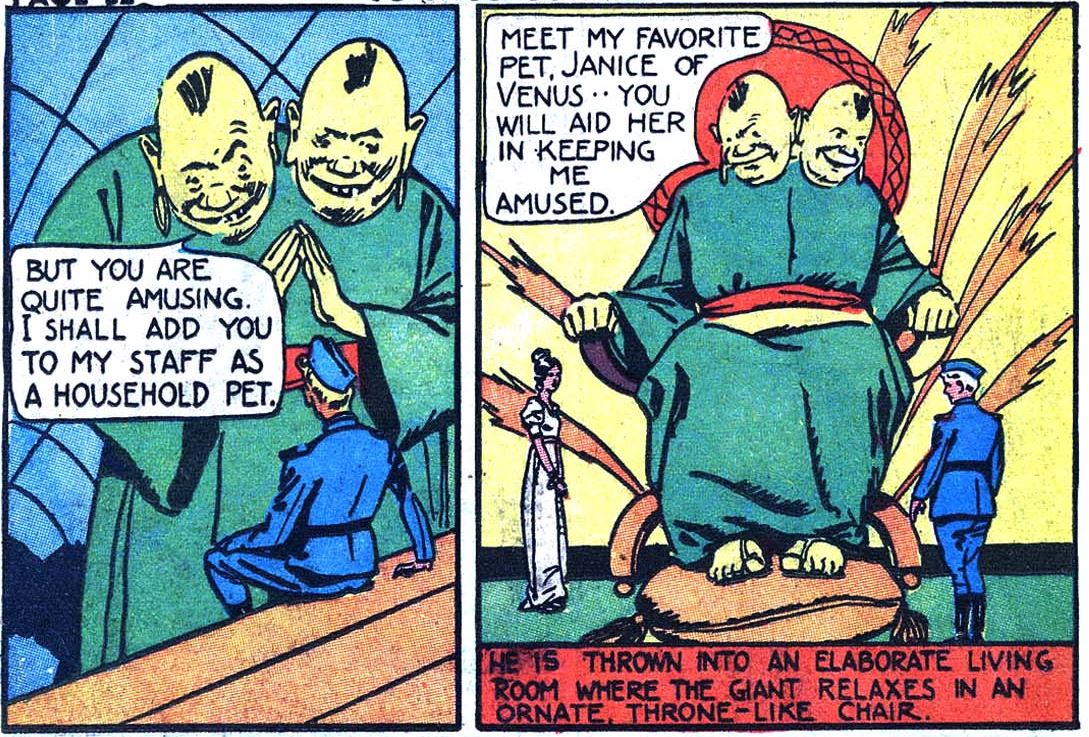
    All questions of  who exactly is responsible for this are cleared up by the appearance of Bonto of Duotania, a giant two-headed alien and generally jolly guy.

    Payne’s bluster earns him a place as one of Bonto’s pets, and en route he gets the lowdown from another pet, Janice of Venus: Bonto and his people come from the twin asteroids of Jutania (presumably aka Duotania) and are blessed not only with a second head and increased size but also an overabundance of cruelty and selfishness. He has captured Freeton as a source of slaves, with the slight implication that the rest of humanity will follow. (Please not also Bonto’s cool two-headed Jutanian pets)

    The real practical problem with using slave labour to run your high-tech society, of course, is that your slaves will inevitably have to learn how to use your high-tech equipment if you want everything to be done as efficiently as you are used to, which is how Perisphere Payne becomes proficient enough in the use of Bonto’s magnetic tractor beam that he is able not only to deposit Freeton back in the giant spaceship for transport back to Earth but also do a cheeky alien genocide on his way out the door. I’m shaking my finger at you, Perisphere Payne – this might be a standard heroic move in the 1940s but as an enlightened future-man you ought to know better.

  • MINOR SUPER-VILLAIN 723: IAKO

    (Science Comics 004, 1940)

    Cosmic Carson is a fairly generic space hero whose main distinction up to this point was that each issue he fought a different kind of alien with a cool species name (from Science Comics 001 and going forward: the Fang-Men of Jupiter, the Skull-Men and the Hoof-Men), but other than that he wasn’t really of interest to us on this here blog. Until now, that is, because Science Comics 004 features a Cosmic Carson adventure illustrated and possibly written by the King himself, Jack Kirby.

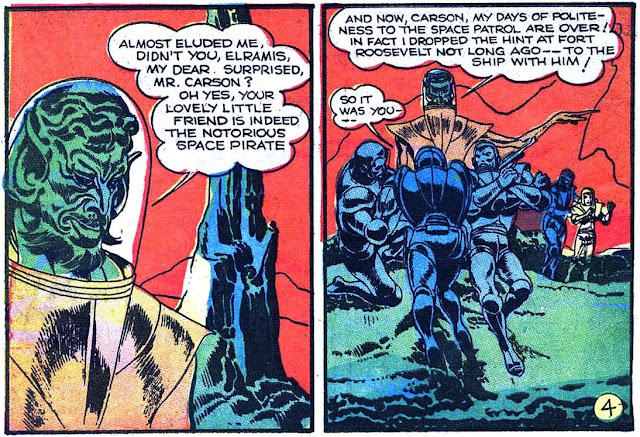
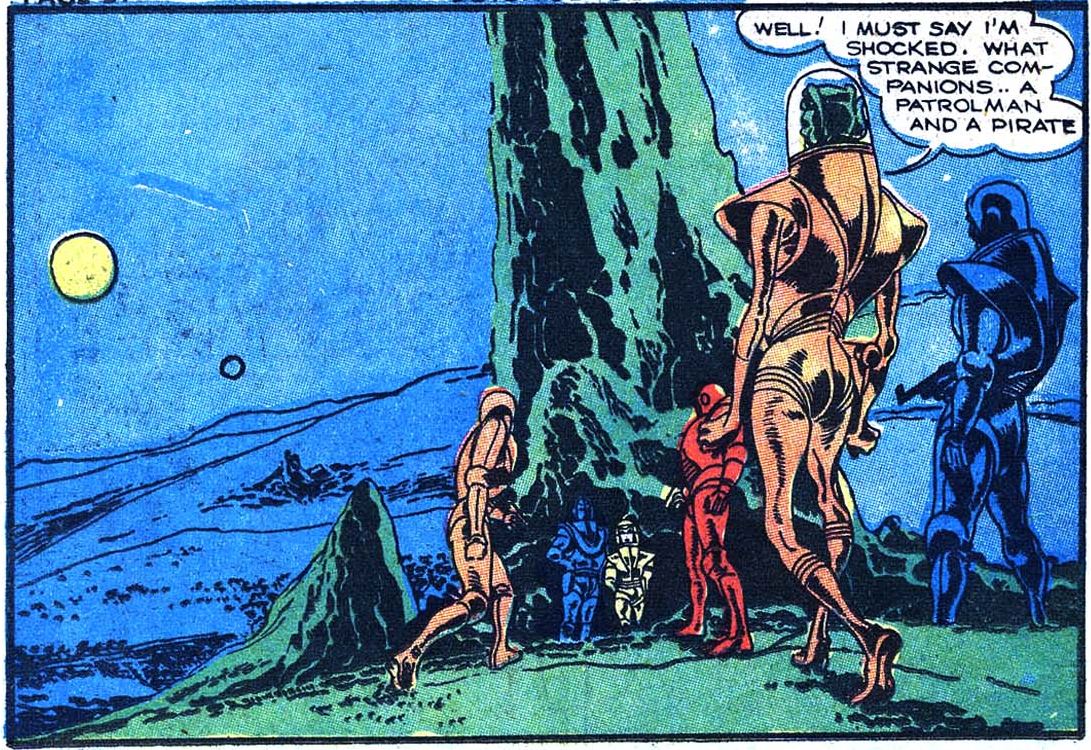
    So: Fort Roosevelt on Mars has been destroyed, and Cosmic Carson is convinced that it was the work of the space pirate Elramis. While hunting for her, he encounters a lone space-suited figure engaged in a firefight with what turns out to be a bunch of thought-controlled androids belonging to the Saturnian trader Iako which causes Iako to jump straight to the top of Carson’s list of suspects.

    While Carson gets some credit for working out the identity of the culprit about five minutes before Iako himself shows up to lay out his entire plan, he loses much more for failing to realize that the woman he had just been battling robots with was in fact Elramis, the original object of his investigations. Perhaps Mars is just the kind of place where that isn’t a remarkable occurrence, but even so he might have checked.

    Iako and Elramis have some sort of thing going on, but the nature of what exactly it is is not explored in the course of the story. The upshot of it, whatever it is, is that Elramis is left to her own devices once everyone is back on Iako’s ship while Cosmic Carson is in for some sort of deathtrap, if Iako has anything to say about it. Thanks to a bit of psychological manipulation on Elramis’ part, however, Carson is able to turn the tables on Iako in a very satisfying looking headlock.

    Sadly there was no second instalment of this particular story so we will never know just why Elramis has taken over the ship or what the ultimate fate of Iako would be. Or, for that matter, why the colourist refused to colour the neck part of Elramis’ spacesuit so that it didn’t look like she had a weird seam under her jawline.

  • MINOR SUPER-VILLAIN 723: IAKO

    MINOR SUPER-VILLAIN 723: IAKO

    (Science Comics 004, 1940)

    Cosmic Carson is a fairly generic space hero whose main distinction up to this point was that each issue he fought a different kind of alien with a cool species name (from Science Comics 001 and going forward: the Fang-Men of Jupiter, the Skull-Men and the Hoof-Men), but other than that he wasn’t really of interest to us on this here blog. Until now, that is, because Science Comics 004 features a Cosmic Carson adventure illustrated and possibly written by the King himself, Jack Kirby.

    So: Fort Roosevelt on Mars has been destroyed, and Cosmic Carson is convinced that it was the work of the space pirate Elramis. While hunting for her, he encounters a lone space-suited figure engaged in a firefight with what turns out to be a bunch of thought-controlled androids belonging to the Saturnian trader Iako which causes Iako to jump straight to the top of Carson’s list of suspects.

    While Carson gets some credit for working out the identity of the culprit about five minutes before Iako himself shows up to lay out his entire plan, he loses much more for failing to realize that the woman he had just been battling robots with was in fact Elramis, the original object of his investigations. Perhaps Mars is just the kind of place where that isn’t a remarkable occurrence, but even so he might have checked.

    Iako and Elramis have some sort of thing going on, but the nature of what exactly it is is not explored in the course of the story. The upshot of it, whatever it is, is that Elramis is left to her own devices once everyone is back on Iako’s ship while Cosmic Carson is in for some sort of deathtrap, if Iako has anything to say about it. Thanks to a bit of psychological manipulation on Elramis’ part, however, Carson is able to turn the tables on Iako in a very satisfying looking headlock.

    Sadly there was no second instalment of this particular story so we will never know just why Elramis has taken over the ship or what the ultimate fate of Iako would be. Or, for that matter, why the colourist refused to colour the neck part of Elramis’ spacesuit so that it didn’t look like she had a weird seam under her jawline.

  • MINOR SUPER-VILLAIN 716: DEVALO

    (Rocket Comics 002, 1940)

    “Rocket Riley, Prince of the Planets” was the namesake strip of Rocket Comics, about lab assistant and pilot Rocket Riley, his boss and amazing hair-haver Professor Sterling and Sterling’s daughter/ Riley’s fiance Griselda. While preparing for an official unveiling of Professor Sterling’s new interplanetary rocket ship, the trio are accosted by spy Kurt von Stengle and his hireling and the whole bunch of them end up accidentally blasting off in the out-of control rocket.

    After a brief stop on an unnamed asteroid where von Stengle’s hireling is eaten by Octopus Men, Rocket and crew end up crash landing on Saturn, where things go even more pear-shaped as they are captured by the planet’s dictatorial ruler, Devalo.

    Devalo, also known as Divalo, has a real Satanic look going on and so I spent some time looking for a classical link between Saturn, Satan, the quality of being saturnine, etc., only to find very little. I’m sure that it’s something I’ve encountered before if only due to a general linking of the more evil-flavoured bits of Greek and Roman mythology and Christian underworld imagery, but there doesn’t seem to be an official-enough link to show up in places like Brewer’s Dictionary of Phrase and Fable, or indeed, Wikipedia.

    Nevertheless, Devalo is both Saturnian and Satanic and I would bet a small sum of money that he won’t be the last character we meet who fits both of those descriptions.

    The Saturnian Saturnite society ruled by Devalo is caste-based, with the military at the top, supported by the enslaved scientist caste. All manual labour is done by the Zeroes, whose bodies have been enhanced and intelligences stunted for maximum efficiency.

    Since von Stengle is the kind of villain who would, for instance, try to commandeer a spacecraft that is currently careening through space, he seizes the opportunity afforded him when everyone is rounded up by Devalo’s men to suggest that they might team up to invade the Earth. Stupidly opportunistic in his evil, that’s von Stengle for you.

    Our heroes manage to escape Devalo’s palace along with Saturnite scientist Xenox and his daughter Ladana, but after an encounter with some Sharkmen the group is scattered and only Rocket and Griselda manage to make it back to Professor Sterling’s ship. And that’s it! Rocket Comics ended with issue 3 and Devalo gets to remain not just uncaptured but firmly in charge. All we can do is rest assured that he would have been deposed in one to ten issues if the series had continued.

  • MINOR SUPER-VILLAIN 714: SKLAR

    (Prize Comics 006, 1940)

    It’s a regular day in Mongol-dominated New-New York City of the year 1982 CE: the people are oppressed in various ways and Power Nelson is around to help them solve some but not all of their problems. Suddenly! A space capsule lands and disgorges a trio of rampaging robots! This is a perfect task for Power Nelson to handle as it it a short-term solution to an immediate problem but very importantly does not require and attempt to change systemic problems. Smashy smashy!

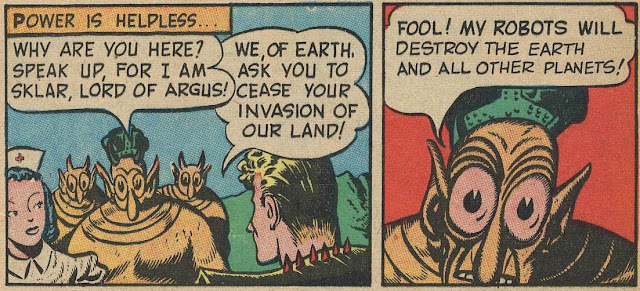
    Nelson’s ally Zora Doone of the Interplanetary Red Cross soon informs him that the robots were sent to Earth from the planet Argus and he speeds there as past as possible, only to find himself outfoxed: Sklar, Lord of Argus has taken Zora hostage, necessitating an escape through the monster-filled Cave of Terror to remove her from danger and pad the pagecount.

    Power Nelson decides that the best solution to Argus’ and Earth’s problems is to depose the unpopular Sklar by way of a revolution, and let me say that this is a very galling thing for him to do. I’ve been bitching and moaning about how Nelson never gets around to freeing the people of Earth from the despotic reign of Seng I, the thing he was created to do, by the way and here he is, 15 minutes into his stay on Argus and elbow deep in revolution? What a piece of work.

    The revolution doesn’t prove to be strictly necessary, as Nelson ends up confronting Sklar one-on-one and just kind of tips him off of his volcano lair into the fiery depths below. I suppose it’s important for the populace to feel like they helped.

    Inspired by this, Nelson bids farewell to Zora Doone and finally, finally heads off to depose Emperor Seng I, a character who, might I remind you, he could crush with one hand and who he stands within five feet of in every single issue of Prize Comics. FINALLY.

    (this is very frustrating on a non-narrative level because the publicly available portions of Prize Comics 007 and 008 do not include the Power Nelson strip and somewhere in those two issues he goes from being a hero of the 1980s to one of the 1940s. Details are scarce, but it seems as though Nelson is flung back in time somehow, but does he actually depose Seng I first? No idea)

  • MINOR SUPER-VILLAIN 714: SKLAR

    (Prize Comics 006, 1940)

    It’s a regular day in Mongol-dominated New-New York City of the year 1982 CE: the people are oppressed in various ways and Power Nelson is around to help them solve some but not all of their problems. Suddenly! A space capsule lands and disgorges a trio of rampaging robots! This is a perfect task for Power Nelson to handle as it it a short-term solution to an immediate problem but very importantly does not require and attempt to change systemic problems. Smashy smashy!

    Nelson’s ally Zora Doone of the Interplanetary Red Cross soon informs him that the robots were sent to Earth from the planet Argus and he speeds there as past as possible, only to find himself outfoxed: Sklar, Lord of Argus has taken Zora hostage, necessitating an escape through the monster-filled Cave of Terror to remove her from danger and pad the pagecount.

    Power Nelson decides that the best solution to Argus’ and Earth’s problems is to depose the unpopular Sklar by way of a revolution, and let me say that this is a very galling thing for him to do. I’ve been bitching and moaning about how Nelson never gets around to freeing the people of Earth from the despotic reign of Seng I, the thing he was created to do, by the way and here he is, 15 minutes into his stay on Argus and elbow deep in revolution? What a piece of work.

    The revolution doesn’t prove to be strictly necessary, as Nelson ends up confronting Sklar one-on-one and just kind of tips him off of his volcano lair into the fiery depths below. I suppose it’s important for the populace to feel like they helped.

    Inspired by this, Nelson bids farewell to Zora Doone and finally, finally heads off to depose Emperor Seng I, a character who, might I remind you, he could crush with one hand and who he stands within five feet of in every single issue of Prize Comics. FINALLY.

    (this is very frustrating on a non-narrative level because the publicly available portions of Prize Comics 007 and 008 do not include the Power Nelson strip and somewhere in those two issues he goes from being a hero of the 1980s to one of the 1940s. Details are scarce, but it seems as though Nelson is flung back in time somehow, but does he actually depose Seng I first? No idea)

  • MINOR SUPER-VILLAIN 711: MAYTUS, KING OF THE BEASTS

    (Prize Comics 005, 1940)

    Late in his first incarnation, Power Nelson makes the acquaintance of Zora Doone, agent of the Interplanetary Red Cross, and the two form a very horny-but-chaste relationship. At her behest, Nelson takes a break from not freeing the people of Earth from the tyrannical rule of Seng I to investigate conditions on planet Ato, where humans are ruled… BY APES!

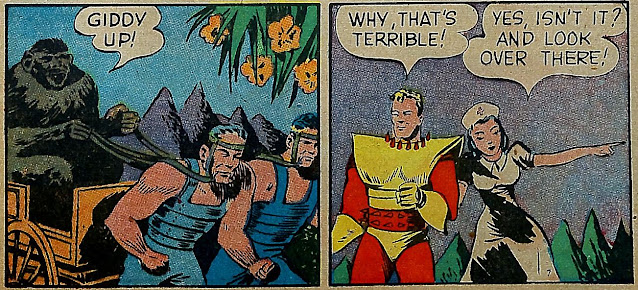
    Yes, it’s a good old fashioned Planet of the Apes situation on Ato. Humans are treated as animals, act as beast of burden, are fed on garbage, etc, while apes get to be cops and wagon-drivers. It just ain’t fair!

    There isn’t really any exploration of why or how exactly the apes are in charge on Ato – the humans seem to be intelligent and verbal and the apes know it… Is this a race thing? It probably is, isn’t it – whether the writer consciously wrote it that way or not it’s got a lot in common with fantasies of white oppression under the heels of the “lesser” races (oh wait, I forgot that this is a comic set in a future in which the West has been conquered by the evil Mongol, isn’t it) . It’s also an interesting bit of commentary on the treatment of animals – that panel of the ape zookeeper feeding its charges garbage straight out of the can speaks of someone who has felt a pang of empathy for a creature in their time.

    King Maytus isn’t really your typical villain, just the head of an oppressive society, but I like his bluster. I also like seeing Power Nelson get mashed up by an elephant for a few panels before he inevitably comes out on top.

    For all my talk of racist allegories above, the situation on Ato is actually resolved far more peacefully than a similar one on a comic set on a Pacific Island would be. Sure Maytus is beaten up and threatened with death, but the story doesn’t end with, say, all of the apes being killed and/or reduced to servitude and/or stripped of their intelligence. In Golden Age comics terms it’s a triumph of diplomacy!

  • MINOR SUPER-VILLAIN 711: MAYTUS, KING OF THE BEASTS

    (Prize Comics 005, 1940)

    Late in his first incarnation, Power Nelson makes the acquaintance of Zora Doone, agent of the Interplanetary Red Cross, and the two form a very horny-but-chaste relationship. At her behest, Nelson takes a break from not freeing the people of Earth from the tyrannical rule of Seng I to investigate conditions on planet Ato, where humans are ruled… BY APES!

    Yes, it’s a good old fashioned Planet of the Apes situation on Ato. Humans are treated as animals, act as beast of burden, are fed on garbage, etc, while apes get to be cops and wagon-drivers. It just ain’t fair!

    There isn’t really any exploration of why or how exactly the apes are in charge on Ato – the humans seem to be intelligent and verbal and the apes know it… Is this a race thing? It probably is, isn’t it – whether the writer consciously wrote it that way or not it’s got a lot in common with fantasies of white oppression under the heels of the “lesser” races (oh wait, I forgot that this is a comic set in a future in which the West has been conquered by the evil Mongol, isn’t it) . It’s also an interesting bit of commentary on the treatment of animals – that panel of the ape zookeeper feeding its charges garbage straight out of the can speaks of someone who has felt a pang of empathy for a creature in their time.

    King Maytus isn’t really your typical villain, just the head of an oppressive society, but I like his bluster. I also like seeing Power Nelson get mashed up by an elephant for a few panels before he inevitably comes out on top.

    For all my talk of racist allegories above, the situation on Ato is actually resolved far more peacefully than a similar one on a comic set on a Pacific Island would be. Sure Maytus is beaten up and threatened with death, but the story doesn’t end with, say, all of the apes being killed and/or reduced to servitude and/or stripped of their intelligence. In Golden Age comics terms it’s a triumph of diplomacy!