The Curse of Skeleton Munroe

Category: alien

  • MINOR SUPER-VILLAIN 710: BLOOR

    (Prize Comics 004, 1940)

    The year is 1982! The world languishes under the heel of a global dictatorship, and the economy is tanking – presumably the Mongols were running a war economy that failed to stand up to the post-world-conquering peace.

    Emperor Seng I offers nothing but empty promises to his subjects, until Power Nelson, as committed as ever to working within the system, bursts in and strongarms him into making… real promises? Frankly, this is Power Nelson at his worst. He was created to remove the dictator’s yoke from around the neck of the people and he consistently works to make the absolute dictator a better leader rather than, say, destroying him utterly. Like, I know that conflict is the essence of storytelling and if Nelson had just broken Seng I’s neck in Prize Comics 001 there would be less of that but… come on, man. Forcing the Emperor to say he’ll make some jobs isn’t going to do anything.

    In fact, Nelson’s threats probably make Seng I more amenable to the offer he receives when he is visited by Bloor, dictator of Uranus. After all, how can Power Nelson complain after thousands of men are given jobs? And how could the Emperor know that they were actually being sold into slavery, wink, wink?

    The men are of course disappointed to learn that they are effectively slaves, to the extent that none of them seem to notice the high-fashion look that their captor is sporting and how much is contrasts with the simple purple pants of the planet’s leader. A bit self-involved, but who am I to judge?
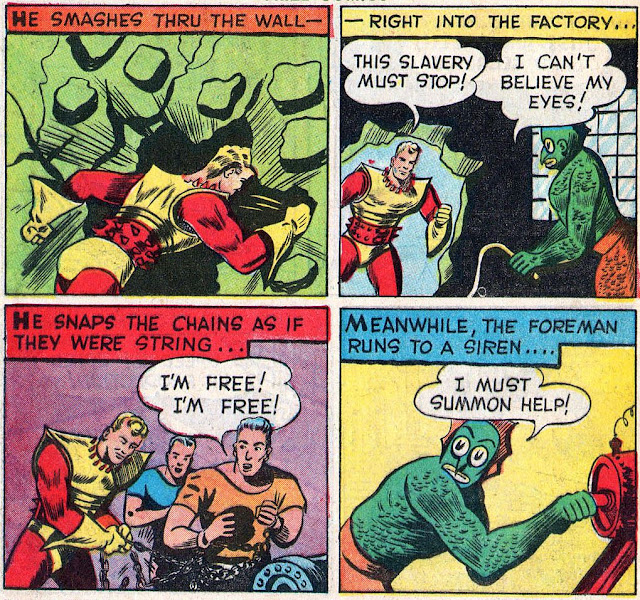
    Power Nelson of course does not abide this, and busts everyone free at the first opportunity. Note also the factory foreman’s look – orange sunburst bonnets must be “in” on Uranus in 1982.

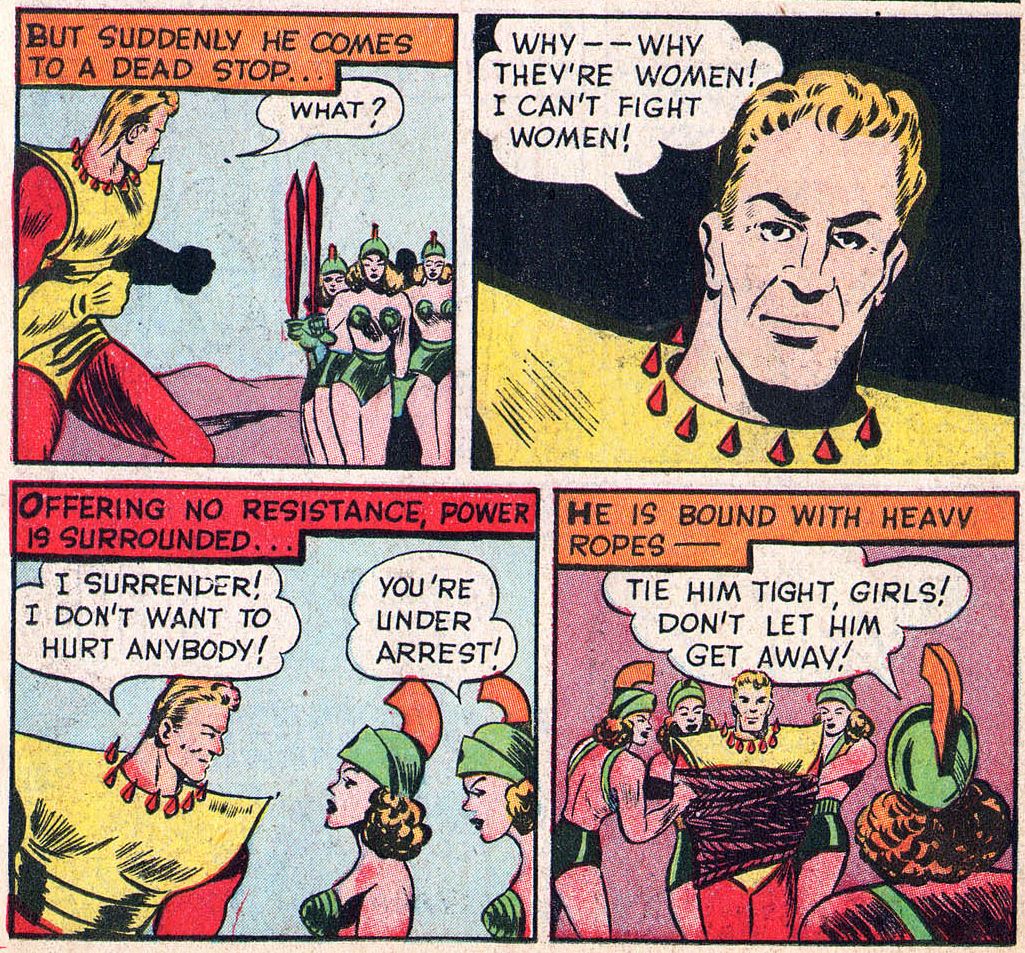
    Power Nelson does not fight women and so Bloor’s strategy to send his Amazon Regiment to capture him really pays off. But who are these Amazons? Is this what female Uranians look like or are they mercenaries from some other planet? Is this a sex thing for Bloor?

    Power Neslon is of course held in place not by ropes but by the power of his own antiquated ideas about gender and he frees himself just in time to get attacked by some really excellent cylindrical robots that, alas, have no visible gender signifiers and are rendered into so much scrap.

    Bloor is forced to release and pay the men, but in keeping with Nelson’s dedication to preserving existing power structures suffers no further consequences. I do really appreciate how committed he is to his role as a manager of Uranus rather than a traditional dictator – he might just be our first villain who operates almost completely from a desk. 

    The men all head home with a week’s wages and I guess that that solves the financial crisis. Everyone is happy under the boot of Seng I. Thanks, Power Nelson!
  • MINOR SUPER-VILLAIN 710: BLOOR

    MINOR SUPER-VILLAIN 710: BLOOR

    (Prize Comics 004, 1940)

    The year is 1982! The world languishes under the heel of a global dictatorship, and the economy is tanking – presumably the Mongols were running a war economy that failed to stand up to the post-world-conquering peace.

    Emperor Seng I offers nothing but empty promises to his subjects, until Power Nelson, as committed as ever to working within the system, bursts in and strongarms him into making… real promises? Frankly, this is Power Nelson at his worst. He was created to remove the dictator’s yoke from around the neck of the people and he consistently works to make the absolute dictator a better leader rather than, say, destroying him utterly. Like, I know that conflict is the essence of storytelling and if Nelson had just broken Seng I’s neck in Prize Comics 001 there would be less of that but… come on, man. Forcing the Emperor to say he’ll make some jobs isn’t going to do anything.

    In fact, Nelson’s threats probably make Seng I more amenable to the offer he receives when he is visited by Bloor, dictator of Uranus. After all, how can Power Nelson complain after thousands of men are given jobs? And how could the Emperor know that they were actually being sold into slavery, wink, wink?

    The men are of course disappointed to learn that they are effectively slaves, to the extent that none of them seem to notice the high-fashion look that their captor is sporting and how much is contrasts with the simple purple pants of the planet’s leader. A bit self-involved, but who am I to judge?

    Power Nelson of course does not abide this, and busts everyone free at the first opportunity. Note also the factory foreman’s look – orange sunburst bonnets must be “in” on Uranus in 1982.

    Power Nelson does not fight women and so Bloor’s strategy to send his Amazon Regiment to capture him really pays off. But who are these Amazons? Is this what female Uranians look like or are they mercenaries from some other planet? Is this a sex thing for Bloor?

    Power Neslon is of course held in place not by ropes but by the power of his own antiquated ideas about gender and he frees himself just in time to get attacked by some really excellent cylindrical robots that, alas, have no visible gender signifiers and are rendered into so much scrap.

    Bloor is forced to release and pay the men, but in keeping with Nelson’s dedication to preserving existing power structures suffers no further consequences. I do really appreciate how committed he is to his role as a manager of Uranus rather than a traditional dictator – he might just be our first villain who operates almost completely from a desk. 

    The men all head home with a week’s wages and I guess that that solves the financial crisis. Everyone is happy under the boot of Seng I. Thanks, Power Nelson!

  • MINOR SUPER-VILLAIN 708: SOPHUS, THE MAD PHILOSOPHER

    (Planet Comics 008, 1940)

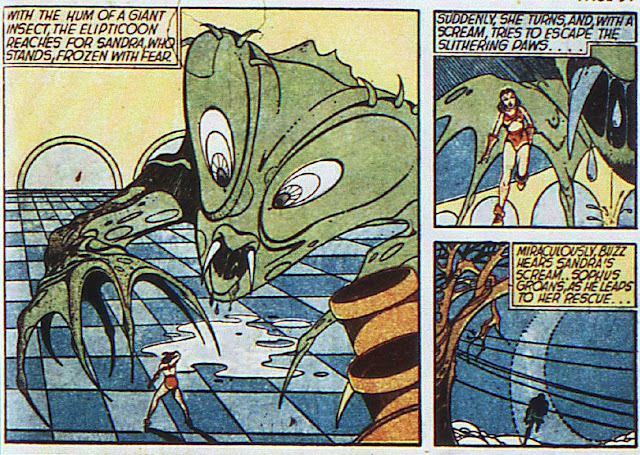
    Once again an adventure begins that most classic sci-fi way: Buzz Crandall and his gal pal Sandra are noodling around in space when they run smack into something, in this case a crystal sphere that houses the secret headquarters of Sophus, the Mad Philosopher.

    I couldn’t tell you what school of philosophy Sophus subscribes to, but it’s one with an intellectual framework that encompasses a) turning other humanoids into mist and keeping them in bottles and b) freaking people out of their gourds by flinging them through a time portal into a crazy abstract weirdscape. Since Sophus is mad, perhaps he’s just taking a philosophy dedicated to helping other improve themselves way too far? Or maybe he took a Philosophy 101 class in university and decided that that was all he needed to be insufferable about his evil interests forever, who knows.

    As Sandra is flung into the timestream and Buzz attempts to rescue her, we get a passable rendition of 1960s Dr Strange-style psychedelia, only in the 1940s. It’s pretty neat, though it does make me pine for what will eventually be.

    Sophus is eventually undone not by the heroes of our story but by his own jerk nature, as his villainous cackling over Buzz and Sandra’s doom is delicious-sounding enough to draw the attention of the Elipticoon, a “giant time entity” that was about to devour Sandra but instead opts for a delicious and attention-grabbing philosopher. All the jarred people are set free, the end.

  • MINOR SUPER-HERO ROUND-UP 036

    Prize Comics time, bay-bee.

    Power Nelson:

    Power Nelson is from the far-off future year of 1982 CE, in which the world has been conquered by the Mongols, but the wink, wink, nudge, nudge kind of Mongols from 1940-1941 where they’re actually supposed to be the Japanese (and for some reason the nation of Mongolia is fair game as far as Explicit Villain Status goes while Japan is still off the table). He has been given super strength by some surprisingly beefy scientists so that he might save civilization from oppression. Three things about Power Nelson:

    1) I think that his first name might actually be Power. So futuristic!

    2) I kind of want to give this series credit for not being too racist but the truth is that it is fairly racist but my senses have been dulled by exposure to the excesses of post Pearl Harbor depictions of the Japanese. 

    3) Power Nelson is very bad at his job? Every issue sees him within striking distance of Emperor Seng I and while assassinating the top man isn’t a guaranteed way to end a regime, it absolutely cannot hurt. Just punch him, man! (Prize Comics 001, 1940)

    Jupiter:

    Jupiter represents two distinct super-hero archetypes: the alien lawman sent to Earth to dispense justice and the magic-user, and as those are two of the more omnipotent origins that a character can have he goes through crooks like a hot knife through butter. The most important question about Jupiter is: was he called Jupiter back on the planet Jupiter or is he adopting a cool new name like a kid at camp? (Prize Comics 001, 1940)

    K the Unknown:

    Douglas Danville, wealthy playboy, takes to the crime-ridden ski slopes as K the Unknown, feared and hunted by ski crooks and ski cops alike. And presumably regular cops and crooks too, but he only had one recorded outing and it took place entirely within the bounds of a ski resort.

    K the Unknown’s one adventure involves embezzlement and murder among the officers of a college alumni group, possibly the perfect case for a wealthy playboy type hero.

    K the Unknown is a great name but perhaps not a great super-hero name, so I can see why he only had on outing. Still, it must be handy to have a calling card that you can piss into the snow. (Prize Comics 001, 1940)

    the Black Owl: 

    It’s hardly unusual for a Golden Age character to make one appearance and then disappear forever, but much more unusually while K the Unknown never had a second adventure his alter ego Doug Danville just kept on trucking under another identity. It’s never explored in the text of the story, so any explanation for why he made the change is an equally valid bit of speculation, from “he wanted a less generic super-hero identity” to “it’s completely different guy named Doug Danville who hangs around with a completely different private eye named Terry Dane.” It turns out that I wrote that last bit prematurely, as in the Black Owl’s second outing his foe is Sigmund Rathko, the crook who was also behind the alumni association shenanigans in the K the Unknown story. I suppose that it could be three completely different people but no, at that point we’re getting silly.

    One thing that you can say for certain is that he didn’t change identities to get the cops off of his back, because they want to get the Black Owl just as much as they did K the Unknown. Moreso, honestly, because K the Unknown was safely carving powder and never even saw a cop. (Prize Comics 002, 1940)

  • MINOR SUPER-HERO ROUND-UP 036

    Prize Comics time, bay-bee.

    Power Nelson:

    Power Nelson is from the far-off future year of 1982 CE, in which the world has been conquered by the Mongols, but the wink, wink, nudge, nudge kind of Mongols from 1940-1941 where they’re actually supposed to be the Japanese (and for some reason the nation of Mongolia is fair game as far as Explicit Villain Status goes while Japan is still off the table). He has been given super strength by some surprisingly beefy scientists so that he might save civilization from oppression. Three things about Power Nelson:

    1) I think that his first name might actually be Power. So futuristic!

    2) I kind of want to give this series credit for not being too racist but the truth is that it is fairly racist but my senses have been dulled by exposure to the excesses of post Pearl Harbor depictions of the Japanese. 

    3) Power Nelson is very bad at his job? Every issue sees him within striking distance of Emperor Seng I and while assassinating the top man isn’t a guaranteed way to end a regime, it absolutely cannot hurt. Just punch him, man! (Prize Comics 001, 1940)

    Jupiter:

    Jupiter represents two distinct super-hero archetypes: the alien lawman sent to Earth to dispense justice and the magic-user, and as those are two of the more omnipotent origins that a character can have he goes through crooks like a hot knife through butter. The most important question about Jupiter is: was he called Jupiter back on the planet Jupiter or is he adopting a cool new name like a kid at camp? (Prize Comics 001, 1940)

    K the Unknown:

    Douglas Danville, wealthy playboy, takes to the crime-ridden ski slopes as K the Unknown, feared and hunted by ski crooks and ski cops alike. And presumably regular cops and crooks too, but he only had one recorded outing and it took place entirely within the bounds of a ski resort.

    K the Unknown’s one adventure involves embezzlement and murder among the officers of a college alumni group, possibly the perfect case for a wealthy playboy type hero.

    K the Unknown is a great name but perhaps not a great super-hero name, so I can see why he only had on outing. Still, it must be handy to have a calling card that you can piss into the snow. (Prize Comics 001, 1940)

    the Black Owl: 

    It’s hardly unusual for a Golden Age character to make one appearance and then disappear forever, but much more unusually while K the Unknown never had a second adventure his alter ego Doug Danville just kept on trucking under another identity. It’s never explored in the text of the story, so any explanation for why he made the change is an equally valid bit of speculation, from “he wanted a less generic super-hero identity” to “it’s completely different guy named Doug Danville who hangs around with a completely different private eye named Terry Dane.” It turns out that I wrote that last bit prematurely, as in the Black Owl’s second outing his foe is Sigmund Rathko, the crook who was also behind the alumni association shenanigans in the K the Unknown story. I suppose that it could be three completely different people but no, at that point we’re getting silly.

    One thing that you can say for certain is that he didn’t change identities to get the cops off of his back, because they want to get the Black Owl just as much as they did K the Unknown. Moreso, honestly, because K the Unknown was safely carving powder and never even saw a cop. (Prize Comics 002, 1940)

  • MINOR SUPER-VILLAIN 706: LEPUS-THE-FIEND

    (Planet Comics 007, 1940) 

    Lepus-the-Fiend has a lot of classic Fletcher Hanks villain qualities: the weirdly hyphenated name, the fact that he lives on a star (to be clear: not a poetic name for a planet. He lives on a five-pointed, flaming star) and of course his hatred of civilization, which is not given a particular motivation so I am left to assume is because he is a hairy and wild looking guy. He’s not the first Hanks character to yell about destroying all the civilized planets but it is his particular phrasing that makes the title of Paul Karasik’s first collection of Hank’s comics.

    Lepus has chosen to destroy civilization in a fairly dramatic fashion, by smashing inhabited planets together like so many pool balls. Effective but fiddly, it seems, as both Earth and Venus are saved by Lepus’ poor aim on his first attempt.

    Lepus-the-Fiend doesn’t get another shot at planet-smashing, as it is at this point that Buzz Crandall and and his aide Sandra really get on top of the adventure and blow him to smithereens. These civilization-haters never seem to be particularly prepared for civilization to defend itself, do they.

    (note the second panel above. This is the answer to a question that had been bouncing around in my head: why would Fletcher Hanks take over an existing character (Buzz Crandall) rather than make up a new one as seems to be his usual modus operandi? Because this was originally a Whirlwind Carter comic that Marvel evidently did not want. We’re solving mysteries here!)

  • MINOR SUPER-VILLAIN 705: ROCKO

    (Planet Comics 005, 1940)

    Rocko is a totally awesome alien (from a species called the Nethermen, a totally awesome name) who looks like a human with one great grandparent who was a toad and dresses in pulp sci-fi armour as he scours the spaceways for a star of sufficient heat to run all of his planet’s industry. Bad luck for humanity: the first adequate star that he manages to find while aimlessly noodling around in space (as opposed to picking one ahead of time and heading directly there) turns out to be our own.

    This comic is a real five-star example of the very muddy understanding of astronomical terminology at play in the comic book sci-fi writing community: the term “universe” is used consistently and with 100% confidence in place of “solar system” (though the other option, that Rocko did in fact come from another universe entirely and that he is so bad at finding stars that he flew right past entire other galaxies of them before bumping into ours, is a tempting one to entertain).

    Earth is of course placed in quite the pickle by the siphoning off of the Sun’s heat, and all of the planet’s hopes and dreams of future survival are placed in the hands of the heroic Space Admiral Curry, who proves that he his the right man for the job by getting into his spaceship and aimlessly noodling around in space hoping to bump into the solution to his problems, just as Rocko had before him. And it works! Curry tracks down the missing solar energy, beats up seemingly every Netherman on the planet and then… leaves without shutting off the heat siphoning machines. For some reason.

    Instead of, again, simply destroying or even turning off the machines that are dooming his planet, Curry comes up with a more complicated plan: he builds his own machines to siphon the energy of the Netherstar and give the Nethermen a taste of their own medicine. This goes pretty well, as all the Nethermen that can flee the planet (leaving the rest to freeze) and the rest are shot down by the Earth spacefleet as they try a last-second invasion. Rocko himself is the only one tomake it all the way to the solar siphons and he falls to a simple deathtrap. Earth is saved! Via genocide!

  • MINOR SUPER-VILLAIN 704: ZIRGO

    (Planet Comics 005, 1940)

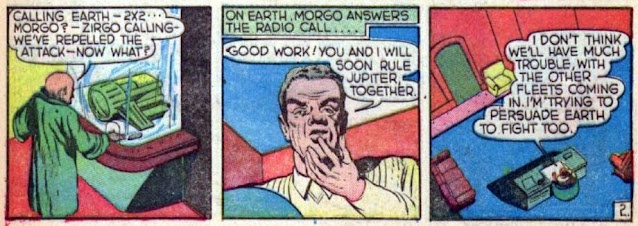
    We’ve seen it before and we’ll see it again: comic book plots spun out of the popular pre-Pearl Harbor US position that America should stay out of the burgeoning European conflict. This time, we’re treated to a political allegory in the far future, as planet Jupiter (Germany, presumably) attacks tiny planetoid Cato (Belgium, I guess) and draws the ire of the rest of the Solar System (the nascent Allied Forces). Many on Earth (America) want to join the anti-Jupiter taskforce, but Captain Nelson Cole advocates caution.

    And he is right to do so!  The entire space war is a ploy by Cato’s ruler Zirgo, in league with Earth munitions king Morgo, to weaken Jupiter sufficiently that they can then step in and take over the larger planet..

    A perfectly reasonable sci-fi plot, but it does fall apart somewhat when scrutinized as an allegory. The US shouldn’t get involved in WWII because it’s just a big set-up by Belgium to weaken Germany in preparation for a counter-invasion? And if the Jovians know about this plan and are in fact only attacking Cato because of it… why attack in the first place? Why not simply expose him?

    Lucky for the Jovians, Captain Nelson Cole is on the case. He exposes Zirgo’s treachery and leads a force to bring down his evil regime, though I’m not sure why this police action is okay when the other was not. Political allegories… are hard.

  • MINOR SUPER-VILLAIN 704: ZIRGO

    (Planet Comics 005, 1940)

    We’ve seen it before and we’ll see it again: comic book plots spun out of the popular pre-Pearl Harbor US position that America should stay out of the burgeoning European conflict. This time, we’re treated to a political allegory in the far future, as planet Jupiter (Germany, presumably) attacks tiny planetoid Cato (Belgium, I guess) and draws the ire of the rest of the Solar System (the nascent Allied Forces). Many on Earth (America) want to join the anti-Jupiter taskforce, but Captain Nelson Cole advocates caution.

    And he is right to do so!  The entire space war is a ploy by Cato’s ruler Zirgo, in league with Earth munitions king Morgo, to weaken Jupiter sufficiently that they can then step in and take over the larger planet..

    A perfectly reasonable sci-fi plot, but it does fall apart somewhat when scrutinized as an allegory. The US shouldn’t get involved in WWII because it’s just a big set-up by Belgium to weaken Germany in preparation for a counter-invasion? And if the Jovians know about this plan and are in fact only attacking Cato because of it… why attack in the first place? Why not simply expose him?

    Lucky for the Jovians, Captain Nelson Cole is on the case. He exposes Zirgo’s treachery and leads a force to bring down his evil regime, though I’m not sure why this police action is okay when the other was not. Political allegories… are hard.

  • MINOR SUPER-VILLAIN 703: THE GREAT INTELLIGENCE

    (Planet Comics 004, 1940)

    Flint Baker and co are making their return trip from Mars and due to an unscheduled diversion to Pluto in Planet Comics 003 they end up passing Jupiter on the way, at which point they are forced to make landfall to avoid an attack by outer space organisms referred to as “stratosphere serpents” despite being more like starfish crossed with octopuses. While there, Flint and gal pal Mimi Wilson do a bit of exploring and discover the city of Zu, inhabited by a wretched mass of oppressed Jovians and ruled over by the Great Intelligence.

    The Great Intelligence is… probably a rogue AI of some description? It watches over the city via the Great Eye, listens with the Great Ear and issues orders with the Great Mouth. It also has flamethrowing capacity. (the reason I hesitate to conclusively say that the Intelligence is a machine is what the Jovian says in the first panel to feature the Great Eye: “our master has lost all human identity.” This could easily be interpreted as a bit of flowery language to describe the declining relationship between the city’s inhabitants and the machines that run it, but how weird and cool would it be if the whole operation was wired into some wizened cyborg in the middle of everything? And as the comic does not bother to resolve the question it could be either, though given the roasting of that poor old man we can at least confirm a distinct lack of humanity)

    Baker manages to fry the Great Eye with his ray gun, upon which we meet the final piece of the city gestalt: its Will, embodied as a bunch of beefy cyborgs.

    For fomenting discord in Zu, Flint and Mimi are  sentenced to death via being ground up and fed to the Great Mouth (and this unusually grotesque method of execution did contribute to my theories about the Intelligence having an at least partially organic makeup, thanks for noticing)! Lucky for them, then, that Mimi stumbles upon the Will’s one weakness: a thin exposed wire at the back of their necks. They escape their fate in the grinder, destroy the Great Ear and Great Mouth, and evacuate the surviving citizens of Zu back to Earth with them. 

    But what of the Great Intelligence itself? Certainly all of its external organs are gone, but the mind itself… who knows?