The Curse of Skeleton Munroe

Category: alien

  • MINOR SUPER-VILLAIN 702: THE DRAGON MAN

    (Planet Comics 003, 1940)

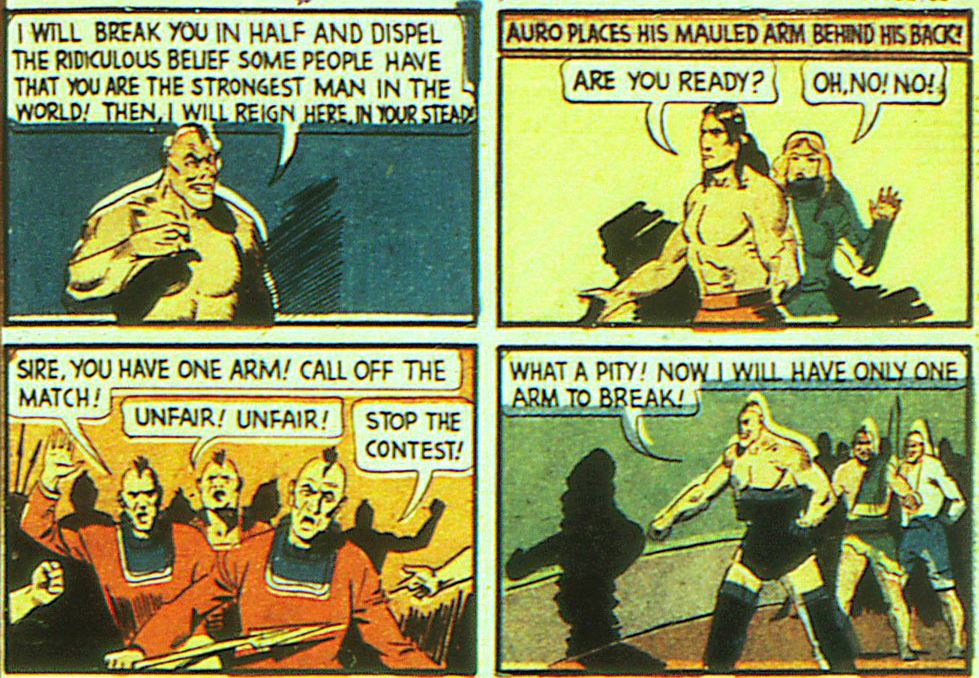
    The work of the Lord of Jupiter is never done, as Auro (Lord of Jupiter, natch) learns one day when he receives the alarming news that a giant flame-breathing dragon has been carrying off dozens of his subjects.

    And indeed, not only is there a dragon running around causing trouble but that dragon is actually a guy who can turn into a dragon and who has used his humanoid powers of reasoning to correctly identify Auro as the biggest threat to his lifestyle. Fortunately for Auro, the power of thought goes hand in hand with the ability to be fooled, and he manages to bluff the Dragon Man into fleeing from a common apple by pretending that it is a grenade.

    Auro sets out to deal with the Dragon Man once and for all and upon finding him learns the reason for his actions: making a kingdom of his own, plus snacks. That really does have to be the one big perk of being an anthropophageous monster – if you’re looking to establish a food supply, a group of humans will organize and try to keep themselves alive. They are more likely to periodically try to kill you than a flock of sheep, though.

    Too late does the Dragon Man learn the important corollary to to plan of “seeking out and preemptively killing the greatest threat to your life,” which is “and then make sure to kill them, because now they know.” Having not followed through, he must perforce be stabbed.

  • MINOR SUPER-VILLAIN 700: RADGIO

    (Planet Comics 003, 1940)

    We open on Spurt Hammond, the Planet-Flyer himself, intercepting an alarming series of images from the planet Mercury. Giants? Explosions? Girls!? What could it all mean?

    It turns out that the girl in question is Princess Zilla, erstwhile ruler of Mercury but recently deposed by her Prime Minister Radgio, who schemes to conquer the world using mutated Mercurians such as the previously-seen giant. Which I suppose strongly implies that Zilla was the ruler of only a part of Mercury – I’m so used to assuming that every sci-fi government is global in nature.

    Zilla and Hammond make their way to Radgio’s fortress and dispose of the unfortunate giant by means of an old reliable method, the portcullis. Move over, Rancor! Make way, two-headed dragon from Willow! there’s a new member of the “Killed by a Falling Portcullis” Club!

    It’s okay though: Radgio is done with boring old giants and has moved on to his ultimate creation, a huge six-armed robot. And unlike many so-called humans-turned-robots in 1940s comics, this isn’t merely a case of extreme mind control but, per the little x-ray cutaway, this poor Mercurian is being mutated into some sort of cybernetic organism with what are possibly horrible organic gears and everything.

    Spurt Hammond bursts in just before Radgio is able to release his creation from where it is shackled to the wall (either as part of the roboticization process or for display purposes, I cannot tell) and, as he believes in ironic punishments, pops the Mercurian into his own machine.

    Radgio is reduced to… somewhere between four inches and a foot in height. But even shrunken so, and nude, he almost manages to turn things back around by assuming voice control of the robot. Unfortunately for him, 1) he failed to make the robot ray gun-proof and it goes down with little effort on Hammond’s part and 2) a nearby rat also has a sense of ironic justice and chows down on his tender Prime Ministerial flesh. Mercury is saved!

  • MINOR SUPER-VILLAIN 699: AGRA

    MINOR SUPER-VILLAIN 699: AGRA

    (Planet Comics 002, 1940)

    We are introduced to Agra when Earth-woman Ava bursts in to Auro. Lord of Jupiter’s court to warn him that Agra intends to kill him. She really talks up Agra’s prowess vis-a-vis elephant- human- and tree-slaying, and hopefully takes the time to describe his outfit which for all the world looks like it was designed by Mike Grell just after he finished with Disco Era Cosmic Boy.

    Auro of course does not know the meaning of the word retreat, even after suffering a particularly gruesome-sounding wound at the fangs of an escaped gorilla that he can only blame himself for having in his palace in the first place

    Agra and his band of hooligans soon arrive to force the confrontation, despite the protestations of Auro’s followers. The important thing to not here is the stripe of hair running down each of these guys’ heads, which is the sign that they are Jovians and makes it easy to tell when someone in an Auro strip is an Earth human or not. Except when the artist forgets. Or when it’s clearly a generic jungle adventure with “AURO”  and “JUPITER” written in as appropriate. Also, I think that Jovian women probably have regular-style hair because Golden Age artists could not countenance drawing a dame without some flowing locks.

    All this build up of Agra was of course just just to build up how mighty Auro is for not only defeating him one handed but doing it with a single punch. An effective narrative technique, albeit one that ends up in a high mortality rate for third-string super-villains in later years.

  • MINOR SUPER-VILLAIN 698: SINFO

    (Planet Comics 002, 1940)

    Sinfo is a scientist of the unspecified future who has used his mind control technology to dominate a city of Neptunian Crab-Men and is now looking into the possibility of doing the same to the people of Earth. As such, he has captured space adventurer Buzz Crandall along with his associates Dr and Susan Curan.

    I have a lot of affection for Sinfo, 100% of which are because I appreciate his aesthetics. Why, just look at the giant fan that he has installed at the highest point of Crab City in order to keep it shrouded in concealing mists! It’s beautiful!

    And speaking of Crab City, I love the design of Sinfo’s thralls the Crab-Men. Talk about simultaneously goofy and menacing! If these were video game enemies I would absolutely underestimate them constantly, only to lose 3/4 of my health to a spinning claw attack.

    Sinfo himself also looks amazing. I don’t know if he’s an alien or a mutant or what, but the important thing is that he’s dressed like someone who lives in a swamp in a movie from the 70s, his facial skin looks like it’s melting, and he’s not balding gracefully. This is peak Scientist Who Lives Alone styling.

    Sinfo’s attempts at taming the human mind are cut short when he makes one of the super-villain’s cardinal errors and allows his primary piece of technology – in this case his Crab-Man controlling device – fall into the hands of the protagonist. This leads to Sinfo falling to his death as he is flung from the top of a building by his former subjects. A fairly ruthless move on Buzz Crandall’s part but I suppose at this point he’d gone through a lot.

  • MINOR SUPER-VILLAIN 697: THE CREATURE

    (Planet Comics 002, 1940)

    Having defeated the evil Sarko, Flint Baker and his crew are ready to head home to accept their accolades as the as-fas-as-anyone-knows first humans to land on Mars, when word comes from Princess Viga that the city of Ru is facing yet another deadly threat. This time it’s a giant four-armed primate that attacks three times per year and hauls Martians away to an uncertain and terrifying fate. Will Flint Baker help them? Of course he will!

    It’s a daunting beast to be sure, and it compounds the danger by immediately grabbing Princess Vigo and Baker Expedition stowaway-turned-crewmember Mimi, but Flint proves the old adage true once more: no matter how big you are or how many arms you have, you’re not walking away from a rocket ship to the mouth.

    I suppose that the old saying was only partially accurate in this case, actually, because the monster does walk away from the scene, if only to die elsewhere. Baker and his crew must pursue on “rocket-propelled degravitation pods” (i.e., pogo sticks).

    Arriving at the monster’s location, Baker and his men find that it is indeed dead, but also that it was not some wild creature with a periodic appetite for Martians but the creation of a little green guy with a big head. The Creature! Which, yes, is almost certainly not what they call themself but “the creature” is basically the only thing that is used to identify them in the caption boxes so I’m going with it.

    Not only does the Creature reveal that they were the creator of the monster, but that the beast was in fact made out of the kidnapped Martians! And they’re making another one! Just how many Martians were being kidnapped, and for how long?

    (this is honestly a pretty great slow burn horror concept that was certainly out of the realm of 1940 comic book storytelling: people start disappearing, nobody knows how or where, and then after a couple of years someone sees a creature grabbing someone. And then every time it comes back, it’s a bit bigger or has another limb, etc. Ideally the reveal comes while the beast is still alive, via DNA sequencing or something like that)

    Honestly, the Creature is an amazing villain. A bombastic weirdo living in a cave and making a monster out of people? Terrific. But also, they are super strong and invulnerable to ray gun blasts that destroy everything around them. Who is this little creep and why are they living in a cave making monsters?

    Sadly, though the Creature might have been immune to ray gun technology they were still susceptible to a good old fashioned sock on the jaw. Flint and his compatriots leave the Creature behind to be blown up with the rest of the laboratory in the obligatory final explosion – a sad end for a terrific antagonist.

  • MINOR SUPER-VILLAIN 697: THE CREATURE

    (Planet Comics 002, 1940)

    Having defeated the evil Sarko, Flint Baker and his crew are ready to head home to accept their accolades as the as-fas-as-anyone-knows first humans to land on Mars, when word comes from Princess Viga that the city of Ru is facing yet another deadly threat. This time it’s a giant four-armed primate that attacks three times per year and hauls Martians away to an uncertain and terrifying fate. Will Flint Baker help them? Of course he will!

    It’s a daunting beast to be sure, and it compounds the danger by immediately grabbing Princess Vigo and Baker Expedition stowaway-turned-crewmember Mimi, but Flint proves the old adage true once more: no matter how big you are or how many arms you have, you’re not walking away from a rocket ship to the mouth.

    I suppose that the old saying was only partially accurate in this case, actually, because the monster does walk away from the scene, if only to die elsewhere. Baker and his crew must pursue on “rocket-propelled degravitation pods” (i.e., pogo sticks).

    Arriving at the monster’s location, Baker and his men find that it is indeed dead, but also that it was not some wild creature with a periodic appetite for Martians but the creation of a little green guy with a big head. The Creature! Which, yes, is almost certainly not what they call themself but “the creature” is basically the only thing that is used to identify them in the caption boxes so I’m going with it.

    Not only does the Creature reveal that they were the creator of the monster, but that the beast was in fact made out of the kidnapped Martians! And they’re making another one! Just how many Martians were being kidnapped, and for how long?

    (this is honestly a pretty great slow burn horror concept that was certainly out of the realm of 1940 comic book storytelling: people start disappearing, nobody knows how or where, and then after a couple of years someone sees a creature grabbing someone. And then every time it comes back, it’s a bit bigger or has another limb, etc. Ideally the reveal comes while the beast is still alive, via DNA sequencing or something like that)

    Honestly, the Creature is an amazing villain. A bombastic weirdo living in a cave and making a monster out of people? Terrific. But also, they are super strong and invulnerable to ray gun blasts that destroy everything around them. Who is this little creep and why are they living in a cave making monsters?

    Sadly, though the Creature might have been immune to ray gun technology they were still susceptible to a good old fashioned sock on the jaw. Flint and his compatriots leave the Creature behind to be blown up with the rest of the laboratory in the obligatory final explosion – a sad end for a terrific antagonist.

  • MINOR SUPER-HERO ROUND-UP 032

    Just a few more minor super-heroes.

    Paul Bunyan: 

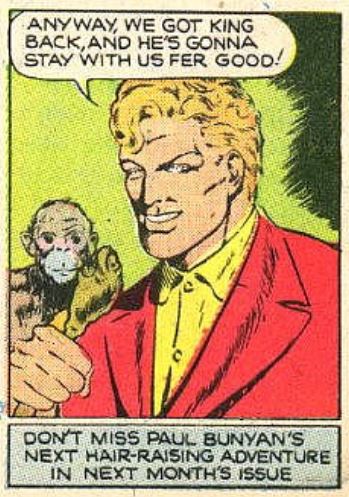
    What’s better than a regular two-fisted lumberjack protagonist? Paul Bunyan himself, that’s who. This version of Bunyan works in a modern-day lumber camp and has been toned down a bit with the suggestion that he’s just some guy who was born in Maine and grew to a mere ten feet tall. His adventures aren’t that much different than those of other lumberjack heroes, but there is something about an enormous man with a giant blue ox that add a bit of spice to the proceedings. (National Comics 001, 1940)

    (Bunyan gets an ape-man sidekick named King for a couple of issues and this is the best place I could think of to note that (National Comics 006, 1940))

    Wonder Boy:

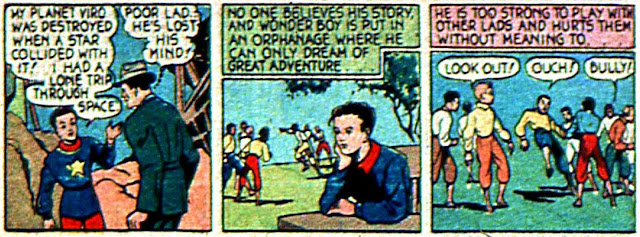
    Wonder Boy is an alien from the planet Viro who is a take on the Superman origin (last survivor of a destroyed planet rocketed to Earth where he is superhuman in comparison to the locals) while simultaneously being a prototype of Superboy (special super-powered boy who can only do good and is loved by all the world). DC Comics bought the rights to him along with all of the other Quality characters but has never seen fit to use him for anything, which I suppose is reasonable. (National Comics 001, 1940)

    Quicksilver:

    He’s got a lot of personality, that Quicksilver. Like other Golden Age super speedsters he handily outclasses most of his opponents and so the main draw is watching just how stylishly he beats them up. Much much later, Quicksilver will be brought back under the name Max Mercury and incorporated into the Flash family but that’s more than a few years out yet. (National Comics 005, 1940)

    the Phantom Knight:

    The Phantom Knight, aka Prince Philip of Kyle, is a very fun concept! As presented in his initial appearance, Philip is a real jerk, a man who cares about nobody and nothing but his horse Lightning.

    Philip is mean, vengeful, faithless and murderous. He kills two men in what were supposed to be bloodless contests because he felt that they insulted them. He joins and then deserts what is presumably the First Crusade, which could be a good act except that he deserts because there isn’t enough slaughtering and he gets bored.
    Philip eventually meets his end at the tusks of a wild boar and finds himself denied access to the afterlife until he makes up for his life of extreme dickishness, so he returns to Earth to do good as the Phantom Knight!.

    Now, here’s the problem: the Phantom Knight appeared twice, in OK Comics 001 and 002, and OK Comics 002 is not available to read anywhere that I know to look (well, there is a copy on ebay right now but I’m not prepared to pay $500 Canadian for the privilege). Thus, all that we really know about the Phantom Knight is that he was a colossal ass in life and now roams the mortal realm as a tormented spirit doomed to do good deeds. Is he still an ass? Is he operating in his home time period or has he been brought to the present – the location of Kyle is never established beyond being in Central Europe, so if he is operating in the modern day there’s a decent chance he fought some Nazis. (OK Comics 001, 1940)

  • MINOR SUPER-VILLAIN 635: KAOS

    MINOR SUPER-VILLAIN 635: KAOS

    (Fantastic Comics 012, 1940)

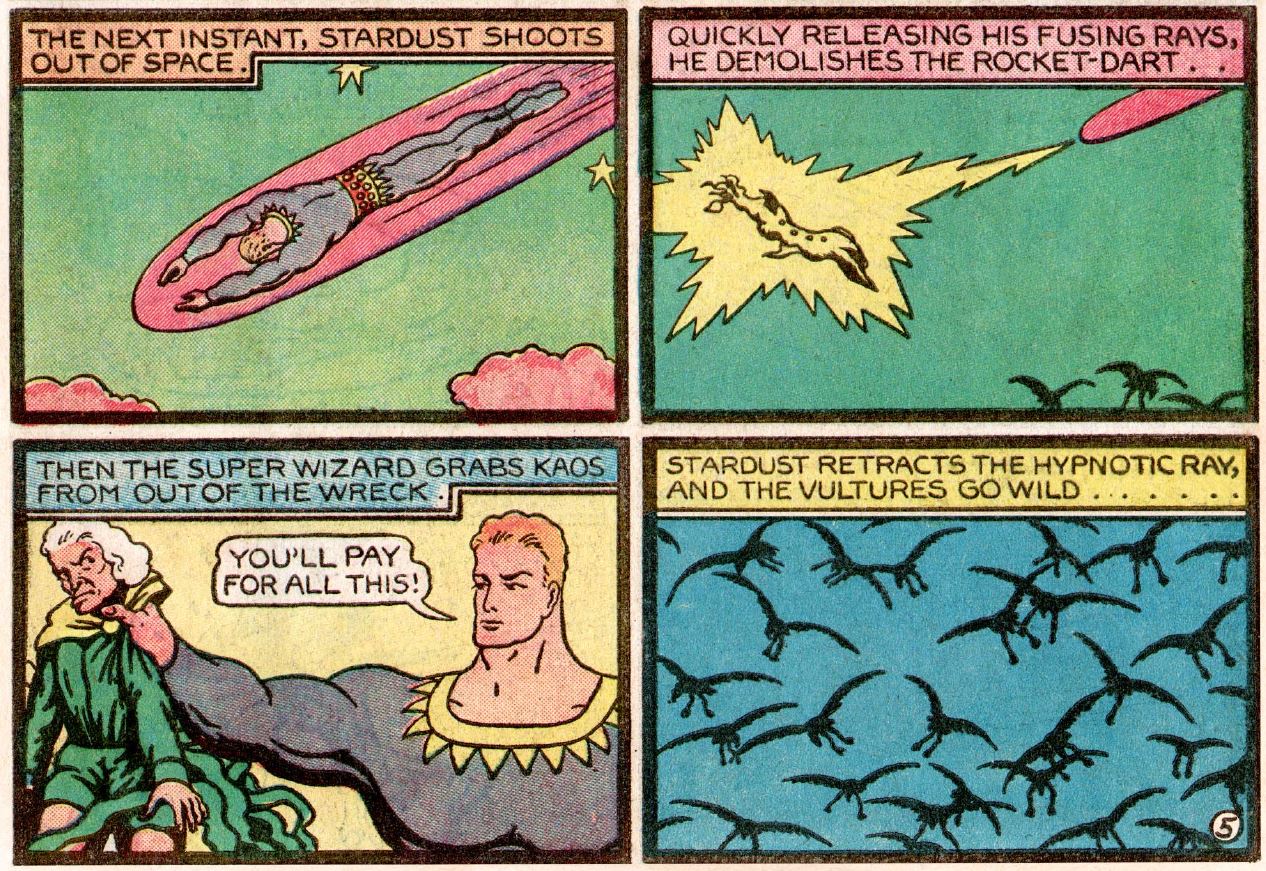
    Kaos, a Venusian scientist, has a plan that in true comics book fashion is both simple (invade the Earth with overwhelming force, thus taking over almost immediately) and overly complicated (hypnotize the local population of giant vultures and then feed them super vitamins extracted from a specially-bred vine, thus making them even more giant and so fast that they are unbeatable, then teleport them to Earth as your main invasion force). Also: those are some crazy legs on those vultures.

    Kaos may be the villain who benefits the most from a frequent plot element in Stardust the Super Wizard adventures, that Stardust lives so gosh darned far away. Thus, despite the fact that Stardust watched Kaos’ entire plan unfold on his View-Plate and Thought-Recorder, Kaos has enough time to effectively conquer the planet while the Super Wizard is on his commute.

    Once Stardust actually shows up, Kaos is subdued in exactly two panels. The vultures take a bit longer but in short order both they and “Kaos-the-Worm” are on their way back to Venus. There’s no mention of removing the birds’ physical enhancements so I guess it’s now up to the Venusians to deal with millions of huge powerful super-fast vultures.

    This is the issue in which a young woman orphaned in the vulture attacks attaches herself to Stardust and ends up returning to his star with him to live. I don’t know if this was intended to be a sexy situation or not – the two of them certainly do seem to be giving each other significant looks, but the same panels are really emphasizing just how much bigger Stardust is than her. It’s unsettling! Though she never appears again in a Fletcher Hanks story, this unnamed character is a frequent feature of more recent Stardust works, so I felt I should include her.

  • MINOR SUPER-VILLAIN 626: THE SUPER FIEND

    (Fantastic Comics 010, 1940)

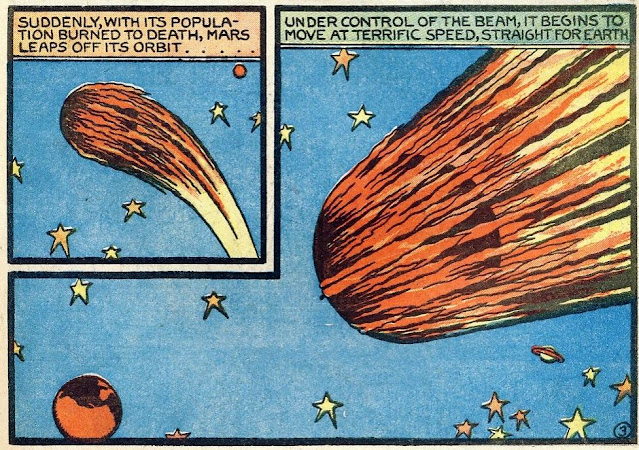
    The Super Fiend (aka the Super Fiend of the Lost Planet) is, if not the archetypal Fletcher Hanks villain then certainly representative of one of the major Hanks villain types, the civilization hater. He’s got no stated motivation but the Super Fiend hates civilization so much that he’s out to destroy it on a planetary scale, starting with Mars and moving on to Earth as an encore.

    The Super Fiend’s Thermal Ray Spore does the job on Mars, rendering the question of whether non-Hanks Stardust stories actually canonically occurred a bit moot – if Dr Martinious and the Brain Men did actually exist then they’re just so many charred bones now.

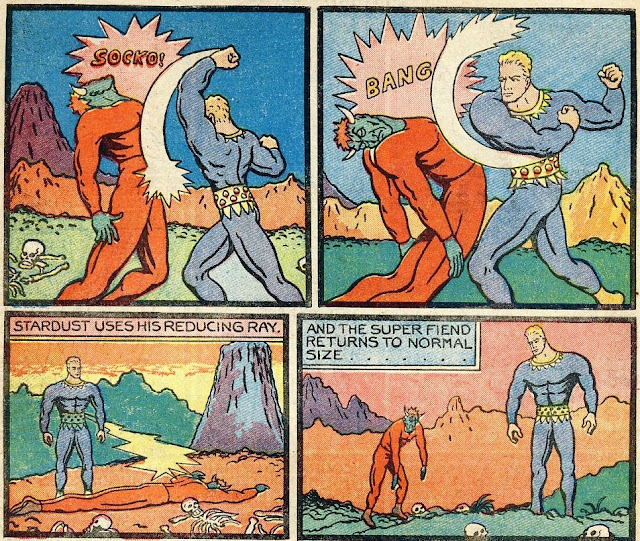
    Though Mars is toast and Earth is in the crosshairs, unfortunately for the Super Fiend Stardust the Super Wizard only allows one genocide per story, and with a cry of “You’re going bye-by!” he whisks his foe off to face justice.

    Like Wolf-Eye before him, the Super Fiend is made big and strong for the final righteous beatdown – presumably this keeps happening because Fletcher Hanks recognized that even the righteous Stardust looks like a bit of a bully beating up people 1/3 his size.

    The Super Fiend is left behind on Mars to contemplate his actions among the bones of his victims for the rest of his life – a classic Stardust punishment and in fact the same one meted out to Moloka in the non-Fletcher Hanks story in the previous issue. This raises the schoolday spectre of the compare-and-contrast vis-a-vis Moloka and the Super Fiend. On paper, they are very similar villains, but Moloka never felt quite right as a Stardust foe while the Super Fiend did. Why? Simple clarity of purpose, perhaps? Molka’s goals remain undefined throughout while the Super Fiend was lightning focused on destroying civilization, one planet at a time.
  • MINOR SUPER-VILLAIN 624: MOLOKA

    (Fantastic Comics 009, 1940)

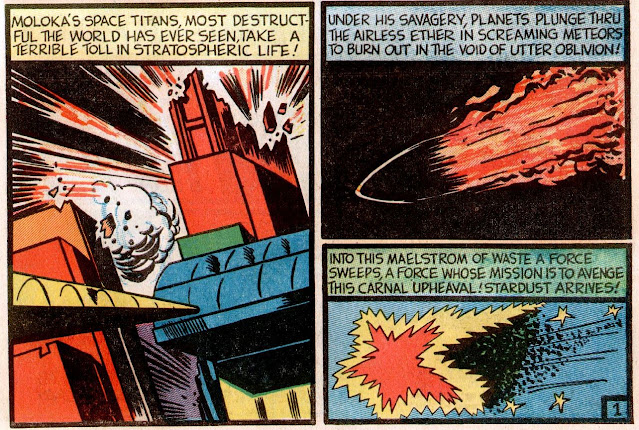
    Moloka is our second Stardust the Super Wizard foe from a story not penned by Fletcher Hanks and I’d say that our unknown scribe gets things mostly right: there’s certainly enough wanton destruction for this to be a Hanks comic. Moloka is a humanoid alien who has developed world-wrecking super weapons and as the comic opens is using them to blast away at various inhabited planets.

    Where exactly this is happening is a little unclear. If Fletcher Hanks’ idea of how outer space is structured is a little fuzzy then his stand-in is even more vague on the particulars. It’s equally possible that Moloka is based in another star system and using weapons with an interstellar range as it is that he’s in our own Solar System and there are just a heap of extra planets to blow up.

    Moloka’s goal is also a bit unclear. I think that he’s looking to become some sort of Galactic or Solar Dictator but he spends an awful lot of time just blasting away at inhabited planets without really asking to be put in charge. It’s possible that the power is an excuse and the blasting is the point.

    Moloka is based on Pluton, which is either an alternate spelling of Pluto (that I have seen before to be honest) or as mentioned above a completely extrasolar one. There’s no way of working out which it is though I will say that none of Pluto’s satellites were discovered before 1978 so I have no idea where Nemus is supposed to be.

    Moloka does give some hints as to his mental state when he mistakes a vengeful Stardust for some sort of elemental being created by the hellish energies at his command. It’s kind of charming! It’s also wildly out of character for Stardust “the shortest distance between two lines is a punch” the Super Wizard. Stardust’s goal with this little ruse is to goad Moloka into firing his weapon at Earth, then using his own patented ray-reversal technology to redirect it back to its source.

    As to whyhe bothers to do this when he’s perfectly capable of blowing the whole of Pluton to hell and gone? I guess it’s a bit more of an ironic punishment to leave a warmonger stranded on a planet that they themself have devastated? Sure, we’ll go with that.