The Curse of Skeleton Munroe

Category: alien

  • ALIENS AND SO FORTH ROUND-UP 045

    No matter how many comic book aliens we catalogue, there are always more to see!

    Fish-Men:

    While fish men are nothing new, these particular ones have a couple of points of distinction: firstly they just look kind of nice, a bit more gracile and svelte than your usual humanoid fish. Secondly, they are in fact Moon Fish-Men, as they serve demi-god(?) and would-be King of the Moon Bakalma. This also makes them Moon Fish-Men from the 12th Century, as Bakalma is an enemy of former Crusader the Golden Knight. Finally, this means that many if not all of them were blown up by a volcano. (Fantastic Comics 017, 1941)

    Martian Imp Men:

    The Martian Imp Men are the servants of Martian villain Skomah the 7th, aka the Brain. They are unfailingly loyal and probably also mind-controlled, so we don’t get much of an idea of their culture is like, but their strong resemblance to something like a cross between a Gremlin and a D&D goblin is certainly giving me ideas. (Fantastic Comics 001, 1939)

    Martian Ogres:

    The Martian Ogres are a also pledged to the service of the Brain. They are larger, seemingly more intelligent and a bit less spiky than their presumably-distant cousins the Imp Men, and as such are sent off in a space fleet to destroy the Earth with Anti-Earth Demolishing Rays.

    Despite their best efforts – and whether it is due to mental conditioning or sheer love of the game they tray very hard – the Ogres are unable to overcome the full might of the Earth space fleet. (Fantastic Comics 002, 1940)

    Martians:

    In 1939, inventor Montague Dexter and his wife pilot an experimental rocket to Mars as a part of the New York World’s Fair. Stranded there by damage to their vehicle, they live there among the Martian people until 2000 CE, when their son Rex flies the newly-repaired rocket back to his ancestral planet. Though Rex sets out with the promise to return some day, this is to my knowledge the only appearance of the Martians in question. I really like them! I think that the artist was going for an amphibian look over all, but the slight bovine cast to the face is quite pleasant. Plus it’s nice to see some benevolent Martians now and then. (Mystery Men Comics 001, 1939)

  • ALIENS AND SO FORTH ROUND-UP 045

    No matter how many comic book aliens we catalogue, there are always more to see!

    Fish-Men:

    While fish men are nothing new, these particular ones have a couple of points of distinction: firstly they just look kind of nice, a bit more gracile and svelte than your usual humanoid fish. Secondly, they are in fact Moon Fish-Men, as they serve demi-god(?) and would-be King of the Moon Bakalma. This also makes them Moon Fish-Men from the 12th Century, as Bakalma is an enemy of former Crusader the Golden Knight. Finally, this means that many if not all of them were blown up by a volcano. (Fantastic Comics 017, 1941)

    Martian Imp Men:

    The Martian Imp Men are the servants of Martian villain Skomah the 7th, aka the Brain. They are unfailingly loyal and probably also mind-controlled, so we don’t get much of an idea of their culture is like, but their strong resemblance to something like a cross between a Gremlin and a D&D goblin is certainly giving me ideas. (Fantastic Comics 001, 1939)

    Martian Ogres:

    The Martian Ogres are a also pledged to the service of the Brain. They are larger, seemingly more intelligent and a bit less spiky than their presumably-distant cousins the Imp Men, and as such are sent off in a space fleet to destroy the Earth with Anti-Earth Demolishing Rays.

    Despite their best efforts – and whether it is due to mental conditioning or sheer love of the game they tray very hard – the Ogres are unable to overcome the full might of the Earth space fleet. (Fantastic Comics 002, 1940)

    Martians:

    In 1939, inventor Montague Dexter and his wife pilot an experimental rocket to Mars as a part of the New York World’s Fair. Stranded there by damage to their vehicle, they live there among the Martian people until 2000 CE, when their son Rex flies the newly-repaired rocket back to his ancestral planet. Though Rex sets out with the promise to return some day, this is to my knowledge the only appearance of the Martians in question. I really like them! I think that the artist was going for an amphibian look over all, but the slight bovine cast to the face is quite pleasant. Plus it’s nice to see some benevolent Martians now and then. (Mystery Men Comics 001, 1939)

  • ALIENS AND SO FORTH ROUND-UP 044

    Aliens! Mostly Martians!

    Treemen:

    Richard of Warwick, aka the Golden Knight, having gone to the Crusades, won the Crusades and returned home from the Crusades, now enters a fourth period of adventuring that is all about family. First, he rescues his little brother from the evil Black Baron, he now sets out to explore his father’s gold mines including the boarded-up one where his mother disappeared twenty years earlier.

    Inside, in addition to a variety of hostile reptile life, Richard encounters a some mostly-nude fellows called Treemen, who look like humans with very prominent upper canine teeth. I was pretty puzzled about their name until I looked a bit harder and saw that they also have awful-looking long curly fingernails. Is this where they get their name? From the fact that they look like they have roots? Horrible.

    Though Richard does do well initially, ultimately falls to the Treemen and is captured. It’s just lucky for him that the mighty Queen Martha of the Treemen turns out to be his mom. (Fantastic Comics 015, 1941)

    Mar-Men:

    The Mar-Men, under the leadership of the vile Craga, have been capturing human space crews to use as slave labour on their warships, a scheme that is ultimately foiled by the heroic Perisphere Payne. Being nothing more than green-skinned humans, the Mar-Men are generally unremarkable as aliens, though they are the only example that I am aware of of a Mars-derived species name that completely omits the “s” sound. (Science Comics 003, 1940)

    Martians: 

    As in every Space Rovers adventure, Ted Hunt and Jane Martin are just toddling around space one day when they notice a bunch of Martian soldiers seemingly lowering a woman to her doom in the Lost Valley of Mars. Upon rescuing her, they learn that she is the exiled Queen Mara of Thurn, whose kingdom has been usurped by her uncle/former regent Xark. The Space Rovers vow to help restore her to the throne, and as is so often the case are lucky to have picked a reliable narrator to back.

    The Martians (or more specifically the Thurnians, I suppose), have one of those weird mixes of technologies that you get in sci-fi adventure comics: they have charming little flying machines armed with projectile weaponry, but their soldiers are all armed with swords. None of this is a match for the Space Rovers’ tommy guns and rocket ships.

    Mara is restores to her throne with a little help from Ted’s jet pack and some phosphorescent paint, and Thurn is once more subject to the whims of the correct absolute monarch. (Exciting Comics 004, 1940) 

    Martian Anthropoids:

    These fellows are the major threat to Queen Mara in the Lost Valley, and while they’re basically just Martian cavemen I do appreciate that they look like Simpsons characters. (Exciting Comics 004, 1940)

  • ALIENS AND SO FORTH ROUND-UP 043

    We’ve met a few of them in the past, but here’s another dose of the inhabitants of the Fourth Dimension, as explored by Flip Falcon.

    Zezo:

    Zezo works for the Fourth Dimensional villain Lucifer as a guardian. We don’t learn too much about this fellow – is he a one-off or representative of a whole species, for example – but I like his moxie and his big teeth. (Fantastic Comics 015, 1941)

    Koggo:

    Koggo is an even more mysterious fellow than Zezo, given that he is more obviously the product of a civilization of some sort: he has clothing and weapons and hypodermics full of Agony Serum, and also a conceptual framework that allows him to believe that human pilots are somehow trying to invade the Fourth Dimension. This leads him to kill and kidnap several of them until he is stopped when he is exploded by Flip Falcon. (Fantastic Comics 018, 1941)

    Fourth Dimensional Dragons: 

    Fourth Dimensional dragons have a body plan that is a variation of the modern fantasy concept of the wyvern, with wings and front limbs appended to a long serpentine body. It’s unclear just how intelligent they are: Robbo here acts like an animal, but he also has a name. (Fantastic Comics 015, 1941)

    Serpo (Poison Dragon of the Elements) also has a name, but given his seeming status as more of a natural disaster than an inhabitant of the Fourth Dimension, that might just be equivalent to when we name hurricanes. Intriguingly, Serpo is able to cross the dimensional boundaries under his own power.

    Serpo comes to the attention of Flip Falcon after he abducts a woman from Earth and learns too late that he is susceptible to being exploded. (Fantastic Comics 016, 1941)

    Demi-Things:

    Any time you talk about Flip Falcon and the Fourth Dimension, you’re going to get Demi-Things coming up. The first time this occurs is when Gogo, Master of the Demi-Things attempts to abduct the same woman who had already been snatched by Serpo. And just like Serpo, Gogo is unprepared for the explosive power of Flip’s dimensional energy. (Fantastic Comics 016, 1941) 

    The death of Gogo opens the way for Kandor to become Lord of the Demi-Things, and while we have no indication of whether he is a more benevolent ruler than his predecessor, he certainly is aware of the fact that he rules at Flip Falcon’s whim. Or perhaps they really are friends, who knows. (Fantastic Comics 018, 1941)

    Finally, we have Zorka, the Giant Demi-Thing. Zorka guards a region of the Fourth Dimension containing the element “acco-nito.” Why? This is not explained – perhaps it’s just a classic case of treasure-hoarding. In any case, Flip needs so acco-nito to save a woman’s life, so Zorka gets exploded.(Fantastic Comics 019, 1941)

    Octopus Men:

    Strictly speaking, the Octopus Men are not Fourth Dimensional beings, instead, they are the inhabitants of the wandering planet Octo, which up and wanders straight through the dimensional barrier one day and allows the Octopus Men to start beating ten kinds of hell out of the Demi-Things.

    Despite this, the Octopus Men prove just as vulnerable to being exploded as all of Flip’s other enemies, which he discovers after intervening to prevent the conquered Demi-Things from being impressed into a life of space piracy by the Octopus Men’s boss, a human man named Otho. Just how he came to be on an extrasolar planet in the first place, let alone in charge of the place, is left unexplored, but since Flip drags him back to Earth to stand trial we must assume that that’s where he started out. I have no idea what Flip thinks that the charges might be, by the way. (Fantastic Comics 017, 1941)

    Unnamed Species: 

    This unnamed fellow is remarkable mostly for being the antagonist of Flip Falcon’s final adventure. He seems to live on a planetoid by himself, has captured space explorer Irwin Burns and demands help in his plan to go to Earth and kidnap a woman (he needs a “queen” and can’t be bothered to date).

    As befits the final Flip Falcon villain, this fellow gets exploded. It’s a real shame that this is our last look at the Fourth Dimension as the cosmology was getting very weird: it’s another dimension but also Hell and/or Purgatory and it connects to all space and time and as a result of this you can just kind of pass from our dimension to it by travelling far enough out into space? I mean, talk about a rich setting for cosmic horror. (Fantastic Comics 021, 1941) 

  • ALIENS AND SO FORTH ROUND-UP 042

    ALIENS AND SO FORTH ROUND-UP 042

    I hope you like aliens, because I just can’t stop finding new ones. 

    Kobolians:

    The Kobolians are from the underwater city of Kobol in the year 10 000 CE, and while we don’t learn too much about how their society functions we can intuit a certain amount of civic pride, given that their leader is named Lobok – did he rise to power on the strength of that name? Did he adopt it? Is the city named after him? Whichever it is, Lobok commands enough loyalty that the Kobolians go along with him when he decides to acquire a human wife via extortion. And not just any human either, but the daughter of Biran, leader of the Army of New America!

    Though the Kobolians live in an underwater city, it is not flooded, indicating that they are amphibious rather than fully water-breathing. They might even be that most rare of things: the underwater species that is fully air-breathing!

    Anyway, Sub Saunders blows the place up after rescuing Ms Nirab. (Fantastic Comics 014, 1941)

    Magyans:

    Space adventurer Iron Munro (born on Jupiter in the 22nd Century and thus very physically mighty. If his name seems familiar it’s because it was swiped by Roy Thomas and used as the name of the post-Crisis Superman replacement) and his companions, after being blasted into a “new universe” (contextually, a new solar system) by a rogue asteroid, find themselves in the middle of a conflict between two groups called the Magyans and the Tefflans. 

    As explained by the Magyan leader, the roots of this conflict stem from a war between their ancestors and the underground-dwelling Tefflans on another planet, tens of thousands of years earlier, a conflict that resulted in the destruction of their mutual home continent as the remnants of both populations fled into outer space. Iron Munro takes an immediate wild swing and identifies this continent as Mu (why no Atlantis? Is Iron Munro a hipster?). 

    If the Magyans are the lost inhabitants of Mu, then what does that make the Tefflans? Why, they are weird evil goat-men, and thus the basis for all of humanity’s legends about demons and devils!

    Munro and his pals side with the humans, of course, and over the next six issues there is an escalating back-and-forth war between the Magyans and the more technologically-advanced Tefflans that culminates in a devastating final attack in which the Magyans launch their twin moons Ma-Ran and Ma-Kanee at the Tefflan planet of Teff-El. It’s a horrifying way to end a war! (Shadow Comics v1 002, 1940)

    Man-Apes:

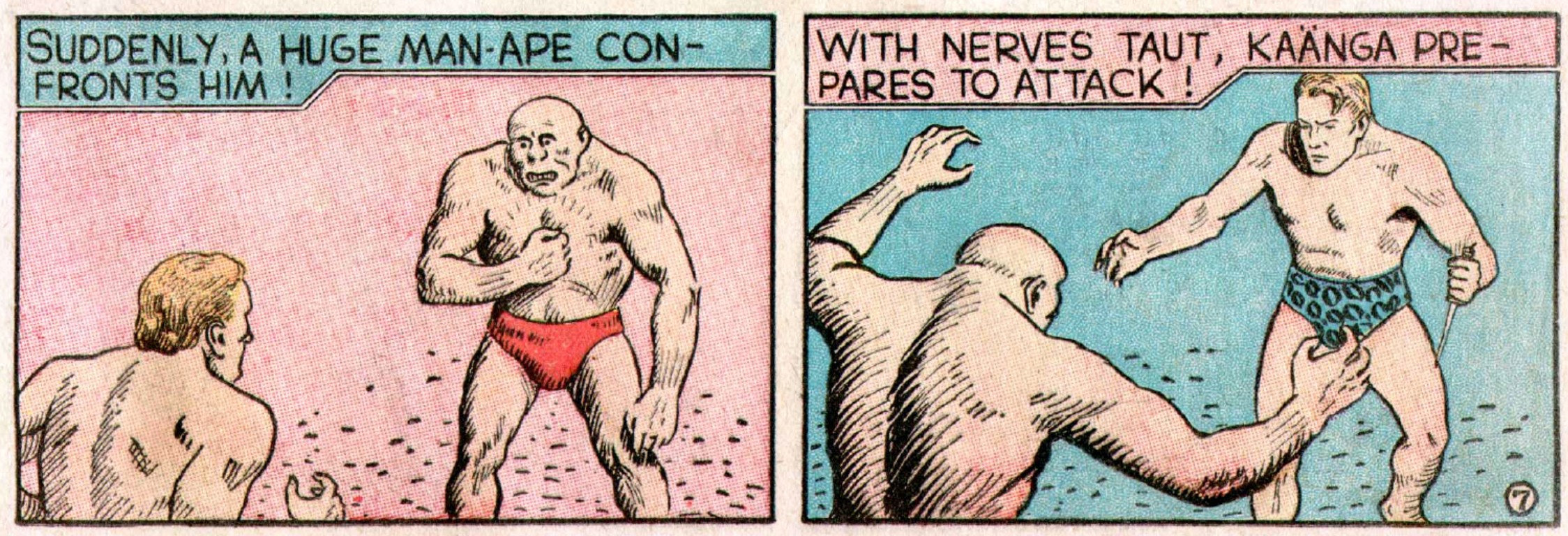
    These Man-Apes serve megacreep Dr Wratt as muscle. They hold the particular distinction of being the least apelike ape-men that I have ever seen. (Jungle Comics 002, 1940)

  • ALIENS AND SO FORTH ROUND-UP 041

    Once again I am inviting you to look at some aliens.

    Martian Sky-Demons:

    We only really ever see the space fleet belonging to these Martians, who have thrown in with the Axis forces to lend their “long-range, disintegrating super-bombs” to the invasion of North America. What they look like is left as just as much a mystery as what they are getting out this alliance with the Nazis.

    The Sky-Demons end up wasting their payload of super-bombs on a replica Earth that Stardust makes out of smoke, shadows and the bodies of a few hundred unlucky fifth columnists, upon which they abandon the plan and return to Mars. Perhaps those were all the bombs they had, or perhaps they wisely realized that they were flirting with disaster – Stardust is after all not known for his restraint in the face of aggression. (Fantastic Comics 014, 1941)

    Living Diamonds:

    The Living Diamonds are a really terrific species who live on Mystery Isle, on the same planet as the crew of Air Sub DX. I love that they’re literally just big diamonds, that they have little hat-shaped flying platforms to get around on, and that they can spit molten glass at their enemies. And I especially love this guy’s extremely weary facial expression which might just be how he looks and might be because crooks have been trying to turn his people into regular, non-living diamonds. 

    Also please note the second-last panel above, which is the earliest instance of someone calling a giant humanoid vehicle a “mech” that I have ever seen. (Amazing Mystery Funnies v2 008, 1939)

    Lunerzons:

    In the future occupied by space adventurer Spurt Hammond (variously placed anywhere from 2520 to 40 000 CE), the polar regions of the Moon are occupied by a group called the Lunerzons, who are as their name suggests Amazons who live on the Moon. The spelling being Lunerzon and not Lunarzon is, of course, maddening.

    The Lunerzons have ambitions of conquest, and to that end have begun raiding passing transport rockets. One of these rockets is piloted by Spurt Hammond, Planet Flyer, who puts up enough of a fuss in defense of his cargo that he ends up as a captive back on the Moon.

    Perhaps because they admire his tenacity, the Lunerzons treat Spurt more as a guest than a prisoner and so give him the official tour, including visits to the explosives factory where all of their men are employed in gruelling slave labour, and the pens where the Lunarzons breed the delightfully-named goblin-like Mooniacs for sport.

    Your average Golden or Silver Age comic featuring this setup would end with Spurt freeing all of the enslaved men and leading them in a revolution against their female oppressors in a not-so-subtle bit of social commentary. Instead, he drops a Mooniac that has been loaded down with explosives onto the factory roof, and while I enjoy a twist it’s a pretty rough way to treat an enslaved underclass.

    Lest you think that the “Spurt Hammond” scribes were above jokes at the expense of women, Our Hero escapes the Moon while the Lunerzon leaders are having a catfight over him. (Planet Comics 001, 1940)

    Spiderpeople:

    The Spiderpeople inhabit an unnamed moon orbiting an unnamed planet in an undisclosed star system, and only become relevant to our interests when some Earth colonists blunder their way into the planet-wide Spiderperson webs and get themselves captured. This attracts the attention of the mighty Red Comet, who is more kindly disposed to Earth people than any aliens, no matter how trespassed-upon.

    Probably the most interesting thing about the Spiderpeople is the arrangement of their limbs: rather than being kind of spider centaurs like so many of their peers, they have four spider legs emerging from their rib cage area and then a tiny little lower body with two more. While it’s not the most physically imposing design, it is neat. 

    Like I said, the Red Comet is not interested in exploring cultural relativity: the Spiderpeople attempt to sacrifice some Earthlings to their gods and so they get squarshed. Not all of them, but he certainly puts a dent in their population. That’ll show ’em for looking kind of gross. (Planet Comics 001, 1940)

  • ALIENS AND SO FORTH ROUND-UP 040

    Weird humanoids as far as the eye can see!

    Demon People: 

    The Demon People are seemingly native to the dimension that Breeze Barton travels to in his first adventure and are in conflict with Miracle City and its population of immortals. Even though their major goal is to get through the dimensional aperture and invade Earth, I would have a lot more sympathy toward them (eternal neighbours really must be the greatest test a people could have, after all) if they weren’t also huge slavers. I do really like the one big wing/fin that they have on their back, even if I can’t figure out what it could be for. (Daring Mystery Comics 003, 1940)

    Jupiterians:

    The Jupiterians, or more specifically the South Jupiterians, are a peaceful, swamp-dwelling people who want to live somewhere other than a swamp and have thus decided to enter into a colonial relationship with Earth. And it works! Against all historical precedent, the South Jupiterians are soon the proud owners of a new city called New Washington! No strings attached!

    The real threat to South Jupiterian sovereignty comes in the form of a diplomatic envoy of lop-eared North Jupiterians under the command of Princess Eelo (whose own long ears are presumably concealed under that kicky headscarf). They represent the bad kind of colonialism, in contrast to the warm fuzzy colonialism of Earth under Captain Nelson Cole, and it takes a plague scare and the complete destruction of New Washington to shift them. Back to work, South Jupiterians! (Planet Comics 009, 1940)

    Link People:

    Comics and other genre fiction are of course chock full of speculative missing links, but the key thing about the missing link concept is that it represents the bridge between ape and human. The idea that the missing link is instead some sort of humanoid reptile that just kind of ignores the existence of mammalian evolution and instead posits (I think) a chain of reptile -> reptile-man -> ape -> human is very weird!

    This being a comic book, such a wild speculation by a collection of white-haired scientists is of course 100% accurate, down to the location and architectural style of the Link Person community. Among other things, this means that the Descent of Man image is going to have to be heavily revised, and also that diver Kinks Mason is immediately sent in to bother this untouched society.

    Fearing that a mere photograph will not be believed, the scientists opt to kidnap one of the Link People, thus completing their introduction to humanity via a whirlwind of violence, death and loss (okay, they do try to sacrifice some of the scientists to their gods, but I think that they might have been justified). (Fight Comics 005, 1940)

  • ALIENS AND SO FORTH ROUND-UP 040

    Weird humanoids as far as the eye can see!

    Demon People: 

    The Demon People are seemingly native to the dimension that Breeze Barton travels to in his first adventure and are in conflict with Miracle City and its population of immortals. Even though their major goal is to get through the dimensional aperture and invade Earth, I would have a lot more sympathy toward them (eternal neighbours really must be the greatest test a people could have, after all) if they weren’t also huge slavers. I do really like the one big wing/fin that they have on their back, even if I can’t figure out what it could be for. (Daring Mystery Comics 003, 1940)

    Jupiterians:

    The Jupiterians, or more specifically the South Jupiterians, are a peaceful, swamp-dwelling people who want to live somewhere other than a swamp and have thus decided to enter into a colonial relationship with Earth. And it works! Against all historical precedent, the South Jupiterians are soon the proud owners of a new city called New Washington! No strings attached!

    The real threat to South Jupiterian sovereignty comes in the form of a diplomatic envoy of lop-eared North Jupiterians under the command of Princess Eelo (whose own long ears are presumably concealed under that kicky headscarf). They represent the bad kind of colonialism, in contrast to the warm fuzzy colonialism of Earth under Captain Nelson Cole, and it takes a plague scare and the complete destruction of New Washington to shift them. Back to work, South Jupiterians! (Planet Comics 009, 1940)

    Link People:

    Comics and other genre fiction are of course chock full of speculative missing links, but the key thing about the missing link concept is that it represents the bridge between ape and human. The idea that the missing link is instead some sort of humanoid reptile that just kind of ignores the existence of mammalian evolution and instead posits (I think) a chain of reptile -> reptile-man -> ape -> human is very weird!

    This being a comic book, such a wild speculation by a collection of white-haired scientists is of course 100% accurate, down to the location and architectural style of the Link Person community. Among other things, this means that the Descent of Man image is going to have to be heavily revised, and also that diver Kinks Mason is immediately sent in to bother this untouched society.

    Fearing that a mere photograph will not be believed, the scientists opt to kidnap one of the Link People, thus completing their introduction to humanity via a whirlwind of violence, death and loss (okay, they do try to sacrifice some of the scientists to their gods, but I think that they might have been justified). (Fight Comics 005, 1940)

  • ALIENS AND SO FORTH ROUND-UP 039

    Today we present some of the many aliens of Jupiter.

    Ganymede Pirates: 

    After facing the upsetting menace of Orro, Ted Hunt and Jane Martin, the Star Rovers, are captured by space pirates and taken to their home base on Ganymede. Whether they are native to Ganymede is hard to say, as the Space Rover Solar System is one that is populated mostly by aliens that look like white guys. This could be a completely heterogeneous group of Ceresians, Martians, Venusians, Jovians and humans and we would never be able to tell without some sort of census.

    These pirates are just that, pirates, and are mostly concerned with plundering and partying. More importantly, they have Prince Kongor of Jupiter imprisoned in their dungeons, and he helps the Space Rovers to escape and head down to the (terrestrial, oxygen atmosphere, non-crushing gravity) planet Jupiter. (Exciting Comics 006, 1940)

    Jovians:

    Ted, Jane and Kongor head back to Kongor’s home: Amkor, capital city of the small country of Xalia, which turns out to have been annexed by the nation of Iraz while he was away. Now, Kongor’s treacherous cousin Hajeck rules as Governor under the Dictator Chotan, and while all this is a bit of a word salad it is an extremely nice change of pace after reading so many comics featuring aliens from single-biome worlds featuring homogeneous cultures living under a single world government. Wowee, there are multiple countries on this one, fellows! The Space Rovers topple all of the Bad Governments in favour of putting their personal friend Kongor in charge, of course. (Exciting Comics 007, 1941)

    Jupiter Brutes:

    After the Hardwich family crash their family space-coupe on the terrestrial planet Jupiter, their unnamed son is the only survivor. Raised by a Jovian tiger, the lad grows up big and strong and eventually starts exploring. On top of a nearby cliff he discovers a village of ape-men that the text refers to as “Jupiter Brutes” or merely “Brutes” and befriends them via the universal language: punching. The Jupiter Brute society doesn’t get too much fleshing out over the course of the story but I sure do appreciate their tree house village.

    Oh, by the way: that Jovian jungle lad? Why he was none other than Auro, Lord of Jupiter. (Planet Comics 001, 1940)

    Jupiter Giants: 

    Finally, we have the Jupiter Giants, who are still improbably humanoid but scaled up to improbably size to match that of their planet. We only meet the one Jupiter Giant, who flies over in a huge rocket ship to essentially bully the Earth. Is this sadistic lout representative of his culture or does he have to turn to such acts because he is an outcast at home? Hard to say.

    The Jupiter Giant gets his comeuppance in the form of a beating from the size-changing Red Comet, who would have been justified in subsequently hurling him into the Sun as retribution for the mass murder and destruction, but who instead crams him back into his spaceship and sends him back from whence he came to think about what he did. (Planet Comics 006, 1940)

  • ALIENS AND SO FORTH ROUND-UP 038

    Where are we going to put all of these aliens? 

    Undergrounders: 

    I want to call these guys mole men who invade the surface world in the year 3050 CE, but looking at the battle scene and the remainder of this adventure I reckon that Abovegrounders of that particular future also look all bald and gangly. It’s a whole world of mole men! Science adventurer Captain Daring kills the Undergrounders’ underground Fuehrer and installs his own ladyfriend as the new Queen of the Underground, which has to be an improvement. (Daring Mystery Comics 007, 1941)

    Juno Men:

    These fellows hail from the planet Juno and are invading the Earth of the far future of the year 3000. We don’t really learn any more than this because we are seeing these events play out from the persepctive of a time-travelling Minimidget and Ritty, and so not only are they without context but they are too small to ask a passerby to explain just what the heck is happening. They are driven off with what I would call embarrassing ease. (Amazing-Man Comics 014, 1940)

    Followers of Elo: 

    Underwater adventurer the Shark is possibly my favourite Centaur Comics character, because he spends a lot of his time palling around with his dad, Father Neptune. A little-explored aspect of this father-son relationship is that it is part of a Phantom-like generational super-hero legacy, with each Shark serving for 500 years before becoming Father Neptune and passing his legacy on to his son. One of the few times that this arrangement is explored is in Amazing-Man Comics 014, when Father Neptune tells the story of how he served on a pirate crew for a while back when he was the Shark, and how in 1664 his crewmates were all slaughtered in the name of the Great God Elo by some lumpy-headed green guys on an island off South America.

    Cut to 1940, and the Shark and Father Neptune decide that a trip to that same island would be a perfect father-son outing. They find that the Great God Elo has only two followers left, and that one of them is a capable enough scientist that he has developed super-hero strength sleep gas grenades. Father and son are swiftly taken prisoner.

    The unnamed scientist has also created an interplanetary teleportation device, which he employs to teleport in some…

    Martians: 

    Specifically, a pretty lucky first teleport brings him Prince Zog, son of Diggo, King of Mars. But just why bring Martians to Earth? We will never know, because Zog is a very rude warmonger and he has electric eyes. The tribe of Elo is down to its very last member and he has sensibly vacated the area.

    No aliens are going to invade the Earth on the Shark’s watch, and he KOs on after another as they pour out of the teleport beam, until a lucky punch sends one crashing into the equipment, wrecking it.

    Though the teleporter is no longer spewing out Martians, there are still a pile of knocked-out ones lying around. How to tie up this loose end? Why, have Father Neptune, who missed the fight due to still being knocked out, throw a bucket of water on them so that they will wake up and engage him in the manly art of fisticuffs, of course! And then make it so that Martians are water soluble! Gruesome! (Amazing-Man Comics 015, 1940)