The Curse of Skeleton Munroe

Category: alien

  • ALIENS AND SO FORTH ROUND-UP 037

    Every once in a while I hit a particularly dense seam of aliens and so forth and this week is one of those times. 

    Neptunii: 

    The Neptunii (and that name is a guess based on the fact that one guy uses “Neptunus” as a singular version of the noun) live in Neptunia, an underground kingdom that could be described as “a big cave” at the bottom of the Atlantic Ocean. There, they seem to just kind of fly around shouting, though this short comic book story might not give a full picture of their society.

    There are a few points of interest about the Neptunii: they are both finned and winged, they all wear little horned circlets, they call their leader the “Sub-Ruler”… but the thing I am always struck by is just how much Prince Ikor and his pal in the above panel look like quirky characters from a late-90s webcomic. 

    Though Peter “the Fin” Noble becomes the ruler of Neptunia via a bit of impulsive regicide and remains so in his infrequent appearances to this day, to my knowledge the Neptunii themselves have not showed their faces since their first appearance in 1941. (Daring Mystery Comics 007, 1941)

    Inus-Men:

    The Inus-Men take their name from the fact that they are the inhabitants of the planet Inus. They are pretty regular-style cavemen, only more red, and are one of the many dangers faced by Dr X’s niece Cynthia when her astral form is blasted willy-nilly through space by her most unethical uncle. (Startling Comics 001, 1940)

    Jovians:

    The Jovians of the year 3964 AC (sic) are an oppressed underclass who work in the radium mines of the human colony on Jupiter. They are unable to own weapons by law, are possibly disallowed from large gatherings or approaching humans (see the first two panels above where the “boldness” of the Jovians is discussed) and generally mirror the conditions of colonized peoples on our world. This all clearly sucks and is unjust, which is especially interesting because the comic it all appears in clearly considers it to be the natural order of things.

    The Jovians are ripe for (and right to) revolt, and do so under the leadership of the evil Space Emperor. Once he is captured and revealed to be an opportunist by Major Mars they are returned to their place under the collective human thumb. (Exciting Comics 001, 1940)

    Jovians:

    Our second set of Jovians are also radium focused, but rather than mining it for their human overlords they use it to generate power, and having run out they are now demanding that both Earth and Mars hand over their radium supply or face annihilation. This draws the ire of space adventurer and Earth-Mars envoy Mitey Powers and he sets out with his entourage to resolve the situation.

    The title of this story is “The Super-Giants of Jupiter,” and I really appreciate that it lives up to the name. These Jovians are big, man. They’re also pleasingly alien, with their fish heads and tendril hands.

    I can only assume that it is the fact that the Jovians and their warships are so big contributes to Mitey’s decision to commit a war crime against their populace by unleashing a swarm of Martian Poison Gnats that will breed uncontrollably and “[kill] off most of the people.” It’s a horrible crime, Mitey! Particularly as radium is one of the less-used radioactive elements today! (Superworld Comics 003, 1940)

  • ALIENS AND SO FORTH ROUND-UP 037

    Every once in a while I hit a particularly dense seam of aliens and so forth and this week is one of those times. 

    Neptunii: 

    The Neptunii (and that name is a guess based on the fact that one guy uses “Neptunus” as a singular version of the noun) live in Neptunia, an underground kingdom that could be described as “a big cave” at the bottom of the Atlantic Ocean. There, they seem to just kind of fly around shouting, though this short comic book story might not give a full picture of their society.

    There are a few points of interest about the Neptunii: they are both finned and winged, they all wear little horned circlets, they call their leader the “Sub-Ruler”… but the thing I am always struck by is just how much Prince Ikor and his pal in the above panel look like quirky characters from a late-90s webcomic. 

    Though Peter “the Fin” Noble becomes the ruler of Neptunia via a bit of impulsive regicide and remains so in his infrequent appearances to this day, to my knowledge the Neptunii themselves have not showed their faces since their first appearance in 1941. (Daring Mystery Comics 007, 1941)

    Inus-Men:

    The Inus-Men take their name from the fact that they are the inhabitants of the planet Inus. They are pretty regular-style cavemen, only more red, and are one of the many dangers faced by Dr X’s niece Cynthia when her astral form is blasted willy-nilly through space by her most unethical uncle. (Startling Comics 001, 1940)

    Jovians:

    The Jovians of the year 3964 AC (sic) are an oppressed underclass who work in the radium mines of the human colony on Jupiter. They are unable to own weapons by law, are possibly disallowed from large gatherings or approaching humans (see the first two panels above where the “boldness” of the Jovians is discussed) and generally mirror the conditions of colonized peoples on our world. This all clearly sucks and is unjust, which is especially interesting because the comic it all appears in clearly considers it to be the natural order of things.

    The Jovians are ripe for (and right to) revolt, and do so under the leadership of the evil Space Emperor. Once he is captured and revealed to be an opportunist by Major Mars they are returned to their place under the collective human thumb. (Exciting Comics 001, 1940)

    Jovians:

    Our second set of Jovians are also radium focused, but rather than mining it for their human overlords they use it to generate power, and having run out they are now demanding that both Earth and Mars hand over their radium supply or face annihilation. This draws the ire of space adventurer and Earth-Mars envoy Mitey Powers and he sets out with his entourage to resolve the situation.

    The title of this story is “The Super-Giants of Jupiter,” and I really appreciate that it lives up to the name. These Jovians are big, man. They’re also pleasingly alien, with their fish heads and tendril hands.

    I can only assume that it is the fact that the Jovians and their warships are so big contributes to Mitey’s decision to commit a war crime against their populace by unleashing a swarm of Martian Poison Gnats that will breed uncontrollably and “[kill] off most of the people.” It’s a horrible crime, Mitey! Particularly as radium is one of the less-used radioactive elements today! (Superworld Comics 003, 1940)

  • ALIENS AND SO FORTH ROUND-UP 036

    Once again we bring you some aliens.

    the Tribe of Gurban:

    The Tribe of Gurban come down out of “the upper valley of the Nile” and clash with the ancient superhuman Dynaman in his one Golden Age adventure, and there’s a part of me questions whether it’s even worth noting groups like this who are just humans but bigger (about eight to ten feet tall if I’m any judge). But no: giants in caveman singlets who attempt to conquer Egypt c. 2500 BCE and who use sauropods as beasts of burden always deserve recognition, particularly when they’re very technically canon to the Marvel Comics Universe.

    Dynaman doesn’t have too much trouble sending Chief Ribur and his compatriots packing, but not before they unleash their ultimate weapon: the Wild War Beasts. (Daring Mystery Comics 006, 1940)

    Inhabitants of Phobos:

    I didn’t really cover them in the entry on Spacehawk’s Martian enemy Glork, but his plan to smash Phobos into Mars in revenge for him losing an election wasn’t just bad news for the Martians but also for these adorable little dudes. They’re just trying to live on a very small moon, Glork! Why are you hassling them? (Target Comics v1 009, 1940)

    Insect-Men:

    Not two issues after his adventures with the Serviles and their enemies the Heidites, Flip Falcon is hopping back into his all-purpose machine and heading back to Mercury for a little aimless exploring. There, he is confronted by a completely different group of aliens than the two he had already met, and while the out-of-universe explanation for this is simply that the “Flip Falcon” comic was nobody’s baby and had a very loose relationship with internal continuity, it is fun to imagine that the sun-blasted surface of Mercury is just teeming with weird life forms. 

    Though the Insect-Men are huge cool-looking bug-men who communicate using long warbling cries (and are able to break the strand of energy that tethers Flip to his machine, a strand that can restrain Lucifer himself), by fat the most interesting thing about them is their unnamed queen, who shows up soon after her followers capture Flip and reveals that she is the child of a similarly-unnamed human man and an Insect. This raises an enormous number of questions: just who is this human? How did he get to Mercury? When did he decide to make love to an enormous humanoid bug? How is it possible to produce hybrid Earth mammal/ Mercurian insect offspring? Is it just her feet that are weird looking or does she have insectoid legs? None of these questions are in fact answered in the text.

    The Queen of the Insect-Men is, it seems, a more picky lover than her father, and so falls for Flip Falcon the instant she lays eyes on him. After watching a little light gladiatorial combat she is ready for the marriage to commence, and the only thing that saves Flip from a lifetime of caring for weird little grubs with baby faces is that his faithful assistant Adele reinstates the connection between Flip and his machine in time, which fries the wedding party and allows him to fly on home. (Fantastic Comics 007, 1940)

    Insects:

    Like Flip Falcon, Stuart Taylor has a time-space machine and a penchant for blasting himself into the void to see what is there. In this instance, Stuart has flung himself randomly forward in time and fetched up on the shores of the year 9250 CE to find that while humanity yet endures they are at the mercy of a species of giant intelligent insects. After helping to repel an Insect attack on one of the remaining human settlements, Stuart offers to infiltrate their capitol, where he is quickly captured and taken to the Insects’ long-winded ruler.

    Stuart jumps the ruler while it is busy manning the city’s defenses against an attack by the humans, and I must say that I really like the image of it in its little console chair. It really looks like the artist (Lou Fine) really sat down for a minute and thought about how that would work. Though the Insect ruler outclasses Taylor physically, it is undone by its own prowess, as it throws him into a control console and causes an electrical overload that leads to its own death (Taylor is fine). (Jumbo Comics 013, 1940)

  • ALIENS AND SO FORTH ROUND-UP 036

    Once again we bring you some aliens.

    the Tribe of Gurban:

    The Tribe of Gurban come down out of “the upper valley of the Nile” and clash with the ancient superhuman Dynaman in his one Golden Age adventure, and there’s a part of me questions whether it’s even worth noting groups like this who are just humans but bigger (about eight to ten feet tall if I’m any judge). But no: giants in caveman singlets who attempt to conquer Egypt c. 2500 BCE and who use sauropods as beasts of burden always deserve recognition, particularly when they’re very technically canon to the Marvel Comics Universe.

    Dynaman doesn’t have too much trouble sending Chief Ribur and his compatriots packing, but not before they unleash their ultimate weapon: the Wild War Beasts. (Daring Mystery Comics 006, 1940)

    Inhabitants of Phobos:

    I didn’t really cover them in the entry on Spacehawk’s Martian enemy Glork, but his plan to smash Phobos into Mars in revenge for him losing an election wasn’t just bad news for the Martians but also for these adorable little dudes. They’re just trying to live on a very small moon, Glork! Why are you hassling them? (Target Comics v1 009, 1940)

    Insect-Men:

    Not two issues after his adventures with the Serviles and their enemies the Heidites, Flip Falcon is hopping back into his all-purpose machine and heading back to Mercury for a little aimless exploring. There, he is confronted by a completely different group of aliens than the two he had already met, and while the out-of-universe explanation for this is simply that the “Flip Falcon” comic was nobody’s baby and had a very loose relationship with internal continuity, it is fun to imagine that the sun-blasted surface of Mercury is just teeming with weird life forms. 

    Though the Insect-Men are huge cool-looking bug-men who communicate using long warbling cries (and are able to break the strand of energy that tethers Flip to his machine, a strand that can restrain Lucifer himself), by fat the most interesting thing about them is their unnamed queen, who shows up soon after her followers capture Flip and reveals that she is the child of a similarly-unnamed human man and an Insect. This raises an enormous number of questions: just who is this human? How did he get to Mercury? When did he decide to make love to an enormous humanoid bug? How is it possible to produce hybrid Earth mammal/ Mercurian insect offspring? Is it just her feet that are weird looking or does she have insectoid legs? None of these questions are in fact answered in the text.

    The Queen of the Insect-Men is, it seems, a more picky lover than her father, and so falls for Flip Falcon the instant she lays eyes on him. After watching a little light gladiatorial combat she is ready for the marriage to commence, and the only thing that saves Flip from a lifetime of caring for weird little grubs with baby faces is that his faithful assistant Adele reinstates the connection between Flip and his machine in time, which fries the wedding party and allows him to fly on home. (Fantastic Comics 007, 1940)

    Insects:

    Like Flip Falcon, Stuart Taylor has a time-space machine and a penchant for blasting himself into the void to see what is there. In this instance, Stuart has flung himself randomly forward in time and fetched up on the shores of the year 9250 CE to find that while humanity yet endures they are at the mercy of a species of giant intelligent insects. After helping to repel an Insect attack on one of the remaining human settlements, Stuart offers to infiltrate their capitol, where he is quickly captured and taken to the Insects’ long-winded ruler.

    Stuart jumps the ruler while it is busy manning the city’s defenses against an attack by the humans, and I must say that I really like the image of it in its little console chair. It really looks like the artist (Lou Fine) really sat down for a minute and thought about how that would work. Though the Insect ruler outclasses Taylor physically, it is undone by its own prowess, as it throws him into a control console and causes an electrical overload that leads to its own death (Taylor is fine). (Jumbo Comics 013, 1940)

  • ALIENS AND SO FORTH ROUND-UP 035

    Aliens! Aliens? Aliens.

    the Black-Light Men:

    Like the Emerald Men of Asperus, the Black-Light Men travel on a mobile planet (the Black-Light Planet, natch, so named because it is not visible using conventional light) and like so many Fletcher Hanks villains they are looking to take over the Earth, in this case by pulling the whole planet out of orbit and freezing it solid before selling it on to the Martians. Due to the Black-Light Planet’s perpetual cold, the Black-Light Men are all blubbery. Just what the little rhino horn situation they have going on is for is beyond me. 

    Luckily for the Earth, space hero Whirlwind Carter is on the case and the planet-jacking is halted before more than a measly few million people are killed. Carter leads the Earth military in a retaliatory strike on the Black-Light Planet but it quickly turns into a hand-to hand battle that leaves the human forces ata severe disadvantage.

    Thanks to Whirlwind Carter’s companion Brenda, the Black-Light Men are discovered to have a crippling fear of fire and armed with that knowledge the Earthian forces are able to drive them to self-destruction. (Daring Mystery Comics 005, 1940)

    Serviles: 

    Flip Falcon’s portal to the Fourth Dimension allows him to do a whole lot of different things, for instance: look at images of the planet Mercury and notice that there is a cool-looking city there, then visit that city with his partner Adele. We soon learn that the city is called Servil, and it is inhabited by some truly delightful aliens with the bodies of plucked chickens and the heads of bargain-basement mannequins and who are revealed to be called Serviles in a text box several issues after this appearance.

    The Serviles communicate using extremely cute golden helmets. Up until this point they might just be the perfect alien species, but they have to go and ruin it all by being weird 1940s misogynists and denying women the ability to speak (!) because they “talk too much.”

    Anyway, Servile civilization is plagued by these cool-looking dragonoid beasts called Heidites that crawl over from the hot side of Mercury to eat them, but who could care? (Fantastic Comics 005, 1940)

    Hoof-Men: 

    The Hoof-Men are 1. extremely burly 2. hoofed and 3. of a class of science fiction alien that can best be described as “space bullies,” who exist to give humans a hard time. In this case they have captured the (also very burly) space explorer Professor Darrel and are threatening to turn him into a bug if he doesn’t say that Hoof-Men are better than humans, and it all gets a little too real until space hero Cosmic Carson has to step in and break things up. (Science Comics 003, 1940)

    Hoppers:

    The Hoppers are yet another group of Fletcher Hanks aliens who live on a wandering planetoid, in this case on that looks just like a cartoon tropical island and seems to just aimlessly float through space. As might be expected given their name the Hoppers a big on jumping and can seemingly do so to get from planet to planet. They have the beefiest legs in comics and show them off in what I can only describe as bicycle shorts, in an astounding bit of predictive design-work.

    Unlike most Fletcher Hanks aliens, the Hoppers don’t have some sort of over-the-top plan to destroy humanity – they aren’t even hostile, as far as I can tell. They do hop on over to Space Smith’s ship as soon as it comes into range, which he interprets as a hostile act, but I’m inclined to disagree. The only aggression the Hoppers display is after they are trapped under a big metal net, and even then it is nonlethal.

    Perhaps Smith agrees with me after all, because instead of gruesomely killing the Hoppers he instead essentially pranks them by bringing them to New York City to be spooked by the hustle and bustle of big city life, with its bodegas and whatnot. Unable to hack the Big Apple, they hop back to their small-town planetoid. (Fantastic Comics 005, 1940)

  • ALIENS AND SO FORTH ROUND-UP 034

    We got your aliens right here.

    Martians: 

    While I think that we might have a couple of Fletcher Hanks aliens in our future, the number is definitely going down at a fairly rapid clip, so let’s enjoy these here Martians while we have them. Like so many aliens, these guys are looking to conquer the Earth, and like so many Fletcher Hanks antagonists they have come up with a completely bonkers and over-the-top method of doing so: by stupefying the entire population with gas and then loading them all into individual rocket pods that are then shot into space to drift forever. This is a Whirlwind Carter adventure and thus set in an undefined future date, which means that the Earth’s population is effectively a big question mark, but the Martians have to be firing off billions of these things, right?

    Perhaps this is why these fellows look so satisfied as they look out over a conquered New York, because they have just put in a very hard day’s work to get it.

    Like I said: this is a Whirlwind Carter story, and the key thing about Whirlwind Carter is that he lives on Venus and is thus not present for the Martian gas attack. Carter rounds up the stranded Earthians and employs them as the crew of a space fleet to take back the planet using a combination of gas and hand-to-hand street combat.

    It makes only a brief appearance in the issue, but perhaps the most intriguing thing that we see in this issue is the Martian vapor arm that is deployed to kidnap Carter’s partner Brenda. Is it a creature? A technology? Something that Martians can just do? Throw these questions on the big Never To Be Answered pile. (Daring Mystery Comics 004, 1940)

    Hawk-Men:

    The people of Earth in the year 3090 CE are being troubled by a series of bright flashes in the clouds, and when troubleshooter Planet Payson flies up to investigate the cause he discovers a hitherto-unknown society of winged people called the Hawk-Men living in a floating city. The flashes turn out to be ray gun blasts, resulting from a war that the Hawk-Men are engaged in with a second, unnamed group of cloud-dwellers. It’s not entirely clear whether the Hawk-Men are a separate species, an offshoot of humanity or simply a group of humans who have bioengineered themselves some wings and taken to the skies, but what is clear is that they were pretty directly inspired by Vultan and the other Hawkmen of Flash Gordon fame. Just look at this Brian Blessed-ass Hawk Commander, for gosh sakes.

    Payson and his companions take it upon themselves to stop the war by invading the cloud city of the other side (unnamed, but led by a jerk named Buzzlark). They aren’t particularly successful, but while Buzzlark is gloating over them after sticking them in some clear tubes, the Hawk Commander is able to sneak in and assassinate him. War over on account of coup t’etat!

    Another technology shout-out: this zippy little one-man tank that Buzzlarks men patrol his city in. (Planet Comics 002, 1940)

    Hawkmen:

    Speaking of things that are pretty clearly inspired by Flash Gordon, I now realize that that is exactly what the Rocket’s adventures in and around the Diamond Empire are, and what would a Flash Gordon pastiche be without some Hawkmen? These particular Hawkmen are introduced in the person of Prince Falkar, who meets the Rocket and the Queen of Diamonds during a pitched battle with some Lizard-Men and becomes their staunch ally thereafter. After a brief interlude with some Ape-Men, he brings the duo back home to the Hawk Kingdom with him.

    Rocket and the Queen’s visit to the Hawk Kingdom causes some Big Problems: Falkor’s fiance Princess Abbie becomes in turn jealous of the Queen and then attracted to Rocket, and the latter’s rejection of her in favour of the former inspires her to assassinate the King and take the throne for herself. Falkor is forced to flee his home for the Diamond Empire, and as of the end of the series is still waiting for a little help in reclaiming his rightful throne. (Pep Comics 004, 1940)

    Headless Men:

    When scientists discover a weird new asteroid, space adventurer Buzz Crandall and his aide Sandra Curan are sent out to investigate. They discover a species of humanoids held in servitude by a bunch of big pitcher plants (who are not really ever given a name other than Plants, so that’s what we’ll go with).

    The Headless Men have been systematically bred by the Plants into small, low-intellect, easy-to-control  creatures by the Plants, but the downside to this is that they are now too feeble to fix a problem that has developed in the solar concentrators that the Plants derive sustenance from. Buzz fixes this problem under threat and is immediately betrayed, and he and Sandra are eaten by the Plant king.

    The Headless Men are not, it turns out, completely without volition, and rise up in defense of Buzz and Sandra. Under Buzz’ direction the solar concentrators are repurposed into heat weapons that fry the Plant population instead of feeding them. (Planet Comics 005, 1940)

  • ALIENS AND SO FORTH ROUND-UP 033

    Aliens. 

    Fifth Dimensional Beings: 

    These big-headed fellows feature in the origin story of Marvex the Super-Robot, but since we only see Marvex’ creator Bolo and his associates, we can’t really say too much about the culture of these Fifth Dimensional creatures. They have big heads, certainly, and a high enough degree of technology that Bolo is able to whip up a sentient robot on a whim, but whether that’s the sort of thing the population at large is getting up to or Bolo is the local equivalent of Lex Luthor is unknown and unknowable, alas. (Daring Mystery Comics 003, 1940)

    Green Devils:

    When Perisphere Payne seeks out a missing scientific expedition on an unnamed planet circling the star Polaris, he finds that they have come to mischief at the nubby little hands of the Green Devils, the planet’s native inhabitants who probably don’t call themselves that.

    While the Green Devils are just another band of primitives, eager to sacrifice the nearest blonde woman to their gods, they are also the most alien aliens that we have seen in a while and so I have a great deal of affection for them. Just look at their long noodly limbs! Their buggy eyes! Beautiful. (Science Comics 006, 1940)

    Pigwidgeons: 

    The final act of the story of the adventures of the Rocket and the Queen of Diamonds involves him leaving the Diamond Empire in his namesake rocket and her abdicating her throne to stow away and go with him. The Queen’s unexpected presence on the ship causes the Rocket to wreck the steering mechanism, and they crash on a strange planet.

    When they recover, the two find that they have been captured Gulliver-style by a group of tiny, rabbit-riding people called Pigwidgeons, who are melodramatic but ultimately good-hearted, and whose initial hostility is due to them mistaking the duo for… 

    … the Gromans, a species of human-sized fascists with a Roman Empire aesthetic to match their name. Though the Gromans have evidently been attacking the Pigwidgeons with impunity for some time, the arrival of the Rocket and the Queen shifts the balance of power, and over the next couple of issues the duo forge a new era of peace at the barrel of a ray gun. (Pep Comics 010, 1940)

    Pluvians:

    A plague is ravaging Earth in the far future of 1982, and Power Nelson has set aside his antipathy for the despotic government of Seng I to help them acquire the radium that they need to effect a cure. He sets out for the radium-rich planet Pluvius, where he meets the Pluvians, ruled by King Rari, and forget what I said about the Green Devils because these guys are my favourite aliens. Whether they have a smooth orange carapace or are wearing modified onesies is not specified and it doesn’t matter because they look fantastic either way, particularly as the sleek and retro-high-tech look it gives them is contrasted with their apparently Medieval society.

    The Pluvians agree to supply the needed radium in exchange for Nelson’s aid against their rival society, the Hairy Guroos, about whom there isn’t much to say. They’re humanoids with luxuriant hair and beards living in a Medieval monarchy (albeit a matriarchal one, which is fun), and that’s about it. They do use radium boulders as ammunition in their catapults, which is a good indication that Nelson has come to the right planet.

    For once in a Golden Age comic the solution to a problem involving hostile aliens does not involve mass alien casualties. Instead, Power Nelson does a regime change, by kidnapping the warmongering Guroo Queen Wodo and leaving her more amiable sister Queen Leelee in charge. (Prize Comics 003, 1940)

  • ALIENS AND SO FORTH ROUND-UP 032

    Aliens (and So Forth) abound!

    Birdmen:

    The Birdmen inhabit Sunev, which is either a planet that orbits perilously close to Earth or a second moon of Earth, and which was supposedly formed out of a piece of our planet which broke away in the distant past. Sunev has never been discovered because of some pseudoscientific gibberish about light rays, but space explorer Zephyr Jones and his assistant Corky Grogan make landfall there while testing out Jones’ experimental rocket ship.

    The Birdmen of Sunev have one of those advanced and peaceful societies that function with the rigidity and ruthlessness of a military dictatorship populated by political naifs. As such, the ambitious Birdman Roudo is able to frame Zephyr and Corky and have them sentenced to death for supposedly collaborating with…

    Parrotmen:

    The Parrotmen! These ancestral enemies of the Birdmen are just kind of caveman versions of them – they don’t even have colourful plumage to justify the name (I know that these images are from a recoloured version but I checked and the original is like this too). Despite the fact that the Birdmen have a roughly Medieval level of technology (castles, steel, swords) they have not yet been able to come up with a way to contend with a bunch of big guys with clubs, and it’s up to Zephyr and Corky to blow them away with the tommy gun that they very sensibly thought to bring along on their space adventure. (Daring Mystery Comics 002, 1940)

    Center People:

    The Center People are one of the many intelligent species that populate the far-off Asteroid Djung. Their king, Goro, has allied with the Djunga King Leon against space heroes Captain Venture and the Planet Princess Zyra. Despite being depicted as spear-wielding ape-men who perform human sacrifice to a pool of lava, they are also armed with a selection of high-tech devices such as Goro’s Mind-Ray Projector, which he uses to briefly compel Captain Venture into his service. This dichotomy is not explored before the Center Person society is devastated by a volcanic eruption. (Master Comics 019, 1941)

    Core Creatures:

    The adventures of sci-fi hero Blaze Barton take place on an Earth ravaged by a freak orbital shift that brought it too close to the Sun in the year 50029 CE (or sometimes 3000 CE or 5029 CE). Blaze and a small human population survived this event by sheltering in a specially-built heat-proof city, and now must rebuild civilization on a radically altered world. 

    One of the first and greatest challenges faced by Blaze et al is the emergence of the underground-dwelling Core Creatures from the great cracks that have developed in the planet thanks to the rapid changes in temperature it has experienced. 

    The Core Creatures, and their king in particular, have an implacable hostility toward the human population, but also indulge in that hoary old trope of being super hot for human women. I do appreciate the fact that they appear to choose their king based on who has the most creepy skull face. (Hit Comics 001, 1940)

    I try and I try to keep these entries at a reasonable four species length, but I am vexed at every turn. Two issues after the Core Creatures breach the surface, Blaze & Co turn the tables and explore the subterranean world, where they encounter:

    Mud Monsters and Rock Men:

    While the Rock Men act as supplementary antagonists to the Core Creatures over the next couple of issues, the Mud Monsters only appear in this single panel. This is a shame, because they are by far the more visually interesting of the two groups. At least the fact that they live in such close proximity to the Rock Men allows us to speculate that they might be related species? That’s kind of fun. (Hit Comics 003, 1940)

    Like so many nonhuman societies, the Rock Men have a monarchy. There are better ways to live, guys!

    Pretty People of the Jewelled Caves: 

    The Pretty People are a bunch of foppish hotties who live in a state perpetual danger between the nations of the Core Creatures and Rock Men, and who survive by playing the two groups off of one another. They are also monarchists. As the most human-looking and least hostile group, these are the ones who the surface humans end up allying with.

    Speaking of alliances, the Core Creature and Rock Man Kings forge one in order to attack the Pretty People and are only driven off thanks to the intervention of the humans and their ray guns. Blaze Barton personally kills the Core Creature king here, ending the Core threat for good. (Hit Comics 003, 1940)

    Crustmen:

    In one final addendum, I reckon that these Crustmen, who attack the surface as part of a coordinated strike on humanity with a group of hostile Martians, are meant to be the Core Creatures. Given the differences in name and appearance I choose to believe that they are a related but distinct species of hostile sub-Earth humanoid.  (Hit Comics 007, 1941)

  • ALIENS AND SO FORTH ROUND-UP 032

    Aliens (and So Forth) abound!

    Birdmen:

    The Birdmen inhabit Sunev, which is either a planet that orbits perilously close to Earth or a second moon of Earth, and which was supposedly formed out of a piece of our planet which broke away in the distant past. Sunev has never been discovered because of some pseudoscientific gibberish about light rays, but space explorer Zephyr Jones and his assistant Corky Grogan make landfall there while testing out Jones’ experimental rocket ship.

    The Birdmen of Sunev have one of those advanced and peaceful societies that function with the rigidity and ruthlessness of a military dictatorship populated by political naifs. As such, the ambitious Birdman Roudo is able to frame Zephyr and Corky and have them sentenced to death for supposedly collaborating with…

    Parrotmen:

    The Parrotmen! These ancestral enemies of the Birdmen are just kind of caveman versions of them – they don’t even have colourful plumage to justify the name (I know that these images are from a recoloured version but I checked and the original is like this too). Despite the fact that the Birdmen have a roughly Medieval level of technology (castles, steel, swords) they have not yet been able to come up with a way to contend with a bunch of big guys with clubs, and it’s up to Zephyr and Corky to blow them away with the tommy gun that they very sensibly thought to bring along on their space adventure. (Daring Mystery Comics 002, 1940)

    Center People:

    The Center People are one of the many intelligent species that populate the far-off Asteroid Djung. Their king, Goro, has allied with the Djunga King Leon against space heroes Captain Venture and the Planet Princess Zyra. Despite being depicted as spear-wielding ape-men who perform human sacrifice to a pool of lava, they are also armed with a selection of high-tech devices such as Goro’s Mind-Ray Projector, which he uses to briefly compel Captain Venture into his service. This dichotomy is not explored before the Center Person society is devastated by a volcanic eruption. (Master Comics 019, 1941)

    Core Creatures:

    The adventures of sci-fi hero Blaze Barton take place on an Earth ravaged by a freak orbital shift that brought it too close to the Sun in the year 50029 CE (or sometimes 3000 CE or 5029 CE). Blaze and a small human population survived this event by sheltering in a specially-built heat-proof city, and now must rebuild civilization on a radically altered world. 

    One of the first and greatest challenges faced by Blaze et al is the emergence of the underground-dwelling Core Creatures from the great cracks that have developed in the planet thanks to the rapid changes in temperature it has experienced. 

    The Core Creatures, and their king in particular, have an implacable hostility toward the human population, but also indulge in that hoary old trope of being super hot for human women. I do appreciate the fact that they appear to choose their king based on who has the most creepy skull face. (Hit Comics 001, 1940)

    I try and I try to keep these entries at a reasonable four species length, but I am vexed at every turn. Two issues after the Core Creatures breach the surface, Blaze & Co turn the tables and explore the subterranean world, where they encounter:

    Mud Monsters and Rock Men:

    While the Rock Men act as supplementary antagonists to the Core Creatures over the next couple of issues, the Mud Monsters only appear in this single panel. This is a shame, because they are by far the more visually interesting of the two groups. At least the fact that they live in such close proximity to the Rock Men allows us to speculate that they might be related species? That’s kind of fun. (Hit Comics 003, 1940)

    Like so many nonhuman societies, the Rock Men have a monarchy. There are better ways to live, guys!

    Pretty People of the Jewelled Caves: 

    The Pretty People are a bunch of foppish hotties who live in a state perpetual danger between the nations of the Core Creatures and Rock Men, and who survive by playing the two groups off of one another. They are also monarchists. As the most human-looking and least hostile group, these are the ones who the surface humans end up allying with.

    Speaking of alliances, the Core Creature and Rock Man Kings forge one in order to attack the Pretty People and are only driven off thanks to the intervention of the humans and their ray guns. Blaze Barton personally kills the Core Creature king here, ending the Core threat for good. (Hit Comics 003, 1940)

    Crustmen:

    In one final addendum, I reckon that these Crustmen, who attack the surface as part of a coordinated strike on humanity with a group of hostile Martians, are meant to be the Core Creatures. Given the differences in name and appearance I choose to believe that they are a related but distinct species of hostile sub-Earth humanoid.  (Hit Comics 007, 1941)

  • ALIENS AND SO FORTH ROUND-UP 031

    ALIENS AND SO FORTH ROUND-UP 031

    Great value for your alien and so forth dollar today: seven for the price of four!

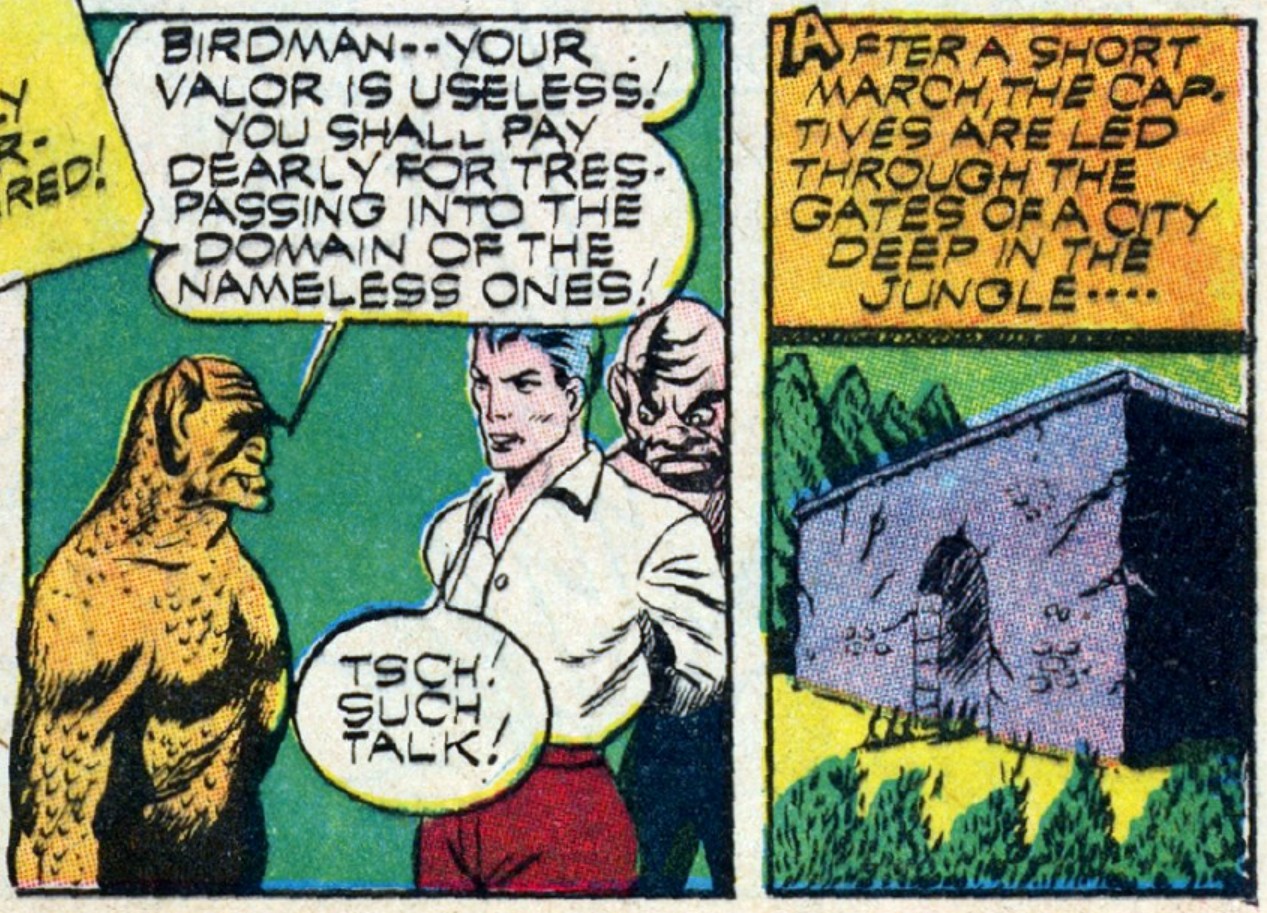
    the Nameless Ones: 

    “The Bingham Boys” was a short-lived feature about twin brothers Billy and Bobby Bingham and their dipshit friend Specs inserting themselves into the life of adventurer Dusty Travis. I their first appearance, the trio tag along on what turns out to be a flight to Mato Grosso, Brazil to search for a clue to the fate of lost Atlantis, for some reason.

    Dusty’s plane crashes thanks to Specs just randomly pushing buttons (I didn’t call him a dipshit for no reason) and the group are quickly set upon and captured by a group of morphologicaly-diverse beings called the Nameless Ones. In a tremendous display of both good and bad luck, the Nameless Ones’ leader – called the Oligarch – confirms that they are the descendants of Atlantis that the four are seeking, but also indicates that they will immediately be sacrificed.

    The Bingham Boys et al cannot be contained by a bunch of scaly weirdos, of course, and once they fight their way free it is time to learn the connection between Atlantis and this extremely inland city, right? WRONG, SUCKA. The Oligarch of the Nameless Ones is extremely serious about the “secret” part of “the secret of the Nameless Ones and Atlantis” and blows up the city rather than giving either Dusty Travis or the reader any kind of satisfaction. (Silver Streak Comics 015, 1941)

    Goors:

    Diver Kinks Mason is testing out a new diving apparatus when a rogue current drags him into an underwater cavern willed with the wreckage of lost ships. There, he encounters two battling groups of aquatic humanoids: the fish-eyed Goors and the conventionally-attractive Proconos.

    Kinks throws in with the Proconos due to the one-two punch of them being led by a hot lady and then telling him that the Goors are evil slavers. We can only hope that they were telling the truth because he proceeds to lead them in an attack that wipes the Goor city off the sub-oceanic map. Using war beasts that look like a cross between a plesiosaur and a duck, to boot! (Fight Comics 001, 1940)

    Grangonians: 

    Space adventurer Flint Baker and his reporter pal Mimi Wilson are noodling around in space one day when they happen upon an old worn-out planet full of immortal old people. These are not the Grangonians but a completely and annoyingly unnamed group. The Grangonians show up later, don’t worry.

    These old aliens have a problem: they discovered the secret to immortality too late and now they are trapped on an old planet. This reflects a kind of… folk belief?… that you get in old science fiction and especially in old science fiction comics, that planets have a sort of life cycle that starts out all swampy and primitive and covered in dinosaurs and ends in dusty ruins. If you’ve encountered this at all it’s probably in the notion of Venus being a younger and thus wetter planet than Earth that continues to crop up in comics into at least the early Sixties.


    Flint and Mimi transport the old aliens to a newly-discovered solar system full of young, vibrant planets, and sure enough they become young aliens as soon as they step foot on the surface of their new home. This is when the Grangonians come in, as their planet (Grango, natch) has been hit by a meteor and they also want to relocate to Planet Dinosaur. Though the Grangonians have more in the way of overt firepower, a combination of dinosaur attacks, old alien technology and Flint Baker’s heroic antics eventually drives them off.

    Both the Grangonians and the old aliens are essentially just regular humans, and while the notion that intelligent life basically looks the same wherever it evolves isn’t exclusive to the “planetary ages” style of sci-fi, it does usually go hand-in-hand with it – just as planets have a life-cycle, so too does the life on them emerge in predictable forms. (Planet Comics 005, 1940)

    Timid Giants:

    The Timid Giants are very appropriately found on the Planet of Timid Giants, where they just kind of keep to themselves. The planet very briefly sees some drama as a group of space explorers are terrified by the Giants’ size, but some light bullying by the Red Comet is sufficient to demonstrate how harmless the aliens are.

    The real threat on the planet are the Stickers, ant-sized aliens who live to torment the Giants and are all too happy to move on to human targets, including a shrunken Red Comet. The Stickers suck. I hate them and their weird cartoon baby faces.

    It turns out that the one thing that can spur the Timid Giants into action is a threat to the life of another, and so one of them eats the Stickers to save the Red Comet. This results in a sequence in which the Comet in turn has to fly his shrunken spaceship inside the giant to save him from being stuck internally, after which he fumigates the entire planet, and while I must still morally be against murdering an entire intelligent species by god do the Stickers make it hard. (Planet Comics 007, 1940)