The Curse of Skeleton Munroe

Category: misogyny

  • MINOR SUPER-VILLAIN 275: THE HAG

    (Marvel  Mystery Comics v1 019, 1941)

    I don’t have to go into how wild it is that this woman is called a Hag, right? The wild misogyny of it all? Great, thanks.

    Aside from her name, the Hag is a gang boss, and one who dreams big. Her plan involves causing a citywide power outage in NYC so that her men could  tamper with the Stock Exchange and then clean up the next day while everyone panics about a nonexistent stock crash that she engineered. And also for some reason she takes over a radio station to get access to incoming news? The motivation behind that one is weird to me.

    The real flaw in the Hag’s plan is that while she accounts for the presence of the Human Torch and Toro, she doesn’t really deal with them. Her men are equipped with flame-resistant clothing and fire-suppressing chemicals, but they just serve to help in avoiding the Torch. Ultimately, he catches up, there is an explosion (inevitable), and the Hag is no more.
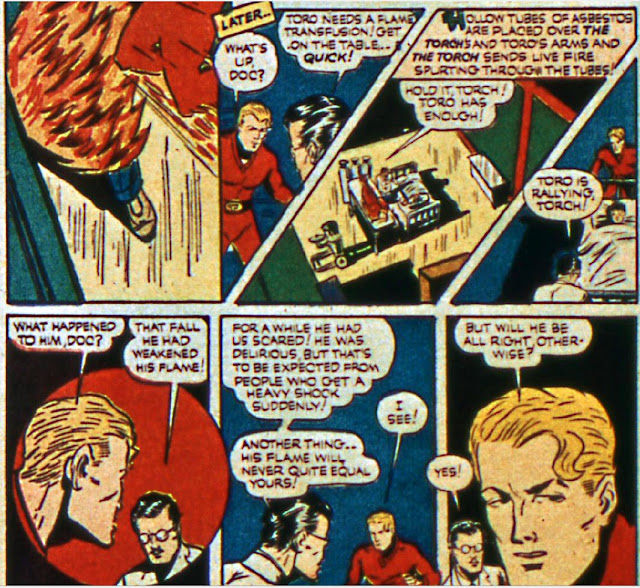
    This adventure also features the concept of Toro needing a “flame transfusion” after being severely hurt, which is very terrific, and which seems to be a convoluted way for Carl Burgos to canonically establish that Toro’s powers are a little weaker than the Torch’s? For some reason? It’ll be interesting to see if this is ever referenced again, frankly.

    ADDENDUM: forgot to mention the Hag’s sweet calling card:

    ADDENDUM II: Toro’s reduced fire-power actually came up in the subsequent issue, so I’m going to go ahead and try to note every issue it came up in right here:

    Marvel Mystery Comics v1 019
    Marvel Mystery Comics v1 020
    Human Torch v1 004
  • MINOR SUPER-VILLAIN 248: THE GOLDEN MUMMY

    (Flash Comics v1 017, 1941)

    It’s the Golden Mummy! As I have previously stated, I love fake mummies and had read this issue before, so I was anticipating this fellow’s appearance with some joy, and it is with great sadness that I must announce that he’s a complete disappointment.

    My threshold for fake mummy appreciation is quite low – usually they just steal a few antiquities before getting tripped up by Archie and Jughead or the Scooby Gang, after all – but the Golden Mummy’s only admirable quality is his dedication to theme. He has the costume, a cave hideout, a bunch of gangsters that he paid well enough to paint themselves gold and pretend to be called the Sect of the Golden Mummy (and of course the only thing better than henchmen in themed costumes is when they also have a cool name). 

    . He even dies lamely, by stumbling into a trap set for Hawkman.

    So why do I dislike this guy so much? The reason is twofold: firstly, the whole Golden Mummy thing is just some incel shit: he’s a guy named Dr Selkirk getting revenge on his ex-fiance for dumping him by murdering her. This is one of those motivations that sucks some of the fun out of super-villain analysis.

    Secondly: the Golden Mummy is a completely unnecessary affectation. He kills her as she’s onstage singing opera, via a poisoned blowdart. The Mummy and his Sect spend the entire adventure coping with Hawkman, and it kind of seems like Selkirk made up the persona expressly because he was afraid of Hawkman – I don’t know if he’d have gotten away with it by not calling attention to himself with cryptic warnings and golden men but it couldn’t have hurt.

    Boo to the Golden Mummy. Booo!

  • MINOR SUPER-VILLAIN 141: THE UNSEEN MAN

     (Adventure 064, 1941)

    The Unseen Man, aside from his pretty great name, is fairly run-of-the-mill: an art supply owner or employee who somehow develops an invisibility paint, he subsequently turns to crime and is captured by the Sandman.

    The reason that the Unseen Man gets such short shrift is that a lot of story real estate is taken up with a subplot of Dian Belmont wanting to be in on the adventure and generally getting in the way, despite discovering at least one key clue. It’s all fairly depressing, especially as her earlier, hypercompetent self was still showing up only a few issues prior and she mostly gets pushed out by Sandy the Golden Boy going forward.

    Anyway, a shame that the Unseen Man didn’t get more to do.

  • MINOR SUPER-VILLAIN 141: THE UNSEEN MAN

     (Adventure 064, 1941)

    The Unseen Man, aside from his pretty great name, is fairly run-of-the-mill: an art supply owner or employee who somehow develops an invisibility paint, he subsequently turns to crime and is captured by the Sandman.

    The reason that the Unseen Man gets such short shrift is that a lot of story real estate is taken up with a subplot of Dian Belmont wanting to be in on the adventure and generally getting in the way, despite discovering at least one key clue. It’s all fairly depressing, especially as her earlier, hypercompetent self was still showing up only a few issues prior and she mostly gets pushed out by Sandy the Golden Boy going forward.

    Anyway, a shame that the Unseen Man didn’t get more to do.

  • MINOR SUPER-HERO 005: RED, WHITE AND BLUE AND DORIS WEST

    (All American Comics 001-071 plus appearances in All-Star, World’s Finest, New York World’s Fair Comics and Comics Cavalcade, 1939-1946)

    They keep coming up, so I might as well spare a word for Red, White and Blue. The concept is simple: three childhood friends, each of whom went into a different branch of the armed forces (and each of whom has a convenient nickname) work for G-2/ US military intelligence to root out enemy plots, most often in partnership with G-2 operative Doris West. Red Dugan (Marine) is their leader, while Whitefield “Whitey” Smith (Army) provides muscle and Heermance B. “Blooey” Blue (Navy) is mainly comic relief.

    Their stories are great looking and generally pretty entertaining but if they have one great flaw it’s in the character personalities: Whitey and Blooey are both complete comic relief dum-dums, which leaves Red and Doris to do a lot of the heavy lifting in terms of moving the actual plot forward, which theoretically works great because they’re both portrayed as quite competent, particularly Doris. What really drags a lot of the stories down, though, is Red’s constant macho assertions that Doris shouldn’t go into danger and his pooh-poohing of her hunches etc as mere womanly fabulation. So many Red, White and Blue stories have an interminable middle portion in which Doris has basically figured everything out and Red refuses to listen to her.

    I’m less familiar with the RWB stories that take place after the US enters the war and the boys are deployed. The few I’ve read from that era take the form of letters home to Doris or one of their parents telling of their war exploits. I’ll check back in if there’s anything worth writing about there (especially if we eventually learn Red’s real first name – secret knowledge).