The Curse of Skeleton Munroe

Category: robot

  • MINOR SUPER-HERO ROUND-UP 085

    MINOR SUPER-HERO ROUND-UP 085

    Welcome to “The Four Characters Least Likely to Return in a Modern Comic” Theatre.

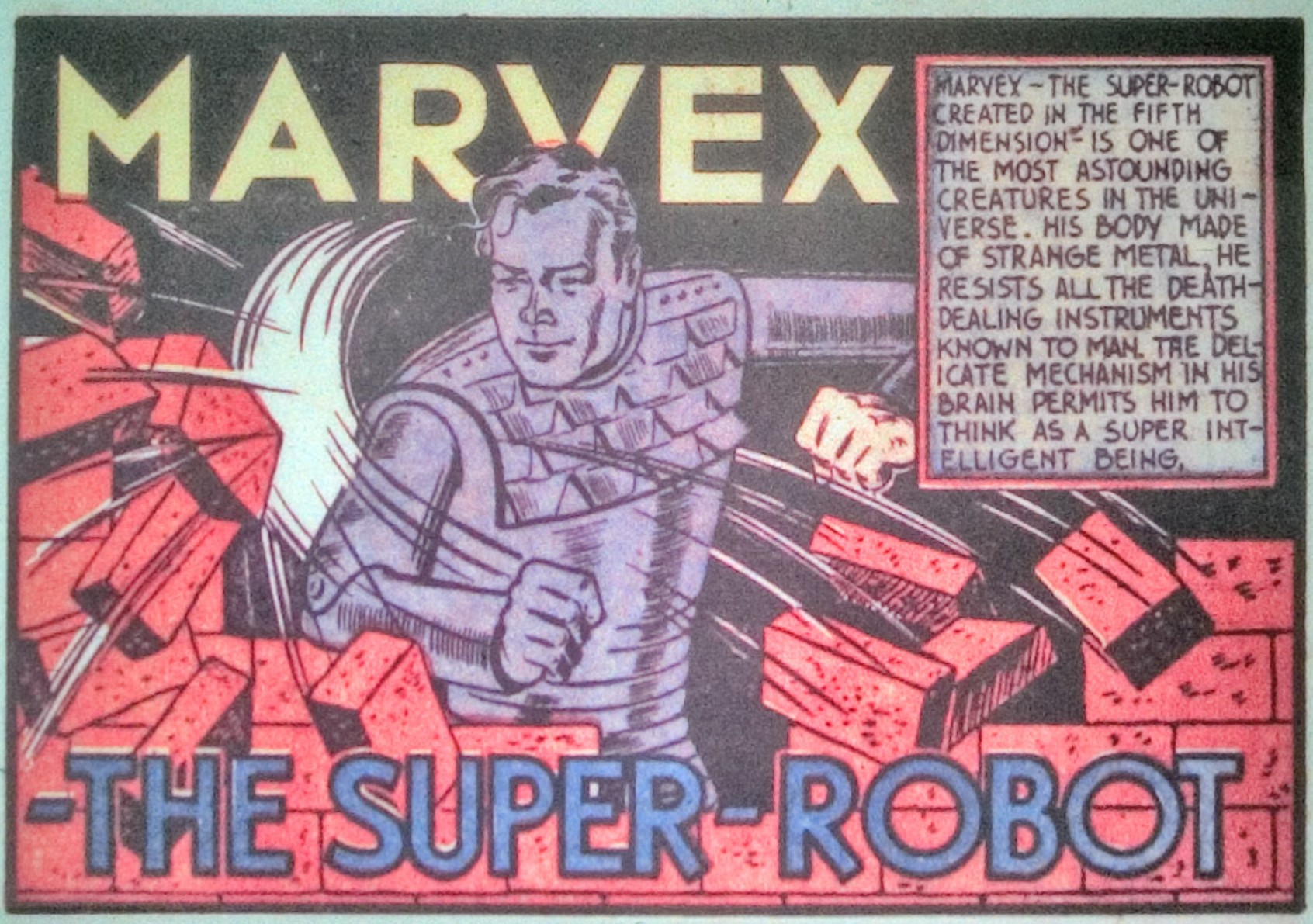
    Marvex the Super-Robot: 

    Marvex the Super-Robot! Created to be a slave by a Fifth Dimensional jerk named Bolo, Marvex rejects his fate, kills Bolo and his associates and accidentally blasts himself to Earth while smashing up Bolo’s lab equipment.

    If you’re already aware of who Marvex is then it’s likely because of the Michael Kupperman strip featuring the character during Marvel’s 70th Anniversary run of comics, and indeed, Marvex’ propensities for cartoonish violence, shutting down romance with sudden nudity and receiving twenty dollars all make him a perfect Kupperman character.

    Sadly, the nudity and twenty dollar reward system go the way of Marvex’ hair in his second and third appearances, but he never stops yelling about being a robot whenever his companion Clara gets a bit too comfortable around him. (Daring Mystery Comics 003, 1940)

    Categorized in: Language (Superlatives – Super), Origins (Extradimensional, Robot), Supranormal Beings (Robots)

    the Falcon:

    The Falcon is Carl Burgess, assistant district attorney in an unnamed city who is kind of betraying the spirit of his office by meting out vigilante justice when he feels like the legal system isn’t working. Though he is a pretty average costumed vigilante, the Falcon has precisely four interesting things to note. The first is that his name is weirdly close to that of Carl Burgos, the creator of the Human Torch. This might be a coincidence, but still. The second is of course that he is the original Marvel Falcon but by far the least-known of the half dozen or so Marvel characters to share that name.

    Like the Eagle, the Falcon is a bit of a fashion plate or at least someone who adjusts his costume on every adventure and for the same reason: a different artist on every one of his appearances.

    Finally, the Falcon has been retroactively assigned an accessory based on an assumption, just like his fellow Daring Mystery Comics alum the Fiery Mask and his morning star. In this case, it’s that his suit gives him the ability to glide. I assume that this is because of a stylistic choice on the part of his various illustrators to have him dive down on his enemies like a falcon stooping on prey, because the suit does not come up in his handful of Golden Age appearances. (Daring Mystery Comics 005, 1940)

    Categorized in: Animals (Falcons), Day Jobs (Assistant District Attorneys)

    Marvel Boy:

    Up until about 2012 I’d have confidently said that “Marvel Boy” was one of the most commonly-shared super-hero identities in the Marvel Universe, but it seems that the concept of the legacy identity has gone through a weird mutation in the last decade or so and I am now regularly surprised to find that there are way more Wolverines or Captains America than I had previously imagined. With that in mind, we’ll revise my statement to be that there are more Marvel Boys than you might expect, like Starmans over at DC.

    This particular Marvel Boy is the Earthly reincarnation of Hercules, come down from Valhalla (?!) to aid a world threatened by fascism. His human form is named Martin Burns and like a veritable Silver Age Superboy he is born with so much physical strength that he must constantly hold himself back lest he endanger those around him and out himself as something strange and different.

    On Martin’s fourteenth birthday a mysterious stranger (who is implicitly the Roman god Jupiter) delivers a package containing his heroic costume to him and then somewhat redundantly also appears in his bedroom to really spell out his whole deal and charge him to uphold democracy etc.

    Marvel Boy is super strong, very agile and fast enough to run from New York City to Washington DC and back – carrying three grown men on the first leg of the trip – in the course of a night that also includes the aforementioned visit from Jupiter and busting up two fifth column cells.

    Both this Marvel Boy and his successor (coming up in 1942) never returned after making a single appearance, and while I can’t say just why they didn’t have further Golden Age adventures, the lack of a modern appearance for either of them is almost certainly down to the fact that their origins both revolve around a dead Hercules, who is in fact more often than not a very living second- or third-tier hero in the Marvel Universe. They’re also both named Martin Burns for some reason, which means that later handbook writers have felt compelled to differentiate them by giving them middle names based on their creators, making this one Martin Simon Burns.

    Frankly, I think that the fact that the two Marvel Boys have origins that are incompatible with both Marvel Comics continuity and also one another is terrific fodder for comic book storytelling. Both of them should be BRUNG BACK immediately, preferably in a comic that also has Hercules in it. (Daring Mystery Comics 006, 1940)

    Categorized in: Generica (Boys), Language (Superlatives – Marvels), Origin (Reincarnated God) 

    the Flying Flame:

    The Flying Flame is a red fighter plane flown for the RAF by the two-fisted American pilot Captain Red Ruff, who is also known as the Flying Flame due to his shock of red hair. During his brief comic book career, Ruff battled the Black Ace and ferreted out some spies at an airbase. (Daring Mystery Comics 006, 1940)

    Categorized in: Activities (Flying), Elements (Fire), Team Membership (RAF)
  • MINOR SUPER-VILLAIN 925: THE IRON-JAW

    MINOR SUPER-VILLAIN 925: THE IRON-JAW

    (Silver Streak Comics 009, 1941)

    The US is being rocked by a series of explosions targeting munitions factories and other facilities contributing to national defense, and not even the speed of the Silver Streak is enough to combat the organizational skills and coordination of the mysterious mastermind behind them. It is only by sheer coincidence that he happens upon an imperilled security guard from a plant in Georgia and learns from him that the men who blew up his workplace were under command of a mysterious figure called “Iron-Jaw” and that they all work for the “Axes Government”.

    Even with this information under his belt, the Silver Streak still loses two more factories to the Iron-Jaw before finally running down some of his men in Boston and discovering the secret of their great organizational abilities: a super-miniaturized (for the 40s) radio set used to relay orders to the Axes forces in America. By following the instructions coming from a captured unit, the Streak and Whiz are finally able to get the jump on the Iron-Jaw’s men and prevent the destruction of a plant in Pittsburgh, though the mastermind remains on the loose.

    The Iron-Jaw returns in Silver Streak Comics 010 with a new set of goals – the focus is now on shutting down media criticism of the Axes. To that end, the Silver Streak is drawn away via a report of a potential bombing in Chicago while Iron-Jaw is grabbing the real target, broadcaster Kitty Doyle, in NYC.

    This is Silver Streak we’re talking about here, so he returns in time to interrupt the kidnapping in progress. the mysterious Iron-Jaw is revealed to be a moderately cool-looking/ moderately goofy-looking/ fairly spiky humanoid robot. With a gold finish, no less – so much for thematic consistency.

    Though Iron-Jaw briefly gets the upper hand, even a super strong, very pointy robot is no match for the world’s fastest man and it takes a fatal header onto the streets of Manhattan below.

    Here’s something about the Iron-Jaw: in its first appearance, all it does is talk, while in its second it is completely mute. This dovetails interestingly with something that Kitty reports after its defeat, that investigation of the robot indicates that it was controlled by trans-oceanic radio waves originating from the Axes government. Which seems to indicate that the Iron-Jaw was merely operating as the mouth and hands of one or more spymasters in some comic book pastiche of Germany, which in turn means that this is one of the few times in Golden Age comics in which the villain gets away at the end!* Neat!

    *excluding all of the recurring villains who get away all the time, of course. 

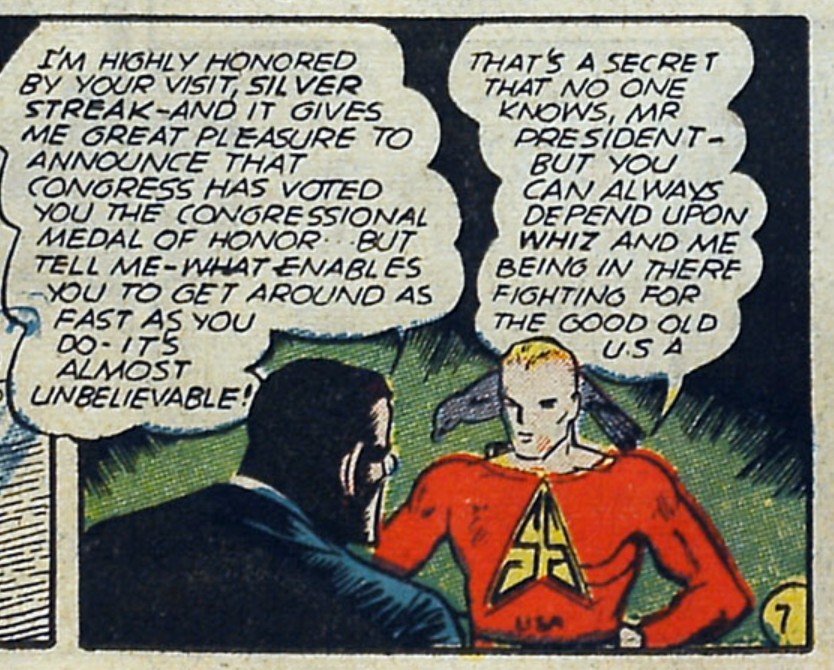
    Finally, Silver Streak and Whiz get to meet FDR to get his congratulationss, plus a Congressional Medal of Honor!

    Categorized in: Body (Jaws), Elements (Iron), Origins (Robots) 

  • MINOR SUPER-VILLAIN 925: THE IRON-JAW

    (Silver Streak Comics 009, 1941)

    The US is being rocked by a series of explosions targeting munitions factories and other facilities contributing to national defense, and not even the speed of the Silver Streak is enough to combat the organizational skills and coordination of the mysterious mastermind behind them. It is only by sheer coincidence that he happens upon an imperilled security guard from a plant in Georgia and learns from him that the men who blew up his workplace were under command of a mysterious figure called “Iron-Jaw” and that they all work for the “Axes Government”.

    Even with this information under his belt, the Silver Streak still loses two more factories to the Iron-Jaw before finally running down some of his men in Boston and discovering the secret of their great organizational abilities: a super-miniaturized (for the 40s) radio set used to relay orders to the Axes forces in America. By following the instructions coming from a captured unit, the Streak and Whiz are finally able to get the jump on the Iron-Jaw’s men and prevent the destruction of a plant in Pittsburgh, though the mastermind remains on the loose.

    The Iron-Jaw returns in Silver Streak Comics 010 with a new set of goals – the focus is now on shutting down media criticism of the Axes. To that end, the Silver Streak is drawn away via a report of a potential bombing in Chicago while Iron-Jaw is grabbing the real target, broadcaster Kitty Doyle, in NYC.

    This is Silver Streak we’re talking about here, so he returns in time to interrupt the kidnapping in progress. the mysterious Iron-Jaw is revealed to be a moderately cool-looking/ moderately goofy-looking/ fairly spiky humanoid robot. With a gold finish, no less – so much for thematic consistency.

    Though Iron-Jaw briefly gets the upper hand, even a super strong, very pointy robot is no match for the world’s fastest man and it takes a fatal header onto the streets of Manhattan below.

    Here’s something about the Iron-Jaw: in its first appearance, all it does is talk, while in its second it is completely mute. This dovetails interestingly with something that Kitty reports after its defeat, that investigation of the robot indicates that it was controlled by trans-oceanic radio waves originating from the Axes government. Which seems to indicate that the Iron-Jaw was merely operating as the mouth and hands of one or more spymasters in some comic book pastiche of Germany, which in turn means that this is one of the few times in Golden Age comics in which the villain gets away at the end!* Neat!

    *excluding all of the recurring villains who get away all the time, of course. 

    Finally, Silver Streak and Whiz get to meet FDR to get his congratulationss, plus a Congressional Medal of Honor!

    Categorized in: Body (Jaws), Elements (Iron), Origins (Robots) 

  • MINOR SUPER-VILLAIN 841: SIKANDUR, THE ROBOT MASTER

    (War Comics 001, 1940) 

    Sikandur, the Robot Master, is a villain-in-a-starring-role who sadly only appeared once. Any evil roboticist who, for example, makes his robots red-hot as a way of discouraging those who might grapple them is an evil roboticist I want to read about, and I only got the one opportunity to do so.

    Sikandur need gold in order to build more robots, though whether he needs it as a necessary component or as a handy source of cash is unspecified. To that end, he sends his boy Robot X5328B to the United States to rob Fort Knox.

    If Sikandur’s feature had continued to appear then presumably these three dingbats would have been the ones who would be foiling him going forward. As it is, they’re just three… college students? who figure out that Robot X5328B is something more than a simple traveller with jet-black eyes and kind of bumble around trying to figure out what he’s up to.

    Also please not that Sikandur has apparently “conquered half of Europe” at this point.

    Robot X5328B is an advanced robot indeed, because he (?) does some excellent and very menacing threats before being undermined by Sikandur’s caution re: the small-town police missing three local oafs. And that’s a wrap on Sikandur the Robot Master. Presumably the next few issues would have concerned our unlikely trio’s efforts to prevent the robbery of Fort Knox and then ultimately the end of Sikandur and his dreams of world conquest.

  • MINOR SUPER-VILLAIN 841: SIKANDUR, THE ROBOT MASTER

    (War Comics 001, 1940) 

    Sikandur, the Robot Master, is a villain-in-a-starring-role who sadly only appeared once. Any evil roboticist who, for example, makes his robots red-hot as a way of discouraging those who might grapple them is an evil roboticist I want to read about, and I only got the one opportunity to do so.

    Sikandur need gold in order to build more robots, though whether he needs it as a necessary component or as a handy source of cash is unspecified. To that end, he sends his boy Robot X5328B to the United States to rob Fort Knox.

    If Sikandur’s feature had continued to appear then presumably these three dingbats would have been the ones who would be foiling him going forward. As it is, they’re just three… college students? who figure out that Robot X5328B is something more than a simple traveller with jet-black eyes and kind of bumble around trying to figure out what he’s up to.

    Also please not that Sikandur has apparently “conquered half of Europe” at this point.

    Robot X5328B is an advanced robot indeed, because he (?) does some excellent and very menacing threats before being undermined by Sikandur’s caution re: the small-town police missing three local oafs. And that’s a wrap on Sikandur the Robot Master. Presumably the next few issues would have concerned our unlikely trio’s efforts to prevent the robbery of Fort Knox and then ultimately the end of Sikandur and his dreams of world conquest.

  • MINOR SUPER-VILLAIN 596: THE ROBOT SCIENTISTS OF VENUS

    (Fantastic Comics 003, 1940) 

    The Robot Scientists of Venus are not particularly noteworthy villains on a lot of axes but they are the bosses of perhaps the most visually distinctive groups of the Golden Age, the Leopard Women of Venus.

    What other comic could offer a visual like this: a bevy of bodacious blonde babes in red leopardprint bodysuits, surfing through space on lizard monsters and blazing away with their head-guns? Other Fletcher Hanks comics, I guess, plus early Wonder Woman. But the point stands!

    (here is where I will put a brief aside on the notion of “transmitting” as it exists in Fletcher Hanks comics. Conceptually, transmitting involves just that, the transmission of matter along a light or radio beam of some kind. In practice, it’s more like just being able to fly around in space without any kind of life support like the Leopard Women here)

    Sadly, the Leopard Women are mere vassals of the dominant Venusian race and we don’t really see them again. Happily, the dominant Venusian race are these cool robots! Their leaders appear to be these robot scientists, who seem to be running these Leopard Woman space raids without any clear goals. Sure, they plan on turning Dianna into a Leopard Woman but that seems to be more of a spur-of-the-moment decision.

    Luckily for them, Space Smith escapes before they have to figure out what to do with him. The rest of the adventure is just a series of encounters with colourful robots as they make their way to their spaceship, starting with these (delightfully and conscientiously masked) robot surgeons.

    Everyone in this panel is grumpy.

  • MINOR SUPER-VILLAIN 544: DR VON THORP & THE IRON MONSTER / MINOR SUPER HERO: HUGH HAZZARD & BOZO THE IRON MAN

    (Smash Comics 001, 1939)

    We open on a city (later established as almost certainly NYC) in the grip of terror. A robot known as the Iron Monster is wantonly robbing and murdering and also stealing one or more babies for reasons that are never made clear. Seriously, we never find out what the deal was with those babies.

    The Iron Monster is the creation of Dr von Thorp, your classic scientist rejected from society for his outre beliefs, though considering the man and his work he may have been ostracized for something other than believing that he might someday build a robot. Regardless of why he was rejected, he has expressed himself in the traditional way, by turning his invention back on society as revenge.

    The police have no hope of dealing with the Iron Monster or his boss, so Police Commissioner Hunt calls in private detective par excellence Hugh Hazzard, whose job is made considerably easier by the fact that von Thorp subscribes to the surprisingly common school of robot design that dictates that the robot contain a large, easily accessible space that a human can get inside and also take control of the robot from. Von Thorp’s capture is almost anticlimactic, in fact.

    The reason for this anticlimax is that this is not, in fact, the story of Dr von Thorp and his Iron Monster but the origin of Hugh Hazzard and the renamed Bozo the Iron Man. As introduced Hazzard is already one of those superhuman-adjacent comic book adventurers complete with a special method for the police commissioner to contact him and a love interest gamely resigned to spending most of her evenings alone. Bozo, despite eventually taking over the name of the strip entirely, is never more than a tool of Hazzard’s with no actual personality or volition (though Hazzard does eventually switch to mostly travelling around inside the robot like the other, later Iron Man and Bozo gets a considerable boost in personality once it seems to be spouting quips from its fixed grimace).

    In Smash Comics 002 Hazzard upgrades Bozo with both a considerably miniaturized controller (cellphone sized vs the old one’s desktop PC) and a weird disc on top of his head that allows him to fly, so I guess that also makes him one of those hobbyist polymath types you get in old comics

    Dr von Thorp returns exactly one more time in Smash Comics 018, wherein he and Hazzard battle for control of Bozo by blasting radio waves at him like two people trying to see who a puppy loves more. No surprise that Hugh Hazzard wins but killing von Thorp off-panel at the very end seems a bit mean.

    Like I said, Bozo’s role in the title of the strip if not as a character continued to grow until the end of their run in 1943. Since then Bozo occasionally turns up in a collection of DC Comics junk that some character has collected. Of Hugh Hazzard there has been no further sign.

  • MINOR SUPER-VILLAIN 494: THE INVENTOR

    (Big Shot Comics 008, 1940) 

    It’s a very big stretch, even by the standards of my own Unofficial Name convention, to call this guy the Inventor but it’s literally the only thing he’s referred to as other than “the man” and I just can’t keep calling these guys “Unnamed Scientist.” I just can’t.

    So! The Inventor has invented a very cool remote-controlled humanoid robot with a special poison-spraying device in the chest. We’ll skip my usual speculation into the potential value that could be reaped by selling this design for industrial purposes rather than using it for mere bank robbery because the Inventor is in fact a mad scientist and thus cannot be held to the same fiscal standards as his more rational colleagues.

    Let’s take a second to appreciate the classic stylings of this robot: cylinder head, pincer claws, speaker ears… all the great robot features in one cool guy.

    This might be a Tom Kerry story but the real hero of the piece is this night watchman who chooses not to pointlessly die in an attempt to protect the bank he works at and instead lives to clue the two-fisted District Attorney in on the culprit’s identity as a robot. I appreciate you, fella.

    Tom Kerry tracks the robot back to its lair by the simple expedient of clinging to the underside of the remote-controlled auto-gyro used to ferry both it and the money back to the Inventor. There he takes advantage of the fact that like a surprising percentage of Golden and Silver Age robots, this one’s exterior shell is easily removed and repurposed as a costume.

    The Inventor is essentially epically pranked into signing a confession, Tom Kerry battles a knife-wielding maniac in his boxer shorts and the whole thing wraps up with a sock to the jaw. No word on what became of that poor nude robot, though.

  • MINOR SUPER-VILLAIN 494: THE INVENTOR

    (Big Shot Comics 008, 1940) 

    It’s a very big stretch, even by the standards of my own Unofficial Name convention, to call this guy the Inventor but it’s literally the only thing he’s referred to as other than “the man” and I just can’t keep calling these guys “Unnamed Scientist.” I just can’t.

    So! The Inventor has invented a very cool remote-controlled humanoid robot with a special poison-spraying device in the chest. We’ll skip my usual speculation into the potential value that could be reaped by selling this design for industrial purposes rather than using it for mere bank robbery because the Inventor is in fact a mad scientist and thus cannot be held to the same fiscal standards as his more rational colleagues.

    Let’s take a second to appreciate the classic stylings of this robot: cylinder head, pincer claws, speaker ears… all the great robot features in one cool guy.

    This might be a Tom Kerry story but the real hero of the piece is this night watchman who chooses not to pointlessly die in an attempt to protect the bank he works at and instead lives to clue the two-fisted District Attorney in on the culprit’s identity as a robot. I appreciate you, fella.

    Tom Kerry tracks the robot back to its lair by the simple expedient of clinging to the underside of the remote-controlled auto-gyro used to ferry both it and the money back to the Inventor. There he takes advantage of the fact that like a surprising percentage of Golden and Silver Age robots, this one’s exterior shell is easily removed and repurposed as a costume.

    The Inventor is essentially epically pranked into signing a confession, Tom Kerry battles a knife-wielding maniac in his boxer shorts and the whole thing wraps up with a sock to the jaw. No word on what became of that poor nude robot, though.

  • MINOR SUPER-VILLAIN 467: DRAGO

    (Amazing-Man Comics 011, 1940)

    On the surface Drago seems to merely be a guy who looks like an evil cat and shoots his henchmen rather than paying them (not only a nightmare for HR but a bad financial decision as you’ll be spending more in headhunting and training new goons than you will save in salaries), and that’s just what he is. There are no hidden depths. He kidnaps world-class scientists and sells them to the Axis-equivalent belligerent governments of the far-off year of 1971.

    But though one-dimensional villain he may be, Drago has a lot of accessories. For instance, his henchmen are either drawn from or organized into a secret society named the Devils Cult, seemingly to promote fanatical loyalty (and this is perhaps why he can get away with bumping them off willy-nilly). Naming a group of henchmen? Why, that’s one of the keys to my heart, Drago.

    Other accessories include:

    Robot guards with charmingly doofy faces!

    A deathtrap that was demonstrably not custom-made to kill the Iron Skull because it commits the cardinal sin of allowing him to smash the spiked parts with his head before they kill him.

    And a dead man’s switch time bomb just in case one of his treacherous over- or underlings manages to bump him off (which is in fact what happens – his employers do unto him as he does to his own henchmen). 

    Drago: unmourned, unloved, well accessorized.