The Curse of Skeleton Munroe

Category: Navy Jones

  • MAD AND CRIMINAL SCIENTIST ROUND-UP 026

    If we criminalize mad science then only criminal scientists will be mad.

    Mauser:

    Mauser is the second of two foes battled by two-fisted chemist Guy Gorham and also the second rogue biologist. Was this comic setting up some sort of biologist/chemist beef that never got a chance to pay off? Mauser’s plans are never really spelled out, but he’s got a colony of vampire bats that he seems to be training to attack human targets, which isn’t great but which spells his undoing when he steals Gorham’s food concentrate formula for use as vampire feed – presumably for when human blood is in short supply. 

    A couple of other things about Mauser: he has a pretty decent uniform which he shares with his underlings, and despite his name (and the name of his henchman Herr Klotz) he does not appear to be a fascist. (Great Comics 002, 1941)

    Dr Berchtoldt:

    All Dr Berchtoldt wants to do is peacefully develop his robot army (and then take over the world). They won’t let him do it on land, so he moves under the sea, where he still gets hassled by the Man, in the form of Navy Jones. And all he did was kidnap Princess Coral and threaten to marry her against her will: is that any justification for hounding a man from his undersea fortress and then blowing up him and his super submarine alike? (Green Mask v1 006, 1941)

    de Moire:

    De Moire and his pal the Skipper have come to the part of Africa that Kaänga hangs out in to do unethical human experiments on what they assume are expendable people. After transforming one guy into a huge green killing machine, de Moire becomes obsessed with doing the same to Kaänga to make an even more beefy creature. This obsession leads him to neglect his original creation, and it wanders off and gets a look at itself in a pool of water and realizes that it is now ugly, which in turn leads it to slay de Moire. The Skipper is likewise killed, leaving Kaänga to battle the monster to the death. (Jungle Comics 013, 1941)

    Zalov Varno:

    Zalov Varno has been sending teams of men out to attack the oil fields of Debra-Tabuk, prompting Tabu, Wizard of the Jungle to pay him a visit and see just what his deal is. Though he captures Tabu with surprising ease given the latter’s vast magical power, Varno never actually explains just what he wants the oil for, which is in my opinion one of the greatest of villainous sins. I don’t even feel bad for him when he gets killed with his own Devitalizer Beam.

    The most interesting thing about Varno is what exactly is going on with his right eye. As far as I can tell, he wears some sort of semi-spherical black monocle, but just why he might care to do so is left as an exercise for the reader. (Jungle Comics 013, 1941)

  • MAD AND CRIMINAL SCIENTIST ROUND-UP 026

    If we criminalize mad science then only criminal scientists will be mad.

    Mauser:

    Mauser is the second of two foes battled by two-fisted chemist Guy Gorham and also the second rogue biologist. Was this comic setting up some sort of biologist/chemist beef that never got a chance to pay off? Mauser’s plans are never really spelled out, but he’s got a colony of vampire bats that he seems to be training to attack human targets, which isn’t great but which spells his undoing when he steals Gorham’s food concentrate formula for use as vampire feed – presumably for when human blood is in short supply. 

    A couple of other things about Mauser: he has a pretty decent uniform which he shares with his underlings, and despite his name (and the name of his henchman Herr Klotz) he does not appear to be a fascist. (Great Comics 002, 1941)

    Dr Berchtoldt:

    All Dr Berchtoldt wants to do is peacefully develop his robot army (and then take over the world). They won’t let him do it on land, so he moves under the sea, where he still gets hassled by the Man, in the form of Navy Jones. And all he did was kidnap Princess Coral and threaten to marry her against her will: is that any justification for hounding a man from his undersea fortress and then blowing up him and his super submarine alike? (Green Mask v1 006, 1941)

    de Moire:

    De Moire and his pal the Skipper have come to the part of Africa that Kaänga hangs out in to do unethical human experiments on what they assume are expendable people. After transforming one guy into a huge green killing machine, de Moire becomes obsessed with doing the same to Kaänga to make an even more beefy creature. This obsession leads him to neglect his original creation, and it wanders off and gets a look at itself in a pool of water and realizes that it is now ugly, which in turn leads it to slay de Moire. The Skipper is likewise killed, leaving Kaänga to battle the monster to the death. (Jungle Comics 013, 1941)

    Zalov Varno:

    Zalov Varno has been sending teams of men out to attack the oil fields of Debra-Tabuk, prompting Tabu, Wizard of the Jungle to pay him a visit and see just what his deal is. Though he captures Tabu with surprising ease given the latter’s vast magical power, Varno never actually explains just what he wants the oil for, which is in my opinion one of the greatest of villainous sins. I don’t even feel bad for him when he gets killed with his own Devitalizer Beam.

    The most interesting thing about Varno is what exactly is going on with his right eye. As far as I can tell, he wears some sort of semi-spherical black monocle, but just why he might care to do so is left as an exercise for the reader. (Jungle Comics 013, 1941)
  • ALIENS AND SO FORTH ROUND-UP 025

    ALIENS AND SO FORTH ROUND-UP 025

    We got Fish-Men, we got Fishmen, we got other kinds of men.

    Fishmen:

    Adventurer Lance Rand has acquired a map showing the location of the sunken continent of Atlantis and so naturally he sets out to see if it’s accurate and more importantly to find out if there’s any ancient Atlantean treasure there for him to loot. Making his way to the ocean floor, Lance and his pal Tubby are almost immediately accosted by a Fishman riding on a sea monster. This is a good sign!

    The sunken city of Atlantis does indeed turn out to me right where the map said it was, complete with some monumental bare-assed statuary. Lance and Tubby are able to drive their submarine tractor right up to the base of what must have been an important Atlantean idol and pry the disco ball-sized diamond out of its forehead, upon which they have to deal with another squad of hostile Fishmen. Though the implication is of course that these fellows are the descendants of drowned Atlantis, the fact that they never say anything really makes it hard to confirm. Perhaps they are unrelated underwater humanoids who just disapprove of Lance and Tubby’s wanton looting. Whichever it is, I really dig the little wing-fins that grow out of their backs. (Cat-Man Comics 001, 1941)

    Fish-Men: 

    When oceanic adventurer Navy Jones’ submarine is lost at sea, he is rescued by an undersea race of aquatic humanoids who don’t really have an official name but who are more often than not called Fish-Men or something similar. Despite some early conflict engineered by the scheming Prime Minister, Jones soon becomes the Fish-Men’s champion.

    Fish-Men society is ruled over by a more humanoid nobility, represented here in the forms of their unnamed king and his daughter/ Navy Jones’ love interest, Princess Coral. As usual, the reasons for these morphological differences are not explained and likely boil down to “we didn’t want our hero to be romantically involved with a fish.”

    Like many Fiction House heroes, Navy Jones passed through a lot of hands over the course of his career, and the Fish-Men had a correspondingly large number of looks, each of them charming in its own way.(Science Comics 001, 1940)

    Fishmen:

    This Fishman is encountered by Tabu, Wizard of the Jungle in what is probably a prehistoric underground enclave that a group of explorers stumble across “far to the Southeast of the Congo”. I say probably because Tabu gasses on about how they have gone back in time, which might be meant literally and might just be a bit of excessively flowery exposition. 

    The above is virtually all of the on-panel time that the Fishmen get, as the narrative is much more focused on the drama of one of the explorers falling in love with a cave woman. (Jungle Comics 011, 1940) 

    Flame-Men: 

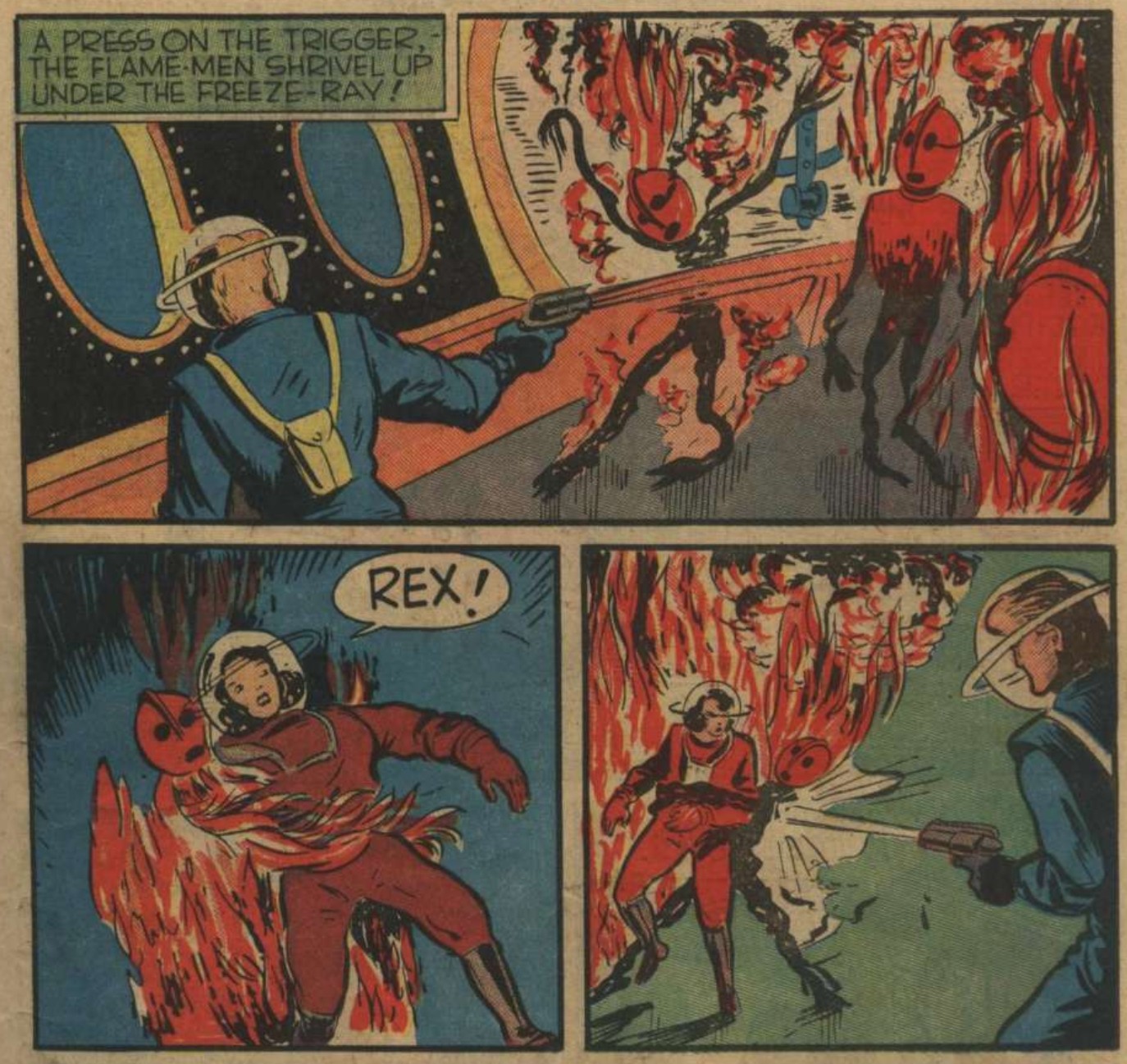
    Just as Rex Dexter of Mars and his companion Cynde are about to leave the planet Nexis and its friendly inhabitants, the Nexis as part of their never-ending attempt to reach Mars, the world is attacked by some sort of apocalyptic flame weapon.

    Rocketing into space to investigate, Rex and Cynde discover that the source of the attack is a fiery comet that is being directed by a massive spacecraft, by which they are swiftly captured. Inside they find the Flame-Men from Planet Emalf, who are attacking Nexis as the first move in their attempt to destroy the rest of the universe. Why are they doing this? No idea.

    The Flame-Men are unprepared for Rex’s freeze-ray gun, and shrivel up into little burnt matchstick men in a way that is as aesthetically pleasing as it is unsettling. (Mystery Men Comics 010, 1940) 

    Categorized under: Aliens, Animals (Fish), Elements (Fire), Generica (Men)

  • REAL PERSON ROUND-UP 018

    World leaders and others. 

    Adolf Hitler: 

    I’m pretty sure that the “Navy Jones” strip is set in an undefined near-future time, which makes the Dictator of Europe here a future analog of Adolf Hitler rather than a stand-in for him. I’m almost certain that that’s the case. Anyway, he tries to invade the US with a fleet of amphibious tanks and gets his ass handed to him by Navy Jones and his fish men. (Weird Comics 008, 1940)

    Chiang Kai-shek and Soong Mei-ling: 

    Styled as Madame and Generalissimo “Kang Shy-check,” the former comes to adventurer Shanghai Sheridan for aid after the latter is captured by Japanese collaborator Wu Fang. (Top-Notch Comics 005, 1940)

    Clyde Beatty: 

    Famous animal trainer and circus mogul Clyde Beatty had a long-running strip across several Dell Comics titles, though given that the supporting cast and premise tended to reset to zero every time the strip changed hands it might be more accurate to say that he had a sequential series of features linked only by his presence. (Crackajack Funnies 001, 1938)

    Franklin Delano Roosevelt:

    A fairly off-model FDR chairs an emergency meeting to discuss what to do about an alien invasion. (War Comics 002, 1940)

    J Edgar Hoover: 

    The Sparkler accepts an assignment from “head G-Man”/his old college roommate’s dad M.L. Roover. (Wham Comics 002, 1940)

    Sténio Vincent: 

    I don’t necessarily trust the creators of the “Voodoo Man” feature to even remember that it is set in Haiti, let alone go to the trouble to accurately represent Haiti’s president on-panel, so I have to give it to them: this is an okay drawing of Sténio Vincent, the President of Haiti c. 1940. Was it done on purpose? Nobody can say. (Weird Comics 004, 1940) 

    Gaius Marius & Sulla: 

    It’s impossible to be certain if Marius and Sulla, the Roman figures associated with the origin of super-hero the Dart, are in fact meant to be Gaius Marius and Sulla, the political figures from the late Roman Republic, but the timeline almost matches up. Plus, there really weren’t that many Sullas running around Rome. (Weird Comics 005, 1940) 

    Mata Hari: 

    Just a notorious spy named Hattie Mary in the comedy melodrama comic strip “Hairbreadth Harry”. (Famous Funnies 074, 1940) 

    Winston Churchill: 

    Inspector Blake of Scotland Yard is called to 10 Downing Street to talk to the Prime Minister, and it sure doesn’t look like he’s Winston Churchill. I do like to roast comics for not getting the appearances of world leaders right, but when it’s somewhere like Madagascar you might at least have the excuse that finding a picture of the current leader of that country might be difficult in the US in 1940, but surely this not so for the Prime Minister of the UK.

    The other possible defense for this, of course, is that this comic came out in June 1940 and Churchill took power in April so Neville Chamberlain might still have been PM when this was drawn, but this is hampered somewhat by the fact that it doesn’t really look like him either. (Whirlwind Comics 001, 1940)

  • REAL PERSON ROUND-UP 018

    World leaders and others. 

    Adolf Hitler: 

    I’m pretty sure that the “Navy Jones” strip is set in an undefined near-future time, which makes the Dictator of Europe here a future analog of Adolf Hitler rather than a stand-in for him. I’m almost certain that that’s the case. Anyway, he tries to invade the US with a fleet of amphibious tanks and gets his ass handed to him by Navy Jones and his fish men. (Weird Comics 008, 1940)

    Chiang Kai-shek and Soong Mei-ling: 

    Styled as Madame and Generalissimo “Kang Shy-check,” the former comes to adventurer Shanghai Sheridan for aid after the latter is captured by Japanese collaborator Wu Fang. (Top-Notch Comics 005, 1940)

    Clyde Beatty: 

    Famous animal trainer and circus mogul Clyde Beatty had a long-running strip across several Dell Comics titles, though given that the supporting cast and premise tended to reset to zero every time the strip changed hands it might be more accurate to say that he had a sequential series of features linked only by his presence. (Crackajack Funnies 001, 1938)

    Franklin Delano Roosevelt:

    A fairly off-model FDR chairs an emergency meeting to discuss what to do about an alien invasion. (War Comics 002, 1940)

    J Edgar Hoover: 

    The Sparkler accepts an assignment from “head G-Man”/his old college roommate’s dad M.L. Roover. (Wham Comics 002, 1940)

    Sténio Vincent: 

    I don’t necessarily trust the creators of the “Voodoo Man” feature to even remember that it is set in Haiti, let alone go to the trouble to accurately represent Haiti’s president on-panel, so I have to give it to them: this is an okay drawing of Sténio Vincent, the President of Haiti c. 1940. Was it done on purpose? Nobody can say. (Weird Comics 004, 1940) 

    Gaius Marius & Sulla: 

    It’s impossible to be certain if Marius and Sulla, the Roman figures associated with the origin of super-hero the Dart, are in fact meant to be Gaius Marius and Sulla, the political figures from the late Roman Republic, but the timeline almost matches up. Plus, there really weren’t that many Sullas running around Rome. (Weird Comics 005, 1940) 

    Mata Hari: 

    Just a notorious spy named Hattie Mary in the comedy melodrama comic strip “Hairbreadth Harry”. (Famous Funnies 074, 1940) 

    Winston Churchill: 

    Inspector Blake of Scotland Yard is called to 10 Downing Street to talk to the Prime Minister, and it sure doesn’t look like he’s Winston Churchill. I do like to roast comics for not getting the appearances of world leaders right, but when it’s somewhere like Madagascar you might at least have the excuse that finding a picture of the current leader of that country might be difficult in the US in 1940, but surely this not so for the Prime Minister of the UK.

    The other possible defense for this, of course, is that this comic came out in June 1940 and Churchill took power in April so Neville Chamberlain might still have been PM when this was drawn, but this is hampered somewhat by the fact that it doesn’t really look like him either. (Whirlwind Comics 001, 1940)

  • REAL PERSON ROUND-UP 009

    Some day these won’t inevitably start with Hitler. Some day.

    Adolf Hitler:

    Rix, a human living on Venus in the peaceful year 3090 CE, learns about dictators thanks to the time capsule from the 1939 New York World’s Fair and immediately sets out to make himself into the Hitler of the future. Beat down by interplanetary troubleshooter Planet Payson. (Planet Comics 008, 1940)

    Aviator Ted O’Neil is brought down in the warlike nation of Gestapia (one of the more on-the-nose Nazi Germany stand-ins I have encountered), ruled over by dictator “Schnitzler.” (Prize Comics 004, 1940)

    Al Capone:

    It’s just a shorthand reference for “bigtime gangster” but Scarface Marone here is absolutely an Al Capone pastiche for the one and a half panels he appears in before jumping out a window to avoid capture. (Rocket Comics 002, 1940)

    Anna Roosevelt:

    She’s referred to only as “the President’s daughter” throughout this adventure which sees her being kidnapped and almost killed by Gerlandian spies before being rescued by Electro here, but it’s 1940 and the US has had precisely one President’s Daughter for nearly eight years at this point and it’s Anna Roosevelt. (Science Comics 001, 1940)

    Captain Nemo:

    It shouldn’t have surprised me when Navy Jones, established in the previous issue to be descended from the legendary Davy Jones, encounters not-just-fictional-but-fictional-from-about-seventy-years-earlier figure Captain Nemo while noodling around under the sea with his paramour Princess Coral, but I’m afraid that it did. And not only do they team up to battle octopus men and recover an ancient Roman map to Atlantis together but Nemo basically joins the “Navy Jones” cast going forward! (Science Comics 005, 1940)

    FDR:

    Minor Appearances:

    Science Comics 003, 1940

    Genghis Khan:

    Obvious allusion to Genghis Khan in Khangiz, the warlike master of Mars in the year 40 000 CE. (Planet Comics 002, 1940)

    J Edgar Hoover:

    You have a comic book character who works for the FBI and eventually an unnamed J Edgar Hoover is going to show up and congratulate them for doing their job, as happens to FBI agent Buck Brady here. (Prize Comics 005, 1940)

    J Edgar Hoover is not only Joe “the Shield” Higgins’ boss at the FBI but he was the best friend of Tom Higgins, Joe’s father. (Shield-Wizard Comics 001, 1940)

    Minor appearances:

    Science Comics 003, 1940

    Oak Island:

    Even though Fu Chang operates out of San Francisco and thus Money Pit Island is located somewhere in the Pacific, its name alone twigs it as at least inspired by the legend of Oak Island, which (I checked) was indeed going strong as of 1940 (Pep Comics 009, 1940)

  • MINOR SUPER-VILLAIN 725: THE SEA-WITCH

    (Science Comics 005, 1940)

    En route to the court of King Neptune to deliver a new invention to him, Navy Jones and Princess Coral find themselves the prisoner of a heinous-looking clarinet-playing mermaid who looks a lot like something out of a 19th Century political cartoon.

    I’ll be honest here: while the Sea-Witch is a notable-enough villain to cover here, the real attraction of this comic is that it all looks like an outsider art fever dream. The Grand Comics database says that the artist was Bert Whitman and that he did enough comics work in the 40s that I should have run into him, but either luck has conspired against me in that regard or this was just a more interesting assignment than usual for him, because it’s just really enjoyably weird.

    Navy Jones escapes the clutches of the One-Eyed Octopus when it turns out that it is fatally allergic to pepper, and he and Princess Coral are able to simply swim away under the cover of its dying ink-cloud. The Sea-Witch’s little imp minions give chase but are unable to contend with the sheer power of the “Speed Sea Tri-Motor” underwater jetapacks that the duo are wearing courtesy of Coral’s as-yet-unnamed father.

    Other weird and wonderful occurrences in this comic:

    An idyll with Queen Nina and her subjects in Mermaid City,

    This two-panel plot by a pair of incompetent undersea pirates,

    Navy Jones visiting the grave/locker of his great great great grandfather, Davy Jones (bah gawd, his name isn’t just a pun, it’s hereditary!),

    and the pomp, circumstance and wide array of weird sea creatures in King Neptune’s court. The question of whether this is the Neptune of myth or just some guy is overshadowed (and possibly answered) by the presence of, for example, a cutlass-wielding fish-man centaur in the background. Delightful!

  • MINOR SUPER-HERO ROUND-UP 038

    Second- and third-tier Fox Features heroes: ACTIVATE

    Dynamo:

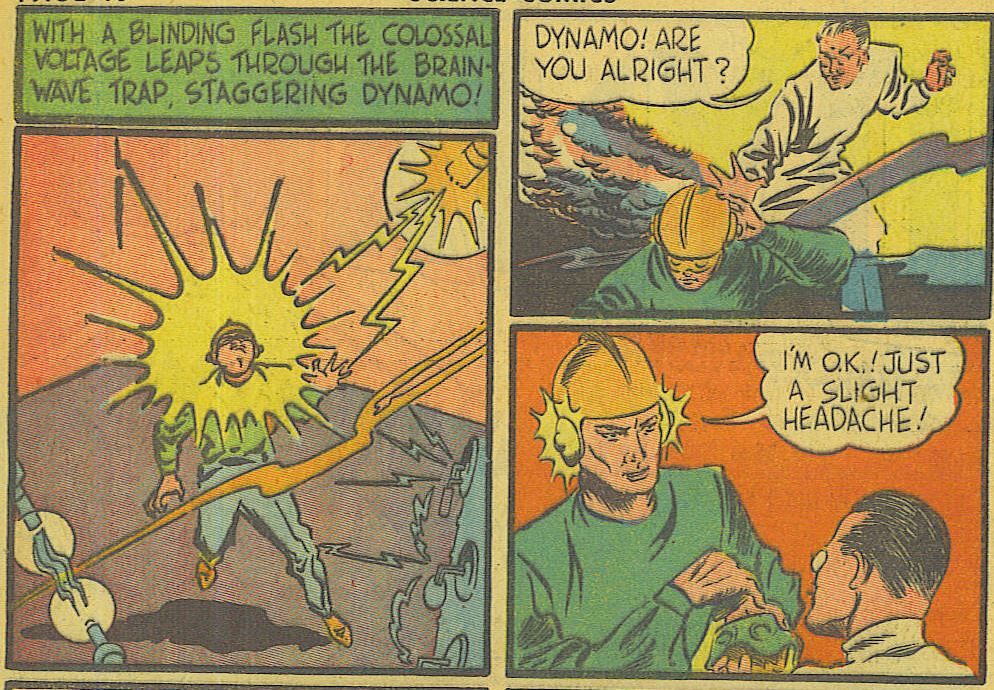
    Jim Andrews is an electrical scientist who heroically risks his own life by using his own body as a conductor to prevent some crazy bit of machinery from blowing the whole laboratory he works at to high heaven. And since he lives in a comic book world, the reward for his bravery is some super powers! He can now emit electricity, create an electrical forcefield, kind of fly by throwing a lightning bolt and then riding it through the air and even be super strong, with the minor caveat that he has to charge himself up from time to time (over time and for narrative convenience he also develops the powers to freeze water, to repair smashed up items by shooting electricity at them and to travel interstellar distances under his own power).

    Andrews originally calls himself Electro but swaps that name out for Dynamo in his second appearance. There is some speculation that the name change comes about because there was already an extant Electro over at Marvel.

    Dynamo’s costume choices over his two years of adventuring range from “generic” to “kind of dumb-looking,” and the real kicker is that the Fox Features cover artist consistently puts him in this incredible red number. (Science Comics 001, 1940)

    ADDENDUM: In Science Comics 005, Dynamo, already wildly powerful, invents a device with the fairly ominous name the Brain-Wave Trap which allows him to read the minds of everyone on Earth and indeed for hundreds of light years around. Ir’s a significant power boost for something that is mainly used to keep the plot chugging along.

    UPDATE: Weird Comics 1940

    the Eagle:

    The Eagle is Bill Powers, a wealthy young gadabout who has developed an “anti-gravitation fluid” which allows him to fly when applied to his wing/flaps.


    The Eagle might just have the greatest number of costume variations before finding his groove, though I suppose a number of them can be ascribed to the whims of the colourist on any given day. While the flying squirrel style flaps are fun for their uniqueness and that fourth version has far nicer-looking wings than Hawkman was sporting at the same time I can absolutely understand the impulse to move toward a more traditional super-hero costume without a bunch of fiddly little feathers all over it. BUT! the Eagle’s costume has not reached its final form – something to look forward to once we get to Fox Features’ 1941 offerings. Or just look up on your own, I suppose.

    I don’t think that it’s intentional so much as a product of many busy hands being involved in making most if not all Fox Features comics, but Bill Powers is one of the better realizations of the “wealthy young playboy” super-hero alter ego. He really and truly comes off as someone who is just kind of doing things, including fighting crime, to keep himself occupied and the greatest example of that is all the little projects such as his “crime cartoons” or his “book on crime” that he keeps mentioning once and then never ever returning to. Plus he has a butler named Jason, whom I love.

    Finally, the Eagle might just have the most mysterious of all calling cards, an unseen “mark like that done by an eagle.” (Science Comics 001, 1940) 

    UPDATE: Weird Comics 1940

    Marga the Panther Woman:

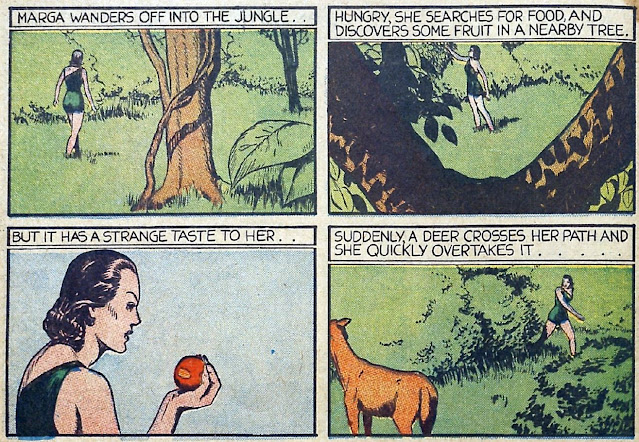
    Marga, formerly a nurse at the asylum housing the mad physiologist von Dorf, finds herself kidnapped and made into a panther/ human hybrid. Is there just a hint of weird race science in the way that Marga going from blonde to black haired is a sign of her primitive nature being brought forward? Maybe just a skosh.

    Marga adapts fairly well to her new situation, even when it means that she is now an obligate carnivore. She just kind of accepts that her life is no longer that of a nurse but that of a jungle predator.

    Marga’s first few adventures take place in what is pretty clearly the future but a series of comics with different creative teams ends with her being a contemporary 1940 figure. (Science Comics 001, 1940)

    Navy Jones:

    Navy Jones (and let me tell you I groaned audibly about two hours after I fist read that name, when I figured out that it was a pun on Davy Jones) is a submarine commander of the future who meets with disaster when his submarine hits a free-floating mine and everyone on board but him is killed. Lucky for Jones, he is picked up by some passing Fish-Men and taken to their city, where he befriends their king.

    Things take a turn when the evil Prime Minister uses the presence of this outsider in the halls of power as a catalyst for rebellion, and Navy Jones is almost killed. In another stroke of fortune, the king happens to be a skilled surgeon and saves Jones’ life at the cost of his ability to breathe air. Jones rescues the kidnapped Princess Coral from the Prime Minister and puts down the rebellion, becoming the city’s champion (and in a final stroke of luck, the Fish-Men are the kind of comic book species where the more aristocratic you are, the more human you look, so Jones’ new Princess love interest is barely a fish at all!). (Science Comics 001, 1940)

  • MINOR SUPER-HERO ROUND-UP 038

    MINOR SUPER-HERO ROUND-UP 038

    Second- and third-tier Fox Features heroes: ACTIVATE

    Dynamo:

    Jim Andrews is an electrical scientist who heroically risks his own life by using his own body as a conductor to prevent some crazy bit of machinery from blowing the whole laboratory he works at to high heaven. And since he lives in a comic book world, the reward for his bravery is some super powers! He can now emit electricity, create an electrical forcefield, kind of fly by throwing a lightning bolt and then riding it through the air and even be super strong, with the minor caveat that he has to charge himself up from time to time (over time and for narrative convenience he also develops the powers to freeze water, to repair smashed up items by shooting electricity at them and to travel interstellar distances under his own power).

    Andrews originally calls himself Electro but swaps that name out for Dynamo in his second appearance. There is some speculation that the name change comes about because there was already an extant Electro over at Marvel.

    Dynamo’s costume choices over his two years of adventuring range from “generic” to “kind of dumb-looking,” and the real kicker is that the Fox Features cover artist consistently puts him in this incredible red number. (Science Comics 001, 1940)

    ADDENDUM: In Science Comics 005, Dynamo, already wildly powerful, invents a device with the fairly ominous name the Brain-Wave Trap which allows him to read the minds of everyone on Earth and indeed for hundreds of light years around. Ir’s a significant power boost for something that is mainly used to keep the plot chugging along.

    UPDATE: Weird Comics 1940

    the Eagle:

    The Eagle is Bill Powers, a wealthy young gadabout who has developed an “anti-gravitation fluid” which allows him to fly when applied to his wing/flaps.


    The Eagle might just have the greatest number of costume variations before finding his groove, though I suppose a number of them can be ascribed to the whims of the colourist on any given day. While the flying squirrel style flaps are fun for their uniqueness and that fourth version has far nicer-looking wings than Hawkman was sporting at the same time I can absolutely understand the impulse to move toward a more traditional super-hero costume without a bunch of fiddly little feathers all over it. BUT! the Eagle’s costume has not reached its final form – something to look forward to once we get to Fox Features’ 1941 offerings. Or just look up on your own, I suppose.

    I don’t think that it’s intentional so much as a product of many busy hands being involved in making most if not all Fox Features comics, but Bill Powers is one of the better realizations of the “wealthy young playboy” super-hero alter ego. He really and truly comes off as someone who is just kind of doing things, including fighting crime, to keep himself occupied and the greatest example of that is all the little projects such as his “crime cartoons” or his “book on crime” that he keeps mentioning once and then never ever returning to. Plus he has a butler named Jason, whom I love.

    Finally, the Eagle might just have the most mysterious of all calling cards, an unseen “mark like that done by an eagle.” (Science Comics 001, 1940) 

    UPDATE: Weird Comics 1940

    Marga the Panther Woman:

    Marga, formerly a nurse at the asylum housing the mad physiologist von Dorf, finds herself kidnapped and made into a panther/ human hybrid. Is there just a hint of weird race science in the way that Marga going from blonde to black haired is a sign of her primitive nature being brought forward? Maybe just a skosh.

    Marga adapts fairly well to her new situation, even when it means that she is now an obligate carnivore. She just kind of accepts that her life is no longer that of a nurse but that of a jungle predator.

    Marga’s first few adventures take place in what is pretty clearly the future but a series of comics with different creative teams ends with her being a contemporary 1940 figure. (Science Comics 001, 1940)

    Navy Jones:

    Navy Jones (and let me tell you I groaned audibly about two hours after I fist read that name, when I figured out that it was a pun on Davy Jones) is a submarine commander of the future who meets with disaster when his submarine hits a free-floating mine and everyone on board but him is killed. Lucky for Jones, he is picked up by some passing Fish-Men and taken to their city, where he befriends their king.

    Things take a turn when the evil Prime Minister uses the presence of this outsider in the halls of power as a catalyst for rebellion, and Navy Jones is almost killed. In another stroke of fortune, the king happens to be a skilled surgeon and saves Jones’ life at the cost of his ability to breathe air. Jones rescues the kidnapped Princess Coral from the Prime Minister and puts down the rebellion, becoming the city’s champion (and in a final stroke of luck, the Fish-Men are the kind of comic book species where the more aristocratic you are, the more human you look, so Jones’ new Princess love interest is barely a fish at all!). (Science Comics 001, 1940)