The Curse of Skeleton Munroe

Category: Falcon

  • CATALOGUE OF WOUNDS 014

    I’ve finally caught up on all the backlogged wounds! Only new wounds for the catalogue going forward.

    the Dart:

    The Dart has come all the way from Ancient Rome to the present day (1940) only to be shot in the left arm. (Weird Comics 006, 1940)

    Doc Strange:

    Though the text box says that Doc Strange is “riddled with bullets” in this exchange, the subsequent first aid suggests that his left arm bore the brunt of the damage. (Thrilling Comics 001, 1940)

    the Falcon:

    The Falcon gets a classic head creasing. (Human Torch v1 002, 1940)

    Ferret:

    Despite the fact that these crooks manage to capture Ferret and force him to remove his bulletproof vest, they not only then choose to shoot him in the head but fail to actually shoot him in the head fatally and instead do a classic skull crease. (Marvel Mystery Comics v1 008, 1940)

    the Flame:

    The Flame gets in on the classic skull crease game. (Wonderworld Comics 018, 1940)

    the Masked Rider:

    Not to be left out, the Masked Raider sustains a head crease, classic. (Startling Comics 001, 1940)

    And again a few issues later. (Startling Comics 004, 1940)

    the Spirit:

    The Spirit (who I’m sure will be a frequent visitor to the Catalogue of Wounds) is shot in the left shoulder by Dr Cobra. (Spirit Section, June 9, 1940)

    A few months later: shot in the right shoulder. (The Spirit Section, September 22, 1940) 

    And a few months after that, the right shoulder again, this time by the Black Queen. (The Spirit Section, November 10, 1940)

    Thor, God of Thunder:

    Thor’s alter identity of Grant Farrel is shot in the back, wounding him badly enough that it takes weeks for him to recover. (Weird Comics 003, 1940)

    Yarko the Great:

    Even Yarko’s great magic cannot save him from occasionally being shot in the right arm. (Wonderworld Comics 004, 1940)

  • CATALOGUE OF WOUNDS 014

    I’ve finally caught up on all the backlogged wounds! Only new wounds for the catalogue going forward.

    the Dart:

    The Dart has come all the way from Ancient Rome to the present day (1940) only to be shot in the left arm. (Weird Comics 006, 1940)

    Doc Strange:

    Though the text box says that Doc Strange is “riddled with bullets” in this exchange, the subsequent first aid suggests that his left arm bore the brunt of the damage. (Thrilling Comics 001, 1940)

    the Falcon:

    The Falcon gets a classic head creasing. (Human Torch v1 002, 1940)

    Ferret:

    Despite the fact that these crooks manage to capture Ferret and force him to remove his bulletproof vest, they not only then choose to shoot him in the head but fail to actually shoot him in the head fatally and instead do a classic skull crease. (Marvel Mystery Comics v1 008, 1940)

    the Flame:

    The Flame gets in on the classic skull crease game. (Wonderworld Comics 018, 1940)

    the Masked Rider:

    Not to be left out, the Masked Raider sustains a head crease, classic. (Startling Comics 001, 1940)

    And again a few issues later. (Startling Comics 004, 1940)

    the Spirit:

    The Spirit (who I’m sure will be a frequent visitor to the Catalogue of Wounds) is shot in the left shoulder by Dr Cobra. (Spirit Section, June 9, 1940)

    A few months later: shot in the right shoulder. (The Spirit Section, September 22, 1940) 

    And a few months after that, the right shoulder again, this time by the Black Queen. (The Spirit Section, November 10, 1940)

    Thor, God of Thunder:

    Thor’s alter identity of Grant Farrel is shot in the back, wounding him badly enough that it takes weeks for him to recover. (Weird Comics 003, 1940)

    Yarko the Great:

    Even Yarko’s great magic cannot save him from occasionally being shot in the right arm. (Wonderworld Comics 004, 1940)

  • MEDIA IN COMICS 005

    This is the stuff that my counterpart in a comic book universe is writing his little blogs about.

    Movies:

    Not only does this theatre feature an appearance by Lady Luck (an impostor, alas), but it has screenings of Boris Scarloff in Mummy Blood and Myrna Powell and William Loy in Thinner than the Thin Man! (Lady Luck, the Spirit Section 1940)

    The villainous Comrade Ratski might have founded Ratski Productions and filmed his opus The Great War as a cover for his espionage activities, but was it a real movie? Was he filming all of his crimes and if so who has the footage? (Speed Comics 009, 1940) 

    Ted Parrish, aka the Man With 1000 Faces stars in Thundering Hoofs, which might appear to be a generic Western to you and I but which nets him the 1941 Oscar for Best Actor – sorry, Jimmy Stewart. (Speed Comics 010, 1940)

    This is another Ted Parrish feature(, and though the title is partially obscured by that rude talking kid I am familiar enough with 1940s parody title conventions to confidently state that it is Went with the Gale. (Speed Comics 008, 1940)

    Newspaper Columns:

    “John Perry In the News,” with its sassy little “Perry Says….” opening is said to be and written like a gossip column but like Bob Phantom before him John “the Black Fury” Perry seems to mostly write about crime. Also please note that both of these clippings have “Daily Standard” down the side even though Perry is consistently said to work for the Daily Clarion. (Fantastic Comics 017, 1941)

    Martin Mitchell is another of these gossip columnist/ hard-core investigative journalist types, only he isn’t a super-hero and so when he starts writing about ongoing criminal activity in “Martin Mitchell About Town” he just gets murdered. (Rocket Comics 003, 1940)

    We don’t get anything more about “The Tattler” than its title, and even that is concealed beneath part of the Press Guardian’s name. Maybe Ted McCoy needs to dig up some hotter gossip. (Pep Comics 001, 1940)

    Radio: 

    Martin Mitchell (America’s most popular columnist!) also has a radio show, and since we never learn its name I’m going to assume that it is also named Martin Mitchell About Town. (Rocket Comics 003, 1940)

    We don’t learn too much about The Brady’s Better Bacon Program due to its star Biff Crossley being mixed up in a string of high-profile murders, but it certainly is well-attended. And it has a full orchestra!(Pep Comics 008, 1940)

    Theatre: 

    Tobacco Turnpike is one of those murder mystery plays that are so beloved of comic and television writers because of dramatic potential inherent in someone being murdered on-stage at the same time as they are supposed to be pretending to be murdered, as happens several times in this story before the Shield gets involved and reveals that the director is responsible and is trying to tank the play because he has sold half stakes in the play to at least four men and doesn’t want to pay out or go to jail.

    Tobacco Turnpike is such a specific name that I was sure that it was a reference to something. I almost gave up the quest for knowledge after my third unsuccessful search for a production of Cigarette Junction, before finally narrowing it down to a play called Tobacco Road. (Shield-Wizard Comics 002, 1940)

  • MINOR SUPER-HERO ROUND-UP 085

    MINOR SUPER-HERO ROUND-UP 085

    Welcome to “The Four Characters Least Likely to Return in a Modern Comic” Theatre.

    Marvex the Super-Robot: 

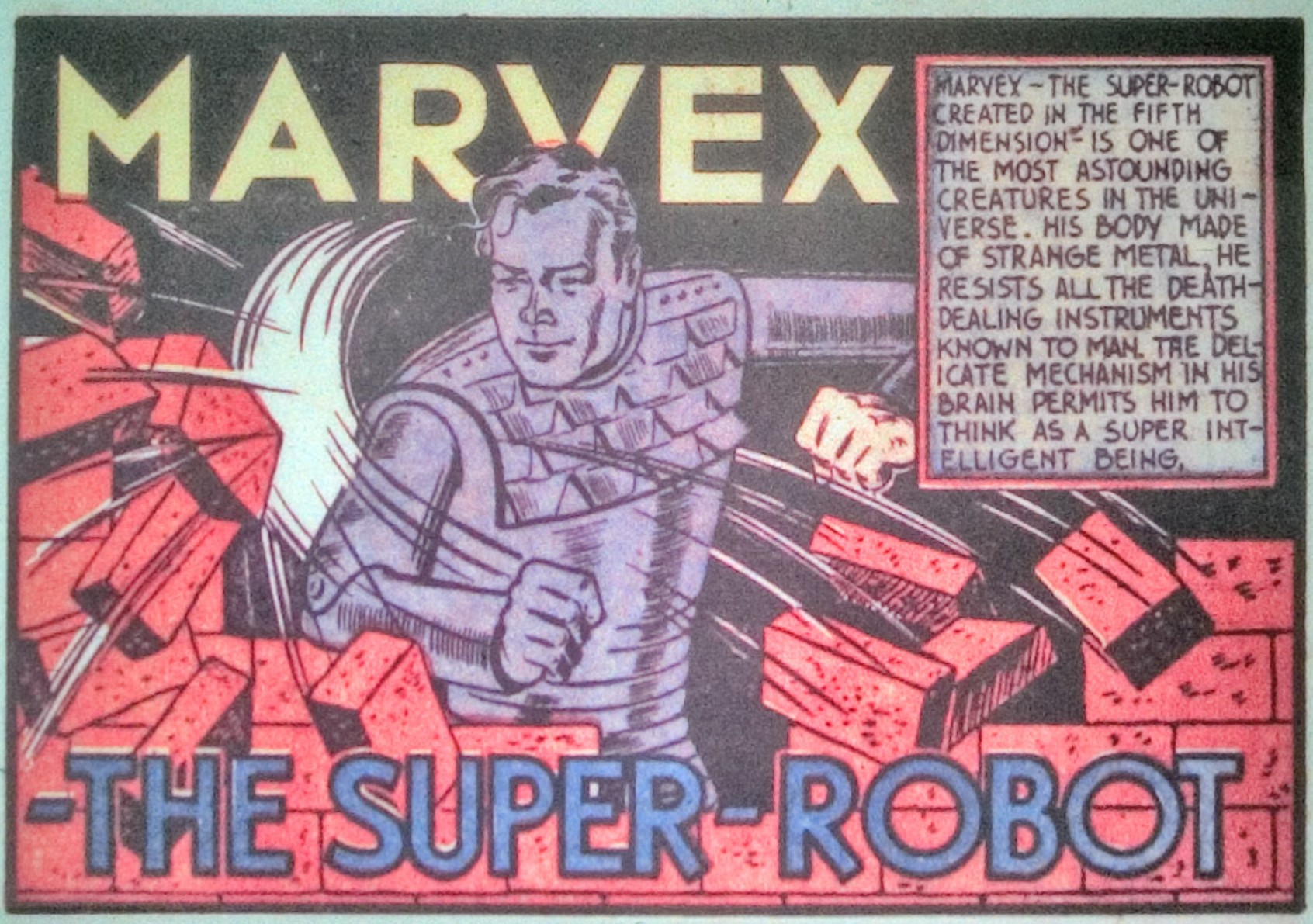
    Marvex the Super-Robot! Created to be a slave by a Fifth Dimensional jerk named Bolo, Marvex rejects his fate, kills Bolo and his associates and accidentally blasts himself to Earth while smashing up Bolo’s lab equipment.

    If you’re already aware of who Marvex is then it’s likely because of the Michael Kupperman strip featuring the character during Marvel’s 70th Anniversary run of comics, and indeed, Marvex’ propensities for cartoonish violence, shutting down romance with sudden nudity and receiving twenty dollars all make him a perfect Kupperman character.

    Sadly, the nudity and twenty dollar reward system go the way of Marvex’ hair in his second and third appearances, but he never stops yelling about being a robot whenever his companion Clara gets a bit too comfortable around him. (Daring Mystery Comics 003, 1940)

    Categorized in: Language (Superlatives – Super), Origins (Extradimensional, Robot), Supranormal Beings (Robots)

    the Falcon:

    The Falcon is Carl Burgess, assistant district attorney in an unnamed city who is kind of betraying the spirit of his office by meting out vigilante justice when he feels like the legal system isn’t working. Though he is a pretty average costumed vigilante, the Falcon has precisely four interesting things to note. The first is that his name is weirdly close to that of Carl Burgos, the creator of the Human Torch. This might be a coincidence, but still. The second is of course that he is the original Marvel Falcon but by far the least-known of the half dozen or so Marvel characters to share that name.

    Like the Eagle, the Falcon is a bit of a fashion plate or at least someone who adjusts his costume on every adventure and for the same reason: a different artist on every one of his appearances.

    Finally, the Falcon has been retroactively assigned an accessory based on an assumption, just like his fellow Daring Mystery Comics alum the Fiery Mask and his morning star. In this case, it’s that his suit gives him the ability to glide. I assume that this is because of a stylistic choice on the part of his various illustrators to have him dive down on his enemies like a falcon stooping on prey, because the suit does not come up in his handful of Golden Age appearances. (Daring Mystery Comics 005, 1940)

    Categorized in: Animals (Falcons), Day Jobs (Assistant District Attorneys)

    Marvel Boy:

    Up until about 2012 I’d have confidently said that “Marvel Boy” was one of the most commonly-shared super-hero identities in the Marvel Universe, but it seems that the concept of the legacy identity has gone through a weird mutation in the last decade or so and I am now regularly surprised to find that there are way more Wolverines or Captains America than I had previously imagined. With that in mind, we’ll revise my statement to be that there are more Marvel Boys than you might expect, like Starmans over at DC.

    This particular Marvel Boy is the Earthly reincarnation of Hercules, come down from Valhalla (?!) to aid a world threatened by fascism. His human form is named Martin Burns and like a veritable Silver Age Superboy he is born with so much physical strength that he must constantly hold himself back lest he endanger those around him and out himself as something strange and different.

    On Martin’s fourteenth birthday a mysterious stranger (who is implicitly the Roman god Jupiter) delivers a package containing his heroic costume to him and then somewhat redundantly also appears in his bedroom to really spell out his whole deal and charge him to uphold democracy etc.

    Marvel Boy is super strong, very agile and fast enough to run from New York City to Washington DC and back – carrying three grown men on the first leg of the trip – in the course of a night that also includes the aforementioned visit from Jupiter and busting up two fifth column cells.

    Both this Marvel Boy and his successor (coming up in 1942) never returned after making a single appearance, and while I can’t say just why they didn’t have further Golden Age adventures, the lack of a modern appearance for either of them is almost certainly down to the fact that their origins both revolve around a dead Hercules, who is in fact more often than not a very living second- or third-tier hero in the Marvel Universe. They’re also both named Martin Burns for some reason, which means that later handbook writers have felt compelled to differentiate them by giving them middle names based on their creators, making this one Martin Simon Burns.

    Frankly, I think that the fact that the two Marvel Boys have origins that are incompatible with both Marvel Comics continuity and also one another is terrific fodder for comic book storytelling. Both of them should be BRUNG BACK immediately, preferably in a comic that also has Hercules in it. (Daring Mystery Comics 006, 1940)

    Categorized in: Generica (Boys), Language (Superlatives – Marvels), Origin (Reincarnated God) 

    the Flying Flame:

    The Flying Flame is a red fighter plane flown for the RAF by the two-fisted American pilot Captain Red Ruff, who is also known as the Flying Flame due to his shock of red hair. During his brief comic book career, Ruff battled the Black Ace and ferreted out some spies at an airbase. (Daring Mystery Comics 006, 1940)

    Categorized in: Activities (Flying), Elements (Fire), Team Membership (RAF)

  • MINOR SUPER-HERO ROUND-UP 034

    Here they are! Some guys you’ve never heard of!

    the Press Guardian: 

    In the Press Guardian’s first outing he is known as the Falcon, but he has the same core mission as he will throughout his career: to clean up crime in Central City via the free press, even if he must do so in a pretty bad costume. A fair few places online list reporter Flash Calvert as the Falcon’s secret identity but this is one of your classic reading comprehension/ research tests: it certainly seems like Calvert is the Falcon right up to the last third of the story, in which they start appearing in the same panels as one another. Thus, a claim that Calvert is the Falcon means that the claimant either skimmed the story in question or is taking the word of another who did so.

    By Pep Comics 002, the Falcon has officially changed his name to the Press Guardian and traded in his Victorian daredevil costume for a classic suit-and-mask combo. His identity is also revealed as Perry Chase, society columnist and universally derided failson of the publisher of the Daily Express. As with a lot of Golden Age heroes the necessity for your secret identity to be the subject of scorn is not really explained – surely the same effect could be achieved by faking a limp or something and then people wouldn’t constantly be insulting you to your face.

    But the papes must go through, and the majority of the Press Guardians adventures have a hand in ensuring that they do, if only tangentially. (Pep Comics 001, 1940)

    Auro, Lord of Jupiter:

    Before Auro was lord of anything he was just some kid with the last name Hardwich who was out on a Sunday space drive with his family when all of a sudden things went wrong and the family space car crashed into the solid, non-gaseous, habitable surface of the planet Jupiter. There, the now-orphaned boy is raised by a Jovian tiger, becomes extra beefy in the high gravity environment, and rises to a position of leadership in the nearby tribe of “Jupiter Brutes,” who name him Auro, meaning “Unconquerable”.

    All this is pretty standard jungle orphan, white guy exceptionalism stuff and I’m sure that one could make a pretty good case for it being just as unpleasant a series of tropes even when divorced from any real-world peoples etc, but what I must focus on is the fact that when you put a jungle guy in space he becomes a space barbarian and is actually pretty entertaining to read. (Planet Comics 001, 1940)

    the Red Comet:

    Speaking of taking character tropes from one comic genre and putting them in another, here’s the Red Comet! Like his fellow Fiction House hero the Red Panther, the Red Comet brings super-hero style to a non-super-heroic world, or worlds in this case, as he beetles around the cosmos righting wrongs.

    The Red Comet’s main trick involves shrinking and growing at will, but over time he demonstrates a wide range of situationally useful abilities including but not limited to: a crime-in-progress sense, insect communication, invisibility, super strength, the ability to survive in space without PPE, flight and the ability to change the size of others.

    The Red Comet’s ability to change size is initially attributed to advanced technology (an “intra-atomic space adjuster,” natch), while his expanded ability set is generally described as “magic.” Then, in Planet Comics 009, he is on a dinner date and explains that he got his size control abilities when he was struck by “some outer space force,” which gives him a more traditional super-hero origin. No word on whether his ability to talk to termites is still magic or as a result of another jolt of cosmic energy. (Planet Comics 001, 1940)

    Tiger Hart of Crossbone Castle:

    Tiger Hart is one of the more obscure Fletcher Hanks characters, a medieval warrior who spends his sole recorded adventure seeking the Great Solinoor Diamond (time for a Real Folk entry for the Koh-i-noor, I suppose) in order to free Queen Hilda from the clutches of the bandit chieftain Turk-the-Terrible. 

    All pretty standard sword and sorcery stuff but, presumably in deference to the fact that the story was being published in Planet Comics, it all takes place on the planet Saturn. This raises many questions! Are Tiger Hart et al Saturnians? Are they from a far enough future that humans have colonized Saturn (and the habitability of Saturn must be taken as a given, alas) and then gone through a societal collapse of some kind, a Dark Age and now a medieval-style era? Or, as the only real reference to Saturn is that the Solinoor is from Saturn, is the story set on a far-future retromedieval Earth? Many things to ponder. (Planet Comics 002, 1940)

  • MINOR SUPER-VILLAIN 567: THE FALCON

    (The Comics 001, 1937)

    The Falcon is a mercenary spy and Doctor Doom’s opposite number in the conflict between the kingdoms of Returia and Merovia. It’s somewhat debatable whether a couple of spies-for-hire can be classified as either heroes or villains in such a situation, but the story certainly presents them as such, with Merovia being vaguely Nazi German and Doctor Doom being proudly American to underline things.

    The Falcon’s espionage is also a bit more dastardly than Doctor Doom’s, as well as being a bit more effective. In particular, the Falcon’s kidnapping of Doom’s son Stephen from a Swiss boarding school with egregiously poor security comes very close to spelling Returia’s end.

    Like the Masked Czar before him, the Falcon provides some insight into the ups and downs of serialized storytelling – in this case, it’s the all-too-often case of a serial being axed before it actually comes to a conclusion,leaving the Falcon in the ascendant. Don’t worry, though! This comic was evidently assembled out of the plot of a Big Little Book, so if you want to find out what happens and how exactly Doctor Doom comes out on top you can probably find out by buying the two extant Doctor Doom books for… looks like around $150 US plus shipping. Have fun!

  • MAD AND CRIMINAL SCIENTIST ROUND-UP 002

    Back again with another collection of science-villains who didn’t quite make the grade!

    Fritz Cardif here has a gunpowder-exploding ray and a lot of big plans. He probably would have made the main list except that I personally find his antics very dull, with the exception of the lil’ stinker moment pictured above. (Hit Comics 006, 1940)

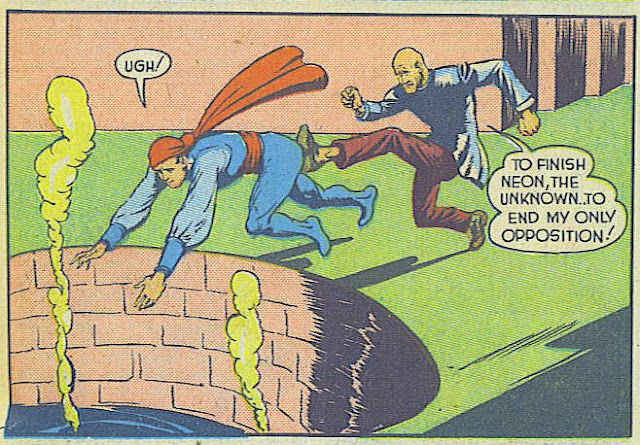
    Dr Marko figured on using kidnapped scientists as research slaves in his Grand Canyon hideout, but he too was corralled by Neon the Unknown. (Hit Comics 013, 1941)

    Professor Dorn here is your typical Nazi scientist obsessed with replicating the powers of the Sub-Mariner for the glory of the cause. He ends up lasting about fifteen minutes after meeting the real deal. (Marvel Mystery Comics v1 023, 1941)

     Dr Sunga has a pretty good scheme going wherein he seeming kills people by sending them a cursed wand that is actually harmless – seemingly the perfect crime! But the Golden Age Falcon figures out the trick: it’s actually the box that the wand is sent in that does the killing. Sunga of course ends up dead by his own fiendish device. (Daring Mystery Comics 005, 1940)

  • MAD AND CRIMINAL SCIENTIST ROUND-UP 002

    Back again with another collection of science-villains who didn’t quite make the grade!

    Fritz Cardif here has a gunpowder-exploding ray and a lot of big plans. He probably would have made the main list except that I personally find his antics very dull, with the exception of the lil’ stinker moment pictured above. (Hit Comics 006, 1940)

    Dr Marko figured on using kidnapped scientists as research slaves in his Grand Canyon hideout, but he too was corralled by Neon the Unknown. (Hit Comics 013, 1941)

    Professor Dorn here is your typical Nazi scientist obsessed with replicating the powers of the Sub-Mariner for the glory of the cause. He ends up lasting about fifteen minutes after meeting the real deal. (Marvel Mystery Comics v1 023, 1941)

     Dr Sunga has a pretty good scheme going wherein he seeming kills people by sending them a cursed wand that is actually harmless – seemingly the perfect crime! But the Golden Age Falcon figures out the trick: it’s actually the box that the wand is sent in that does the killing. Sunga of course ends up dead by his own fiendish device. (Daring Mystery Comics 005, 1940)