The Curse of Skeleton Munroe

Category: heroes of the future

  • MINOR SUPER-HERO ROUND-UP 036

    Prize Comics time, bay-bee.

    Power Nelson:

    Power Nelson is from the far-off future year of 1982 CE, in which the world has been conquered by the Mongols, but the wink, wink, nudge, nudge kind of Mongols from 1940-1941 where they’re actually supposed to be the Japanese (and for some reason the nation of Mongolia is fair game as far as Explicit Villain Status goes while Japan is still off the table). He has been given super strength by some surprisingly beefy scientists so that he might save civilization from oppression. Three things about Power Nelson:

    1) I think that his first name might actually be Power. So futuristic!

    2) I kind of want to give this series credit for not being too racist but the truth is that it is fairly racist but my senses have been dulled by exposure to the excesses of post Pearl Harbor depictions of the Japanese. 

    3) Power Nelson is very bad at his job? Every issue sees him within striking distance of Emperor Seng I and while assassinating the top man isn’t a guaranteed way to end a regime, it absolutely cannot hurt. Just punch him, man! (Prize Comics 001, 1940)

    Jupiter:

    Jupiter represents two distinct super-hero archetypes: the alien lawman sent to Earth to dispense justice and the magic-user, and as those are two of the more omnipotent origins that a character can have he goes through crooks like a hot knife through butter. The most important question about Jupiter is: was he called Jupiter back on the planet Jupiter or is he adopting a cool new name like a kid at camp? (Prize Comics 001, 1940)

    K the Unknown:

    Douglas Danville, wealthy playboy, takes to the crime-ridden ski slopes as K the Unknown, feared and hunted by ski crooks and ski cops alike. And presumably regular cops and crooks too, but he only had one recorded outing and it took place entirely within the bounds of a ski resort.

    K the Unknown’s one adventure involves embezzlement and murder among the officers of a college alumni group, possibly the perfect case for a wealthy playboy type hero.

    K the Unknown is a great name but perhaps not a great super-hero name, so I can see why he only had on outing. Still, it must be handy to have a calling card that you can piss into the snow. (Prize Comics 001, 1940)

    the Black Owl: 

    It’s hardly unusual for a Golden Age character to make one appearance and then disappear forever, but much more unusually while K the Unknown never had a second adventure his alter ego Doug Danville just kept on trucking under another identity. It’s never explored in the text of the story, so any explanation for why he made the change is an equally valid bit of speculation, from “he wanted a less generic super-hero identity” to “it’s completely different guy named Doug Danville who hangs around with a completely different private eye named Terry Dane.” It turns out that I wrote that last bit prematurely, as in the Black Owl’s second outing his foe is Sigmund Rathko, the crook who was also behind the alumni association shenanigans in the K the Unknown story. I suppose that it could be three completely different people but no, at that point we’re getting silly.

    One thing that you can say for certain is that he didn’t change identities to get the cops off of his back, because they want to get the Black Owl just as much as they did K the Unknown. Moreso, honestly, because K the Unknown was safely carving powder and never even saw a cop. (Prize Comics 002, 1940)

  • MINOR SUPER-HERO ROUND-UP 036

    Prize Comics time, bay-bee.

    Power Nelson:

    Power Nelson is from the far-off future year of 1982 CE, in which the world has been conquered by the Mongols, but the wink, wink, nudge, nudge kind of Mongols from 1940-1941 where they’re actually supposed to be the Japanese (and for some reason the nation of Mongolia is fair game as far as Explicit Villain Status goes while Japan is still off the table). He has been given super strength by some surprisingly beefy scientists so that he might save civilization from oppression. Three things about Power Nelson:

    1) I think that his first name might actually be Power. So futuristic!

    2) I kind of want to give this series credit for not being too racist but the truth is that it is fairly racist but my senses have been dulled by exposure to the excesses of post Pearl Harbor depictions of the Japanese. 

    3) Power Nelson is very bad at his job? Every issue sees him within striking distance of Emperor Seng I and while assassinating the top man isn’t a guaranteed way to end a regime, it absolutely cannot hurt. Just punch him, man! (Prize Comics 001, 1940)

    Jupiter:

    Jupiter represents two distinct super-hero archetypes: the alien lawman sent to Earth to dispense justice and the magic-user, and as those are two of the more omnipotent origins that a character can have he goes through crooks like a hot knife through butter. The most important question about Jupiter is: was he called Jupiter back on the planet Jupiter or is he adopting a cool new name like a kid at camp? (Prize Comics 001, 1940)

    K the Unknown:

    Douglas Danville, wealthy playboy, takes to the crime-ridden ski slopes as K the Unknown, feared and hunted by ski crooks and ski cops alike. And presumably regular cops and crooks too, but he only had one recorded outing and it took place entirely within the bounds of a ski resort.

    K the Unknown’s one adventure involves embezzlement and murder among the officers of a college alumni group, possibly the perfect case for a wealthy playboy type hero.

    K the Unknown is a great name but perhaps not a great super-hero name, so I can see why he only had on outing. Still, it must be handy to have a calling card that you can piss into the snow. (Prize Comics 001, 1940)

    the Black Owl: 

    It’s hardly unusual for a Golden Age character to make one appearance and then disappear forever, but much more unusually while K the Unknown never had a second adventure his alter ego Doug Danville just kept on trucking under another identity. It’s never explored in the text of the story, so any explanation for why he made the change is an equally valid bit of speculation, from “he wanted a less generic super-hero identity” to “it’s completely different guy named Doug Danville who hangs around with a completely different private eye named Terry Dane.” It turns out that I wrote that last bit prematurely, as in the Black Owl’s second outing his foe is Sigmund Rathko, the crook who was also behind the alumni association shenanigans in the K the Unknown story. I suppose that it could be three completely different people but no, at that point we’re getting silly.

    One thing that you can say for certain is that he didn’t change identities to get the cops off of his back, because they want to get the Black Owl just as much as they did K the Unknown. Moreso, honestly, because K the Unknown was safely carving powder and never even saw a cop. (Prize Comics 002, 1940)
  • MINOR SUPER-HERO ROUND-UP 035

    MINOR SUPER-HERO ROUND-UP 035

    Planet Comics how I love you, cobbled-together pile of scraps that you are.

    Torro:

    In an adventure that I can only assume was concocted in order to use up some extraneous art, Captain Nelson Cole of the Solar Force travels to the distant planet Zog and ends up taking up the mantle (and magic whip) of the hero Torro in order to help recover the planet’s treasures from an evil giant.

    As befits a personality that is probably just, again, repurposed art from an unused fantasy comic, Cole adopts the Torro identity completely. Using his magic clothes, boots, belt and whip, he battles and ultimately kills the two-headed giant and his one-headed wife and then goes back to being a spaceman. (Planet Comics 002, 1940)

    Amazona the Mighty Woman:

    Amazona belongs to a pre-Ice Age civilization that is not advanced so much as stubborn in that as the ice advanced on them they just toughed it out until the only ones left were super strong and immune to cold.

    Amazona is understandably bored of the endless expanses of ice and snow afforded her and decides to tag along when reporter Blake Manners passes through following a shipwreck. In their one adventure together back in the US, Amazona gets to beat the tar out of a bunch of gangsters while wearing a party dress and I’m pretty sad that there wasn’t more of this. (Planet Comics 003, 1940)

    Jim Giant:

    Jim Giant, billed as both the Strongest Man in the Universe and the Mightiest Man on Earth (both can be correct, in the right order), is super strong and super tough and in his single recorded adventure he beats the stuffing out of an entire invasion force that sweeps down from the Arctic. (Planet Comics 004, 1940)

    Fero, Planet Detective:

    I’m going to call it: Fero, Planet Detective started life as an unused Zero, Ghost Detective story that found its way from Quality Comics to Fiction House and was altered just enough to be distinct. Scrub out the Z and add an F, swap “Ghost” for “Planet” and most importantly slap an extra line on the text box about how all the werewolves and vampires are actually from Pluto. It’s seamless!

    I actually unironically love the first Fero adventure. It’s a great example of how restriction and constraint can make for the most weird and creative choices. “Occult Detective” is after all an entertaining and rich subgenre, but “Occult Detective But All of the Monsters Are Also Space Aliens” is the sort of wild and wacky stuff you come up with while trying to pad out the pagecount of your science fiction comic book and all you have is a second-hand story about vampires and goblins. It’s great stuff!

    Sadly, though Fero continued to appear in Planet Comics for three more issues the occult aspects of his adventures fell by the wayside in favour of more traditional space detective cases – space theft, space kidnappings, etc. It’s a real blow for fans of occult sci fi.

    Fero’s remaining adventures are all right, but nothing to write home about. He does have a fun futuristic high-collared shirt, so that’s something, but the most interesting thing about his latter adventures is his selection of transformation pills that he uses to get out of  scrapes, including one that turns you into a toddler and the amazing one that he is taking above to turn into a rampaging anthropoid. (Planet Comics 005, 1940)

  • MINOR SUPER-HERO ROUND-UP 035

    MINOR SUPER-HERO ROUND-UP 035

    Planet Comics how I love you, cobbled-together pile of scraps that you are.

    Torro:

    In an adventure that I can only assume was concocted in order to use up some extraneous art, Captain Nelson Cole of the Solar Force travels to the distant planet Zog and ends up taking up the mantle (and magic whip) of the hero Torro in order to help recover the planet’s treasures from an evil giant.

    As befits a personality that is probably just, again, repurposed art from an unused fantasy comic, Cole adopts the Torro identity completely. Using his magic clothes, boots, belt and whip, he battles and ultimately kills the two-headed giant and his one-headed wife and then goes back to being a spaceman. (Planet Comics 002, 1940)

    Amazona the Mighty Woman:

    Amazona belongs to a pre-Ice Age civilization that is not advanced so much as stubborn in that as the ice advanced on them they just toughed it out until the only ones left were super strong and immune to cold.

    Amazona is understandably bored of the endless expanses of ice and snow afforded her and decides to tag along when reporter Blake Manners passes through following a shipwreck. In their one adventure together back in the US, Amazona gets to beat the tar out of a bunch of gangsters while wearing a party dress and I’m pretty sad that there wasn’t more of this. (Planet Comics 003, 1940)

    Jim Giant:

    Jim Giant, billed as both the Strongest Man in the Universe and the Mightiest Man on Earth (both can be correct, in the right order), is super strong and super tough and in his single recorded adventure he beats the stuffing out of an entire invasion force that sweeps down from the Arctic. (Planet Comics 004, 1940)

    Fero, Planet Detective:

    I’m going to call it: Fero, Planet Detective started life as an unused Zero, Ghost Detective story that found its way from Quality Comics to Fiction House and was altered just enough to be distinct. Scrub out the Z and add an F, swap “Ghost” for “Planet” and most importantly slap an extra line on the text box about how all the werewolves and vampires are actually from Pluto. It’s seamless!

    I actually unironically love the first Fero adventure. It’s a great example of how restriction and constraint can make for the most weird and creative choices. “Occult Detective” is after all an entertaining and rich subgenre, but “Occult Detective But All of the Monsters Are Also Space Aliens” is the sort of wild and wacky stuff you come up with while trying to pad out the pagecount of your science fiction comic book and all you have is a second-hand story about vampires and goblins. It’s great stuff!

    Sadly, though Fero continued to appear in Planet Comics for three more issues the occult aspects of his adventures fell by the wayside in favour of more traditional space detective cases – space theft, space kidnappings, etc. It’s a real blow for fans of occult sci fi.

    Fero’s remaining adventures are all right, but nothing to write home about. He does have a fun futuristic high-collared shirt, so that’s something, but the most interesting thing about his latter adventures is his selection of transformation pills that he uses to get out of  scrapes, including one that turns you into a toddler and the amazing one that he is taking above to turn into a rampaging anthropoid. (Planet Comics 005, 1940)

  • MINOR SUPER-HERO ROUND-UP 034

    Here they are! Some guys you’ve never heard of!

    the Press Guardian: 

    In the Press Guardian’s first outing he is known as the Falcon, but he has the same core mission as he will throughout his career: to clean up crime in Central City via the free press, even if he must do so in a pretty bad costume. A fair few places online list reporter Flash Calvert as the Falcon’s secret identity but this is one of your classic reading comprehension/ research tests: it certainly seems like Calvert is the Falcon right up to the last third of the story, in which they start appearing in the same panels as one another. Thus, a claim that Calvert is the Falcon means that the claimant either skimmed the story in question or is taking the word of another who did so.

    By Pep Comics 002, the Falcon has officially changed his name to the Press Guardian and traded in his Victorian daredevil costume for a classic suit-and-mask combo. His identity is also revealed as Perry Chase, society columnist and universally derided failson of the publisher of the Daily Express. As with a lot of Golden Age heroes the necessity for your secret identity to be the subject of scorn is not really explained – surely the same effect could be achieved by faking a limp or something and then people wouldn’t constantly be insulting you to your face.

    But the papes must go through, and the majority of the Press Guardians adventures have a hand in ensuring that they do, if only tangentially. (Pep Comics 001, 1940)

    Auro, Lord of Jupiter:

    Before Auro was lord of anything he was just some kid with the last name Hardwich who was out on a Sunday space drive with his family when all of a sudden things went wrong and the family space car crashed into the solid, non-gaseous, habitable surface of the planet Jupiter. There, the now-orphaned boy is raised by a Jovian tiger, becomes extra beefy in the high gravity environment, and rises to a position of leadership in the nearby tribe of “Jupiter Brutes,” who name him Auro, meaning “Unconquerable”.

    All this is pretty standard jungle orphan, white guy exceptionalism stuff and I’m sure that one could make a pretty good case for it being just as unpleasant a series of tropes even when divorced from any real-world peoples etc, but what I must focus on is the fact that when you put a jungle guy in space he becomes a space barbarian and is actually pretty entertaining to read. (Planet Comics 001, 1940)

    the Red Comet:

    Speaking of taking character tropes from one comic genre and putting them in another, here’s the Red Comet! Like his fellow Fiction House hero the Red Panther, the Red Comet brings super-hero style to a non-super-heroic world, or worlds in this case, as he beetles around the cosmos righting wrongs.

    The Red Comet’s main trick involves shrinking and growing at will, but over time he demonstrates a wide range of situationally useful abilities including but not limited to: a crime-in-progress sense, insect communication, invisibility, super strength, the ability to survive in space without PPE, flight and the ability to change the size of others.

    The Red Comet’s ability to change size is initially attributed to advanced technology (an “intra-atomic space adjuster,” natch), while his expanded ability set is generally described as “magic.” Then, in Planet Comics 009, he is on a dinner date and explains that he got his size control abilities when he was struck by “some outer space force,” which gives him a more traditional super-hero origin. No word on whether his ability to talk to termites is still magic or as a result of another jolt of cosmic energy. (Planet Comics 001, 1940)

    Tiger Hart of Crossbone Castle:

    Tiger Hart is one of the more obscure Fletcher Hanks characters, a medieval warrior who spends his sole recorded adventure seeking the Great Solinoor Diamond (time for a Real Folk entry for the Koh-i-noor, I suppose) in order to free Queen Hilda from the clutches of the bandit chieftain Turk-the-Terrible. 

    All pretty standard sword and sorcery stuff but, presumably in deference to the fact that the story was being published in Planet Comics, it all takes place on the planet Saturn. This raises many questions! Are Tiger Hart et al Saturnians? Are they from a far enough future that humans have colonized Saturn (and the habitability of Saturn must be taken as a given, alas) and then gone through a societal collapse of some kind, a Dark Age and now a medieval-style era? Or, as the only real reference to Saturn is that the Solinoor is from Saturn, is the story set on a far-future retromedieval Earth? Many things to ponder. (Planet Comics 002, 1940)

  • MINOR SUPER-HERO ROUND-UP 030

    Some real obscurities from the Hillman House of Ideas:

    the Sky Wizard:

    The Sky Wizard is an otherwise-unnamed super-scientist who seemingly dresses in his futuristic super suit 24/7. There’s not too much else to him other than that because he’s one of those characters who has so many gadgets and gizmos that all the narrative focus goes to them rather than him. A partial list: wing suits, super planes, super strength serum (the amazingly named “powerstrength formula”), a paralyzing Q-Ray gun…

    … and by far the coolest of the Sky Wizard’s accessories, his laboratory base, the grounds of which are composed of the elastic metal rubberium and which can be filled with helium so that the entire estate becomes a mobile floating island. (Miracle Comics 001, 1940)

    Dash Dixon:

    Dash Dixon works for an unnamed police department in an unnamed city in an undefined role (he is described only as a “top athlete with the police force” in his first appearance), Assigned to protect one Dr Lorenz and succeeding in doing so, Dixon is rewarded with a chance to be the subject of an experiment in which he is injected with “perpetual life rays” which render him super strong, at least partially invulnerable and presumably immortal.

    To counter the fact that the ray would seep out of Dixon’s body within 24 hours, Lorenz equips him with a suit of pliable metal that he will presumably have to wear for the rest of his presumably immortal existence. Two things about this suit:

    1. Dr Lorenz has a fantastic look with his lab getup and green dome helmet. Why Dixon’s suit is charitably Very Bad Looking is beyond me.

    2. It might not be clear from this picture but the suit includes a haircut-shaped black helmet held on by a strap. It can thus be implied that the ray will leak out of Dash Dixon’s scalp but will not do so from his face and hands.

    Frankly the whole suit thing gives me mild anxiety. If I were Dash Dixon I might just opt to receive my immortality treatment daily.

    One last thing about Dash Dixon is that the first issue seems to imply that he exists in a near future world with air taxis and commuter rockets but it doesn’t really come up otherwise. A mystery for the ages. (Miracle Comics 001, 1940)

    the Scorpion:

    A regular-style two-fisted vigilante, hated and feared by the underworld, occasionally wanted by the police, etc. The real thing that makes the Scorpion (aka Hal Ward) stand out is that he doesn’t really bother with a mask or any other way to not be immediately recognized by all of his mortal enemies. (Miracle Comics 001, 1940)

    Blanda the Jungle Queen:

    Blanda the Jungle Queen really lives up to her name by being the most by-the-book version of the White Goddess style of jungle adventurer, right down to the fact that she immediately abandons her adoptive people and their ways in a wave of horniness the second that a mediocre white guy hoves into view. (Miracle Comics 001 1940)

  • MINOR SUPER-HERO ROUND-UP 025

    Just a great bunch of guys.

    David:

    I read the Samson stories in Big 3 before those in his home comic Fantastic, so while I knew about his sidekick David I didn’t really know what his whole deal was. I had read that Samson just found him sitting around somewhere and assumed that that was hyperbole but no, it’s not: Samson is investigating some mysterious plane crashes in the Rockies when he just finds a kid, who turns out to be the only survivor of the latest crash, and just… brings him along. There’s no real attempt to address the fact that he must be an orphan now (or if not and he was travelling alone for some reason, that his family now thinks he is dead) or to find him a familial guardian – heck, his name isn’t even David. It’s low-key one of the weirdest sidekick origins in comics and that’s before he gets his own pair of fur briefs. (Fantastic Comics 010, 1940)

    UPDATES: Even in the updated Samson origin, David is still a hanger-on (Samson 001, 1940)

    UPDATE – the Fantom of the Fair:

    The Fantom of the Fair gets his own short-lived book that sees him spending more and more time fighting crime outside the New York World’s Fair, if you can believe it. To that end he adopts the more generic name of the Fantoman. The costume changes (blue instead of black, uncovered lower face) happened at the end of 1939 and technically I’ve read more Fantom stories in which he had the new one than the old but it never feels right to me. At least you can still see his hair through the cowl.

    Though he has a new name and a not-so-new look, Fantoman retains one of his most iconic properties: every time you start thinking of him as just another masked adventurer he busts out another heretofore-unseen superpower or bit of lore suggesting he is a thousand year old demigod or something. See above as he either teleports or passes through matter for the first and last time. (Fantoman 003, 1940)

    the Spy Fighter:

    It kind of says something about the mood of America in 1940 that there are multiple comic book series that take place in the 1990s after what we know as World War II has stretched on for fifty years (Marvel’s Breeze Barton is the other one that I can recall off the top of my head, while MLJ’s Doc Strong is from a future ravaged by a whole century of WWII). In this version of that, the war has resulted in an amalgamation of the world into three rival nations: Russmany (Europe and Africa), Mongo (Asia) and Greater America (the Americas), and in this world of super nations, a super spy is required to ensure the sanctity of the Greater American way of life.

    That man is Saber, the Spy Fighter! Who does eventually put on a shirt. Saber starts out as physically gifted telepath who roots out enemy agents by reading their ill intent in their own minds and then beats them up for it. Over time, the challenges he faces get larger and less specifically espionage related, and he develops new abilities to meet them, including that of changing his own size at will, to the point that he is eventually able to travel through space on his own power to fight planet-sized enemies. And what can Mongo do to challenge that? (Fight Comics 001, 1940)

    Update 1941

    the Skull Squadron:

    Chip Collins’ Skull Squadron is extremely unremarkable but at this point I have to make note of every skull-adjacent comic book thing. They operate somewhere in between a commando group and the Suicide Squad and barely even have skulls painted on their planes. SKULL SCORE: 1/2 and only for the name. (Fight Comics 001, 1940)

  • MINOR SUPER-HERO ROUND-UP 023

    The most minor bunch so far!

    Don Rance and the Mysticape: 

    Don Rance saves an old man from a tiger in the Indian jungle and is given a mystic cape as a reward. In his single documented adventure he runs into spy trouble while ferrying some papers from the American embassy in London to Washington DC and must use the cape’s powers (generic physical enhancement and slow falling or some other way to jump from a plane and land safely on the ground. Also possibly teleportation? The art was unclear) to complete his mission safely.

    So: an utterly generic character who barely qualifies as a super-hero, but I just can’t help but be tickled that he calls his mystic cape the Mysticape and dream of a world in which Don Rance was such a popular character that he continued appearing for long enough that some bored writer had him battle the Mystic Ape. (Detective Eye 002, 1940)

    Ken Traymore and the Invisobox:

    Really really enjoy these guys. Properly this strip should be called Ken Traymore and His Dad and Their Invisoboxes because that’s what it is: a guy and his dad and their invisibility girdles palling around and investigating mysteries. It’s very wholesome! Particularly as your standard Golden Age comic would have featured the murder of Traymore Sr on page 1 as a bit of motivation for Ken in his neverending quest for justice.

    Aside from the delightful father/son dynamics, the best part of the Traymores’ single adventure is the fact that they spend the entire time investigating three suspects in the murder of their friend and do not catch the killer. Rather, he accidentally sees one of them turn invisible and freaks out because he thinks that he’s being haunted by his victim’s ghost. They don’t even know who he is – it’s great! 10/10 no notes, BRING BACK the Traymores and their Invisoboxes immediately. (Detective Eye 002, 1940)

    the Mask:

    The Mask is an adaptation of pulp character the Black Bat, but without the bat part due to some sort of gentleman’s agreement with DC after a squabble over who ripped who off, bat-wise. What he does share with his predecessor is an origin: District Attorney Tom Colby is blinded when gangsters working for crimelord Olly Snate splash acid on some key evidence during Snate’s trial. When Colby’s sight is restored via an experimental operation he decides to continue working as a supposedly-blind DA while also punching crooks as the Mask.

    (Also like the Black Bat he has enhanced night vision as a result of the operation but it never really comes up)

    Colby also inherits the Black Bat’s stable of assistants: Silk Davis (crook turned butler), Carol Smith (the one who lined up the eye operation for him) and Butch O’Leary (former boxer). As with all heroic associates they spend about half the time helping out and half the time captured by crooks, with the added twist that since there are three of them they often end up rescuing each other or getting serially captured while trying to rescue one another.

    The Mask was also quite clearly going to be the Owl in his first couple of appearances – presumably someone at Exciting Comics noticed that 1940 was a big year for owl-themed comic book characters and decided to skip the potential drama. By Exciting issue 3 he had traded in his owl-cowl for a beakless version and replaced his owl calling cards with a frankly hilarious version featuring a picture of his own face, clearly labelled. 

    One thing that always springs to mind when reading comics from the Nedor (etcetera – these people could not settle on a name for their publishing company) stable: did Alan Moore include them in Terra Incognito? The answer is of course no – the Mask is utterly middle-of-the-road and would have added nothing to the proceedings. (Exciting Comics 001, 1940)

    Major Mars:

    Major Mars, hero of 3964 AC, is another retooled version of an older pulp character, in this case the still-occasionally-name-checked-to-this-day Captain Future. Some basic research into the character indicates that the broad details are the same: brought up on the Moon (i.e., he should be called Major Moon), Major Mars battles injustice across the Solar System with the help of his robot pal Grag and love interest Joan. My major (ha) beef with this is that they left out Captain Future’s other two associates, a sassy shapechanging android and a brain in a jar! 

    Why Captain Future became Major Mars and why all of the best companions were left out of this adaptation are a question for the ages. (Exciting Comics 001, 1940)

  • MINOR SUPER-HERO ROUND-UP 021

    They’re just these guys, you know?

    the Solar Legion:

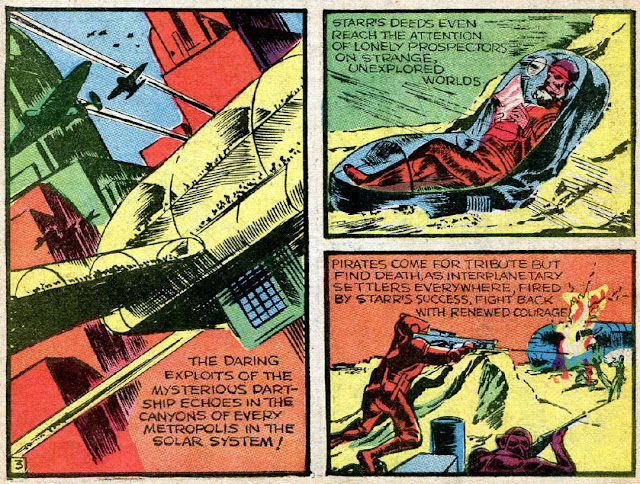
    The Solar Legion is the brainchild of Adam Starr, a 23rd Century man about whom very little is ever revealed. Emerging from a concealed base on Io, he sets out to rid the Solar System of the scourge of space piracy via the most direct route possible: blowing up all of the space pirates.

    Starr’s exploits have their intended effects: 1. many pirates are blown up and 2. the authorities are convinced of the need for an interplanetary peacekeeping force, aka the Solar Legion, with Starr as the head.

    Despite his new position of authority, the remaining four Solar Legion stories feature Adam Starr as a solo operator, hunting down pirates and settling factional disputes with his ray gun and two-fisted attitude. (Crash Comics Adventures 001, 1940)

    the Cat Man:

    The Cat Man is David Merrywether, who is orphaned in India after his father William brings his entire family along on a scientific expedition to collect butterflies and they run afoul of a hostile tribe (no word on whether William did something to draw their ire or if they were universally hostile to intruders – in either case the question of just why he would have his wife and two young children along on such a dangerous endeavour remains unaddressed). David, the only survivor, ends up being adopted by a tiger and spends his youth with her in an expository caption.

    (I really appreciate this “yadda yadda yadda” version of the Raised by Animals origin story. You’ve heard it all before, folks: he lived among the tigers and now he has tiger powers. He’s back in civilization because he saved a tiger’s life and that tiger’s mother owed him a favour. Now let’s get to the costumed antics!)

    Cat Man has all of the expected cat-related superpowers – enhanced dexterity, strength, speed and jumping ability – plus a few less common ones like the ability to speak to tigers and the ability to fall any distance and land on his feet without harm. He also has a cat’s enhanced night vision, which takes the form of literal beams of light that emit from his eyes. Fun!

    The Cat Man’s most striking power is that of having nine lives, bestowed on him by his adoptive tiger mama when he saved her cub. The problem with the “multiple lives” superpower has always been that it’s not interesting if it’s not used, with the result being that after two 1940 appearances Cat Man is down to seven lives. Surely this cannot be sustained going forward.

    Speaking of going forward, we will be hearing more out of Cat Man, one of the minor successes of the Golden Age. Changes are afoot once he has his own title in 1941, starting with a revisions to his much-derided original costume (personally, I like this costume. It very much feels like the sort of thing that someone who had spent their youth alone in a jungle might put together). See you then! (Crash Comics Adventures 004, 1940)

    UPDATE 1941

    Tornado Tom:

    Like the word-box says: Tornado Tom is just some guy who was sucked up by a tornado one day and when he came down again he was inhumanly strong, fast and durable. He also had amnesia, so even though he shares the name Tom Kenny with the famous voice actor of such characters as Spongebob Squarepants, he himself did not know that.

    Tornado Tom’s origin is never really explored and the two hints we get about the nature of his powers are a bit contradictory:

    Possible Mystical Origin: in Cyclone Comics 002, Tom battles some thugs in a stuffy apartment and is drained of vitality by the lack of fresh breezes. In a moment of desperation he calls out to Boreas, “God of Wind” and is revived and re-energized by a gust of air that blasts through the window. Talking points: was it a mystic tornado sent by the gods? Is Tom Kenny a descendant of Boreas or another Greco-Roman figure?

    Possible Biological Origin: In Cyclone Comics 005* Tornado Tom’s blood is asserted to have miraculous healing properties, possibly as  a result of his being some sort of mutant or mutate. Talking points: was it a radioactive tornado?

    This is all ultimately clutching at straws because Tornado Tom is a classic Golden Age cipher, much as I would like to know otherwise. (Cyclone Comics 001, 1940)

    * his blood is reportedly transfused into a dying man in Cyclone Comics 004 but that issue is currently unavailable.

    Mister Q:

    Your typical master of disguise style hero, with a manservant named Ying and a dog named Satan. I quite like Mister Q because I’m pretty sure that his name is derived from the idea of wartime Q-Ships, ie, warships disguised as harmless merchant vessels. It’s a neat name for a disguise-based crimefighter! (Cyclone Comics 001, 1940)

  • MINOR SUPER-HERO ROUND-UP 010

    MINOR SUPER-HERO ROUND-UP 010

    MORE MLJ ACTION

    Doc Strong:

    Doc Strong is a famous scientist living in the year 2041, in a world where WWII dragged on for an entire century and a new Mongol Horde has swept in and conquered the battered remnants of civilization. The strangely Doc Savage-like Doc Strong gathers a group of like-minded scientists and starts a new civilization called the Isle of Right from which to strike back at the invaders with such inventions as a ray gun that solidifies shadows. (Blue Ribbon Comics 004, 1940)

    the Fox:

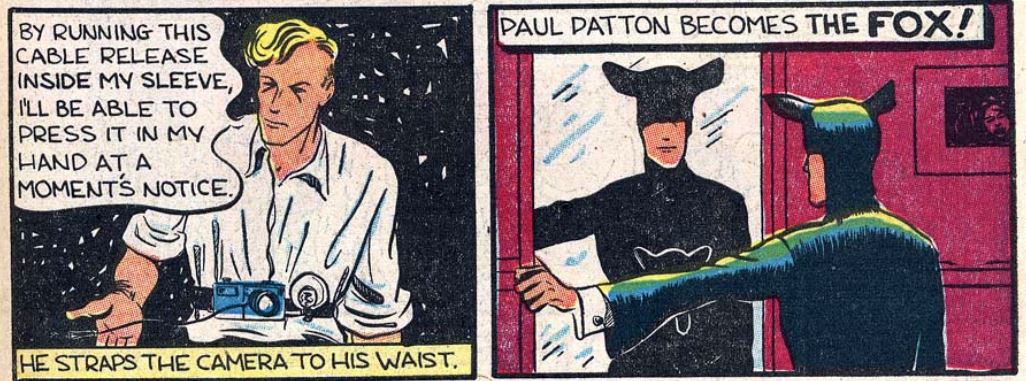
    Paul Patton, photographer for the Daily Globe, gets the tar beaten out of him by some fellows called the Night Riders and comes up with a plan:

    That’s right, he’s about halfway between Spider-Man and Batman. Okay, he’s mostly Batman but his wearable camera scheme anticipates Perter Parker’s epic work hack by about twenty years. The Fox’s first attempt at a costume is a bit rough, but eventually…

    … he adopts one of the top costumes of the Golden Age! His adventures may be a bit regular but he looks great doing it.

    BONUS FOX FACT: his “bat flies through the window” moment comes when he hears a song on the radio. (Blue Ribbon Comics 004, 1940)

    the Green Falcon: 

    The Green Falcon feature is essentially a Robin Hood Elseworlds story in which Robin is a knight instead of a forest outlaw and his pals Tiny Tuck and Jolly Roundfellow kind of encapsulate a few Merry Men each. Prince John is still there, and Maid Marion, but there are more swordfights than arrow tricks. Hey, I never said it was a particularly compelling Elseworlds story. It is more high concept than you usually get in a Golden Age comic, though. (Blue Ribbon Comics 004-015, 1940-1941)

    Ty-Gor:

    Ty-Gor is MLJ’s answer to Mowgli: a British child orphaned in the jungles of Malaysia and raised by tigers. Ty-Gor is a shortened form of his birth name, Tyrone Gorman, which he learns thanks to an absurd series of events pictured above.

    I don’t usually have a lot of time for jungle adventures but Ty-Gor does have a pretty fun twist in that after a half dozen issues he is brought to New York by explorer Dr Davis and his daughter Joan and Does Not Adapt. He’s just a wild kid who knows about five word maximum thrust into the public school system and causing havoc. It’s fun! (Blue Ribbon Comics 004, 1940)

    BONUS TY-GOR AS A BABY EATING GRAPES