The Curse of Skeleton Munroe

Category: Thun-Dohr

  • MEDIA IN COMICS 016

    MEDIA IN COMICS 016

    Production on these Media in Comics showcases must sadly slow down now, for I have worked my way through my backlog. As evidence of this, today we are showcasing some magical books, which are genrally unique items that fall under nobody’s definition of mass media but which I want to include anyway, for fun’s sake.

    Books of Magic:
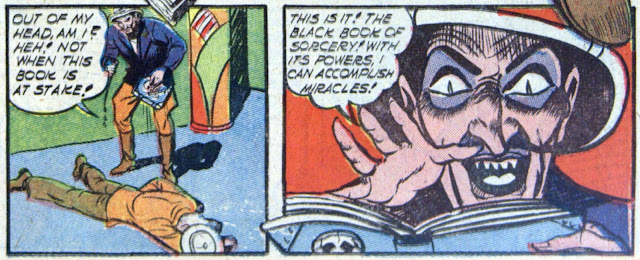
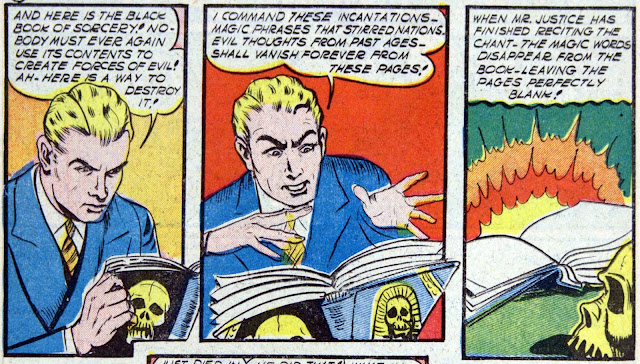
    You all remember the fabled Black Book of Sorcery that the wicked Egyptologist Ford committed all those murders for, well here it is! Until Mr Justice wipes its pages with a convenient self-destruct spell contained within it, that is.

    Origin: Ancient Egyptian 

    Status: Destroyed (Jackpot Comics 003, 1941)
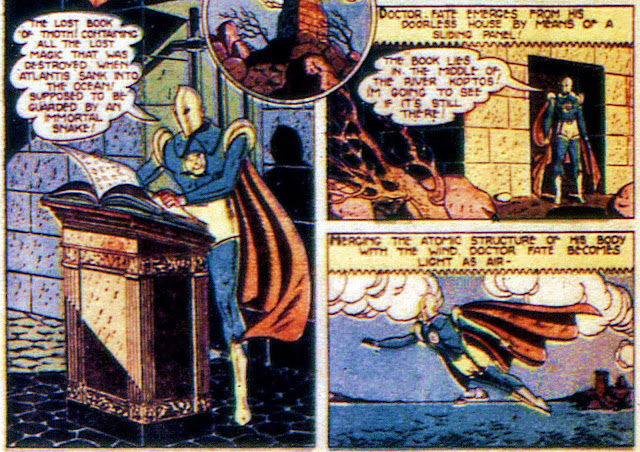
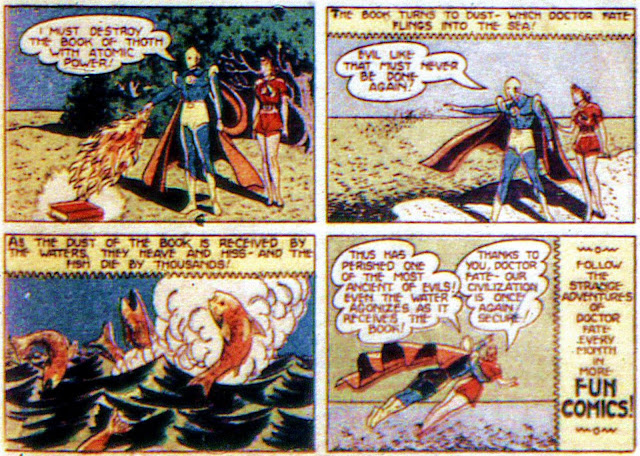
    The Lost Book of Thoth, containing all the magics of sunken Atlantis, is supposed to rest on the bottom of the Nile under the watchful eye of an immortal serpent. The plans of mice and men and whoever is in charge of everlasting snakes often go astray, alas, and the book is stolen by an unnamed mage and nearly used to destroy the world. Having solved that particular problem, Dr Fate doesn’t take any chances and reduces the book to a powder.

    Origin: Ancient Atlantis

    Status: Destroyed (More Fun Comics 058, 1941)
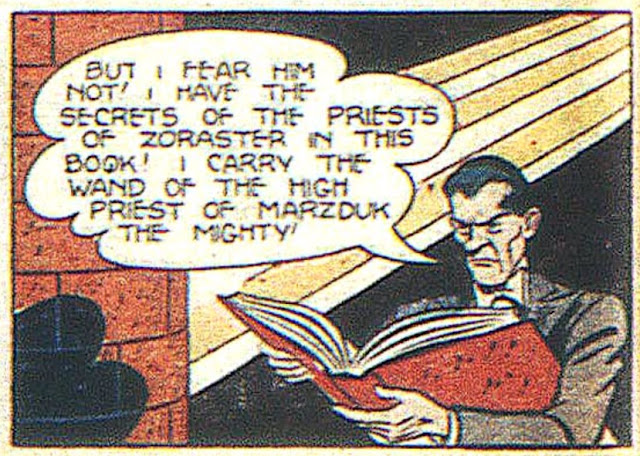
    The Secrets of the Priests of Zoraster (sic) might not be the official title of the book used by Haldane the Sorcerer, but it’s a pretty good title for a made-up book of magic and we have no other options. This one gets left behind in a secret passage rather than being destroyed, so it’s technically up for grabs.

    Origin: Persian? 

    Status: Extant (More Fun Comics 063, 1941)
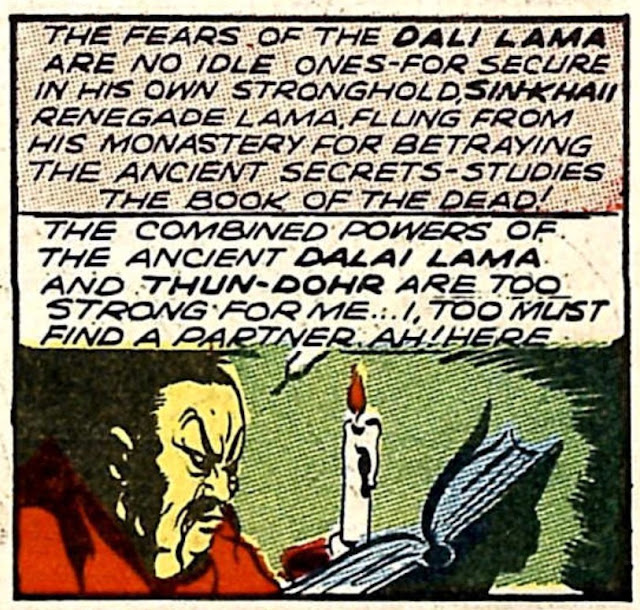
    Though Sin Khaii is an apostate Tibetan Buddhist, the Book of the Dead that he is referencing here is more likely to be the Egyptian on than the Tibetan, as he is using it to research the Black Pharaoh. He also casts spells out of it later!

    Origin: Ancient Egyptian 

    Status: Extant (Silver Streak Comics 014, 1941) 

    Theatre:
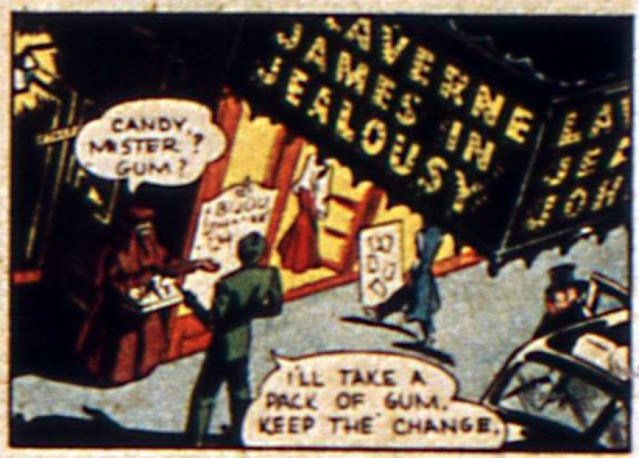
    Detective Larry Steele is called to the set of Jealousy to look into threats against star Laverne James, and then stays to solve the murder of Laverne James. More interesting than the murder mystery, however, is the mystery of just what is going on in this production.
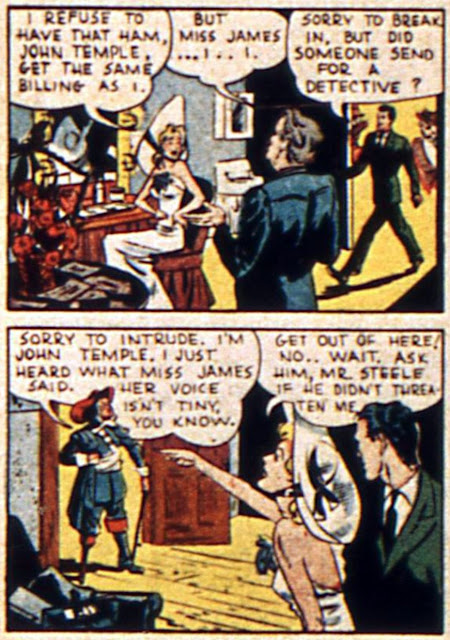
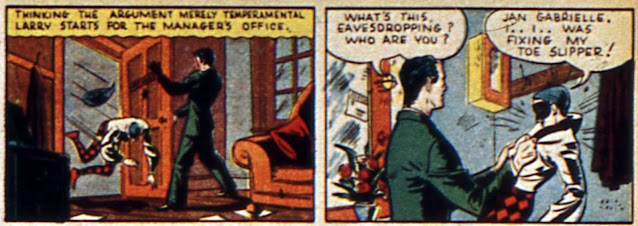
     

    We don’t actually see any of the on-stage action, but the costuming is extremely intriguing: James’ co-stars John Temple and Jan Gabrielle are dressed like off-model commedia dell’arte characters, while she looks more like a character from a Southern Gothic. Finally we have Peggy, who is part of the chorus line and is dressed like she is in a high-budget napkin advertisement. It’s a baffling selection. (Detective Comics v1 047, 1941) 
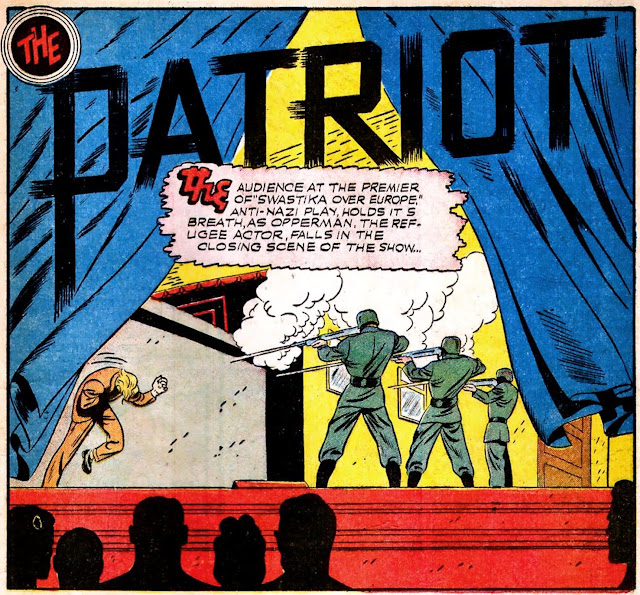
    Swastika Over Europe is a play designed to rally American support for the beleaguered nations of the Continent and as such is a target for sabotage by Nazi fifth columnists, as seen here when lead actor Opperman is murdered on-stage. (Marvel Mystery Comics v1 023, 1941)
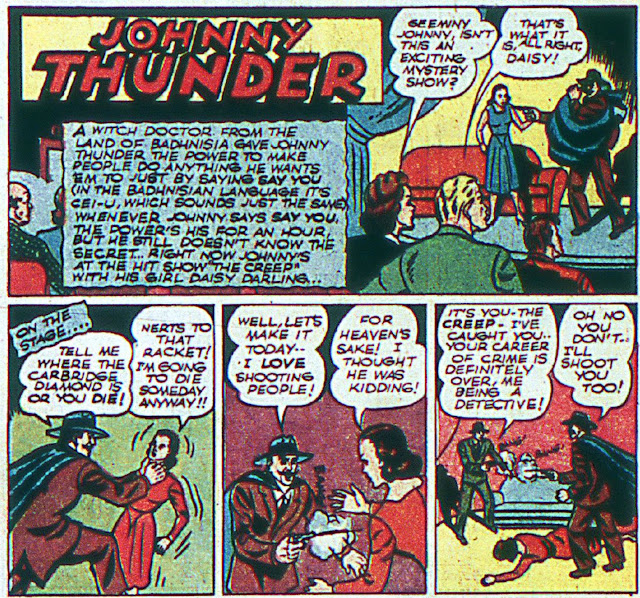
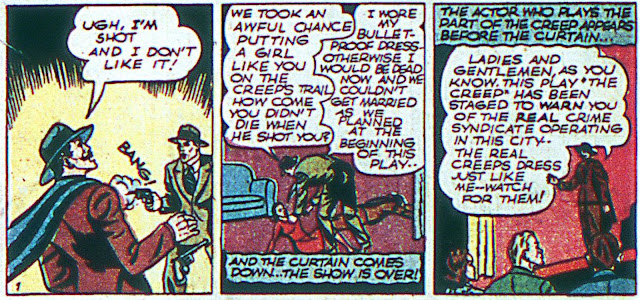
    Here we have The Creep, a play written expressly to warn the people of NYC about the threat of Crime & Corruption, Inc. I guess it works, because Johnny Thunder slapsticks them out of existence. (Flash Comics 013, 1941)
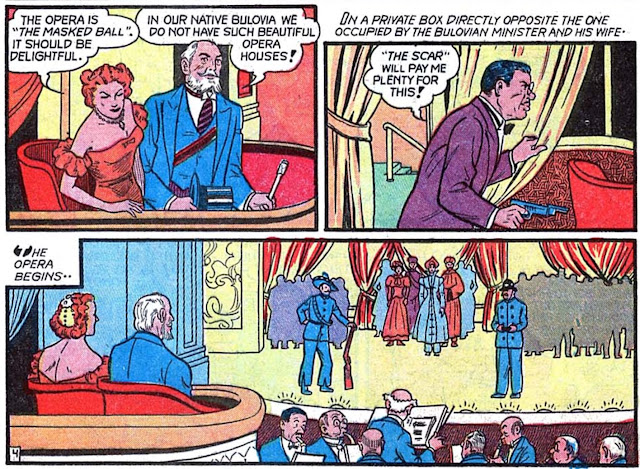
    Ordinarily getting such a good view of the stage would be very exciting to me as it would be a chance to divine some information about the production. Alas, this is an opera called The Masked Ball and so the only thing we can learn is that someone at the titular ball has come dressed as a police officer. (More Fun Comics 067, 1941)
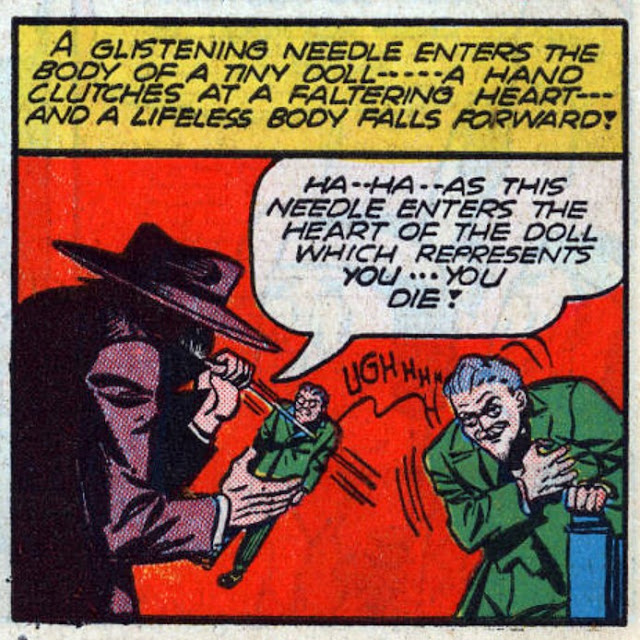
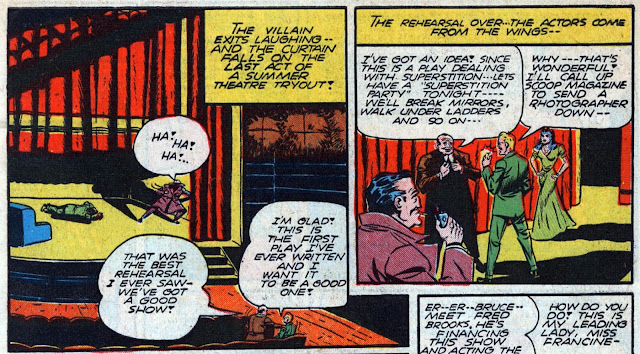
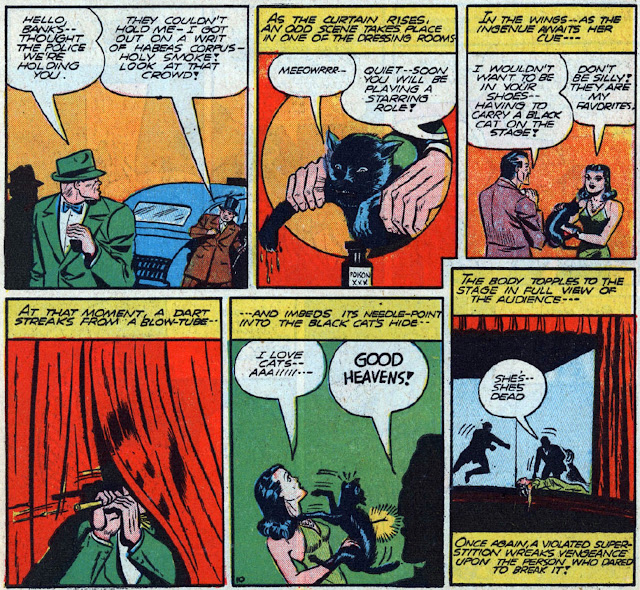
    The Superstition Murders is of course the play written by Johnny Glim the alter ego of the villainous Masked Man, who commits a series of superstition-themed murders in the hopes of tanking the production and thus securing the movie rights for his work. Though the motivation for the fictional killer is unrevealed, this seems to essentially be what the play is about as well. (Batman Comics v1 008, 1941)
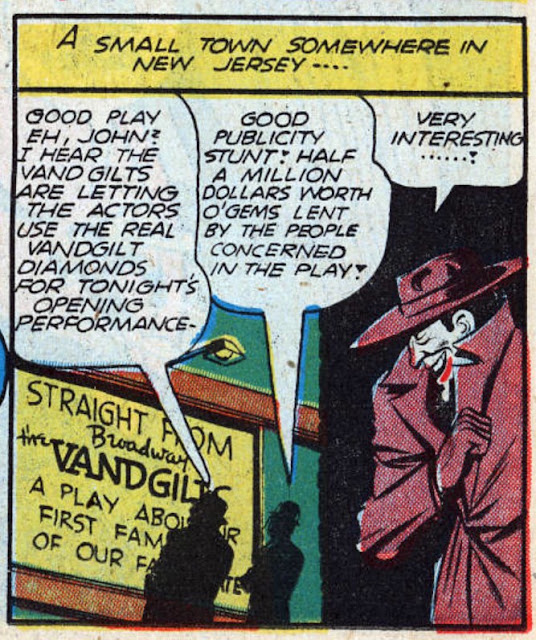
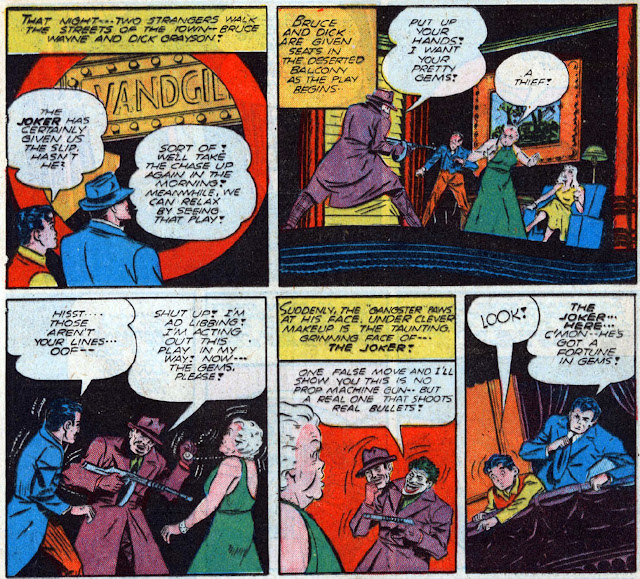
    Though there are many fine plays about the lives of the wealthy, there is no way The Vandgilts, about a real-life family who are on good enough terms with the production to lend them half a million dollars worth of jewellery, isn’t complete sycophantic mush. Luckily the Joker spices things up by robbing the actors mid-performance. (Batman Comics v1 008, 1941)

  • DIVINE ROUND-UP 028

    Religions of the world: you are not being well-represented in fiction.

    the Dream Warner: 

    While they never actually say the words “Tibetan Buddhism” in either of Thun-Dohr’s two appearances, he was brought up in a lamasery in Tibet and is personally mentored by the Dalai Lama (though not the one you’re thinking of), so I think that we can extrapolate and assign the Dream Warner to that religious tradition. Though it does not actually appear on-panel, the Dream Warner does give the Dalai Lama an accurate heads-up on the machinations of the villainous Sin Khaii, so me must conclude that it actually exists. It also has a very fun if on-the-nose name.

    God Style: Real (Silver Streak Comics 014, 1941)

    Ratzinatzi: 

    In Cloud Curtis’ final adventure he sets out alone to solve the mystery of some mysterious disappearances and air raids across South America, and ends up crashing his plane in the middle of the jungle. There he stumbles upon an idol to “Ratzinatzi, the Demon-God of the Ancient Incas” and is seemingly about to enter a chamber that opens up underneath it when the story ends. Sadly for all the completionists out there the story never concludes and so we never learn what kind of pseudo-Nazi air base or whatever lies below, though I think that we can safely assume that it continues to be pretty disrespectful to the Incas.

    God Style: Idol (Silver Streak Comics 017, 1941)

    the Devil-Flower:

    Trojak the Tiger Man’s friend Edith’s brother is sick, and according to the nearest wise man the only thing that will aid him is the juice of the sacred Devil-Flower, as worshipped by the Gemba tribe.

    Trojak and Edith brave fanatical cultists and flower-charmed animals until they are able to harvest the sacred juice and seemingly kill the plant. One can only hope that the Devil-Flower, which not only has magical powers but also seemingly some degree of self-awareness, had the foresight to do a little precautionary propagation.

    God style: Animist (Real?) (Daring Mystery Comics 005, 1940)

    Mars:

    Seen overlooking the Axis war machine in an image I would say is meant to be purely allegorical if it wasn’t from the origin of Marvel Boy, a reincarnation of Hercules in whose story Jupiter figures prominently. Were the Marvel Boy stories to have continued I’m sure that this version of Mars would have gotten a sock on the jaw in due time.

    God style: Real (Daring Mystery Comics 006, 1940)

  • MINOR SUPER-VILLAIN 939: THE BLACK PHARAOH

    (Silver Streak Comics 014, 1941)

    After his initial defeat at the hands of Thun-Dohr, the villainous Sin Khaii is on the lookout for an ally in his war on humanity and he finds one in the pages of a tome called the Book of the Dead, and presumably it’s the Egyptian Book of the Dead because the candidate he lines up is called the Black Pharaoh, the only Pharaoh evil enough that he was cursed and sealed up in a pyramid to think about what he had done for all time. The only way he would be able to go free is if a) the pyramid moves, which will free the Pharaoh’s servant Tut-Mut, who b) must then find new guys to take the place of the Black Pharaoh and his cronies. All of this stands as a real lesson for those inclined to mete out mystic justice: if you’re going to seal away evil or otherwise prevent awfulness from getting everywhere and your work can only be undone by a very specific set of circumstances, don’t write those circumstances down anywhere.

    As usual, I attempted to figure out just who if anyone the Black Pharaoh is supposed to be, with the only real clue being that he was buried in “the oldest pyramid in Egypt,” and while there are a few contenders for that title due to the gradual development of pyramid technology, the oldest pyramid-shaped pyramid like the depicted in the story seems to be the Red Pyramid near Cairo. What does this tell us? Only that the Black Pharaoh was interred some time after 2563 BC, alas.

    Sin Khaii isn’t one to be deterred by any Ancient Egyptian mystics. He uses his dark majicks to transport the pyramid to the former site of the New York World’s Fair and then deploys a bug from the criminally-underutilized Pandora’s Box to infect passersby with Curiosity so that they will enter the structure and fall prey to Tut-Mut.

    The innocent people of Queens need not fear, however, for Thun-Dohr and his mentor the Dalai Lama (not that one) are on the case. Thun-Dohr ambushes the Black Pharaoh’s servants as they ransack a museum, only to be captured via some pretty cool shadow magic.

    Finally, the Black Pharaoh and Sin Khaii get down to business and formulate a plan: they are going to recreate Ancient Egypt on a grand scale by smothering the entire United States in a layer of sand. This is why the Pharaoh’s men are looting museums, to get all of their boss’ stuff back before it is buried forever.

    (the duo’s apocalyptic sandstorm is shown blowing across the Atlantic from Egypt, and there’s a part of me that wants to get really pedantic about the relative sizes of the two countries and point out just how thin the available sand would be spread, but we are dealing with magic after all. Presumably the sand would be multiplied somehow? I’m much more concerned about the state that Egypt was left in – just how much of that sand was load-bearing?) 

    If there’s one thing about shadow magic, it’s that you need shadows to use it, and the Dalai Lama deals with that by blowing out the candle that was supplying the particular shadows keeping Thun-Dohr bound. Thun-Dohr disrupts the ritual – is the sand just hovering somewhere in the mid-Atlantic? This has to be the kind of thing that inspires conspiracy theories in a comic book universe, particularly in the kind where super-heroic stuff isn’t front page news.

    Thun-Dohr and the Black Pharaoh engage in Thrilling Astral Combat (I think. Whenever two people are battling on a cloud I assume that this is shorthand for their astral forms duking it out in the Aetherial Realms, but in this case it’s possible that they have merely chosen the clouds as their battlefield for some unexplained reason) with Our Hero emerging victorious and the villainous Pharaoh at the bottom of the ocean, weighed down by his sins. After that it is a simple matter for Thun-Dohr and his mentor to restore the pyramid and sand to Egypt.

    As always, it’s kind of disappointing when an ancient evil that was sealed away for untold eons is dispatched with relative ease in the present day. After all, why go to all the trouble with the curse of eternal slumber if you could just murder the guy in the first place? I suppose the fact that the Black Pharaoh was royalty might have played into it somehow, though on the other hand “being murdered” has to be the most expected way to die for a historical royal. Give me more formidable primordial evils!

    Categorized in: Colour (Black), Origin (Resurrected Mummy), Royalty (Pharaoh)

  • MINOR SUPER-VILLAIN 936: SIN KHAII

    (Silver Streak Comics 013, 1941)

    Sin Khaii, a lama at the same monastery that Thun-Dohr was raised at, has been cast out for unspecified reasons. His reaction to being an outcast – to steal Pandora’s Box and use it in a war on all humanity – would seem to retroactively justify the exile, however. Just why a Tibetan monastery would be the hiding place of Pandora’s Box is likewise left unexplored.

    Sin Kahii is able to use the Box to unleash fresh evils upon mankind, in the form of mosquito-like insects that are under his control. The first such is a plague called the Black Madness, which seems to act both as a traditional and deadly disease and as a vector for insanity, as seen above after Dr Benson Bell concocts a cure for it and his assistant is immediately driven to homicidal rage to keep it from being distributed.

    No madness or madman is a match for the mystic might of Thun-Dohr, however. Sin Khaii’s first plot is foiled with a sock to the jaw. Of Clavell, the madman. Sin Khaii remains unpunched.

    Since regular humans have proved to be no match for his foe, Sin Khaii’s next plan involves allying with someone more powerful, namely the ancient and evil Black Pharaoh (check in in a day or two for more on him). To that end, he levitates the Pharaoh’s whole damn pyramid and moves it from Giza to the former site of the New York World’s Fair (I was going to gripe about the comic missing an opportunity to feature the pyramid next to the Trylon and Perisphere but it seems like they were demolished with much more alacrity than I might have expected).

    As will be discussed further in the Black Pharaoh’s own entry, his imprisonment in the pyramid can only be ended when he and his servants’ places are taken by other people. Sin Khaii facilitates this via another Pandora’s Box bug, in this case “curiosity.” Could one argue that curiosity is not one of the evils contained in the box since Pandora already had it her curiosity was in fact foundational to the whole myth? I think that one could, but of course if we’re going to insist on mythic accuracy then Sin Khaii is going to have to be finding increasingly unlikely ways to weaponize hope, seeing as it’s the only thing that’s supposed to still be in the dang thing.

    Once the Black Pharaoh is free, he and Sin Khaii plot to destroy the United States but are once again foiled by the flying fists of Thun-Dohr. The pyramid (and all of the sand in Egypt) is restored to its proper resting place and Sin Khaii, still at large, swears further vengeance. Sadly for us plot resolution fans out there, the “Thun-Dohr” feature never returned after this second instalment and Sin Khaii is presumably at large to this day.

    Categorized in: Accessories (Pandora’s Box), Day Jobs (Lamas), Powers (Various Magical)

  • MINOR SUPER-HERO ROUND-UP 081

    Lev Gleason characters filling every available ecological niche over here. 

    Thun-Dohr:

    We’ve seen it before and we’ll see it again: Thun-Dohr (Thun-dohr?) is a white guy brought up in the traditions of a Tibetan monastery and he’s just the best dang mystic anyone’s ever seen, much better than all those Tibetan monks could ever be. 

    Like Iron Fist, the 1970s version of this character archetype, Thun-Dohr was orphaned when his parents succumbed to the elements while attempting to reach the fabled monastery. Baby Thun-Dohr (and I can no longer think of new ways to ask why these people brought their baby along on this super dangerous expedition) was found and brought to safety by the monks, who acclaimed him as some sort of prophesied kid. 

    Thanks to his training in “the arts of the Gom-Pa,” Thun-Dohr has a wide variety of mystic powers, including invisibility, teleportation, invulnerability to a variety of environmental conditions, the ability to see the last moments of a person’s life in their corpse’s eyes, astral projection and so on and so forth. He also has a mystical bracelet that allows him to remain in mental contact with the 300+ year-old Dalai Lama (not the one you’re thinking of) who raised him as he goes out into the world to battle evil (i.e., the other guy from the same monastery who is attempting to end the world – could’ve used a prophecy telling them not to let him in, amirite?). (Silver Streak Comics 013, 1941)

    Categorized in: Day Jobs (Lamas), Elements (Thunder), Origin (Mystic Traditions)

    Undercover Man:

    Police Detective Phil Barrows is unpopular at the Centre Street Homicide Department due to his habit of working alone (I think? Nobody seems to like him and this is the only stated reason why) so what does he do? Create a secondary identity called the Undercover Man so that he can work even more alone while adopting a variety of disguises. During his one published adventure he takes down corrupt politician Eduardo Donati and while I’m not normally one to critique someone’s decision to adopt a costumed identity I think he probably could have done it as a regular cop if he’d tried to. (Captain Battle Comics 001, 1941)

    Categorized in: Day Jobs (Police Detective), Powers (Master of Disguise), Professions (Law Enforcement)

    Blackout: 

    Blackout is the new name adopted by Dr Basil Brusiloff after he is mutated by chemicals randomly mixed together during a Nazi air raid on the hospital in which he is working. Unlike many other super-heroes who undergo physical transformations, Brusiloff’s new, jet-black form appears to be a permanent change and not something that he can switch on and off.

    Blackout is able to fly at speed comparable to a fighter plane, but his main power is the ability to emit a thick black smoke from his pores, the specificity of which somehow makes it seem more gross than a smoke power usually does.

    In addition to being opaque, this smoke is thick enough to suffocate someone in an unventilated environment (this is also gross. Huff my gas, miscreants!). Blackout is able to direct this smoke and even shape it to some degree (such as when he forms a long tunnel out of it to shield fleeing civilians from Nazi eyes), but most remarkably is able to emit it in large enough quantities that at one point he escapes a sealed room by bursting the walls through sheer air pressure.

    Aside from his powers, there are two remarkable things about Blackout: firstly, his origin takes place in Belgrade, which makes him the first in what is sure to be a pretty short list of Yugoslavian superhumans. Secondly, Blackout is the subject of some very minor debate vis-a-vis just how hairy/furry he is, with the two sides boiling down to “the text never says he’s hairy so it must just be something else” versus “he looks very hairy.” I am inclined to side with the latter side. He looks very hairy!

    Related to the hairiness question is a third interesting thing about Blackout: it is quite possible that he is completely nude, aside from that stylish green mask. (Captain Battle Comics 001, 1941)

    Categorized in: Activities (Blackouts), Colours (Black), Origin (Chemical Mutates)

    Nightro: 

    Nightro is Hugh Goddard, a scientist who was betrayed and left to die by his associates after they found a rich radium deposit in Alaska and Goddard expressed his desire to donate it to medical research, and though I do have some sympathy for his partners’ position that as the expedition’s financial backers they should see some profit from the mine they resort to murder a bit too quickly for my tatse. Surely this is a case for the courts!

    If you look Nightro up online, odds are that you will be told that he is blinded by the ambient radiation from the deposit. This is not true! What actually happens is that he wanders around in the snow until he is found by some helpful Inuit fellows and ends up with an extreme case of snow-blindness. Radiation doesn’t even come up.

    Goddard eventually makes his way back to the US, where a Dr Frank Miller (!) discovers that polarized lenses will allow him to see. Unlike his blind super-hero contemporaries the Mask and Dr Mid-Nite, Nightro does not appear to have any kind of enhanced dark vision. Instead, his stated reason for adopting a costumed alias is that his goggles are too ugly for him to be accepted in polite society.

    Goddard continues to live as a blind man as part of maintaining his secret identity as Nightro, meaning that from his second appearance onward he has a seeing eye dog companion named Blackie. He is called the “Streamlined Robinhood,” supposedly because he takes money from crooks and redistributed it to the needy – I reckon that it’s just a way to attach a buzzword to the character – if he had debuted tenyears later he might’ve been “the Jet Age Robinhood.”  (Daredevil Comics 002, 1941)

    Categorized in: Accessories (Dogs), Locations (Temporal), Origins (Blind Characters)

  • MINOR SUPER-HERO ROUND-UP 081

    Lev Gleason characters filling every available ecological niche over here. 

    Thun-Dohr:

    We’ve seen it before and we’ll see it again: Thun-Dohr (Thun-dohr?) is a white guy brought up in the traditions of a Tibetan monastery and he’s just the best dang mystic anyone’s ever seen, much better than all those Tibetan monks could ever be. 

    Like Iron Fist, the 1970s version of this character archetype, Thun-Dohr was orphaned when his parents succumbed to the elements while attempting to reach the fabled monastery. Baby Thun-Dohr (and I can no longer think of new ways to ask why these people brought their baby along on this super dangerous expedition) was found and brought to safety by the monks, who acclaimed him as some sort of prophesied kid. 

    Thanks to his training in “the arts of the Gom-Pa,” Thun-Dohr has a wide variety of mystic powers, including invisibility, teleportation, invulnerability to a variety of environmental conditions, the ability to see the last moments of a person’s life in their corpse’s eyes, astral projection and so on and so forth. He also has a mystical bracelet that allows him to remain in mental contact with the 300+ year-old Dalai Lama (not the one you’re thinking of) who raised him as he goes out into the world to battle evil (i.e., the other guy from the same monastery who is attempting to end the world – could’ve used a prophecy telling them not to let him in, amirite?). (Silver Streak Comics 013, 1941)

    Categorized in: Day Jobs (Lamas), Elements (Thunder), Origin (Mystic Traditions)

    Undercover Man:

    Police Detective Phil Barrows is unpopular at the Centre Street Homicide Department due to his habit of working alone (I think? Nobody seems to like him and this is the only stated reason why) so what does he do? Create a secondary identity called the Undercover Man so that he can work even more alone while adopting a variety of disguises. During his one published adventure he takes down corrupt politician Eduardo Donati and while I’m not normally one to critique someone’s decision to adopt a costumed identity I think he probably could have done it as a regular cop if he’d tried to. (Captain Battle Comics 001, 1941)

    Categorized in: Day Jobs (Police Detective), Powers (Master of Disguise), Professions (Law Enforcement)

    Blackout: 

    Blackout is the new name adopted by Dr Basil Brusiloff after he is mutated by chemicals randomly mixed together during a Nazi air raid on the hospital in which he is working. Unlike many other super-heroes who undergo physical transformations, Brusiloff’s new, jet-black form appears to be a permanent change and not something that he can switch on and off.

    Blackout is able to fly at speed comparable to a fighter plane, but his main power is the ability to emit a thick black smoke from his pores, the specificity of which somehow makes it seem more gross than a smoke power usually does.

    In addition to being opaque, this smoke is thick enough to suffocate someone in an unventilated environment (this is also gross. Huff my gas, miscreants!). Blackout is able to direct this smoke and even shape it to some degree (such as when he forms a long tunnel out of it to shield fleeing civilians from Nazi eyes), but most remarkably is able to emit it in large enough quantities that at one point he escapes a sealed room by bursting the walls through sheer air pressure.

    Aside from his powers, there are two remarkable things about Blackout: firstly, his origin takes place in Belgrade, which makes him the first in what is sure to be a pretty short list of Yugoslavian superhumans. Secondly, Blackout is the subject of some very minor debate vis-a-vis just how hairy/furry he is, with the two sides boiling down to “the text never says he’s hairy so it must just be something else” versus “he looks very hairy.” I am inclined to side with the latter side. He looks very hairy!

    Related to the hairiness question is a third interesting thing about Blackout: it is quite possible that he is completely nude, aside from that stylish green mask. (Captain Battle Comics 001, 1941)

    Categorized in: Activities (Blackouts), Colours (Black), Origin (Chemical Mutates)

    Nightro: 

    Nightro is Hugh Goddard, a scientist who was betrayed and left to die by his associates after they found a rich radium deposit in Alaska and Goddard expressed his desire to donate it to medical research, and though I do have some sympathy for his partners’ position that as the expedition’s financial backers they should see some profit from the mine they resort to murder a bit too quickly for my tatse. Surely this is a case for the courts!

    If you look Nightro up online, odds are that you will be told that he is blinded by the ambient radiation from the deposit. This is not true! What actually happens is that he wanders around in the snow until he is found by some helpful Inuit fellows and ends up with an extreme case of snow-blindness. Radiation doesn’t even come up.

    Goddard eventually makes his way back to the US, where a Dr Frank Miller (!) discovers that polarized lenses will allow him to see. Unlike his blind super-hero contemporaries the Mask and Dr Mid-Nite, Nightro does not appear to have any kind of enhanced dark vision. Instead, his stated reason for adopting a costumed alias is that his goggles are too ugly for him to be accepted in polite society.

    Goddard continues to live as a blind man as part of maintaining his secret identity as Nightro, meaning that from his second appearance onward he has a seeing eye dog companion named Blackie. He is called the “Streamlined Robinhood,” supposedly because he takes money from crooks and redistributed it to the needy – I reckon that it’s just a way to attach a buzzword to the character – if he had debuted tenyears later he might’ve been “the Jet Age Robinhood.”  (Daredevil Comics 002, 1941)

    Categorized in: Accessories (Dogs), Locations (Temporal), Origins (Blind Characters)