The Curse of Skeleton Munroe

Category: reincarnated

  • MINOR SUPER-HERO ROUND-UP 085

    MINOR SUPER-HERO ROUND-UP 085

    Welcome to “The Four Characters Least Likely to Return in a Modern Comic” Theatre.

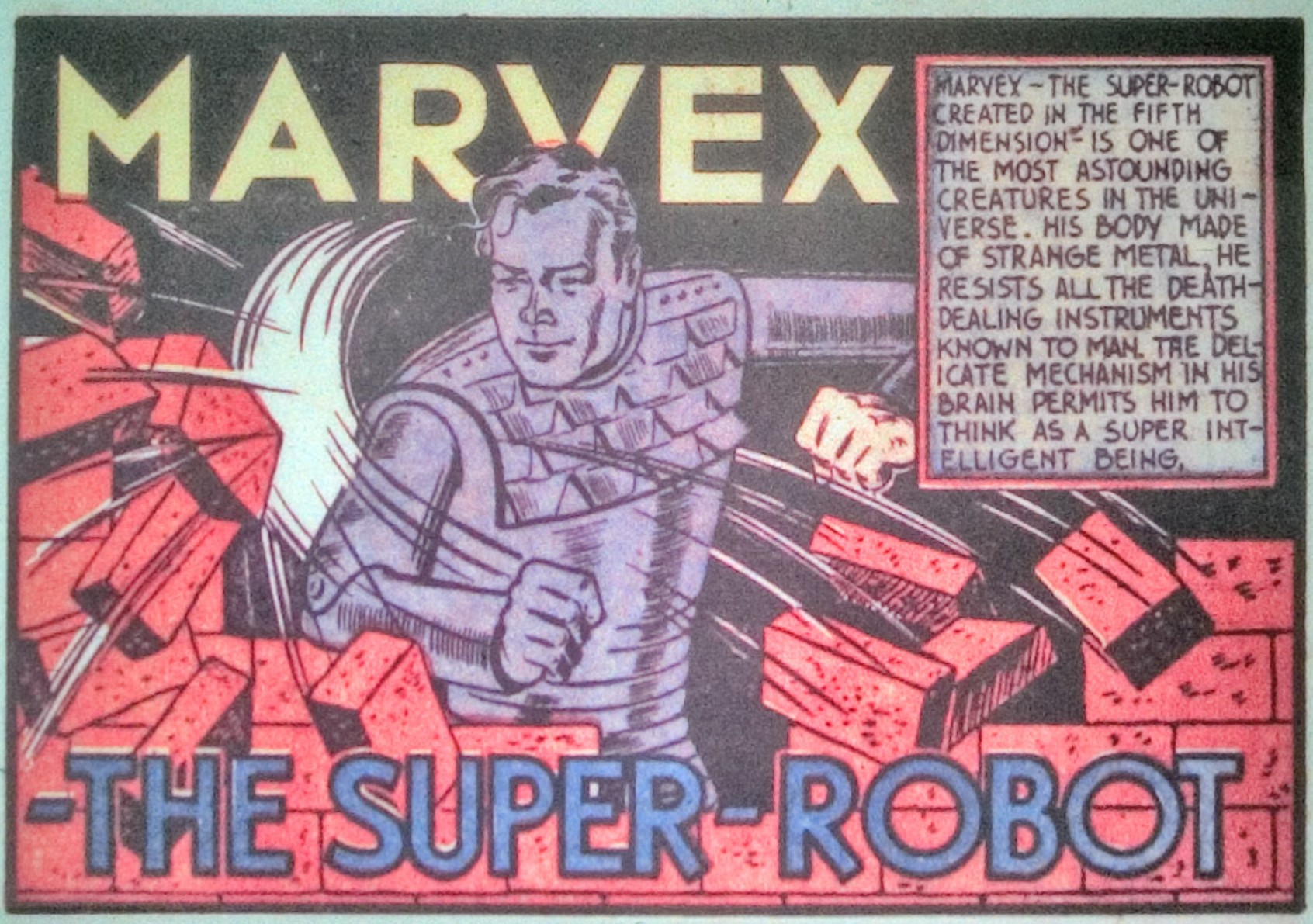
    Marvex the Super-Robot: 

    Marvex the Super-Robot! Created to be a slave by a Fifth Dimensional jerk named Bolo, Marvex rejects his fate, kills Bolo and his associates and accidentally blasts himself to Earth while smashing up Bolo’s lab equipment.

    If you’re already aware of who Marvex is then it’s likely because of the Michael Kupperman strip featuring the character during Marvel’s 70th Anniversary run of comics, and indeed, Marvex’ propensities for cartoonish violence, shutting down romance with sudden nudity and receiving twenty dollars all make him a perfect Kupperman character.

    Sadly, the nudity and twenty dollar reward system go the way of Marvex’ hair in his second and third appearances, but he never stops yelling about being a robot whenever his companion Clara gets a bit too comfortable around him. (Daring Mystery Comics 003, 1940)

    Categorized in: Language (Superlatives – Super), Origins (Extradimensional, Robot), Supranormal Beings (Robots)

    the Falcon:

    The Falcon is Carl Burgess, assistant district attorney in an unnamed city who is kind of betraying the spirit of his office by meting out vigilante justice when he feels like the legal system isn’t working. Though he is a pretty average costumed vigilante, the Falcon has precisely four interesting things to note. The first is that his name is weirdly close to that of Carl Burgos, the creator of the Human Torch. This might be a coincidence, but still. The second is of course that he is the original Marvel Falcon but by far the least-known of the half dozen or so Marvel characters to share that name.

    Like the Eagle, the Falcon is a bit of a fashion plate or at least someone who adjusts his costume on every adventure and for the same reason: a different artist on every one of his appearances.

    Finally, the Falcon has been retroactively assigned an accessory based on an assumption, just like his fellow Daring Mystery Comics alum the Fiery Mask and his morning star. In this case, it’s that his suit gives him the ability to glide. I assume that this is because of a stylistic choice on the part of his various illustrators to have him dive down on his enemies like a falcon stooping on prey, because the suit does not come up in his handful of Golden Age appearances. (Daring Mystery Comics 005, 1940)

    Categorized in: Animals (Falcons), Day Jobs (Assistant District Attorneys)

    Marvel Boy:

    Up until about 2012 I’d have confidently said that “Marvel Boy” was one of the most commonly-shared super-hero identities in the Marvel Universe, but it seems that the concept of the legacy identity has gone through a weird mutation in the last decade or so and I am now regularly surprised to find that there are way more Wolverines or Captains America than I had previously imagined. With that in mind, we’ll revise my statement to be that there are more Marvel Boys than you might expect, like Starmans over at DC.

    This particular Marvel Boy is the Earthly reincarnation of Hercules, come down from Valhalla (?!) to aid a world threatened by fascism. His human form is named Martin Burns and like a veritable Silver Age Superboy he is born with so much physical strength that he must constantly hold himself back lest he endanger those around him and out himself as something strange and different.

    On Martin’s fourteenth birthday a mysterious stranger (who is implicitly the Roman god Jupiter) delivers a package containing his heroic costume to him and then somewhat redundantly also appears in his bedroom to really spell out his whole deal and charge him to uphold democracy etc.

    Marvel Boy is super strong, very agile and fast enough to run from New York City to Washington DC and back – carrying three grown men on the first leg of the trip – in the course of a night that also includes the aforementioned visit from Jupiter and busting up two fifth column cells.

    Both this Marvel Boy and his successor (coming up in 1942) never returned after making a single appearance, and while I can’t say just why they didn’t have further Golden Age adventures, the lack of a modern appearance for either of them is almost certainly down to the fact that their origins both revolve around a dead Hercules, who is in fact more often than not a very living second- or third-tier hero in the Marvel Universe. They’re also both named Martin Burns for some reason, which means that later handbook writers have felt compelled to differentiate them by giving them middle names based on their creators, making this one Martin Simon Burns.

    Frankly, I think that the fact that the two Marvel Boys have origins that are incompatible with both Marvel Comics continuity and also one another is terrific fodder for comic book storytelling. Both of them should be BRUNG BACK immediately, preferably in a comic that also has Hercules in it. (Daring Mystery Comics 006, 1940)

    Categorized in: Generica (Boys), Language (Superlatives – Marvels), Origin (Reincarnated God) 

    the Flying Flame:

    The Flying Flame is a red fighter plane flown for the RAF by the two-fisted American pilot Captain Red Ruff, who is also known as the Flying Flame due to his shock of red hair. During his brief comic book career, Ruff battled the Black Ace and ferreted out some spies at an airbase. (Daring Mystery Comics 006, 1940)

    Categorized in: Activities (Flying), Elements (Fire), Team Membership (RAF)

  • MINOR SUPER-HERO ROUND-UP 024

    Buncha fresh heroes here!

    Son of the Gods: 

    Dr John Thesson, big tall archaeologist and 1940s arch-skeptic, has the misfortune to find himself on an expedition to Crete with true believer Professor Craig who can’t stop running his mouth about how great Theseus was and how he totally existed and maybe Thesson and Craig can find Theseus’ mystic Ring of Poseidon if they look hard enough. It is a very annoying expedition for Thesson.

    Just kidding: this is a comic book and Professor Craig is completely right – it’s John “We’re Scientists” Thesson who has to get with the picture.

    The expedition is rich with incident: on the way there the duo ore attacked by a wild boar and Thesson kills it…

    … and then once they start the dig in earnest it is plagued by sabotage that is eventually traced back to their host Procostous and his manservant Cercion. This is the point at which the back of Professor Craig’s head blows clean off and he starts talking about how Thesson is the reincarnation of Theseus and is reliving his famed Six Labours (he actually does half: Periphetes the Club Bearer and Sinis the Tree Bender appear only as recounted myths and Sciron is not mentioned at all. And to be honest Cercion = Cercyon is a bit flimsy. It’s lucky for Professor Craig that he turns out to be correct. Again).

    Surprising nobody, Thesson does indeed find the Ring of Poseidon after one last sabotage attempt that leaves Procrustous dead. This is enough for the local mystery cult to acclaim him the Reincarnation of Theseus and he vows to use the powers granted by the ring (super strength and a degree of invulnerability, mostly) to battle crime and injustice. I initially hoped that Theseus would have fun mythology-inspired adventures like the MLJ Hercules but no, it’s all super-scientists and fascists – not even a hint of poor neglected Sciron and his giant turtle.

    (later issues cast Thesson as a mere descendant of Theseus but whether this is because reincarnation was a but too mystical or due to simple sloppy record keeping I cannot say)

    (the Minotaur only appears as one of Professor Craig’s stories but I just wanted to highlight the rare bull-bodied version here) (Exciting Comics 002, 1940)

    the Masked Rider:

    Geologist Jim Sanford becomes the Masked Rider in order to catch crooks (including the Specter) operating a covert gold min under the Diamond D Ranch without them knowing he was onto them with specific geological knowledge. Unlike most of his peers, he has no trouble hanging up his mask once the job is done. (Exciting Comics 002, 1940)

    the Sphinx:

    The Sphinx is a tuxedo-clad, domino-masked vigilante (real name Ellsworth Forrester!), a perhaps over represented group in early comics but generally a solid one (I initially forgot the name of the Scarab from Terra Obscura and thought that he was this guy – imagine my confusion). The main difference between the Sphinx and his peers like the Clock or the Mouthpiece or Just n’ Right is that the Sphinx is loosely affiliated with the police rather than being hunted by them.

    The other main difference is the fact that the Sphinx is one of the few suit-and-mask heroes with legitimate super powers, specifically super strength and at least partial invulnerability.

    Why is he called the Sphinx? As far as I can tell it’s just because he’s mysterious. (Exciting Comics 002, 1940)

    UPDATE – the Golden Knight:

    The Golden Knight
    stops off on his way to the Crusades to do a mission for Kara the
    Magician, who gifts him a magic ring that emits light in order to help
    him overcome the many dangers along the way and then a magic cloak of
    protection once he gets back – it’s a very Dungeons & Dragons style quest, honestly.

    The
    Golden Knight also takes a dip in a magic lake that triples his
    strength, which is handy for a warrior type. Does this strength persist? No idea. (Fantastic
    Comics 003, 1940)

     A couple of issues later, the Golden Knight meets the love of his life, Alice. Alice fell down a well as a child and was raised by (and eventually made queen of) a race of winged people in an underground city. Alice rules – in her first proper appearance she stabs two people to death which is way, way more than your typical female Golden Age adventurer. (Fantastic Comics 005, 1940)

  • MINOR SUPER-HERO ROUND-UP 024

    Buncha fresh heroes here!

    Son of the Gods: 

    Dr John Thesson, big tall archaeologist and 1940s arch-skeptic, has the misfortune to find himself on an expedition to Crete with true believer Professor Craig who can’t stop running his mouth about how great Theseus was and how he totally existed and maybe Thesson and Craig can find Theseus’ mystic Ring of Poseidon if they look hard enough. It is a very annoying expedition for Thesson.

    Just kidding: this is a comic book and Professor Craig is completely right – it’s John “We’re Scientists” Thesson who has to get with the picture.

    The expedition is rich with incident: on the way there the duo ore attacked by a wild boar and Thesson kills it…

    … and then once they start the dig in earnest it is plagued by sabotage that is eventually traced back to their host Procostous and his manservant Cercion. This is the point at which the back of Professor Craig’s head blows clean off and he starts talking about how Thesson is the reincarnation of Theseus and is reliving his famed Six Labours (he actually does half: Periphetes the Club Bearer and Sinis the Tree Bender appear only as recounted myths and Sciron is not mentioned at all. And to be honest Cercion = Cercyon is a bit flimsy. It’s lucky for Professor Craig that he turns out to be correct. Again).

    Surprising nobody, Thesson does indeed find the Ring of Poseidon after one last sabotage attempt that leaves Procrustous dead. This is enough for the local mystery cult to acclaim him the Reincarnation of Theseus and he vows to use the powers granted by the ring (super strength and a degree of invulnerability, mostly) to battle crime and injustice. I initially hoped that Theseus would have fun mythology-inspired adventures like the MLJ Hercules but no, it’s all super-scientists and fascists – not even a hint of poor neglected Sciron and his giant turtle.

    (later issues cast Thesson as a mere descendant of Theseus but whether this is because reincarnation was a but too mystical or due to simple sloppy record keeping I cannot say)

    (the Minotaur only appears as one of Professor Craig’s stories but I just wanted to highlight the rare bull-bodied version here) (Exciting Comics 002, 1940)

    the Masked Rider:

    Geologist Jim Sanford becomes the Masked Rider in order to catch crooks (including the Specter) operating a covert gold min under the Diamond D Ranch without them knowing he was onto them with specific geological knowledge. Unlike most of his peers, he has no trouble hanging up his mask once the job is done. (Exciting Comics 002, 1940)

    the Sphinx:

    The Sphinx is a tuxedo-clad, domino-masked vigilante (real name Ellsworth Forrester!), a perhaps over represented group in early comics but generally a solid one (I initially forgot the name of the Scarab from Terra Obscura and thought that he was this guy – imagine my confusion). The main difference between the Sphinx and his peers like the Clock or the Mouthpiece or Just n’ Right is that the Sphinx is loosely affiliated with the police rather than being hunted by them.

    The other main difference is the fact that the Sphinx is one of the few suit-and-mask heroes with legitimate super powers, specifically super strength and at least partial invulnerability.

    Why is he called the Sphinx? As far as I can tell it’s just because he’s mysterious. (Exciting Comics 002, 1940)

    UPDATE – the Golden Knight:

    The Golden Knight
    stops off on his way to the Crusades to do a mission for Kara the
    Magician, who gifts him a magic ring that emits light in order to help
    him overcome the many dangers along the way and then a magic cloak of
    protection once he gets back – it’s a very Dungeons & Dragons style quest, honestly.

    The
    Golden Knight also takes a dip in a magic lake that triples his
    strength, which is handy for a warrior type. Does this strength persist? No idea. (Fantastic
    Comics 003, 1940)

     A couple of issues later, the Golden Knight meets the love of his life, Alice. Alice fell down a well as a child and was raised by (and eventually made queen of) a race of winged people in an underground city. Alice rules – in her first proper appearance she stabs two people to death which is way, way more than your typical female Golden Age adventurer. (Fantastic Comics 005, 1940)

  • SUPER-VILLAIN YEARBOOK: HATH-SET 1940

    What was Hath-Set up to in 1940?

    That’s actually a tricky question, because Hath-Set is a tricky character! Technically, he did absolutely nothing in 1940, because he died somewhere in the 1200s BC. Because, yes, Hath Set is mixed up in the unholy mess that is Hawkman and Hawkgirl’s origin story.

    Of course, it didn’t start out complicated: Hath-Set was an evil priest of Anubis who murdered Prince Khufu and his lover Shiera and then they all got reincarnated some 3000 years later to do it all over again. Nice and simple. But comic books are comic books, so all three of these fools have been reincarnated more times than any reasonable person would care to count, including retroactively as characters like the Silent Knight. Hath-Set himself doesn’t always show up – his piddly number of appearances in any incarnation would probably net him the status of minor super-villain if he wasn’t such an integral part of the Hawks’ origin story.

    As for Doctor Hastor: he electrocutes passengers on the New York subway system in an attempt to extort the city for big bux but before he can get any further Hawkman shows up, there’s some back-and-forth that includes an attempt to sacrifice Shiera Sanders to Anubis, and Hawkman shoots Hastor dead with a crossbow.

    Don’t worry, he’ll be back!

  • SUPER-VILLAIN YEARBOOK: HATH-SET 1940

    What was Hath-Set up to in 1940?

    That’s actually a tricky question, because Hath-Set is a tricky character! Technically, he did absolutely nothing in 1940, because he died somewhere in the 1200s BC. Because, yes, Hath Set is mixed up in the unholy mess that is Hawkman and Hawkgirl’s origin story.

    Of course, it didn’t start out complicated: Hath-Set was an evil priest of Anubis who murdered Prince Khufu and his lover Shiera and then they all got reincarnated some 3000 years later to do it all over again. Nice and simple. But comic books are comic books, so all three of these fools have been reincarnated more times than any reasonable person would care to count, including retroactively as characters like the Silent Knight. Hath-Set himself doesn’t always show up – his piddly number of appearances in any incarnation would probably net him the status of minor super-villain if he wasn’t such an integral part of the Hawks’ origin story.

    As for Doctor Hastor: he electrocutes passengers on the New York subway system in an attempt to extort the city for big bux but before he can get any further Hawkman shows up, there’s some back-and-forth that includes an attempt to sacrifice Shiera Sanders to Anubis, and Hawkman shoots Hastor dead with a crossbow.

    Don’t worry, he’ll be back!