The Curse of Skeleton Munroe

Category: Great Comics

  • MAD AND CRIMINAL SCIENTIST ROUND-UP 026

    If we criminalize mad science then only criminal scientists will be mad.

    Mauser:

    Mauser is the second of two foes battled by two-fisted chemist Guy Gorham and also the second rogue biologist. Was this comic setting up some sort of biologist/chemist beef that never got a chance to pay off? Mauser’s plans are never really spelled out, but he’s got a colony of vampire bats that he seems to be training to attack human targets, which isn’t great but which spells his undoing when he steals Gorham’s food concentrate formula for use as vampire feed – presumably for when human blood is in short supply. 

    A couple of other things about Mauser: he has a pretty decent uniform which he shares with his underlings, and despite his name (and the name of his henchman Herr Klotz) he does not appear to be a fascist. (Great Comics 002, 1941)

    Dr Berchtoldt:

    All Dr Berchtoldt wants to do is peacefully develop his robot army (and then take over the world). They won’t let him do it on land, so he moves under the sea, where he still gets hassled by the Man, in the form of Navy Jones. And all he did was kidnap Princess Coral and threaten to marry her against her will: is that any justification for hounding a man from his undersea fortress and then blowing up him and his super submarine alike? (Green Mask v1 006, 1941)

    de Moire:

    De Moire and his pal the Skipper have come to the part of Africa that Kaänga hangs out in to do unethical human experiments on what they assume are expendable people. After transforming one guy into a huge green killing machine, de Moire becomes obsessed with doing the same to Kaänga to make an even more beefy creature. This obsession leads him to neglect his original creation, and it wanders off and gets a look at itself in a pool of water and realizes that it is now ugly, which in turn leads it to slay de Moire. The Skipper is likewise killed, leaving Kaänga to battle the monster to the death. (Jungle Comics 013, 1941)

    Zalov Varno:

    Zalov Varno has been sending teams of men out to attack the oil fields of Debra-Tabuk, prompting Tabu, Wizard of the Jungle to pay him a visit and see just what his deal is. Though he captures Tabu with surprising ease given the latter’s vast magical power, Varno never actually explains just what he wants the oil for, which is in my opinion one of the greatest of villainous sins. I don’t even feel bad for him when he gets killed with his own Devitalizer Beam.

    The most interesting thing about Varno is what exactly is going on with his right eye. As far as I can tell, he wears some sort of semi-spherical black monocle, but just why he might care to do so is left as an exercise for the reader. (Jungle Comics 013, 1941)

  • MAD AND CRIMINAL SCIENTIST ROUND-UP 026

    If we criminalize mad science then only criminal scientists will be mad.

    Mauser:

    Mauser is the second of two foes battled by two-fisted chemist Guy Gorham and also the second rogue biologist. Was this comic setting up some sort of biologist/chemist beef that never got a chance to pay off? Mauser’s plans are never really spelled out, but he’s got a colony of vampire bats that he seems to be training to attack human targets, which isn’t great but which spells his undoing when he steals Gorham’s food concentrate formula for use as vampire feed – presumably for when human blood is in short supply. 

    A couple of other things about Mauser: he has a pretty decent uniform which he shares with his underlings, and despite his name (and the name of his henchman Herr Klotz) he does not appear to be a fascist. (Great Comics 002, 1941)

    Dr Berchtoldt:

    All Dr Berchtoldt wants to do is peacefully develop his robot army (and then take over the world). They won’t let him do it on land, so he moves under the sea, where he still gets hassled by the Man, in the form of Navy Jones. And all he did was kidnap Princess Coral and threaten to marry her against her will: is that any justification for hounding a man from his undersea fortress and then blowing up him and his super submarine alike? (Green Mask v1 006, 1941)

    de Moire:

    De Moire and his pal the Skipper have come to the part of Africa that Kaänga hangs out in to do unethical human experiments on what they assume are expendable people. After transforming one guy into a huge green killing machine, de Moire becomes obsessed with doing the same to Kaänga to make an even more beefy creature. This obsession leads him to neglect his original creation, and it wanders off and gets a look at itself in a pool of water and realizes that it is now ugly, which in turn leads it to slay de Moire. The Skipper is likewise killed, leaving Kaänga to battle the monster to the death. (Jungle Comics 013, 1941)

    Zalov Varno:

    Zalov Varno has been sending teams of men out to attack the oil fields of Debra-Tabuk, prompting Tabu, Wizard of the Jungle to pay him a visit and see just what his deal is. Though he captures Tabu with surprising ease given the latter’s vast magical power, Varno never actually explains just what he wants the oil for, which is in my opinion one of the greatest of villainous sins. I don’t even feel bad for him when he gets killed with his own Devitalizer Beam.

    The most interesting thing about Varno is what exactly is going on with his right eye. As far as I can tell, he wears some sort of semi-spherical black monocle, but just why he might care to do so is left as an exercise for the reader. (Jungle Comics 013, 1941)

  • REAL PERSON ROUND-UP 027

    Real people? In comic books? Now I’ve seen everything.

    Abu Khan:

    I sincerely cannot tell if this Black Knight foe is supposed to be Abu Sa’id Bahadur Khan, last ruler of the Mongol Ilkhanate, or if they just pulled a couple of syllables out of the air and added “Khan” to the end and called it a day. On the one hand, the real Abu Khan never tried to invade Egypt, as the Black Knight is trying to prevent him from doing, but on the other he is from about the right time to be a Black Knight character, i.e., within about two hundred years of all the other elements of the comic. (The Funnies 059, 1941)

    Adolf Hitler:

    Pays for the services of super-villain the Artist to facilitate the invasion of Tomania with his soul-stealing powers. (Jackpot Comics 004, 1941)

    Al Capone:

    “Scar Lapone,” used as a generic gangster name. (Green Mask v1 005, 1941)

    Jean Lafitte:

    A false vision of Lafitte is summoned by a fake medium. (Green Mask v1 007, 1941)

    Napoleon Bonaparte:

    Viewed through a time machine’s viewscreen by the Black Hood. (Jackpot Comics 003, 1941)

    Nero:

    Kim Hale and the Purple Zombie, blasted back in time, are condemned to death by Emperor Nero for telling him about things that he hadn’t heard of before. (Reg’lar Fellers Heroic Comics 008, 1941)

    Though the duo make it out of the gladiatorial arena okay, they almost get caught up in the Great Fire of Rome before being shunted to another time zone by their allies. Unusually, Nero is not shown fiddling at all. (Reg’lar Fellers Heroic Comics 009, 1941)

    Nero, or at least his ghost, appears in a very different form after being summoned by the would-be necromancer Ford. Is this barbaric Nero a reflection of how the Emperor saw himself, or did the artist just kind of wing it? (Jackpot Comics 003, 1941)

    Paul Revere:

    Minor comic book protagonist Paul Revere Jr is awfully smug for someone who just has the name of a famous patriot, and that goes double for his friends Betsy Ross and Patrick Henry.

    His father Paul Revere Sr is at least out there writing a column called “America, Awake!” and putting himself in the crosshairs of local fascists. (Banner Comics 003, 1941)

    Sherlock Holmes:

    Yet another comedy Holmes analog with a terrible if intriguing name. Foreclose is just close enough to a play on Sherlock to be particularly maddening. Featuring: a Watson analog named Batsin Belfry. (Great Comics 001, 1941)

    Walter Winchell:

    He only appears as a corpse, but gossip columnist Walt Willard is a clear play on Walt Winchell. (Jackpot Comics 004, 1941)

  • REAL PERSON ROUND-UP 027

    Real people? In comic books? Now I’ve seen everything.

    Abu Khan:

    I sincerely cannot tell if this Black Knight foe is supposed to be Abu Sa’id Bahadur Khan, last ruler of the Mongol Ilkhanate, or if they just pulled a couple of syllables out of the air and added “Khan” to the end and called it a day. On the one hand, the real Abu Khan never tried to invade Egypt, as the Black Knight is trying to prevent him from doing, but on the other he is from about the right time to be a Black Knight character, i.e., within about two hundred years of all the other elements of the comic. (The Funnies 059, 1941)

    Adolf Hitler:

    Pays for the services of super-villain the Artist to facilitate the invasion of Tomania with his soul-stealing powers. (Jackpot Comics 004, 1941)

    Al Capone:

    “Scar Lapone,” used as a generic gangster name. (Green Mask v1 005, 1941)

    Jean Lafitte:

    A false vision of Lafitte is summoned by a fake medium. (Green Mask v1 007, 1941)

    Napoleon Bonaparte:

    Viewed through a time machine’s viewscreen by the Black Hood. (Jackpot Comics 003, 1941)

    Nero:

    Kim Hale and the Purple Zombie, blasted back in time, are condemned to death by Emperor Nero for telling him about things that he hadn’t heard of before. (Reg’lar Fellers Heroic Comics 008, 1941)

    Though the duo make it out of the gladiatorial arena okay, they almost get caught up in the Great Fire of Rome before being shunted to another time zone by their allies. Unusually, Nero is not shown fiddling at all. (Reg’lar Fellers Heroic Comics 009, 1941)

    Nero, or at least his ghost, appears in a very different form after being summoned by the would-be necromancer Ford. Is this barbaric Nero a reflection of how the Emperor saw himself, or did the artist just kind of wing it? (Jackpot Comics 003, 1941)

    Paul Revere:

    Minor comic book protagonist Paul Revere Jr is awfully smug for someone who just has the name of a famous patriot, and that goes double for his friends Betsy Ross and Patrick Henry.

    His father Paul Revere Sr is at least out there writing a column called “America, Awake!” and putting himself in the crosshairs of local fascists. (Banner Comics 003, 1941)

    Sherlock Holmes:

    Yet another comedy Holmes analog with a terrible if intriguing name. Foreclose is just close enough to a play on Sherlock to be particularly maddening. Featuring: a Watson analog named Batsin Belfry. (Great Comics 001, 1941)

    Walter Winchell:

    He only appears as a corpse, but gossip columnist Walt Willard is a clear play on Walt Winchell. (Jackpot Comics 004, 1941)

  • MINOR SUPER-HERO ROUND-UP 099

    Super-heroes. Like heroes, but super.

    Captain Midnight:

    Like the second, more popular (though still pretty obscure) Captain Midnight that will be published by Fawcett starting in 1942, this fellow is an adaptation of the radio character, and unlike the second Captain Midnight, this one is a pretty direct adaptation. It’s a bit abbreviated and you kind of have to keep referring to the Captain Midnight Wikipedia page to fill in the gaps where your assumed familiarity with the radio show lies, but it’s all there:

    Captain Midnight is an otherwise-unnamed pilot who gets his nickname after returning on the stroke of 12 after completing a secret mission to prevent Paris from being captured by the Germans during World War One. In the present day (1941) he is recruited to head a secret counter-espionage unit called the Secret Squadron by a mysterious government official who is implicitly Franklin Delano Roosevelt in disguise. 

    The Secret Squadron has hidden airbases and headquarters all over the United States and is comprised of a horde of agents referred to by alphanumeric designations starting at SS-1 (Captain Midnight) up to at least SS-85 (the guy who runs the elevator in one of the bases). The “SS” part of the names is quietly changed to “SQ” once the US enters WWII, but I don’t think that this comic book adaptation goes on long enough for that to be a concern.

    Finally, Captain Midnight’s flying clock insignia is very fun. (The Funnies 057, 1941)

    Categorized in: Generica (Captains), Locations (Temporal Locations), Origins (WWI Vets)

    the Great Zarro:

    The Great Zarro is otherwise nameless adventurer with the power of flight. He is also one of the most bland super-heroes in the history of the medium, personality-wise.

    A former circus acrobat, the Great Zarro lost his job, fiance and friends when a gang of extortionists burned the whole circus down and killed everyone but Rags, his lover’s kid brother. The two swear an eternal war on crime and Zarro gains his ability to fly by consuming some magical herbs given to him by the circus fortune teller, who was just good enough to fortell that he would need them but evidently failed to see why. 

    There are precisely two interesting things about this character: Firstly, that as a circus acrobat he was known as Eagle Man, while as a flying super-hero he goes by the Great Zarro. That’s a fun little inversion of naming conventions!

    Secondly, there’s Rags. Rags is an example of something that you occasionally get with comic relief characters, where they and only they are rendered as a full cartoon while everyone else is in a comic book. This is a particularly egregious clash of styles in a comic as full of stiff, human-proportioned figures as “The Great Zarro,” rendering Rags more of a figure of horror than comedy. Rags finally becomes a real boy in the third and final Zarro adventure, but it’s too little too late. (Great Comics 001, 1941)

    Categorized in: Day Jobs (Circus Acrobats), Language (Superlatives (Greats)), Powers (Flight)

    Madame Strange:

    On the one hand, Madame Strange is pretty great: she’s at least somewhat super fast and super strong, will throw a knife at the drop of a hat and prevents the Japanese destruction of Pearl Harbor in November 1941 (though not the one in December). Just like Ripley in Alien, she is an example of a character not being written as a “girl-version” of a default-male archetype but simply as that archetype, which is basically always the more entertaining option.

    On the other hand, Madam Strange suffers from the same lack of depth – including any sort of backstory – as so many of her peers. Sure she can throw a knife into a goon from a city block away, but is that enough? I also do not care for the combination of red top, pale blue bottoms, aesthetically.  (Great Comics 001, 1941)

    Categorized in: Abstract Concepts (Strangeness), Genrica (Madames), Powers (Enhanced Strength and Speed) 

    the Green Mask and Domino the Miracle Boy **Update**:

    I am reasonably certain that this is the first time that Domino is given a first name. Don! He’s Don! (Green Mask v1 006, 1941)

    The same issue that Don gets his name also marks the introduction of the Green Mask’s expanded supporting cast. Joining his reporter pal News Blake are heiress/ love interest Olivia Tracey and her chauffeur Peters, who serves as comic relief thanks to his two character traits of “enthusiastic tinkerer” and “very clumsy and hapless.” (Green Mask v1 006, 1941)

    I can’t find anywhere that it’s explicitly stated (which may be exacerbated by the fact that the only copy of this issue that I can find is missing 8 pages or so) but by Green Mask v1 008 Olivia Tracey seems to explicitly know that Michael Shelby and the Green Mask – and by extension Don and Domino – are the same.

  • GENERIC COSTUMED VILLAIN ROUND-UP 044

    GENERIC COSTUMED VILLAIN ROUND-UP 044

    Bored? Unemployed? Why not explore a career in low-tier supercrime? 

    the ABC Gang:

    I must regretfully inform you that the ABC Gang that is described here does not appear in this issue, as Spencer Steel and his pal Doakes instead get sidetracked by a different gang that is looking to rob the bank that they pegged as the logical next target in the ABCs’ pattern. This is a real shame, because “gang who robs banks in alphabetical order by name, but only if the town also conforms to alphabetical order” is a 1950s Batman villain-level of crime-as-compulsive puzzle and I would love to see a 1940s interpretation of that.

    Logically, Steel and Doakes would pick up the hunt for the ABC Gang in the next issue but no, they are completely forgotten by then. Golden Age comics, baybee! (Fight Comics 011, 1941)

    the Vultures:

    The Vultures, an elite Nazi air squadron, owe their success to the fact that they get all hopped up on “dope” (weed? heroin? are either of those going to help you do a dogfight? My lack of familiarity with both hard drugs and aerial combat is showing) before taking to the air.

    The Vultures show up to defend the German military assets that Chip Collins and what I will charitably still call the Skull Squadron are busy blowing up. Disappointingly, the fact that the Vulture leader is high as hell throughout the ensuing dogfight and parachute duel does not come up at all.  (Fight Comics 014, 1941)

    the Dust Bandits:

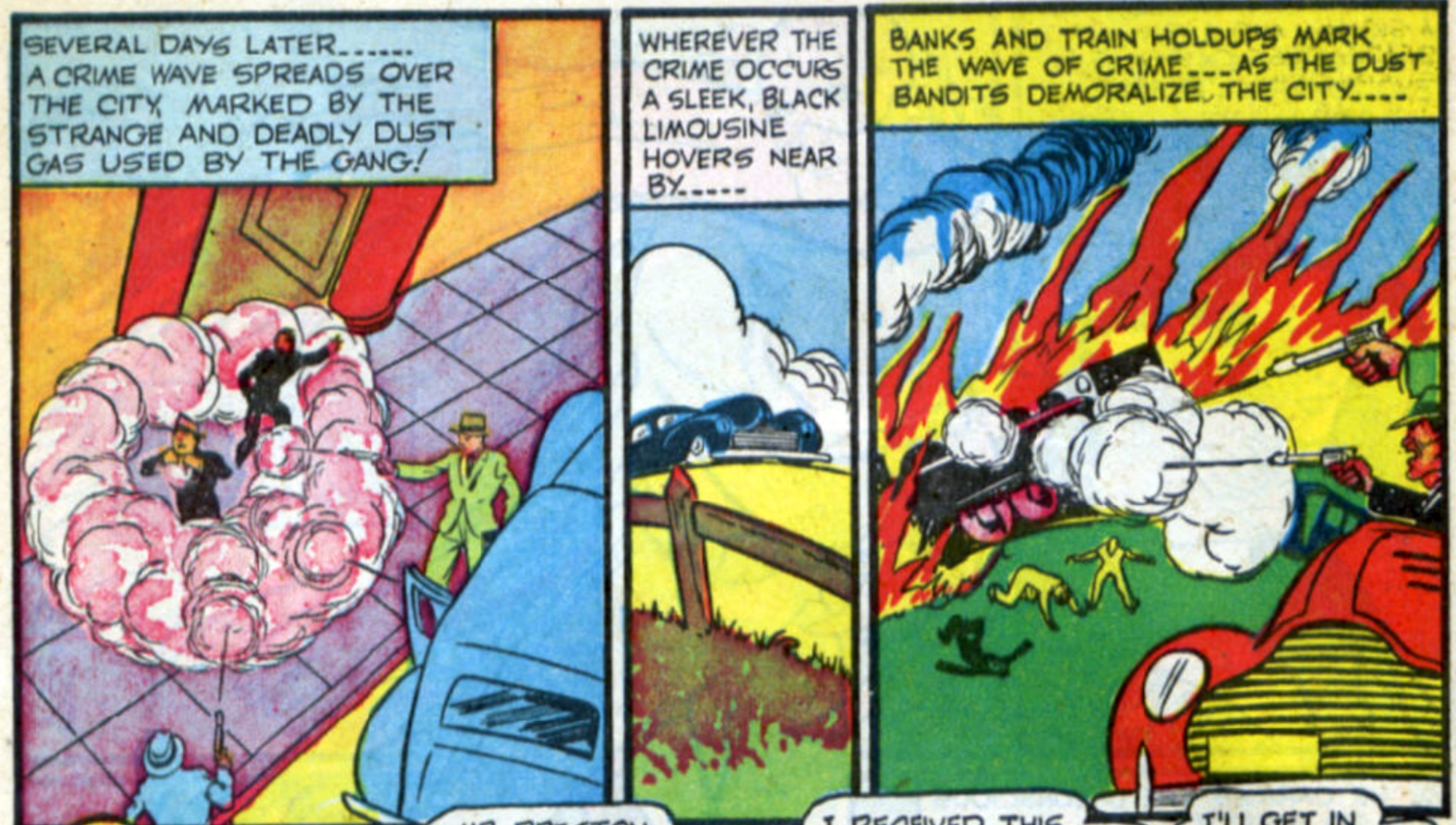
    When Professor Fraser’s incendiary dust gas bullets are rejected by the US Government for being a horrible war crime, he is determined to destroy the formula rather than, say, selling it to the Nazi Baron lurking in his home. Objecting to this lack of initiative, Fraser’s lab assistant and step-daughter conspire to kill him, then hook up with a crooked banker to organize the Dust Bandits, aka the Dust-Gas Gang, for a quick crime spree before taking the Baron up on his offer. As is so often the case with fire-based super-villains they find themselves opposed by a fire-based super-hero, in this case the Flame. (The Flame 007, 1941)

    the Leopard Men:

    To my shame, this instance of the Leopard Man trope marks the first time that I thought to look into whether there was a reason that it was so common in jungle fiction other than that leopards are cool. It turns out that as has so often been the case a cultural practice among a colonized people was vilified and outlawed as a part of the process of cultural subjugation. Leopard Societies appear to have filled a pretty diverse set of roles across West and Central Africa, ranging from pro-trade fraternal orders to vigilante groups, but thanks to sensationalist reporting and pulp writing we are going to keep on encountering them as generic jungle villains. 

    This particular bunch is after explorer Buck Johnson for some bullshit reason. (Great Comics 002, 1941)

  • MAD AND CRIMINAL SCIENTIST ROUND-UP 025

    I feel like we could avoid some of this unpleasantness if we made the Mad Arts a required part of the curriculum again.

    Unnamed Sorcerer:

    The Golden Knight and Alice are up to some good old-fashioned adventure, as they travel into the land of Kongola to seek out the cause of mysterious disappearances of people in adjoining Kooran. Just where are Kongola and Kooran? I’m going to say somewhere in what is now the United Kingdom since that that is where the Golden Knight is headquartered, but they could literally be anywhere given that he has started visiting his supernatural brothers in-law on the Moon and the Sun and thus has an interplanetary range.

    Kongola turns out to be a good place for adventure, as it is filled with magical and monstrous threats including:

    – hypnotic illusions

    – carnivorous trees hiding behind those illusions

    – club-wielding minotaurs

    – giant bats

    – ape men, who manage to carry off Alice

    Pressing on, the Golden Knight arrives at a huge tower that he says has been built by the enslaved people of Kooran, but I never see them.

    So just who is responsible for the kidnappings, the tower and the monsters? Why, this insane magician, who claims to have done it all so that he can be safe from floods and then promptly jumps off the tower into a… lake? and drowns. More importantly, why is he listed here in the space reserved for low-rent mad scientists? Because while comic book magic users fill a very similar ecological niche as super-scientists they don’t have as great a population and consequently a far lesser rate of one-note losers, and I had to put him somewhere. (Fantastic Comics 019, 1941)

    the Professor:

    The Professor is a hypnotist of some stripe who uses his powers to turn lawmen into agents of his gang. He meets his match in detective Spencer Steel, who as a comic book protagonist is of course immune to such feeble things as mind control and quickly turns the tables on his would-be master. (Fight Comics 011, 1941)

    Unnamed Scientist:

    Though this unnamed scientist talks a bit like a kindly mentor who gives you super-powers in order to save mankind from aliens etc, in practice he just has a kid tied up in his jungle compound who he feeds potions to. Perhaps he had some sort of important plan that would justify this behaviour but if so it is lost to the ages when he wanders out into the jungle to get hilariously killed by an extremely jumpy snake.

    The poor kid, meanwhile, grows into a giant and aimlessly wanders the countryside battling various world militaries until Power-Man shows up and tosses a bomb at his gut. It’s a bummer ending that wouldn’t happen in most comics and I kind of respect it. (Fight Comics 012, 1941)

    Dr Moluk:

    Dr Moluk and his assistant Scorpo have developed a machine that takes germs and bacteria and assembles them into multicellular organisms that resemble golden dragon-dogs. He intends to use these creatures to sow mass panic and ultimately take over the world. An evil plan, but a cool one. 

    Unfortunately for Moluk, his assigned heroic enemy is Guy Gorham, who is billed as the World’s Greatest Chemist but acts like the World’s Most Thorough Ass-Kicker. He busts in, beats ten kinds of hell out of Moluk and Scorpo, and ends up feeding the former to his own dragons. It honestly feels like bullying by the end. (Great Comics 001, 1941)

  • REAL PERSON ROUND-UP 021

    REAL PERSON ROUND-UP 021

    They just love putting real folks and versions of real folks in comics and I just love finding them and putting them on my blog. 

    Adolf Hitler:

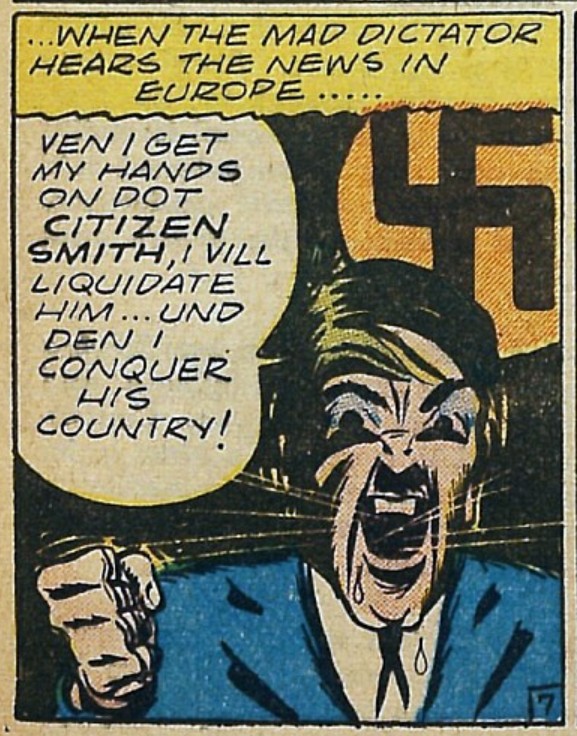
    An in-all-but-name version of Hitler gets mad at Citizen Smith for foiling his plans and plots. (Captain Fearless Comics 002, 1941)

    Gang boss and Deacon foe Duke Adare’s little toothbrush mustache is what initially drew my attention, even though that wasn’t nearly as glaring a signpost of a character being a Hitler stand-in in the 1940s. As the story wore on it became clear that my instincts were correct, as Adare used overwhelming military force to overwhelm the lawmen of Midland City and loot its treasury. And then of course you get to the end of the story, where they’re referring to him as a “would-be Crime Fuehrer”. (Cat-Man Comics 005, 1941)

    Minor appearances: 

    Captain Fearless Comics 001, 1941 

    Al Capone: 

    Lou Pacone, gang boss and murderer of the Secret Circle’s father, is yet another example of Al Capone’s name being remixed to give someone a gangstery sounding moniker. (Choice Comics 001, 1941)

    Axis & Allied Figures: 

    “America’s Air Army” was an extremely patriotic feature that was essentially US Army Air Force fan fiction about what would happen if and when the United States entered WWII, published just before they did. It’s the tale of the US forces (with a little help from the Brits) curb stomping the Axis for about half an hour before we get this little scene, with Hitler surrendering while Goering, Walther von Brauchitch (recently relieved of duty when this comic was published), Cordell Hull (I think) and Churchill observe. (Air Fighters v1 001, 1941) 

    FDR: 

    The President gets kidnapped by Dr Sivana! And Rescued by Captain Marvel! (Whiz Comics 014, 1941)

    Minor Appearances: Captain Aero Comics 001, 1941

    Lord Haw-Haw: 

    In his final Golden Age adventure, the Arrow aka intelligence agent Ralph Payne heads into Germany to apprehend the traitorous broadcaster “Lord Hawford.” (The Arrow 003, 1941) 

    Manuel Prado Ugarteche: 

    Lance O’Casey and his pal Dan’l Doom wash up on the shores of Peru and get mixed up in a scheme to overthrow the country by the wicked El Tigre. They foil him and restore power to the rightful president, Alfredo Blanco, who is extremely not Manuel Prado Ugarteche, the Peruvian president in our version of 1941. (Whiz Comics 015, 1941)

    Rudolph Hess: 

    “Deputy-Dictator Brinker” lands in a farmer’s field near Washington in what is certainly a reference to Hess’ flight to Scotland but is in fact revealed to be part of a plan to invade the US. The whole thing is nearly undone by the fact that the FBI doesn’t even bother to check on this seeming defection and just tells the poor farmer to deal with it. (Captain Fearless Comics 002, 1941)

    Sherlock Holmes:

    Dr Miracle is on the trail of a mystery, and who better to help than the summoned spirit of Sherlock Holmes Herlock Sholmes? Per the conceit of the story I guess this means that Sholmes was a real living guy at some point. (Champ Comics 012, 1941)

    Unknown Dancers: 

    Yet again we have an example of “this seems like a reference to something but I can’t find specifics,” in this case a dance team known as Velox & Costanza. The concept of a duo performing cultural dances from exotic locales crops up now and then as entertainment in comics but I’m never sure if the references to them are general or specific, and brief fads in live entertainment are among the trickiest things to casually research on the internet – it’s more of a “comb through several years’ worth of newspapers” kind of thing. (Whiz Comics 023, 1941)

    Walter Winchell: 

    As an example of why I include the Unknown entries in these round-ups: I had Walter Chinwell here listed as “Unknown Reporter” for something like two weeks before I came across Walter Winchell’s name in a list of 1940s radio announcers. And Winchell is someone I had already heard of! (Silver Streak Comics 008, 1941) 

  • MINOR SUPER-HERO ROUND-UP 077

    MINOR SUPER-HERO ROUND-UP 077

    Please enjoy about half of the Great Comics stable of characters.  

    Kangaroo Man:

    The Kangaroo Man is Jack Brian, who gets his name thanks to his animal companion: Bingo, an astonishingly well-trained kangaroo. 

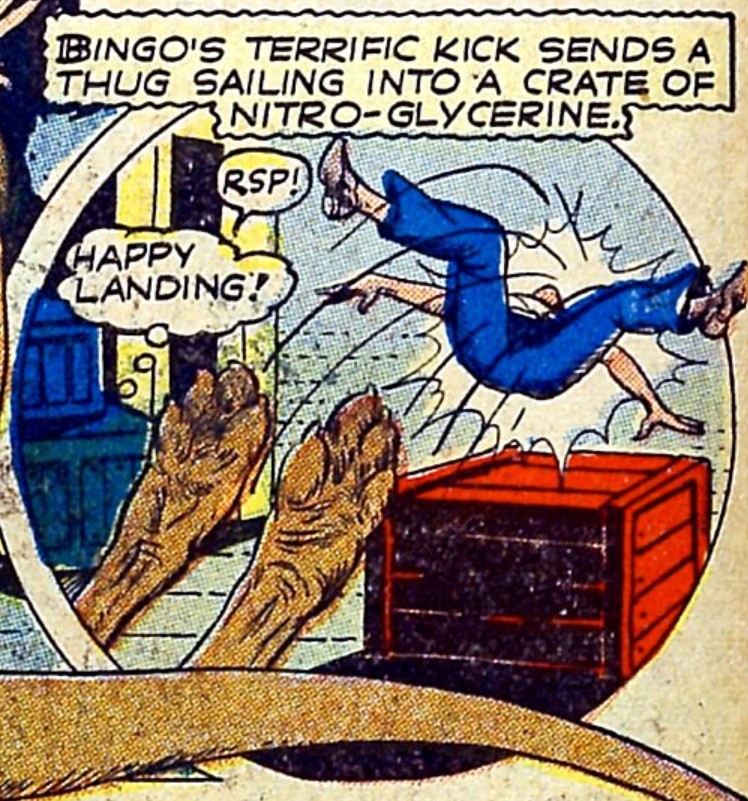
    Jack might be a pretty standard comic book adventurer, but Bingo, though his vocabulary is limited to a “rsp, rsp” sound, is of seemingly near-human intelligence and able to act essentially as another human character in the strip. Here’s Bingo parachuting out of an airplane, for example.

    Bingo also has a respectable body count for an animal hero – he does a lot of whacking explosives at people and people at explosives. (Choice Comics 001, 1941)

    Categorized in: Animals (Marsupials), Generica (Mans), Origins (Nonhuman)

    Atlas the Mighty:

    Atlas the Mighty has exactly one recorded adventure, in which he foils a band of fifth columnists who are stealing war materials in Oregon and then smuggling them to Canada. Or possibly the other way around. Though his name and his powers (super strength, invulnerability) evoke the Titan Atlas, Atlas the Mighty gets not one whiff of an origin and so any connection between the two is speculative at best. (Choice Comics 001, 1941)

    Categorized in: Famous Figures (Mythological), Language (Superlatives), Origins (Unknown)

    the Secret Circle:

    The Secret Circle are actually brothers Jim (heavyweight boxing champion), Larry (pole vault record holder) and Mac (track star) Storm. Does it bother me that there are three of them and they went with a circle rather than a triangle? Heck yes it does.

    Though there’s some indication that the Secret Circle are already established vigilantes, they really get going when gang boss Lou Pacone murders their father, Police Commissioner Storm (incidentally, this happens while all three brothers are out setting records in their chosen fields, and while I won’t go so far as to say that Commissioner Storm deserved to be murdered for being a bad father I will note that he would still be alive if he had taken the day off to support his sons instead of doing work that could have been delegated).

    Though Larry and Mac’s specialties do occasionally come in handy, all three Storm brothers spend most of their adventures punching out crooks, which kind of devalues Jim’s contributions. (Choice Comics 001, 1941)

    Categorized in: Generica (Circles), Origins (Crime Orphans)

    Fire-Eater: 

    Fire-Eater, aka Mike O’Malley, is a stage performer whose act consists of the same fire-eating and -exhaling that he employs in his crimefighting. This is very important for those of us who are interested in the in-universe origins of super-hero (and super-villain) costumes, because it means that Fire-Eater’s is in fact his stage outfit, and that he looks like that for professional reasons rather than as an expression of his secret inner self.

    Despite his name, Fire-Eater does not actually eat any fire in his two recorded adventures. Instead, he eats “sodium capsules” (yikes) that allow him to breath streams of flame hot enough to melt lead and iron, and with enough force to travel at least a few dozen feet. He also seems to be at least somewhat invulnerable to heat and flame, which is handy not just because he deals in the stuff but because like a lot of fire guys he mostly fights arsonists, together with his girlfriend, nurse Louise Peters (Choice Comics 001, 1941)

    Categorized in: Activities (Eating), Elements (Fire)