The Curse of Skeleton Munroe

Category: Black Fury

  • GENERIC COSTUMED VILLAIN ROUND-UP 043

    You give a guy access to a mask and some super-science and how does he repay you? Crime!

    Karno:

    The dapper Karno has a cool flying submarine, a metal-melting weapon and a plan to combine the two and do some old-fashioned piracy with them. He thinks that this scheme will be enhanced by the expert submarine piloting skills of Sub Saunders, but quickly learns the same lesson that all villains do upon incorporating a hero into their plans: it’s more hassle than it’s worth. Karno gets a sock on the jaw and his own submarine melted around him for his efforts. (Fantastic Comics 017, 1941)

    Captain Nomo: 

    Speaking of ocean-based criminals from the future, Captain Nomo wants to run a successful smuggling operation in the year 10 000, despite being a member of the Coast Patrol, so he puts on a mask and sets out to eliminate the greatest threat to his grift: Sub Saunders. It goes poorly! (Fantastic Comics 019, 1941)

    Bim Bagley:

    “Big-shot criminal lawyer” Bagley is so into the idea of being a drug kingpin that he does at least a couple of dozen murders in an attempt to get ahold of a big dope stash, including shooting down a whole-ass airliner. It doesn’t work out thanks to the Black Fury. (Fantastic Comics 022, 1941)

    Whitey:

    If he had only appeared once I would have written Whitey here off as just another dime-a-dozen gang boss, but in fact he vexes the Black Fury and Chuck an impressive four times, including at least twice after seemingly meeting a grisly end in the previous installment, and such persistence merits acknowledgement (particularly as his appearances all happen as Fox Features are entering their Time of Troubles and jettisoning most of their characters. His final appearance is in fact in a Holyoke-published issue of Blue Beetle!). Also please note the weird shadow on his right cheek, which is a persistent detail in his appearance that I think is supposed to be a gnarly scar. (Fantastic Comics 023, 1941)

  • CATALOGUE OF WOUNDS 009

    How can we have nice things if they keep getting so dinged up?

    the Black Terror:

    It might look like the Black Terror (‘s secret identity) is knocked out by falling down a flight of stairs onto his head, but according to him it was actually a bullet creasing the old skull that did the trick. (Exciting Comics 010, 1941)

    This is a tough one: the Black Terror is shot and nearly killed, and he kind of seems to be clutching his head but the gun is aimed at his torso as it fires. Guess we’ll file this under “shot, unspecified.” (Exciting Comics 012, 1941)

    the Black Fury:

    Shot in the left shoulder and tossed out of a moving car. (Fantastic Comics 020, 1941)

    Chuck:

    The Black Fury’s sidekick Chuck is shot in the ever-popular left shoulder and knocked clean off of a building by one of the Fang’s henchmen, but makes out okay nonetheless. (Fantastic Comics 019, 1941)

    Dr Hypno: 

    I never expected a fellow whose whole shtick is putting his mind into animal bodies to get mixed up in the action enough to take a wound, but here he is: poor ol’ Dr Hypno getting branded on the chest by a crook. (Amazing-Man Comics 018, 1940)

    the Mask:

    The Mask, in his civilian identity of District Attorney Tony Colby, joins the “skull creased by a bullet” club. EDIT: I wrote this without checking and it turns out that this is the second time that the Mask’s skull has been creased, so he was already a member of the club. My apologies. (Exciting Comics 011, 1941)

    Mighty Man:

    Mighty Man gets shot through the left shoulder. Considering his size at the time (enormous) he’s lucky that the guy didn’t score a headshot. (Amazing-Man Comics 014, 1940)

    the Shark:

    The Shark (temporarily weakened by the loss of his magic knife) gets whipped with belts by a bunch of jerk Nazis. (Amazing-Man Comics 011, 1940)

    A couple of issue later, the Shark gets stabbed in the gut by his own dang knife. Yes, the stab wound is swiftly turned back on his attacker by the weapon’s magic, but you can’t tell me that the Shark doesn’t get stabbed first. (Amazing-Man Comics 013, 1940)

    Super Ann:

    In one of Super Ann’s handful of adventures she gets a real one-two: a bullet-creased scalp followed by a near-drowning. (Amazing-Man Comics 025, 1941)

  • MINOR SUPER-VILLAIN 967: THE FANG

    (Fantastic Comics 017, 1941)

    The Fang is a recurring villain in the mould of his Fox Features contemporaries the Rook and the Beast: you can knock him down and seemingly kill him as much as you want but he’s just going to keep on coming back to do more crimes.

    When he first appears, the Fang’s major goal is to acquire the Burma Emerald from its caretaker Princess Kava, in order to decipher the secret of invisibility that has been carved into its surface. His initial attempt to snatch the emerald leads him to murder Police Sergeant Marley of the Princess’ protection detail, which directly inspires Marley’s son Chuck to become a costumed crimefighter under the tutelage of the Black Fury.

    Perhaps because Black Fury scribe realized that a series of comics about a man trying and failing to achieve invisibility would be less interesting than one about an invisible crook, the Fang breaks prison in his second appearance and gets ahold of the emerald almost immediately. So what does he use his newfound powers of invisibility for?

    – bank robbery (Fantastic Comics 018)

    – framing a man for murder in order to buy his house that has an ideal smuggling setup in the form of a secret tunnel to the coast (Fantastic Comics 019)

    – sabotaging arms shipments to Allied Europe on behalf of the Axis (Fantastic Comics 020)

    I judge these… okay criminal uses of invisibility. Nothing spectacular.

    Though I set up the comparison between the Fang and the Rook/the Beast
    myself, I must now point out the way in which he differs from them: he doesn’t seemingly die at the end of every appearance. Instead, he alternates seeming to die being caught: he’s caught in Fantastic 017, crashes into an oil tank in 018, caught again in 019, and does a header into a well full of slime in Fantastic Comics 020. 

    If there’s one thing that invisibility powers are extremely good at it’s in helping to fake one’s own death, though how they help to get out of an ooze pit is beyond me.

    Sadly and annoyingly, the final page or two of the Fang’s last appearance is not currently available. He is in the process of planting a bomb at the end of the portion that we do have, which makes it highly likely that he went on to be blown up, and that death finally claimed him. Alternately, perhaps he was arrested again and just treated with the appropriate amount of care by the authorities. It is my hope that we will someday learn the truth.

    Categorized in: Body (Nonhuman Parts – Fangs), Narrative Footballs (Origin Story Guys), Powers (Invisibility)

  • MINOR SUPER-VILLAIN 967: THE FANG

    (Fantastic Comics 017, 1941)

    The Fang is a recurring villain in the mould of his Fox Features contemporaries the Rook and the Beast: you can knock him down and seemingly kill him as much as you want but he’s just going to keep on coming back to do more crimes.

    When he first appears, the Fang’s major goal is to acquire the Burma Emerald from its caretaker Princess Kava, in order to decipher the secret of invisibility that has been carved into its surface. His initial attempt to snatch the emerald leads him to murder Police Sergeant Marley of the Princess’ protection detail, which directly inspires Marley’s son Chuck to become a costumed crimefighter under the tutelage of the Black Fury.

    Perhaps because Black Fury scribe realized that a series of comics about a man trying and failing to achieve invisibility would be less interesting than one about an invisible crook, the Fang breaks prison in his second appearance and gets ahold of the emerald almost immediately. So what does he use his newfound powers of invisibility for?

    – bank robbery (Fantastic Comics 018)

    – framing a man for murder in order to buy his house that has an ideal smuggling setup in the form of a secret tunnel to the coast (Fantastic Comics 019)

    – sabotaging arms shipments to Allied Europe on behalf of the Axis (Fantastic Comics 020)

    I judge these… okay criminal uses of invisibility. Nothing spectacular.

    Though I set up the comparison between the Fang and the Rook/the Beast
    myself, I must now point out the way in which he differs from them: he doesn’t seemingly die at the end of every appearance. Instead, he alternates seeming to die being caught: he’s caught in Fantastic 017, crashes into an oil tank in 018, caught again in 019, and does a header into a well full of slime in Fantastic Comics 020. 

    If there’s one thing that invisibility powers are extremely good at it’s in helping to fake one’s own death, though how they help to get out of an ooze pit is beyond me.

    Sadly and annoyingly, the final page or two of the Fang’s last appearance is not currently available. He is in the process of planting a bomb at the end of the portion that we do have, which makes it highly likely that he went on to be blown up, and that death finally claimed him. Alternately, perhaps he was arrested again and just treated with the appropriate amount of care by the authorities. It is my hope that we will someday learn the truth.

    Categorized in: Body (Nonhuman Parts – Fangs), Narrative Footballs (Origin Story Guys), Powers (Invisibility)

  • MEDIA IN COMICS 005

    This is the stuff that my counterpart in a comic book universe is writing his little blogs about.

    Movies:

    Not only does this theatre feature an appearance by Lady Luck (an impostor, alas), but it has screenings of Boris Scarloff in Mummy Blood and Myrna Powell and William Loy in Thinner than the Thin Man! (Lady Luck, the Spirit Section 1940)

    The villainous Comrade Ratski might have founded Ratski Productions and filmed his opus The Great War as a cover for his espionage activities, but was it a real movie? Was he filming all of his crimes and if so who has the footage? (Speed Comics 009, 1940) 

    Ted Parrish, aka the Man With 1000 Faces stars in Thundering Hoofs, which might appear to be a generic Western to you and I but which nets him the 1941 Oscar for Best Actor – sorry, Jimmy Stewart. (Speed Comics 010, 1940)

    This is another Ted Parrish feature(, and though the title is partially obscured by that rude talking kid I am familiar enough with 1940s parody title conventions to confidently state that it is Went with the Gale. (Speed Comics 008, 1940)

    Newspaper Columns:

    “John Perry In the News,” with its sassy little “Perry Says….” opening is said to be and written like a gossip column but like Bob Phantom before him John “the Black Fury” Perry seems to mostly write about crime. Also please note that both of these clippings have “Daily Standard” down the side even though Perry is consistently said to work for the Daily Clarion. (Fantastic Comics 017, 1941)

    Martin Mitchell is another of these gossip columnist/ hard-core investigative journalist types, only he isn’t a super-hero and so when he starts writing about ongoing criminal activity in “Martin Mitchell About Town” he just gets murdered. (Rocket Comics 003, 1940)

    We don’t get anything more about “The Tattler” than its title, and even that is concealed beneath part of the Press Guardian’s name. Maybe Ted McCoy needs to dig up some hotter gossip. (Pep Comics 001, 1940)

    Radio: 

    Martin Mitchell (America’s most popular columnist!) also has a radio show, and since we never learn its name I’m going to assume that it is also named Martin Mitchell About Town. (Rocket Comics 003, 1940)

    We don’t learn too much about The Brady’s Better Bacon Program due to its star Biff Crossley being mixed up in a string of high-profile murders, but it certainly is well-attended. And it has a full orchestra!(Pep Comics 008, 1940)

    Theatre: 

    Tobacco Turnpike is one of those murder mystery plays that are so beloved of comic and television writers because of dramatic potential inherent in someone being murdered on-stage at the same time as they are supposed to be pretending to be murdered, as happens several times in this story before the Shield gets involved and reveals that the director is responsible and is trying to tank the play because he has sold half stakes in the play to at least four men and doesn’t want to pay out or go to jail.

    Tobacco Turnpike is such a specific name that I was sure that it was a reference to something. I almost gave up the quest for knowledge after my third unsuccessful search for a production of Cigarette Junction, before finally narrowing it down to a play called Tobacco Road. (Shield-Wizard Comics 002, 1940)

  • MINOR SUPER-HERO ROUND-UP 093

    Fox Features, you burned hot and bright and brought us so many minor super-heroes.

    the Black Fury:

    The Black Fury, like Bob Phantom before him, is a newspaper gossip columnist who moonlights as a costumed vigilante. What are the chances that we would have two of those? I enjoy his costume even if it is somewhat generic even for 1941, though I am a bit upset that the glowing gemstone on his and his sidekick’s foreheads is never addressed. For instance: is it really glowing or is that a stylistic choice?

    As of his first appearance, John has already been the Black Fury for an unspecified amount of time, having adopted the mantle after his father was killed by gangsters for writing “anti-crime editorials” in the newspaper, a thing that comic book criminals react to like they are a farm lobby trying to influence government nutritional guidelines. (Fantastic Comics 017, 1941)

    Categorized in: Day Job (Newspaper Columnists), Origin (Crime Orphans), Supranormal Beings (Mythological – Furies)

    Chuck:

    John Perry relates his origin as the Black Fury to young Chuck Marley after Chuck’s own father, Police Sergeant Marley, is killed by henchmen of the evil Fang. Chuck is essentially bequeathed to Perry as the elder Marley lies dying, which is a very straightforward way for a hero to acquire a boy for sidekick duties.

    Chuck does not get his own super-hero name, alas (at least not right away, spoilers for some comics from 1942), but he does get his own costume, which is more than a lot of sidekicks can say. The fact that his costume is exactly the same as the Black Fury’s does make it a bit difficult to tell them apart at times but that’s a small price to pay for the peace of mind of knowing that Chuck’s identity is at least somewhat protected. (Fantastic Comics 017, 1941)

    Categorized in: Day Job (High School Students),  Origin (Crime Orphans), Origin (Sidekicks)

    the Banshee:

    The origin story of the Banshee involves a remarkable number of steps. First, Irishman Jim O’Donnell finds that his step-father has been murdered out on the moors by the evil Scorpion, who is only prevented from bumping off Jim as well because he is extremely superstitious, mistakes a wailing wind for the cry of a banshee and runs off.

    Jim discovers that the Scorpion has set out for the United States and, unable to secure a visa (“I am seeking vengeance on my step-father’s killer” seemingly not good enough. Probably they would have let him in if it was his full-on father, though) stows away on a steamship. He is spotted disembarking in New York, making him one of the small group of super-heroes whose civilian rather than super identities are wanted by the authorities and the only one that I am aware of who is wanted for entering the country illegally.

    But just why is the Scorpion in America? Why, to murder Jim’s step-father’s niece, who, as his only remaining blood relative, will inherit some land that is rich in gold and which the Scorpion is trying to get his mitts on. Just why Jim is out of the picture is unexplained – he and his step-dad have a relationship that is at the very least strong enough for a vengeance quest, so why shouldn’t Jim be in the will?

    Jim once again benefits from the Scorpion’s banshee-focused superstitions after he falls through a load of bedsheets and onto the villain’s head, with an assist by a distant police siren. This might just be the rarest and dumbest of super-hero costume origins, the Dressed by Slapstick approach.

    Having enacted his vengeance, Jim decides to remain in the US and continue his fight against crime as the Banshee. He throws together a more super-heroic version of his accidental costume and crashes on Joan’s couch while he figures out what to do about work, and it’s okay that Joan kind of becomes his love interest because she is only his step-cousin. 

    All this just to have an Irish guy fighting crime in NYC.  (Fantastic Comics 021, 1941)

    (from Fantastic Comics 022 on, Jim adopts a simpler version of his initial pass at the super-hero look. He also adopts the “banshee wail” as his calling card rather than simply relying on it to happen diegetically as needed)

    Categorized in: Accessories (Style – Calling Cards, Costume Origins),  Origin (Crime Orphans), Supranormal Beings (Banshees)

    Samson **UPDATE**:

    Some time in mid-to-late 1941, Fox Features presumably decided to round out a few of their more prominent characters such as the Flame, the Green Mask and Samson and give them a supporting cast so that they weren’t just ping-ponging from adventure to adventure without any sense of continuity. In Samson’s case, he gained a love interest with the very on-the-nose name of Lila Dee, along with a moderately annoying comic relief character in the form of perpetually-horny artist J. Rembrandt Speedball.

    The same issue marks the very first time that someone thought to have David use a sling instead of just going around lassoing people the whole time. Credit to Al CarreƱo for that one. (Fantastic Comics 022, 1941)

    This is also when Samson takes a stab at having a secret identity, but since he still has to have his trademark shoulder-length hair and that is a Huge Giveaway in 1941, this involves wearing a Very Big Coat with a Very Big Collar that he can pull up around his ears. Did he even try a wig before going coat shopping, you reckon? (Fantastic Comics 023, 1941)

  • MINOR SUPER-HERO ROUND-UP 093

    Fox Features, you burned hot and bright and brought us so many minor super-heroes.

    the Black Fury:

    The Black Fury, like Bob Phantom before him, is a newspaper gossip columnist who moonlights as a costumed vigilante. What are the chances that we would have two of those? I enjoy his costume even if it is somewhat generic even for 1941, though I am a bit upset that the glowing gemstone on his and his sidekick’s foreheads is never addressed. For instance: is it really glowing or is that a stylistic choice?

    As of his first appearance, John has already been the Black Fury for an unspecified amount of time, having adopted the mantle after his father was killed by gangsters for writing “anti-crime editorials” in the newspaper, a thing that comic book criminals react to like they are a farm lobby trying to influence government nutritional guidelines. (Fantastic Comics 017, 1941)

    Categorized in: Day Job (Newspaper Columnists), Origin (Crime Orphans), Supranormal Beings (Mythological – Furies)

    Chuck:

    John Perry relates his origin as the Black Fury to young Chuck Marley after Chuck’s own father, Police Sergeant Marley, is killed by henchmen of the evil Fang. Chuck is essentially bequeathed to Perry as the elder Marley lies dying, which is a very straightforward way for a hero to acquire a boy for sidekick duties.

    Chuck does not get his own super-hero name, alas (at least not right away, spoilers for some comics from 1942), but he does get his own costume, which is more than a lot of sidekicks can say. The fact that his costume is exactly the same as the Black Fury’s does make it a bit difficult to tell them apart at times but that’s a small price to pay for the peace of mind of knowing that Chuck’s identity is at least somewhat protected. (Fantastic Comics 017, 1941)

    Categorized in: Day Job (High School Students),  Origin (Crime Orphans), Origin (Sidekicks)

    the Banshee:

    The origin story of the Banshee involves a remarkable number of steps. First, Irishman Jim O’Donnell finds that his step-father has been murdered out on the moors by the evil Scorpion, who is only prevented from bumping off Jim as well because he is extremely superstitious, mistakes a wailing wind for the cry of a banshee and runs off.

    Jim discovers that the Scorpion has set out for the United States and, unable to secure a visa (“I am seeking vengeance on my step-father’s killer” seemingly not good enough. Probably they would have let him in if it was his full-on father, though) stows away on a steamship. He is spotted disembarking in New York, making him one of the small group of super-heroes whose civilian rather than super identities are wanted by the authorities and the only one that I am aware of who is wanted for entering the country illegally.

    But just why is the Scorpion in America? Why, to murder Jim’s step-father’s niece, who, as his only remaining blood relative, will inherit some land that is rich in gold and which the Scorpion is trying to get his mitts on. Just why Jim is out of the picture is unexplained – he and his step-dad have a relationship that is at the very least strong enough for a vengeance quest, so why shouldn’t Jim be in the will?

    Jim once again benefits from the Scorpion’s banshee-focused superstitions after he falls through a load of bedsheets and onto the villain’s head, with an assist by a distant police siren. This might just be the rarest and dumbest of super-hero costume origins, the Dressed by Slapstick approach.

    Having enacted his vengeance, Jim decides to remain in the US and continue his fight against crime as the Banshee. He throws together a more super-heroic version of his accidental costume and crashes on Joan’s couch while he figures out what to do about work, and it’s okay that Joan kind of becomes his love interest because she is only his step-cousin. 

    All this just to have an Irish guy fighting crime in NYC.  (Fantastic Comics 021, 1941)

    (from Fantastic Comics 022 on, Jim adopts a simpler version of his initial pass at the super-hero look. He also adopts the “banshee wail” as his calling card rather than simply relying on it to happen diegetically as needed)

    Categorized in: Accessories (Style – Calling Cards, Costume Origins),  Origin (Crime Orphans), Supranormal Beings (Banshees)

    Samson **UPDATE**:

    Some time in mid-to-late 1941, Fox Features presumably decided to round out a few of their more prominent characters such as the Flame, the Green Mask and Samson and give them a supporting cast so that they weren’t just ping-ponging from adventure to adventure without any sense of continuity. In Samson’s case, he gained a love interest with the very on-the-nose name of Lila Dee, along with a moderately annoying comic relief character in the form of perpetually-horny artist J. Rembrandt Speedball.

    The same issue marks the very first time that someone thought to have David use a sling instead of just going around lassoing people the whole time. Credit to Al CarreƱo for that one. (Fantastic Comics 022, 1941)

    This is also when Samson takes a stab at having a secret identity, but since he still has to have his trademark shoulder-length hair and that is a Huge Giveaway in 1941, this involves wearing a Very Big Coat with a Very Big Collar that he can pull up around his ears. Did he even try a wig before going coat shopping, you reckon? (Fantastic Comics 023, 1941)

  • PROBLEMATIC ROUND-UP 001

    The kinds of character that are a part of comics history so it would be wrong to ignore them but are also pretty racist (usually – I’m sure that eventually I’ll find something else distasteful enough to put here) and unpleasant to dedicate a whole lot of time to. We’re going with a round-up!

    Our first culprit is George Harvard AKA Big Sun, a guy with a way too complicated plan to sell oil to the Axis out of the Florida Everglades under the cover of being a geological surveyor or prospector or something. He comes to the attention of adventurer Clip Carson due to not accounting for his partner maybe poking around looking for samples like their job is supposed to be? It’s a bad plan.

    I’m mad at myself for finding Big Sun’s mask so cool looking, but it’s mitigated by how dumb his gimmick is: he has a shiny breastplate on under his robe and he reveals it flasher-style to blind his foes. Hence the name, I guess. (More Fun Comics 069, 1941) 

    I didn’t even know that Zingaro was an Italian slur for people of Romani descent until I looked up this guy – just why it was used as the name of a fellow trying to take over Mexico I will never know. On the one hand he is stopped by weirdo character the Voice so that’s good. On the other, he gets away so there’s a chance he could appear again, which is bad. It’s okay though: the Voice only ever had two adventures and this is the second one.

    Thankfully there aren’t too many characters whose names are racial slurs. (Amazing-Man Comics 022, 1941)

    I don’t know if you could call it lucky, per se, but it is kind of fortunate for the purposes of this round-up that I’m hitting a lot of the major categories of racist super-villains all in one go. We’ll see if this questionable luck holds for the fourth entry.

    So: Banga the Elephant God is predicated on the old trope that indigenous peoples are so credulous and superstitious that they will believe that anything (eg, a big mean elephant with a guy in a skull mask on it) is a god or other supernatural occurrence – in this case the people of the hidden jungle civilization of Yenya are helped along by the fact that the human part of the Banga gestalt is actually their witch doctor (called a “wizard doctor” in this case, which is kind of a neat linguistic variation if nothing else). Banga is eventually unmasked by jungle hero Morak the Mighty and meets his dual ends.

    As with so many racist characters it is very unfortunate that Banga the Elephant God looks sick as hell. (Super-Magic Comics 001, 1941)

    The very next issue we have more of the same: a bunch of white guys dress up like the very cool looking Lizard-Lion Men of local legend and fleece ivory out of villagers in… Malaysia? If Rex King aka Black Fury stayed put between issues then it’s Malaysia.

    There’s not too much to these guys: one of them hides inside the statue of the Lizard-Lion in the local temple and says for the locals to bring all of their ivory hence and then costumed goons go beat up anyone who refuses. And then Black Fury beats them up. (Super-Magician v1 002, 1941)

    We didn’t hit all the greats in one go – there’s a lot of untapped racism coming up once we hit the comics of 1942 after all – but it’s a good – bad? – sample.

  • PROBLEMATIC ROUND-UP 001

    The kinds of character that are a part of comics history so it would be wrong to ignore them but are also pretty racist (usually – I’m sure that eventually I’ll find something else distasteful enough to put here) and unpleasant to dedicate a whole lot of time to. We’re going with a round-up!

    Our first culprit is George Harvard AKA Big Sun, a guy with a way too complicated plan to sell oil to the Axis out of the Florida Everglades under the cover of being a geological surveyor or prospector or something. He comes to the attention of adventurer Clip Carson due to not accounting for his partner maybe poking around looking for samples like their job is supposed to be? It’s a bad plan.

    I’m mad at myself for finding Big Sun’s mask so cool looking, but it’s mitigated by how dumb his gimmick is: he has a shiny breastplate on under his robe and he reveals it flasher-style to blind his foes. Hence the name, I guess. (More Fun Comics 069, 1941) 

    I didn’t even know that Zingaro was an Italian slur for people of Romani descent until I looked up this guy – just why it was used as the name of a fellow trying to take over Mexico I will never know. On the one hand he is stopped by weirdo character the Voice so that’s good. On the other, he gets away so there’s a chance he could appear again, which is bad. It’s okay though: the Voice only ever had two adventures and this is the second one.

    Thankfully there aren’t too many characters whose names are racial slurs. (Amazing-Man Comics 022, 1941)

    I don’t know if you could call it lucky, per se, but it is kind of fortunate for the purposes of this round-up that I’m hitting a lot of the major categories of racist super-villains all in one go. We’ll see if this questionable luck holds for the fourth entry.

    So: Banga the Elephant God is predicated on the old trope that indigenous peoples are so credulous and superstitious that they will believe that anything (eg, a big mean elephant with a guy in a skull mask on it) is a god or other supernatural occurrence – in this case the people of the hidden jungle civilization of Yenya are helped along by the fact that the human part of the Banga gestalt is actually their witch doctor (called a “wizard doctor” in this case, which is kind of a neat linguistic variation if nothing else). Banga is eventually unmasked by jungle hero Morak the Mighty and meets his dual ends.

    As with so many racist characters it is very unfortunate that Banga the Elephant God looks sick as hell. (Super-Magic Comics 001, 1941)

    The very next issue we have more of the same: a bunch of white guys dress up like the very cool looking Lizard-Lion Men of local legend and fleece ivory out of villagers in… Malaysia? If Rex King aka Black Fury stayed put between issues then it’s Malaysia.

    There’s not too much to these guys: one of them hides inside the statue of the Lizard-Lion in the local temple and says for the locals to bring all of their ivory hence and then costumed goons go beat up anyone who refuses. And then Black Fury beats them up. (Super-Magician v1 002, 1941)

    We didn’t hit all the greats in one go – there’s a lot of untapped racism coming up once we hit the comics of 1942 after all – but it’s a good – bad? – sample.

  • MINOR SUPER-HERO ROUND-UP 006

    MINOR SUPER-HERO ROUND-UP 006

    Minor super-heroes need to be rounded up now and then.

    Blackstone the Magician: 

    There are a fair number of comic versions of real life people: movie cowboys by the dozen, big game tracker Clyde Beatty a couple of times, etc. Not too many of them quite cross over into the super-hero side of things, but here we have magician Harry Blackstone Sr, who absolutely did (Blackstone is also a great example of someone who was at one point wildly famous and has now receded far enough from the public consciousness that you might not have heard of him unless you’re really into the Dresden Files).

    Blackstone’s adventures fall more into the Action-Packed World Travel to Places Where Ethnics Live category of comics, with the gimmick that he uses stage magic to overcome various obstacles. But stage magic in a controlled environment using your own props and ad hoc stage magic using random items out in the world are different things, comic! (Super-Magic Comics 001, 1941)

    Black Fury:

    Rex King is an adventurer who spares the life of a panther in the jungles of Borneo because it has a white star marking on its throat. Later, that same panther saves Rex from a leopard attack and he takes this as a some grand life lesson about how animals can be full of humanity while men are bestial – long story short, he dresses up like something halfway between Black Condor and Wildcat and teams up with the panther (now named Kato) to beat up evil. (Super-Magic Comics 001, 1941)

    the Blue Bolt:

    Harvard University student Fred Parrish had the misfortune to be struck by lightning twice in the same storm, the second time while he was attempting to fly his light aircraft for help. Lucky for him, he crashed near the underground lair of Doctor Bertoff, a scientist looking for just such a lightning-charged person to experiment on and empower to fight in his ongoing war of Bertoff’s land of Deltos with the Green Sorceress and her kingdom of Voltor (later sumply “Bertoff’s Scientific City” vs “the Green Kingdom”).

    Blue Bolt was a willing conscript in this war, although he tempered Bertoff’s bloodthirstiness somewhat by seeking to reform the Green Sorceress rather than kill her outright, destroy her kingdom and salt the earth. This could be traced to a “don’t hit girls 1940s sense of fair play and also because he had the hots for her.

    Up to Blue Bolt v1 010 the Blue Bolt comic was written by Joe Simon and drawn by Jack Kirby and it was full of all kinds of crazy fun sci-fi malarky. Sadly, the instant they left to create Captain America it all went out the window and Blue Bolt became a regular-syle super-hero fighting Nazis on the boring old surface of the planet.

    For a few issues, Blue Bolt follows his kid brother Kip Parrish around as he serves with the RAF but this gets boring after a while and he heads back to the States. Once the US enters the war he ditches the costume entirely and seemingly forgets that he has super-powers and becomes a regular-style soldier with the unusual name Blue Bolt. Ho hum.

    This, by the way, is part of a pattern with the good folks at Novelty Press. They had it in their heads that their readers didn’t want stories that were “too fantastic” and this was reinforced by their letters page which every month featured missives from little killjoys asking for more boy inventors and fewer giant robots. I assume that these kids grew up to be the people hectoring DC every time Batman cracked a joke in the 60s and 70s and that their children form the vanguard of the “gritty realism” movement.

    Sergeant Spook:

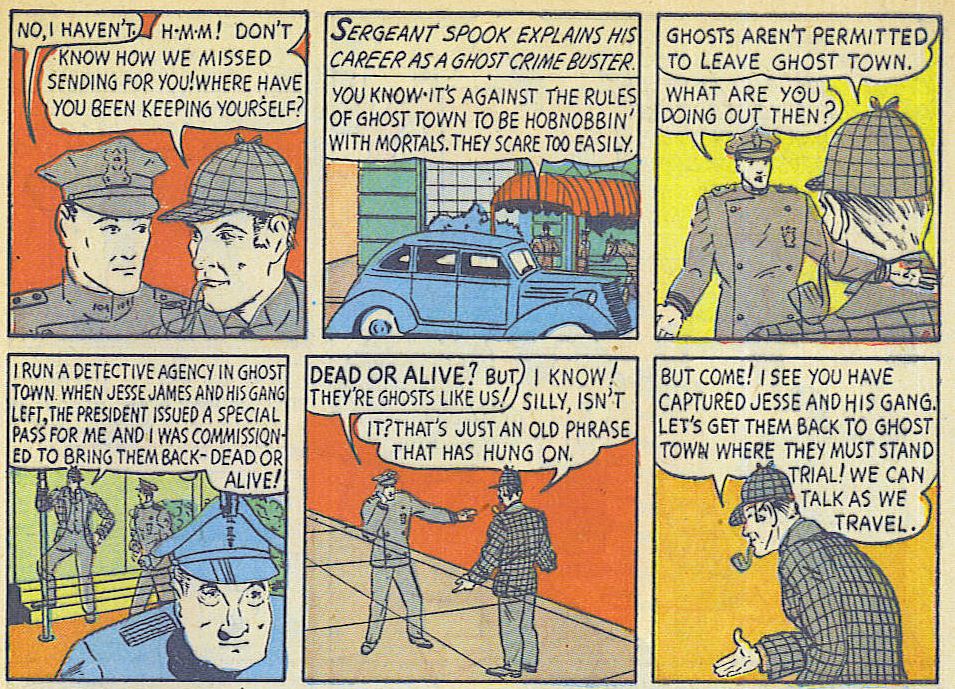
    Sergeant Spook here started out as a cop already named Sergeant Spook in a clear case of nominative determinism. After blowing himself up with a carelessly placed pipe in perhaps the least dramatic origin of any of the surprisingly large number of dead police officers to return as undead super-heroes, he basically just carries on as normal. He’s intangible and invisible, per regular ghost rule, but can interact with the material world just fine. (Blue Bolt v1 001)

    Then, in Blue Bolt v1 006 Sergeant Spook meets legally-distinct-from-Sherlock-Holmes ghost detective Dr Sherlock, who informs him that not only is he not unique but that there is a large community of ghosts that he is flouting the rules of by for instance beating the tar out of gangsters who can neither see nor touch him. He relocates to Ghost Town and becomes the de facto troubleshooter of its President, George Washington until rounding up the ghosts of dead troublemakers begins to get stale, at which point Spook heads back to the mortal world to deal with human/ghost conflicts.