The Curse of Skeleton Munroe

Category: Lady Luck

  • MEDIA IN COMICS 005

    This is the stuff that my counterpart in a comic book universe is writing his little blogs about.

    Movies:

    Not only does this theatre feature an appearance by Lady Luck (an impostor, alas), but it has screenings of Boris Scarloff in Mummy Blood and Myrna Powell and William Loy in Thinner than the Thin Man! (Lady Luck, the Spirit Section 1940)

    The villainous Comrade Ratski might have founded Ratski Productions and filmed his opus The Great War as a cover for his espionage activities, but was it a real movie? Was he filming all of his crimes and if so who has the footage? (Speed Comics 009, 1940) 

    Ted Parrish, aka the Man With 1000 Faces stars in Thundering Hoofs, which might appear to be a generic Western to you and I but which nets him the 1941 Oscar for Best Actor – sorry, Jimmy Stewart. (Speed Comics 010, 1940)

    This is another Ted Parrish feature(, and though the title is partially obscured by that rude talking kid I am familiar enough with 1940s parody title conventions to confidently state that it is Went with the Gale. (Speed Comics 008, 1940)

    Newspaper Columns:

    “John Perry In the News,” with its sassy little “Perry Says….” opening is said to be and written like a gossip column but like Bob Phantom before him John “the Black Fury” Perry seems to mostly write about crime. Also please note that both of these clippings have “Daily Standard” down the side even though Perry is consistently said to work for the Daily Clarion. (Fantastic Comics 017, 1941)

    Martin Mitchell is another of these gossip columnist/ hard-core investigative journalist types, only he isn’t a super-hero and so when he starts writing about ongoing criminal activity in “Martin Mitchell About Town” he just gets murdered. (Rocket Comics 003, 1940)

    We don’t get anything more about “The Tattler” than its title, and even that is concealed beneath part of the Press Guardian’s name. Maybe Ted McCoy needs to dig up some hotter gossip. (Pep Comics 001, 1940)

    Radio: 

    Martin Mitchell (America’s most popular columnist!) also has a radio show, and since we never learn its name I’m going to assume that it is also named Martin Mitchell About Town. (Rocket Comics 003, 1940)

    We don’t learn too much about The Brady’s Better Bacon Program due to its star Biff Crossley being mixed up in a string of high-profile murders, but it certainly is well-attended. And it has a full orchestra!(Pep Comics 008, 1940)

    Theatre: 

    Tobacco Turnpike is one of those murder mystery plays that are so beloved of comic and television writers because of dramatic potential inherent in someone being murdered on-stage at the same time as they are supposed to be pretending to be murdered, as happens several times in this story before the Shield gets involved and reveals that the director is responsible and is trying to tank the play because he has sold half stakes in the play to at least four men and doesn’t want to pay out or go to jail.

    Tobacco Turnpike is such a specific name that I was sure that it was a reference to something. I almost gave up the quest for knowledge after my third unsuccessful search for a production of Cigarette Junction, before finally narrowing it down to a play called Tobacco Road. (Shield-Wizard Comics 002, 1940)
  • REAL PERSON ROUND-UP 016

    REAL PERSON ROUND-UP 016

    Are you ready for some comic book versions of real life and fictional people? I sure hope so! 

    Adolf Hitler:  

    Premier Grahvin of the fictional African country of Cadiwa is a pretty broad pastiche of the Axis leaders, but the sheer speed at which he accelerates into full-blown dictator mode (before Mr Mystic turns up to reveal that he had not, in fact killed the king of Cadiwa and was not, in fact, in charge) must be highlighted. (The Spirit Section, 21 July, 1940)

    Likewise, Karoly Gore is an Axis dictator pastiche from a Mr Mystic story a few weeks earlier (but I read them out of order so it’s okay) (The Spirit Section, 9 June, 1940) 

    Axtrol here is a third in our series of Axis dictator pastiches, and he’s possibly the biggest shithead of the bunch. (The Spirit, “Dr Prince von Kalm”, 17 November, 1940)

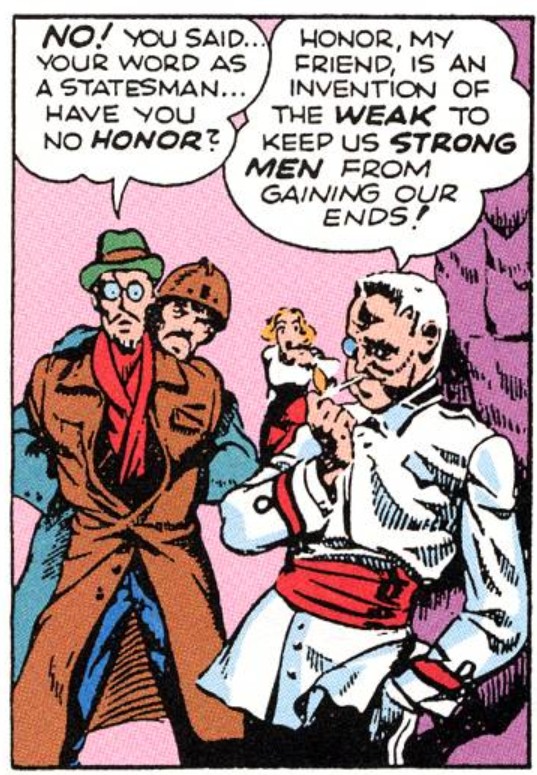
    Nargoff, aka the Leader, is either a would-be North American dictator or the agent of a European one looking to set up a local franchise. Either way, the Spirit burns down his fake island/submarine base and then engineers a situation in which the might-makes-right philosophies espoused in Nargoff’s book “The New Order” are explored by way of Nargoff and his burly assistant Max being stranded on a small boat in the Caribbean with a limited amount of water. (The Spirit, “The Leader”, 29 December, 1940)

    Don Juan: 

    Mr Mystic and his fiance Elena encounter a whole castle full of ghosts in the woods of Spain, among whom is the spirit of the entirely fictional man Don Juan, who mistakes Elena for his missing wife Ysabel and almost kills her before himself being double-killed by Mystic. (The Spirit Section, 15 December, 1940)

    Khufu aka Cheops: 

    When Mr Mystic decides to go back in time to the creation of the Great Pyramid of Giza, he is mistaken for the god Ammon Ra and of course just immediately gets his grubby little mitts all over the progress of history. It’s kind of okay, though, because the history he’s in seems to already be a big mess – for instance, while Pharaoh Cheops is indeed the ruler supposed to have commissioned the building of the Great Pyramid c. 2600 BCE, the Babylonian invasion they’re worried about is tricky because a) Babylonia is dated from 1890 BCE b) the earliest Nebuchadnezzar I can find ascended to the throne in 1121 BCE and c) given the cultural milieu that this comic was written in they’re probably talking about Nebuchadnezzar II, the one from the Bible, who did invade Egypt a couple of times but didn’t come to power until 605 BCE. Like I said: a real mess. Plus, Amun didn’t even become associated with Ra until the 16th Century BCE!

    There’s also this guy, Prince Sargon of Babylonia, and while there’s a part of me that wants to say that he’s supposed to be Sargon II (the most famous Sargon, 722 BCE), I don’t reckon that Bob Powell, mad as he was with creative power when he wrote this story, would make someone the son of someone else born a hundred years after them. Right? (Sargon does return as a time-travelling mummy out for revenge in the next installment of Mr Mystic but this alas does nothing to clear up the puzzle of his identity) (The Spirit Section, 29 September 1940)

    Misc Arthurian Figures: 

    During one of his jaunts into the past, the Ghost finds himself in Camelot, where he meets a very small selection of Arthurian figures (all of the big name knights are away on the Crusades, we are told). These include Sir Kay, who acts like a weird creep (accurate) and gets beaten up for his efforts, King Arthur, an amiable doormat, and Merlin the Magician, who is portrayed as a fraud with no magical power who sells out Arthur as soon as he gets the chance. An interesting choice for a comic about a magic man, but perfectly in keeping with 1940s secular values. (Thrilling Comics 005, 1940) 

    Myrna Loy & William Powell: 

    A simple flip of the last names renders Myrna Loy and William Powell into Myrna Powell and William Loy on this marquee, with a bonus “Boris Scarloff” for Boris Karloff. (The Spirit Section, 10 November, 1940)

    Ty Cobb: 

    If there’s anything more tedious than a 1940s sports comic it’s a 1940s hillbilly comic, so trust me when I say that this one-off about a baseball-playing hillbilly named Obadiah “Pie” Gobb is one of the the worst things I have ever read. 

    What’s even more egregious is the fact that while Pie Gobb and his new teammate Moe de Muggio (the World’s Greatest Slugger, thanks to the fact that he eats his Fleeties every morning) are easy to identify as Ty Cobb and Joe DiMaggio, respectively, the rest of his team also have goofy names but as far as I can tell none of them are also puns on famous baseball players, meaning that I just spent all that time playing rhyming games on Wikipedia for no reason. (The Funnies 047, 1940)

  • REAL PERSON ROUND-UP 016

    REAL PERSON ROUND-UP 016

    Are you ready for some comic book versions of real life and fictional people? I sure hope so! 

    Adolf Hitler:  

    Premier Grahvin of the fictional African country of Cadiwa is a pretty broad pastiche of the Axis leaders, but the sheer speed at which he accelerates into full-blown dictator mode (before Mr Mystic turns up to reveal that he had not, in fact killed the king of Cadiwa and was not, in fact, in charge) must be highlighted. (The Spirit Section, 21 July, 1940)

    Likewise, Karoly Gore is an Axis dictator pastiche from a Mr Mystic story a few weeks earlier (but I read them out of order so it’s okay) (The Spirit Section, 9 June, 1940) 

    Axtrol here is a third in our series of Axis dictator pastiches, and he’s possibly the biggest shithead of the bunch. (The Spirit, “Dr Prince von Kalm”, 17 November, 1940)

    Nargoff, aka the Leader, is either a would-be North American dictator or the agent of a European one looking to set up a local franchise. Either way, the Spirit burns down his fake island/submarine base and then engineers a situation in which the might-makes-right philosophies espoused in Nargoff’s book “The New Order” are explored by way of Nargoff and his burly assistant Max being stranded on a small boat in the Caribbean with a limited amount of water. (The Spirit, “The Leader”, 29 December, 1940)

    Don Juan: 

    Mr Mystic and his fiance Elena encounter a whole castle full of ghosts in the woods of Spain, among whom is the spirit of the entirely fictional man Don Juan, who mistakes Elena for his missing wife Ysabel and almost kills her before himself being double-killed by Mystic. (The Spirit Section, 15 December, 1940)

    Khufu aka Cheops: 

    When Mr Mystic decides to go back in time to the creation of the Great Pyramid of Giza, he is mistaken for the god Ammon Ra and of course just immediately gets his grubby little mitts all over the progress of history. It’s kind of okay, though, because the history he’s in seems to already be a big mess – for instance, while Pharaoh Cheops is indeed the ruler supposed to have commissioned the building of the Great Pyramid c. 2600 BCE, the Babylonian invasion they’re worried about is tricky because a) Babylonia is dated from 1890 BCE b) the earliest Nebuchadnezzar I can find ascended to the throne in 1121 BCE and c) given the cultural milieu that this comic was written in they’re probably talking about Nebuchadnezzar II, the one from the Bible, who did invade Egypt a couple of times but didn’t come to power until 605 BCE. Like I said: a real mess. Plus, Amun didn’t even become associated with Ra until the 16th Century BCE!

    There’s also this guy, Prince Sargon of Babylonia, and while there’s a part of me that wants to say that he’s supposed to be Sargon II (the most famous Sargon, 722 BCE), I don’t reckon that Bob Powell, mad as he was with creative power when he wrote this story, would make someone the son of someone else born a hundred years after them. Right? (Sargon does return as a time-travelling mummy out for revenge in the next installment of Mr Mystic but this alas does nothing to clear up the puzzle of his identity) (The Spirit Section, 29 September 1940)

    Misc Arthurian Figures: 

    During one of his jaunts into the past, the Ghost finds himself in Camelot, where he meets a very small selection of Arthurian figures (all of the big name knights are away on the Crusades, we are told). These include Sir Kay, who acts like a weird creep (accurate) and gets beaten up for his efforts, King Arthur, an amiable doormat, and Merlin the Magician, who is portrayed as a fraud with no magical power who sells out Arthur as soon as he gets the chance. An interesting choice for a comic about a magic man, but perfectly in keeping with 1940s secular values. (Thrilling Comics 005, 1940) 

    Myrna Loy & William Powell: 

    A simple flip of the last names renders Myrna Loy and William Powell into Myrna Powell and William Loy on this marquee, with a bonus “Boris Scarloff” for Boris Karloff. (The Spirit Section, 10 November, 1940)

    Ty Cobb: 

    If there’s anything more tedious than a 1940s sports comic it’s a 1940s hillbilly comic, so trust me when I say that this one-off about a baseball-playing hillbilly named Obadiah “Pie” Gobb is one of the the worst things I have ever read. 

    What’s even more egregious is the fact that while Pie Gobb and his new teammate Moe de Muggio (the World’s Greatest Slugger, thanks to the fact that he eats his Fleeties every morning) are easy to identify as Ty Cobb and Joe DiMaggio, respectively, the rest of his team also have goofy names but as far as I can tell none of them are also puns on famous baseball players, meaning that I just spent all that time playing rhyming games on Wikipedia for no reason. (The Funnies 047, 1940)

  • GENERIC COSTUMED VILLAIN ROUND-UP 023

    Some real gems here tonite. 

    Executed gangster Black Morger’s four identical sons reconvene twenty-five years after their father’s execution to seek revenge on the four people who they consider to be responsible for his death (and for that of their mother, who had some sort of rage-induced heart attack at the instant of Black Morger’s demise). To their credit, they manage to kill two of them before the Spirit butts in and foils their plot. 

    REVENGE KILLER SCORE: 2/4 (The Spirit, “The Morger Boys”, 18 August, 1940) 

    Waxy Morgan is a gang boss with the bright idea to commit crimes while dressed as the Spirit so as to throw suspicion off of himself and his men. This goes poorly for him. (The Spirit, “The Spirit! Who is He?”, 13 October, 1940)


    This unnamed villain deduces Lady Luck’s secret identity by the simple trick of being the only one in the city capable of visualizing a lady in a hat. But though he has this unimaginable deductive power his people skills are lacking, and he fails both to convince Lady Luck to help him kill rich guys and to predict that his huge servant Tortu might eventually tire of being beaten with a whip and subsequently totally pulverize him. (The Spirit Section, 3 November, 1940)

    When Mr Mystic has a ski accident in the Carpathian Mountains, he ends up being cared for in an idyllic village that has been cut off from the outside world for 700 years, but which has one major problem: a horrible ogre who lives in the mountains above and demands the sacrifice of one maiden per year or else he will wipe the place off the map with a well-placed avalanche. What’s worse, this year the Ogre has demanded a red-haired maiden and the village is fresh out. And what’s worse, Mr Mystic’s red-haired friend Penny Douglas has just wandered into town. 

    Anyway, the Ogre turns out to just be some creep hermit who likes making the village kill women for some reason. He manages to yeet himself off the side of a mountain while trying to murder Mr Mystic. (The Spirit Section, 29 December, 1940) 

  • MINOR SUPER-HERO ROUND-UP 054

    Whoops there are two more super-heroes in the Spirit Section. Should have included them with the Spirit himself, tsk tsk. 

    Lady Luck: 

    The Spirit’s home, the “Spirit Section” of newspaper comics also included two other Will Eisner-created but not -written or -drawn characters, the first of whom is Lady Luck. In actuality wealthy socialite Brenda Banks, Lady Luck is a costumed vigilante out of boredom with the day-to-day of high society. She is wanted by the law and specifically by her civilian life love interest Police Chief Hardy Moore, a cop so dumb that not only is he about to send a woman to the electric chair for the murder of her still-living husband in the above set of panels but he also is unable to recognize the object of his affections under the brim of a big hat (in fairness to him he does mention that Brenda and Lady Luck are very similar looking but then turns out to be cartoonishly easy to fool). Lady Luck does a bit of globetrotting here and there, but her focus is mainly on high society crimes. Her adventures are a bit lighter than the Spirit’s, but not by too much. (The Spirit Section, 2 June, 1940) 

    Mr Mystic: 

    The thing about the Spirit Section is that people love the Spirit and so his two companions tend to be overshadowed, particularly when it comes to widely-available archival work: the Spirit was reprinted while Lady Luck and our new friend here Mr Mystic languished in obscurity, and while Lady Luck’s adventures were eventually reprinted in Smash Comics, the archival record of Mr Mystic is much spottier.

    Mr Mystic is supposedly a retooling of Eisner’s prior effort Yarko the Great, and I can see it – luckily for him he got the look of Yarko rather than the terrible naming sensibility. Mystic is (or was, presumably) an American diplomat who, like so many characters before and after him, acquired great mystical powers from the mysterious and spiritual residents of Tibet, specifically a “council of seven Lamas,” and brought them back to the US to be put to use in beating up ne’er-do-wells. 

    Mr Mystic is a magic-using super-hero, which means that he is a nigh-omnipotent force of nature only occasionally slowed down by a lucky bop on the bean from a crook. His major mark of distinction from his peers is a literal one: a mystic tattoo on his forehead, which would mean that he’s almost certainly the first person to have to field a lot of well-meaning concern over the effect that that sort of thing would have on his employability. (The Spirit Section, 2 June, 1940)

    ADDENDUM:

    After all my talk about how a lot of the non-Spirit related parts of the Spirit Section were unavailable I thought to double check, and I had forgot that yes, they are. Granted, it’s as medium-quality photocopies, but that’s better than nothing, right?

    Having rediscovered that fact, I went back and read the first Mr Mystic story, and was shocked and surprised to learn that rather than being a student of the occult who spent long years studying in Tibet, our unnamed hero is a cultural attache serving somewhere in presumably-Eastern Europe when he is blown very off-course while fleeing an Axis invasion force. He crashes in Tibet and is given the forehead brand/tattoo that I did not realize was the sole source of his power while still unconscious. The whole thing is a pretty far cry from what I had imagined his origin to be!

  • MINOR SUPER-HERO ROUND-UP 054

    Whoops there are two more super-heroes in the Spirit Section. Should have included them with the Spirit himself, tsk tsk. 

    Lady Luck: 

    The Spirit’s home, the “Spirit Section” of newspaper comics also included two other Will Eisner-created but not -written or -drawn characters, the first of whom is Lady Luck. In actuality wealthy socialite Brenda Banks, Lady Luck is a costumed vigilante out of boredom with the day-to-day of high society. She is wanted by the law and specifically by her civilian life love interest Police Chief Hardy Moore, a cop so dumb that not only is he about to send a woman to the electric chair for the murder of her still-living husband in the above set of panels but he also is unable to recognize the object of his affections under the brim of a big hat (in fairness to him he does mention that Brenda and Lady Luck are very similar looking but then turns out to be cartoonishly easy to fool). Lady Luck does a bit of globetrotting here and there, but her focus is mainly on high society crimes. Her adventures are a bit lighter than the Spirit’s, but not by too much. (The Spirit Section, 2 June, 1940) 

    Mr Mystic: 

    The thing about the Spirit Section is that people love the Spirit and so his two companions tend to be overshadowed, particularly when it comes to widely-available archival work: the Spirit was reprinted while Lady Luck and our new friend here Mr Mystic languished in obscurity, and while Lady Luck’s adventures were eventually reprinted in Smash Comics, the archival record of Mr Mystic is much spottier.

    Mr Mystic is supposedly a retooling of Eisner’s prior effort Yarko the Great, and I can see it – luckily for him he got the look of Yarko rather than the terrible naming sensibility. Mystic is (or was, presumably) an American diplomat who, like so many characters before and after him, acquired great mystical powers from the mysterious and spiritual residents of Tibet, specifically a “council of seven Lamas,” and brought them back to the US to be put to use in beating up ne’er-do-wells. 

    Mr Mystic is a magic-using super-hero, which means that he is a nigh-omnipotent force of nature only occasionally slowed down by a lucky bop on the bean from a crook. His major mark of distinction from his peers is a literal one: a mystic tattoo on his forehead, which would mean that he’s almost certainly the first person to have to field a lot of well-meaning concern over the effect that that sort of thing would have on his employability. (The Spirit Section, 2 June, 1940)

    ADDENDUM:

    After all my talk about how a lot of the non-Spirit related parts of the Spirit Section were unavailable I thought to double check, and I had forgot that yes, they are. Granted, it’s as medium-quality photocopies, but that’s better than nothing, right?

    Having rediscovered that fact, I went back and read the first Mr Mystic story, and was shocked and surprised to learn that rather than being a student of the occult who spent long years studying in Tibet, our unnamed hero is a cultural attache serving somewhere in presumably-Eastern Europe when he is blown very off-course while fleeing an Axis invasion force. He crashes in Tibet and is given the forehead brand/tattoo that I did not realize was the sole source of his power while still unconscious. The whole thing is a pretty far cry from what I had imagined his origin to be!

  • NOTES – JUNE 2025

    NOTES – JUNE 2025

    Letters to the Editor: 

    I rag on Novelty Press and their horrible and possibly fictional readership every chance I get, but I think I need to start presenting the letters they print in their comics so that I have some evidence to back up my grumbling. Here’s Clarence Pool of Seattle Washington advocating for the nice sensible adventures of an Army Air Force cadet who manages to foil a Fifth Column plot ever week over the exploits of a magic robot. (Target Comics v1 011, 1940)

    Skeletons with Jobs: 

    Driver is a job, certainly. Onto the pile! (The Funnies 047, 1940) 

    Honours: 

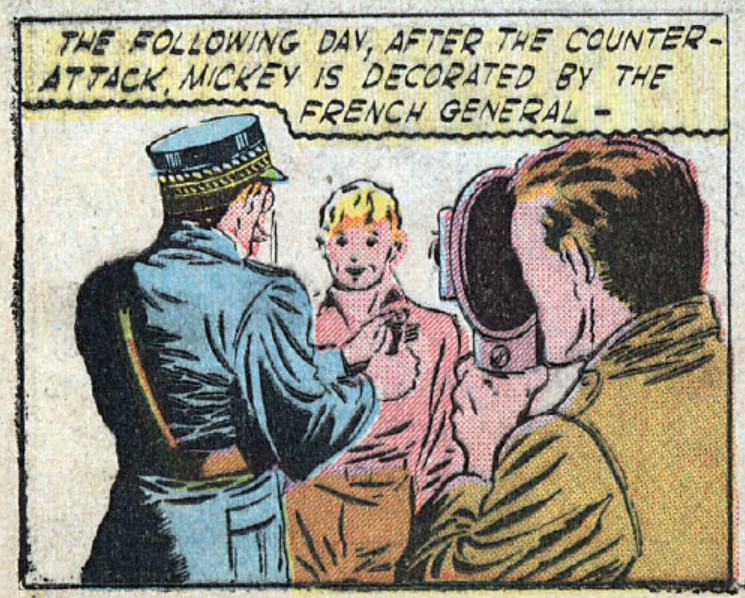
    Mickey Kelly, sidekick to swashbuckling newsreel cameraman Speed Martin, gets a medal from the French Army for foiling a spy. (The Funnies 048, 1940)

    Two issues later Mickey Riley (they forgot that he already had a last name, it seems) is decorated by the British for saving Gibraltar from the Axis. (The Funnies 050, 1940)

    Heroes Going to Costume Parties as Themselves: 

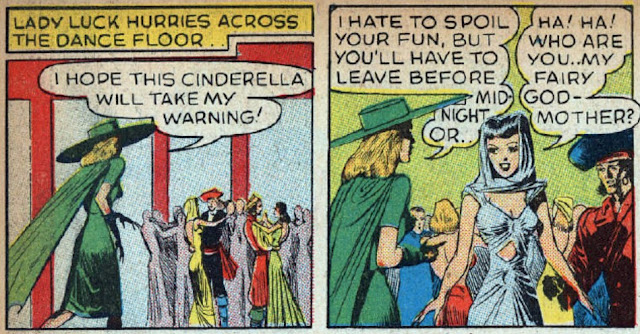
    Brenda Banks attends the Grand Costume Ball as Lady Luck, in an attempt to save a life. (The Spirit Section, “The Cinderella Murder Case”, 28 July, 1940)

    Mr Mystic also attends a costume party as himself in 1940, and a guy with no secret identity doing this might just be the most baffling thing I’ve read today, and this is the episode in which Mystic’s fiance is seduced by Death. (The Spirit Section, 22 December, 1940)

    Cops Shooting at Fleeing Suspects: 

    Sure, the Spirit has just confessed to a murder he did not commit for complicated reasons, but forgive me if I don’t agree with Mayor Aldrich here that that means that Commissioner Dolan has free license to shoot him in the back. (The Spirit “Eldas Thayer”, 21 July, 1940) 

    Interior Decoration: 

    This child’s ducky bed is just barely charming and not eerie. (The Spirit Section, 1 December, 1940) 

  • NOTES – JUNE 2025

    NOTES – JUNE 2025

    Letters to the Editor: 

    I rag on Novelty Press and their horrible and possibly fictional readership every chance I get, but I think I need to start presenting the letters they print in their comics so that I have some evidence to back up my grumbling. Here’s Clarence Pool of Seattle Washington advocating for the nice sensible adventures of an Army Air Force cadet who manages to foil a Fifth Column plot ever week over the exploits of a magic robot. (Target Comics v1 011, 1940)

    Skeletons with Jobs: 

    Driver is a job, certainly. Onto the pile! (The Funnies 047, 1940) 

    Honours: 

    Mickey Kelly, sidekick to swashbuckling newsreel cameraman Speed Martin, gets a medal from the French Army for foiling a spy. (The Funnies 048, 1940)

    Two issues later Mickey Riley (they forgot that he already had a last name, it seems) is decorated by the British for saving Gibraltar from the Axis. (The Funnies 050, 1940)

    Heroes Going to Costume Parties as Themselves: 

    Brenda Banks attends the Grand Costume Ball as Lady Luck, in an attempt to save a life. (The Spirit Section, “The Cinderella Murder Case”, 28 July, 1940)

    Mr Mystic also attends a costume party as himself in 1940, and a guy with no secret identity doing this might just be the most baffling thing I’ve read today, and this is the episode in which Mystic’s fiance is seduced by Death. (The Spirit Section, 22 December, 1940)

    Cops Shooting at Fleeing Suspects: 

    Sure, the Spirit has just confessed to a murder he did not commit for complicated reasons, but forgive me if I don’t agree with Mayor Aldrich here that that means that Commissioner Dolan has free license to shoot him in the back. (The Spirit “Eldas Thayer”, 21 July, 1940) 

    Interior Decoration: 

    This child’s ducky bed is just barely charming and not eerie. (The Spirit Section, 1 December, 1940)