The Curse of Skeleton Munroe

Category: Hillman

  • MAD AND CRIMINAL SCIENTIST ROUND-UP 028

    These guys use science for crime and evil, for which we excoriate them, but they also make entertaining villains, for which we celebrate them. 

    Dr Stone:

    Dr Elijah Stone has a calling and it is in creating and disseminating deadly plagues upon mankind. This, however, is the kind of passion that society frowns upon and Stone is locked away in the State Mental Hospital. Unfortunately for mankind, the State Mental Hospital seems to be one of those places that contracts its security out to the lowest bidder, because Stone escapes in no time flat.

    Sure enough, there is soon a hot new Dr Stone plague ravaging humanity. This quiet New England Town is absolutely screwed, and the rest of the world is soon to follow if someone doesn’t do something soon.

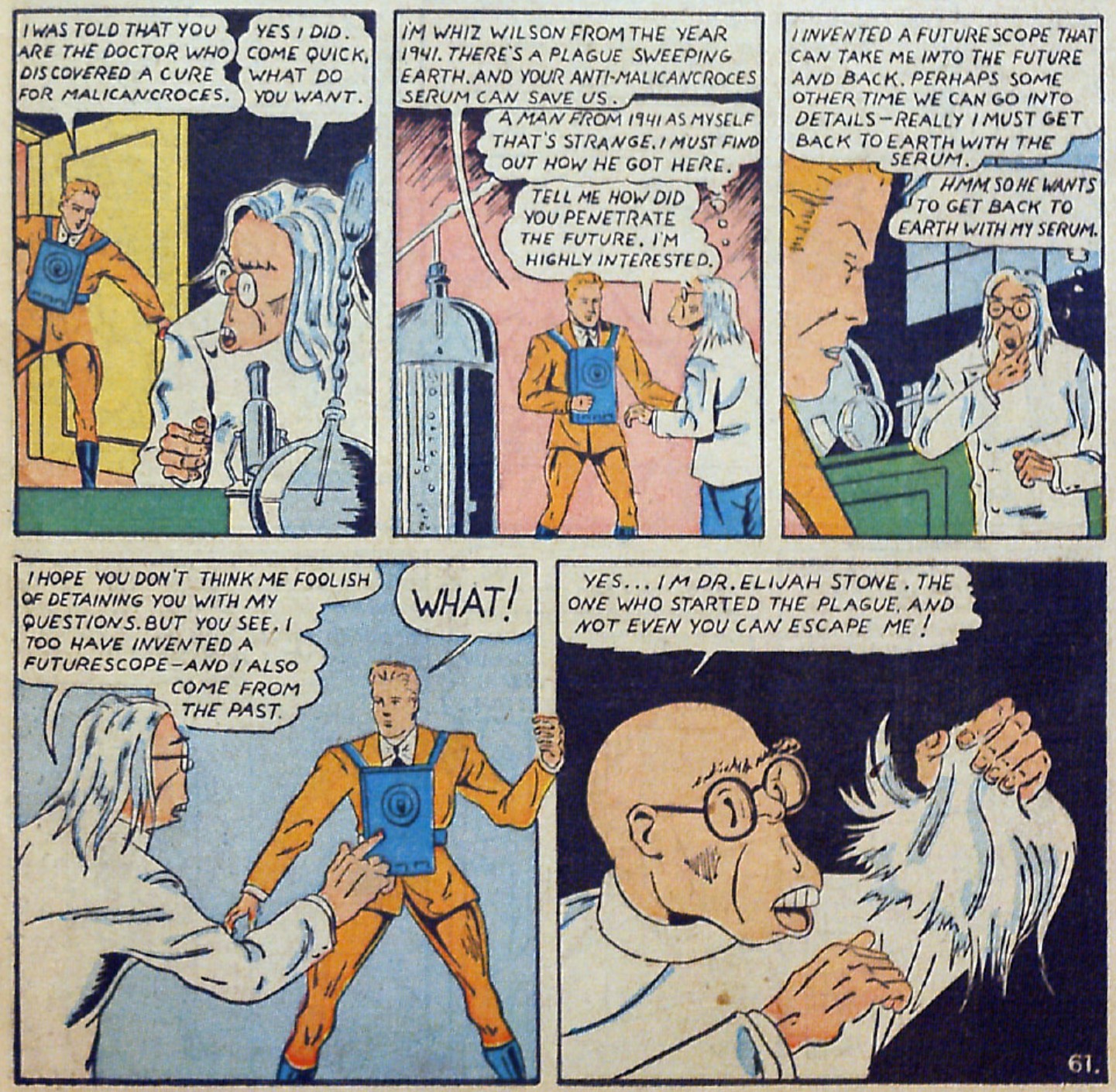
    Enter time/space explorer Whiz Wilson, who pops into the future to a time when there simply must be a cure and is referred to the Medical Center on Mars. His quest hits a small speedbump when the Martian doctor turns out to actually be Dr Stone in disguise – it seems that when not making plagues Stone has dabbled in chronal physics and has independently developed Futurescope technology. He has been using the future as a home base to culture up enough plague germs to wipe out 1941 humanity in one fell swoop, after which he will enjoy some alone time on an unpopulated planet. 

    Whiz Wilson smashes Stone’s Futurescope and makes off with his personal supply of anti-plague serum but is forced to let the man himself escape. Both Stone and the text boxes set up Dr Stone as an upcoming recurring nemesis for Whiz to deal with, presumably in different time periods, but his evil plans are foiled by the fact that this is the final Whiz Wilson story. (Lightning Comics v2 004, 1941)

    Professor Hanley:

    Professor Hanley is one of the many comic book scientists whose development of a means of making artificial diamonds is seen as dangerous and/or criminal by a super-hero. Hanley is at least attempting to pass artificial diamonds off as natural ones so I guess this counts as selling counterfeit good, but I still think that this is not worth your time, the Angel. (Marvel Mystery Comics v1 014, 1940)

    Howland:

    Howland, the second and final foe faced by Sky Wizard, has been causing mass chaos by sending out his army of humanoid robots to loot and kill. He also has a real “evil Vulcan” look that I appreciate.

    In addition to the extremely nifty robots (called the Robot Terrors by one and all, though I suspect that Howland just adopted the very cool name after he heard Sky Wizard use it), Howland is notable for creating these deathtraps that kill their victims by dropping slats out from under their feet at a rate of one per five seconds and then leaving them to dangle and strangle thanks to the tight neck shackle. This is pretty gruesome, but it’s also very quick, and Howland still manages to be out of the room when Sky Wizard and his aide Keeshan manage to escape. 

    Let’s be clear: I was already worked up about this before I noticed that he says how many slats there are because even at, say, one hundred slats that’s only eight and a half minutes, but no, it’s six slats. That’s thirty seconds, Howland. You’re too busy to wait thirty seconds for a super-hero to die? I don’t even feel sorry for you that you eventually die at the cold metal hands of your own robots, because I only feel contempt. (Miracle Comics 004, 1941)

    Captain Kiddlaw:

    Captain Kiddlaw, the Wizard-Pirate, is a scientific scoundrel who vexes the Super Police of the far-flung year 2023. His scheme involves dragging passing cruise ships to the bottom of the ocean for loot and slaves and is never technically foiled due to the cancellation of the “Super Police 2023” serial. They probably get him eventually, though. (New Fun Comics 002, 1935)

  • MAD AND CRIMINAL SCIENTIST ROUND-UP 028

    MAD AND CRIMINAL SCIENTIST ROUND-UP 028

    These guys use science for crime and evil, for which we excoriate them, but they also make entertaining villains, for which we celebrate them. 

    Dr Stone:

    Dr Elijah Stone has a calling and it is in creating and disseminating deadly plagues upon mankind. This, however, is the kind of passion that society frowns upon and Stone is locked away in the State Mental Hospital. Unfortunately for mankind, the State Mental Hospital seems to be one of those places that contracts its security out to the lowest bidder, because Stone escapes in no time flat.

    Sure enough, there is soon a hot new Dr Stone plague ravaging humanity. This quiet New England Town is absolutely screwed, and the rest of the world is soon to follow if someone doesn’t do something soon.

    Enter time/space explorer Whiz Wilson, who pops into the future to a time when there simply must be a cure and is referred to the Medical Center on Mars. His quest hits a small speedbump when the Martian doctor turns out to actually be Dr Stone in disguise – it seems that when not making plagues Stone has dabbled in chronal physics and has independently developed Futurescope technology. He has been using the future as a home base to culture up enough plague germs to wipe out 1941 humanity in one fell swoop, after which he will enjoy some alone time on an unpopulated planet. 

    Whiz Wilson smashes Stone’s Futurescope and makes off with his personal supply of anti-plague serum but is forced to let the man himself escape. Both Stone and the text boxes set up Dr Stone as an upcoming recurring nemesis for Whiz to deal with, presumably in different time periods, but his evil plans are foiled by the fact that this is the final Whiz Wilson story. (Lightning Comics v2 004, 1941)

    Professor Hanley:

    Professor Hanley is one of the many comic book scientists whose development of a means of making artificial diamonds is seen as dangerous and/or criminal by a super-hero. Hanley is at least attempting to pass artificial diamonds off as natural ones so I guess this counts as selling counterfeit good, but I still think that this is not worth your time, the Angel. (Marvel Mystery Comics v1 014, 1940)

    Howland:

    Howland, the second and final foe faced by Sky Wizard, has been causing mass chaos by sending out his army of humanoid robots to loot and kill. He also has a real “evil Vulcan” look that I appreciate.

    In addition to the extremely nifty robots (called the Robot Terrors by one and all, though I suspect that Howland just adopted the very cool name after he heard Sky Wizard use it), Howland is notable for creating these deathtraps that kill their victims by dropping slats out from under their feet at a rate of one per five seconds and then leaving them to dangle and strangle thanks to the tight neck shackle. This is pretty gruesome, but it’s also very quick, and Howland still manages to be out of the room when Sky Wizard and his aide Keeshan manage to escape. 

    Let’s be clear: I was already worked up about this before I noticed that he says how many slats there are because even at, say, one hundred slats that’s only eight and a half minutes, but no, it’s six slats. That’s thirty seconds, Howland. You’re too busy to wait thirty seconds for a super-hero to die? I don’t even feel sorry for you that you eventually die at the cold metal hands of your own robots, because I only feel contempt. (Miracle Comics 004, 1941)

    Captain Kiddlaw:

    Captain Kiddlaw, the Wizard-Pirate, is a scientific scoundrel who vexes the Super Police of the far-flung year 2023. His scheme involves dragging passing cruise ships to the bottom of the ocean for loot and slaves and is never technically foiled due to the cancellation of the “Super Police 2023” serial. They probably get him eventually, though. (New Fun Comics 002, 1935)
  • MEDIA IN COMICS 005

    This is the stuff that my counterpart in a comic book universe is writing his little blogs about.

    Movies:

    Not only does this theatre feature an appearance by Lady Luck (an impostor, alas), but it has screenings of Boris Scarloff in Mummy Blood and Myrna Powell and William Loy in Thinner than the Thin Man! (Lady Luck, the Spirit Section 1940)

    The villainous Comrade Ratski might have founded Ratski Productions and filmed his opus The Great War as a cover for his espionage activities, but was it a real movie? Was he filming all of his crimes and if so who has the footage? (Speed Comics 009, 1940) 

    Ted Parrish, aka the Man With 1000 Faces stars in Thundering Hoofs, which might appear to be a generic Western to you and I but which nets him the 1941 Oscar for Best Actor – sorry, Jimmy Stewart. (Speed Comics 010, 1940)

    This is another Ted Parrish feature(, and though the title is partially obscured by that rude talking kid I am familiar enough with 1940s parody title conventions to confidently state that it is Went with the Gale. (Speed Comics 008, 1940)

    Newspaper Columns:

    “John Perry In the News,” with its sassy little “Perry Says….” opening is said to be and written like a gossip column but like Bob Phantom before him John “the Black Fury” Perry seems to mostly write about crime. Also please note that both of these clippings have “Daily Standard” down the side even though Perry is consistently said to work for the Daily Clarion. (Fantastic Comics 017, 1941)

    Martin Mitchell is another of these gossip columnist/ hard-core investigative journalist types, only he isn’t a super-hero and so when he starts writing about ongoing criminal activity in “Martin Mitchell About Town” he just gets murdered. (Rocket Comics 003, 1940)

    We don’t get anything more about “The Tattler” than its title, and even that is concealed beneath part of the Press Guardian’s name. Maybe Ted McCoy needs to dig up some hotter gossip. (Pep Comics 001, 1940)

    Radio: 

    Martin Mitchell (America’s most popular columnist!) also has a radio show, and since we never learn its name I’m going to assume that it is also named Martin Mitchell About Town. (Rocket Comics 003, 1940)

    We don’t learn too much about The Brady’s Better Bacon Program due to its star Biff Crossley being mixed up in a string of high-profile murders, but it certainly is well-attended. And it has a full orchestra!(Pep Comics 008, 1940)

    Theatre: 

    Tobacco Turnpike is one of those murder mystery plays that are so beloved of comic and television writers because of dramatic potential inherent in someone being murdered on-stage at the same time as they are supposed to be pretending to be murdered, as happens several times in this story before the Shield gets involved and reveals that the director is responsible and is trying to tank the play because he has sold half stakes in the play to at least four men and doesn’t want to pay out or go to jail.

    Tobacco Turnpike is such a specific name that I was sure that it was a reference to something. I almost gave up the quest for knowledge after my third unsuccessful search for a production of Cigarette Junction, before finally narrowing it down to a play called Tobacco Road. (Shield-Wizard Comics 002, 1940)

  • REAL PERSON ROUND-UP 021

    REAL PERSON ROUND-UP 021

    They just love putting real folks and versions of real folks in comics and I just love finding them and putting them on my blog. 

    Adolf Hitler:

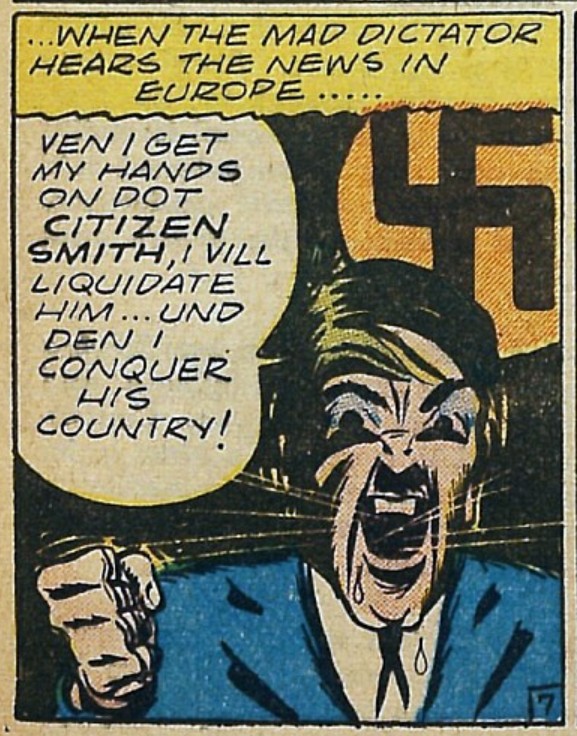
    An in-all-but-name version of Hitler gets mad at Citizen Smith for foiling his plans and plots. (Captain Fearless Comics 002, 1941)

    Gang boss and Deacon foe Duke Adare’s little toothbrush mustache is what initially drew my attention, even though that wasn’t nearly as glaring a signpost of a character being a Hitler stand-in in the 1940s. As the story wore on it became clear that my instincts were correct, as Adare used overwhelming military force to overwhelm the lawmen of Midland City and loot its treasury. And then of course you get to the end of the story, where they’re referring to him as a “would-be Crime Fuehrer”. (Cat-Man Comics 005, 1941)

    Minor appearances: 

    Captain Fearless Comics 001, 1941 

    Al Capone: 

    Lou Pacone, gang boss and murderer of the Secret Circle’s father, is yet another example of Al Capone’s name being remixed to give someone a gangstery sounding moniker. (Choice Comics 001, 1941)

    Axis & Allied Figures: 

    “America’s Air Army” was an extremely patriotic feature that was essentially US Army Air Force fan fiction about what would happen if and when the United States entered WWII, published just before they did. It’s the tale of the US forces (with a little help from the Brits) curb stomping the Axis for about half an hour before we get this little scene, with Hitler surrendering while Goering, Walther von Brauchitch (recently relieved of duty when this comic was published), Cordell Hull (I think) and Churchill observe. (Air Fighters v1 001, 1941) 

    FDR: 

    The President gets kidnapped by Dr Sivana! And Rescued by Captain Marvel! (Whiz Comics 014, 1941)

    Minor Appearances: Captain Aero Comics 001, 1941

    Lord Haw-Haw: 

    In his final Golden Age adventure, the Arrow aka intelligence agent Ralph Payne heads into Germany to apprehend the traitorous broadcaster “Lord Hawford.” (The Arrow 003, 1941) 

    Manuel Prado Ugarteche: 

    Lance O’Casey and his pal Dan’l Doom wash up on the shores of Peru and get mixed up in a scheme to overthrow the country by the wicked El Tigre. They foil him and restore power to the rightful president, Alfredo Blanco, who is extremely not Manuel Prado Ugarteche, the Peruvian president in our version of 1941. (Whiz Comics 015, 1941)

    Rudolph Hess: 

    “Deputy-Dictator Brinker” lands in a farmer’s field near Washington in what is certainly a reference to Hess’ flight to Scotland but is in fact revealed to be part of a plan to invade the US. The whole thing is nearly undone by the fact that the FBI doesn’t even bother to check on this seeming defection and just tells the poor farmer to deal with it. (Captain Fearless Comics 002, 1941)

    Sherlock Holmes:

    Dr Miracle is on the trail of a mystery, and who better to help than the summoned spirit of Sherlock Holmes Herlock Sholmes? Per the conceit of the story I guess this means that Sholmes was a real living guy at some point. (Champ Comics 012, 1941)

    Unknown Dancers: 

    Yet again we have an example of “this seems like a reference to something but I can’t find specifics,” in this case a dance team known as Velox & Costanza. The concept of a duo performing cultural dances from exotic locales crops up now and then as entertainment in comics but I’m never sure if the references to them are general or specific, and brief fads in live entertainment are among the trickiest things to casually research on the internet – it’s more of a “comb through several years’ worth of newspapers” kind of thing. (Whiz Comics 023, 1941)

    Walter Winchell: 

    As an example of why I include the Unknown entries in these round-ups: I had Walter Chinwell here listed as “Unknown Reporter” for something like two weeks before I came across Walter Winchell’s name in a list of 1940s radio announcers. And Winchell is someone I had already heard of! (Silver Streak Comics 008, 1941) 

  • MINOR SUPER-HERO ROUND-UP 071

    It’s time for another round of aviator-heroes, most of whom hail from Air Fighters Comics 001, a distinguished publication that was home to many storied characters. None of those characters appear here.

    the Black Commander: 

    A little while ago I covered the character Spitfire Ace and posited that he had one of the most complicated origins in comic books, and while the origin of the Black Commander doesn’t quite manage to take the crown away from its predecessor it is written as if creators Kermit Jaediker & Harry Anderson had read my comment and taken it as a challenge. Some notes:

    • Barry Haynes, an American pilot commanding an RAF squadron, agrees to go undercover to infiltrate a Nazi spy network for one Commander Northrup. He does so by getting caught selling information to a German spy, then effecting an escape on the morning of his scheduled execution.
    • Haynes flies a stolen plane across the English channel to “defect” to the Nazis, but is spotted by the Luftwaffe and shot down over France. His body shattered and near-dead, he is rebuilt with a completely different appearance by a surgeon named Dr Gort.
    • As Barry Haynes is believed dead, the Nazis send him back over the Channel to infiltrate the RAF and pave the way for a big air raid, under the new identity of Ronald Joyce.
    • Haynes/Joyce attempts to report the Nazi’s plans to Colonel Northrup, only to discover that he had been captured by the Axis some time earlier. Since Northrup was the only one who knew that Haynes was innocent and nobody in England knows Joyce, he steals an experimental plane called the Commander (but it’s painted black, see, hence the Black Commander) and foils the attack himself. Now he’s wanted by both sides while trying to help one.

    Presumably future adventures of the Black Commander would have seen him embarking on a quest to prove his innocence and/or rescue Commander Northrup but since he never returned we must assume that he never moved on from the last place we saw him: crashing on his aunt’s couch. (Air Fighters Comics v1 001, 1941)

    the Black Sheep Squadron: 

    The Black Sheep Squadron is your classic gang of highly-skilled misfits brought together and forged into a greater whole by a charismatic leader, in this case RAF Captain Logan Black. Only replace “charismatic” with “huge jerk.”

    Aside from Black’s odious personality, main problem with the Black Sheep Squadron is that we only really get to see one misfit, the girl-crazy Gunner Wilson, who’s always sneaking off to party. The whole appeal of a set-up like this is the eccentricities of the various squad-mates, and Reclining Redhead, Smoker and Bald are just not compelling enough personality traits to carry a series. (Air Fighters Comics v1 001, 1941)

    the Mosquito: 

    The Mosquito, aka Steve Stanton, is the rare entry in the “pilot with a cool name” brand of super-hero who kind of actually has a super-power. Raised on the slopes of Chile’s Mt Aconcagua, the highest mountain in the Americas (by an American father, as the text is at great pains to point out), Stanton has a much greater tolerance for high altitudes than other pilots. He’s also a short king, which is the origin of his name. Stanton is recruited from the US Border Patrol by Army Intelligence to deal with airplane based espionage in the US. (Air Fighters Comics v1 001, 1941)

    Captain Aero: 

    Our only recurring character for today is Captain Aero, a pretty standard two-fisted pilot-adventurer who is at least loosely affiliated with the US military and whose adventures tend to veer into the fantastic, as seen above as he discovers an artificial Nazi island that has been capturing Allied bombers using a super magnet and a fog generator.

    The most intriguing thing about Captain Aero is of course his name: is it a code name or one of comics’ many cases of nominative determinism?  (Captain Aero Comics 001, 1941) 

  • REAL PERSON ROUND-UP 009

    Some day these won’t inevitably start with Hitler. Some day.

    Adolf Hitler:

    Rix, a human living on Venus in the peaceful year 3090 CE, learns about dictators thanks to the time capsule from the 1939 New York World’s Fair and immediately sets out to make himself into the Hitler of the future. Beat down by interplanetary troubleshooter Planet Payson. (Planet Comics 008, 1940)

    Aviator Ted O’Neil is brought down in the warlike nation of Gestapia (one of the more on-the-nose Nazi Germany stand-ins I have encountered), ruled over by dictator “Schnitzler.” (Prize Comics 004, 1940)

    Al Capone:

    It’s just a shorthand reference for “bigtime gangster” but Scarface Marone here is absolutely an Al Capone pastiche for the one and a half panels he appears in before jumping out a window to avoid capture. (Rocket Comics 002, 1940)

    Anna Roosevelt:

    She’s referred to only as “the President’s daughter” throughout this adventure which sees her being kidnapped and almost killed by Gerlandian spies before being rescued by Electro here, but it’s 1940 and the US has had precisely one President’s Daughter for nearly eight years at this point and it’s Anna Roosevelt. (Science Comics 001, 1940)

    Captain Nemo:

    It shouldn’t have surprised me when Navy Jones, established in the previous issue to be descended from the legendary Davy Jones, encounters not-just-fictional-but-fictional-from-about-seventy-years-earlier figure Captain Nemo while noodling around under the sea with his paramour Princess Coral, but I’m afraid that it did. And not only do they team up to battle octopus men and recover an ancient Roman map to Atlantis together but Nemo basically joins the “Navy Jones” cast going forward! (Science Comics 005, 1940)

    FDR:

    Minor Appearances:

    Science Comics 003, 1940

    Genghis Khan:

    Obvious allusion to Genghis Khan in Khangiz, the warlike master of Mars in the year 40 000 CE. (Planet Comics 002, 1940)

    J Edgar Hoover:

    You have a comic book character who works for the FBI and eventually an unnamed J Edgar Hoover is going to show up and congratulate them for doing their job, as happens to FBI agent Buck Brady here. (Prize Comics 005, 1940)

    J Edgar Hoover is not only Joe “the Shield” Higgins’ boss at the FBI but he was the best friend of Tom Higgins, Joe’s father. (Shield-Wizard Comics 001, 1940)

    Minor appearances:

    Science Comics 003, 1940

    Oak Island:

    Even though Fu Chang operates out of San Francisco and thus Money Pit Island is located somewhere in the Pacific, its name alone twigs it as at least inspired by the legend of Oak Island, which (I checked) was indeed going strong as of 1940 (Pep Comics 009, 1940)

  • MINOR SUPER-VILLAIN 717: THE MASKED TERROR

    MINOR SUPER-VILLAIN 717: THE MASKED TERROR

    (Rocket Comics 003, 1940)

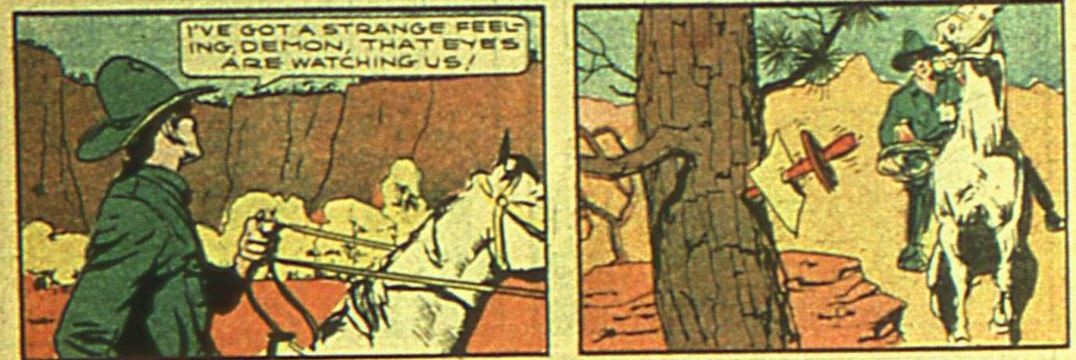
    The Phantom Ranger is just minding his business one day when he receives a sternly-worded letter via throwing knife, warning him to “steer clear of the red-headed girl.” This is of course your classic case of warning the hero off before he has a dang clue what’s going on.

    Everything is okay though, because the young woman who shortly rides up and requests the Ranger’s help has blonde hair. The “red-headed girl” must be seeking aid elsewhere. Or the colourist and the letterer had some sort of miscommunication. One of the two.

    The girl, whatever her hair colour, is named Lindy Davis, and the Masked Terror has kidnapped her father for ransom, a crime you don’t see as much in a lot of Western comics but I am certain is an authentic Old West crime.

    The Phantom Ranger accompanies Lindy to the handoff, where we learn that a) the Masked Terror is one homely cuss and eventually b) that he has already killed Mr Davis. The Phantom Ranger sets off in hot pursuit.

    And of course the Masked Terror turns out to be Ansom, the Davis’ neighbour and, crucially, the only one Lindy told about her plan to contact the Phantom Ranger. Plus I assume that he is the only nearby man ugly enough to be a suspect. The Terror chooses to go for his gun and meets a swift end.

  • MINOR SUPER-VILLAIN 717: THE MASKED TERROR

    MINOR SUPER-VILLAIN 717: THE MASKED TERROR

    (Rocket Comics 003, 1940)

    The Phantom Ranger is just minding his business one day when he receives a sternly-worded letter via throwing knife, warning him to “steer clear of the red-headed girl.” This is of course your classic case of warning the hero off before he has a dang clue what’s going on.

    Everything is okay though, because the young woman who shortly rides up and requests the Ranger’s help has blonde hair. The “red-headed girl” must be seeking aid elsewhere. Or the colourist and the letterer had some sort of miscommunication. One of the two.

    The girl, whatever her hair colour, is named Lindy Davis, and the Masked Terror has kidnapped her father for ransom, a crime you don’t see as much in a lot of Western comics but I am certain is an authentic Old West crime.

    The Phantom Ranger accompanies Lindy to the handoff, where we learn that a) the Masked Terror is one homely cuss and eventually b) that he has already killed Mr Davis. The Phantom Ranger sets off in hot pursuit.

    And of course the Masked Terror turns out to be Ansom, the Davis’ neighbour and, crucially, the only one Lindy told about her plan to contact the Phantom Ranger. Plus I assume that he is the only nearby man ugly enough to be a suspect. The Terror chooses to go for his gun and meets a swift end.

  • MINOR SUPER-HERO ROUND-UP 037

    MINOR SUPER-HERO ROUND-UP 037

    More cream rises from the milky depths of the Golden Age!

    Red Roberts, the Electro Man:

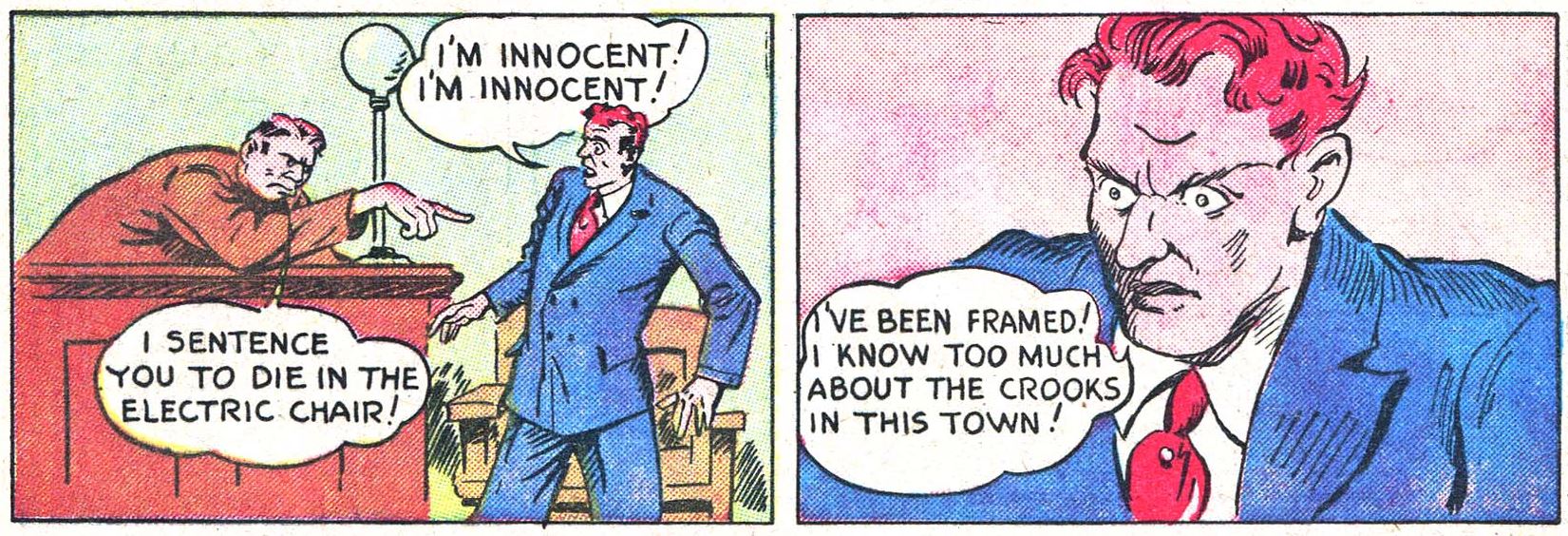
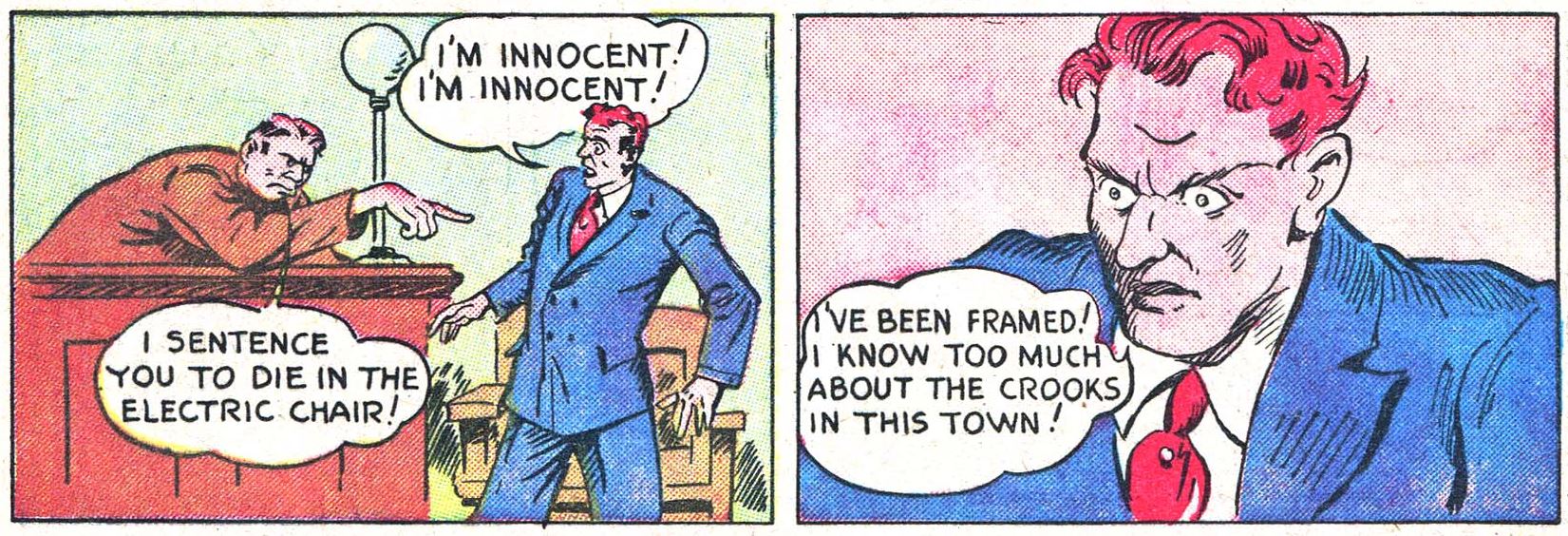
    It’s unclear what Red Roberts’ actual job is, but he is a guy who Knows Too Much about the corruption in the unnamed city he lives in and so he is framed for murder and fast-tracked to the electric chair.

    Luckily for Roberts, this is a comic book universe and being an innocent person sentenced to be executed via the electric chair means that you get sick-ass electricity powers instead of dying like everyone else. Red Roberts quickly parleys these powers into revenge on the city’s crooked mayor and his cronies and then cleans up crime around town for a couple of issues more for good measure. He doesn’t bother with a secret identity because at least half a dozen people were there to witness his origin, which must feel quite freeing. (Rocket Comics 001, 1940)

    the Phantom Ranger:

    There’s not much to distinguish the Phantom Ranger from his contemporaries in the ranks of Mysterious Cowboys Who Stick Around Just Long Enough to Help Out, but here goes: his horse is named Demon and he likes to ride around with his sleeves rolled up, which gives him a business casual look that I appreciate. (Rocket Comics 001, 1940)

    the Defender:

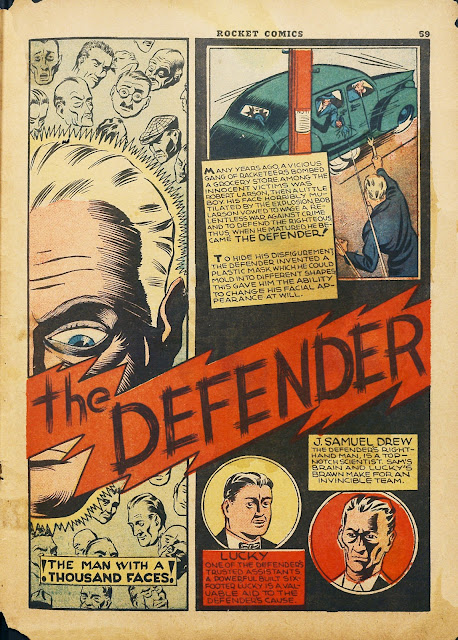
    Is the Defender (Robert Larson, who was scarred facially by criminals as a child and who now fights crime using a malleable rubberoid mask and two dedicated assistants) a take on pulp and comic character the Avenger (Richard Benson, whose face was rendered inhuman by the shock of losing his wife and child to criminals and who now fights crime using his own malleable face and 4-5 dedicated assistants)? I certainly think he is, but I don’t know if you could conclusively prove it. (Rocket Comics 002, 1940)

    Samson UPDATE:

    Samson being descended from the long-haired Biblical figure of the same name is not a new origin for the character, but once he had his own series it was time to explicitly lay it out in the form of his mother telling him in plain English that he is. Frankly, I’d much rather learn how he managed to get away with  having shoulder-length hair as a teenager in the early 1930s, but it’s just left as an exercise for the reader to figure out.

    No such luck for David, however. He remains an orphaned Boy Scout who Samson just found and adopted one day. David is not his actual name and we do not know his actual name. There is some early effort to play up his Boy Scout knowledge as valuable to the crimefighting enterprise but that soon falls by the wayside. (Samson 001, 1940)

  • MINOR SUPER-HERO ROUND-UP 037

    MINOR SUPER-HERO ROUND-UP 037

    More cream rises from the milky depths of the Golden Age!

    Red Roberts, the Electro Man:

    It’s unclear what Red Roberts’ actual job is, but he is a guy who Knows Too Much about the corruption in the unnamed city he lives in and so he is framed for murder and fast-tracked to the electric chair.

    Luckily for Roberts, this is a comic book universe and being an innocent person sentenced to be executed via the electric chair means that you get sick-ass electricity powers instead of dying like everyone else. Red Roberts quickly parleys these powers into revenge on the city’s crooked mayor and his cronies and then cleans up crime around town for a couple of issues more for good measure. He doesn’t bother with a secret identity because at least half a dozen people were there to witness his origin, which must feel quite freeing. (Rocket Comics 001, 1940)

    the Phantom Ranger:

    There’s not much to distinguish the Phantom Ranger from his contemporaries in the ranks of Mysterious Cowboys Who Stick Around Just Long Enough to Help Out, but here goes: his horse is named Demon and he likes to ride around with his sleeves rolled up, which gives him a business casual look that I appreciate. (Rocket Comics 001, 1940)

    the Defender:

    Is the Defender (Robert Larson, who was scarred facially by criminals as a child and who now fights crime using a malleable rubberoid mask and two dedicated assistants) a take on pulp and comic character the Avenger (Richard Benson, whose face was rendered inhuman by the shock of losing his wife and child to criminals and who now fights crime using his own malleable face and 4-5 dedicated assistants)? I certainly think he is, but I don’t know if you could conclusively prove it. (Rocket Comics 002, 1940)

    Samson UPDATE:

    Samson being descended from the long-haired Biblical figure of the same name is not a new origin for the character, but once he had his own series it was time to explicitly lay it out in the form of his mother telling him in plain English that he is. Frankly, I’d much rather learn how he managed to get away with  having shoulder-length hair as a teenager in the early 1930s, but it’s just left as an exercise for the reader to figure out.

    No such luck for David, however. He remains an orphaned Boy Scout who Samson just found and adopted one day. David is not his actual name and we do not know his actual name. There is some early effort to play up his Boy Scout knowledge as valuable to the crimefighting enterprise but that soon falls by the wayside. (Samson 001, 1940)