The Curse of Skeleton Munroe

Category: Knights of the Round Table

  • MINOR SUPER-VILLAIN 851: MORGANA LE FAY

    (Weird Comics 007, 1940)

    Here we are again with another Morgan(a) le Fay entry, our third in about a month and a half. Was there something in the water? This is also going to double as a micro Real Folk Round-Up, as all of the Arthurian characters who appear in the story are plot-relevant enough that I might as well detail them here as duplicate my effort.

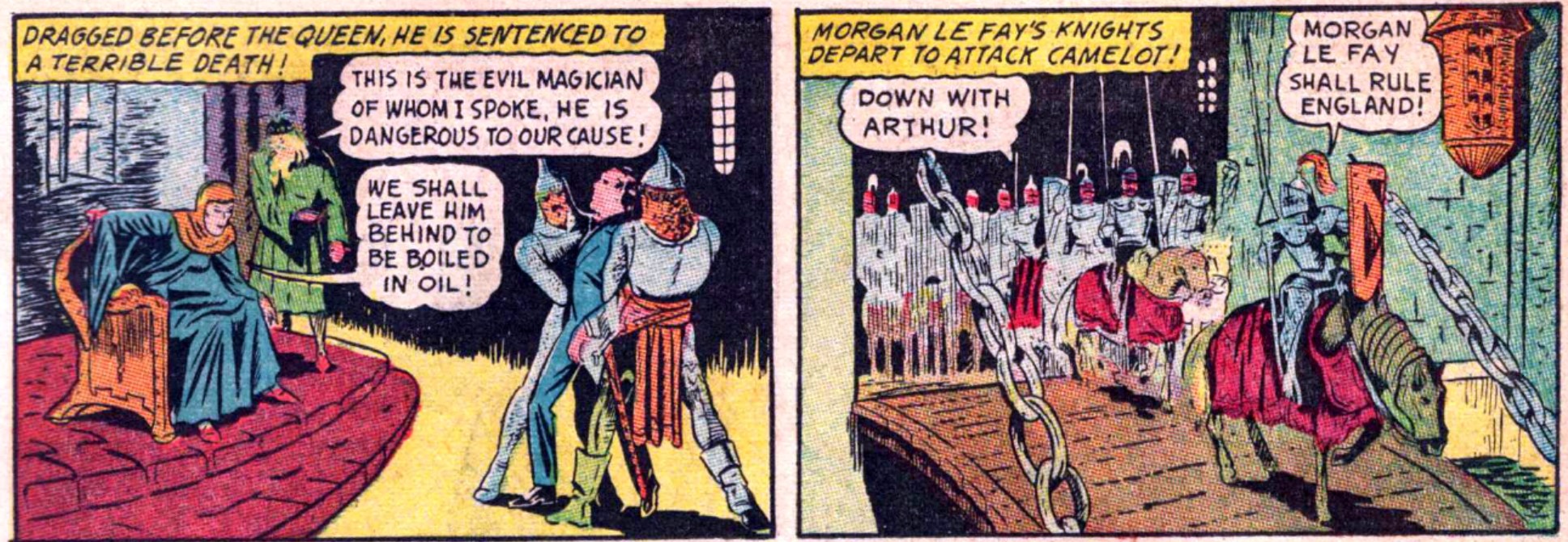
    Our Real Folk start off with Sir Gareth, Knight of the Round Table, brother to Gawaine, not quite the sort of household name knight as his brother or a Lancelot or a Galahad but held in pretty high esteem by the fans of such things. Gareth is rescued from a group of murderous knights by the Sorceress of Zoom after she travels back in time to avoid the burgeoning World War II, and is pining after his lady Elaine*, held captive by Morgana le Fay and destined to be married to the odious Mordred.

    The Sorceress of Zoom, horny for Gareth, decides to aid him on his quest in hopes of finding a way to eliminate Elaine along the way. Approaching le Fay’s castle, the duo find themselves imprisoned and facing death by the sword. 

    The Sorceress’ shirtless men prove a match for Morgana le Fay’s knights; her flying dragons make short work of le Fay’s flightless ones, and her magic is easily able to save Sir Gareth from being changed into a pig. Morgana le Fay is seemingly beaten!

    The Sorceress of Zoom does not press her advantage, but instead encourages a joust for Elaine’s freedom between Sir Gareth and Sir Mordred (not much of a character beyond being a generic evil knight here. He is portrayed as the son of Morgana le Fay rather than of her sister Margawse, but whether that is because that is so common a literary elision that it has entered the public consciousness or because Gareth is also the son of Margawse and having them be half brothers would be a complication that the story did not need, is hard to say). Her plan is to influence the joust so that Sir Gareth loses and thus is single, but is foiled in this by Merlin the Magician (also barely a character and just there to deus ex machina the Sorceress back to her own time), who tells her she is not wanted in Arthurian England. Morgana, while technically defeated and foiled, is left to go about her business.

    *Lady Elaine is not a reference to a specific Arthurian character to my knowledge. There are a half dozen or so Elaines running around Camelot and its environs, and the only one connected to Sir Gareth is his aunt/ Morgana le Fay’s sister, who she hopefully wouldn’t be trying to marry to her son.

  • REAL PERSON ROUND-UP 017

    Guest stars from reality! 

    Arthuriana: 

    Galahad is an ongoing feature inthe 1940 issues of Top-Notch Comics, which always means that we’re going to have a variety of very on- and off-brand characters from Arthuriana in supporting roles. King Arthur here functions mainly as a questing hub for Galahad to report to between missions, for instance. (Top-Notch Comics 005, 1940)

    Sir Kay, meanwhile, is very comfortably fulfilling his role as a low-level knight who can be defeated as a demonstration of basic competency. He also says his own name quite a lot. (Top-Notch Comics 005, 1940)

    According to my copy of The Arthurian Companion, Lady Lynette appealed to King Arthur on behalf of her sister Lyonors, whose castle was being laid siege to by the evil Sir Ironsides and who was sent away with the green-around-the-ears Gareth rather than her preferred choices of Launcelot or Gawaine. Here, newly-minted knight Galahad stands in for Gareth and it is Lynette’s own land that is under threat, (Top-Notch Comics 005, 1940)

    The Second Galahad adventure features Queen Guinevere as the victim of a robbery: her possibly-magical Golden Chalice has been stolen. (Top-Notch Comics 006, 1940)

    The culprit in the chalice theft is the Earl of Pellam, and I’m just going to assume that these names aren’t just random collections of appropriate-sounding syllables. King Pellam features in a version of the tale of the Fisher King, which makes this a pretty ironic crime for him, with the grail of it all. (Top-Notch Comics 006, 1940)

    Further, in the Pellam version of the Fisher King story, the Dolorous Stroke responsible for his eternal wound is dealt to him by the not-quite-a Knight of the Round Table Sir Balin le Sauvage, and so while it’s a bit unusual to find a Sir Balin here in the Earl of Pellam’s employ, it is perhaps on-brand that he ends up striking down his boss while trying to retrieve the Golden Chalice from Galahad. (Top-Notch Comics 006, 1940)

    This very monk-like Merlin the Magician first shows up during the knight of the griffin affair and acts as and occasional magical support character thereafter. (Top-Notch Comics 007, 1940)

    King Pellinore shows up to help Arthur fight off a joint invasion by the kings of Ireland and Denmark. (Top-Notch Comics 008, 1940)

    The Lady of the Lake eventually shows up to give Galahad a magic sword, once he proves worthy to draw it, and she even gets a chance to do the whole “rising up out of the water with a sword” thing after Galahad loses it in a moat – when your whole raison d’etre is handing out swords you have to know all of these tricks. 

    The sword itself has the terrible name “Scabor,” and miiiiiiight be a reference to King David’s Sword, which it resembles solely in the fact that it too could only be drawn by a worthy knight and that only Galahad qualified. (Top-Notch Comics 009, 1940)

    Now for some non-Arthurian characters: 

    Christopher Columbus: 

    The Ghost and a couple of guys from the 20th Century end up in 1492 sailing the ocean blue with Columbus on the Santa Maria, and of course the Ghost is instrumental in making sure that the voyage to the New World is successful, which is a much less valorous achievement through modern eyes than it would have been in 1940. There’s a bit at the end where the Ghost is allowed to fly the ship back to Spain so that they can catch the time-beam home, which I think ties into an early 20th Century bit about the Santa Maria going missing during the voyage, even though as far as I can tell it just got damaged and left behind. (Thrilling Comics 007, 1940)

    George Washington: 

    During a jaunt to the American Revolution in Professor Fenton’s time machine, the Ghost not only helps deliver the news of the impending Hessian attack to Washington but both suggests the crossing of the Delaware and uses yogi magic to make it possible. (Thrilling Comics 009, 1940) 

    Nero: 

    This is the first time that Nero has shown up in the Real Person Round-Up and I’m gonna call it: it’s never going to be a flattering depiction when he does. This time, he orders the Ghost and his two time travel companions tossed in the Colosseum to die in glorious combat. (Thrilling Comics 008, 1940) 

    Oliver Cromwell: 

    During another of the Ghost’s jaunts into the past to recover some of the various Important Men that science-crook Professor Fenton had stashed away in Commonwealth-era England, he runs into the Lord Protector himself: Oliver Cromwell.

    Cromwell employs the Ghost’s talents to quash a rebellion by the Duke of Northumberland and I was all set to point out that the guy in the comic didn’t look anything like the real historical character but upon looking into it it seems that though there have been many Dukes of Northumberland at the point in time that this comic was set there had not been any for about a century and would not be another for at least twenty-five years. This isn’t as fun to point out! (Thrilling Comics 006, 1940) 

  • REAL PERSON ROUND-UP 017

    Guest stars from reality! 

    Arthuriana: 

    Galahad is an ongoing feature inthe 1940 issues of Top-Notch Comics, which always means that we’re going to have a variety of very on- and off-brand characters from Arthuriana in supporting roles. King Arthur here functions mainly as a questing hub for Galahad to report to between missions, for instance. (Top-Notch Comics 005, 1940)

    Sir Kay, meanwhile, is very comfortably fulfilling his role as a low-level knight who can be defeated as a demonstration of basic competency. He also says his own name quite a lot. (Top-Notch Comics 005, 1940)

    According to my copy of The Arthurian Companion, Lady Lynette appealed to King Arthur on behalf of her sister Lyonors, whose castle was being laid siege to by the evil Sir Ironsides and who was sent away with the green-around-the-ears Gareth rather than her preferred choices of Launcelot or Gawaine. Here, newly-minted knight Galahad stands in for Gareth and it is Lynette’s own land that is under threat, (Top-Notch Comics 005, 1940)

    The Second Galahad adventure features Queen Guinevere as the victim of a robbery: her possibly-magical Golden Chalice has been stolen. (Top-Notch Comics 006, 1940)

    The culprit in the chalice theft is the Earl of Pellam, and I’m just going to assume that these names aren’t just random collections of appropriate-sounding syllables. King Pellam features in a version of the tale of the Fisher King, which makes this a pretty ironic crime for him, with the grail of it all. (Top-Notch Comics 006, 1940)

    Further, in the Pellam version of the Fisher King story, the Dolorous Stroke responsible for his eternal wound is dealt to him by the not-quite-a Knight of the Round Table Sir Balin le Sauvage, and so while it’s a bit unusual to find a Sir Balin here in the Earl of Pellam’s employ, it is perhaps on-brand that he ends up striking down his boss while trying to retrieve the Golden Chalice from Galahad. (Top-Notch Comics 006, 1940)

    This very monk-like Merlin the Magician first shows up during the knight of the griffin affair and acts as and occasional magical support character thereafter. (Top-Notch Comics 007, 1940)

    King Pellinore shows up to help Arthur fight off a joint invasion by the kings of Ireland and Denmark. (Top-Notch Comics 008, 1940)

    The Lady of the Lake eventually shows up to give Galahad a magic sword, once he proves worthy to draw it, and she even gets a chance to do the whole “rising up out of the water with a sword” thing after Galahad loses it in a moat – when your whole raison d’etre is handing out swords you have to know all of these tricks. 

    The sword itself has the terrible name “Scabor,” and miiiiiiight be a reference to King David’s Sword, which it resembles solely in the fact that it too could only be drawn by a worthy knight and that only Galahad qualified. (Top-Notch Comics 009, 1940)

    Now for some non-Arthurian characters: 

    Christopher Columbus: 

    The Ghost and a couple of guys from the 20th Century end up in 1492 sailing the ocean blue with Columbus on the Santa Maria, and of course the Ghost is instrumental in making sure that the voyage to the New World is successful, which is a much less valorous achievement through modern eyes than it would have been in 1940. There’s a bit at the end where the Ghost is allowed to fly the ship back to Spain so that they can catch the time-beam home, which I think ties into an early 20th Century bit about the Santa Maria going missing during the voyage, even though as far as I can tell it just got damaged and left behind. (Thrilling Comics 007, 1940)

    George Washington: 

    During a jaunt to the American Revolution in Professor Fenton’s time machine, the Ghost not only helps deliver the news of the impending Hessian attack to Washington but both suggests the crossing of the Delaware and uses yogi magic to make it possible. (Thrilling Comics 009, 1940) 

    Nero: 

    This is the first time that Nero has shown up in the Real Person Round-Up and I’m gonna call it: it’s never going to be a flattering depiction when he does. This time, he orders the Ghost and his two time travel companions tossed in the Colosseum to die in glorious combat. (Thrilling Comics 008, 1940) 

    Oliver Cromwell: 

    During another of the Ghost’s jaunts into the past to recover some of the various Important Men that science-crook Professor Fenton had stashed away in Commonwealth-era England, he runs into the Lord Protector himself: Oliver Cromwell.

    Cromwell employs the Ghost’s talents to quash a rebellion by the Duke of Northumberland and I was all set to point out that the guy in the comic didn’t look anything like the real historical character but upon looking into it it seems that though there have been many Dukes of Northumberland at the point in time that this comic was set there had not been any for about a century and would not be another for at least twenty-five years. This isn’t as fun to point out! (Thrilling Comics 006, 1940) 

  • MINOR SUPER-VILLAIN 836: MORGANA LE FAY

    (Top-Notch Comics 009, 1940) 

    It’s another version of Morgan le Fay, less than two weeks after the last one! Will le Fay end up being the mythic/fictional character with the greatest number of comic book interpretations? Possibly!

    This version of Morgan le Fay, Morgana le Fey, is after revenge on Galahad for the death of her husband the Knight of the Griffin and so sends out squads of knights to find him and bring him back to be tiger food. Unfortunately for her, her knights are pretty unprofessional and fail to question the fact that the “Galahad” that they capture is unusually scrawny and meek and in fact turns out to be Garlan, Galahad’s squire, doing a bit of roleplay while his boss is asleep.

    Once the real Galahad shows up, Morgana’s men prove to be as inadequate at combat as they are at knight-identification and she is forced to play her trump card: the Monster. An eight-foot tall green guy who looks like he just stepped out of a science fiction comic, the Monster proves to be a match for Galahad and his horse.

    Lucky for Galahad, Garlan is on-hand to save the day by delivering the poorly-named magic sword Scabor to him as he and the Monster are battling in the depths of Morgana’s moat. It’s a heroic act for the lad, and it really underscores how terrible it was when he was captured earlier in the story and Galahad did not go after him because he was late for a meeting.

    Presumably Morgana le Fay would have continued to vex Galahad going forward, but the series ends while she is planning her next move. 

  • MINOR SUPER-VILLAIN 834: THE KNIGHT OF THE GRIFFIN

    (Top-Notch Comics 007, 1940) 

    Tasked with finding the two-days-overdue Sir Gawain, Galahad discovers him being set upon by ruffians in the employ of the Knight of the Griffin, a dastardly character who hates King Arthur and the Knights of the Round Table.

    Galahad proceeds to confront the Knight himself, where we find that he is based on Sir Turquine, a villainous knight who had both the knight-summoning bell and tree full of defeated knights’ shields as seen above, but who critically hated Lancelot, Galahads father, and battled knights as part of a long-term plan to kill him, whereas the Knight of the Griffin is more of an anti-Knights of the Round Table guy.

    Thanks to an exposure to a Choose Your Own Adventure version of this story in my youth, I think I have an inflated sense of how iconic the tree of shields is, but I love it. It’s very ominous! 

    The Knight of the Griffin is also aided and abetted by his wife, Morgana le Fay, who hoodwinks knights into getting her a drink of water and then swaps their good swords for ones that will shatter during the cut and thrust of knightly combat. This is not a part of Sir Turquine’s story – though Morgan le Fay has plenty of evil knights in her roster of exes, she and Turquine don’t seem to have been an item.

    Between the broken sword and the home field advantage, the Knight of the Griffin has Galahad on the ropes, and might have emerged victorious if Merlin the Magician hadn’t been lurking nearby to bring the tree of shields crashing down to unhorse him. Given a more even contest, Galahad is able to employ some Arthurian judo and heave tKotG off of a cliff to his doom.

  • MINOR SUPER-VILLAIN 832: SIR GILBERT, THE SUN KNIGHT

    MINOR SUPER-VILLAIN 832: SIR GILBERT, THE SUN KNIGHT

    (Top-Notch Comics 005, 1940)

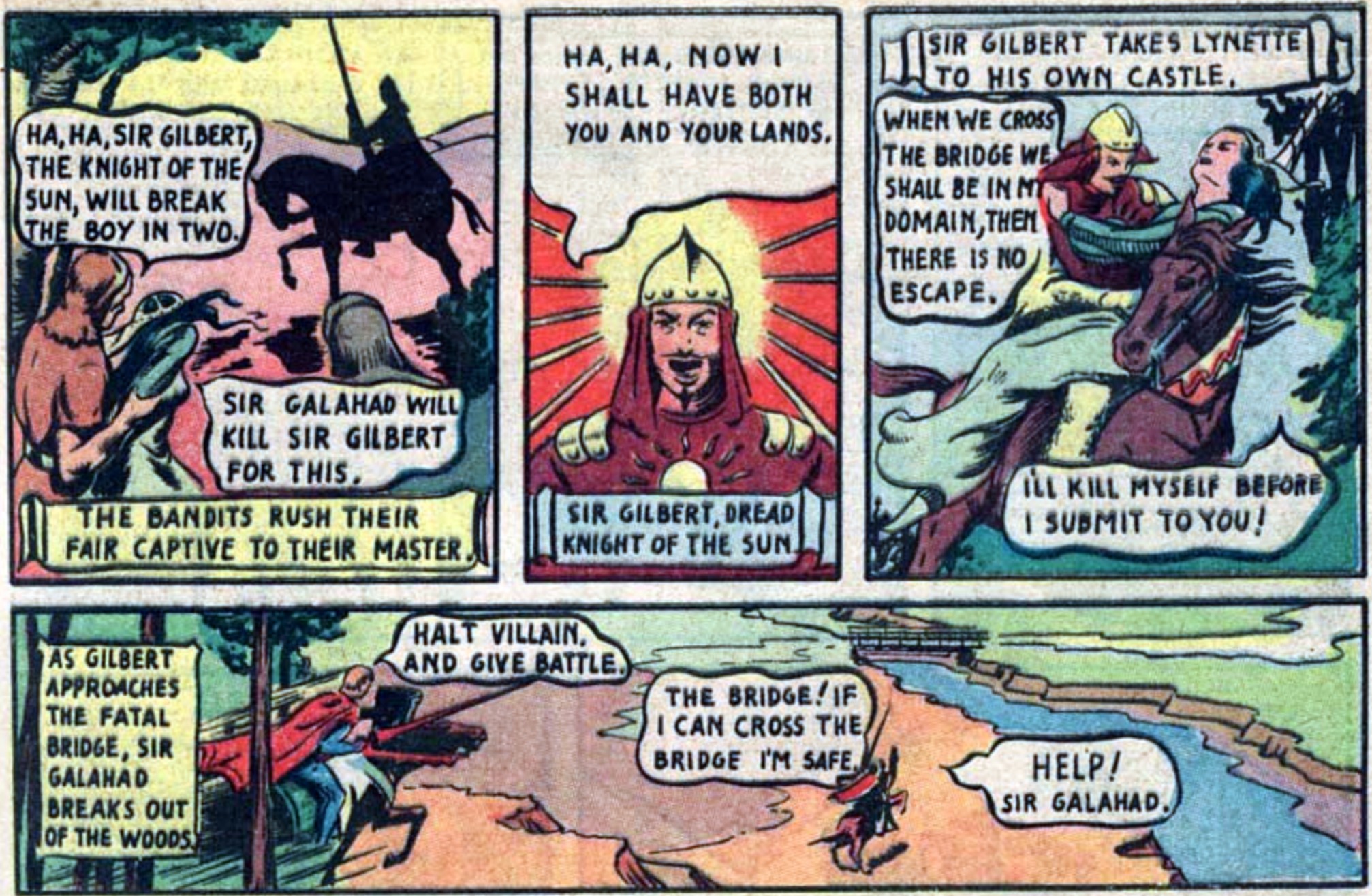
    Sir Gilbert is the evil knight who Galahad sets out to vanquish on his first official Knights of the Round Table mission. He’s got all the requisite qualities of an evil Arthurian knight: a cool name, a rakish attitude toward kidnapping and menacing women, and designs on the lands near his castle. And like most if not all non-Mordred evil knights in comic book Arthuriana, he’s a completely original character, which is always a bit confusing because there are ever so many villains and scumbags to choose from in the source material.

    Canonicity aside, Sir Gilbert is a good first foe for any character. He’s got a good name and a bit if a reputation, and he provides just enough challenge to be a credible threat before being defeated so thoroughly that he can be repurposed into an improvised missile.

  • MINOR SUPER-HERO ROUND-UP 057

    Two MLJ Round-Ups in a row! They’re just churning out the heroes! 

    Galahad:

    Hey, it’s Galahad! Or rather a version of Galahad who is standing in for a pretty wide array of different Knights of the Round Table with lesser name brand recognition. It’s some clean-cut knightly action. (Top-Notch Comics 005, 1940)

    Shanghai Sheridan:

    Jack “Shanghai” Sheridan, aside from having a sounding like a cheeky nickname for a POW camp, is notable mostly for the fact that he is one of many characters who have “the Batman origin but for…”, in this case, the Batman origin but for the Japanese invasion of China. His adventures are nothing particularly special, alas. (Top-Notch Comics 005, 1940)

    Firefly:

    Oh hey, it’s the Firefly, wearing one of the great super-hero costumes of the Golden Age!

    The Firefly is really Harley Hudson, a young biochemist who sought to understand the tremendous proportionate strength possessed by insects and found that it was as a result of their “muscular coordination,” and further managed to unlock that same power within himself! Now he’s on an anti-crime crusade, and I’m not sure if he’s able to glow because of his muscular coordination abilities or he just has some phosphorescent paint slapped onto the front of his costume – the brief appearance of the character in the 60s Mighty Crusaders comic suggests the former, but they were also trying to make him some sort of equivalent of the Fireball and Inferno, so I don’t know if I’m going to take that as canon. (Top-Notch Comics 008, 1940)

    The Firefly also gets around in a “combination airplane and glider” called the Fireflier (or Fireflyer), which is an objectively great name for a subjectively terrible-looking vehicle. (Top-Notch Comics 009, 1940) 

    the Black Hood: 

    The Black Hood is perhaps the Archie/MLJ super-hero with the greatest number of different versions, both legacy and reboot-style. He also bumps the Wizard out of the top spot in Top-Notch as soon as he appears – someone at MLJ clearly really liked this guy from the start.

    This original Black Hood (and a pretty decent percentage of his successors) is named Kip Burland, and he was a New York cop until he attempted to arrest super-villain the Skull while he was doing some crime and ended up framed and then murdered for his troubles. Except the murder didn’t take, and Burland was found by an old hermit who nursed him back to health.

    In an amazing coincidence, the hermit in question turns out to be a former sheriff who was also framed by the Skull, and who took so long in training for his revenge/redemption that he grew too old for the job. This turns out to be a perfect combination: the Hermit teaches Kip all that he knows, and the Black Hood sallies forth to mete out justice to the Skull. (Top-Notch Comics 009, 1940) 

  • MINOR SUPER-VILLAIN 827: MORGAN LE FAY

    MINOR SUPER-VILLAIN 827: MORGAN LE FAY

    (Thrilling Comics 005, 1940) 

    Sometimes when I’m writing the original drafts of these entries I’m tired or rushed or the like and I go into Extreme Shorthand Mode, and sometimes that version of the writeup is very charming to me when I come back to it a couple of weeks later. Which is all to say that the younger, rushed version of me wrote “merlin stung by brutal own” to describe how the venerable wizard took being exposed as a fraud by the Ghost during one of his time-travel adventures, and I think it captures something. Is it enough to explain Merlin selling out Camelot to Morgan le Fay? Probably not, but it clearly was in the eyes of a 1940s comics book writer.

    Don’t worry, however, because the Ghost is still on hand and is most certainly not a charlatan. He conjures up a big pile of machine guns and grenades for the Knights of the Round Table, and s my past self put it: “modern weapons vs medieval is okay if its vs bad guys.”

  • REAL PERSON ROUND-UP 016

    REAL PERSON ROUND-UP 016

    Are you ready for some comic book versions of real life and fictional people? I sure hope so! 

    Adolf Hitler:  

    Premier Grahvin of the fictional African country of Cadiwa is a pretty broad pastiche of the Axis leaders, but the sheer speed at which he accelerates into full-blown dictator mode (before Mr Mystic turns up to reveal that he had not, in fact killed the king of Cadiwa and was not, in fact, in charge) must be highlighted. (The Spirit Section, 21 July, 1940)

    Likewise, Karoly Gore is an Axis dictator pastiche from a Mr Mystic story a few weeks earlier (but I read them out of order so it’s okay) (The Spirit Section, 9 June, 1940) 

    Axtrol here is a third in our series of Axis dictator pastiches, and he’s possibly the biggest shithead of the bunch. (The Spirit, “Dr Prince von Kalm”, 17 November, 1940)

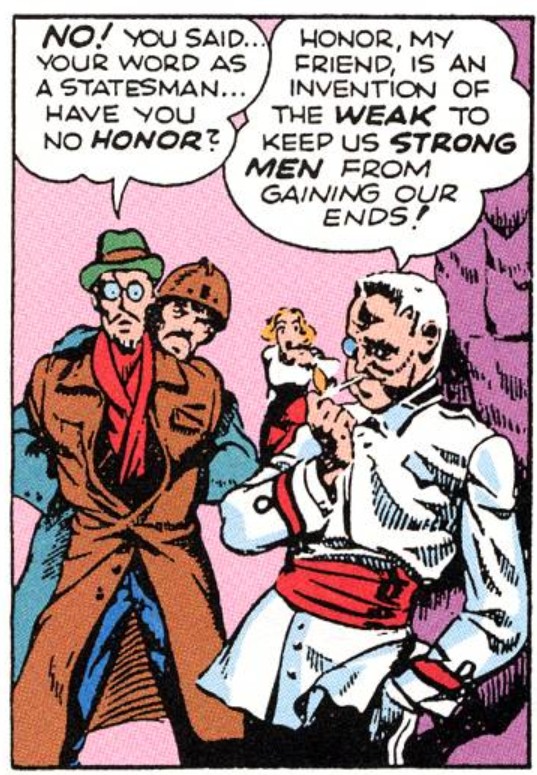
    Nargoff, aka the Leader, is either a would-be North American dictator or the agent of a European one looking to set up a local franchise. Either way, the Spirit burns down his fake island/submarine base and then engineers a situation in which the might-makes-right philosophies espoused in Nargoff’s book “The New Order” are explored by way of Nargoff and his burly assistant Max being stranded on a small boat in the Caribbean with a limited amount of water. (The Spirit, “The Leader”, 29 December, 1940)

    Don Juan: 

    Mr Mystic and his fiance Elena encounter a whole castle full of ghosts in the woods of Spain, among whom is the spirit of the entirely fictional man Don Juan, who mistakes Elena for his missing wife Ysabel and almost kills her before himself being double-killed by Mystic. (The Spirit Section, 15 December, 1940)

    Khufu aka Cheops: 

    When Mr Mystic decides to go back in time to the creation of the Great Pyramid of Giza, he is mistaken for the god Ammon Ra and of course just immediately gets his grubby little mitts all over the progress of history. It’s kind of okay, though, because the history he’s in seems to already be a big mess – for instance, while Pharaoh Cheops is indeed the ruler supposed to have commissioned the building of the Great Pyramid c. 2600 BCE, the Babylonian invasion they’re worried about is tricky because a) Babylonia is dated from 1890 BCE b) the earliest Nebuchadnezzar I can find ascended to the throne in 1121 BCE and c) given the cultural milieu that this comic was written in they’re probably talking about Nebuchadnezzar II, the one from the Bible, who did invade Egypt a couple of times but didn’t come to power until 605 BCE. Like I said: a real mess. Plus, Amun didn’t even become associated with Ra until the 16th Century BCE!

    There’s also this guy, Prince Sargon of Babylonia, and while there’s a part of me that wants to say that he’s supposed to be Sargon II (the most famous Sargon, 722 BCE), I don’t reckon that Bob Powell, mad as he was with creative power when he wrote this story, would make someone the son of someone else born a hundred years after them. Right? (Sargon does return as a time-travelling mummy out for revenge in the next installment of Mr Mystic but this alas does nothing to clear up the puzzle of his identity) (The Spirit Section, 29 September 1940)

    Misc Arthurian Figures: 

    During one of his jaunts into the past, the Ghost finds himself in Camelot, where he meets a very small selection of Arthurian figures (all of the big name knights are away on the Crusades, we are told). These include Sir Kay, who acts like a weird creep (accurate) and gets beaten up for his efforts, King Arthur, an amiable doormat, and Merlin the Magician, who is portrayed as a fraud with no magical power who sells out Arthur as soon as he gets the chance. An interesting choice for a comic about a magic man, but perfectly in keeping with 1940s secular values. (Thrilling Comics 005, 1940) 

    Myrna Loy & William Powell: 

    A simple flip of the last names renders Myrna Loy and William Powell into Myrna Powell and William Loy on this marquee, with a bonus “Boris Scarloff” for Boris Karloff. (The Spirit Section, 10 November, 1940)

    Ty Cobb: 

    If there’s anything more tedious than a 1940s sports comic it’s a 1940s hillbilly comic, so trust me when I say that this one-off about a baseball-playing hillbilly named Obadiah “Pie” Gobb is one of the the worst things I have ever read. 

    What’s even more egregious is the fact that while Pie Gobb and his new teammate Moe de Muggio (the World’s Greatest Slugger, thanks to the fact that he eats his Fleeties every morning) are easy to identify as Ty Cobb and Joe DiMaggio, respectively, the rest of his team also have goofy names but as far as I can tell none of them are also puns on famous baseball players, meaning that I just spent all that time playing rhyming games on Wikipedia for no reason. (The Funnies 047, 1940)

  • REAL PERSON ROUND-UP 016

    REAL PERSON ROUND-UP 016

    Are you ready for some comic book versions of real life and fictional people? I sure hope so! 

    Adolf Hitler:  

    Premier Grahvin of the fictional African country of Cadiwa is a pretty broad pastiche of the Axis leaders, but the sheer speed at which he accelerates into full-blown dictator mode (before Mr Mystic turns up to reveal that he had not, in fact killed the king of Cadiwa and was not, in fact, in charge) must be highlighted. (The Spirit Section, 21 July, 1940)

    Likewise, Karoly Gore is an Axis dictator pastiche from a Mr Mystic story a few weeks earlier (but I read them out of order so it’s okay) (The Spirit Section, 9 June, 1940) 

    Axtrol here is a third in our series of Axis dictator pastiches, and he’s possibly the biggest shithead of the bunch. (The Spirit, “Dr Prince von Kalm”, 17 November, 1940)

    Nargoff, aka the Leader, is either a would-be North American dictator or the agent of a European one looking to set up a local franchise. Either way, the Spirit burns down his fake island/submarine base and then engineers a situation in which the might-makes-right philosophies espoused in Nargoff’s book “The New Order” are explored by way of Nargoff and his burly assistant Max being stranded on a small boat in the Caribbean with a limited amount of water. (The Spirit, “The Leader”, 29 December, 1940)

    Don Juan: 

    Mr Mystic and his fiance Elena encounter a whole castle full of ghosts in the woods of Spain, among whom is the spirit of the entirely fictional man Don Juan, who mistakes Elena for his missing wife Ysabel and almost kills her before himself being double-killed by Mystic. (The Spirit Section, 15 December, 1940)

    Khufu aka Cheops: 

    When Mr Mystic decides to go back in time to the creation of the Great Pyramid of Giza, he is mistaken for the god Ammon Ra and of course just immediately gets his grubby little mitts all over the progress of history. It’s kind of okay, though, because the history he’s in seems to already be a big mess – for instance, while Pharaoh Cheops is indeed the ruler supposed to have commissioned the building of the Great Pyramid c. 2600 BCE, the Babylonian invasion they’re worried about is tricky because a) Babylonia is dated from 1890 BCE b) the earliest Nebuchadnezzar I can find ascended to the throne in 1121 BCE and c) given the cultural milieu that this comic was written in they’re probably talking about Nebuchadnezzar II, the one from the Bible, who did invade Egypt a couple of times but didn’t come to power until 605 BCE. Like I said: a real mess. Plus, Amun didn’t even become associated with Ra until the 16th Century BCE!

    There’s also this guy, Prince Sargon of Babylonia, and while there’s a part of me that wants to say that he’s supposed to be Sargon II (the most famous Sargon, 722 BCE), I don’t reckon that Bob Powell, mad as he was with creative power when he wrote this story, would make someone the son of someone else born a hundred years after them. Right? (Sargon does return as a time-travelling mummy out for revenge in the next installment of Mr Mystic but this alas does nothing to clear up the puzzle of his identity) (The Spirit Section, 29 September 1940)

    Misc Arthurian Figures: 

    During one of his jaunts into the past, the Ghost finds himself in Camelot, where he meets a very small selection of Arthurian figures (all of the big name knights are away on the Crusades, we are told). These include Sir Kay, who acts like a weird creep (accurate) and gets beaten up for his efforts, King Arthur, an amiable doormat, and Merlin the Magician, who is portrayed as a fraud with no magical power who sells out Arthur as soon as he gets the chance. An interesting choice for a comic about a magic man, but perfectly in keeping with 1940s secular values. (Thrilling Comics 005, 1940) 

    Myrna Loy & William Powell: 

    A simple flip of the last names renders Myrna Loy and William Powell into Myrna Powell and William Loy on this marquee, with a bonus “Boris Scarloff” for Boris Karloff. (The Spirit Section, 10 November, 1940)

    Ty Cobb: 

    If there’s anything more tedious than a 1940s sports comic it’s a 1940s hillbilly comic, so trust me when I say that this one-off about a baseball-playing hillbilly named Obadiah “Pie” Gobb is one of the the worst things I have ever read. 

    What’s even more egregious is the fact that while Pie Gobb and his new teammate Moe de Muggio (the World’s Greatest Slugger, thanks to the fact that he eats his Fleeties every morning) are easy to identify as Ty Cobb and Joe DiMaggio, respectively, the rest of his team also have goofy names but as far as I can tell none of them are also puns on famous baseball players, meaning that I just spent all that time playing rhyming games on Wikipedia for no reason. (The Funnies 047, 1940)