The Curse of Skeleton Munroe

Category: aviator

  • MINOR SUPER-HERO ROUND-UP 098

    We’ve got no time for major super-heroes around here. We’re too busy with the minor ones.

    the Black Ace:

    The Black Ace, aka Captain McRae, is yet another American pilot serving in the RAF in advance of the US entrance into WWII. As such, he is not only a highly accomplished pilot and bombardier but fully versed in the arts of prison escape, hand-to-hand combat, impersonating German soldiers and leaping from plane to plane in mid-flight. (Four Favorites 002, 1941)

    Categorized in: Activities (Cards), Colours (Black), Team Memberships (RAF)

    Phantasmo **Update**:

    The thing about Phantasmo is that he does all of his super-heroing while in his super-huge astral form, and I guess that I had somehow gotten the impression that most of his powers were tied to that form, because I while reading his 1941 run of adventures I kept being surprised when he would do something like heal an old man (The Funnies 052) or kill a bunch of guys with a giant fish while in Phil Anson form (The Funnies 051). 

    I guess it’s pretty convenient to have the option of being an invulnerable giant but that getting your mortal hands dirty lends a certain thrill to the crimefighting – that’s probably why he tolerates the poor standard of care that he gets from Whizzer McGee as he guards the unconscious Anson-body, hey?

    In The Funnies 061, Phantasmo and Whizzer witness the murder of a crooked FBI filing clerk named Ted Bart and, partially because they are touched by his dying confession (“I only blackmailed a gang boss-turned politician to help my sister, honest!”) and partially due to this desire for more action in his life (life as an FBI filing clerk v. action packed), Phantasmo takes over his identity. The series ends before this development pays off beyond giving Phantasmo a few crime leads, but it’s still an interesting turn for the character to take.

    Whizzer McGee:

    Phantasmo’s young friend Whizzer McGee does not really qualify as a sidekick most if the time. He’s more of an employee, really, who watches over Phil Anson’s unconscious body while his mind is out terrorizing criminals. And he’s not even good at it! Whizzer and the body are always getting into scrapes because of Whizzer’s incompetence (and also because Phil is very bad at picking a convenient place to leave his mortal coil, in all fairness).

    Despite this, Phantasmo gives Whizzer McGee the opportunity to be a real-deal super-powered guy when he has to go out of town for a few days, in the form of an amulet that gives him invulnerability and super strength. I can only assume that Phil was worried that Whizzer would immediately walk out into traffic if someone wasn’t around to tell him not to and was trying to bump up the likelihood of his survival a bit.  

    Whizzer screws it all up of course – not only does he lose the amulet by trying to capture a smuggling gang single-handed, but he spills Phantasmo’s secrets – including his secret identity and home address! – to the gang boss after he does a low-effort impression of an FBI agent. Surprisingly, this leads to absolutely no consequences going forward: Whizzer keeps his job, the amulet doesn’t end up in the wrong hands… it’s not even a factor in Phantasmo changing secret identities. (The Funnies 056, 1941)

    Categorized in: Accessories (Amulets), Origins (Sidekicks)

    the Black Knight **Update**:

    In our initial look at the Black Knight, we spent a lot of time trying to nail down exactly when the series is supposed to take place, and we are not backing down from that challenge. We have determined that he lived in at least the early 12th Century CE, which the presence of Canterbury Cathedral (looking much as it does today, a form it took after being rebuilt and refurbished in the 11th and 12th Centuries) supports. This is comforting! All of our hard work paid off! Hold on to that feeling for a little while.

    The firmly 12th Century Black Knight’s 1941 adventures continue much as they had in 1940: the Black Knight travels the land slaying villains in the name of Good King Victor. Things get a bit less episodic with the introduction of a mysterious ring that the Knight is given by the King in The Funnies 053, that is then revealed to contain some mysterious drugs in issue 054.

    The Funnies 053 also introduces Peter, an archer who begins travelling with the Black Knight after helping him slay some bandits. He’s very serious about being a sidekick, is Peter.

    So we have: a reasonably firm grasp on the time period, an ongoing plot hook and a new friend. All of which is dumped in the trash as of The Funnies 055-056, when Good King Victor falls victim to an illness with only one known cure, a drug that is only available in Egypt.

    The ring is completely forgotten until the Black Knight need to escape a prison guard and the mysterious drugs turn out to be knockout drops. Peter is technically still around to the end, but he and the other members of the Black Knight’s party are all dressed like desert nomads and usually end up tagging behind him on camelback rather than actually participating in the story. As for the 12th Century… the artist’s vision of what Medieval North Africa looked like was not quite as precisely calibrated as it was for Medieval England, and so we start getting things like hookahs (15th-16th Century and even then in India) almost immediately.

    The transition to Egypt does come with a pretty good alternate costume unlock for the Black Knight, though there are also some weird Jesus overtones. (The Funnies 059)

    The Black Knight’s plan to get the drug involves appealing directly to the Queen of Egypt for aid, which is appropriate, as she is from the same lineage of fictional monarchs as Good King Victor. In actuality, Egypt was in the hands of a series of Muslim dynasties from the 650s through to the 1500s when the Ottomans took it. The plotters above, meanwhile, are all from Sudan, which was Nubian-controlled and matrilineal at the time, so the misogyny is weird.

    Once the Queen actually shows up (The Funnies 061) it is pretty clear that she is based on Cleopatra (died 30 BC), which is fine. One huge anachronism is much easier to deal with than a million mild ones, after all. The Black Knight is clearly set in an alternate timeline or a human zoo built by aliens with poor research skills.

    Finally, the Egyptian odyssey introduces a love interest for the Black Knight in the form of a Persian (?) woman named Zellah who he rescues from a harem in The Funnies 057. There isn’t too much to this relationship – it’s just kind of nice. The Black Knight does get this sick scorpion amulet from her, but it’s just before she and the Queen of Egypt are kidnapped in a cliffhanger ending that is never resolved, so overall, it’s a bummer.

  • MINOR SUPER-HERO ROUND-UP 098

    We’ve got no time for major super-heroes around here. We’re too busy with the minor ones.

    the Black Ace:

    The Black Ace, aka Captain McRae, is yet another American pilot serving in the RAF in advance of the US entrance into WWII. As such, he is not only a highly accomplished pilot and bombardier but fully versed in the arts of prison escape, hand-to-hand combat, impersonating German soldiers and leaping from plane to plane in mid-flight. (Four Favorites 002, 1941)

    Categorized in: Activities (Cards), Colours (Black), Team Memberships (RAF)

    Phantasmo **Update**:

    The thing about Phantasmo is that he does all of his super-heroing while in his super-huge astral form, and I guess that I had somehow gotten the impression that most of his powers were tied to that form, because I while reading his 1941 run of adventures I kept being surprised when he would do something like heal an old man (The Funnies 052) or kill a bunch of guys with a giant fish while in Phil Anson form (The Funnies 051). 

    I guess it’s pretty convenient to have the option of being an invulnerable giant but that getting your mortal hands dirty lends a certain thrill to the crimefighting – that’s probably why he tolerates the poor standard of care that he gets from Whizzer McGee as he guards the unconscious Anson-body, hey?

    In The Funnies 061, Phantasmo and Whizzer witness the murder of a crooked FBI filing clerk named Ted Bart and, partially because they are touched by his dying confession (“I only blackmailed a gang boss-turned politician to help my sister, honest!”) and partially due to this desire for more action in his life (life as an FBI filing clerk v. action packed), Phantasmo takes over his identity. The series ends before this development pays off beyond giving Phantasmo a few crime leads, but it’s still an interesting turn for the character to take.

    Whizzer McGee:

    Phantasmo’s young friend Whizzer McGee does not really qualify as a sidekick most if the time. He’s more of an employee, really, who watches over Phil Anson’s unconscious body while his mind is out terrorizing criminals. And he’s not even good at it! Whizzer and the body are always getting into scrapes because of Whizzer’s incompetence (and also because Phil is very bad at picking a convenient place to leave his mortal coil, in all fairness).

    Despite this, Phantasmo gives Whizzer McGee the opportunity to be a real-deal super-powered guy when he has to go out of town for a few days, in the form of an amulet that gives him invulnerability and super strength. I can only assume that Phil was worried that Whizzer would immediately walk out into traffic if someone wasn’t around to tell him not to and was trying to bump up the likelihood of his survival a bit.  

    Whizzer screws it all up of course – not only does he lose the amulet by trying to capture a smuggling gang single-handed, but he spills Phantasmo’s secrets – including his secret identity and home address! – to the gang boss after he does a low-effort impression of an FBI agent. Surprisingly, this leads to absolutely no consequences going forward: Whizzer keeps his job, the amulet doesn’t end up in the wrong hands… it’s not even a factor in Phantasmo changing secret identities. (The Funnies 056, 1941)

    Categorized in: Accessories (Amulets), Origins (Sidekicks)

    the Black Knight **Update**:

    In our initial look at the Black Knight, we spent a lot of time trying to nail down exactly when the series is supposed to take place, and we are not backing down from that challenge. We have determined that he lived in at least the early 12th Century CE, which the presence of Canterbury Cathedral (looking much as it does today, a form it took after being rebuilt and refurbished in the 11th and 12th Centuries) supports. This is comforting! All of our hard work paid off! Hold on to that feeling for a little while.

    The firmly 12th Century Black Knight’s 1941 adventures continue much as they had in 1940: the Black Knight travels the land slaying villains in the name of Good King Victor. Things get a bit less episodic with the introduction of a mysterious ring that the Knight is given by the King in The Funnies 053, that is then revealed to contain some mysterious drugs in issue 054.

    The Funnies 053 also introduces Peter, an archer who begins travelling with the Black Knight after helping him slay some bandits. He’s very serious about being a sidekick, is Peter.

    So we have: a reasonably firm grasp on the time period, an ongoing plot hook and a new friend. All of which is dumped in the trash as of The Funnies 055-056, when Good King Victor falls victim to an illness with only one known cure, a drug that is only available in Egypt.

    The ring is completely forgotten until the Black Knight need to escape a prison guard and the mysterious drugs turn out to be knockout drops. Peter is technically still around to the end, but he and the other members of the Black Knight’s party are all dressed like desert nomads and usually end up tagging behind him on camelback rather than actually participating in the story. As for the 12th Century… the artist’s vision of what Medieval North Africa looked like was not quite as precisely calibrated as it was for Medieval England, and so we start getting things like hookahs (15th-16th Century and even then in India) almost immediately.

    The transition to Egypt does come with a pretty good alternate costume unlock for the Black Knight, though there are also some weird Jesus overtones. (The Funnies 059)

    The Black Knight’s plan to get the drug involves appealing directly to the Queen of Egypt for aid, which is appropriate, as she is from the same lineage of fictional monarchs as Good King Victor. In actuality, Egypt was in the hands of a series of Muslim dynasties from the 650s through to the 1500s when the Ottomans took it. The plotters above, meanwhile, are all from Sudan, which was Nubian-controlled and matrilineal at the time, so the misogyny is weird.

    Once the Queen actually shows up (The Funnies 061) it is pretty clear that she is based on Cleopatra (died 30 BC), which is fine. One huge anachronism is much easier to deal with than a million mild ones, after all. The Black Knight is clearly set in an alternate timeline or a human zoo built by aliens with poor research skills.

    Finally, the Egyptian odyssey introduces a love interest for the Black Knight in the form of a Persian (?) woman named Zellah who he rescues from a harem in The Funnies 057. There isn’t too much to this relationship – it’s just kind of nice. The Black Knight does get this sick scorpion amulet from her, but it’s just before she and the Queen of Egypt are kidnapped in a cliffhanger ending that is never resolved, so overall, it’s a bummer.
  • MINOR SUPER-HERO ROUND-UP 085

    MINOR SUPER-HERO ROUND-UP 085

    Welcome to “The Four Characters Least Likely to Return in a Modern Comic” Theatre.

    Marvex the Super-Robot: 

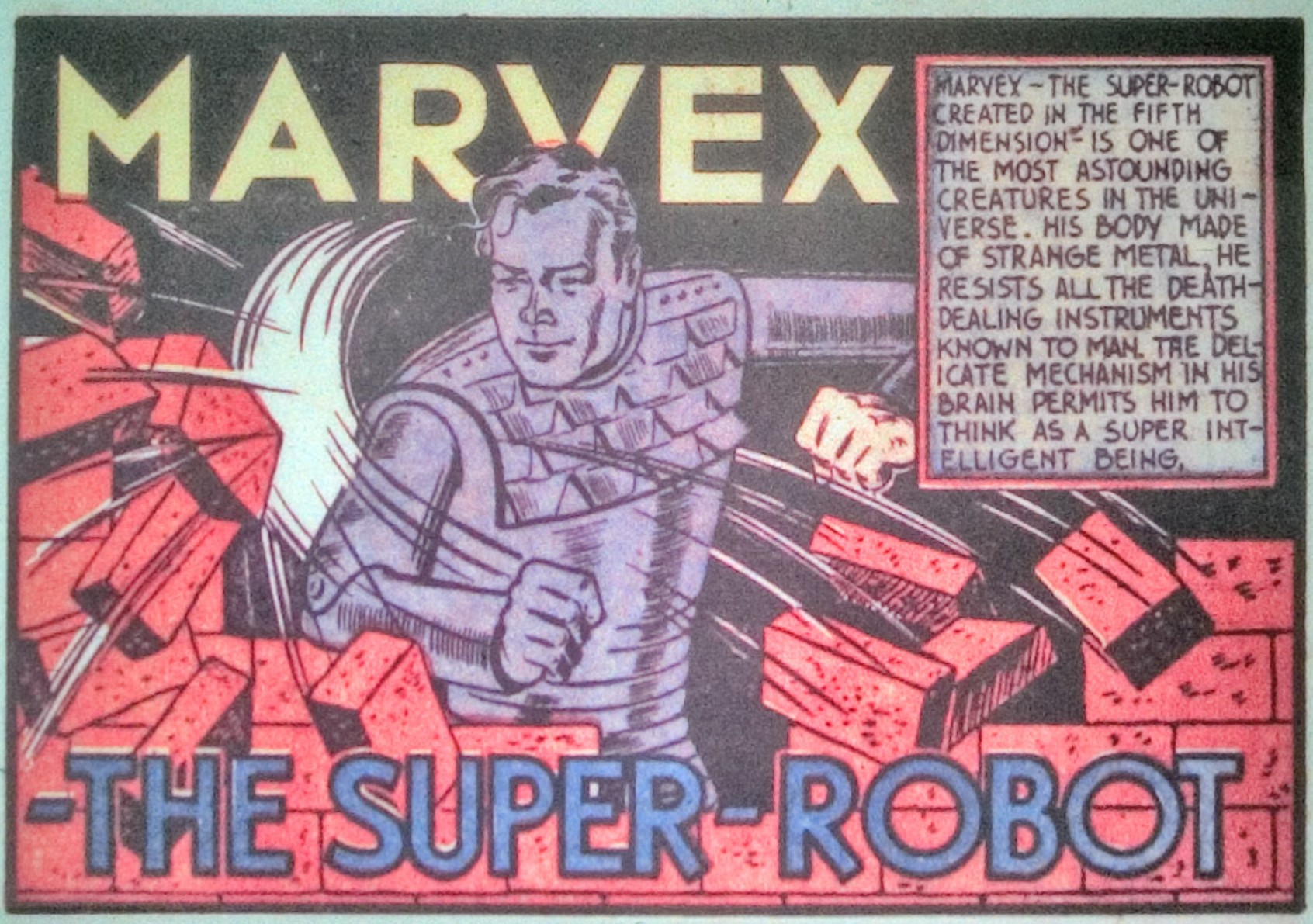
    Marvex the Super-Robot! Created to be a slave by a Fifth Dimensional jerk named Bolo, Marvex rejects his fate, kills Bolo and his associates and accidentally blasts himself to Earth while smashing up Bolo’s lab equipment.

    If you’re already aware of who Marvex is then it’s likely because of the Michael Kupperman strip featuring the character during Marvel’s 70th Anniversary run of comics, and indeed, Marvex’ propensities for cartoonish violence, shutting down romance with sudden nudity and receiving twenty dollars all make him a perfect Kupperman character.

    Sadly, the nudity and twenty dollar reward system go the way of Marvex’ hair in his second and third appearances, but he never stops yelling about being a robot whenever his companion Clara gets a bit too comfortable around him. (Daring Mystery Comics 003, 1940)

    Categorized in: Language (Superlatives – Super), Origins (Extradimensional, Robot), Supranormal Beings (Robots)

    the Falcon:

    The Falcon is Carl Burgess, assistant district attorney in an unnamed city who is kind of betraying the spirit of his office by meting out vigilante justice when he feels like the legal system isn’t working. Though he is a pretty average costumed vigilante, the Falcon has precisely four interesting things to note. The first is that his name is weirdly close to that of Carl Burgos, the creator of the Human Torch. This might be a coincidence, but still. The second is of course that he is the original Marvel Falcon but by far the least-known of the half dozen or so Marvel characters to share that name.

    Like the Eagle, the Falcon is a bit of a fashion plate or at least someone who adjusts his costume on every adventure and for the same reason: a different artist on every one of his appearances.

    Finally, the Falcon has been retroactively assigned an accessory based on an assumption, just like his fellow Daring Mystery Comics alum the Fiery Mask and his morning star. In this case, it’s that his suit gives him the ability to glide. I assume that this is because of a stylistic choice on the part of his various illustrators to have him dive down on his enemies like a falcon stooping on prey, because the suit does not come up in his handful of Golden Age appearances. (Daring Mystery Comics 005, 1940)

    Categorized in: Animals (Falcons), Day Jobs (Assistant District Attorneys)

    Marvel Boy:

    Up until about 2012 I’d have confidently said that “Marvel Boy” was one of the most commonly-shared super-hero identities in the Marvel Universe, but it seems that the concept of the legacy identity has gone through a weird mutation in the last decade or so and I am now regularly surprised to find that there are way more Wolverines or Captains America than I had previously imagined. With that in mind, we’ll revise my statement to be that there are more Marvel Boys than you might expect, like Starmans over at DC.

    This particular Marvel Boy is the Earthly reincarnation of Hercules, come down from Valhalla (?!) to aid a world threatened by fascism. His human form is named Martin Burns and like a veritable Silver Age Superboy he is born with so much physical strength that he must constantly hold himself back lest he endanger those around him and out himself as something strange and different.

    On Martin’s fourteenth birthday a mysterious stranger (who is implicitly the Roman god Jupiter) delivers a package containing his heroic costume to him and then somewhat redundantly also appears in his bedroom to really spell out his whole deal and charge him to uphold democracy etc.

    Marvel Boy is super strong, very agile and fast enough to run from New York City to Washington DC and back – carrying three grown men on the first leg of the trip – in the course of a night that also includes the aforementioned visit from Jupiter and busting up two fifth column cells.

    Both this Marvel Boy and his successor (coming up in 1942) never returned after making a single appearance, and while I can’t say just why they didn’t have further Golden Age adventures, the lack of a modern appearance for either of them is almost certainly down to the fact that their origins both revolve around a dead Hercules, who is in fact more often than not a very living second- or third-tier hero in the Marvel Universe. They’re also both named Martin Burns for some reason, which means that later handbook writers have felt compelled to differentiate them by giving them middle names based on their creators, making this one Martin Simon Burns.

    Frankly, I think that the fact that the two Marvel Boys have origins that are incompatible with both Marvel Comics continuity and also one another is terrific fodder for comic book storytelling. Both of them should be BRUNG BACK immediately, preferably in a comic that also has Hercules in it. (Daring Mystery Comics 006, 1940)

    Categorized in: Generica (Boys), Language (Superlatives – Marvels), Origin (Reincarnated God) 

    the Flying Flame:

    The Flying Flame is a red fighter plane flown for the RAF by the two-fisted American pilot Captain Red Ruff, who is also known as the Flying Flame due to his shock of red hair. During his brief comic book career, Ruff battled the Black Ace and ferreted out some spies at an airbase. (Daring Mystery Comics 006, 1940)

    Categorized in: Activities (Flying), Elements (Fire), Team Membership (RAF)

  • MINOR SUPER-HERO ROUND-UP 084

    MINOR SUPER-HERO ROUND-UP 084

    Obscure Marvel super-heroes, you say? But of course!

    Monako, Prince of Magic:

    Monako is a classic comic book magic hero in the Zatara vein, right down to the top hat, tuxedo and little mustache, though he does eventually switch to wearing a fez. His major distinction from his legion of peers is that he was brought back in a fairly recent Doctor Strange run, though as is so often the case he was dug up only to be horribly killed off.

    Monako gets an origin story in Daring Mystery Comics 004, in which he is orphaned when an Indian group referred to only as “the Cruel Tribe” ritually explode the entire caravan that he and his parents were travelling in as missionaries (this at least gives us an answer to the perennial question of why bring your young child along on such a dangerous journey: because missionaries).

    Young Monako (a last name? a stage name?) inexplicably survives the conflagration and is subsequently adopted by the chief of the Cruel Tribe, who teaches him the ways of magic. Just why he does this is not explored and will never be, because the British eventually show up to massacre the entire village and send young Monako back to England. Were he a going concern for the seventy-odd years between his final Golden Age appearance and his death, I’m sure that the question of just how a whole group of people with powers similar to the nigh-omnipotent Monako were killed with simple firearms, but alas, such was not the case. (Daring Mystery Comics 001, 1940)

    Categorized in: Locations (Unrelated Name), Power Categories (Magic), Royalty (Princes)

    Phantom of the Underworld: 

    “Doc” Denton is a surgeon-turned-detective who helps the police round up a gang boss named Perrone in his sole recorded adventure. I one hundred percent am including him here because “Phantom of the Underworld” is such a terrific name, even if nobody calls him that in-story. (Daring Mystery Comics 001, 1940)

    Categorized in: Day Jobs (Private Detectives), Locations (the Underworld), Supranormal Beings (Phantoms)

    Trojak the Tiger Man: 

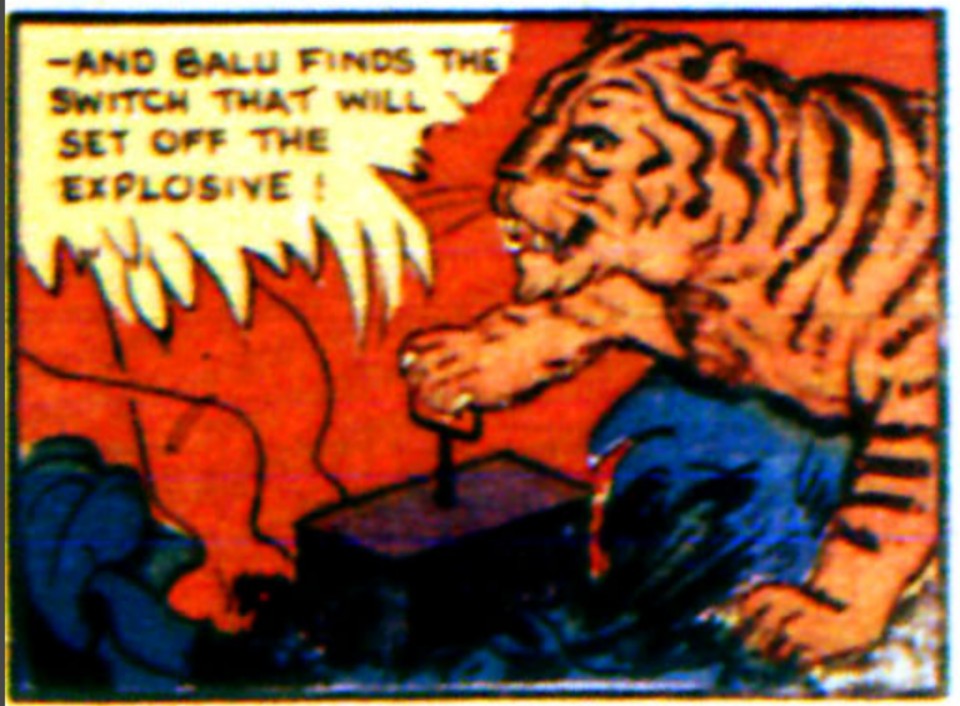
    Trojak, orphaned son of a jungle explorer who made the inexplicable yet very popular decision to bring a baby along with him on his travels (perhaps as a difficulty boost? Was Trojak’s father a gamer?), has grown up among a tribe his father died in defense of. As is so often the case in adventure literature, being a white guy in the jungle has made Trojak both stronger and cooler than everyone else, plus he can talk to animals like Balu, his geographically-anomalous tiger companion. (Daring Mystery Comics 002, 1940)

    (he is a very intelligent tiger)

    Categorized in: Animals (Tigers), Generica (Mans), Origin (Orphan Raised in Jungle)

    Tigerman:

    “Trojak the Tiger Man” becomes “Tigerman” for its final instalment, and it’s a bit of a toss-up on whether the two characters are supposed to be the same or not. Both Trojak and Tigerman are orphaned youths who were raised by jungle tribe and who now adventure while in the company of a tiger named Balu, sure, but crucially “Trojak” is set in Africa while the Tigerman roams India. You’d be forgiven for assuming that Tigerman was Indian but no, he’s American by birth – he’s just the rare near-naked jungle guy who has the ability to get a tan. 

    The one thing that could have cleared up the mystery of whether these two are the same guy or not would be more adventures featuring either one of them and sadly there are no more (Daring Mystery Comics 006, 1940)

    Categorized in: Animals (Tigers), Generica (Mans), Origin (Orphan Raised in Jungle) 

    K-4 and his Sky Devils:

    K-4 is the code name of a “flying spy,” and WWI/Spanish Civil War fighter ace (the youngest WWI ace, according to the text box, which would make him at most 18 as far as I can tell) who leads the Sky Devils, comprised of fellow WWI ace René d’Auvergne and makeup expert Ronald Wolverstone-Clodd. Some of the usual fun of the multinational team set-up is missing here because K-4 spends a lot of his time doing solo missions. (Daring Mystery Comics 002, 1940)

    Categorized in: Alphanumeric (K, 4), Origins (WWI vets), Supranormal Beings (Devils)

  • MINOR SUPER-VILLAIN 933: THE RIPPER

    (Silver Streak Comics 011, 1941)

    For the third issue in a row, a souped up super-plane takes to the skies of probably-California to menace law-abiding aviators. The Ripper, like the Heater before it, is a vehicle with a singular name being run by a group, which is a mildly interesting taxonomic trend that unfortunately does not continue to occur.

    Where the Wingers and the Heater were armed with sci-fi ray cannons, the Ripper relies on a comparatively low-tech blade that is used to slice up aircraft and parachutes alike. Ironically, this is a far less believable means of attacking a plane on the wing than a thermodynamic ray of some sort. Just what kind of flying does the Ripper’s pilot have to be doing to slice off a wing with a comparatively short, fixed blade, anyway? Just how sharp can that thing be considering that it looks perfectly cylindrical? There are some wavy lines around the blade in precisely one panel – perhaps it’s meant to be a vibro-blade of some kind.

    Like the Heater before them, the crew of the Ripper are prepared for Cloud Curtis and his crew to interfere in their plans. In addition to the standard-issue bulletproofing, their plane is equipped with a magnetic generator to lock the Golden Bullet’s grapplers in place on their hull and knockout gas dispensers on the plane’s exterior act as a counter to Curtis’ favoured tactic of clambering onto an enemy aircraft’s exterior. Cloud and his assistants are taken into custody but not, crucially, immediately murdered.

    In contrast to the Heater, the Ripper has an actual defined goal: shut down US aviation in order to weaken the country for vague foreign agent reasons. And it’s astonishingly effective!

    Having not been murdered, Cloud and pals soon escape and take to the skies, where the Ripper crew learn the same posthumous lesson as the Heater gang before them: if you render yourself impossible to capture then you are much more likely to be killed outright. One shattered propeller later, the skies are safe for trainee pilots once more.

    Categorized in: Accessories (Aircraft), Activities (Ripping), Espionage (Saboteurs)

  • MINOR SUPER-VILLAIN 931: THE HEATER

    (Silver Streak Comics 010, 1941)

    Having so recently weathered the cold-based threat of the Wingers, the US aviation community is now faced with another elemental enemy in the form of the Heater, a mysterious plane that is attacking aircraft with a heat ray. Cloud Curtis, self-appointed defender of the airways, is of course keenly interested in this development.

    Unlike the Wingers, the Heater’s motivations are never explored. They could be spies, territorial smugglers, extortionists like their predecessors, any number of things. And yes: despite being a group of at least four men they are called the Heater singular, probably because it is the plane that is being referred to rather than the gang inside of it.

    Cloud Curtis’ first attempt to stop the Heater is stymied when they melt the grappling arms right off of his Golden Bullet. This marks the second out of two times that his signature move (grab ahold of a plane and then personally board it and punch everyone out) has been stymied by these uncouth plane gangs.

    Thankfully for Curtis and the other denizens of the skies, while he was trading bullets for heat ray blasts his ally Pop Whistler was back at their home base inventing a new type of plastic that not is only heatproof but reflects heat back at its source. Once the Golden Bullet is coated in this material it is a simple matter of engaging the Heater in another dogfight and they are soon treated to a dose of their own incendiary medicine.

    Categorized in: Accessories (Aircraft & Rays), Elements (Fire), Murder

  • MINOR SUPER-HERO ROUND-UP 078

    Lev Gleason characters for EVERYONE!

    Daredevil **UPDATE**:

    Daredevil had but one appearance in 1940, so it’s no surprise that the character still had some changes and revisions to go once 1941 rolled around. Firstly, his costume gets an update, with yellow swapped out for red and the complicated “DD” design on the abdomen dropped entirely.

    The most dramatic change, however, is that the Daredevil can now talk. Just how Bart Hill’s traumatic muteness was alleviated is unaddressed – I’m sure that the real answer is that it was inconvenient to write around and so was quietly dropped, but imagining that his successful crimefighting career allowed him to let go of the past is nice.

    Finally, Bart is now a wealthy playboy with a fiance (Tonia Saunders) who isn’t too sure about marrying this manchild after all. Thankfully, Tonia discovers the truth about Bart’s double life in her first appearance, because the Clark/Lois dynamic can get a bit tedious when grafted onto every super-hero’s relationship by default.

    Our final update from Silver Streak Comics 007 is this revelation that the Daredevil’s mastery of the boomerang is so complete that, when thrown by the Claw, he can cause his own body to act like one. This here might just be a new contender for inclusion in lists of obscure and ridiculous super powers, folks.

    In Silver Streak Comics 008 & 009, Daredevil employs a couple of high-tech fighter planes called “the Airdevil,” which a top-notch example of a jokey super-accessory name. Both planes are destroyed during Daredevil’s clashes with the Claw, and he seems to have given up on the idea of the custom plane, at least for the year 1941.

    In Silver Streak Comics 015 Daredevil employs a decoy double named Chester to help in the capture of a villain named the Serpent. Who is Chester? No idea. Will he ever return? Probably not.

    Finally, in Daredevil Comics 002, Daredevil engages in what I would say is some Spider-Man style super-hero quipping as he battles this horde of silent men. Not that super-heroes aren’t constantly mouthing off, mind you, but it doesn’t have this kind of flow. I shall be looking out for more of this kind of patter to see how long it takes to become an established thing.

    Categorized in: Accessories (Airplanes), Day Job (Wealthy Socialite)

    Presto Martin: 

    Presto Martin, though voted “Least Likely to Succeed” in college, is now Captain of Detectives in the NYPD. More importantly for our purposes, he is a master of disguise who is for instance more than willing to take the place of a heavyweight boxer in the ring if it means that he can solve a big case. (Silver Streak Comics 007, 1941)

    Per Silver Streak Comics 008, Presto is aided in his work by a super-moldable plastic putty of his own concoction.

    Categorized in: Day Job (Police Captain), Powers (Master of Disguise), Team Membership (NYPD)

    Zongar, the Miracle Man:

    Zongar, the Miracle Man, is a functionally-omnipotent magical adventurer like so many of his peers, but rather than casting spells per se Zongar uses a mystical amulet to command the spirit Abaraxx to do his bidding. This might have lead to some interesting developments over time if, for example, a nogoodnik were to get ahold of the amulet but alas, Zongar had only one recorded adventure. (Silver Streak Comics 007, 1941)

    Categorized in: Abstract Concepts (Miracles), Accessories (Amulets)

    Cloud Curtis: 

    Dashing young aviator Cloud Curtis has developed the super plane Golden Bullet, which he flies both as a job and against the enemies of the US and which has one of the goofier features of any comic book super plane in the form of that big propeller located halfway down the fuselage. Curtis is assisted by the apelike Crusher McCoy and the avuncular Pop Whistler as he keeps the airways safe from a series of increasingly unlikely airplane-based threats. (Silver Streak Comics 007, 1941)

    Categorized in: Accessories (Airplanes), Day Job (Aviators)

  • MINOR SUPER-HERO ROUND-UP 076

    Yet more super-heroes for your delectation.

    the Black Widow:

    There are a lot of Black Widows in comics, but Linda Masters is the first one who I have encountered who is actually a widow and not just a woman named after a spider as a way of emphasizing how creepy-deadly she is. And since her husband was Murdered by a Crime™, she expresses her grief by becoming a crimefighter.

    We don’t see a lot of the Black Widow’s modus operandi during her single recorded adventure, but she is handy with a gun and a judo throw. She spends most of her time standing outside in an overcoat in the rain, so we don’t even get much of a chance to observe her costume aside from the fact that it includes a black turtleneck with a particularly leggy spider logo on it. 

    She is also at least a better detective than the police in whatever NYC-alike city she calls home, given that the entirety of her first adventure takes place while they are misreading the directions she gave them to the villain’s hideout that she has already found. (Cat-Man Comics 001, 1941)

    Categorized in: Animals (Arachnids), Colours (Black), Family (Widows)

    the Flying Legion: 

    Headquartered out of a hollowed-out mesa, this combination air rescue/air vigilante corps is notable mainly for the fact that every single member seems to have a nickname, from leader Chute Harmon to his aides Wolf, Slip and Piston. Perhaps it’s part of the onboarding process. (Cat-Man Comics 002, 1941)

    Categorized in: Generica (Legions), Professions (Aviators)

    the Pied Piper: 

    The Pied Piper is a super-hero whose origin combines two popular tropes: that of the member of the legal system who discovers that the justice they seek can only be found outside of the normal bounds of the law and that of the framed person who must operate outside the law to clear their name (BONUS: he is also an example of a much less common trope, that of the super-hero who has a little mustache). Specifically, the Pied Piper is Stephen Prentice, a lawyer who finds himself framed twice in rapid succession and must turn to his mastery of the pipes to expose the corrupt judge and political boss behind the plot against him.

    (the second framing is for a pretty standard murder, but the first one does demand some comment. Prentice is framed for defending a guilty man for murder, with the really damning aspect being that he supposedly set out to do so while knowing that he was guilty. While I am admittedly not a lawyer I cannot imagine that this would be enough to ruin someone’s career, even in 1941. Which is probably why they doubled down and also framed him for murder, now that I think of it)

    As his name implies, the Pied Piper employs flute and recorder type instruments in his crimefighting, and while his first adventure heavily implies that he is using the power of suggestion to make his foes believe that the music has the power to compel them, subsequent stories make it clear that he is armed with one or more magical instruments acquired as part of his flute-collecting hobby.

    Some examples of just what a man can do when armed with a magical flute:

    – knock a man unconscious

    – compel a man to give a confession

    – kill animals 

    – collapse buildings 

    It really is a very useful item. (Cat-Man Comics 003, 1941)

    Categorized in: Accessories (Musical Instruments), Famous Figures (Literary), Professions (Law)

    the Hood: 

    The Hood, in reality FBI agent Craig Williams, is a non-super-powered vigilante who had only one appearance in 1941, and while I’m sure that there is more to say about him, almost all of it will have to come in the due course of time.

    Two things I can say about him are 1. his adventures are extremely dynamic and 2. he kind of looks like the Golden Age Atom. Chew on that for a while, I guess. (Cat-Man Comics 005, 1941)

    Categorized in: Objects (Hoods), Professions (Law)

  • MINOR SUPER-HERO ROUND-UP 071

    It’s time for another round of aviator-heroes, most of whom hail from Air Fighters Comics 001, a distinguished publication that was home to many storied characters. None of those characters appear here.

    the Black Commander: 

    A little while ago I covered the character Spitfire Ace and posited that he had one of the most complicated origins in comic books, and while the origin of the Black Commander doesn’t quite manage to take the crown away from its predecessor it is written as if creators Kermit Jaediker & Harry Anderson had read my comment and taken it as a challenge. Some notes:

    • Barry Haynes, an American pilot commanding an RAF squadron, agrees to go undercover to infiltrate a Nazi spy network for one Commander Northrup. He does so by getting caught selling information to a German spy, then effecting an escape on the morning of his scheduled execution.
    • Haynes flies a stolen plane across the English channel to “defect” to the Nazis, but is spotted by the Luftwaffe and shot down over France. His body shattered and near-dead, he is rebuilt with a completely different appearance by a surgeon named Dr Gort.
    • As Barry Haynes is believed dead, the Nazis send him back over the Channel to infiltrate the RAF and pave the way for a big air raid, under the new identity of Ronald Joyce.
    • Haynes/Joyce attempts to report the Nazi’s plans to Colonel Northrup, only to discover that he had been captured by the Axis some time earlier. Since Northrup was the only one who knew that Haynes was innocent and nobody in England knows Joyce, he steals an experimental plane called the Commander (but it’s painted black, see, hence the Black Commander) and foils the attack himself. Now he’s wanted by both sides while trying to help one.

    Presumably future adventures of the Black Commander would have seen him embarking on a quest to prove his innocence and/or rescue Commander Northrup but since he never returned we must assume that he never moved on from the last place we saw him: crashing on his aunt’s couch. (Air Fighters Comics v1 001, 1941)

    the Black Sheep Squadron: 

    The Black Sheep Squadron is your classic gang of highly-skilled misfits brought together and forged into a greater whole by a charismatic leader, in this case RAF Captain Logan Black. Only replace “charismatic” with “huge jerk.”

    Aside from Black’s odious personality, main problem with the Black Sheep Squadron is that we only really get to see one misfit, the girl-crazy Gunner Wilson, who’s always sneaking off to party. The whole appeal of a set-up like this is the eccentricities of the various squad-mates, and Reclining Redhead, Smoker and Bald are just not compelling enough personality traits to carry a series. (Air Fighters Comics v1 001, 1941)

    the Mosquito: 

    The Mosquito, aka Steve Stanton, is the rare entry in the “pilot with a cool name” brand of super-hero who kind of actually has a super-power. Raised on the slopes of Chile’s Mt Aconcagua, the highest mountain in the Americas (by an American father, as the text is at great pains to point out), Stanton has a much greater tolerance for high altitudes than other pilots. He’s also a short king, which is the origin of his name. Stanton is recruited from the US Border Patrol by Army Intelligence to deal with airplane based espionage in the US. (Air Fighters Comics v1 001, 1941)

    Captain Aero: 

    Our only recurring character for today is Captain Aero, a pretty standard two-fisted pilot-adventurer who is at least loosely affiliated with the US military and whose adventures tend to veer into the fantastic, as seen above as he discovers an artificial Nazi island that has been capturing Allied bombers using a super magnet and a fog generator.

    The most intriguing thing about Captain Aero is of course his name: is it a code name or one of comics’ many cases of nominative determinism?  (Captain Aero Comics 001, 1941) 

  • MINOR SUPER-HERO ROUND-UP 070

    MINOR SUPER-HERO ROUND-UP 070

    No more of those fancy-pants vigilantes that you’ve had a chance to have heard of: here’s some real minor super-heroes for you:

    the Rainbow: 

    The Rainbow, aka Jim Travis, may just be the first super-hero whose origin involves reading a comic book and taking inspiration from it, but unlike the other examples of this that I can think of Jim reads less like someone finding a solution to a problem that they have and more like one of those guys who is convinced that they could score a point off of a professional athlete if they tried. Most of his motivation honestly seems to come from a desire to prove his girlfriend wrong when she says that his idea is not good. 

    To his credit, Jim does put in a pretty good show as the Rainbow. He hops around the rooftops and foils some crooks with a few timely punches. Though the real-world reason that he only made one appearance was the fact that Centaur Comics was a very short-lived phenomenon that tailed off pretty sharply in 1941/1942, it is very tempting to imagine that the Rainbow’s second outing ended in some sort of career-ending and unpublishable disaster.

    Finally, the name: while the natural assumption is that Jim called himself the Rainbow after assembling such a multicoloured outfit (and making some real choices, too! The barely laced-up shirt, the cape depending from the cowl mask, the footie tights… this is one of the more eccentric costumes in comics, if only at a second or third glance), I personally think that the name was chosen solely in order to make the above very poor virtually incomprehensible joke. (The Arrow 003, 1941)

    Cosmo Mann: 

    Cosmo Mann is a scientific adventurer who has developed an extremely bulky ray gun with three different modes: a “Sun Ray” capable of vaporizing a tank, a paralysis ray and an ill-defined “G Ray” that seems to both increase the mass of the bullets being fired at him in the above demonstration and also melt them somehow. He also has a cool personal flight suit called the Sun Ray Suit that he dons in his second appearance to rescue his cigar-chomping aide Archy from the diabolical Commander Darke.

    Like all Progressive Publications characters, any enthusiasm I feel toward Cosmo Mann is tempered by the fact that he only ever appeared in three comics, one of which is currently lost to the ages. Still, I have to admit that he is a pretty cool guy. (Bang-Up Comics 001, 1941)

    Buzz Balmer: 

    Buzz Balmer is a young aircraft enthusiast whose father has just perfected his Minus-Ray shrinking device, and thanks to his youthful enthusiasm he ends up bounding directly into the Minus beam and becoming permanently shrunk to a few inches tall.

    Thanks to his guilty conscience, Professor Balmer makes sure to equip him with the very latest in shrunken aviation technology so that he can fly around the countryside making up excuses to kill the wildlife for fun. Eventually – perhaps thanks to all the favours that his dad has been calling in to procure ever-faster fighter planes – military intelligence gets wind of Buzz and recruits him as an asset. His second and final appearance is spent tooling around Europe for the Army.

    The most vexing thing about Buzz Balmer is that I want to say that his name is a pun on “buzz bomber” but I can only really find evidence of v1 Rockets being called that and they don’t start being used for three more years. While it seems like the term might have been used for something before that, any further web-based research is hampered by the popularity of both the Sonic the Hedgehog enemy and novelty fishing lures that also use the name. (Bang-Up Comics 001, 1941)

    Lady Fairplay: 

    Lady Fairplay, the “Goddess of Chastisement,” is actually Mary Lee, a mild-mannered schoolteacher given super powers by the never-seen Professor Amazo. I find her costume quite charming, particularly the scale-mail skirt.

    Here’s the thing about Lady Fairplay: she is a perfectly generic super-hero. She is super fast, super strong, agile enough to climb up the side of a plane while it is in flight. She drives around in a super car and ducks out of her day job to fight crime at the drop of a hat. 

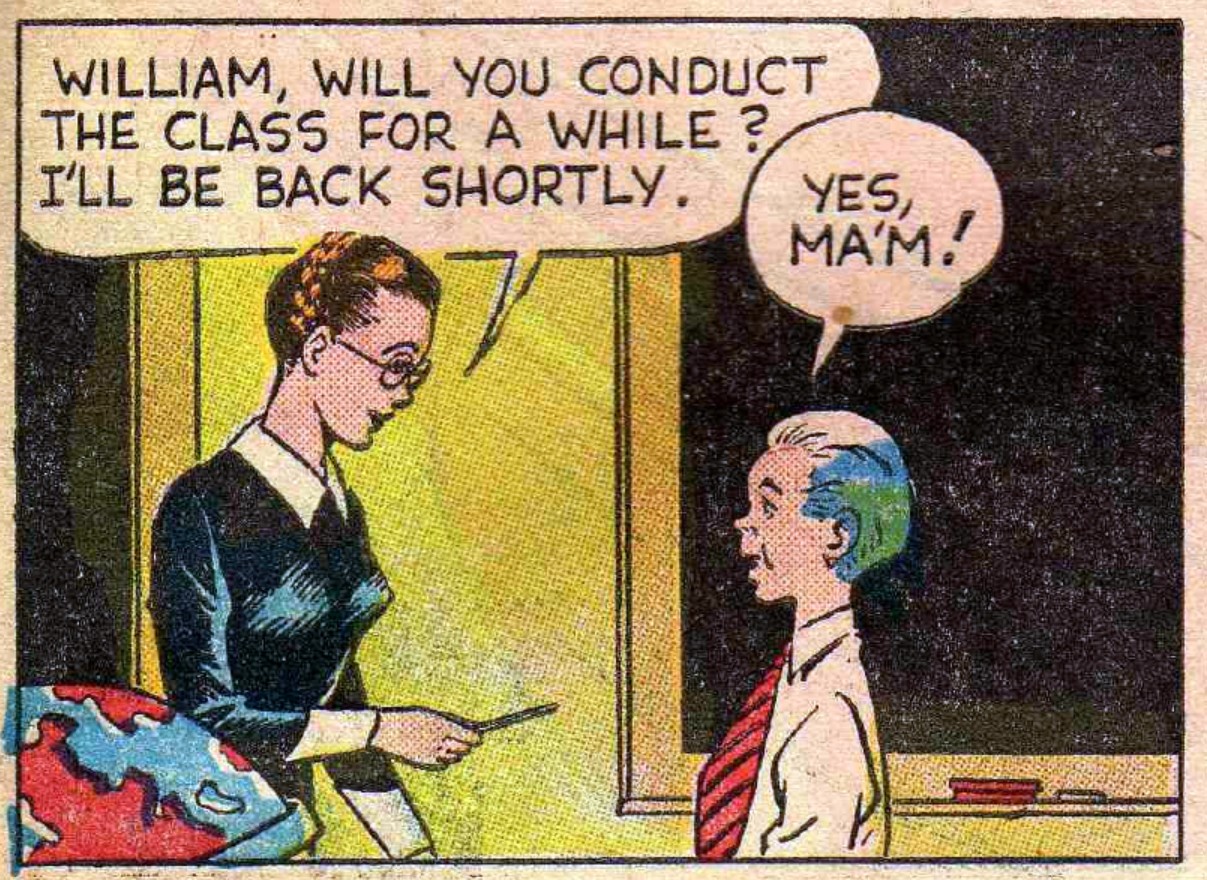
    Perhaps the most extraordinary thing about Lady Fairplay is that she just leaves some kid named William in charge of her class while she runs off to fight crime. Good luck on the bullying, William! (Bang-Up Comics 001, 1941)