The Curse of Skeleton Munroe

Category: cult

  • MINOR SUPER-VILLAIN 978: THE BLACK LEGION

    (The Flame 007, 1941)

    The Black Legion is a mysterious cult who recruit members by sending them a sternly-worded letter through the mail. Presumably they have some way of researching their potential inductees to screen for susceptibility to peer pressure and so forth, because the initiation process involves carving a large letter D into your own chest while swearing fealty to the cult’s leader, the skull-masked Master of Death.

    The Black Legion takes its vows seriously, as member Graves finds when he tries to leave and is brutally murdered. Even Linda Dale, the niece of Black Legion co-leader Emma Dale, is almost killed when she asks a few too many questions about the secret ceremonies taking place in her basement on a regular basis. Lucky for her, then, that she has just become a member of the Flame’s supporting cast, as has Pug, the newest prospective member of the cult.

    So just what is the deal with the Black Legion? What ethos they espouse or dark deity they serve? What, in short, is the point of all this? As the Flame learns after busting the place up, it’s all a huge scam. Emma Dale and the Master of Death have been recruiting gullible fools to the organization and then pocketing the mandatory membership fees, and making even more money off of sales of the mandatory green velour robes. It’s a shocking indictment of the state of comic book cults.

    Categorized in: Colours (Black), Fraud (Con Artists), Misc (Cults)

  • MINOR SUPER-VILLAIN 977: THE HOODED MEN

    MINOR SUPER-VILLAIN 977: THE HOODED MEN

    (The Flame 006, 1941)

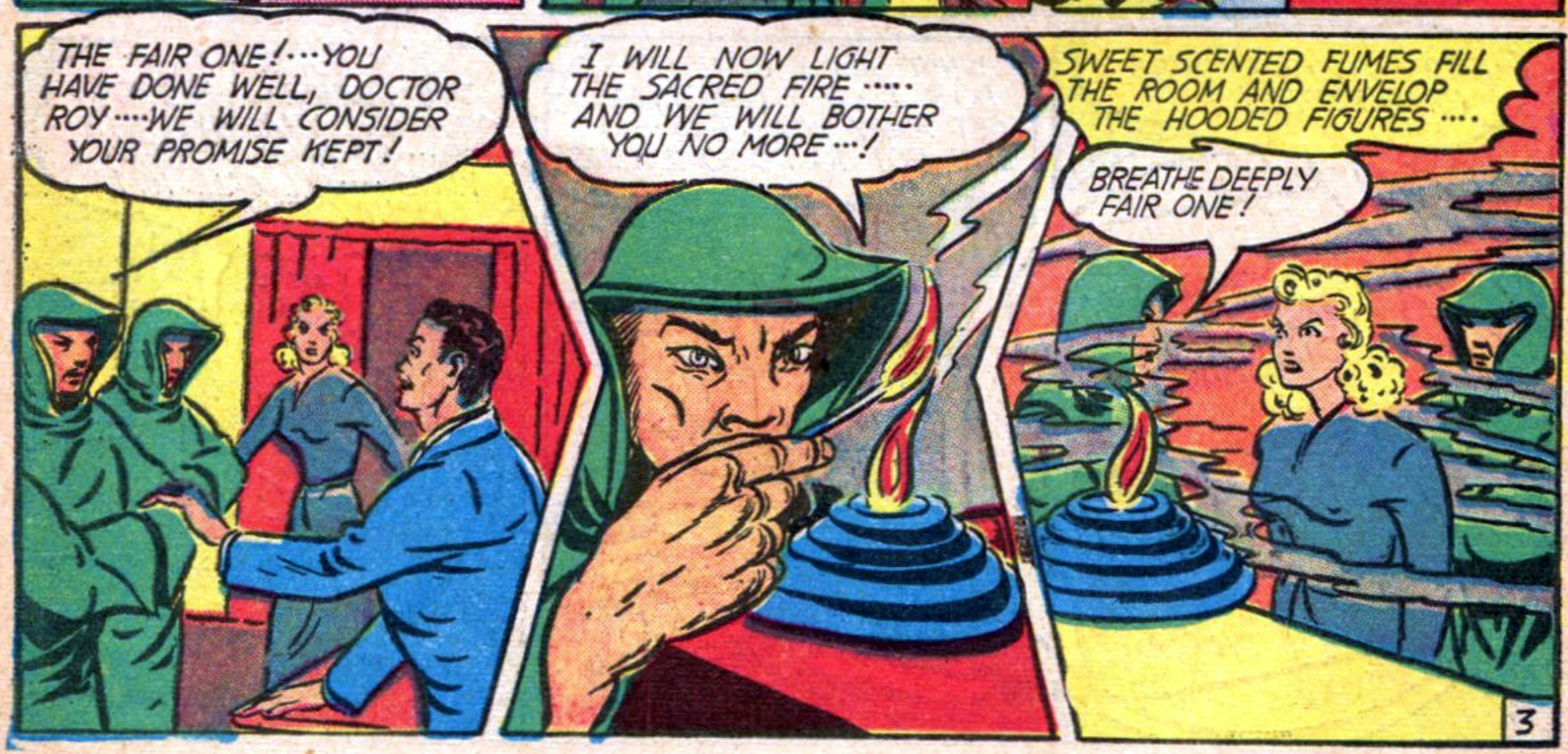
    The Hooded Men are a cult of Tibetan fire worshippers who show up one day and kidnap the daughter of the Flame’s friend Doctor Roy. This is a huge coincidence, as the Flame (as I’m sure you all remember) is also a member of a sect of Tibetan fire worshippers! How lucky for Doctor Roy and his child, No First Name Given!

    The Flame is able to follow the cult back to Tibet thanks to the fact that he, like they, can teleport himself through fire. Once there, he engages them in thrilling hand-to-hand combat and sends them all plummeting to the bottom of a cliff to explode, and while history tells us that attempting to settle which religion is best through violent conflict is a net negative proposition there is something very satisfying about this in a strict Fire Worshippers Power Ranking kind of way.

    So just why did the Hooded Men show up to steal Nameless Girlchild Roy anyway? Turns out that the Hooded Men offered Dr Roy shelter while he was backpacking around Asia in his youth and he had to promise that they could have his firstborn child in order to not be sacrificed himself, and he subsequently just… failed to mention this to either the child in question or his good friend who might be able to offer some crucial insight. Father of the year, folks.

    Categorized in: Misc (Cults), Origin (Ancient Tradition Followers), Powers (Elemental Teleportation)

  • MINOR SUPER-VILLAIN 876: THE CULT OF ANKKAMAN

    (Zip Comics 006, 1940)

    Zambini the Miracle man is visiting his old friend the archaeologist Professor Lorenz when he learns that Lorenz is potentially filled with curse-energy thanks to an ancient tomb he violated. The Professor is dismissive of these concerns, even though both his daughter Greta and Zambini himself reckon that there might be something to them.

    Sure enough, the very instant that Zambini has left the Lorenz house, two members of the Cult of Ankkaman show up and kidnap Professor Lorenz, making use of the magical Doorway of King Ankkaman (one of the items that he brought back from his travels/ that the cult are angry about him making off with) to spirit him away. 

    Sensing trouble, Zambini returns and finds Greta Lorenz in a state of hypnotic paralysis thanks to the cultists’ magics. He frees her and they use the Doorway to follow.

    Now. There are exactly two things that got me excited about this particular entry, which is otherwise a pretty standard tale of a group objecting to the theft of their cultural objects from back when that was seen as unreasonable and villainous thing to do. The first of these is the fact that the Cult of Ankkaman comes from the country of Egyptasia, which I am 90% certain based on context clues is a country exactly like Egypt, only in Asia. Why set a story that could so very easily take place in regular old Egypt in this unnecessary new country you ask? Beats me, but it’s exactly the sort of weird comics thing that I love.

    The second thing is simply that Saki, the Cult’s magic user, does his spells Zatara-style, by speaking backward, and that the close proximity of this to Zambini’s “abbi dabbi” style of spellcasting really highlight just how silly both of these affectations are.

    Prof Lorenz is weirdly calm about being sacrificed to Ankkaman, which he rationalizes as some sort of extremely visceral research. Fortunately for the field of anthropology, Zambini shows up in time to ensure that he is able to publish this experience rather than perish due to it.

    Zambini, the Professor and Greta make their way back through the Doorway of Ankkaman, which Zambini then seals by the simple expedient of adding a door to the frame. The Professor is saved! Unless the cultists make their way back to his house via conventional travel, of course. 

  • MINOR SUPER-VILLAIN 735: THE SILVER-WORSHIPPERS

    (Silver Streak Comics 005, 1940)

    Comics book cults, am I right? They’ll worship anything. Case in point: the Silver-Worshippers, who believe that silver is sacred and are pretty dang mad that it is being profaned by its use in finance and currency. They also very frustratingly do not seem to have a name that they use for themselves, so the Silver-Worshippers will have to do.

    But just how to remove the sacred silver from the hands of the heathen financiers? Why via a series of bank robberies, of course! The Silver-Worshippers devise a system so foolproof that they use it upwards of thirty-five times: set off a big explosion and/or fire on the edge of town and then rob the town bank of all of its silver while the emergency services are busy.

    Of course, the Silver Streak is no slouch and so by the thirty-fourth or thirty-fifth silver robbery he is ready to get in on the action, zipping off to Easton, Ohio in time to help with the fire and in grand comics tradition almost catch the bank robbers so that it will be more satisfying when he gets ’em later.

    Now to reveal a little bit about the kind of person I am: I absolutely love when an old comic uses a real place (or even better: a real street address) due to the ease with which I can use modern mapping software to check out just where things supposedly happened, and of course I was overjoyed to discover that Easton, Ohio was a real place, but let me tell you, it does not have a downtown, or a bank, or indeed a fire department.

    Our adventure in geography continues, as the Silver Streak determines that the Silver-Worshippers have been writing the word DOOM in cursive across a map of the US (this is where my “thirty-five robberies” calculation comes from, by the way), and that Clayton, Ohio is the next likely stop to complete the M.

    (Clayton, Ohio is also a real place, by the way, and while it does have a small downtown that I can believe held a robbable bank in 1940 it is not directly South of Easton. What wild geography games was Jack Cole playing with us? did he just pick two names out of the air and get lucky?)

    The Silver Streak tracks the cultists sent to rob the Clayton bank back to their hidden temple and comes very close to being gruesomely killed in a wave of molten silver, but because he is a super speed character this only comes about because he clumsily knocks himself out with a bit of falling masonry.

    The Silver Streak recovers in time to not be fatally silvered and proves my usual point about speedster heroes vs regular crooks by taking on a whole temple-full of guys using only hand-thrown bricks of silver, only they turn out to actually be silvered bricks, substituted for the real thing by the cult’s leader Gregory Randil. “Just who is Gregory Randil?” I hear you cry. Why he is the owner of Randil Silver Co and he has been playing the Silver-Worshippers for chumps by having them steal for him so that he can cut down on overhead. And to forestall any further questions: no, Randil has never appeared or been mentioned in the comic prior to his unmasking. This is the definition of an unfair mystery!

    The Randil Silver Co. deception of course does not go down well with the room full of Silver-Worshippers, and the Silver Streak has to bop every one of them into unconsciousness before hauling them off to jail.

    NEXT DAY ADDENDUM: Okay, here is a bonus thing about me. Sometimes I get so excited and full of pride in myself for figuring something out that I overlook the obvious. Yes, Easton and Clayton are real places in Ohio, as I so smugly pointed out, but it’s a Golden Age comic book – if you see a place name one of the things you have to assume is that there is a simple substitution going on. Forget Easton and Clayton, I should have checked for a Weston and assumed that it was Dayton, and when I did in fact do so, the line between them was almost perfect for the finale of a cursive “m”. Weston even has a little downtown which, while it doesn’t appear to have many buildings over two stories, probably had a perfectly lootable bank in 1940. Just a reminder for me to stay humble.

  • MINOR SUPER-VILLAIN 735: THE SILVER-WORSHIPPERS

    (Silver Streak Comics 005, 1940)

    Comics book cults, am I right? They’ll worship anything. Case in point: the Silver-Worshippers, who believe that silver is sacred and are pretty dang mad that it is being profaned by its use in finance and currency. They also very frustratingly do not seem to have a name that they use for themselves, so the Silver-Worshippers will have to do.

    But just how to remove the sacred silver from the hands of the heathen financiers? Why via a series of bank robberies, of course! The Silver-Worshippers devise a system so foolproof that they use it upwards of thirty-five times: set off a big explosion and/or fire on the edge of town and then rob the town bank of all of its silver while the emergency services are busy.

    Of course, the Silver Streak is no slouch and so by the thirty-fourth or thirty-fifth silver robbery he is ready to get in on the action, zipping off to Easton, Ohio in time to help with the fire and in grand comics tradition almost catch the bank robbers so that it will be more satisfying when he gets ’em later.

    Now to reveal a little bit about the kind of person I am: I absolutely love when an old comic uses a real place (or even better: a real street address) due to the ease with which I can use modern mapping software to check out just where things supposedly happened, and of course I was overjoyed to discover that Easton, Ohio was a real place, but let me tell you, it does not have a downtown, or a bank, or indeed a fire department.

    Our adventure in geography continues, as the Silver Streak determines that the Silver-Worshippers have been writing the word DOOM in cursive across a map of the US (this is where my “thirty-five robberies” calculation comes from, by the way), and that Clayton, Ohio is the next likely stop to complete the M.

    (Clayton, Ohio is also a real place, by the way, and while it does have a small downtown that I can believe held a robbable bank in 1940 it is not directly South of Easton. What wild geography games was Jack Cole playing with us? did he just pick two names out of the air and get lucky?)

    The Silver Streak tracks the cultists sent to rob the Clayton bank back to their hidden temple and comes very close to being gruesomely killed in a wave of molten silver, but because he is a super speed character this only comes about because he clumsily knocks himself out with a bit of falling masonry.

    The Silver Streak recovers in time to not be fatally silvered and proves my usual point about speedster heroes vs regular crooks by taking on a whole temple-full of guys using only hand-thrown bricks of silver, only they turn out to actually be silvered bricks, substituted for the real thing by the cult’s leader Gregory Randil. “Just who is Gregory Randil?” I hear you cry. Why he is the owner of Randil Silver Co and he has been playing the Silver-Worshippers for chumps by having them steal for him so that he can cut down on overhead. And to forestall any further questions: no, Randil has never appeared or been mentioned in the comic prior to his unmasking. This is the definition of an unfair mystery!

    The Randil Silver Co. deception of course does not go down well with the room full of Silver-Worshippers, and the Silver Streak has to bop every one of them into unconsciousness before hauling them off to jail.

    NEXT DAY ADDENDUM: Okay, here is a bonus thing about me. Sometimes I get so excited and full of pride in myself for figuring something out that I overlook the obvious. Yes, Easton and Clayton are real places in Ohio, as I so smugly pointed out, but it’s a Golden Age comic book – if you see a place name one of the things you have to assume is that there is a simple substitution going on. Forget Easton and Clayton, I should have checked for a Weston and assumed that it was Dayton, and when I did in fact do so, the line between them was almost perfect for the finale of a cursive “m”. Weston even has a little downtown which, while it doesn’t appear to have many buildings over two stories, probably had a perfectly lootable bank in 1940. Just a reminder for me to stay humble.

  • MINOR SUPER-VILLAIN 718: MASK

    (Samson 001, 1940)

    Mask here has a fairly ordinary set of plans and goals, for Masked Criminal levels of ordinary. His associate Dr Dag has developed a super-germ and his other associate Ko has control of a death cult, and he is going to use the latter to deliver the former to a number of nearby cities as revenge for tossing him out on his ear. Plus he’s going to loot once the cities are cleared out by disease, but that’s just good business. Like I said, regular stuff.

    The really interesting things about Mask are… etymological? in nature. Firstly, as you might have noticed he has no “the” on his name. He’s just Mask, and considering the fact that we have already encountered seven separate fellows called the Mask (and four more the [Adjective] Masks), it’s a surprisingly simple way to stand out among the maskèd crowd!

    The other thing is in regards to Mask’s ally Ko, high priest of Lalore – Lalore is as far as I can tell a made-up god, in keeping with the vaguely pan-Asian setting of the story. However, Lalore’s cult fanatics are called Thugs, which is a new one on me. Thuggees/ Thugs are a real historical group (albeit one of which basically every aspect is seemingly the subject of hot scholarly debate) and a fairly popular bunch to dust off as stock villains, but a real key part of their charter is that they worship the goddess Kali. This is the first time that I can recall seeing Thug used as a kind of generic term for a cult murderer.

    Too bad for Mask (and Dr Dag and Ko and all the nameless cultists) Samson and David just happen to be travelling through the same vaguely Subcontinental area that they are plotting and scheming in and they live in a temple city so there are a lot of pillars around. Sure enough, Samson does the thing that he’s best known for doing and kills basically everyone. Tough luck, Mask.

  • PROBLEMATIC ROUND-UP 003

    This edition of the Problematic Round-Up is devoted to minor MLJ character Fu Chang and his foes.

    Fu Chang:

    Reading Charlie Chan comics has absolutely messed my head up in a specific way: because Charlie Chan is so clearly a project with the set goal of having a Chinese character who is not an overt racist Yellow Peril stereotype (while, yes, being pretty racist in a bunch of other ways) I give it more of the benefit of the doubt than I otherwise would. For instance, I just kind of skim most of what Charlie Chan says because actually parsing it is very painful. 

    The problem is, I keep automatically giving various other series featuring Chinese American detectives the benefit of the doubt, and very few of them are also earnest-but-flawed attempts to avoid the overtly racist tropes of the day. This is all to say Fu Chang and his adventures are pretty racist and it caught me off guard and I had to work through it here.

    So: Fu Chang is an American educated Chinese man (with a more Caucasian skin tone than the bright yellow Evil Chinese such as the Dragon, below) who is very dedicated to his (personal? family?) god and as a result has been gifted a chess set with “all the magic powers of Aladdin’s Lamp” (and this smearing of everything East of the Mediterranean into one big exotic mess is classic Orientalism) which in effect means that he has a bunch of little guys at hand to do his bidding.

    If there’s one fun thing about Fu Chang, it’s trying to figure out exactly what the heck kind of game this chess set could be used for. Here are the known pieces:

    – the Warrior – just a little guy, used to spy on folks

    – unnamed stage magician – has ESP or other way of locating hidden objects

    – the Little Man of Magic – a magician in the Indian mystic vein. More talkative and proactive than many others. Able to paralyze humans via magic 

    – the Doctor – healing plus some hand-to hand. Also has wings in one story

    – the Mermaid – amphibious

    – the Woodsman – tree-chopping action

    – a pilot – can fly a plane but the plane is sold separately

    – group of men in suits plus military officer and a jodhpured adventurer – engage in combat with the Tiger-Devil

    – Seen but never used: the shirtless guy, the blonde lady in the red dress, the policeman, the crook, the fat bald guy

    – winged people – obviously they can fly. As the series goes on the winged figures show up more and more until the last few adventures feature nothing but up to a couple of dozen of them.

    I suppose it’s possible that you could cobble together a complete chess set out of those. Obviously the winged guys would be the pawns, but where would the mermaid come in? Even more concerning than the fact that there might not have been a complete Fu Chang lore bible with detailed breakdowns of all the chess pieces and their powers is the constant slander of Aladdin’s lamp. Unless Fu Chang and his god have a chronic lack of imagination, this is a pretty weak showing from a fabled object. (Pep Comics 001, 1940)

    the Dragon:

    The Dragon is really notable only for his fantastic name as well as to illustrate the weird vibes-based skin-colouring in the Fu Chang comic – the more good and Westernized you are, the pinker your skin. Otherwise he’s a creep and a low-level Yellow Peril gangster. (Pep Comics 001, 1940)

    the Cult of the Tiger-Devil: 

    While I love the Tiger-Devil itself, the Tiger-Devil Cult that serves and has summoned him is some pan-Asian degeneracy nonsense straight out of Lovecraft. Serves them right for summoning a demon to conquer the world with that it gets beaten up by a bunch of little chessmen – though the Tiger-Devil has dominion over all men, the chess pieces are no men. 

    If the MLJ Universe hadn’t stopped being a continuous continuity in the early 90s it might be more significant that the Tiger-Devil ends up sealed in a jar and dropped into San Francisco Bay. Alas. (Pep Comics 002, 1940)

    the Drug-Master:

    It’s a Fu Chang sweep for this instalment of the Problematic Round-Up with Ghor here, aka the Drug-Master, a very hard-core name that I wish I could celebrate a bit more but no: he’s yet another Yellow Peril type with a bit of added spice in that he is also involved in the sinister Asian Drug Trade. Specifically, he’s bringing a powerful new drug into San Francisco’s Chinatown, one so addictive that it makes anyone his slave rather than do without it, even Fu Chang’s fiance Tay Ming. It’s so potent, in fact, that withdrawal induces a suicidal/homicidal frenzy and since the Drug-Master does not seem to be a particularly good boss, he’s letting his drug slaves go into withdrawal all over town. As is usually the case, the skills that make a criminal successful in human circles are of little use against a bunch of Fu Chang’s tiny guys and the Drug-Master ends up blowing himself to kingdom come. (Pep Comics 003, 1940)

  • MINOR SUPER-VILLAIN 591: THE CULT OF DEATH

    (Exciting Comics 006, 1940)

    The Cult of Death comes into conflict with adventurer Ted Crane and his pals as they look for their associate, Egyptologist Dr Turner, in Luxor. Despite its very evocative name, the Cult of Death seems to sort of broadly worship the concept of Ancient Egypt and resent those who would pry into its secrets – Dr Turner has in fact been killed by them for seeking the lost tomb of King Mephtet.

    Does the cult’s leader Phator shares his followers’ beliefs? It’s up for debate, but whether it is for the glory of the Cult of Death or that of himself he seeks to drive the colonial forces out of Egypt and assume control.

    For unclear reasons the keystone of Phator’s plane is the destruction of the Aswan Dam (or “Assuan Dam” as it is called here), which, granted, would flood part of Egypt. How exactly that would lead to the Cult of Death’s ascension to power is never spelled out.

    It’s a moot point anyway, as Phator has sent his two most clownish dunces to place the bomb on the dam and they end up not only blowing themselves up but only flooding the region that the Temple of Death is located in. The entire Cult is wiped out save fore Phator himself, who must face colonial justice on his own.

  • MINOR SUPER-VILLAIN 559: THE COUNCIL OF VAMPIRES

    (Wonderworld Comics 004, 1939)

    Firstly: re the first panel, I really struggled with whether to call these guys the Deadly Council of Vampires or just the Council of Vampires. Still doubting myself.

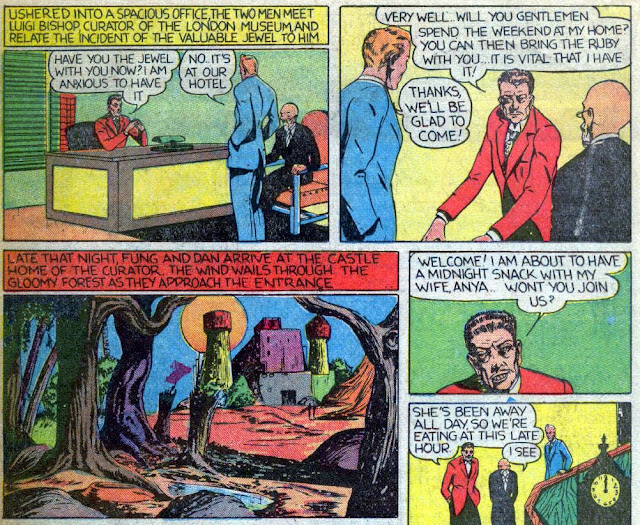
    Secondly: I am going to lay out these guys’ whole deal up front in order to properly critique them in the manner I am compelled to: they are not, despite the name, vampires. Instead, they are what seems to be a cult devoted to a vampire named Anya and they are looking for an artifact called the Vampire Ruby that will allow her to live in “our world,” which contextually seems to mean that she will be able to remain awake and alive during the daytime.

    The Vampire Ruby turns out to be in the possession of an agent of the London Museum and here’s where my critique comes in: the Singapore branch of the Council captures that agent and tortures him to death in an unsuccessful attempt to get him to give up the Ruby’s location (he had it between his toes! Very sloppy searching on the Council’s part). BUT!

    THE CURATOR OF THE LONDON MUSEUM IS MARRIED TO ANYA! If they had just left the agent alone he would have taken it directly to their Queen! And then once protagonist Dr Fung and his pal Dan Barrister show up at the museum late on a Friday to say that they have Vampire Ruby, the curator invites them to his country estate for the weekend rather than (presumably) waiting until Monday office hours for them to come back with it!

    If the curator (Luigi Bishop, btw) was just able to be cool for two and a half days he would have had the thing! Instead, he brings a famous detective to his mirror-filled home to meet his vampire bride.

    But maybe I’m being unfair to the mortals in this story. After all, they’re all in thrall to a vampire who is dumb enough to tip off Fung and his pal Dan before doing a clumsy room invasion on them when, again, just waiting a couple of days would have delivered them the ruby on a silver platter. Presumably some of that dumb impulsiveness rubbed off on the ordinary cult members.

    It all ends in a huge fire, like maybe a third of all vampire stories. Anya and her husband perish and the Singapore branch of the cult has to find something else to do on weekends.

  • MINOR SUPER-VILLAIN 342: THE MASTER

    MINOR SUPER-VILLAIN 342: THE MASTER

    (Master Comics 007, 1940)

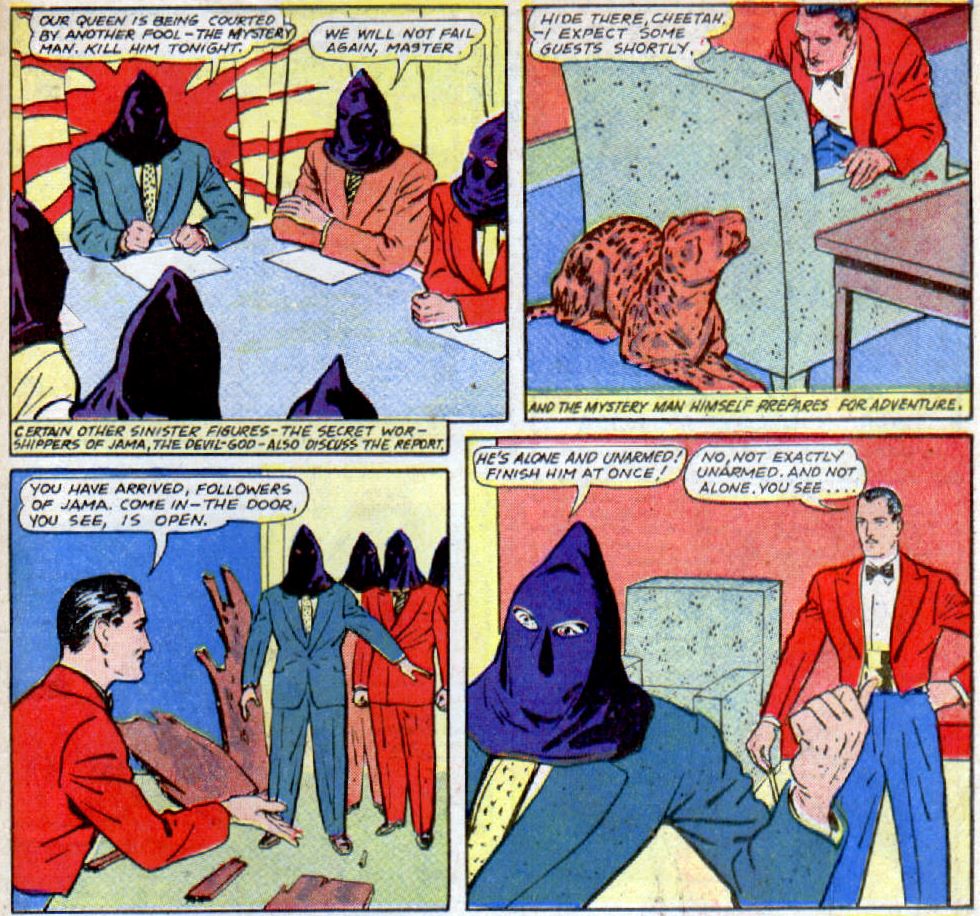
    Once more we find ourselves with a cult on our hands, and it’s my favourite kind of cult: a) completely fictional and b) just a bunch of bored rich people taking what probably started as an excuse for some light swinging or BDSM way too seriously. It’ the Cult of Jama the Devil-God, folks! Officially broken up by the US government in 1919, they have in fact been lurking in the shadows of the probably-New York upper crust since then, with a particular focus on molding wealthy orphan Imelda Loree (born on the Feast Day of Jama, parents possibly murdered by the cult) into a living goddess figure. This process seems to require either virginity or some sort of spiritual isolation because the main thing tat they do to prepare her is to murder any man who even seems like he might be interested in her.

    And of course this is where my favourite Golden Age adventurer Zoro the Mystery Man comes in, because if there’s a society event where people are trying to hook up, it’s a fair bet that he’ll be there. He witnesses the fourth “keep Imelda Loree from getting any” murder and it’s at that point that the cult is finished.

    But what of this Master character, you ask? Why he’s Murdock Daw, leader of the cult and huge creep. In classic cult leader fashion, Daw has been duping the Jama cultists for decades in order to enrich himself, and in true creep fashion he seems to have been angling to marry Imelda Loree since she was roughly two years old, and even if I’m reading things wrong he has absolutely been having her suitors murdered in order to make her desperate enough to marry him – real creep behaviour, if you ask me.