The Curse of Skeleton Munroe

Category: circus of crime

  • MINOR SUPER-VILLAIN 890: THE BLACK CLOWN

    (Wow Comics 003, 1940)

    The circus is in town! And in what must be a complete coincidence, a circus-themed villain murders a prominent banker using a python! And did I mention that the circus has a big box full of pythons as one of its attractions? 

    As someone who sincerely enjoys clown- and circus-themed villains despite having no particular affection for either in real life I have to say: do a bit better, the Black Clown. Like, try a bit harder to conceal just exactly who you are. Especially don’t leave a note on the body of the banker you just murdered that basically says “I did this because you didn’t give me, a clown-man, a business loan.” Plausible deniability, man.

    He does have a great Evil Clown costume, though.

    I’ll give the Black Clown this: at least he tries to rob the bank after revenge-killing the banker rather than merely exult in the downfall of his enemy. This robbery is also where we learn that the Black Clown has a whole circus of crime thing going on to match his theme, as he employs a sideshow thin man to slip through the bank’s bars and let the rest of the crew in.

    Though Mr Scarlet interrupts the robbery he is unable to prevent the Black Clown and his crew from escaping, as he is being crushed to death by a python at the time. Or is he? No, he is too strong.  

    The Black Clown next attempts to murder Petrie, the partner of the first victim, but at this point we are firmly in the part of the comic where the hero has the villain in his sights and none of his schemes shall profit. The Black Clown escapes with the help of some acrobats and Petrie lives on to deny loans another day.

    Probably the most interesting thing about this sequence is that the Black Clown gains entrance to Petrie’s apartment via a fellow named Tiny Tom who slips through the transom and opens the door. Given the name and the theme of the gang (and the initial shot of his legs as they slip out of sight) one would expect Tiny Tom to perhaps be little person of some kind, perhaps a sideshow performer, but he’s on-hand throughout the fight in Petrie’s apartment (that’s him in the blue suit) and he’s just about half a head shorter than everyone else. Is it just a particularly rough nickname or did the initial Tiny Tom concept get lost in the shuffle?

    Hearkening back to my initial critique of the Black Clown: it is in fact so obvious who this guy is that Mr Scarlet has to be interrupted twice in two different conversations over the course of three panels rather than learn it too early. And he doesn’t bother to ask Mr Petrie to shout it at him on the way out the door.

    After a final battle with a sideshow wild man and a chase through the trapezes the Black Clown is finally captured and OF COURSE it turns out to be Henry Parrish, the circus owner, who is OF COURSE mad about a rejected business loan. CHOOSE YOUR SUPER-VILLAIN THEME MORE WISELY is what I’m trying to get at.

    REVENGE KILLER SCORE: 1/2 

  • MINOR SUPER-VILLAIN 395: THE GREAT CAESAR

    (More Fun Comics 071, 1941)

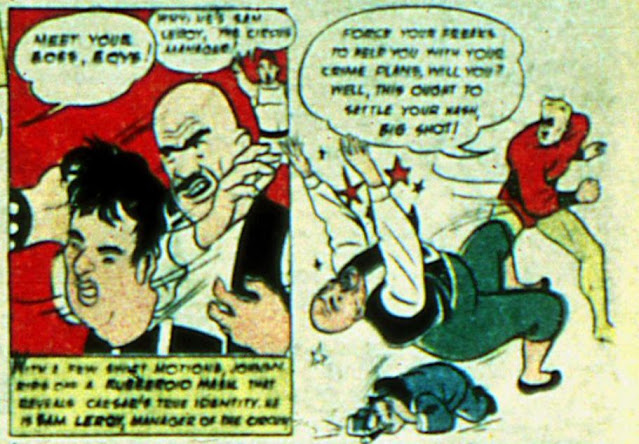
    The Great Caesar is the antagonist of the first published Johnny Quick adventure (though not, of course, the first overall Johnny Quick adventure – as revealed in the last round of Generic Costumed Villains he had a several-year career before this). He’s got the ever-popular array of circus of crime henchmen who he coerces to rob and kill at his pleasure. He also has the much dumber but just as popular “death as consequence of failure” policy which, while motivationally potent, is a staffing and HR nightmare in practise.

    The Great Caesar is eventually unmasked and revealed to be Sam Leroy, the circus manager. Hooray for Johnny Quick!

    More importantly, hooray for this marking one of the few actual uses of the term “rubberoid mask” in comics. I feel so validated!

  • MINOR SUPER-VILLAIN 300: THE RINGMASTER OF CRIME

    (Captain America Comics 005, 1941)

    Finally, FINALLY, after 300  of these guys an arbitrary milestone lines up with a reasonably cool character: the Ringmaster of Crime AKA the Ringmaster of Death. Compounding the fun of the circus of crime aesthetic is the fact that some of that good-style retconning has been going on and the Ringmaster in this tale has been made the father (and presumably later grandfather, per Marvel’s sliding timeline) of the mid-level super-villain the Ringmaster! Uh, if saying that someone is someone else’s grampaw is a retcon, that is.

    The practical upshot of this is that this Minor Super-Villain writeup also functions as Super-Villain Yearbook, 1941 for the Circus of Crime, which, as a family-owned business entity, is contiguous with the version that reappeared in the 60s even though no individual members reoccur.

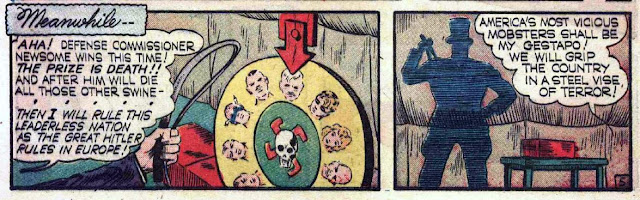
    All that said, the Ringmaster himself is a fairly regular Nazi creep super-villain. Sure he’s got the Jack Kirby villain snake-man look that we all love to hate but compared to his descendant (or, indeed, a regular circus ringmaster) he’s a positively dour dresser – his actual theming is pretty weak, when you get right down to it.

    Although we must not neglect the Wheel of Death, a perfectly cromulent random victim generator that the Ringmaster presumably stole from one of the sideshow games and spends hours/day applying all the little faces to.

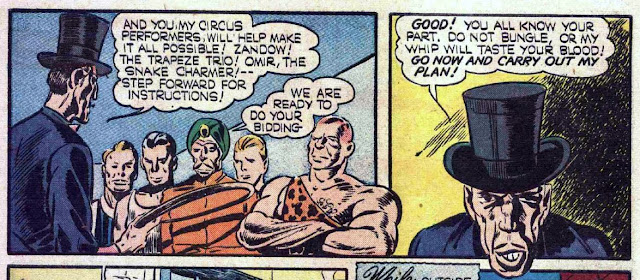
    The real star here is the burgeoning Circus of Crime. Not all of the classic archetypes are present (no tall man, no fat guy) but it’s a pretty good criminal circus lineup already. To whit:

    Omir the Snake Charmer

    the Missing Link putting in an appearance for the sideshow folk

    Tommy Thumb the circus dwarf who might be held against his will? He definitely does not want to be there

    the Trapeze Trio

    Zandow the Strong Man

    various unnamed clowns, roustabouts and elephant handlers

    It’s not quite Princess Python levels but it’s a good showing.

    The Ringmaster of course gets trounced by Captain America, and then according to lore he gets murdered after the war by Nazi loyalists for his failure. His circus endures to this day, however, so that’s something. Speaking of which:

    CIRCUS OF CRIME 1941 

    Body Count: 2

    End-of-year Status: Captured/ Defunct

  • MINOR SUPER-VILLAIN 300: THE RINGMASTER OF CRIME

    (Captain America Comics 005, 1941)

    Finally, FINALLY, after 300  of these guys an arbitrary milestone lines up with a reasonably cool character: the Ringmaster of Crime AKA the Ringmaster of Death. Compounding the fun of the circus of crime aesthetic is the fact that some of that good-style retconning has been going on and the Ringmaster in this tale has been made the father (and presumably later grandfather, per Marvel’s sliding timeline) of the mid-level super-villain the Ringmaster! Uh, if saying that someone is someone else’s grampaw is a retcon, that is.

    The practical upshot of this is that this Minor Super-Villain writeup also functions as Super-Villain Yearbook, 1941 for the Circus of Crime, which, as a family-owned business entity, is contiguous with the version that reappeared in the 60s even though no individual members reoccur.

    All that said, the Ringmaster himself is a fairly regular Nazi creep super-villain. Sure he’s got the Jack Kirby villain snake-man look that we all love to hate but compared to his descendant (or, indeed, a regular circus ringmaster) he’s a positively dour dresser – his actual theming is pretty weak, when you get right down to it.

    Although we must not neglect the Wheel of Death, a perfectly cromulent random victim generator that the Ringmaster presumably stole from one of the sideshow games and spends hours/day applying all the little faces to.

    The real star here is the burgeoning Circus of Crime. Not all of the classic archetypes are present (no tall man, no fat guy) but it’s a pretty good criminal circus lineup already. To whit:

    Omir the Snake Charmer

    the Missing Link putting in an appearance for the sideshow folk

    Tommy Thumb the circus dwarf who might be held against his will? He definitely does not want to be there

    the Trapeze Trio

    Zandow the Strong Man

    various unnamed clowns, roustabouts and elephant handlers

    It’s not quite Princess Python levels but it’s a good showing.

    The Ringmaster of course gets trounced by Captain America, and then according to lore he gets murdered after the war by Nazi loyalists for his failure. His circus endures to this day, however, so that’s something. Speaking of which:

    CIRCUS OF CRIME 1941 

    Body Count: 2

    End-of-year Status: Captured/ Defunct

  • MINOR SUPER-VILLAIN 217: THE STONE IDOL

    (Detective Comics v1 056, 1941)

    The Stone Idol is a bit of a weird one: a miner living in the ghost town of Ghost Gulch City discovers silver on town land and recruits an unscrupulous group of circus performers to aid him in driving out the town’s remaining inhabitants so as to have all the silver for themselves. The actual Stone Idol is the circus strongman disguised as a local Native American statue in order to play on the local superstitions but really it’s a group effort.

    Sadly for Mad Mack the prospector and his circus of crime, the Stone Idol’s push to take over the town coincides with Bruce Wayne and Dick Grayson’s stay in a local hotel and the entire group of them die in a mine collapse while fighting Batman and Robin. Perils of living in a comic book world, I guess.

  • SUPER-VILLAIN YEARBOOK: THE JOKER 1940

    What did the Joker get up to in 1940?

    1. Batman Comics v1 001, ‘Untitled’ **first appearance**

    The Joker really hits the ground running in his first crime-outing. He establishes his character – prideful, mercurial and on-theme – and methods that are still in his repertoire to this day

    He indulges in the old standard of warning the police ahead of time, then killing his target and stealing their named gems (uh, this is a personal term for any gem famous enough to have a name, like the Hope Diamond. they make more frequent appearances in comics than real life, unsurprisingly). Not the most creative of crime sprees by his own eventual standard, but everyone has to start somewhere. He also murders a number of people who challenge him, including a gang boss and a judge who once sent him to jail (a perfect 1/1 judge and jury revenge slaying! Aim low, kids!).

    Also established this adventure: the smiling-death style of Joker Venom, as well as:

    …the classic hideous Joker calling card design.

    But despite racking up an impressive success rate and almost killing both Batman and Robin on several occasions, the Joker ends his first outing in the slammer.

    2. Batman Comics v1 001, ‘The Joker Returns’

    That’s right, the Joker makes his second appearance in the same issue as his first! They knew he was a hot property from the very start!

    After a very dramatic escape from prison and a relocation to his secret cemetery hideout, the Joker settles into his familiar pattern: a taunting message, then theft or the murder of his enemies. In achieving the latter, he employs two of my very favourite deathtraps in comics:

    To bump off the Chief of Police: a sound-activated poison dart launcher concealed in his telephone – and he activates it by shouting his own name real loud! Tremendous style points there.

    The second is just sharpened playing cars with poison on the edges, but again there’s some tremendous style on display in the commitment to the bit of having an entire pack of jokers. Completely worth going around to every gaming supply store in Gotham to buy packs of the same brand of cards.

    A minor point in this adventure is that it highlights that the Joker is primarily a jewel thief, something that I associate with the Golden Age version of the character but that might just be me extrapolating from this issue.

    And finally we have the death of the Joker, truly one of the great on-brand death scenes of all time as he gets stabbed while struggling over a knife with Batman. It was a good run but the Joker is dead.

    OR IS HE???

    3. Batman Comics v1 002, ‘Untitled’

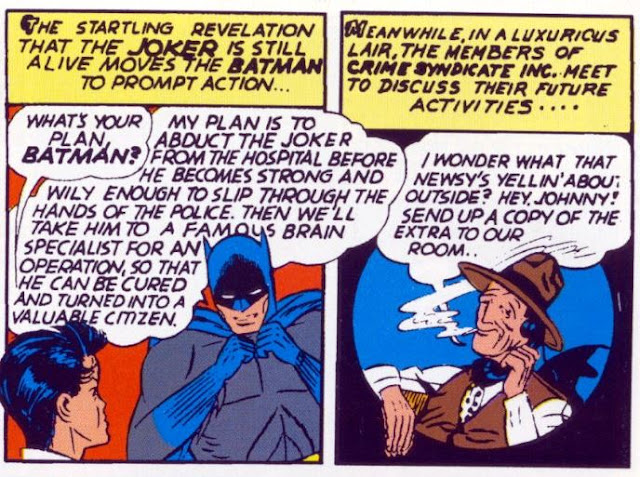
    Since the Joker actually survived the last issue, both Batman and the members of Crime Syndicate Inc  have the same idea: kidnap him while he’s being treated for his injuries, the former for some sort of gruesome lobotomy and the latter as a replacement for their recently deceased leader. More than half of the story is taken up with the dueling Joker kidnappings, after which he predictably betrays the crooks, strikes out on his own and ends up left for dead in a burning castle.

    More interesting to me is that this is the end of a sequence of events that, well, here’s a timeline:

    -Initial Joker crime spree. No time period is specified in the story but it seems a fairly rapid-fire series of crimes. Somewhere between 1 and 2 weeks, we’ll say. Joker is captured.

    -Two days later, Joker escapes. His crime spree resumes at the same pace, with at least two robberies occurring sequentially. Say another 1 to 2 weeks. Joker is seriously injured and rushed to hospital.

    -Crooks spirit Joker away following his treatment. His recovery lasts one week, after which he seemingly dies in a fire.

    What this all adds up to is a situation like Friday the Thirteenth 2 through 4, but whereas that was an astonishingly bloody weekend told over the course of three movies, this is the Joker committing at least 6 high-profile robberies and 13 murders over the course of one to two months! A huge debut for the big guy!

    4. Detective Comics v1 045, ‘The Case of the Laughing Death’

    Predictably, the Joker is not, in fact, dead! He remains alive to this day if you can believe it!

    He has, though, adopted a brand new modus operandi. Perhaps drawing on his brief time with Crime Syndicate Inc, he slips for the first time into an alter ego with the infuriating surname of Rekoj and forms a little gang of his own. Then, after his gang pulls a heist, he robs them as the Joker so that he doesn’t have to split the profits with them. IT’S A DUMB PLAN BUT IT WORKS.

    I’m willing to forgive, but only because of the great deathtraps, and this is a fun one: a record that releases Joker Toxin as it plays, thus killing even as its message is delivered. Insidious!

    At story’s end, the Joker is in the drink, presumed dead. For good? No.

    5. Batman Comics v1 004, ‘The Case of the Joker’s Crime Circus!’

    For his final outing of 1940, the Joker assembles another gang. This time, it’s one of my favourite styles of gang, the circus of crime! They specialize in casing wealthy patrons’ estates and manors and then using their circus skills to rob the various joints.

    Batman being Batman, he pieces together the clues and tracks down the Joker, who ends the adventure in the traditional manner by seemingly plummeting to his death.

    Body Count: at least 14

    End-of-year Status: Presumed Dead

  • SUPER-VILLAIN YEARBOOK: THE JOKER 1940

    What did the Joker get up to in 1940?

    1. Batman Comics v1 001, ‘Untitled’ **first appearance**

    The Joker really hits the ground running in his first crime-outing. He establishes his character – prideful, mercurial and on-theme – and methods that are still in his repertoire to this day

    He indulges in the old standard of warning the police ahead of time, then killing his target and stealing their named gems (uh, this is a personal term for any gem famous enough to have a name, like the Hope Diamond. they make more frequent appearances in comics than real life, unsurprisingly). Not the most creative of crime sprees by his own eventual standard, but everyone has to start somewhere. He also murders a number of people who challenge him, including a gang boss and a judge who once sent him to jail (a perfect 1/1 judge and jury revenge slaying! Aim low, kids!).

    Also established this adventure: the smiling-death style of Joker Venom, as well as:

    …the classic hideous Joker calling card design.

    But despite racking up an impressive success rate and almost killing both Batman and Robin on several occasions, the Joker ends his first outing in the slammer.

    2. Batman Comics v1 001, ‘The Joker Returns’

    That’s right, the Joker makes his second appearance in the same issue as his first! They knew he was a hot property from the very start!

    After a very dramatic escape from prison and a relocation to his secret cemetery hideout, the Joker settles into his familiar pattern: a taunting message, then theft or the murder of his enemies. In achieving the latter, he employs two of my very favourite deathtraps in comics:

    To bump off the Chief of Police: a sound-activated poison dart launcher concealed in his telephone – and he activates it by shouting his own name real loud! Tremendous style points there.

    The second is just sharpened playing cars with poison on the edges, but again there’s some tremendous style on display in the commitment to the bit of having an entire pack of jokers. Completely worth going around to every gaming supply store in Gotham to buy packs of the same brand of cards.

    A minor point in this adventure is that it highlights that the Joker is primarily a jewel thief, something that I associate with the Golden Age version of the character but that might just be me extrapolating from this issue.

    And finally we have the death of the Joker, truly one of the great on-brand death scenes of all time as he gets stabbed while struggling over a knife with Batman. It was a good run but the Joker is dead.

    OR IS HE???

    3. Batman Comics v1 002, ‘Untitled’

    Since the Joker actually survived the last issue, both Batman and the members of Crime Syndicate Inc  have the same idea: kidnap him while he’s being treated for his injuries, the former for some sort of gruesome lobotomy and the latter as a replacement for their recently deceased leader. More than half of the story is taken up with the dueling Joker kidnappings, after which he predictably betrays the crooks, strikes out on his own and ends up left for dead in a burning castle.

    More interesting to me is that this is the end of a sequence of events that, well, here’s a timeline:

    -Initial Joker crime spree. No time period is specified in the story but it seems a fairly rapid-fire series of crimes. Somewhere between 1 and 2 weeks, we’ll say. Joker is captured.

    -Two days later, Joker escapes. His crime spree resumes at the same pace, with at least two robberies occurring sequentially. Say another 1 to 2 weeks. Joker is seriously injured and rushed to hospital.

    -Crooks spirit Joker away following his treatment. His recovery lasts one week, after which he seemingly dies in a fire.

    What this all adds up to is a situation like Friday the Thirteenth 2 through 4, but whereas that was an astonishingly bloody weekend told over the course of three movies, this is the Joker committing at least 6 high-profile robberies and 13 murders over the course of one to two months! A huge debut for the big guy!

    4. Detective Comics v1 045, ‘The Case of the Laughing Death’

    Predictably, the Joker is not, in fact, dead! He remains alive to this day if you can believe it!

    He has, though, adopted a brand new modus operandi. Perhaps drawing on his brief time with Crime Syndicate Inc, he slips for the first time into an alter ego with the infuriating surname of Rekoj and forms a little gang of his own. Then, after his gang pulls a heist, he robs them as the Joker so that he doesn’t have to split the profits with them. IT’S A DUMB PLAN BUT IT WORKS.

    I’m willing to forgive, but only because of the great deathtraps, and this is a fun one: a record that releases Joker Toxin as it plays, thus killing even as its message is delivered. Insidious!

    At story’s end, the Joker is in the drink, presumed dead. For good? No.

    5. Batman Comics v1 004, ‘The Case of the Joker’s Crime Circus!’

    For his final outing of 1940, the Joker assembles another gang. This time, it’s one of my favourite styles of gang, the circus of crime! They specialize in casing wealthy patrons’ estates and manors and then using their circus skills to rob the various joints.

    Batman being Batman, he pieces together the clues and tracks down the Joker, who ends the adventure in the traditional manner by seemingly plummeting to his death.

    Body Count: at least 14

    End-of-year Status: Presumed Dead