We’re reading Shield-Wizard Comics, bay-bee, so here’s some stuff about the Shield and the Wizard.
the Shield UPDATE:
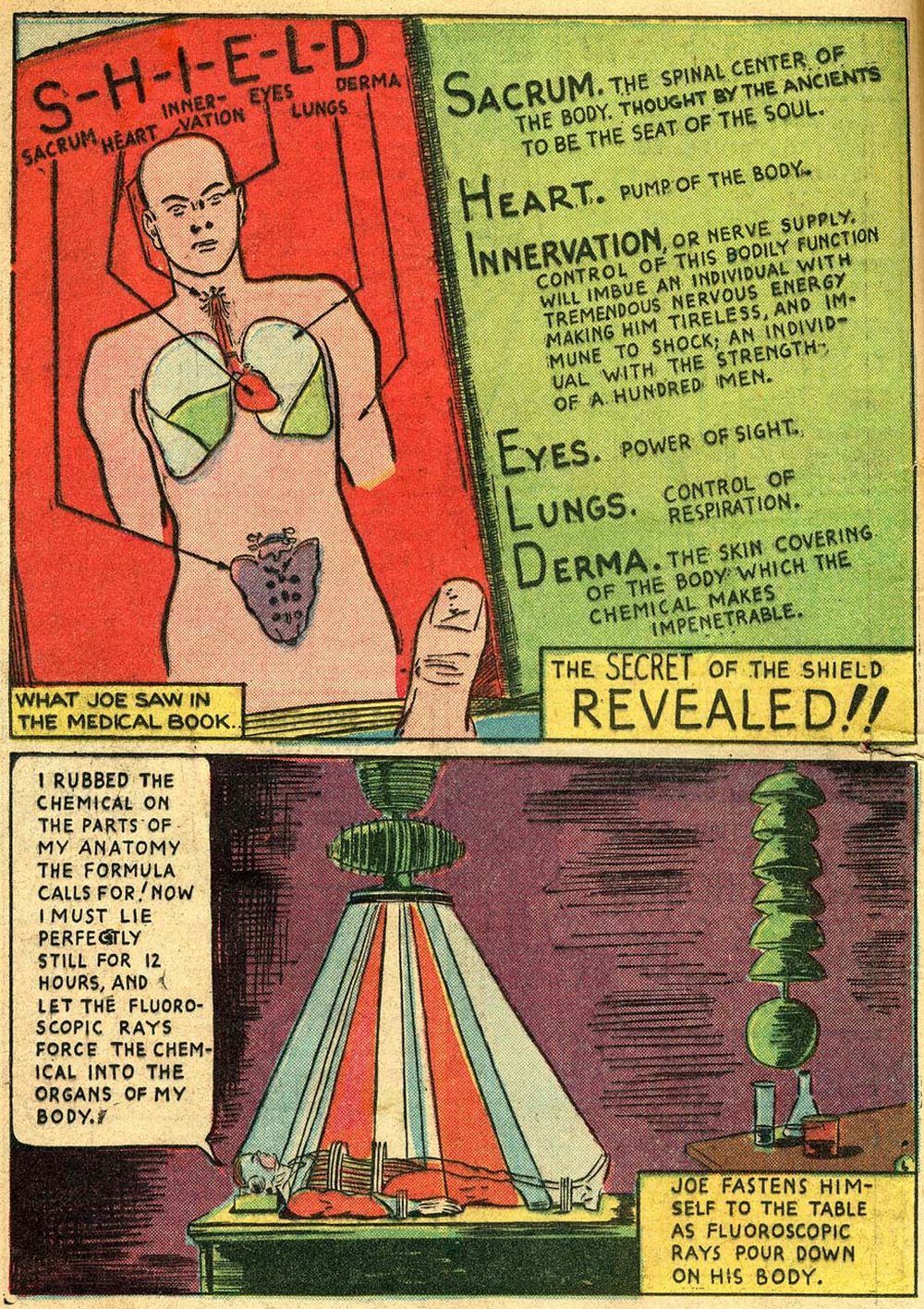
In our original write-up of the Shield, we noted that the origin of his powers shifted from being solely down to his super-suit to being more of an ingrained thing over time, and the time is now! Yes, Shield-Wizard Comics 001 provides a slightly tweaked version of the Shield’s origin, in which Joe Higgins’ father Tom was not just a US Army Intelligence agent but a gifted scientist who discovered the secret of inducing superpowers but died juuuust before being able to tell Joe the full secret.


Joe grows up to become a chemist himself but remains puzzled by his father’s last instructions to remember “anatomy formula S•H•I•E•L•D,” and with good reason, because it’s a nonsense jumble of anatomical parts that must have been put together only in the specific medical textbook that Joe eventually finds it in. But hey, he needed to find out where exactly to rub the chemical formula, and how would he otherwise know that it boiled down to “your eyes and skin, but especially the skin over your chest and groin” without that handy mnemonic device?
The all-white costume that Joe is sporting before he settles down for a 12-hour session under the fluoroscopic ray shows up in at least a few retellings of the Shield’s origin going forward and I always thought that it was a pretty snappy look. Unfortunately, the rays dye his suit (and possibly his limbs?) in patriotic colours and so we get a red-white-and-blue Shield rather than merely a white one.
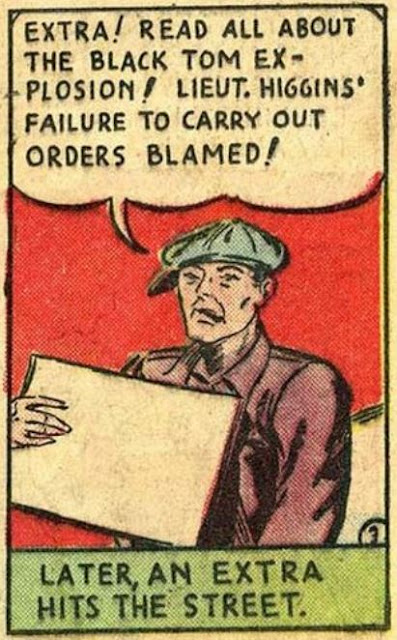
The other tweak to the Shield’s origin is that rather than merely dying in the Black Tom Explosion of 1916, Tom Higgins is blamed for it, so the Shield now not only has a Batman-style motivation (spies killed my dad and now I must battle espionage) but also a Geoff Johns-Barry Allen-Flash one (I fight crime as part of my attempt to clear my father’s name). Thankfully, his first case involves rounding up the very German Hans Fritz and forcing him to confess, thus clearing Tom Higgins’ name without it becoming a whole thing. (Shield-Wizard Comics 001, 1940)
the Wizard I:
In the original account of the Wizard’s origin in Top-Notch Comics 001, the Whitney family’s close connection to American history is pretty thoroughly emphasized, with Whitneys present and getting things done at all major American wartimes. Well, Shield-Wizard Comics took up that gauntlet and ran with it: John Whitney organized the Mayflower expedition, and his son John Whitney organized the first Thanksgiving, and his son or grandson John Whitney thought up the idea of uniting the colonies.
But that wasn’t all: the third John Whitney’s son Blane (the main line of Whitneys only have time for three male names: John, Blane and Grover. All other named Whitneys are from dead end branches of the family tree, it seems) is just as super-human as his descendant, and in fact was the first of a line of Whitney family superhumans to call themself the Wizard (adopted as an ironic name after John Whitney was burned at the stake for witchcraft after acting on his son’s extrasensory visions to protect the colonies).
The Wizard ends up making quite a big difference in the tides of the American Revolution, including:
– informing Paul Revere that the British were approaching Concord and lighting the “one if by land, two if by sea” lanterns
– showing up to participate in the fighting at Concord and turning the tide
– wielding a cannon as a sidearm in the Battle of Bunker Hill and again at the Battle of Saratoga
– saving Nathan Hale from being executed as a spy only not really because he chooses to die and be an inspiration instead
– orchestrating the crossing of the Delaware and the surprise attack on the Hessian forces
-very nearly getting Benedict Arnold before he gets away to join the British forces
– proving instrumental in the capture of Major André
– participating in several key battles, including the charge of Mad Anthony Wayne and the defeat of Cornwallis
– orchestrating the support of the French for the revolution
This original Wizard also creates a number of anachronistic inventions, including:
– a glider that seems to function a bit more like a full-fledged airplane
– a steam powered speedboat
– something in between a deep sea diving rig and a scuba suit
– a machine gun
– radio communication
– an electrified, battery-powered suit
– a self-propelled sled
– a tiny high-powered cannon
All in all, the tale of the original Wizard holds up as a classic of the form, with the form being “super-heroes added to historical events.” Comics love to showcase the great moments of US history in particular, but as a comic book must prioritize action, any super-heroic character who is present must have an extraordinary amount of influence on history. It’s great! (Shield-Wizard Comics 001, 1940)
the Wizard II:
The second Wizard, like his father the original Wizard, is essentially a carbon copy of the modern character in appearance, name (Blane Whitney, natch) and abilities. Blane Whitney II also takes after his father in his commitment to inserting himself into important US historical events, including:
– participating in various military engagements, including the defeat of the HMS Gurrierre, the Battle of Lake Erie, the Battle of the Thames (I think?) and the Battle of Bladensburg
– saving William Henry Harrison from an assassination attempt
– almost preventing the burning of the White House by the British
– planning the defense of Fort McHenry and then participating in it
– accidentally enabling Francis Scott Key to get inspired to write the Star-Spangled Banner
This Wizard also has a lot of ahead of its time technology, including:
– a version of his father’s glider
– smoke (possibly tear gas) grenades
– a dang tank
The second Wizard obviously has less of a direct impact on the events of US history, if only because the War of 1812 has fewer Stand Up and Cheer moments than its predecessor. Still, he’s in there, and there’s every indication that we’d continue on to see a Civil War Wizard and a World War I Wizard and so forth, and the stated reason that we don’t see them is that as of Shield-Wizard Comics 003, the Wizard’s sidekick Roy the Super-Boy was too popular to not feature and so it was contemporary Wizard from then on out. (Shield-Wizard Comics 002, 1940)
And speaking of Roy the Super-Boy:
Tommy the Super-Boy:
A part of any big project is choosing a methodology and then sticking to it and as my project is “reading all comics, in order” I had to figure out what “in order” meant. And while doing things in a month by month basis might be more true to the spirit of the experience, for my own sanity I opted to go alphabetical by year instead – the prep work alone for that other method hurts my head a bit to contemplate.
All that is by way of explaining that Tommy, “the Original Super-Boy of History” (aka the original wonder-boy according to that one panel) is a retroactively created predecessor of the Wizard’s sidekick Roy the Super-Boy, who we will not meet until I have read the around 180 other comics between Shield-Wizard Comics 002 and Top-Notch Comics 008. He’s your classic orphan kid who gets to hang around a super-hero because he’s scrappy, and it turns out that that’s not unheard-of in historical youths.
This particular scrappy kid, Tommy by name, is peeling potatoes when he meets an incognito Blane Whitney II and ends up discovering his secret identity after the Wizard participates in a sea battle and Tommy runs off afterward to berate Blane for cowardice, like a normal person does. And once you have discovered a super-hero’s identity, you get to become a super-hero! If you are a scrappy kid, of course. (Shield-Wizard Comics 002, 1940)