The Curse of Skeleton Munroe

Category: Bob Phantom

  • MEDIA IN COMICS 001

    I’ve often mentioned how comics as a medium has a grand tradition of not using the real names for people (see about half the entries in our collection of Real Folk in comics) places (see the grand list of fictional countries on every continent of our list of Locations) and things, so I hope that it won’t surprise you when I say that they make up all the media, too. And since I have a big list of all the made-up books, newspaper columns, stage shows and movies sitting around already I figured I should share.

    Movies:

    Lover Mine (Funny Picture Stories v2 005, 1938)

    Flying Cadets, Colossal Pictures, stunts by the Four Aces (The Funnies 021, 1938)

    Star-Dust (Funny Picture Stories v3 002, 1939)

    War Eagles, Colossal Studios (Keen Detective Funnies v2 006, 1939)

    Pilots All, Mammoth Film Company (Keen Detective Funnies v2 010, 1939)

    The Mystery of the Creeping Spook, Superbo Pictures (Keen Detective Funnies v2 011, 1939)

    White Goddess (Funny Pages v3 008 1939) 

    Newspaper Columns:

    “On Broadway” by Walt “Bob Phantom” Whitney. (Blue Ribbon Comics 002, 1939)

    Plays:

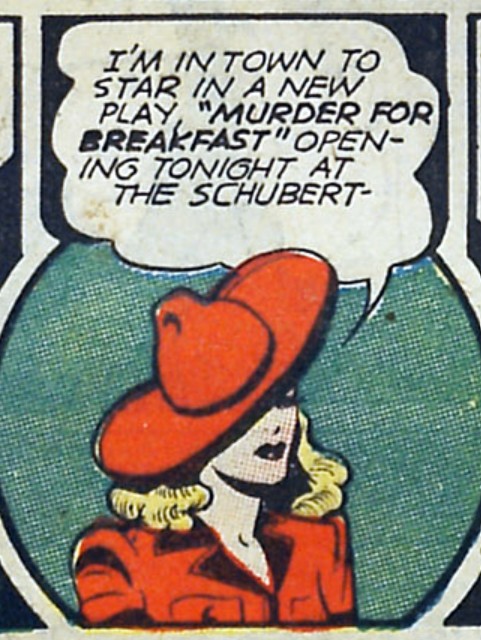
    “Murder for Breakfast”, starring Kay Kenyon, one of Presto Martin’s many Hollywood friends. (Silver Streak Comics 010, 1941)

    Songs:

    “Boogie-Woogie Blast” (Champion Comics 002, 1939)

  • MEDIA IN COMICS 001

    MEDIA IN COMICS 001

    I’ve often mentioned how comics as a medium has a grand tradition of not using the real names for people (see about half the entries in our collection of Real Folk in comics) places (see the grand list of fictional countries on every continent of our list of Locations) and things, so I hope that it won’t surprise you when I say that they make up all the media, too. And since I have a big list of all the made-up books, newspaper columns, stage shows and movies sitting around already I figured I should share.

    Movies:

    Lover Mine (Funny Picture Stories v2 005, 1938)

    Flying Cadets, Colossal Pictures, stunts by the Four Aces (The Funnies 021, 1938)

    Star-Dust (Funny Picture Stories v3 002, 1939)

    War Eagles, Colossal Studios (Keen Detective Funnies v2 006, 1939)

    Pilots All, Mammoth Film Company (Keen Detective Funnies v2 010, 1939)

    The Mystery of the Creeping Spook, Superbo Pictures (Keen Detective Funnies v2 011, 1939)

    White Goddess (Funny Pages v3 008 1939) 

    Newspaper Columns:

    “On Broadway” by Walt “Bob Phantom” Whitney. (Blue Ribbon Comics 002, 1939)

    Plays:

    “Murder for Breakfast”, starring Kay Kenyon, one of Presto Martin’s many Hollywood friends. (Silver Streak Comics 010, 1941)

    Songs:

    “Boogie-Woogie Blast” (Champion Comics 002, 1939)

  • MINOR SUPER-VILLAIN 840: THE CRAWLER

    (Top-Notch Comics 010, 1940) 

    The antagonist of the Bob Phantom story in Top-Notch Comics 010 is Joe Chizzler, who uses his low-rent marriage agency to set scumbags up with wives then murder the wives for insurance payouts. It’s a mean, low-rent, misogynistic little scheme, and the only saving grace of/reason I’m talking about it is the fact that the actual murdering is done by this character, the Crawler.

    Is the Crawler a superhuman? Just a very talented human fly? We cannot know! He crawls up walls and he pulls people out of windows and that’s it.

    Walt “Bob Phantom” Whitney figures it all out, of course, and since the police in his version of NYC are some of the most incompetent in comics it is up to him to solve the problem with his patented combination of gossip column rabble-rousing and teleportation-heavy vigilantism. The former earns him a visit from the Crawler…

     … and the latter helps him deliver a taste of the Crawler’s own methods to him. 

    Our subject is dead on page four of a six page story, but for the completionists: Joe Chizzler takes the Crawler’s death as a sign that someone is on to him and he should blow town. He bumps off his gang in order to avoid paying them their shares of the loot and then Bob Phantom shows up and throws Chizzler out of a window in the second bit of bit of poetic justice of the story. 

  • PROBLEMATIC ROUND-UP 005

    PROBLEMATIC ROUND-UP 005

    Some day we will hit Peak Problematic and I can’t decide if it will be soon or in a decade or so. 

    the White Leader: 

    Our last Problematic Round-Up featured a lot of white guys dressing up like Yellow Peril villains in order to lead Chinese gangs, something that we will unfortunately be seeing plenty more of. This here fellow follows a different path: not putting on yellowface in order to lead a Chinese gang and in fact leaning hard the other way by having them call him “the Great White Leader” or just “the White Leader” the whole time. Is this technically better? I suppose it is. Is it not by much? Certainly!

    Anyway, the White Leader is really wealthy playboy Anthony Clare, who turns out to be wealthy because he is a drug kingpin. Until he gets pinched by Detective Sergeant Burke, of course. (Startling Comics 001, 1940) 

    the Voa:

    Roger Barrow and his nephew Phillip Acton have just returned from a diamond-buying trip to Africa, and they must have been on their best behaviour because the local inhabitants of wherever they were doing their business sent them home with what is essentially a curse on their heads: the promise that the death-god Voa will follow them back.

    This is of course a classic setup for a Woman in Red whodunnit mystery, with one of the six possible suspects bumping off the rest for those sweet, sweet diamonds. It’s a classic solution to such a problem!

    To give this comic the tiniest amount of benefit of the doubt I think that the false Voa that shows up to start killing people (aka Phillip Acton, the nephew) is dressed up like some sort of mahogany idol, but what that all adds up to is that while he is not technically doing blackface, he certainly appears to be doing blackface. It’s not better, I’ll say that right now.

    Anyway, he was going to murder his whole family in order to get his hands on some stupid diamonds, so it’s not like we were under the impression that he was a good person. About the only fun thing about this one is that Acton’s chosen weapon is a blowgun that shoots poisoned crystal shards. (Thrilling Comics 005, 1940)

    Princess Ah-Ku:

    Princess Ah-Ku is a recurring villain of Bob Phantom’s and she’s just kind of generic: generically villainous, generically Yellow Peril… she even adopts an extremely generic alter ego called the Master in her first appearance. Most of her schemes involve smuggling. (Top-Notch Comics 004, 1940)

    Princess Ah-Ku returns in Top-Notch Comics 005 under yet another identity, as the Doctor, leader of a gang of kidnappers. As always, the surgical outfit-as-costume is a very strong look, though something about the reveal of Ah-Ku as the real identity of the Doctor makes me think that this was a last-minute change to spice up the adventure a bit.

    Top-Notch Comics 006 involves Ah-Ku doing some opium smuggling, with a sideline in trying to figure out who Bob Phantom is so that she can kill him off. This allows for the hilarious old bit where she captures Walt Whitney in order to grill him for information on his own alter ego.

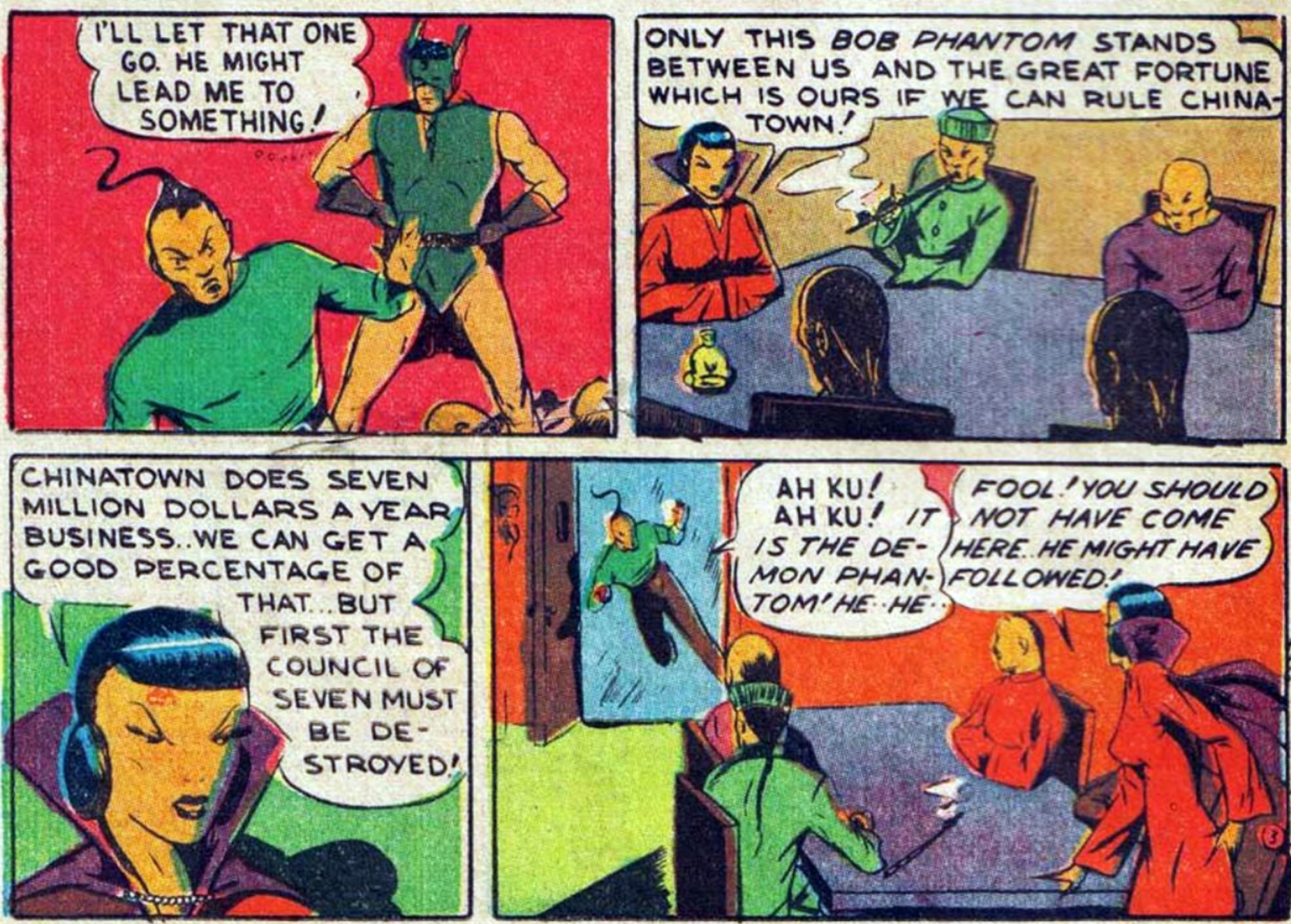
    In her final appearance in Top-Notch Comics 009, Princess Ah-Ku attempts to take over Chinatown by killing off the Council of Seven who apparently have been running it. She manages to get it down to a Council of Four before Bob Phantom catches wise and steps in.

    Princess Ah-Ku is finally brought to justice thanks to Bob Phantom’s unexpected skill with the throwing axe. Perhaps it’s for the best – at the rate her Yellow Peril levels were rising, the next time we saw Ah-Ku she might have sported a fu manchu.

    the Brahmins: 

    Kardak the Mystic and his gal-pal Lorna are just kind of wandering around the Louisiana bayous when they stumble across a Siva-worshipping cult of fanatics in a weird mystical pocket dimension. They foil the Brahmins’ initial attempts to destroy human civilization (and acquire a new companion named Balthar in the process) and then spend the remainder of 1940 on a voyage through various other magical lands on the way to confront the Brahmins’ masters, conveniently named the Master Brahmins. Look out for them in a 1941 edition of this very Round-Up. (Top-Notch Comics 006, 1940)

  • PROBLEMATIC ROUND-UP 005

    PROBLEMATIC ROUND-UP 005

    Some day we will hit Peak Problematic and I can’t decide if it will be soon or in a decade or so. 

    the White Leader: 

    Our last Problematic Round-Up featured a lot of white guys dressing up like Yellow Peril villains in order to lead Chinese gangs, something that we will unfortunately be seeing plenty more of. This here fellow follows a different path: not putting on yellowface in order to lead a Chinese gang and in fact leaning hard the other way by having them call him “the Great White Leader” or just “the White Leader” the whole time. Is this technically better? I suppose it is. Is it not by much? Certainly!

    Anyway, the White Leader is really wealthy playboy Anthony Clare, who turns out to be wealthy because he is a drug kingpin. Until he gets pinched by Detective Sergeant Burke, of course. (Startling Comics 001, 1940) 

    the Voa:

    Roger Barrow and his nephew Phillip Acton have just returned from a diamond-buying trip to Africa, and they must have been on their best behaviour because the local inhabitants of wherever they were doing their business sent them home with what is essentially a curse on their heads: the promise that the death-god Voa will follow them back.

    This is of course a classic setup for a Woman in Red whodunnit mystery, with one of the six possible suspects bumping off the rest for those sweet, sweet diamonds. It’s a classic solution to such a problem!

    To give this comic the tiniest amount of benefit of the doubt I think that the false Voa that shows up to start killing people (aka Phillip Acton, the nephew) is dressed up like some sort of mahogany idol, but what that all adds up to is that while he is not technically doing blackface, he certainly appears to be doing blackface. It’s not better, I’ll say that right now.

    Anyway, he was going to murder his whole family in order to get his hands on some stupid diamonds, so it’s not like we were under the impression that he was a good person. About the only fun thing about this one is that Acton’s chosen weapon is a blowgun that shoots poisoned crystal shards. (Thrilling Comics 005, 1940)

    Princess Ah-Ku:

    Princess Ah-Ku is a recurring villain of Bob Phantom’s and she’s just kind of generic: generically villainous, generically Yellow Peril… she even adopts an extremely generic alter ego called the Master in her first appearance. Most of her schemes involve smuggling. (Top-Notch Comics 004, 1940)

    Princess Ah-Ku returns in Top-Notch Comics 005 under yet another identity, as the Doctor, leader of a gang of kidnappers. As always, the surgical outfit-as-costume is a very strong look, though something about the reveal of Ah-Ku as the real identity of the Doctor makes me think that this was a last-minute change to spice up the adventure a bit.

    Top-Notch Comics 006 involves Ah-Ku doing some opium smuggling, with a sideline in trying to figure out who Bob Phantom is so that she can kill him off. This allows for the hilarious old bit where she captures Walt Whitney in order to grill him for information on his own alter ego.

    In her final appearance in Top-Notch Comics 009, Princess Ah-Ku attempts to take over Chinatown by killing off the Council of Seven who apparently have been running it. She manages to get it down to a Council of Four before Bob Phantom catches wise and steps in.

    Princess Ah-Ku is finally brought to justice thanks to Bob Phantom’s unexpected skill with the throwing axe. Perhaps it’s for the best – at the rate her Yellow Peril levels were rising, the next time we saw Ah-Ku she might have sported a fu manchu.

    the Brahmins: 

    Kardak the Mystic and his gal-pal Lorna are just kind of wandering around the Louisiana bayous when they stumble across a Siva-worshipping cult of fanatics in a weird mystical pocket dimension. They foil the Brahmins’ initial attempts to destroy human civilization (and acquire a new companion named Balthar in the process) and then spend the remainder of 1940 on a voyage through various other magical lands on the way to confront the Brahmins’ masters, conveniently named the Master Brahmins. Look out for them in a 1941 edition of this very Round-Up. (Top-Notch Comics 006, 1940)

  • MINOR SUPER-HERO ROUND-UP 056

    Some hot Archie/MLJ super-hero action. 

    **Hero Update** Bob Phantom:

    Perhaps in honour of his making the jump from Blue Ribbon Comics to Top-Notch Comics, Bob Phantom gets two hitherto-unseen powers: super-breath powerful enough to turn aside oncoming bullets and the ability to summon cyclones by flapping his cape. (Top-Notch Comics 003, 1940) 

    Bob Phantom also demonstrates super strength sufficient to tear an airplane to pieces in mid air. (Top-Notch Comics 004, 1940)

    And not content with three new super powers, in Top-Notch 010, Bob is shown to be completely bulletproof.

    Bob Phantom’s modus operandi, to reveal crimes and taunt both police and criminals in his gossip column as Walt Whitman and then bust things up as Bob Phantom, has never been particularly kind to the police of his corner of MLJ New York, and at this point they openly hate him in both of his identities. (Top-Notch Comics 009, 1940) 

    **Hero Update** the Wizard: 

    The Wizard’s powers also get expanded once 1940 rolls around: not only can he now hypnotically mind control people with a mere glance but he can mentally contact his thralls across distances of at least 500 miles (the above message was broadcast from somewhere in the vicinity of Dallas to somewhere in Mexico). 

    1940 is also the year that the Wizard’s already-formidible strength was rounded up to full-on super, seen here as he is bodily heaving an entire u-boat Bundonian submarine out of the water with only the power of his little kicking feet to hold him up.

    The Wizard’s arsenal of weapons and gadgets also gets a fair few additions this year, including:

    – more rays guns than one would assume could fit in a suit with such clean lines: death rays, two different engine-killing rays (the vibra-ray gun and the neutronic ray gun), an explosive ray (the destructo-ray), a metal-melting ray (the VB-ray gun), a paralysis ray (the electrolysis ray), a rainmaking ray (the H2-VX-0 ray), fire-extinguishing ray (the Hydra Gun), and the dynamagno saw ray projector, a cutting ray which can be tuned to selectively destroy mechanical parts such as the wires that hold a plane together.

    – secret chemicals including: Secret Chemical L-77 (solidifies liquids), Ethyl Formula 2X-Y-BZ (superfuel additive) and Super-Caloric Capsules and Secret Formula Ho Mg 4, which put pep back in a weary Wizard’s step.

    – special vehicles, the greatest of which is the Contra-Gravity Flask, pictured above, which allows the Wizard to float harmlessly to the ground from a height or run through the air, merely by virtue of being in his pocket.

    (Top-Notch Comics 002, 1940) 

    I somehow also failed to note in the original Wizard entry that he is not only a calling card guy but an obnoxiously patriotic one. (Top-Notch Comics 001, 1939) 

    After being blinded by his enemies the Mosconians, the Wizard changes out his tuxedo costume for a more super-heroic one with even less room for ray guns. This is supposedly to protect him from getting acid splashed in his eyes again, but since the Mosconians don’t actually get a chance for a second try the actual mechanism by which the same mask but a different shirt might help in that situation is not explored. (Top-Notch Comics 007, 1940)

    Finally, Blane Whitney abandons the life of the wealthy playboy to become a crusading newspaper publisher with ex-fiance Jane Barlowe as his star reporter, though he of course does not get a break for this. (Top-Notch Comics 008, 1940)

    Roy the Super-Boy: 

    He’s not quite the Sensational Character Find of 1940, but Roy the Super-Boy is the Marvel of 1940 and that has to count for something. He’s also our first Archie/MLJ sidekick (yes, yes, Tommy the Super-Boy, but he was a reference to Roy and we only covered him first because of the alphabet and its tricks). Does he suffer the “just running around without a mask calling yourself by your own name” problem common to a lot of Golden Age sidekicks? Sure he does, but at least he has a partial code name. And I was wrong: he totally wears a mask most of the time! 

    As is often the case, Roy is just a scrappy young orphan making his way in the world as a bootblack, when he ends up in a fight with some grown-ass men and impresses the Wizard with his sweet moves and devotion to justice. He soon finds himself with an invite to a rich man’s private gymnasium!

    Thanks to an intensive training regimen, Roy is quickly developed into an impressive physical specimen. The Wizard claims that they are equivalent barring the Wizard’s mind-powers, but I haven’t seen Roy bench-press a submarine yet. (Top-Notch Comics 008, 1940) 

    Kardak the Mystic: 

    There is a general consensus online that Kardak the Mystic is the same character as the Mystic, who appeared in Top-Notch Comics 001 and 002, but I ain’t buying it. For one, where the Mystic was an ordinary stage magician who used his skills at slight-of-hand to battle crime, Kardak has actual magical power. For another, where the Mystic was already engaged to an unnamed woman in his first adventure, Kardak’s adventures are all set in motion when a girl he just met on a cruise to India is kidnapped by undersea creatures. Certainly, relationships break up all the time, but not the Mystic and Unnamed Woman! Their love is forever!

    Kardak’s adventures take him and his gal-pal Lorna from the bottom of the Indian Ocean to Louisiana, where they enter a series of extra-dimensional lands populated by hostile weirdos. It’s a pretty good setup to showcase the power of a magical hero without having story after story of him just destroying regular gangsters.

    Kardak also acquires the services of Balthar, a huge dude with a magic turban, and he’s just as annoying as Tong and the other members of the Shirtless Broken English Magicians’ Assistants Collective. (Top-Notch Comics 004, 1940) 

  • MINOR SUPER-HERO ROUND-UP 016

    A pretty motley collection this time.

    the Ermine:

    A frontier vigilante who wears a reversible ermine skin outfit (white for winter wear, brown for regular), leaves an ermine tail as his calling card and can communicate/ is friends with with all the creatures of the forest (except for the ermine, presumably). The Ermine would be an interesting character if he wasn’t explicitly and murderously racist against Native peoples. He’s classed as a minor hero here because all of his recorded adventures involve him acting as the protector of two youths but I assume that he has a lot of hate crimes under his belt. (Star Ranger Funnies v1 015, 1938)

    the Lone Marshal:

    I have a strong suspicion that the Lone Marshal is a Lone Ranger knockoff. Obviously there’s no way to peer into the past and be sure, and admittedly the name was a really big influence on my opinion, but I’m sticking with it. He’s got a Sioux companion named Vajo and a horse named Lobo, so he’s just as not-technically-Lone as the Ranger is. (The Comics 001, 1937)

    Doctor Doom:

    Doctor Doom, “the Robin Hood of International Spies,” is some sort of freelance spy chief who we join as he works for the small Balkan nation of Returia as they fend off invasion plans by their rival, the similarly-small, not-as-Balkan Kingdom of Merovia. Doctor Doom and his double handful of associates are on the back foot for the entirety of their time battling the Falcon and never really manage to get the upper hand before the feature is cancelled but I assume that they would have come out on top eventually. (The Comics 001, 1937)

    Jungleman:

    Jungleman is your typical white-kid-raised-by-beasts jungle hero, in this case based out of Cambodia. He lives in a temple and collects treasure and repeatedly kidnaps a young woman named Louise until she falls in love with him – like I said, typical stuff. 

    The real thing that sets Jungleman apart from his peers is both the sheer number and variety of his animal companions and their tremendous attrition rate – he goes through two tigers in his first three appearances when most jungle heroes have to make one big cat last their entire career! 

    Eventually, Louise and her dad convince Jungleman to relocate to the US under the more civilized alias of “Mister Jay” and I was all set for a lot of the same kind of fish-out-of-water stuff that Ty-Gor spent a lot of his time on but no! Their ship gets wrecked and they just end up in a different jungle! It’s the old jungle switcherooo and I never saw it coming! (Champion Comics 002, 1939)

    **UPDATE** Bob Phantom **UPDATE**

    Star Comics 001, 1938 features a different guy named Bob Phantom, which only reinforces my paranoia vis-a-vis there being a joke or a reference that I’m missing about the last name Phantom. Also, given the slapdash nature of early comics and their record keeping, nobody actually knows who created this guy and so it’s entirely possible that he’s the same Bob Phantom and Harry Shorten and/or Irv Novick just took him from Centaur to MLJ and upgraded him from stage magician to super-hero.

  • MINOR SUPER-HERO ROUND-UP 009

    All Archie/MLJ edition!

    Rang-a-Tang the Wonder Dog:

    The Wonder Dog is an uncommon but distinct type of comic book hero and Rang-a-Tang here is typical of the breed: essentially a dog with human intelligence. Rang-a-Tang escaped from a cruel but evidently very talented circus dog trainer and almost immediately teamed up with police Detective Hy Speed, who was perhaps lashing out at the world for his own moniker when he gave his new dog one of the all-time worst names. I mean, I get that it’s a knockoff of Rin-Tin-Tin but he also had a very bad name. 

    By issue seven of Blue Ribbon Comics Rang and Hy had moved to Hollywood and acquired a third companion in Richy Waters, aka Richy the Amazing Boy, and apparently free-range child actor with no adult supervision to speak of. Richy gradually usurps Rang-a-Tang’s place as the strip’s protagonist over the next year or so, which is disappointing to those of us who enjoy dogs more than child actors. (Blue Ribbon Comics 001-022, 1939-1942)

    Bob Phantom:

    As far as his super-hero identity goes, Bob Phantom is fairly regular: he shares with many other Golden Age heroes the power to suddenly appear – in a cloud of smoke in his case (though crucially he is generating the smoke as opposed to appearing in a preexisting cloud like the Vision. Or preexisting fire like the Flame, preexisting water like the Shark, etc. You get it) – and also has some degree of intangibility – definitely enough that bullets don’t affect him. Per his name, he’s very into spooking crooks out via psychological torment.

    Bob Phantom’s civilian identity is that of Walt Whitney, writer of the newspaper gossip column “On Broadway” which he uses to taunt both criminals and the New York District Attorney for some reason. Possibly just to be a scamp. (Blue Ribbon Comics 002, 1939)

    (between Bob Phantom, Top Ten character Jack Phantom and cartoon character Danny Phantom there are just enough characters with “Phantom” as a last name to make me think I’m missing some sort of very obvious pun)

    UPDATE

    UPDATE 1940 

    Corporal Collins, Infantryman:

    An American serving in the French Army (and later the British Army after the Nazis conquer France), Corporal Collins is for no apparent reason a super soldier with crack reflexes,  a danger sense that allows him to dodge enemy bullets and a “fabri-steel flexible repeller” that allows him to effectively deflect incoming bullets back to their source. The more overtly super-heroic aspects of  Collins get toned down after a couple of issues and he becomes just another comic book military paragon with a comic relief sidekick named Slapsie and a rivalry with fellow MLJ military hero Sergeant Boyle and his sidekick Twerp. (Blue Ribbon Comics 002, 1939)

    Hercules:

    It’s time for another Hercules! This Hercules is the real deal Olympian, sent to Earth by Zeus to combat evil (and possibly also as a prank? He seems to be completely unprepared when he pops up in the middle of a New York City analog). Functionally, he’s exactly the same as the other two Herculeses we’ve seen so far: a great big shirtless blonde guy with super strength. He even gets a job as a sideshow strongman like the both of them.

    The real innovation in this version of Hercules is the assertion that his famous Twelve Labours were in fact “wiping out the evils of Ancient Greece” and then drawing parallels between them and his adventures in the modern day, including:

    – the Slaying of the Nemean Lion -> killing gang boss Leo Nymia, the Lion of the Underworld (Hercules also steals Nymia’s suit as a version of wearing the lion’s hide)

    – the Slaying of the Lernean Hydra ->  deposing political fixer Hy Dralerny and his “Nameless Nine” organization

    – the Cleaning of the Augean Stables -> cleaning up crooked gambling at the local racetrack – very tortured and involves both a gambler named Augie King, and two jockeys named Tom and Dick Rivers who had to be “set in the right channels”

    – the Capture of the Erymanthian Boar -> very disappointing. Hercules captures a fat pseudo-Nazi General (who isn’t even named Hairy Man Ian) and because he shoots down a bunch of planes while doing it shoehorns in the Slaying of the Stymphalian Birds. Absolutely the worst of the bunch.

    – Stealing the girdle of Hippolyta -> Contending with the villainess Natch, about whom we shall speak anon.

    Sadly for the mythological completionists out there, Hercules stopped appearing after just six labours, so we’ll never get to see him take on Mary Diomedes the Cannibal Equestrian or twin cattle rustlers Gary and Gerry Young. (Blue Ribbon Comics 004, 1940)

  • MINOR SUPER-HERO ROUND-UP 009

    All Archie/MLJ edition!

    Rang-a-Tang the Wonder Dog:

    The Wonder Dog is an uncommon but distinct type of comic book hero and Rang-a-Tang here is typical of the breed: essentially a dog with human intelligence. Rang-a-Tang escaped from a cruel but evidently very talented circus dog trainer and almost immediately teamed up with police Detective Hy Speed, who was perhaps lashing out at the world for his own moniker when he gave his new dog one of the all-time worst names. I mean, I get that it’s a knockoff of Rin-Tin-Tin but he also had a very bad name. 

    By issue seven of Blue Ribbon Comics Rang and Hy had moved to Hollywood and acquired a third companion in Richy Waters, aka Richy the Amazing Boy, and apparently free-range child actor with no adult supervision to speak of. Richy gradually usurps Rang-a-Tang’s place as the strip’s protagonist over the next year or so, which is disappointing to those of us who enjoy dogs more than child actors. (Blue Ribbon Comics 001-022, 1939-1942)

    Bob Phantom:

    As far as his super-hero identity goes, Bob Phantom is fairly regular: he shares with many other Golden Age heroes the power to suddenly appear – in a cloud of smoke in his case (though crucially he is generating the smoke as opposed to appearing in a preexisting cloud like the Vision. Or preexisting fire like the Flame, preexisting water like the Shark, etc. You get it) – and also has some degree of intangibility – definitely enough that bullets don’t affect him. Per his name, he’s very into spooking crooks out via psychological torment.

    Bob Phantom’s civilian identity is that of Walt Whitney, writer of the newspaper gossip column “On Broadway” which he uses to taunt both criminals and the New York District Attorney for some reason. Possibly just to be a scamp. (Blue Ribbon Comics 002, 1939)

    (between Bob Phantom, Top Ten character Jack Phantom and cartoon character Danny Phantom there are just enough characters with “Phantom” as a last name to make me think I’m missing some sort of very obvious pun)

    UPDATE

    UPDATE 1940 

    Corporal Collins, Infantryman:

    An American serving in the French Army (and later the British Army after the Nazis conquer France), Corporal Collins is for no apparent reason a super soldier with crack reflexes,  a danger sense that allows him to dodge enemy bullets and a “fabri-steel flexible repeller” that allows him to effectively deflect incoming bullets back to their source. The more overtly super-heroic aspects of  Collins get toned down after a couple of issues and he becomes just another comic book military paragon with a comic relief sidekick named Slapsie and a rivalry with fellow MLJ military hero Sergeant Boyle and his sidekick Twerp. (Blue Ribbon Comics 002, 1939)

    Hercules:

    It’s time for another Hercules! This Hercules is the real deal Olympian, sent to Earth by Zeus to combat evil (and possibly also as a prank? He seems to be completely unprepared when he pops up in the middle of a New York City analog). Functionally, he’s exactly the same as the other two Herculeses we’ve seen so far: a great big shirtless blonde guy with super strength. He even gets a job as a sideshow strongman like the both of them.

    The real innovation in this version of Hercules is the assertion that his famous Twelve Labours were in fact “wiping out the evils of Ancient Greece” and then drawing parallels between them and his adventures in the modern day, including:

    – the Slaying of the Nemean Lion -> killing gang boss Leo Nymia, the Lion of the Underworld (Hercules also steals Nymia’s suit as a version of wearing the lion’s hide)

    – the Slaying of the Lernean Hydra ->  deposing political fixer Hy Dralerny and his “Nameless Nine” organization

    – the Cleaning of the Augean Stables -> cleaning up crooked gambling at the local racetrack – very tortured and involves both a gambler named Augie King, and two jockeys named Tom and Dick Rivers who had to be “set in the right channels”

    – the Capture of the Erymanthian Boar -> very disappointing. Hercules captures a fat pseudo-Nazi General (who isn’t even named Hairy Man Ian) and because he shoots down a bunch of planes while doing it shoehorns in the Slaying of the Stymphalian Birds. Absolutely the worst of the bunch.

    – Stealing the girdle of Hippolyta -> Contending with the villainess Natch, about whom we shall speak anon.

    Sadly for the mythological completionists out there, Hercules stopped appearing after just six labours, so we’ll never get to see him take on Mary Diomedes the Cannibal Equestrian or twin cattle rustlers Gary and Gerry Young. (Blue Ribbon Comics 004, 1940)